INTRODUCTION
The population structure and reproductive biology of the species are important parameters to consider in studies of crustaceans, as they provide an approximation of the ecology and life history of any population (Corey & Reid, Reference Corey and Reid1991; Béguer et al., Reference Béguer, Bergé, Girardin and Boët2010). Characteristics such as size at maturity or fecundity allow us to understand the status, strategies and/or reproductive potential of a species (Mantelatto & Franzoso, Reference Mantelatto and Fransozo1997; Béguer et al., Reference Béguer, Bergé, Girardin and Boët2010), whereas the egg size may reflect the action of several selective pressures on reproductive effort and/or larval development of a species (Bauer, Reference Bauer, Wenner and Kuris1991).
Bauer (Reference Bauer2004) points out that knowledge about the features in the life history of some decapod crustaceans can be considered relatively scarce, and states that it is necessary to gather more information about groups of species from diverse habitats, latitudes and depths in order to distinguish between phylogenetic and environmental sources of variation that could influence the life history of a species.
The genus Hippolyte Leach, 1814 comprises over 30 species that live worldwide, except in extremely cold water (Udekem d'Acoz, Reference Udekem d'Acoz1996). Generally it is located in shallow waters (<50 m), perching on or under rocks and algae, but also can be clinging to seagrasses or sessile invertebrates that inhabit these areas (Corey & Reid, Reference Corey and Reid1991; Bauer, Reference Bauer2004).
Hippolyte zostericola (Smith, 1873) is distributed along the western Atlantic from Massachusetts and North Carolina to Yucatan, and from Bermuda to Trinidad and Tobago and Curaçao (Chace, Reference Chace1972), as well as on the Colombian Pacific coast (Wicksten, Reference Wicksten1989).
In the lagoon systems of the south-west Gulf of Mexico H. zostericola is the numerically dominant component in the epifauna associated with submerged aquatic vegetation (SAV) (Thalassia Banks ex König, Syringodium Kuetzing and Halodule Endlicher) (Sánchez et al., Reference Sánchez, Raz-Guzmán, Barba, Kuo, Phillips, Walker and Kirkman1996; Barba et al., Reference Barba, Sánchez, Raz-Guzmán and Gallegos2000). It is a free swimming species of low activity. Therefore, it is preferentially located on seagrass leaves that are used to protect it from predators and as feeding grounds (Solís-Weiss & Carreño, Reference Solís-Weiss and Carreño1986).
The diet of H. zostericola consists mainly of filamentous algae (31.6%) and diatoms (22.2%), although it can be considered an omnivorous species, as its diet also includes a percentage of animal matter (13%) (Barba et al., Reference Barba, Sánchez, Raz-Guzmán and Gallegos2000). This species is important in the control of the epiphytic algae growth and in the transference of energy from primary producers to higher trophic levels (Barba et al., Reference Barba, Sánchez, Raz-Guzmán and Gallegos2000, Reference Barba, Raz-Guzmán and Sánchez2005).
In contrast to other species of the genus, such as Hippolyte inermis Leach, 1815, Hippolyte kraussiana Stimpson, 1860 and Hippolyte obliquimanus Dana, 1852, population and reproductive aspects of H. zostericola have been poorly considered. Previous studies have been concerned with the association of the species with different kinds of seagrass (Zupo & Nelson, Reference Zupo and Nelson1999), the taxonomic identity of the genus Hippolyte (Negreiros-Fransozo et al., Reference Negreiros-Fransozo, Barba, Sánchez, Fransozo and Raz-Guzmán1996) or the prevalence of Bopyrina abbreviata Richardson, 1904 on H. zostericola (Román-Contreras & Romero-Rodríguez, Reference Román-Contreras and Romero-Rodríguez2005), as well as ecological studies on benthic and/or carcinological fauna that inhabit the seagrass beds (Williams, Reference Williams1984; Ledoyer, Reference Ledoyer1986; Solis-Weiss & Carreño, Reference Solís-Weiss and Carreño1986; Corey & Reid, Reference Corey and Reid1991; Raz-Guzmán & de la Lanza, Reference Raz-Guzmán and de la Lanza1993; Raz-Guzmán & Sánchez, Reference Raz-Guzmán, Sánchez, Kuo, Phillips, Walker and Kirkman1996; Sánchez, et al., Reference Sánchez, Raz-Guzmán, Barba, Kuo, Phillips, Walker and Kirkman1996; Barba et al., Reference Barba, Raz-Guzmán and Sánchez2005).
The aim of the present work is to describe the population structure and some reproductive aspects of H. zostericola through an annual cycle, in order to offer a basis for comparison both with other species of the genus and for future studies, that contributes to understanding the population dynamics of the species and allows a better understanding of its life history.
MATERIALS AND METHODS
Specimens were collected bimonthly from June 2009 to April 2010 through trawling with a Colman–Seagrove sledge net over seagrass beds of Thalassia testudinum Banks ex König located along the inside of Isla del Carmen, Laguna de Términos, Campeche, México (19°10′–18°05′N 92°12′–91°10′W).
The study area is characterized by the euhaline SAV (26–35 ‰), as it is bathed by marine water, and presents biogenic sediment, sandy and rich in carbonates, and low turbidity; for a more detailed description of this area see Yáñez-Arancibia et al. (Reference Yáñez-Arancibia, Lara-Domínguez, Chavance, Hernández, Yáñez-Arancibia and Day1988) and Raz-Guzmán & Sánchez (Reference Raz-Guzmán, Sánchez, Kuo, Phillips, Walker and Kirkman1996).
The samples were fixed in 100% ethanol and later preserved in ethanol 70%. At each sampling were recorded depth, temperature and salinity.
From each organism the carapace length (CL) was measured from the postorbital margin to the posterior end of the cephalothorax (Corey & Reid, Reference Corey and Reid1991), and organized into ten size-classes of 0.24 mm intervals, according to the Sturges' rule (Daniel, Reference Daniel1997).
The sex in Hippolyte zostericola was determined by the presence (males) or absence (females) of the appendix masculina on the second pair of pleopods, and by the shape of the third pereiopod that in the males is prehensile and more robust than that in females (Ledoyer, Reference Ledoyer1986).
The sex-ratio was obtained by counting the number of males and females of the population. A Chi square test (X 2) was used to compare the sex-ratio total and by sampling period considering the theoretical sex-ratio of one female per male (Martínez-Mayén & Román-Contreras, Reference Martínez-Mayén, Román-Contreras and Hendrickx2003).
To estimate the size at maturity (L50) of H. zostericola 520 individuals were used. The size was determined by adjusting the logistic curve between the proportion of sexually mature females (ovigerous) and the CL with the equation P = 1/(1+ exp[−(a + b*CL]), where P is the proportion of mature females, while a and b are the parameters resulting from regression between P and CL. The L50 corresponds to 50% of sexually mature females and was calculated from the relationship L50 = –(a/b) (Oh & Hartnoll, Reference Oh and Hartnoll1999a).
Based on the criteria proposed by Wehrtmann (Reference Wehrtmann1990) and Terossi et al. (Reference Terossi, Wehrtmann and Mantelatto2010) the development of the embryos were classified as stage I, yolk uniformly distributed; stage II, eyes slightly outlined as a slight black line and poorly developed appendages; and stage III, eyes clearly defined, well developed appendages and abdomen folded on the ventral side of cephalothorax.
The realized fecundity, considered as the number of embryos attached to the pleopods of a female produced in a spawning (Anger & Moreira, Reference Anger and Moreira1998), was estimated by direct counting in 169 females of different sizes that carried a compact brood with eggs in stage I. The data of the number of eggs and CL were transformed into a logarithm and the relationship between fecundity and size of females was estimated using a regression analysis (Bauer, Reference Bauer, Wenner and Kuris1991).
The rest of eggs in stage I from ovigerous females with no compact brood and all those with stages II and III were used to estimate the egg volume.
From each ovigerous female 10 eggs were randomly selected to measure the width (d1), length (d2) and calculate their volume (V) by the formula V = π(d1)2 (d2)/6 (Turner & Lawrence, Reference Turner, Lawrence and Stancyk1979; Bauer, Reference Bauer, Wenner and Kuris1991). The volume of the eggs at different stages was compared with a one-way analysis of variance (ANOVA) (Martínez-Mayén & Román-Contreras, Reference Martínez-Mayén, Román-Contreras and Hendrickx2003).
To estimate the potential egg loss between stages I and III the ovigerous females whose brood were as compact as possible were classified as small (1.6–2.24 mm CL), medium (2.25–2.88 mm CL) and large (2.89–3.52 mm CL); the number of eggs and CL were recorded for each female, and the relationship between variables was examined using a linear regression analysis, with previous transformation of the data to a logarithm (Bauer, Reference Bauer, Wenner and Kuris1991; Torres et al., Reference Torres, Penha-Lopes, Macia and Paula2007). Then the confidence limits of the slopes of both regressions were estimated and compared with an expected slope of 3 (see Bauer, Reference Bauer, Wenner and Kuris1991; Torres et al., Reference Torres, Penha-Lopes, Macia and Paula2007).
RESULTS
Population structure
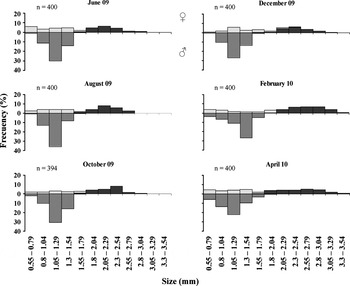
Two thousand three hundred and ninety-four individuals of Hippolyte zostericola were collected (1341 males, 533 non-ovigerous females and 520 ovigerous females). The minimum size of males and females was similar (0.57 and 0.55 mm CL, respectively), however, in the first size-classes, between 0.80 and 1.54 mm CL (Figure 1), males were numerically dominant throughout the year while in larger classes there were only females, mainly ovigerous, whose maximum size was 3.52 mm CL, while the largest male recorded was 1.8 mm CL.
Frequency histograms of size-classes of Hippolyte zostericola. Black shading denotes ovigerous females.

Ovigerous females occurred in all months of sampling, although in greater percentage during February and April (Figure 1).
Based on the proposals by Bauer (Reference Bauer1989), Pardo et al. (Reference Pardo, Piraud, Mantelatto and Ojeda2007) and Terossi & Mantelatto (Reference Terossi and Mantelatto2010) individuals in the smallest size-class (0.55 to 0.79 mm CL) were considered as recruits. In this study it was observed that the incorporation of new individuals to the population occurs throughout the year, nevertheless the highest recruitment was observed in February and April (Figure 1).
Size at maturity and sex-ratio
The smallest CL of an ovigerous female of H. zostericola was 1.6 mm, which can be considered the size at first reproduction.
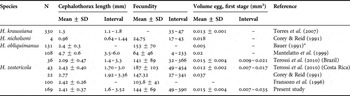
The logistic function that adjusts the relationship between CL and the percentage of sexually mature females (P = 1/ [1+ exp(10.01 – 4.4*CL)]) allows us to estimate that the size at maturity (L50) of H. zostericola is 2.28 ± 0.1 mm CL, with a confidence interval of ± 95%, while the mean CL of the ovigerous females was 2.41 ± 0.37 mm (Table 1).
Fecundity of some species of the genus Hippolyte.

*, as Hippolyte curacaoensis; N, number; SD, standard deviation.
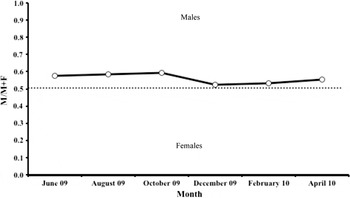
The sex-ratio between males and females was 1.3:1, which differs significantly from the ratio 1:1 (X 2 = 21.26; P < 0.05); it did not show significant variations throughout the year (X 2 = 7.76; P > 0.05) and always remained in favour of males (Figure 2).
Sex-ratio of Hippolyte zostericola. F, female; M, male.

Fecundity, development and egg loss
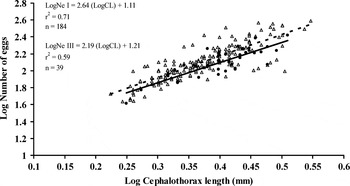
Hippolyte zostericola produces in average 144 ± 69 eggs, with a minimum of 49 in individuals of 1.9 mm CL, and a maximum of 390 in females of 3.52 mm of CL (Table 1). The relationship between the number of eggs (Ne) and the CL of the females was positive (r2 = 0.71), significant (t0 = 51.75; P < 0.01) and is described by the equation Log Ne = 2.64 (LogCL) + 1.11 (Figure 3). Nevertheless, there were females of small sizes with higher number of eggs than some larger ones. This variation was also observed in females of similar size (Figure 3).
Relationship between size of Hippolyte zostericola and eggs number in stage I (grey triangles; discontinuous line) and stage III (black circles; continuous line).

Eggs of H. zostericola are ovoid in shape with mean size of 0.35 × 0.29 mm in stage I, and 0.46 × 0.35 mm in stage III (Table 2). The volume of the embryos showed significant differences between the different stages (F[2,5058] = 3038, P < 0.01), as it increased 98.38% over its initial volume.
Size and volume of Hippolyte zostericola eggs.

L, length; W, width; SD, standard deviation.
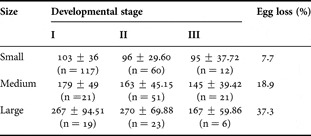
The mean number of eggs in stage I increases significantly as the female size increases, but decreases through the incubation period in each of the size-classes (Table 3).
Mean number (± standard deviation) of eggs by size of ovigerous females of Hippolyte zostericola.

n, number of specimens.
The egg loss from stages I to III was greater in larger females (37.3%) than in smaller ones (7.7%) (Table 3), i.e. fecundity in both stages showed a linear relationship, positive and significant between the number of eggs and female CL (Figure 3), which is represented by the equations:
 $$\eqalign{&\hbox{Eggs in stage I}\colon \ \hbox{Log Ne} = 2.64\lpar \hbox{LogLC}\rpar + 1.11\comma \; \cr & \qquad \hbox{r}^{2}= 0.71\semicolon \; \hbox{F}_{\lpar 1\comma 182\rpar }=453.9\semicolon \; {P}\lt 0.01\cr &\hbox{Eggs in stage III}\colon \ \hbox{Log Ne} = 2.19\lpar \hbox{LogLC}\rpar +1.21\comma \; \cr &\qquad\hbox{r}^{2}=0.59\semicolon \; \hbox{F}_{\lpar 1\comma 37\rpar }=54.14\semicolon \; {P} \lt 0.01}$$
For both regressions, the 95% confidence limits on b include b <3; this indicates that fecundity is a function of the female age.
DISCUSSION
Population structure
The population structure of Hippolyte zostericola was similar during the period of study which agrees with the description by Negreiros-Fransozo et al. (Reference Negreiros-Fransozo, Barba, Sánchez, Fransozo and Raz-Guzmán1996) for the same species in the study area.
Females were larger than males and ovigerous females larger than non-ovigerous, this coincides with observations of this species by Román-Contreras & Romero-Rodríguez (Reference Román-Contreras and Romero-Rodríguez2005), as well as for Hippolyte inermis (Cobos et al., Reference Cobos, Díaz, García-Raso and Manjón-Cabeza2005; Manjón-Cabeza et al., Reference Manjón-Cabeza, Cobos, García-Muñoz and García-Raso2009), Hippolyte kraussiana (Torres et al., Reference Torres, Penha-Lopes, Macia and Paula2007), Hippolyte obliquimanus (Terossi et al., Reference Terossi, López-Greco and Mantelatto2008; Terossi & Mantelatto, Reference Terossi and Mantelatto2010) and Hippolyte williamsi Schmitt, 1924 (Espinoza-Fuenzalida, Reference Espinoza-Fuenzalida, Thiel, Dupre and Baeza2008).
This size–frequency distribution by sex is consistent with the expected distribution in a gonochorism population proposed by Bauer (Reference Bauer2004), a condition that in some species of the genus remains controversial (Zupo, Reference Zupo1994, Reference Zupo2000, Reference Zupo2001; Cobos et al., Reference Cobos, Díaz, García-Raso and Manjón-Cabeza2005; Zupo & Messina, Reference Zupo and Messina2007).
In terms of reproductive strategy, Bauer (Reference Bauer2004) notes that a strong relationship between sexual dimorphism and mating system exists in carideans. Therefore species where males are smaller than females, as in H. zostericola, commonly have a mating system known as pure searching.
Males do not need to grow to a large size or develop stout chelipeds. As they do not invest energy in the female guarding they could move constantly to find and fertilize as many females as possible (Correa & Thiel, Reference Correa and Thiel2003; Bauer, Reference Bauer2004). The larger size of females is advantageous for the production of embryos, because the fecundity is positively related to female size (Bauer, Reference Bauer2004).
The presence of ovigerous females throughout the year suggests continuous reproduction of the population of H. zostericola analysed. This coincides with the results of Williams (Reference Williams1984) for the same species in Florida and the Caribbean, and in other members of the genus Hippolyte: H. inermis (Manjón-Cabeza et al., Reference Manjón-Cabeza, Cobos, García-Muñoz and García-Raso2009), H. obliquimanus (Terossi & Mantelatto, Reference Terossi and Mantelatto2010) and Hippolyte varians Leach, 1814 (Udekem d' Acoz, Reference Udekem d'Acoz1996).
Based on the increase in the percentage of ovigerous females registered during February and April (Figure 1), the main reproductive period for H. zostericola occurs during the first third of the year. This is similar to that recorded by Terossi & Mantelatto (Reference Terossi and Mantelatto2010) for H. obliquimanus in the south-east of Brazil.
In species with this reproductive pattern, sexual maturity is estimated to be reached at relatively small size. After they mature successive spawnings occur over short periods (1–2 weeks) until death. Their life expectancy probably is short (Bauer, Reference Bauer, Wenner and Kuris1991, Reference Bauer2004).
Hippolyte zostericola presents simultaneous recruitment of males and females throughout the year, similar to that described in H. inermis by Cobos et al. (Reference Cobos, Díaz, García-Raso and Manjón-Cabeza2005). Bauer (Reference Bauer1992) points out that although recruitment is continuous, it can be more intense during certain months. The recruitment observed in H. zostericola fits well with this approach, since the incorporation of new individuals to the population was variable, presenting the minimum recruitment during December and maximum in February and April (Figure 1).
Bauer (Reference Bauer1989) states that these variations can be caused by factors such as seasonal reproduction of the species, temporal mortality of planktonic larvae or the recently settled recruits in seagrass beds, as well as changes in circulation patterns of these habitats, among other factors.
The variations in recruitment of H. zostericola observed in the study area possibly are caused by seasonal changes in circulation patterns in the system described by Yáñez-Arancibia et al. (Reference Yáñez-Arancibia, Lara-Domínguez, Chavance, Hernández, Yáñez-Arancibia and Day1988) and/or due to the mortality of larvae and juveniles of the species; the latter aspect was not estimated in this study.
Size at maturity and sex-ratio
Although sexual maturity represents the stage where the organisms are able to produce new individuals (Martinez-Mayén & Román-Contreras, Reference Martínez-Mayén, Román-Contreras and Hendrickx2003) few studies have addressed this issue in the genus Hippolyte.
The size at maturity (L50) of H. zostericola (2.28 mm CL) differs from the L50 estimated by Torres et al. (Reference Torres, Penha-Lopes, Macia and Paula2007) in H. kraussiana (1.28 mm CL) and by Manjón-Cabeza et al. (Reference Manjón-Cabeza, Cobos, García-Muñoz and García-Raso2009) for H. inermis (3.98 mm CL). This difference is related to the size of the ovigerous females, since females of H. zostericola are larger than females of H. kraussiana (Table 1) but smaller than those of H. inermis (1.62 to 6.72 mm CL: Manjón-Cabeza et al., Reference Manjón-Cabeza, Cobos, García-Muñoz and García-Raso2009).
The size of the smallest ovigerous female (1.6 mm CL) and the size interval in the highest number of ovigerous females of H. zostericola (1.8 to 2.79 mm CL) are lower than those estimated seasonally by Román-Contreras & Romero-Rodríguez (Reference Román-Contreras and Romero-Rodríguez2005) for the species in the study area (1.8 mm and 2.8 to 3.5 mm CL, respectively).
The difference in results may be due to the frequency of the present study, since in carideans the number and sizes of ovigerous females vary throughout the annual cycle (Bauer, Reference Bauer1989).
The sex-ratio of H. zostericola skewed to males during the analysed cycle contrasts with that observed for the same species in both the study area (Román-Contreras & Romero-Rodríguez, Reference Román-Contreras and Romero-Rodríguez2005) and in other locations (Espinoza-Fuenzalida et al., Reference Espinoza-Fuenzalida, Thiel, Dupre and Baeza2008). Similarly, the sex-ratio differs from that observed in other species of the genus in which the number of females varies from 1.2 to 2.5 females per male (see Espinoza-Fuenzalida et al., Reference Espinoza-Fuenzalida, Thiel, Dupre and Baeza2008).
Even when the sex-ratio of a population tends to the ratio 1:1 (Smith, Reference Smith, Krebs and Davies1984), the predominance of one can be influenced by several factors among those are the differential mortality (that can be caused by differences in the growth rate, or a sexual dimorphism in size) (Berglund, Reference Berglund1981).
This could explain the greater number of males of H. zostericola registered throughout the year, since males were smaller than females allowing them greater mobility and to be cryptic to visual predators (Bauer, Reference Bauer2004), mainly in areas with submerged aquatic vegetation, where they are actively preyed upon by fish of different species (Barba et al., Reference Barba, Sánchez, Raz-Guzmán and Gallegos2000, Reference Barba, Raz-Guzmán and Sánchez2005).
Fecundity, development and egg loss
Fecundity is an important parameter to evaluate among crustaceans because it is a direct expression of their reproductive performance (Bauer, Reference Bauer, Wenner and Kuris1991). The mean fecundity of H. zostericola calculated in this study is similar to that estimated by Corey & Reid (Reference Corey and Reid1991) for the same species in Florida, but is higher than observed by Negreiros-Fransozo et al. (Reference Negreiros-Fransozo, Barba, Sánchez, Fransozo and Raz-Guzmán1996) in Laguna de Términos (Table 1).
The fecundity of H. zostericola varies depending on the size of the female as in other carideans (Bauer, Reference Bauer, Wenner and Kuris1991; Corey & Reid, Reference Corey and Reid1991; Clarke, Reference Clarke1993). Therefore, females of larger size produce more eggs than those of smaller size (Bauer, Reference Bauer, Wenner and Kuris1991; Corey & Reid, Reference Corey and Reid1991) mainly because the physical space between the pleopods limits the number of eggs that they can carry (Bauer, Reference Bauer, Wenner and Kuris1991).
Corey & Reid (Reference Corey and Reid1991) established that hippolytids apparently produce an excessive number of eggs to compensate for the loss that might occur during their development and thus maximize the number of larvae hatched.
This condition may explain why some females of H. zostericola of smaller size carry a larger number of eggs than some larger females, which coincides with results reported for other carideans (Martínez-Mayén & Román-Contreras, Reference Martínez-Mayén and Román-Contreras2005, Reference Martínez-Mayén and Román-Contreras2009). Moreover, because fecundity is related to the nutritional status of organisms (Ramírez-Llodra, Reference Ramírez-Llodra2002), smaller females may present a better physiological condition and direct more energy into the production of embryos (Clarke, Reference Clarke1993).
Ramírez-Llodra (Reference Ramírez-Llodra2002) argues that the egg size could be influenced by factors such as availability and quality of food, energy content and larval developmental time. This author considers that fecundity is related to the egg size; therefore, some species produce few eggs but large in size as observed in H. kraussiana (Torres et al., Reference Torres, Penha-Lopes, Macia and Paula2007), while those species with small eggs have high fecundity such as H. obliquimanus (Terossi et al., Reference Terossi, Wehrtmann and Mantelatto2010) and H. zostericola in this study.
The mean length and width of the eggs of H. zostericola in the first stage of development are slightly lower than those reported by Mantelatto et al. (Reference Mantelatto, Martinelli, Garcia, Schram and von Vaupel1999) for H. obliquimanus (0.37 ± 0.05 and 0.31 ± 0.03) and by Manjón-Cabeza et al. (Reference Manjón-Cabeza, Cobos, García-Muñoz and García-Raso2009) for H. inermis (0.037 ± 0.04 and 0.29 ± 0.02).
In H. zostericola the greatest egg loss occurs in larger females (Table 3), this coincides with reports by Torres et al. (Reference Torres, Penha-Lopes, Macia and Paula2007) for H. kraussiana and by Penha-Lopes et al. (Reference Penha-Lopes, Torres, Macia and Paula2007) for Latreutes pymoeus Nobili, 1904.
Although the rate estimated of egg loss (37%) for H. zostericola in Laguna de Términos is less than reported for this species in Florida (50%) (Corey & Reid, Reference Corey and Reid1991), and also lower than the interval observed in H. kraussiana (47–58%) by Torres et al. (Reference Torres, Penha-Lopes, Macia and Paula2007), it is similar to that estimated for H. obliquimanus (36.8%) by Terossi et al. (Reference Terossi, Wehrtmann and Mantelatto2010) and fits well with the percentages of egg loss estimated in caridean shrimps (12–74%) by Oh & Hartnoll (Reference Oh and Hartnoll1999b).
Kuris (Reference Kuris, Wenner and Kuris1991) conducted a review of the causes that promote the egg loss during their development. He mentioned the mechanical losses, caused by, among other factors brood abrasion, stress during the collection of organisms or increase in embryos during development, which in turn causes the ovigerous mass to exceed the available space between the pleopods of the female and as a result of this some embryos may be discarded.
The increase in volume of embryos during caridean development is roughly 100% (Terossi et al., Reference Terossi, Wehrtmann and Mantelatto2010), which coincides with the estimate for H. zostericola, and usually is associated both with the absorption of water and the development of embryos (Wehrtmann & Kattner, Reference Wehrtmann and Kattner1998). The larger size of late-stage eggs could make them more vulnerable to wear and tear of their attachment structures and make them more susceptible to being detached (Oh & Hartnoll, Reference Oh and Hartnoll1999b), so likely the reduced number of embryos observed is the result of this increase.
The fecundity increase of H. zostericola in respect of female size was estimated as negative allometric, thereby, age could be a factor that affects the fecundity of larger females in the population analysed; this also coincides with observations of H. kraussiana by Torres et al. (Reference Torres, Penha-Lopes, Macia and Paula2007).
Therefore, we can conclude that in Laguna de Términos the population structure of H. zostericola is similar throughout the year; the sex-ratio is skewed to males, which are significantly smaller than females. Likewise, in the study area this species has its main reproductive period during the first third of the year. The fecundity of H. zostericola can vary depending on the size and age of the female, and the greatest egg loss occurs in larger females.
ACKNOWLEDGEMENTS
The authors express their gratitude to H. Álvarez-Guillén and J. Reda-Deara (Estación El Carmen, ICMyL–UNAM) for their support during the fieldwork; to H.M. Alexander-Valdés (Unidad de Procesos Oceánicos, ICMyL–UNAM) for the analysis of the salinity of some water samples; and to M. Martínez-Mayén (Unidad de Ecología, ICMyL–UNAM) for their assistance in the fieldwork and laboratory, helpful comments and for the literature provided. Thanks are extended to Consejo Nacional de Ciencia y Tecnología (CONACyT) for the scholarship (170315/170315) granted to the first author during his postgraduate studies. We also are grateful to the authorities of Instituto de Ciencias del Mar y Limnología (ICMyL, UNAM) for the economic support to this study that is part of the project 136: Biología, sistemática y ecología de crustáceos decápodos de México: Laguna de Términos.