Introduction
Empathy is a complex social cognitive ability which has been defined as a person's affective response to the directly perceived, imagined or inferred feeling state of another being (Batson, Reference Batson and Ickes2009). It is considered to be important for interpersonal relationships and social functioning in both healthy and clinical populations. Although it is commonly agreed that empathy is a complex multidimensional social cognitive ability, the components that it is composed of are debated. Nevertheless, it is generally suggested that there are at least two empathy components, namely, cognitive and affective (Blair, Reference Blair2005; Borke, Reference Borke1971; Byrant, Reference Bryant1982). The cognitive component of empathy is a form of social cognition which allows a person to understand another person's emotional state and situation from their perspective. The emotional component of empathy, on the other hand, involves the individual's actual emotional reaction to another person's situation (Spinella, Reference Spinella2005).
Due to its complex structure, the measurement of empathy has always been a problem. The most common method is the use of self-report questionnaires. Although this approach has long been criticised for its subjectivity and proneness to response bias, it is still the most convenient and direct way to assess psychological constructs such as empathy. Several questionnaires have been developed to measure empathy (for a review, see Neumann, Chan, Boyle, Wang, & Westbury, Reference Neumann, Chan, Boyle, Wang, Westbury, Boyle and Saklofskein press). The most frequently used questionnaires are the Empathy Quotient (EQ) (Baron-Cohen & Wheelwright, Reference Baron-Cohen and Wheelwright2004) and the Interpersonal Reactivity Index (IRI) (Davis, Reference Davis1980, Reference Davis1983). The EQ contains 40 empathy items and 20 filler/control items. It is rated on a three-point Likert scale ranging from 0 to 2. Results of an exploratory factor analysis suggested that EQ has three factors: cognitive empathy, emotional reactivity and social skills (Lawrence, Shaw, Baker, Baron-Cohen, & David, Reference Lawrence, Shaw, Baker, Baron-Cohen and David2004). There is a validated Chinese version of EQ (Guan, Jin, & Qian, Reference Guan, Jin and Qian2012). However, it is an abridged version consisting of 22 items. The authors found a one-factor structure for the Chinese version (Guan, Jin, & Qian, Reference Guan, Jin and Qian2012). Thus, the Chinese EQ does not fully discriminate between the different components of empathy, as was intended in the original version. The IRI is another frequently used empathy questionnaire. It consists of four subscales that assess a person's dispositional empathy from ‘perspective taking’, ‘empathic concern’, ‘fantasy’ and ‘depression’ prospects (Davis, Reference Davis1980, Reference Davis1983). A Chinese version has been validated (Chan, Reference Chan1986). However, preliminary findings of this instrument showed that the IRI has different factor structures to the original English version (Siu & Shek, Reference Siu and Shek2005).
The Griffith Empathy Measure (GEM) is a 23-item questionnaire of empathy (Dadds et al., Reference Dadds, Hunter, Hawes, Frost, Vassallo, Bunn and Masry2008). It is designed to be completed by parents, in which they make ratings of their young or adolescent children's level of empathy using a nine-point Likert scale, from strongly disagree (−4) to strongly agree (+4). The wording of each item is concise and simple, which makes the items easy for children to understand. Nevertheless, this questionnaire seems to be an appropriate tool to evaluate empathy in participants at different ages across the entire lifespan and to have a wider scope of application in different educational and clinical settings. Results of a confirmatory factor analysis (CFA) suggested a two-factor model, namely, a cognitive and an affective factor (Comparative Fit Index (CFI) = .9, Root Mean Square Error of Approximation (RMSEA) = .05) (Dadds et al., Reference Dadds, Hunter, Hawes, Frost, Vassallo, Bunn and Masry2008). Given its potentially wide range of applications and satisfactory factor structure, the GEM seems to be an appropriate instrument for assessing empathy in the Chinese setting.
One important topic for empathy research is its impairment in clinical and subclinical groups. Individuals with schizophrenia, bipolar disorder, autism, depression, as well as some sub-clinical groups such as those with schizotypal personality disorder (SPD) traits, have been found to have impaired empathy abilities (Henry, Bailey, & Rendell, Reference Henry, Bailey and Rendell2008; Iannotti, Reference Iannotti1978; O’Connor, Berry, Weiss, & Gilbert, Reference O’Connor, Berry, Weiss and Gilbert2002; Seidel et al., Reference Seidel, Habel, Finkelmeyer, Hasmann, Dobmeier and Derntl2012; Shamay-Tsoory, Shur, Harari, & Levkovitz, Reference Shamay-Tsoory, Shur, Harari and Levkovitz2007). The ability to empathise has been assumed to be undermined in patients with schizophrenia because the core impairment underlying schizophrenia is a deficit in ‘meta-cognition’, the awareness of the mental state of oneself and of others (Frith, Reference Frith, David and Cutting1994). Consequently, these patients cannot recognise their ideas and cannot make correct reference to other people's motives and feelings (Frith, Reference Frith, David and Cutting1994). Empirical findings also suggest that individuals with SPD traits have poorer empathic ability than controls, in the cognitive as well as the affective aspect (Henry et al., Reference Henry, Bailey and Rendell2008). However, these findings warrant replication.
Given that the GEM was designed and originally validated with ratings made by parents of their young and adolescent children, it would be desirable to have a scale that can be used across the lifespan (i.e., both young and old ages).
The purpose of the current study was to examine the psychometric properties of a Chinese version of the GEM in a sample of healthy college students. Its internal consistency was examined by Cronbach's alpha and its construct validity was assessed via: (1) correlating with an existing measure; (2) factor analysis of subtypes; and (3) comparing performance across gender and groups with and without SPD traits.
Method
Participants
Participants were recruited from two colleges in Beijing and Guangzhou. The data from Beijing were used for the main analyses, and the data from Guangzhou were used for confirmatory analysis. The sample from Beijing comprised 420 college students (mean age = 18.68 years, SD = 1.73), with 184 males and 236 females. The sample from Guangzhou comprised 526 college students (mean age = 18.71 years, SD = 1.40), with 235 males and 291 females. Exclusion criteria included a history of psychiatric disorders, comorbid neurological pathology and substance abuse.
Measures
The GEM
After gaining the approval of the authors of the GEM to translate the GEM into Chinese, we adopted a two-stage translation process (Dadds et al., Reference Dadds, Hunter, Hawes, Frost, Vassallo, Bunn and Masry2008). First, all items were changed from a third person's perspective into a first person's perspective to make the rating a self-referential anchor point. Then items which were not suitable for use with adults were revised. There were two of these items: 7 and 21. For item 7, the statement ‘My child gets upset seeing another child being punished for being naughty’ was changed to ‘I get upset seeing another person being punished for breaking rules’. For item 21, the statement ‘My child would eat the last cookie in the cookie jar, even when he/she knows that someone else wants it’, was changed into ‘On the bus, I would sit on the last empty seat even when I know that someone else wants it’.
The resulting items of the GEM were next translated by a bilingual (Chinese and English) postgraduate psychology student into Chinese. The Chinese version was then back-translated into English by another bilingual postgraduate student without reference to the original version. The version of the Chinese GEM used in this study was finalised based on feedback received from the authors of the original GEM and results of a pilot study. The scoring method of the GEM was computed by summing all items of the respective subscales and then dividing it by the number of items.
The IRI
The IRI is a 28-item self-report instrument that measures four components of empathy, namely perspective taking, empathic concern, personal distress and fantasy (Davis, Reference Davis1980, Reference Davis1983). The IRI has been demonstrated to have impressive psychometric properties (Davis, Reference Davis1980, Reference Davis1983). The 22-item Chinese version of the IRI was used in this study (Chan, Reference Chan1986).
The Schizotypal Personality Questionnaire (SPQ)
The SPQ is a 74-item self-report instrument developed based on DSM-III-R criteria for schizotypal personality disorder, and it contains subscales for all nine schizotypal traits (namely, ideas of reference; odd beliefs or magical thinking; unusual perceptual experiences; odd thinking and speech; suspiciousness or paranoid ideation; inappropriate or constricted affect; behaviour or appearance that is odd, eccentric or peculiar; lack of close friends or confidants; excessive social anxiety) (Raine, Reference Raine1991). It was rated on a ‘yes’ and ‘no’ dichotomous scale. The SPQ has been reported to have satisfactory psychometric properties and it was found to measure three main characteristics of SPD, namely, cognitive–perceptual, interpersonal and disorganisation. The Chinese version of SPD was used in the current study (Chen, Hsiao, & Lin, Reference Chen, Hsiao and Lin1997).
Data Analysis
All statistical tests were carried out using the Statistical Package for the Social Sciences (SPSS) version 17.0 for Windows with significance level set at p = .05 (two-tailed test). The factor structure of the translated GEM was analysed by both exploratory and confirmatory factor analyses (EFA and CFA) using the two independent samples from Beijing and Guangzhou, respectively. Principal component analysis with scree plot examination for the number of factors extracted and varimax rotation was conducted using the Beijing sample. The factor structure resulting from the EFA was then cross-validated using CFA on the Guangzhou sample. The CFA was conducted using Analysis of Moment Structures (AMOS) (Arbuckle, Reference Arbuckle1999). Internal consistency of the GEM was assessed by using Cronbach's coefficient alpha (Cronbach, Reference Cronbach1951). Construct validity was examined by computing the correlations between the GEM and IRI scores, and by comparing the GEM scores between individuals with and without SPD traits. Correlation analyses between GEM scores and SPD traits were also conducted. To classify SPD traits, we followed the instruction suggested by the SPQ manual that participants with the 10% of the highest SPQ scores were classified as those with SPD traits and those with the 50% lowest SPQ scores were classified as individuals without SPD traits (Raine, Reference Raine1991).
Procedures
All participants were administered the Chinese version of the GEM, IRI and SPQ in group format. The study was approved by the ethics committee of the Institute of Psychology, Chinese Academy of Sciences. Participants took part in the study voluntarily. Written consent was obtained from all participants before the administration of the questionnaires.
Results
Reliability
Cronbach's alpha was calculated to evaluate the internal consistency of the Chinese version of the GEM. A value above .7 is considered to be satisfactory. The Cronbach's alpha for the Chinese version for the GEM, as calculated from the Beijing sample, was .83. Corrected item to total correlations ranged from .20 to .65, with only one exception for item 3, which was −.12. The low value for this item is likely to be due to translation difficulty and cultural differences, and it was deleted from the questionnaire in subsequent analyses. The Cronbach's alpha for the remaining 22 items was .85. This supports the reliability of the Chinese version of the GEM.
EFA and CFA
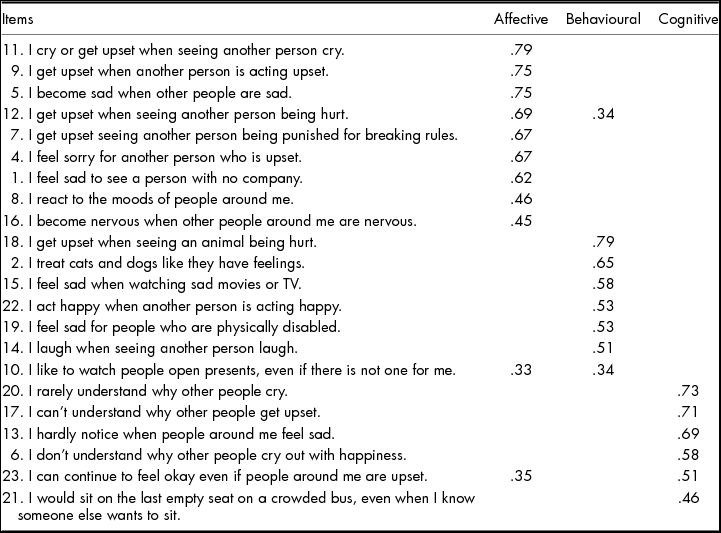
Results from the EFA suggested a three-factor model: affective, behavioural and cognitive. Each factor accounted for 20.18%, 12.95% and 11.88% of total variance, respectively. Table 1 summarises the statistics of this three-factor model. Items 8, 10, 12, 16, 23 were eliminated because of split loadings on two or three factors. The first factor comprises six items (namely, 1, 4, 5, 7, 9 and 11) and captures the affective component of empathy. The Cronbach's alpha for this factor was .84. The second factor comprises six items (namely, 2, 14, 15, 18, 19 and 22) and captures the behavioural component of empathy. The Cronbach's alpha for this factor was .72. The third factor comprises five items (namely, 6, 13, 17, 20 and 21) and captures the cognitive component of empathy. The Cronbach's alpha for this factor was .66, which was less satisfactory when compared to the other factors. This might be because it has one less item than the other two factors. When compared with the two-factor model of Dadds et al. (Reference Dadds, Hunter, Hawes, Frost, Vassallo, Bunn and Masry2008), the cognitive factor consisted of exactly the same items as their cognitive subscale, whereas the affective and behavioural factors included items from their affective subscale and the items they excluded from their two subscales.
Factor Loadings of the Three-factor Solution for the Translated 22-item GEM in Beijing Students

Blank entries are < .3.
The three-factor model obtained based on our Beijing sample and the original two-factor model of Dadds et al. (Reference Dadds, Hunter, Hawes, Frost, Vassallo, Bunn and Masry2008) were evaluated using CFA based on an independent sample from Guangzhou. Goodness-of-fit Index (GFI), Adjusted Goodness-of-fit Index (AGFI), Root Mean Square Residual (RMR), Normed Fit Index (NFI), Non-normed Fit Index (NNFI), Comparative Fit Index (CFI) and Root Mean Square Error of Approximation (RMSEA) were used to evaluate the goodness of fit of the two models. The values of GFI, AGFI, NFI, NNFI and CFI are between 0 and 1. Larger values mean better fit. A value above .9 indicates the fitness of the model is acceptable. Smaller RMR and RMSEA values suggest better fit. RMR value below .1 and RMSEA value below .05 are considered to be the standard of good fit. As shown in Table 2, the two models yielded similar results. There were no meaningful differences between the two-factor model and our model. While the two-factor model performed slightly better than ours on some of the indices, such as CFI and GFI, our model outperformed the two-factor model on the other indices. The values of the indices were mostly close to the standards of ‘good fit’. However, none of them had reached the standards. This meant that the two models were both generally acceptable.
The Comparison of Two Fitting Models in CFA in the Guangzhou Sample

GFI = Goodness-of-fit Index; AGFI = Adjusted Goodness-of-fit Index; RMR = Root Mean Square Residual; NFI = Normed Fit Index; NNFI = Non-normed Fit Index; CFI = Comparative Fit Index; RMSEA = Root Mean Square Error of Approximation.
However, when computed using our Chinese data, the values of some of the indices of Dadds et al.'s (Reference Dadds, Hunter, Hawes, Frost, Vassallo, Bunn and Masry2008) model were found to vary a great deal from the original results they reported. For example, the value of RMSEA was much larger than .05 and the value of CFI did not reach .9. This suggests that the two-factor model was a less satisfactory fit for the Chinese college students sample than the Australian children sample.
Convergent Validity
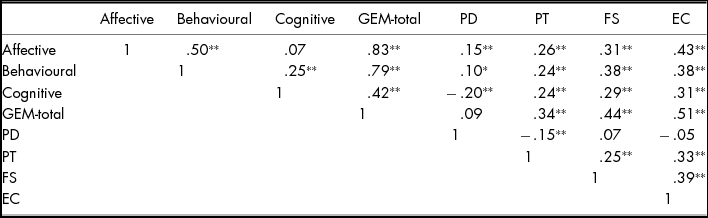
Significant correlations were found between IRI and GEM (Table 3).
Correlations between IRI and GEM
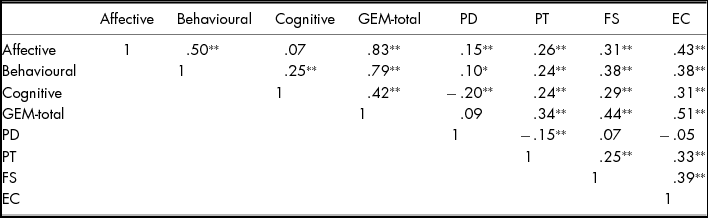
** Correlation is significant at the .01 level (two-tail).
* Correlation is significant at the .05 level (two-tail).
GEM = Griffith Empathy Measurement; PD = personal distress; PT = perspective taking; FS = fantasy; EC = emotional concern.
Sex Difference
The female participants (M = 1.08; SD = 0.74) were found to have a significantly greater GEM total score than the male participants (M = 0.79; SD = 0.77) (t(1,418) = 3.81, p < .01), which was consistent with the findings of Dadd et al. (Reference Dadds, Hunter, Hawes, Frost, Vassallo, Bunn and Masry2008). Further analysis indicated that females reported significantly higher cognitive (t(1,418) = 3.17, p < .01) and behavioural (t(1,418) = 4.25, p < .01) empathy than males. Nevertheless, there was no significant sex difference on the affective empathy (t(1,418) = 1.67, p = .09).
Differences between Individuals with and without SPD Traits
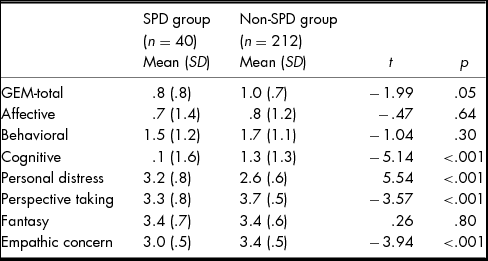
Table 4 summarises the comparison of the GEM and IRI scores in individuals with and without SPD traits. Individuals with SPD traits reported significantly lower scores on the cognitive component of empathy than those without SPD traits (t(1,250) = −5.13, p < .05). Moreover, the total GEM scores between the two groups were also significantly different (t(1,250) = −1.99, p < .05). The SPD group showed lower scores on all the IRI subscales except the fantasy subscale.
The Comparison of GEM and IRI Scores between SPD and Non-SPD Groups
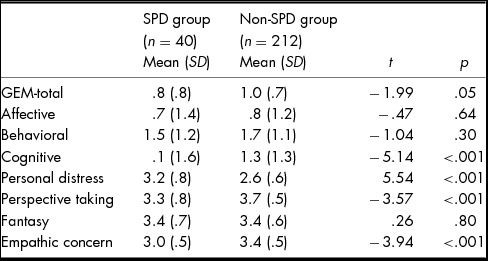
SPD = Schizotypal Personality Disorder; GEM = Griffith Empathy Measurement.
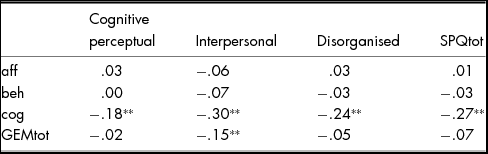
We performed correlation analyses between SPQ scores and the GEM scores (Table 5). Results showed that all the cognitive–perceptual, interpersonal, disorganised SPQ subscale scores and the total score correlated significantly, although with small effect sizes, with the cognitive factor of the GEM (r ranges from −.18 to −.30). Additionally, the interpersonal score correlated significantly with GEM total score (r = −.15 p < .01).
Correlation of GEM and SPQ Subscales
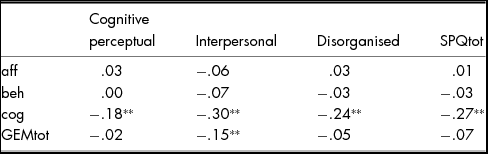
** Correlation is significant at the .01 level (two-tail).
* Correlation is significant at the .05 level (two-tail).
Abbreviations: SPQtot = total score of Schizotypal Personality Questionnaire; GEMtot = total score of Griffith Empathy Measurement; aff = affective; beh = behavioural; cog = cognitive.
Discussion
The current study showed that the Chinese version of the GEM has a three-factor structure, namely cognitive, affective and behavioural. Although the findings were inconsistent with the original version of the GEM, which has a two-factor structure, the current findings overlapped with those of the original version. Our findings added one more factor of behavioural empathy which was not found in the original findings of Dadds et al. (Reference Dadds, Hunter, Hawes, Frost, Vassallo, Bunn and Masry2008).
The behavioural component included items that indicated overt behaviour that people exhibit, which reflects empathy. For example, ‘I treat cats and dogs like they have feelings’. The difference in the number of factors extracted was likely to be caused by the different methods employed for factor extraction. Dadds and colleagues (Reference Dadds, Hunter, Hawes, Frost, Vassallo, Bunn and Masry2008) adopted an uncommon analysis, the Velicer's minimum average partial (MAP) and Parallel Analysis (O’Connor, Reference O’Connor2000), instead of the commonly used scree plot method. The developer of the former method (O'Connor, Reference O’Connor2000) suggested that it is a suitable method because ‘demarcations do not always exist or there may be more than one demarcation point’ when drawing the scree plot. Considering that clear demarcation was found in our results, we decided to extract our factors based on the scree plot methods. The behavioural factor emerged when we applied this method. This factor correlated significantly with all IRI subscales, and was found to be higher in females than in males. This evidence supported our conclusion that the behavioural factor was a unique factor of empathy.
When checking the goodness of fit of the two models in CFA, the two models showed no meaningful differences on any of the indices. Although the results were both generally acceptable, neither of the two models reached all the standards for good fit, suggesting that the structure of the GEM is still inconclusive. Thus the total score of GEM is preferable for use in research, as recommended by Dadds et al. (Reference Dadds, Hunter, Hawes, Frost, Vassallo, Bunn and Masry2008), and future studies are needed to establish the structure of the GEM and the associated mechanisms of empathy.
To check the sensitivity of the Chinese version of GEM, we used it to examine the differences between gender, and between SPD and non-SPD groups. A number of researchers have reported sex differences in empathy, with a consistently better performance by females than males (Hoffman, Reference Hoffman1977). Our findings supported the sex differences of empathy in the Chinese population. As for the differences between SPD and non-SPD groups, few researches have examined this issue (Henry et al., Reference Henry, Bailey and Rendell2008; Thakkar & Park, Reference Thakkar and Park2010). Our research found that SPD individuals performed worse than the non-SPD group on the cognitive and total scores. This finding is different from the report of Henry and her colleagues, that both cognitive and affective empathy were impaired in SPD individuals (Henry et al., Reference Henry, Bailey and Rendell2008). The inconsistency may be the result of differences in the participants and experimental materials that were employed. Furthermore, we found that the interpersonal SPD subtype was the one that related most closely to impaired empathy. This is consistent with the research of Thakkar and Parks (Reference Thakkar and Park2010), which showed a significant correlation between the SPD interpersonal subscale and the EQ. This consistency of findings supports the validity and utility of the Chinese version of the GEM and confirms that the interpersonal SPD subtype is associated with empathic impairment.
Several limitations of our study should be noted. First, no clinical group was included in this study. To examine empathy deficits of schizophrenia spectrum disorder systematically, schizophrenic patients should be recruited in future studies. Second, as a preliminary study, no test–retest reliability was conducted. We intend to do this in follow-up studies to corroborate the stability of the Chinese version of the GEM.
Despite these limitations and the preliminary nature of the current study, the findings suggested satisfactory psychometric properties of the Chinese version of GEM. These have added further knowledge to the application and clinical utility of the GEM in the Chinese context. These findings may also open a window of opportunity for further cross-cultural studies of empathy.
Acknowledgments
This study was supported by grants from the National Key Technologies R&D Program (2012BAI36B01), the Key Laboratory of Mental Health, Institute of Psychology, Chinese Academy of Sciences, the Knowledge Innovation Project of the Chinese Academy of Sciences (KSCX2-EW-J-8), a grant from the initiation fund of the CAS/SAFEA International Partnership Programme for Creative Research Team (Y2CX131003) and a grant from an Area of Strategic Investment Chronic Disease Prevention Innovation Grant (213507) from Griffith University. These funding agents had no further role in the study design; in the collection, analysis and interpretation of the data; in the writing of the manuscript; or in the decision to submit the paper for publication.