CHD is one of the most common birth defects, and approximately eight in 1000 children are affected by CHD.Reference Daymont, Neal, Prosnitz and Cohen 1 Thanks to robust technological advances in diagnostic, surgical, and catheter interventional techniques, an increasing number of patients with different types of CHD can gain access to cardiac catheter interventional treatment than ever before. Approximately 85–90% of children with CHD survive to adulthood.Reference Hoffman and Kaplan 2 Therefore, it is extremely necessary to measure the quality of life of patients with CHD undergoing cardiac catheter therapy.
Health-related quality of life is defined as multi-dimensional instruments that include physical, emotional, and social well-being as well as functioning. It has been increasingly recognised as an important assessment of the effect of a specific disease or medical treatment or health service policy on the function of a population in various aspects of life.Reference Fryback 3 , Reference Goldbeck and Melches 4 Health-related quality of life of patients with CHD has been investigated by a rich body of studiesReference Marino, Uzark, Ittenbach and Drotar 5 – for instance, a cross-sectional study in Switzerland unveiled that the health-related quality of life of children or adolescents is reduced after open heart surgery and might be negatively affected by adverse relationships with family members.Reference Landolt, Valsangiacomo Buechel and Latal 6 Female adult patients with CHD appear to have decreased physical and psychological quality of life than male adult patients;Reference Chen, Liao and Wang 7 moreover, it has been reported that the health-related quality of life appears to be increasingly declined in older age groups, especially with respect to psychological components.Reference Müller, Berner, Ewert and Hager 8 A recent health-related quality of life study in a large, geographically diverse cohort of the United States of America has revealed that children and adolescents with CHD have significantly reduced health-related quality of life scores than healthy controls and have similar scores with patients with other chronic diseases.Reference Mellion, Uzark and Cassedy 9 Despite considerable achievements in health-related quality of life of patients with CHD, studies specifically focussed on health-related quality of life of children who have undergone cardiac catheter interventions are still lacking.
The Pediatric Quality of Life Inventory 4.0 generic core scales (PedsQL), which was first proposed by Varni et al,Reference Varni, Seid and Kurtin 10 has been proved to be a reliable and valid health-related quality of life instrument.Reference Uzark, Jones, Burwinkle and Varni 11 – Reference Chaudhry and Siddiqui 13 The PedsQLTM has been translated into many languages and is widely used around the world. The Chinese version of PedsQLTM 4.0 was developed by Hao in his study,Reference Hao, Tian, Lu, Chai and Rao 14 and has been applied to evaluate the life quality of children with cardiovascular disease.Reference Uzark, Jones, Burwinkle and Varni 11 , Reference Uzark, Jones, Slusher, Limbers, Burwinkle and Varni 15
Using PedsQLTM 4.0, the present study aimed at comparing pre-and post-treatment health-related quality of life of children and adolescences with CHD in the north-east of China, who underwent cardiac catheter intervention from March, 2013 to January, 2014. This study provides more insights into the association of life quality of patients with the duration following cardiac catheter intervention.
Patients and methods
Patients
This prospective study enrolled 96 children with CHD aged 5–15 years (median age, 9.81) who were admitted to the Second Affiliated Hospital of Harbin Medical University in China from March, 2013 to January, 2014. These participants met the following criteria: age between 5 and 15 years, no invasive treatment for CHD, and met the indications for cardiac catheter intervention, which were verified by a cardiologist. Children who had major developmental disability or intelligence defect or an associated non-cardiac condition that might affect life quality were excluded from the study. Adolescents with intelligence defect were also excluded. The cardiac catheter interventional treatment for patients with CHD had been shown to be successful and effective by clinical medical examination, ultrasonic cardiography, and cardiac catheter angiography. This survey was approved by the hospital’s research ethics committee. Informed consent was obtained from each participant.
Instruments
The PedsQLTM 4.0 generic core scale is a generic instrument to assess general aspects of health-related quality of life in children. The 23-item PedsQLTM 4.0 generic core scale was used in the present study, encompassing physical functioning, psychological functioning, emotional functioning, social functioning, and school functioning. The form asked about the frequency of problems that occurred during the past month.Reference Varni, Seid and Kurtin 10 Responses from the participants aged 8–18 were rated on a five-point Likert scale as follows: 0=never a problem; 1=almost never a problem; 2=sometimes a problem; 3=often a problem; and 4=almost always a problem.Reference Mellion, Uzark and Cassedy 9 To facilitate easy use for children aged 5–7 years, the response scale was modified and simplified to a three-point scale (0=not at all a problem; 2=sometimes a problem; and 3=always a problem). Items of the PedsQLTM 4.0 were reverse scored and converted to a 0–100 scale in a linear manner. A higher converted score signified better health-related quality of life.
Procedure
For the present investigation, two cardiology nurses and two physicians were trained as interviewers. The definite cardiac diagnosis was made by a paediatric cardiologist. We collected demographic data of the involved patients using a self-designed questionnaire. Health-related quality of life was assessed at 24 hours before the treatment, 1 month after treatment, and 6 months after treatment in children/adolescents with CHD, respectively, for the purpose of measuring the changes in health-related quality of life before and after cardiac catheter intervention. The pre-treatment assessment of health-related quality of life was conducted in the meeting room of the hospital, whereas the 1-month and 6-month post-treatment assessments were conducted at the hospital when the patients came back for review. All questionnaires were completed by the interviewers using the items of PedsQLTM 4.0 one by one. Participants were available to answer the questions during the process of collecting information.
Statistical analysis
Data are expressed as median±SD in the present study. The health-related quality of life scores at 24 hours before treatment, 1 month after treatment, and 6 months after treatment were compared using a univariate repeated measures analysis of variance. If the sphericity assumption was violated via the Mauchly’s sphericity test, p values were adjusted using Huynh–Feldt correction. Pairwise comparisons were then carried out with the Fisher least significant difference test. All statistical analyses were conducted using SPSS 17.0 software (SPSS Inc., Chicago, Illinois, United States of America). A p Value <0.05 was considered significantly different.
Results
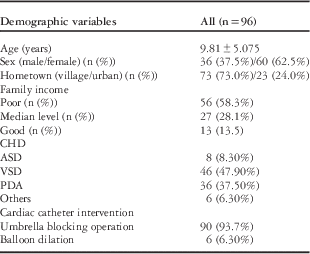
In total, 96 children or adolescents with CHD aged 5–15 years were recruited to the present study. Their demographic data, cardiac diagnosis, and interventions are summarised in Table 1. The 96 patients included 36 males and 60 females with a median age of 9.81 years.
Demographic data and intervention of 96 participants.

ASD=atrial septal defect; PDA=patent ductus arteriosus; VSD=ventricular septal defect
A repeated measure analysis of variance analysis was performed for the scores in five health-related quality of life domains including physical functioning, psychological functioning, emotional functioning, social functioning, and school functioning at 24 hours before treatment, 1 month after treatment, and 6 months after treatment. As shown in Table 2, total score and each score in the five health-related quality of life domains were markedly elevated 1 month and 6 months after treatment compared with pre-treatment scores (p<0.05). Furthermore, total score, physical functioning score, and psychological functioning score were further increased 6 months after treatment compared with scores 1 month after treatment (p<0.05); yet, no significant difference was found for emotional functioning, social functioning, or school functioning. These results suggest that cardiac catheter interventional treatment may contribute to a significant improvement in life quality of children or adolescents with CHD as time increased after the intervention.
Comparison of health-related quality of life scores of the CHD samples (n=96) at three time points.

*p<0.05, **p<0.01 compared with before treatment; #p<0.05, ##p<0.01 compared with 1 month after treatment
Discussion
Previous studies on outcomes of children with CHD have often regarded mortality and morbidity or health status after surgical intervention as critical indicators of the efficacy of medical interventions.Reference Gilboa, Salemi, Nembhard, Fixler and Correa 16 , Reference Hoffman, Wernovsky and Atz 17 Although these indicators can be easily assessed, they often do not fully mirror the entire impact of CHD on patients. Notably, health-related quality of life instruments can be used to comprehensively evaluate the effect of a disease or treatment on patients. Our study focussed on the effects of cardiac catheter intervention on life quality of children or adolescents with CHD. The study enrolled 96 children or adolescents with CHD from the north-east of China, who received cardiac catheter intervention treatment. Results of the present study support that cardiac catheter intervention improved the health-related quality of life of children/adolescents with CHD noticeably. The health-related quality of life exhibited improvements as time progressed after treatment. These findings suggest that cardiac catheter intervention could significantly improve the life quality of patients with CHD.
There is a common consensus that cardiac catheterisation is of great diagnostic and therapeutic value.Reference Mills, Bergersen, Jolley, Teele, Mayer and Salvin 18 Its clinical application dates back to 1930 by Werner Forssmann. Thanks to advances in catheter-based technologies, the procedures have acquired clinical maturity.Reference Lock, Keane and Perry 19 , Reference Lock, Keane and Fellows 20 It is less-invasive and can minimise the risk of cardiovascular bypass compared with surgical procedures. Application of cardiac catheterisation causes a reduction in the number of surgical procedures required by patients with CHD and improves the outcome of patients. Cardiac catheter intervention has been regarded as an important alternative to surgical repair.Reference Feltes, Bacha and Beekman 21 It has been shown that the transcatheter closure has a sound therapeutic effect in selected patients with CHD using appropriate devices.Reference Arora, Trehan, Kumar, Kalra and Nigam 22 In concordance with these findings, the present study showed that children or adolescents with CHD had improved physical functioning, psychological functioning, emotional functioning, social functioning, and school functioning after cardiac catheter intervention, as evidenced by the elevated post-treatment PedsQL scores of patients compared with pre-treatment scores.
Over the past few decades, remarkable progress in diagnostic, surgical, and catheter interventional techniques has led to substantial decrease in mortality among children with CHD. Extensive studies have been carried out for studying health-related quality of life of children and adolescents with CHD.Reference Müller, Kühn, Vogt, Schreiber, Hess and Hager 23 – Reference McCrindle, Williams and Mitchell 25 It has been reported that functional status might play a more important role in the assessment of life quality than initial diagnosis and disease course in patients with CHD.Reference Moons, Van Deyk, De Geest, Gewillig and Budts 26 Moreover, there is positive evidence that reconstruction of the right ventricular outflow tract using an allograft conduit achieves good therapeutic effect and markedly improves perceived quality of life in patients with congenital heart malformations.Reference Mokhles, van de Woestijne and de Jong 27 Furthermore, the study delivers longer-term evidence that cardiac catheter intervention significantly benefits children/adolescents with CHD in north-east China. PedsQL scores at 1 or 6 months after the treatment appeared to be higher in comparison with pre-treatment scores. Furthermore, there was a trend for the scores to be elevated as time increased after treatment. This encouraging trend reveals that post-treatment health-related quality of life in children/adolescents with CHD is not a stable and defined condition but one that progresses. Nevertheless, the results of this study are not sufficient to prove whether this growth would continue in the long term. Therefore, both the health-related quality of life scores of CHD patients before and after cardiac catheter intervention need our close attention. A programmed clinical follow-up is warranted to obtain more information on the project. In addition, it should be mentioned that there were differences in various terms such as sample size, age range, and study design among these studies, making it difficult to compare the findings. Thus, increasing efforts should be made to elevate the comparability of the results.
Participants of the present study consisted of children and adolescents with mild disease and less severe manifestations of CHD. They occasionally found that they were sick during a physical examination. Consequently, the health-related issues of the subpopulation were often overlooked. Poor living conditions in the north-east of China might be partly accounted for the issues; nonetheless, scholars are more concerned about patients with relatively severe types of CHD, especially patients undergoing open heart surgery.Reference Landolt, Valsangiacomo Buechel and Latal 6 Life quality of the subpopulation deserves more attention.
Some limitations of our study have to be considered. First, its sample size was relatively small. Second, the follow-up only lasted for 6 months. In order to obtain more meaningful information, future studies of larger sample sizes and long-term follow-up of children/adolescents with CHD undergoing cardiac catheter intervention are needed. If possible, information should be collected from multiple informants such as children, parents, teachers, and doctors/nurses; moreover, a group of eligible patients with CHD not undergoing interventional treatment would be needed as control for comparing with patients receiving cardiac catheter intervention, so as to further elucidate the impact of cardiac catheter intervention on health-related quality of life.
Conclusion
Our study showed that cardiac catheter intervention can markedly improve health-related quality of life in children/adolescents with CHD. The improvement appeared to be enhanced as time progressed after intervention. This study sheds light on the association of life quality of patients with the duration following cardiac catheter intervention. Further studies with larger sample sizes should focus on the long-term health-related quality of life in children/adolescents with CHD.
Acknowledgements
This study was supported by the Research Fund of Health and Family Planning Commission of Heilongjiang Province, China.
The authors gratefully acknowledge the kind cooperation of all patients who participated in this study. The authors also thank Professor Yuantao Hao for his support in using the Chinese version of PedsQL4.0 generic core scales Self-Report.
Financial Support
This work is supported by the Research Fund of Health and Family Planning Commission of Heilongjiang Province, China.
Conflicts of Interest
None.
Ethical Standards
This survey was approved by the hospital’s research ethics committee. Informed consent was obtained from each participant.