Motor vehicle accidents are one of the leading causes of death among young people in Spain (EMCDDA, 2013). Alcohol consumption greatly increases the likelihood of having a car crash (Plan Nacional sobre Drogas, 2012) and the severity of its consequences (Waylen & McKenna, Reference Waylen and McKenna2008). Drivers who use alcohol are involved in more traffic crashes, violate traffic rules more frequently, and engage in more aggressive driving compared to other drivers (Malta, Blanchard, & Freidenberg, Reference Malta, Blanchard and Freidenberg2005). Risk behaviors related to driving under the influence not only affect drivers, but passengers as well, particularly among young people. When the occupant of a vehicle is under the influence of alcohol, he or she is three times more likely to suffer fatal injuries than are those free of alcohol after controlling for the severity and circumstances of the accident. In a previous study, half of middle school students studied had travelled recently in a vehicle whose driver was under the influence of alcohol (Muilenberg, Johnson, Usdan, Annang, & Clayton, Reference Muilenburg, Johnson, Usdan, Annang and Clayton2007). Alcohol-impaired driving episodes are linked to decreased perception of risk associated with intoxicated driving and higher likelihood of future driving after drinking (Lewis, Thombs, & Olds, Reference Lewis, Thombs and Olds2005).
Spanish culture has typically had a high tolerance for alcohol use, which may contribute to higher prevalence rates of both alcohol consumption and driving under the influence of alcohol compared to other countries. More than 60% of drivers in Spain drink regularly, and 26.8% drink at a level that may be harmful (Álvarez & del Río, Reference Álvarez and del Río2001). Most drinkers (73.4%) acknowledge having driven at least once after consuming an alcoholic beverage. Historically, Spanish males have a higher rate of driving under the influence of alcohol (77.1%) than do women (61.4%; Chou et al., Reference Chou, Dawson, Stinson, Huang, Pickering, Zhou and Grant2006), although alcohol-related crashes appear to be similar for men and women (Mayhew, Ferguson, Desmond, & Simpson, Reference Mayhew, Ferguson, Desmond and Simpson2003). Other studies found that females had higher rates of alcohol use while males showed more dangerous driving behaviors (Meneses et al., Reference Meneses, Romo, Uroz, Gil, Markez, Giménez and Vega2009). From 1983 to 2002, the percentage of positive breath tests on drivers showed a significant increase (from around 1.4% to 5% per year; del Río, Gómez, Sancho, & Álvarez, Reference del Río2002), eventually reaching 31% in 2010. During that year, 855 traffic crashes deaths occurred among adolescents and young adults under 34 years old (Dirección General de Tráfico, 2011).
Young people who start drinking under the legal age are more likely to drive under the influence of alcohol and present a higher risk of having traffic crashes (Hingson, Heeren, Levenson, Jamanka, & Voas, Reference Hingson, Heeren, Levenson, Jamanka and Voas2002; Zakrajsek & Shope, Reference Zakrajsek and Shope2006). In a cross-sectional study, Schell, Chan, and Morral (Reference Schell, Chan and Morral2006) found that driving under the influence of alcohol was predicted by a variety of behavioral, attitudinal, and personality factors, including positive alcohol expectancies. An international study (Steptoe et al., Reference Steptoe, Wardle, Bages, Sallis, Sanabria-Ferrand and Sánchez2004) with university students concluded that attitudes toward drinking and driving and other aspects of hazardous driving were strongly associated with drinking and driving.
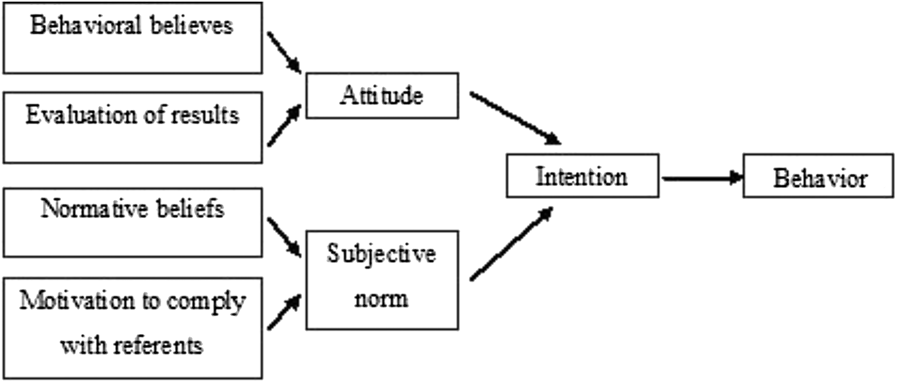
Among the theoretical models that explain health behaviors, one of the most widely used is the theory of reasoned action (TRA, Ajzen & Fishbein, Reference Ajzen and Fishbein1980; Fishbein & Ajzen, Reference Fishbein and Ajzen1975). According to TRA, attitudinal and normative components are the two primary predictors of intention to implement behavior. Moreover, the theory holds that any variable outside the proposed model can influence the intention and, indirectly, the behavior, only if it influences the attitudinal component and/or the normative component. Therefore, TRA hypothesizes that individuals intend to perform a behavior when they have a positive attitude toward its performance and when they believe their significant social references approve. According to this theory, individuals will have the intention of driving under the influence if they have a positive attitude towards this behavior and when they believe that their significant referents (peers and adults) think this behavior is normative (Figure 1).
Theory of reasoned action (TRA, Fishbein & Ajzen, Reference Fishbein and Ajzen1975).

New regulations in Spain have been instituted in an attempt to control and punish driving under the influence of alcohol, in order to reduce these behaviors and lower subsequent collision rates. Recent studies have focused on the prevalence and predictors of drinking and driving behaviors among Spanish youth (del Río, Reference del Río, Gómez, Sancho and Álvarez2002; Meneses et al., Reference Meneses, Romo, Uroz, Gil, Markez, Giménez and Vega2009), but these studies have been limited by including youth who do not drive on a regular basis (Tomas et al., Reference Tomas Dols, Álvarez González, Llorens Aleixandre, Vidal-Infer, Torrijo Rodrigo and Valderrama-Zurián2010). Therefore, it is necessary to study the behaviors related to driving under the influence of alcohol in a sample of young Spanish adults with more stable driving behavior. The goal of the present paper was to determine if the TRA model (Ajzen & Fishbein, Reference Ajzen and Fishbein1980; Fishbein & Ajzen, Reference Fishbein and Ajzen1975) adequately predicts driving under the influence of alcohol. Thus, we examine behaviors related to driving under the influence of alcohol among Spanish youth; furthermore, we analyzed gender differences in drinking behavior and driving under the influence of alcohol.
Materials and Method
Participants
The sample consisted of 478 Spanish university students with a mean age of 19.8 years (SD = 1.85), of which 319 (66.7%) were women. Incomplete answers to the surveys caused 4% of cases to be discarded. Thus, a total of 310 participants (64.9%) had a driving license, with most having received their licenses at the age of 18 years (73.9%) (M = 18.41; SD = 0.90). Of the total sample, 170 (35.6%) had their own car.
Measures
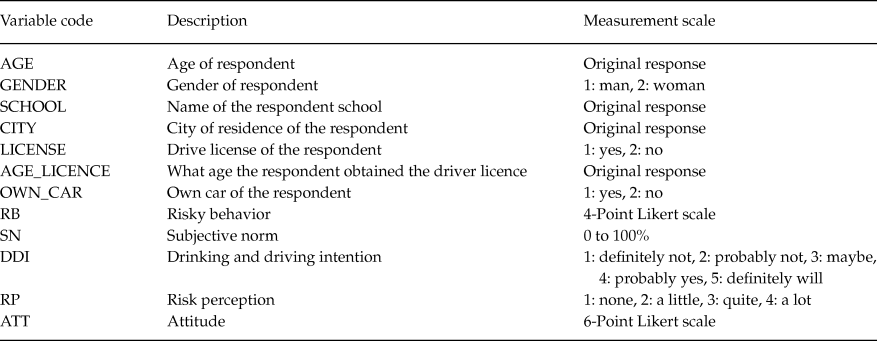
This section gives a brief description of the variables used. Table 1 shows the variables with a short description and presentation of the measurement scale.
Coding, description and measurement scale of variables

Demographics
Information concerning demographic variables (age, gender, school, city of residence) and variables related to the driving license, including age driving license originally received and whether they owned a car, were collected with questionnaires.
Risky behaviors in driving
A questionnaire was used to assess driving under the influence of alcohol, or riding in a vehicle with a driver under the influence of substances.
Subjective norm
Participants were asked to estimate the percentage of peers and adults who had ever driven under the influence of alcohol using two items (‘How many of your peers do you think have ever driven a car after drinking?’ and ‘How many adults do you think have ever driven a car after drinking?’); possible answers ranged from 0 to 100%.
Drinking and driving intention
Participants were asked to estimate the probability of engaging in several risk behaviors over the next twelve months through six items, such as ‘I will drive after drinking alcohol’. Response options were on a five-point scale from ‘Definitely not’ to ‘Definitely will’. Internal consistency for this sample was α = .68.
Risk perception
Items assessed the perceived risk in driving after drinking alcohol or traveling with a driver who has consumed. This scale included four items with response options on a four-point scale (1 = None to 4 = A lot). The internal consistency for this scale was high (α = .80).
Attitude
The Spanish version of the Positive Expectancies for Drinking and Driving for Youth (PEDD-Y; Espada, Griffin, Carballo, & McCarthy, Reference Espada, Griffin, Carballo and McCarthy2012) was administered. The instrument consists of 29 items grouped into four factors: Convenience (e.g. ‘Drinking and driving makes it easier to get home’), Control (e.g. ’While drinking and driving, it is fun to vandalize property’), Avoiding Consequences (e.g. ‘People don’t have to wait for a ride if they drink and drive’), and Excitement Seeking (e.g. ‘Drinking and driving makes one feel high’). The scale showed high internal consistency in this sample (α = .91).
Procedure
After approval of the study by an ethics committee, first year college students were asked to voluntarily participate and informed consent was obtained. Students were informed about the objectives of the research and were provided with brief instructions on how to complete the questionnaires in a classroom setting. The survey was administered by two members of the research team to groups of 30 participants in sessions that lasted approximately 40 minutes. Students were provided with an operational definition of drinking and driving (”consumption of alcohol before or while driving a vehicle”) and were asked to provide a response to each question even if they had never engaged in drinking and driving.
Statistical Analyses
Gender differences in behavioral intentions and risk perception were analyzed using a series of contingency tables, using SPSS Statistics software (Version 19.0; SPSS Inc.). A path analysis with maximum likelihood estimation method was conducted to test the TRA, using MPlus software (Muthén & Muthén, Reference Muthén and Muthén2006). Path analysis is a multivariate statistical method in which several linear regression analyses are specified simultaneously, allowing for models with multiple predictors and/or outcomes. Each coefficient in a path model represents a standardized partial regression coefficient, illustrating the effect of a predictor on an outcome, controlling for other variables in the model. The adequacy of the path model is evaluated by the ratio χ² and degrees of freedom (χ²/df), squared root mean square residual (SRMR), and comparative fit index (CFI). Path models were estimated for the sample overall, and then for men and women separately to examine potential gender differences.
Results
Alcohol Use and Driving
About 84% of participants reported having travelled with a drunk driver, and 4.4% reported having had a collision while driving under the influence of alcohol.
Subjective Norms
Findings indicated that the perception of the frequency with which people drive under the influence of alcohol was high. On average, participants estimated that more than half of their peers (56.8%; SD = 23.9) and adults (57.2%; SD = 23.94) had ever driven under the influence of alcohol.
Drinking and Driving Intention
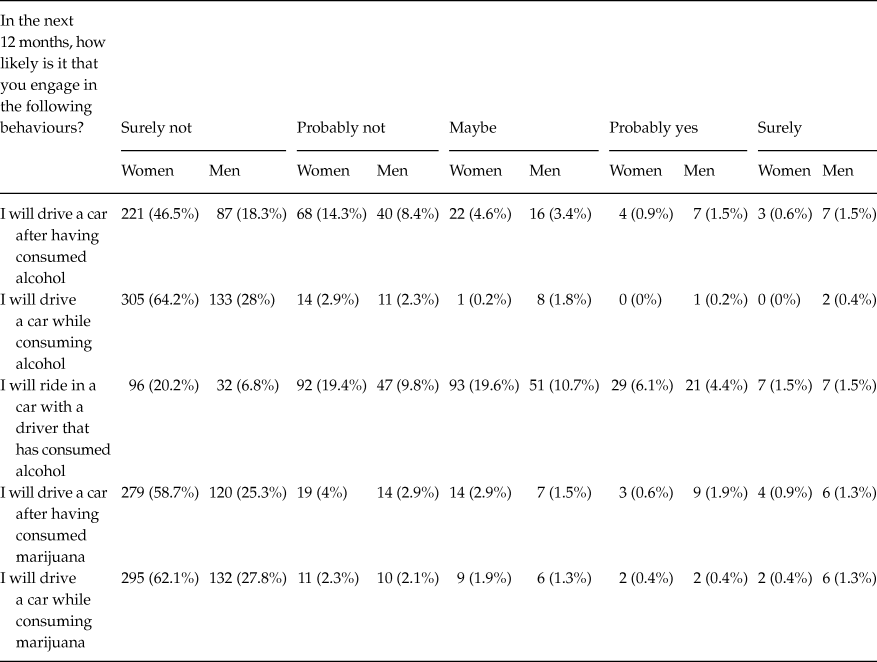
A small percentage (2.1%) said that they surely will drive after drinking alcohol in the next 12 months, while 3.1% said they will surely travel with a driver who has consumed alcohol. Table 2 shows the frequencies related to the intended use and driving.
Frequency and Percentage of Participants’ Behavioural Intentions

Risk Perception
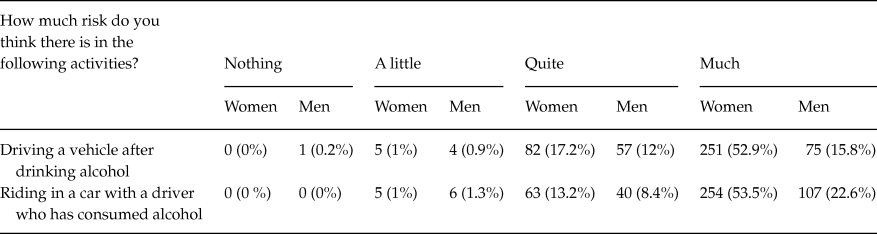
Participants rated the level of risk as high for driving a vehicle after drinking alcohol (M = 3.16; SD = 0.53) and for traveling in a car with a driver who has drunk alcohol (M = 3.67; SD = 0.51). Table 3 shows the frequencies related to the risky behaviors on driving.
Frequency and Percentage of Participants’ Risk Perception

Gender Differences
Men consumed more alcohol (98.1%) than women did (97%). As for driving under the influence of alcohol, men reported driving under the influence of alcohol (39%) more than did women (20.4%; p < .01). Women perceived significant risk in driving after consuming alcohol (68.7%) and reported that they will not drive under the influence of this substance (68%; p < .01) or while consuming it (94.9%; p < .01). Regarding behavioral intention, 68.7% of women said that surely they will not drive under the influence of alcohol in the next 12 months, compared to 57.2% of men (p < .01). Men were more likely to report riding with a driver who has been drinking (15.8%; p < .01).
Predictive Model of Driving Under the Influence
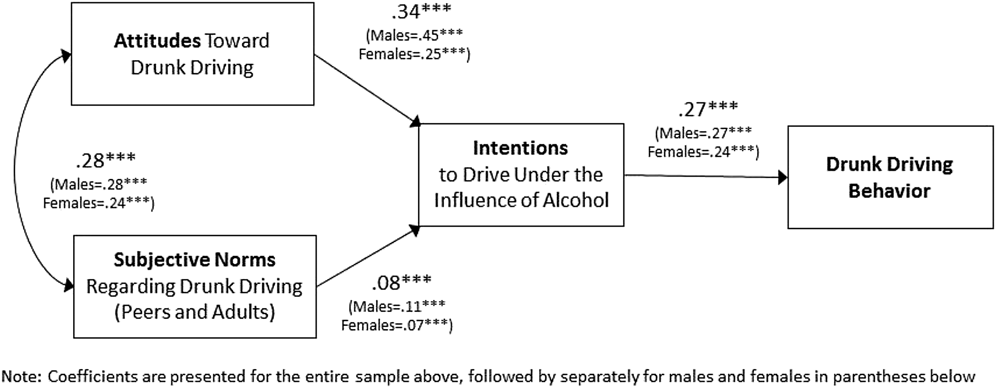
A path analysis model with maximum likelihood estimation was used to test the TRA as a model to predict drinking and driving behaviors. As shown in Figure 2, for the sample as a whole, attitudes towards drunk driving (as measured by the PEDD-Y) positively predicted intentions to drive under the influence of alcohol (β = .34; p < .001) which in turn predicted drunk driving behavior (β = .27; p < .001). Similarly, subjective norms regarding drunk driving (as being typical for peers and adults) positively predicted intention to drive under the influence of alcohol (β = .08; p < .001) which in turn predicted drunk driving behavior (β = .27; p < .001). Several criteria were used to evaluate the overall fit of the path, including (1) the χ² to degree of freedom ratio (X 2/df), which should be less than 5.0; (2) the SRMR, which should be less than .05; and (3) the CFI, which compares the predicted covariation in the hypothesized model to that of the null model, with values greater than .95 indicating a good fit of the model to the data. According to these criteria, there was a good fit of the overall model to the data, χ2/df = 3.51; SRMR = .025; and CFI = .977. Potential interactions among predictors’ variables were examined and none were found to be statistically significant. The path model was also tested for men and women separately to examine potential gender differences. These analyses showed that all path coefficients were highly statistically significant for both men and women, although the magnitude of the coefficients were somewhat larger for men than for women. Thus, TRA is an appropriate explanatory framework for drunk driving behavior for both men and women, with somewhat stronger associations among the variables for men compared to women.
Theory of reasoned action as applied to driving under the influence of alcohol.

Discussion
First, this study examined the prevalence of behaviors related to driving under the influence of alcohol in Spanish youth. To date, few studies have examined this problem in this population, which is a particularly vulnerable group that has been shown to report a pattern of heavy drinking associated with behavioral disinhibition during weekends (Álvarez & del Río, Reference Álvarez and del Río2001). Spain has specific characteristics, as traditionally its population has had high tolerance for alcohol use and alcohol associated with driving. However, limited data exists on the relationship between alcohol and driving under their effects. Our findings are consistent with this relationship in that alcohol was associated with driving, having had a collision, and having travelled with a driver under the influence. Although there has been a decrease in alcohol use in recent years among Spanish youth (Espada et al., Reference Espada, Griffin, Carballo and McCarthy2012), Spain has the highest percentage of alcohol consumers compared to other European countries (Scandurra, García-Altés, & Nebot, Reference Scandurra, García-Altés and Nebot2011). While there is a growing trend toward greater similarity in substance use rates across European countries (Cortés et al., Reference Cortés, Espejo, Giménez, Luque, Gómez and Motos2011), there remains great variability globally in different countries’ rates of driving under the influence of alcohol. Findings from the present study show high rates of driving under the influence of alcohol and riding with drivers who have consumed alcohol among Spanish young people compared with other countries, although risk perception regarding this behavior was similar to that found in other countries. Our findings also support previous research showing that young people are aware of the costs of these risk behaviors despite their participation in them (Dhami, Mandel, & García-Retamero, Reference Dhami, Mandel and García-Retamero2010).
Epidemiological studies have shown gender differences in alcohol (Meneses et al., Reference Meneses, Romo, Uroz, Gil, Markez, Giménez and Vega2009). In this study, men had higher consumption overall than did women. This result is consistent with recent Spanish population studies that although have found decreasing gender differences in alcohol use (Orgaz, Segovia, López, & Tricio, Reference Orgaz Gallego, Segovia Jimenez, López de Castro and Tricio2005; Salamó, Gras, & Font-Mayolas, Reference Salamó, Gras and Font-Mayolas2010), historically, men have been found to consume more than women (Calvete & Estévez, Reference Calvete and Estévez2009; Zaldívar, López, García, & Molina, Reference Zaldívar, López, García and Molina2011). Furthermore, according to the results of this study, women drive less frequently under the influence of alcohol, a fact consistent with the results of other studies performed with Spanish (Calafat, Adrover, Juan, & Blay, Reference Calafat, Adrover, Juan and Blay2008) and U.S. populations (Chou et al., Reference Chou, Dawson, Stinson, Huang, Pickering, Zhou and Grant2006; Schwartz, Reference Schwartz2008).
Substance use associated with driving greatly increases the risk of crashes (Calafat et al., Reference Calafat, Adrover, Juan and Blay2008). Identifying the variables that predict this behavior can be very useful when designing interventions to reduce their frequency. In the present study, the TRA provides support for predicting driving under the influence among young people. Subjective norms (regarding peers and adults) for driving under the influence of alcohol had low predictive power, although they were still significantly associated with attitudes, which in turn had a strong impact on intentions to drive under the influence of alcohol. Our findings, which support the theoretical model tested, may enable better prediction of driving under the influence and thus are useful to develop more effective interventions. Since the results of this study confirm that attitude is most strongly predictive of driving under the influence of alcohol, future interventions should focus on motivation strategies to change attitudes related to driving under the influence of alcohol. This may be a challenge because, according to findings from meta-analyses, prevention programs proved to be more successful in improving knowledge than in changing attitudes towards drugs (Espada et al., Reference Espada, Méndez, Botvin, Griffin, Orgilés and Rosa2002).
Some limitations of this study affect its interpretation. It was completed with a small convenience sample of young Spanish youth, limiting the ability to generalize the results to the general population. Previous studies that examined the variables that influence driving under the influence of alcohol found that paternal alcohol consumption is a risk factor among both men and women (Maldonado-Molina, Reingle, Delcher, & Branchini, Reference Maldonado-Molina, Reingle, Delcher and Branchini2011). A recent study conducted with young Americans stresses the importance of genetic factors, which explain 53% of the variance in driving under the influence (Beaver & Barnes, Reference Beaver and Barnes2012). While the number of variables analyzed in this study is limited, the present findings suggest that variables related to the TRA model are able to predict drinking and driving behaviors in Spanish youth. Future research would do well to investigate these variables in relation to other factors associated with driving under the influence of alcohol. Finally, student samples and cross-sectional design need to be acknowledged as potential limitations.
This study empirically supports using the TRA to accurately predict driving under the influence of alcohol. Alcohol use and driving under the influence of alcohol are highly prevalent in Spanish young people, and some gender differences exist in these behaviors. The results suggest the need for preventive interventions among Spanish young drivers, taking into account the importance of changing attitudes and subjective norms in order to reduce this type of behavior.
This study was supported by the Spanish Ministerio de Economía y Competitividad (Reference PSI2011–26819).