1. INTRODUCTION
Engineering design spans from the identification of needs to the development of manufacturable solutions to satisfy the needs; conceptual design is a phase in engineering design in which solution principles are developed (Pahl et al., Reference Pahl, Beitz, Feldhusen and Grote2007). Owing to higher flexibility in conceptual design, this phase offers greater scope for improvements, which have greater impact yet cost less, in comparison to other phases of engineering design (French, Reference French1988). Therefore, efforts must be taken to understand and support conceptual design. Various design methods are proposed to improve the quality and quantity of ideation in conceptual design, and design by analogy is one among them.
In this paper, analogies are defined as similarities in some aspects between two or more seemingly unrelated objects. In design by analogy, analogous knowledge is transferred from objects in the source domain to objects in the target domain, to solve problems in the target domain. This method is used to produce creative solutions (Qian & Gero, Reference Qian and Gero1996; Goel, Reference Goel1997; Sarkar & Chakrabarti, Reference Sarkar and Chakrabarti2008), in particular to enhance novelty and number of solutions (Young, Reference Young1987; Kletke et al., Reference Kletke, Mackay, Barr and Jones2001). In designing, analogies aid (Jansson & Smith, Reference Jansson and Smith1991) and inhibit fixation (Lopez et al., Reference Lopez, Linsey and Smith2011). Various kinds of analogies are identified in literature based on different criteria: surface similar and dissimilar analogies based on similarity between objects in the source and target domains; structurally similar and dissimilar analogies based on similarity between relationships of elements within objects in the target domain and elements within objects in the source domain; direct, personal, symbolic, and fantasy analogies based on association of analogies to cognition; natural and artificial analogies based on the source domain of analogies; close domain and distant domain analogies based on analogical distance between target and source domains; verbal-, image-, and video-based analogies based on representation of analogies in the source domain; and so forth (VanGundy, Reference VanGundy1981; Gentner, Reference Gentner, Vosniadou and Ortony1989; Chakrabarti et al., Reference Chakrabarti, Sarkar, Leelavathamma and Nataraju2005; Sarkar & Chakrabarti, Reference Sarkar and Chakrabarti2008; Lopez et al., Reference Lopez, Linsey and Smith2011). In this research, another category, internal and external analogies, is identified based on the source of creation of analogies. Internal analogies are created when only designers' cognition is used for obtaining knowledge in the source domain. External analogies are created when a combination of external sources (like databases, ontologies, and literature) and cognition of designers is used for gathering knowledge in the source domain. Vattam and Goel (Reference Vattam and Goel2013) also distinguish between analogies created from within cognition and using external sources of knowledge. Most research on analogies in engineering design is related to understanding and supporting the use of external analogies. However, before understanding and supporting the use of external analogies, it is important to understand the use of internal analogies. Further, this understanding of internal analogies should be the basis for understanding and supporting the use of external analogies. Therefore, this research focuses on understanding the use of internal analogies in conceptual design.
The remainder of this paper is structured in the following way. In Section 2, relevant findings from literature are reported. Based on the gaps in the literature reviewed, research questions are also identified in Section 2. An approach to answer the questions is proposed in Section 3. Findings from this research are reported in Section 4, and discussed in Section 5. In Section 6, important conclusions are presented, and directions for future work are shown in Section 7.
2. LITERATURE SURVEY
2.1. Research on analogies
Several pieces of research are undertaken to understand and support design by analogy; a few representative ones are reviewed in this section. Chakrabarti et al. (Reference Chakrabarti, Sarkar, Leelavathamma and Nataraju2005) developed IDEA-INSPIRE, a computer-based tool, which supports ideation by providing relevant analogies from a database of biological and engineered systems. Each system in the database is represented using text, images, and videos or animations. The textual information in the database is described using the SAPPhIRE model (Chakrabarti et al., Reference Chakrabarti, Sarkar, Leelavathamma and Nataraju2005; see Section 2.2 for more details) and function–behavior–structure. A comparative empirical evaluation, without and with IDEA-INSPIRE, shows that designers are able to develop more conceptual solutions with analogies from IDEA-INSPIRE than without them. Further, Sarkar and Chakrabarti (Reference Sarkar and Chakrabarti2008) studied the effect of representation of analogies from IDEA-INSPIRE on representation, quantity, and quality of solutions developed using these analogies, through empirical studies conducted in a laboratory environment. They analyzed six designers individually solving a design problem, using various representations (video/animation with audio, image, and text) of five analogies from IDEA-INSPIRE. Nontextual representation of analogies is found to help development of higher quantity, quality, and variety of concepts. To support design by analogy, another computer-based support, Design by Analogy to Nature Engine (DANE), is developed by Vattam et al. (Reference Vattam, Helms and Goel2011). DANE is an interactive knowledge-based design environment to retrieve and transfer analogies. In the database of DANE, the working of biological and engineering systems is described using the structure–behavior–function model and images, at various levels of detail, namely, cell, organ, and function. DANE is validated through in situ studies involving undergraduate students in a project-based, interdisciplinary course, and the students reported the usefulness of the support for conceptualizing complex systems. The commonality of the aforementioned pieces of research is the development of a prescriptive support followed by its validation.
Ahmed and Christensen (Reference Ahmed and Christensen2008) used industrial data to understand the role of experience of designers on purposes of analogies, analogical distance, design reasoning of analogies, and usage of analogies in different stages of designing. In this study, transcriptions of 12 design engineers (6 novice and 6 experienced) are used; each transcription comprises utterances of a designer solving a design problem at the conceptual and detail design phases. The following are reported: experienced designers use more analogies for problem identification and solving, while novice designers use more analogies for direct transfer; while analogizing, novice designers use more form to form reasoning, and experienced designers use more behavioral reasoning; and novice designers use analogies for solution generation, and experienced designers use analogies for solution evaluation and analysis, in addition to solution generation. Howard et al. (Reference Howard, Dekoninck and Culley2010) introduced stimuli from both within and outside company resources to designers working in industries, during brainstorming-based ideation. In this study, the rate and appropriateness of ideation of five groups of designers (four with stimuli and one without stimuli) are compared. The stimuli are given to the experimental groups after the teams are exhausted with ideation without stimuli. It is found that with stimuli, the rate of ideation is maintained for a longer duration and more appropriate solutions are developed. In contrast to the research by Ahmed and Christensen (Reference Ahmed and Christensen2008) and Howard et al. (Reference Howard, Dekoninck and Culley2010), which use empirical data from industry, the following pieces of research use empirical data collected from laboratory environments in academia. Tseng et al. (Reference Tseng, Moss, Cagan and Kotovsky2008) studied the timing for analogical inspiration during problem solving and the impact of the type of analogies on creativity of solutions. They analyzed 71 student designers, solving design problems individually by using analogies from surface similar, surface dissimilar, and irrelevant sources. The sources of analogies were given either before or during a break while solving the problem. Tseng et al. found that surface dissimilar analogies help increase the number of solutions regardless of their introduction before or during problem solving; however, novelty of solutions increases only when analogies are introduced during problem solving. More solutions are developed when structurally dissimilar analogies are used, but higher novelty is achieved when structurally similar analogies are used. In the context of biologically inspired design, Vattam et al. (Reference Vattam, Helms and Goel2010) observed the following trends in the usage of biological analogies. Five types of analogies are observed: direct transfer, schema induction, problem transformation, deferred goal, and compositional analogy. Analogies are used for generating, evaluating, and explaining solutions and in all major phases of designing: problem definition, solution search, initial design, design evaluation, and design analysis. Most analogies in the phases of problem definition and initial search for biological solutions use the direct transfer method. Generative analogies that aid transfer of causal mechanisms occur frequently, and the majority of analogies that infer a mechanism have employed the direct transfer method. These findings are based on observations of semester-long bioinspired design projects comprising teams of undergraduate student designers. Wilson et al. (Reference Wilson, Rosen, Nelson and Yen2010) studied the effects of using biological- and engineering-based analogies in ideation during conceptual design, by observing 26 undergraduate mechanical engineering students solving a design problem by developing conceptual solutions. The students are divided into three groups, which are characterized by various degree of support (no analogies, engineering analogies, and biological analogies) in the second half of ideation. It is observed that novelty of solutions increases after the introduction of engineering and biological analogies; the increase is higher in the case of engineering analogies. The variety of solutions is not affected much after the introduction of the biological analogies, but decreases in the case of engineering analogies due to fixation. Lopez et al. (Reference Lopez, Linsey and Smith2011) hypothesized that using analogies from distant domains will help enhance creativity of solutions by creating greater abstraction. The hypothesis is investigated through empirical studies of 17 student designers solving a design problem individually by using analogies from both near and far source domains. The number of ideas increases when the analogies from semantically distant domains are used. Even though the designers perceive the analogies from distant domains as less useful, an analysis of their solutions shows that creativity of solutions is the same for analogies from distant and near domains.
2.2. SAPPhIRE model
Chakrabarti et al. (Reference Chakrabarti, Sarkar, Leelavathamma and Nataraju2005) developed the SAPPhIRE model of causality to explain the working of engineered and biological systems. The entities of the model are defined in (Srinivasan & Chakrabarti, Reference Srinivasan and Chakrabarti2009), as follows: phenomenon: an interaction between a system and its environment (e.g., displacement of an object over a surface); state change: change in property of the system due to the interaction (e.g., change in position of an object); action: high-level interpretation or abstraction of the interaction (e.g., movement of an object); effect: principle underlying the interaction (e.g., equation of motion,  $x = u \times t + 0.5 \times a \times t^2$, where x, u, a, and t are the displacement, initial velocity, acceleration, and time, respectively); input: physical quantity originating from outside the system boundary, required for activating the interaction (e.g., acceleration on an object); organs: properties and conditions of the system and its environment, which are also required for the interaction to occur (e.g., degrees of freedom of an object to move, Newtonian properties of the object, and frictionless surface); and parts: components and interfaces that constitute the system and its environment (e.g., object on a surface). The model of causality is described as follows. A system (e.g., an object) and its environment (e.g., surface) together constitute the parts (e.g., an object on a surface). The parts exhibit certain properties and conditions, referred to as organs (e.g., degrees of freedom of the object to move in certain directions, Newtonian properties of the object, and frictionless surface). When there is an input to the system (e.g., acceleration applied on object), the physical quantity and the properties together activate an effect (e.g., equation of motion,
 $x = u \times t + 0.5 \times a \times t^2$), which creates a phenomenon (e.g., displacement of the object over the surface). This interaction creates a state change (e.g., change in position of the object), which can be interpreted or abstracted as action (e.g., movement of the object). In addition to being a model of causality, the model also assists in describing outcomes in the early phases of engineering design (Srinivasan & Chakrabarti, Reference Srinivasan and Chakrabarti2010a).
2.3. Measures of ideation
Several measures to assess quantity and quality of ideation are proposed in the literature. Shah et al. (Reference Shah, Vargas-Hernandez and Smith2003) proposed novelty, variety, quantity, and quality as the measures of ideation effectiveness. Nelson et al. (Reference Nelson, Yen, Wilson and Rosen2009) and Verhaegen et al. (Reference Verhaegen, Vandevenne, Peeters and Duflou2013) refined some of these metrics. Sarkar and Chakrabarti (Reference Sarkar and Chakrabarti2011) proposed design creativity as a measure of novelty and utility. Srinivasan and Chakrabarti (Reference Srinivasan and Chakrabarti2010b) proposed methods to assess variety and novelty of ideas and concepts. A concept is defined as an overall solution developed in conceptual design, which is intended to satisfy the identified requirements. An idea is defined as a constituent of a concept at a level of abstraction, which is intended to satisfy requirements pertaining only to that level of abstraction. Variety of idea space is a measure of the difference of the ideas from each other in that idea space. Variety of a concept is a measure of the difference of the concept from those developed earlier in that concept space. Novelty of a concept is a measure of the difference of the concept from: the existing concepts that satisfy the same overall function and those developed earlier in the concept space. The methods for assessing the above parameters are described in detail in Srinivasan and Chakrabarti (Reference Srinivasan and Chakrabarti2010b).
2.4. Summary of literature and research questions
The following is the summary of the literature reviewed in Sections 2.1–2.3:
a. Most research focuses on understanding (e.g., Sarkar & Chakrabarti, Reference Sarkar and Chakrabarti2008; Wilson et al., Reference Wilson, Rosen, Nelson and Yen2010; Lopez et al., Reference Lopez, Linsey and Smith2011) and supporting (e.g., Chakrabarti et al., Reference Chakrabarti, Sarkar, Leelavathamma and Nataraju2005; Vattam et al., Reference Vattam, Wiltgen, Helms, Goel, Yen, Taura and Nagai2011) the use of external analogies for ideation in conceptual design. Fewer efforts (e.g., Ahmed & Christensen, Reference Ahmed and Christensen2008) are undertaken to understand the use of internal analogies in conceptual design.
b. Although various researchers such as Tseng et al. (Reference Tseng, Moss, Cagan and Kotovsky2008), Wilson et al. (Reference Wilson, Rosen, Nelson and Yen2010), and Lopez et al. (Reference Lopez, Linsey and Smith2011) study the effects of various characteristics (surface similarity, analogical distance, domains, etc.) on the use of analogies, none of them analyze the role of the design problem on the use of analogies.
c. Several researchers, such as Qian and Gero (Reference Qian and Gero1996) and Goel (Reference Goel1997), discuss the analogical transfer at various levels of abstraction. The SAPPhIRE model can describe the working of engineered and biological systems and the outcomes in the early phases of engineering design (Chakrabarti et al., Reference Chakrabarti, Sarkar, Leelavathamma and Nataraju2005; Srinivasan & Chakrabarti, Reference Srinivasan and Chakrabarti2010a). Sartori et al. (Reference Sartori, Pal and Chakrabarti2010) report the various levels of transfer from the source to the target domain using the SAPPhIRE model, for natural analogies. However, describing analogical transfer from the target to the source domains and vice versa, using the SAPPhIRE model, for both natural and artificial analogies, is yet to be explored.
d. With the exception of (Ahmed & Christensen, Reference Ahmed and Christensen2008), no other research focuses on analyzing the role of experience in the use of analogies in engineering design.
e. Various pieces of research (e.g., Tseng et al., Reference Tseng, Moss, Cagan and Kotovsky2008; Wilson et al., Reference Wilson, Rosen, Nelson and Yen2010; Lopez et al., Reference Lopez, Linsey and Smith2011) report mixed results while assessing the effects of using analogies from the natural and artificial domains on the solution space.
The research in this paper focuses on understanding the use of internal analogies in conceptual design through the following questions:
• What types of internal analogies are used in conceptual design?
• What are the roles of internal analogies in conceptual design?
• How do design problems influence the use of internal analogies?
• How does experience of designers affect the use of internal analogies?
• At what levels of abstraction of the SAPPhIRE model are internal analogies searched in the target domain, identified in the source domain, and realized in the target domain?
• What is the effect of using internal analogies from the natural and artificial domains on the solution space created using these analogies?
3. RESEARCH METHODOLOGY
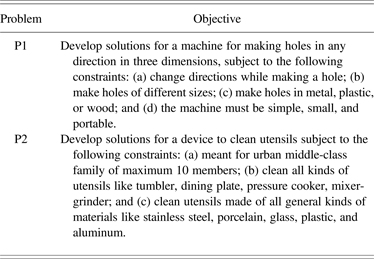
To answer the research questions posed earlier, protocol studies of eight design sessions from earlier research (Sarkar & Chakrabarti, Reference Sarkar and Chakrabarti2007; Srinivasan & Chakrabarti, Reference Srinivasan and Chakrabarti2010b) are used. In these protocol studies, each design session involves an experienced (E1–E4) or a novice designer (N1–N4) solving a design problem (P1 or P2), individually, by following a think-aloud protocol (see Tables 1, 2). All the experienced designers have postgraduate education in product design and manufacturing and more than 2 years of industrial experience, while all the novice designers are pursuing their postgraduate education and have less than 2 years of designing experience in industries. The designers are instructed to identify requirements and develop as many conceptual solutions as possible, with no constraints on design time. In all these design sessions, no external support is used. Therefore, it is argued that all analogies are created from within designers' cognition; that is, they are internal analogies. To identify the internal analogies, the designers are also instructed to think aloud to explain how the conceptual solutions are developed. To train the designers to think aloud, a pilot problem is solved individually by following the think-aloud protocol, before solving problems P1 and P2. From the transcriptions, the following are identified:
1. internal analogies,
2. domains of internal analogies,
3. roles of internal analogies, and
4. levels of abstraction in:
• the target domain from which the search for internal analogies commenced,
• the source domain in which the internal analogies are created, and
• the target domain in which the internal analogies are implemented.
Design sessions

Objective of problems

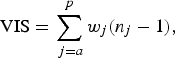
The domains are used to identify the types of analogies. The roles of internal analogies are the tasks for which the analogies are used in designing. The influence of type of design problem is assessed in terms of the number of analogies used for each problem. The role of experience is assessed in terms of the number of analogies used by the experienced and novice designers. Because the SAPPhIRE model can describe outcomes at several levels of abstraction in the early phases of engineering design (see Section 2.2), the levels of abstraction in the source and target domains are identified using this model. The coded transcriptions of the design sessions, with a higher than accepted level of intercoder reliability, are available from earlier research (Srinivasan & Chakrabarti, Reference Srinivasan and Chakrabarti2010b). To assess the effect of using artificial and natural analogies on the solution space, the values of variety of idea space and the number of ideas, also available from earlier research (Srinivasan & Chakrabarti, Reference Srinivasan and Chakrabarti2010b), are correlated with the number of artificial analogies and natural analogies used in that solution space. Variety of idea space (VIS) is computed using the following formula,
 $${\rm VIS} = \sum_{\,j=a}^p w_j \lpar n_j-1\rpar \comma$$
where n a, n s, n i, n ph, n e, n r, and n i are the number of ideas at the action, state change, input, phenomenon, effect, organ, and part levels, respectively, and w a, w s, w i, w ph, w e, w r, and w p are the weightings at the action, state change, input, phenomenon, effect, organ, and part levels, respectively (Srinivasan & Chakrabarti, Reference Srinivasan and Chakrabarti2010b). The number of ideas is the sum of the number of ideas at each level of abstraction.
4. RESULTS
4.1. Identification of internal analogies
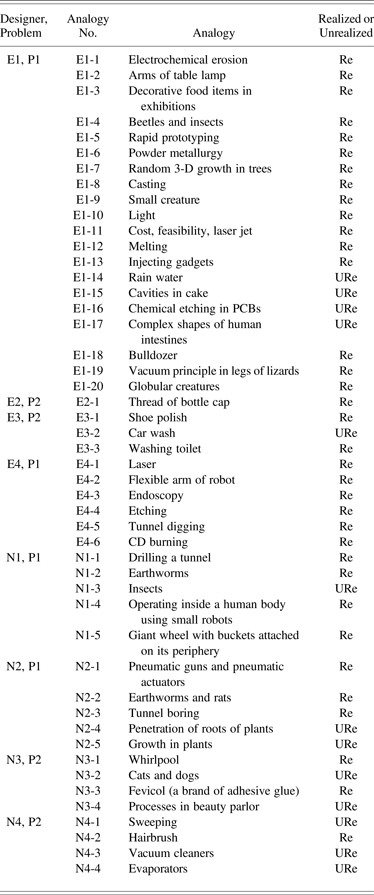
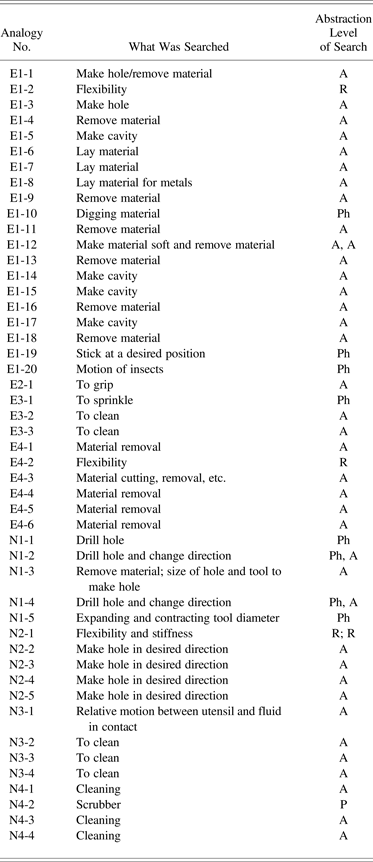
Table 3 shows all the internal analogies identified from the transcriptions. An example of an internal analogy (E1-1 in Table 3) is shown through the utterances of E1:
It is a sort of electro-chemical erosion. I have read it somewhere in some manufacturing technology handbook. If you have a book … I do not remember erosion exactly. It is electrochemical erosion. There are other methods in this but that [sic electrochemical erosion] can be used. It has many limitations.
Here, the designer E1 uses an analogy of electrochemical erosion for removing material and making a hole, and remembers reading about this phenomenon in a book. In this research, not all internal analogies are identified. In some instances, designers forget to describe how they created an idea. In these cases, the researchers did not interfere, remind them for the pending description, and thus interrupt the design session.
Analogies created by designers
Solutions and requirements developed earlier in design sessions are used as analogies later during the same sessions. This is epitomized by the following utterances of E1:
That idea (laser) triggered the second idea of water jet because I felt laser might be little expensive. Water jet is, I think, a little cheaper and, I know that there is a process, so it was not very difficult correlating these two processes.
E1 develops a solution of water-jet machining by using the analogy of laserjet, which is developed as a solution earlier.
4.2. Types of analogies
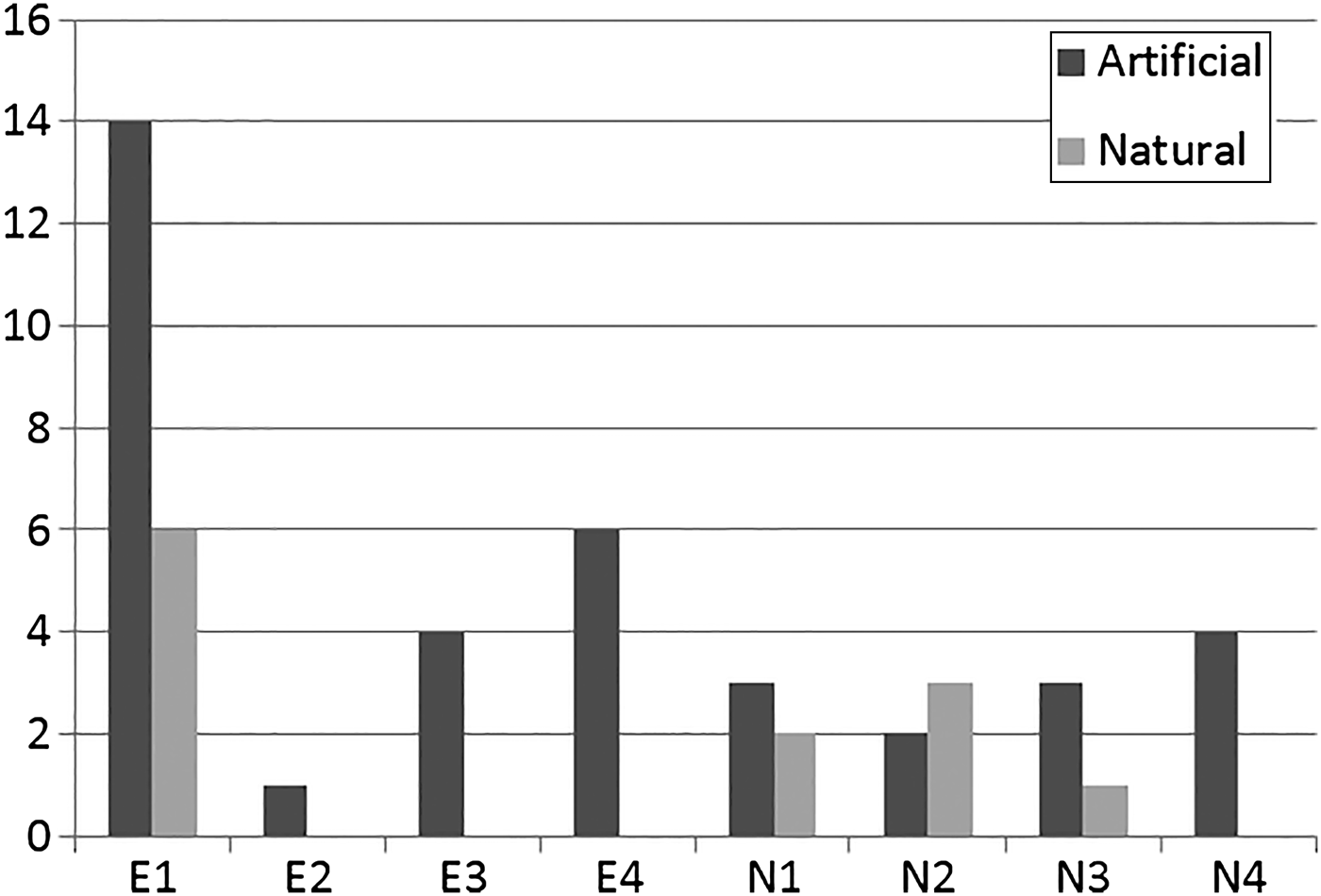
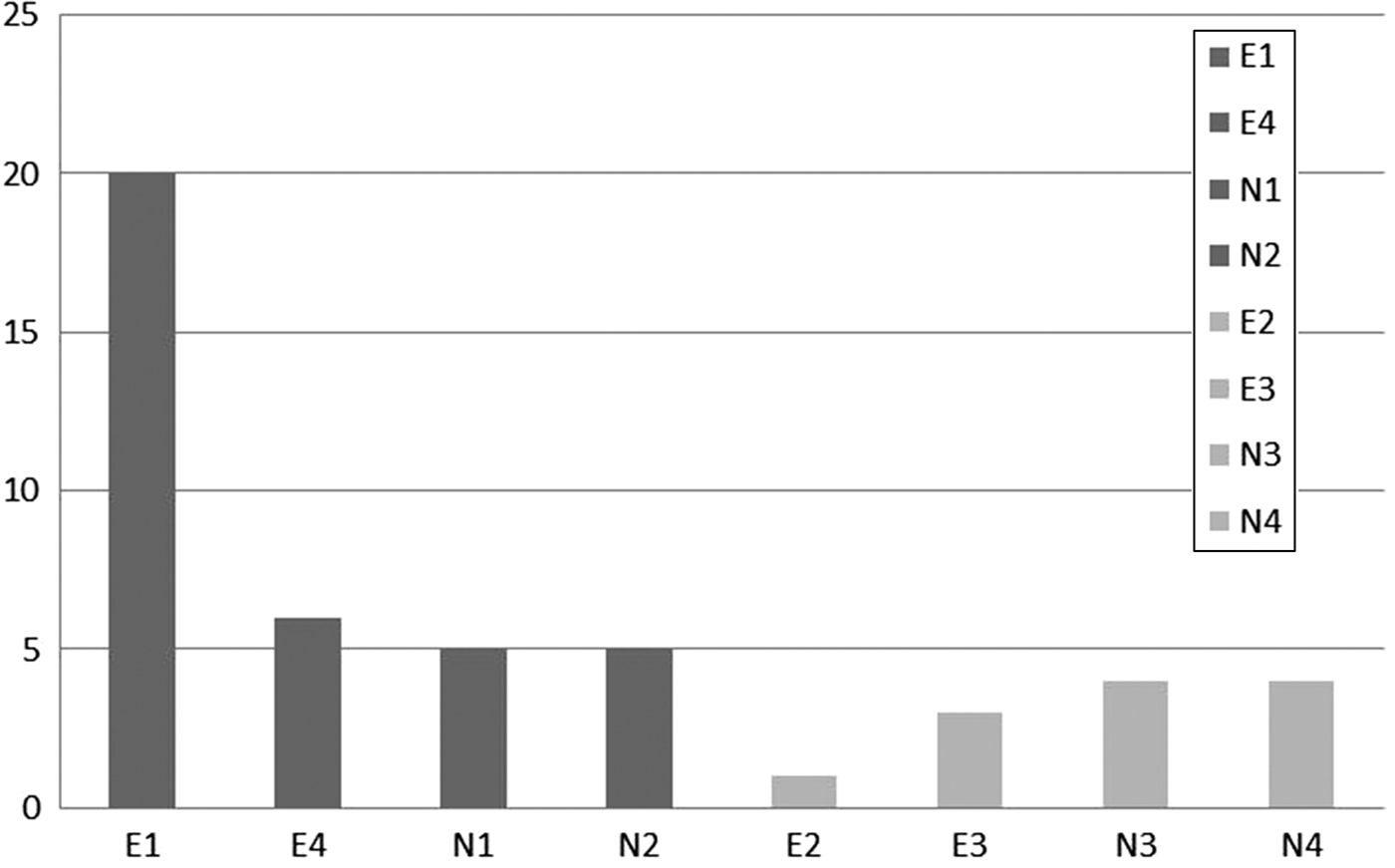
It is observed that the designers use analogies from both the artificial and natural domains (see Fig. 1). An example for an analogy from the natural domain is illustrated through the utterances of E1:
It [tool head] can stick to any surface it wants to stick to locally … then, why don't it have a, have a, you know, lizards can stick upside down because of vacuum sort of … so why don't I use that principle here. I want to stick inside it [work-piece]. It has some sort of vacuum pads it sticks wherever it wants.
Here, E1 uses the analogy of the vacuum principle in lizards' legs, in the tool head to fix it. An example for an analogy from the artificial domain is shown through the utterance of N3,
So if we have to do that, why not dip the fresh utensil in a solution? This idea I got from Fevicol. When you apply Fevicol on the hand and after it gets dried, it comes out as a layer and we can peel off, comes with dirt or say everything.
Here, N3 uses the analogy of Fevicol, a brand of adhesive, from the artificial domain, which after coming in contact with the hands, forms a layer after drying and can be easily peeled off. This analogy is used for cleaning utensils (i.e., utensils are dipped in a special solution, a layer of the material of the solution is formed on the utensils, and the layer with the food leftovers can be separated after using the utensils). A total of 12 and 36 analogies are used from the natural and artificial domains, respectively. All the designers, except N2, use more analogies from the artificial domain than from the natural domain.
Number of analogies used by each designer from the artificial and natural domains.
4.3. Roles of analogies
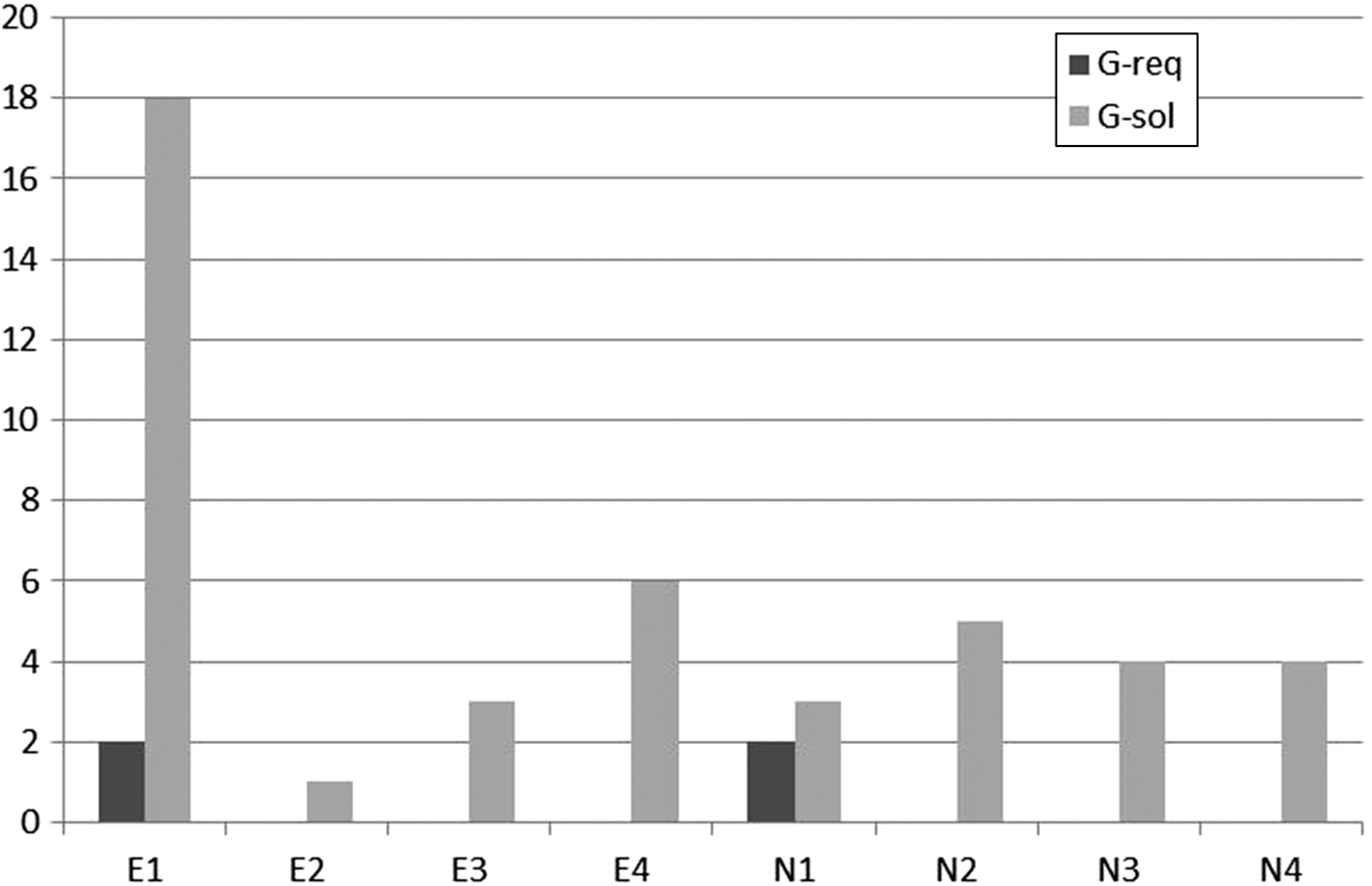
In this empirical study, analogies are observed to be used for the following tasks in the early phases of engineering design: generating requirements and generating solutions (see Fig. 2). To clarify, analogies are used for generating ideas (i.e., solutions at a level of abstraction). An example for generating a requirement is depicted through the utterances of E1:
For example, you consider trees. Trees grow in all directions, in three dimensions. There is no fixed pattern as such, and that's the kind of hole (that) I am trying to achieve. So, it is, basically, there is an open space and, the branches and leaves are growing in different directions, so material is added into space. So, if I think of this problem in a different direction—it would be similar to adding material in (an) open space and achieving my goal of creating cavity. In space I create the material from zero.
Here, designer E1 uses an analogy of three-dimensional tree growth to develop the requirement of adding material in space, instead of removing material from a given work-piece. Out of a total of 48 analogies, only 4 are used for generating requirements, while the rest are used for generating solutions (see Fig. 2).
Number of analogies used by each designer for generating requirements (G-req) and generating solutions (G-sol).
4.4. Roles of problems
The number of internal analogies used by each designer while solving the given problem is shown in Figure 3. E1, E4, N1, and N2 solve problem P1; E2, E3, N3, and N4 solve problem P2. Note that all the designers who solve P1 use more analogies individually than those who solve P2.
Number of analogies used to solve Problem 1 (by E1, E4, N1, and N2) and Problem 2 (by E2, E3, N3, and N4).
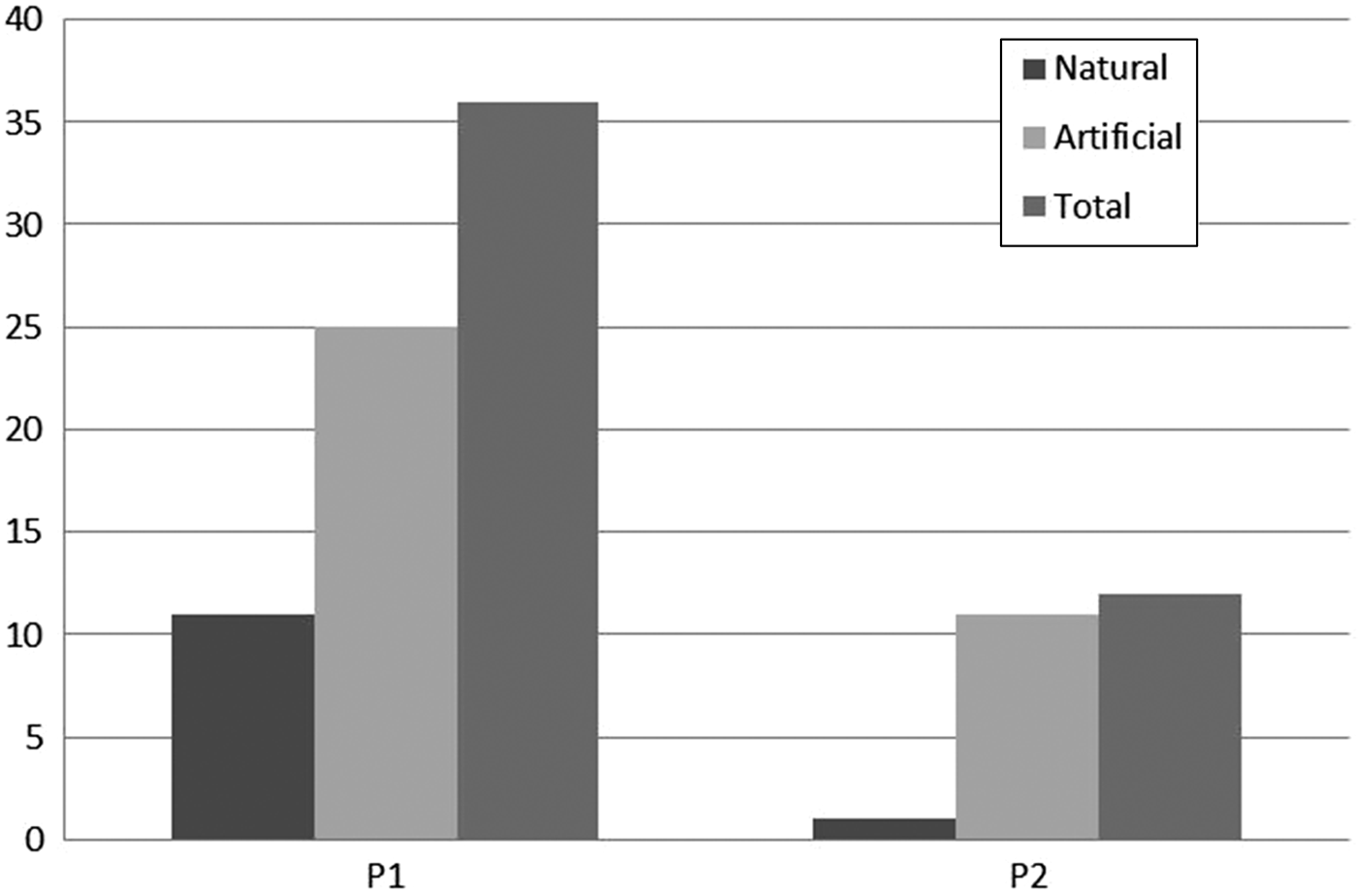
Figure 4 shows the number of analogies from the natural and artificial domains used in solving problems P1 and P2. Eleven natural and 25 artificial analogies are used while solving P1, while 1 natural and 11 artificial analogies are used while solving P2.
Number of analogies (natural, artificial, and total) used to solve Problem 1 and Problem 2.
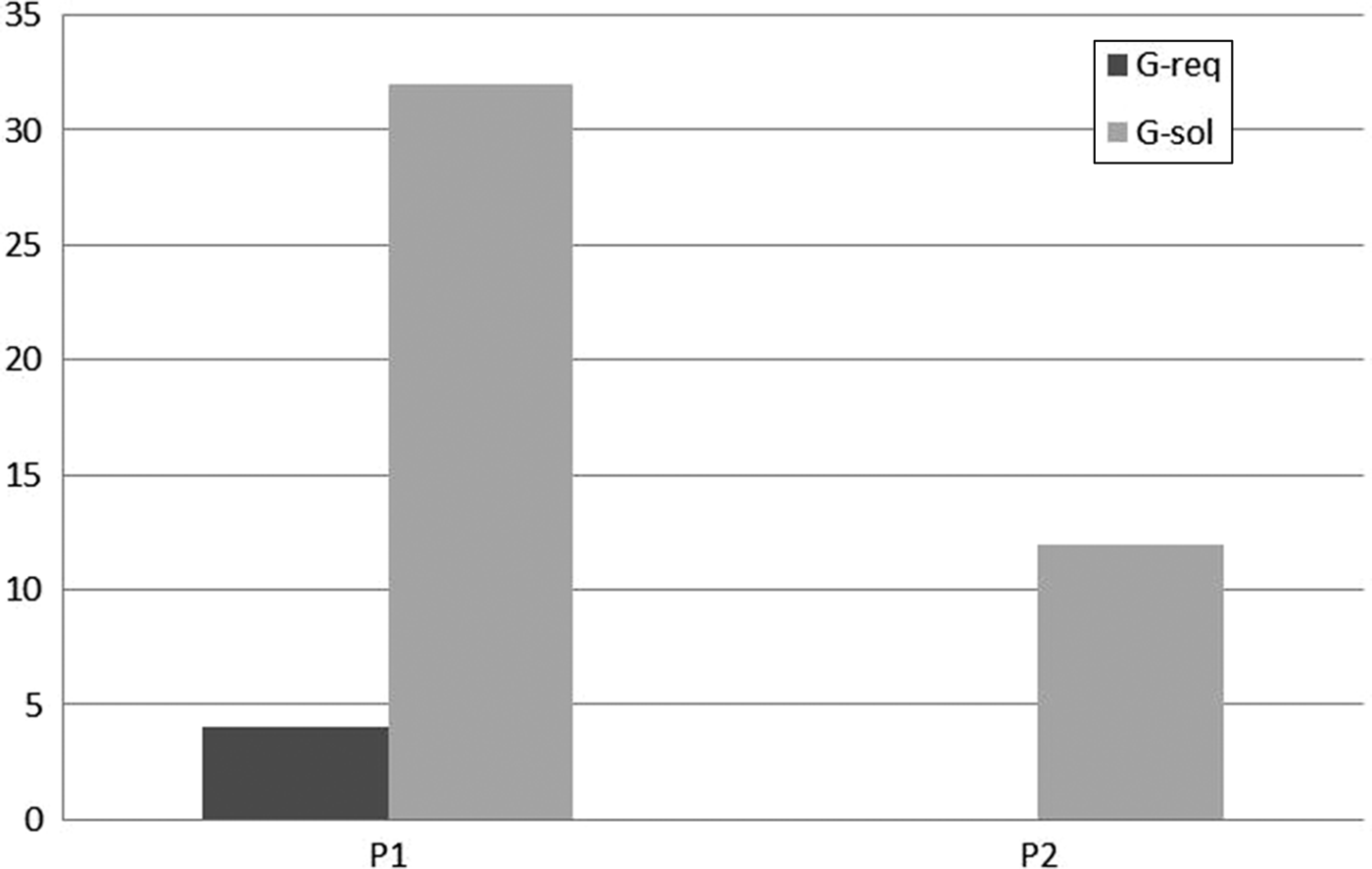
Figure 5 shows the plot of analogies used for generating requirements and solutions, for problems P1 and P2. For problem P1, analogies are used for generating both requirements and solutions, but for problem P2, analogies are used only for generating solutions.
Number of analogies used for generating requirements (G-req) and solutions (G-sol) in Problem 1 and Problem 2.
4.5. Role of experience of designers
The role of experience on usage of internal analogies could not be ascertained clearly from the empirical studies. On the one hand, experienced designers E1 and E4 used more analogies, individually, than any novice designer, while on the other hand, experienced designers E2 and E3 used fewer analogies than any novice designer (see Fig. 3). The average number of internal analogies used by experienced designers (7.5) is still more than those used by novice designers (4.5). No experienced designer, except E1, used any analogy from the natural domain, but all the novice designers, except N4, used analogies from both the natural and artificial domains (see Fig. 1).
4.6. Level of abstraction
The process of analogical transfer is analyzed in three steps: search for analogies in the target domain, identification of analogies in the source domain, and realization of analogies in the target domain.
4.6.1. Search for analogies in the target domain
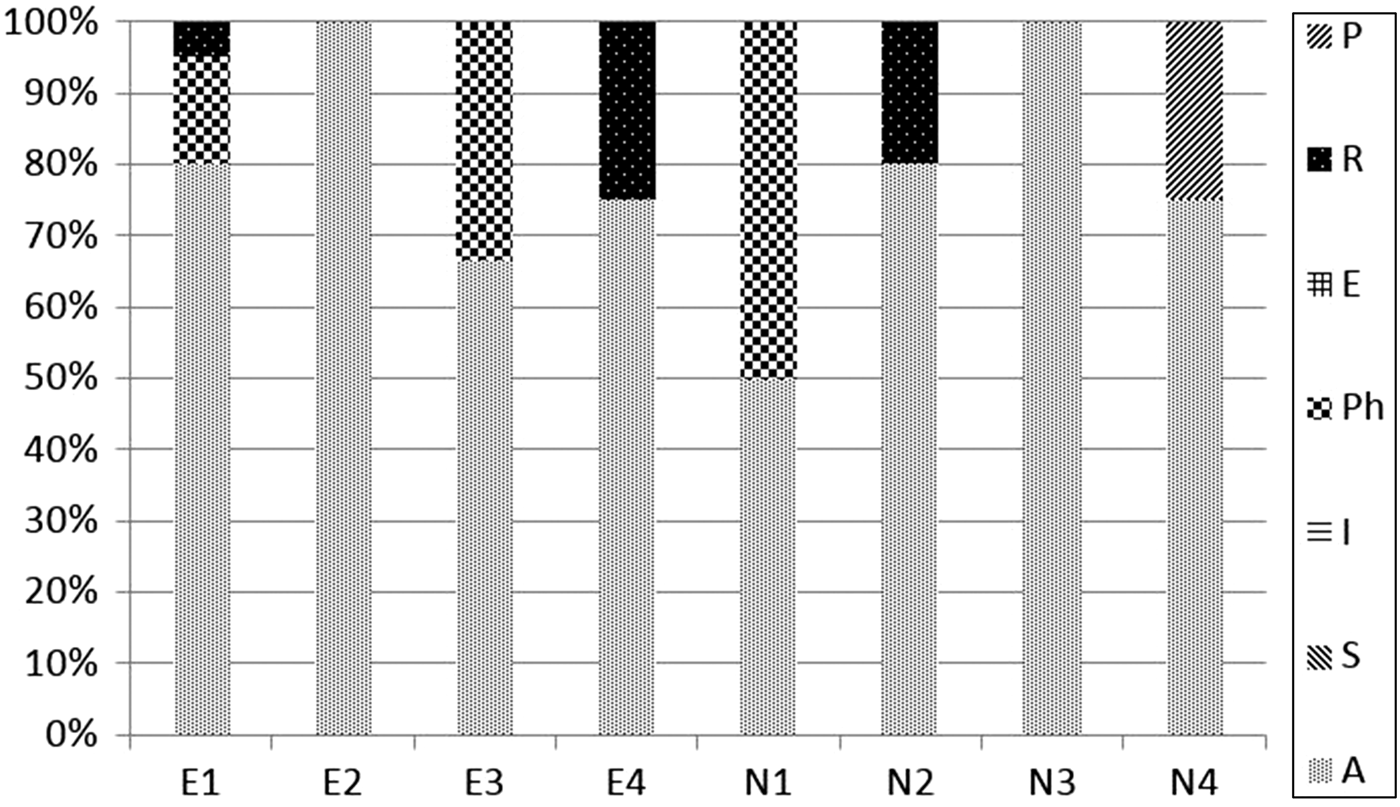
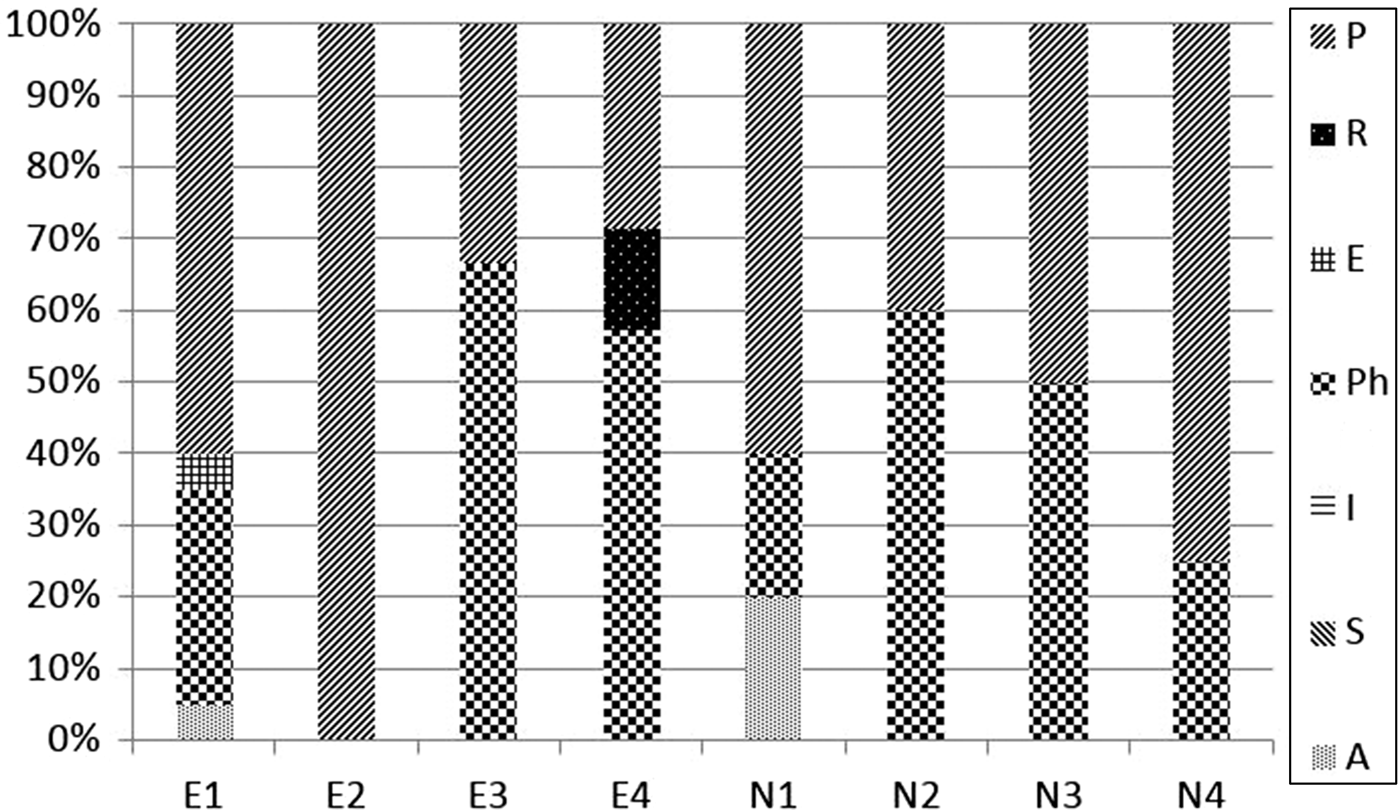
The search for analogies in the target domain is conducted at various levels of abstraction, which can be described using the SAPPhIRE model. Table 4 shows the contents and their levels of abstraction with which the search for analogies is performed. Figure 6 shows the percentage distribution of the levels of abstraction in the target domain from which searching is done. It is observed that a majority of the search for analogies, for all the designers, is carried out at the level of action, followed by phenomenon, organ, and part. No search is performed at the abstraction levels of state change, input and effect, by any designer.
Percentage distribution of search for analogies at various abstraction levels (A, Action; S, State change; I, Input; Ph, Phenomenon; E, Effect; R, oRgan; P, Part).
Contents and their abstraction levels of search in target domain
4.6.2. Identify analogies in the source domain
Analogies are observed to be created in the source domain at various levels of abstraction, which are described using the SAPPhIRE model. Figure 7 shows the percentage distribution of the levels of abstraction of the analogies. It is observed that most designers create analogies at the level of abstraction of phenomenon and part, followed by action, effect, and organ. Analogies at the other levels of abstraction are not found. Note that all the analogies identified in the source domain by all the designers are at the same or lower levels of abstraction than the contents in the target domain with which the search for analogies is performed. In other words, the transfer from the target domain to the source domain is from a higher to the same or a lower level of abstraction.
Percentage distribution of analogies at various abstraction levels (A, Action; S, State change; I, Input; Ph, Phenomenon; E, Effect; R, oRgan; P, Part).
4.6.3. Realize analogies in the target domain
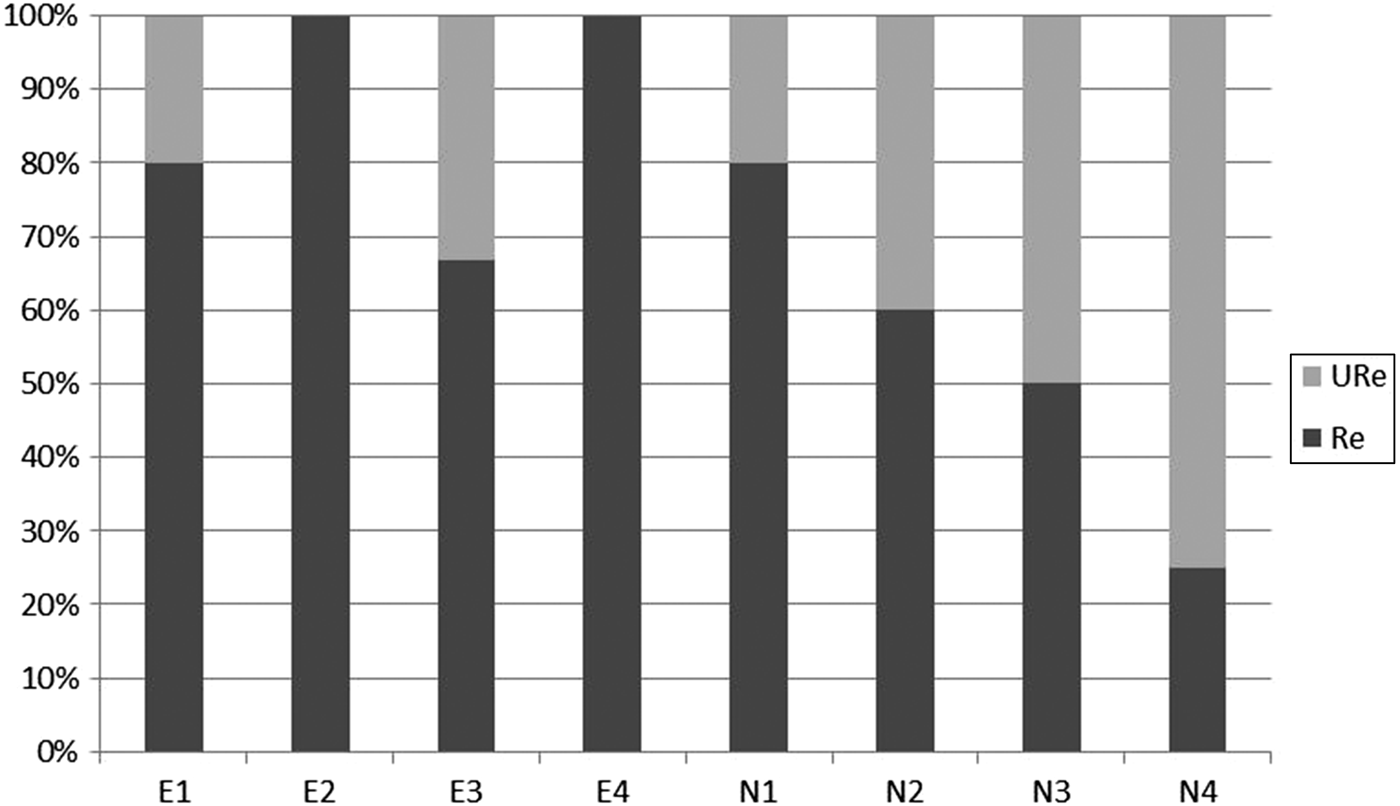
Among the internal analogies created by the designers, not all are realized in the target domain as requirements or solutions (see Table 3). For example, designer E1 used an analogy of “cavities in cake” for “make cavity,” but the designer finds that this analogy cannot be transformed because the direction of making cavity cannot be controlled for the given materials, and so this analogy is not realized (utterance from transcription: “I thought cake, cake is porous and has cavities in random direction, but it is made out of baking process, so baking process creates the random cavities, I won't be able to bake metal.”). In another instance, designer N2 developed an analogy of “underground penetration of roots of plants” and “growth of plants in direction of sunlight” to make a hole in the desired direction (utterance from transcription: “I am thinking of the roots of the plants, it [sic root] penetrates and goes inside. But they do not have pre-defined path. They go in search of water in the ground.” and “Even the plant grows such that it gets maximum sunlight.”), but is not realized. Figure 8 shows the percentage of analogies that are realized and unrealized. Novice designers have a higher percentage of unrealized analogies than experienced designers.
Percentage distribution of analogies that are realized (Re) and unrealized (URe).
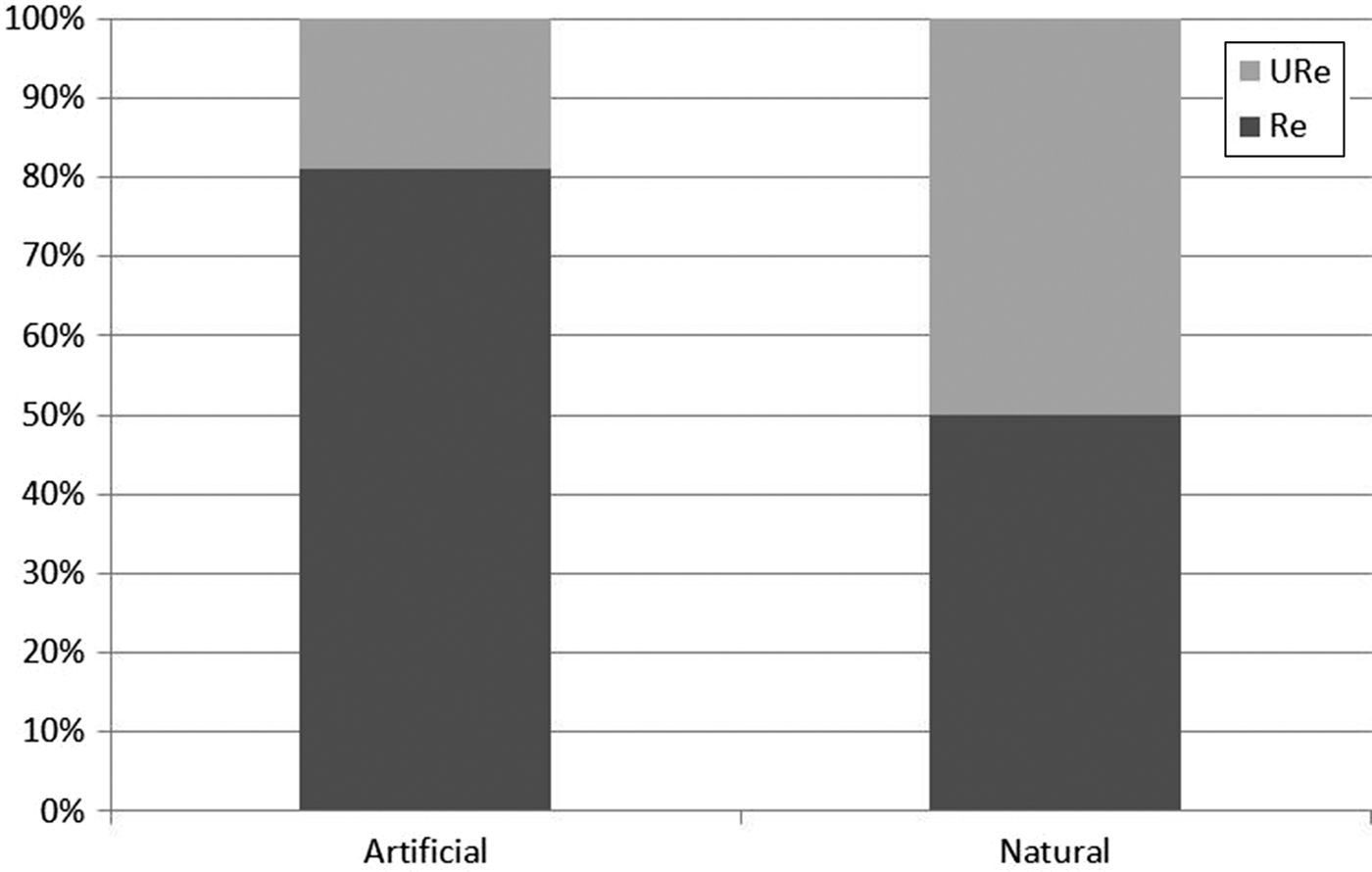
Figure 9 shows the percentage of analogies from the natural and artificial domains that are realized and unrealized. A higher percentage of analogies from the artificial domain is realized, while a higher percentage of analogies from the natural domain remains unrealized.
Percentage distribution of artificial and natural analogies that are realized (Re) and unrealized (URe).
4.7. Effect on solution space
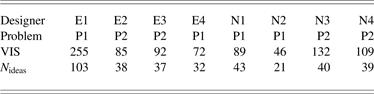
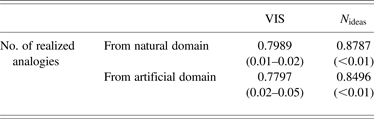
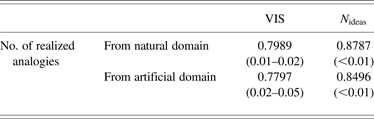
Because analogies first influence ideas, which later are combined to form concepts, VIS and the number of ideas (N ideas) are assessed as influences on solution space (see Sections 2.3 and 3 for their definition and assessment). The values of these are available from earlier research (Srinivasan & Chakrabarti, Reference Srinivasan and Chakrabarti2010b; see Table 5). To assess the influence of analogies from the natural and artificial domains on the solution space, the values of VIS and N ideas are correlated with the number of realized analogies from the natural domain and the artificial domain. Table 6 shows the correlation values; the values within the brackets show the level of significance in a two-tailed test. For instance, 0.7989 is the correlation between VIS and the number of realized analogies from the natural domain, with a level of significance in the range of 0.01–0.02. Although the correlation values for the natural analogies is slightly higher than those for the artificial analogies, there is not much to separate in terms of the influences of the natural and artificial analogies on the variety of idea space and the number of ideas. However, if one considers the higher percentage of analogies from the natural domain that are not realized, then it can be argued that analogies from the natural domain in comparison to the artificial domain have a more positive influence on the variety of idea space and the number of ideas.
Values of VIS and Nideas in design sessions
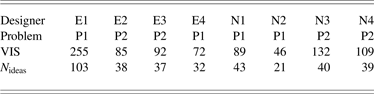
Note: According to Srinivasan and Chakrabarti (Reference Srinivasan and Chakrabarti2010b).
Correlation values and level of significance in a two-tailed test
5. DISCUSSION
In this section, the findings from the previous section are described along with their potential influences and possible implications, and they are compared with similar results from literature.
In the empirical studies used in this research, because no external support is used for assisting designing, it is reasoned that the internal analogies must have been sourced from the past experiences of the designers. This signifies that in research involving the use of external analogies from a support, designers may be creating both internal and external analogies. These analogies need to be distinguished, especially while studying the influence of the support. However, the influence of external analogies in stimulating the creation of new internal analogies cannot be discounted.
The designers used both requirements and solutions, previously developed in the same session, as analogies for further requirements and solutions (see Section 4.1). This shows that the perception of what is internal and external is temporal; that is, external analogies or other external experiences become potential sources of internal analogies to be used in future.
Most designers used more analogies from the artificial domain than from the natural domain (see Section 4.2). This is expected because all the designers had engineering or architecture backgrounds, and therefore, their cognition was based more on the know-hows of artificial than natural. This finding signifies that, to use the knowledge of nature, designers from backgrounds in artifact-based domains need assistance. This need for assistance has also been pointed out by several researchers, for instance, Chakrabarti et al. (Reference Chakrabarti, Sarkar, Leelavathamma and Nataraju2005), Wilson et al. (Reference Wilson, Rosen, Nelson and Yen2010), and Vattam et al. (Reference Vattam, Helms and Goel2010).
Goel (Reference Goel1997), Christensen and Schunn (Reference Christensen and Schunn2007), and Sarkar and Chakrabarti (Reference Sarkar and Chakrabarti2008) have pointed out that analogies, in addition to assisting in generating solutions, can also be used for: searching, identifying, interpreting, elaborating, decomposing, and reformulating problems; evaluating and refining candidate designs; and interpreting evaluation information. In the early phases of designing, comprising task clarification and conceptual design, outcomes at various levels of abstraction of the SAPPhIRE model are generated, evaluated, modified, and selected as requirements and solutions (Srinivasan & Chakrabarti, Reference Srinivasan and Chakrabarti2010a). Therefore, it is possible that analogies are used for each of these tasks. However, it was observed that the designers used analogies only for generating requirements and generating solutions; more analogies are used for generating solutions than for generating requirements (see Section 4.3). This could be primarily because all the designers were explicitly asked to only describe how the solutions were developed, and not other tasks, and therefore may not have reported those.
In the context of biologically inspired design, Helms and Goel (Reference Helms and Goel2012) observed instances of coevolution of problem and solution as a consequence of using biological analogies, in empirical studies of course projects carried out by students at Georgia Tech. Further, Helms and Goel (Reference Helms and Goel2013) developed Structured Representations for Biologically Inspired Design, a knowledge representation scheme to track the influence of use of biological analogies on the evolution of problem formulation with time. In contrast, the role of design problems on the usage of internal analogies from the natural and artificial domains is investigated in this paper (see Section 4.4).
The general expectation is that experienced designers will use more analogies than will novice designers by drawing more analogies from their “bigger box” of cognition. Ahmed and Christensen (Reference Ahmed and Christensen2008) have also reported, through a case study in an aerospace industry of a variant design process, that experienced designers used more analogies than novice designers. However, in this study, the experienced and the novice designers, who solved problem P1, used more analogies individually than the experienced and novice designers who solved problem P2 (see Section 4.4). Therefore, the role of experience could not be ascertained with clarity (see Section 4.5). This could be due to the influence of the design problem; that is, both the experienced and the novice designers were able to better analogically relate their cognition to problem P1 than to P2 on the assumption that the number of analogies used is an indicator of the apparent distance between the source and target domains. Both the experienced and the novice designers created more analogies from the artificial than the natural domain (see Section 4.5). The findings indicate that both experienced and novice designers need support for creating analogies from the natural domain, as discussed earlier.
Goel (Reference Goel1997) has pointed out that analogical transfer can comprise knowledge of problem, solution, domain, or strategy. Using IDEA-INSPIRE (Chakrabarti et al., Reference Chakrabarti, Sarkar, Leelavathamma and Nataraju2005), designers can be analogically inspired at any level of abstraction of the SAPPhIRE model. In the context of bio-inspired design, Sartori et al. (Reference Sartori, Pal and Chakrabarti2010) have reported four kinds of transfer from the source domain to the target domain, in terms of the entities of the SAPPhIRE model: copy parts, transfer organs, transfer attributes, and transfer state change. In this study, it was found that the search for analogies in the target domain was mostly conducted at the level of action by all the designers, followed by phenomenon and organ levels by some designers. The higher frequency of search is attributed to better exploration at the level of action, and fewer or no search at other levels of abstraction to less intensive exploration at other levels of state change, phenomenon, effect, and organ. Because part is the lowest level of abstraction, the designers did not search for analogies at this level. These corroborate well with earlier observations in (Srinivasan & Chakrabarti Reference Srinivasan and Chakrabarti2010a), relating to the differing intensity of search at the various levels of abstraction, using a different set of designers and problems. The observations made in the paper also highlight the need for a support that can help designers explore the unexplored levels of abstraction in the source and target domains. Most of the analogies created by all the designers in the source domain were at the level of phenomenon and parts. Because analogizing can occur at any level of abstraction, and analogizing at multiple levels of abstraction can potentially help increase the number and variety of solutions, there is a need for supporting designers to create analogies at multiple levels of abstraction with which to increase the number and variety of solutions. The instructions in the empirical studies did not suffice to clearly identify the levels of abstraction at which the analogies were realized in the target domain. However, it was observed that not all analogies were realized in the target domain. A greater percentage of analogies created by the novice designers, in comparison to those by the experienced designers, were not realized into requirements or solutions (see Section 4.6.3). In the same section, it was also observed that a higher percentage of analogies from the natural domain were not realized into requirements or solutions. These could be due to difficulties that novice designers encountered while translating analogies into viable outcomes and issues of comprehending and realizing analogies from the natural domain. These imply a need for supporting novice designers to help realize analogies into requirements and solutions and supporting designers in general in transforming analogies from the natural domain into viable outcomes. The transition from higher to lower levels of abstraction when moving from the target domain to the source domain was observed in this study, which could be specific to the chosen set of designers and problems. However, in theory, transition from lower to higher levels of abstraction is also possible.
One of the roles of analogies is for generating ideas. For this reason, the variety of idea space and the number of ideas have been correlated against the number of realized analogies from the natural and artificial domains. From the correlation values in Table 6, it can be concluded that there is not much to separate the influence of analogies from the natural and artificial domains, on the number of ideas and variety of idea space. It has to be noted that many interesting analogies from the natural domain were unrealized. Therefore, if realization of natural analogies is supported, then from the observed correlation values it can be argued that analogies from the natural domain will potentially help in creation of more ideas with greater variety in comparison to analogies from the artificial domain. Srinivasan and Chakrabarti (Reference Srinivasan and Chakrabarti2010b) showed that variety of idea space correlates to variety of concept space, which in turn correlates to novelty of concept space. Therefore, it can be argued that ideas analogized from the natural domain should also assist in the creation of concepts that have greater variety and novelty than those analogized from the artificial domain. Tseng et al. (Reference Tseng, Moss, Cagan and Kotovsky2008) and Lopez et al. (Reference Lopez, Linsey and Smith2011) have reported that using surface dissimilar analogies and distant domain analogies, respectively, help increase the number of solutions. Tseng et al. have also found that novelty of solutions increases with the use of surface-similar analogies, while Lopez et al. have reported that creativity of solutions is the same when using distant or near-domain analogies.
One factor that was not considered in this study is the time taken to solve the problem. Because no time constraint was enforced on the designers, they solved the assigned problem until they were exhausted and could generate no more ideas. No two designers had the same time to exhaustion.
6. CONCLUSIONS
This paper focuses on understanding the use of internal analogies in conceptual design using existing empirical studies. The following are investigated: the types of internal analogies used; the roles of internal analogies; the influence of design problems on the use of internal analogies; the role of experience of designers on using internal analogies; the levels of abstraction of the SAPPhIRE model at which internal analogies are searched for in target domain, identified in source domain, and realized in target domain; and the effect of using internal analogies from the natural and artificial domains on the number and variety of idea space. Two kinds of internal analogies are identified: artificial and natural. Analogies are used for generating both requirements and solutions. The use of analogies depends on the analogical relevance of the problem being solved. Internal analogies are searched for primarily at the level of action, and identified principally at the levels of phenomenon and part. Not all analogies are realized in the target domain. A greater percentage of natural analogies, and analogies in general from novice designers, remain unrealized. Analogies from the natural domain have more positive influence on the variety of idea space and the number of ideas, and potentially on the variety and novelty of concepts created from these ideas.
7. FUTURE WORK
The research in this paper develops a preliminary but necessary understanding of the use of internal analogies in the conceptual phase of engineering design. The understanding gained from this study is planned to be used in the development of an analogical design support. In the empirical study reported in this paper, the influence of multiple design variables is studied using few (eight) design experiments. More design experiments are needed to study in greater detail the influence of variables, such as complexity of design problem, domain of design problem, experience of designers, and domain knowledge of designers, on the use of internal analogies. For instance, to assess the influence of complexity of design problems, design experiments comprising design problems of varying complexity being solved by teams need to be compared, and such experiments should be repeated by multiple teams of varying degrees of experience.
V. Srinivasan is a Postdoctoral Researcher at the Institute of Product Development, Technische Universität München. He received his PhD in engineering design from the Indian Institute of Science and his Bachelors in mechanical engineering from the University of Madras. His research interests include design creativity and innovation, bioinspired design, functional reasoning, design methods, theories and methodologies, design for adaptability, and engineering design.
Amaresh Chakrabarti is a Professor in the Centre for Product Design and Manufacturing, Indian Institute of Science; Coordinator for the Innovation, Design Study and Sustainability Laboratory; and Cofounder of the Virtual Reality Laboratory. He received a PhD in engineering design from the University of Cambridge, an MS in mechanical systems design from the Indian Institute of Science, and a BS in mechanical engineering from the University of Calcutta. His research interests include design synthesis, creativity, ecodesign and sustainability, knowledge capture and reuse, requirements engineering, computer-aided design, and design for variety.
Udo Lindemann is a Professor and Head of the Institute of Product Development, Technische Universität München. He received a PhD from Technische Universität München and an MS from Technische Universität Hannover. He has 15 years of diverse experience in industries like RENK AG and MAN Miller Printing Machines GmbH. His research interests include innovation and creativity, design representations, product design methodologies, integrated product development, industrial design, entrepreneurship, design to cost, knowledge management, cooperation and collaboration in distributed teams, lean development, structural complexity, change management, and strategic planning.