Introduction
Diuraphis noxia (Kurdjumov) (Homoptera: Aphididae), commonly known as Russian wheat aphid, is considered one of the most damaging pests of wheat (Triticum aestivum) and barley (Hordeum vulgare) (Hughes & Maywald, Reference Hughes and Maywald1990; Zhang et al., Reference Zhang, Edwards, Kang and Fuller2012). It is believed to be native to central-western Asia (Kovalev et al., Reference Kovalev, Poprawski, Stekolshchikov, Vereshchagina and Gandrabur1991), but now widely distributed throughout the grain-growing regions of Russia, the Middle East, Asia Minor, north-western China, Europe, Africa, the Americas (Kovalev et al., Reference Kovalev, Poprawski, Stekolshchikov, Vereshchagina and Gandrabur1991; Starý, Reference Starý2000; Smith et al., Reference Smith, Belay, Stauffer, Stary, Kubeckova and Starkey2004; Zhang et al., Reference Zhang, Edwards, Kang and Fuller2012), and most recently in Australia (Plant Health Australia, 2017; Yazdani et al., Reference Yazdani, Baker, DeGraaf, Henry, Hill, Kimber, Malipatil, Perry, Valenzuela and Nash2017). In heavily infested wheat and barley crops, this aphid has been responsible for yield losses of up to 80–100% (Hughes & Maywald, Reference Hughes and Maywald1990).
D. noxia is not known to vector viruses or pathogens but the salivary proteins D. noxia injects into a plant when feeding on phloem cause a severe systemic phytotoxic effect (Nicholson et al., Reference Nicholson, Nickerson, Dean, Song, Hoyt, Rhee, Kim and Puterka2015), resulting in disruption of the chloroplasts and subsequent loss of chlorophyll content. Observable plant damage symptoms include longitudinal leaf rolling with white, yellow or purple streaking, trapped heads and prostrate growth (Fouché et al., Reference Fouché, Verhoeven, Hewitt, Walters, Kriel and Jager1984; Burd & Burton, Reference Burd and Burton1992; Mezey & Szalay-Marzsó, Reference Mezey and Szalay-Marzsó2001). In parts of North America, peak abundance of D. noxia and associated crop damage can occur in spring and early summer, as well as late summer when the cereal crop senesces. At this time D. noxia shifted to non-cultivated grasses, then dispersed onto the emerging autumn-sown cereal crop (Merrill et al., Reference Merrill, Holtzer, Peairs and Lester2009b; Merrill & Peairs, Reference Merrill and Peairs2012). In South Africa, Kriel et al. (Reference Kriel, Hewitt and Westhuizen1986) observed infestations occurring when adults moved from volunteer wheat or other grass hosts to an emerging wheat crop.
In some regions, D. noxia includes a sexual cycle in autumn where oviparous females lay overwintering eggs (holocyclic) (Zhang et al., Reference Zhang, Liang, Ren and Zhang2001, Reference Zhang, Edwards, Kang and Fuller2014). In its native range, D. noxia rarely reaches damaging numbers (Hopper et al., Reference Hopper, Coutinot, Chen, Kazmer, Mercadier, Halbert, Miller, Pike, Tanigoshi, Quisenberry and Peairs1998) which is why it is not a concern in these areas. However, D. noxia has caused extensive economic damage in North America and South Africa, where populations are predominantly anholocyclic (i.e. males are totally absent), overwintering as viviparous parthenogenetic females (Hewitt et al., Reference Hewitt, Niekerk, Walters, Kriel and Fouché1984; Morrison & Peairs, Reference Morrison, Peairs, Quisenberry and Peairs1998; Merrill et al., Reference Merrill, Holtzer and Peairs2009a; Zhang et al., Reference Zhang, Edwards, Kang and Fuller2014), and enabling the population to grow rapidly. Along with a high degree of phenotypic plasticity, the presence of host plants, limited diversity and abundance of natural enemies, these characteristics are likely contributing to their success to invade new habitats (Puterka et al., Reference Puterka, Black, Steiner and Burton1993; Hopper et al., Reference Hopper, Coutinot, Chen, Kazmer, Mercadier, Halbert, Miller, Pike, Tanigoshi, Quisenberry and Peairs1998; Clua et al., Reference Clua, Castro, Ramos, Gimenez, Vasicek, Chidichimo and Dixon2004; Zhang et al., Reference Zhang, Edwards, Kang and Fuller2014). Estimated losses to the small grains industry in the USA were nearly one billion dollars since it was first detected in the mid-1980s (Morrison & Peairs, Reference Morrison, Peairs, Quisenberry and Peairs1998).
D. noxia was first detected in South Australia in May 2016 (Yazdani et al., Reference Yazdani, Baker, DeGraaf, Henry, Hill, Kimber, Malipatil, Perry, Valenzuela and Nash2017). It was found in cereal crops in the western half of Victoria, the Murray Region of southern New South Wales (Plant Health Australia, 2017; Yazdani et al., Reference Yazdani, Baker, DeGraaf, Henry, Hill, Kimber, Malipatil, Perry, Valenzuela and Nash2017), and northern Tasmania (Plant Health Australia, 2017). It has not yet been reported in New Zealand. However, because of New Zealand's proximity to Australia and previous instances of trans-Tasman aphid dispersal from Australia to New Zealand (e.g. Close & Tomlinson, Reference Close and Tomlinson1975), the chance of D. noxia arriving and establishing a population within grain-producing areas of New Zealand is a credible threat, and a major concern to producers because of expected revenue losses if it was to arrive.
Climate has long been recognised as an important environmental determinant of the geographic distribution of pest species (Kriticos et al., Reference Kriticos, Webber, Leriche, Ota, Macadam, Bathols and Scott2012; Reference Kriticos, Leriche, Palmer, Cook, Brockerhoff, Stephens and Watt2013). Using meteorological data records from different locations worldwide and by weighting specific environmental factors (e.g. rainfall, minimum and maximum temperatures) (Kriticos et al., Reference Kriticos, Maywald, Yonow, Zurcher, Herrmann and Sutherst2015), climate modelling software packages are widely used to estimate the potential global distributions of pests and other species (Guisan & Thuiller, Reference Guisan and Thuiller2005; Ward, Reference Ward2007; Kriticos et al., Reference Kriticos, Leriche, Palmer, Cook, Brockerhoff, Stephens and Watt2013). Species distribution projections resulting from these climate models can be useful tools to assist with biosecurity planning and the management of pest invasions (Kriticos et al., Reference Kriticos, Potter, Alexander, Gibb and Suckling2007). CLIMEX is well-recognised climate modelling software which has been widely used to estimate the potential distribution of insect pests (Kriticos et al., Reference Kriticos, Potter, Alexander, Gibb and Suckling2007; Saavedra et al., Reference Saavedra, Avila, Withers and Holwell2015), weeds (Kriticos et al., Reference Kriticos, Sutherst, Brown, Adkins and Maywald2003; Potter et al., Reference Potter, Kriticos, Watt and Leriche2009; Watt et al., Reference Watt, Kriticos, Lamoureaux and Bourdôt2011) and diseases (Yonow et al., Reference Yonow, Kriticos and Medd2004; Watt et al., Reference Watt, Kriticos, Alcaraz, Brown and Leriche2009). In contrast to many other methods of predicting species distribution, CLIMEX includes a global meteorological database and process-based algorithms, which make it more reliable and accurate than regression-based models when projecting a species’ potential distribution into novel climates (Kriticos et al., Reference Kriticos, Maywald, Yonow, Zurcher, Herrmann and Sutherst2015).
A CLIMEX niche model by Hughes & Maywald (Reference Hughes and Maywald1990) (referred to from here on as the Hughes and Maywald model) attempted to simulate the potential distribution of D. noxia in Australia. However, we noticed a number of issues with their model when we compared the projected potential distribution data of D. noxia with its current known distribution data. The main issue was that their model did not predict a number of known locations (e.g. in Europe, the Middle East, north-western China, Australia), where D. noxia is present, as climatically suitable for the establishment of the aphid. Thus, the ability of Hughes and Maywald's model to inform any current decision-making on potential risk and preparedness for a potential invasion/establishment of this pest required updating.
In the present study, we used the climate modelling software CLIMEX, version 4 (Hearne Scientific Software Pty Ltd, Australia) to re-parameterise the Hughes and Maywald model and improved the fit by including presently known distribution records of D. noxia. We also adjusted the CLIMEX model considering the role of irrigation explicitly, thus avoiding the distortion of CLIMEX parameters (i.e. SM0: lower soil moisture threshold) that is apparent in the Hughes and Maywald model. We then examined the projected potential distribution in New Zealand from the updated CLIMEX model in relation to the ecology of D. noxia. Given wheat and barley are important components of primary production in New Zealand; D. noxia has not yet been reported in this country; and New Zealand's proximity to Australia where the aphid has recently been reported, makes New Zealand an ideal case study to assess the potential of D. noxia to persist as a permanent population in the country. In addition, we provide updated global predictions on the potential distribution of D. noxia.
Methods
The CLIMEX model
CLIMEX is a dynamic species niche model that integrates weekly responses of a population to climate and calculates a series of annual indices that allow prediction of the potential distribution of a species based on these calculations (Sutherst & Maywald, Reference Sutherst and Maywald1985; Kriticos et al., Reference Kriticos, Maywald, Yonow, Zurcher, Herrmann and Sutherst2015). CLIMEX uses an annual Growth Index (GIA) (1) to describe the potential for population growth as a function of soil moisture and temperature during favourable conditions, and up to eight stress indices (2) and (3) to simulate the ability of the population to survive unfavourable conditions, where SI is the product of single stressors and SX is the product of combinations of stressors (Kriticos et al., Reference Kriticos, Maywald, Yonow, Zurcher, Herrmann and Sutherst2015):
 $${\rm G}{\rm I}_{\rm A} = \displaystyle{{100} \over {{\rm S}2}}\sum\limits_{w = 1}^{{\rm S}2} {({\rm TI}w \times {\rm MI}w)} $$
 $${\rm SI} = (1 - {\rm CS}/100)(1 - {\rm DS}/100)(1 - {\rm HS}/100)(1 - {\rm WS}/100)$$
 $$\eqalign{{\rm SX} = & (1 - {\rm CDX}/100)(1 - {\rm CWX}/100)(1 - {\rm HDX}/100) \cr & (1 - {\rm HWS}/100)}$$
Where in (1) w is the week of the year, TIw the temperature index for week w, and MIw the moisture index for week w; (2) CS, DS, HS and WS are the annual cold, dry, heat and wet stress indices, respectively; and in (3) CDX, CWX, HDX and HWX are the annual cold–dry, cold–wet, hot–dry and hot–wet stress interaction indices.
The growth and stress indices are calculated weekly and they are combined to generate an annual index of climatic suitability called: the Ecoclimatic Index (EI) (4), which provides an overall measure of the climatic suitability of a given location to support a permanent population of the species (Kriticos et al., Reference Kriticos, Maywald, Yonow, Zurcher, Herrmann and Sutherst2015). The EI ranges from 0, for locations at which the species is not able to persist, to a theoretical maximum of 100, for locations that are climatically perfect for the species to persist (Kriticos et al., Reference Kriticos, Maywald, Yonow, Zurcher, Herrmann and Sutherst2015). However, maximum values are rare and only occur in highly stable environments, such as those found near the equator or created artificially in incubators (Sutherst & Maywald, Reference Sutherst and Maywald2005; Kriticos et al., Reference Kriticos, Maywald, Yonow, Zurcher, Herrmann and Sutherst2015). In practice, EI values greater than 20 have been demonstrated to be able to support substantial population densities (Sutherst & Maywald, Reference Sutherst and Maywald2005; Kriticos et al., Reference Kriticos, Maywald, Yonow, Zurcher, Herrmann and Sutherst2015).
 $${\rm EI} = {\rm G}{\rm I}_{\rm A} \times {\rm SI} \times {\rm SX}$$
where GIA is the annual growth index, SI is the total stress and SX is the interaction between stresses.
The stress parameters for CLIMEX models are generally fitted to known distribution data using an iterative manual process. This involves adjusting growth and stress parameters and then comparing model results with the known distribution of the species, and including consideration of any additional information about the species being modelled, such as minimum and maximum temperatures for the development of the species (Kriticos et al., Reference Kriticos, Maywald, Yonow, Zurcher, Herrmann and Sutherst2015). In setting these parameters, consideration is also given to the biological plausibility of the selected parameters. Thus, this process allows models to be developed in accordance with the known biology of the species.
In addition, CLIMEX also includes a mechanism for defining the minimum annual developmental heat sum (degree days above the base temperature) during the growing season that is necessary for population persistence (PDD). This parameter is used to calculate the potential number of generations per year and may also act as a limiting condition when a minimum of one generation per annum needs to be completed for the species to survive in a determined location. To complete a generation, the species must reach the number of degree days set for PDD (Kriticos et al., Reference Kriticos, Maywald, Yonow, Zurcher, Herrmann and Sutherst2015).
Location records of D. noxia
Collection locations for D. noxia were compiled from the CABI-Invasive Species Compendium database (CABI, 2017) and from published GPS records (Puterka et al., Reference Puterka, Black, Steiner and Burton1993; Dolatti et al., Reference Dolatti, Ghareyazie, Moharramipour and Noori-Daloii2005; Shufran et al., Reference Shufran, Kirkman and Puterka2007; Liu et al., Reference Liu, Marshall, Michael Smith, Stary, Stary, Edwards, Puterka, Dolatti, El Bouhssini, Malinga and Lage2010; Ricci et al., Reference Ricci, Cakir and Castro2012; Turanli et al., Reference Turanli, Jankielsohn, Morgounov and Cakir2012; Zhang et al., Reference Zhang, Edwards, Kang and Fuller2012; Tadele, Reference Tadele2015; Yazdani et al., Reference Yazdani, Baker, DeGraaf, Henry, Hill, Kimber, Malipatil, Perry, Valenzuela and Nash2017). The most recent distribution records from Australia were provided by various biosecurity sources (i.e. Department of Agriculture and Fisheries Queensland; South Australian Research and Development Institute; Department of Economic Development, Jobs, Transport and Resources, Victoria; Department of Primary Industries, Parks, Water and Environment Tasmania; Department of Primary Industries and Rural Development, Western Australia).
Meteorological data
The CliMond global 10′ (spatial resolution) gridded climate dataset described in Kriticos et al. (Reference Kriticos, Webber, Leriche, Ota, Macadam, Bathols and Scott2012) was used to fit parameter values under a natural rainfall scenario. This dataset includes 30-year averages of monthly values of minimum and maximum air temperature, relative humidity recorded at 09:00 and 15:00 h, and monthly rainfall total (mm). A higher resolution (5′ spatial resolution) gridded climate dataset (12ModelAvg), which is available in the database of CLIMEX models and projections on the New Zealand website (http://www.b3.net.nz/climenz/), was used for mapping results for New Zealand.
Parameters adjustment
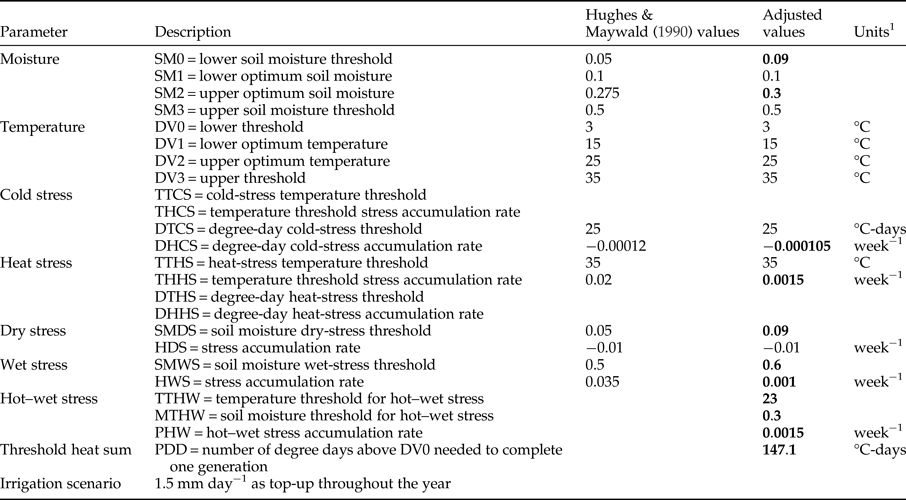
We started with the parameter values (Table 1) published by Hughes & Maywald (Reference Hughes and Maywald1990), then using the ‘Compare’ module, we adjusted the parameters to fit the projected distribution of D. noxia to all known records in Europe, the Middle East, the USA and China under a natural rainfall scenario. Similarly to Hughes and Maywald's model, the projected potential distribution of our model could not cover a number of known location records in dry areas of north-western China. Following our initial analysis, we proposed that these dry area records might reflect populations able to persist only when irrigation is used to sustain the crop, which in turn might help to maintain a suitable microclimate in arid zones (Kriticos et al., Reference Kriticos, Maywald, Yonow, Zurcher, Herrmann and Sutherst2015).
CLIMEX parameter values for Diuraphis noxia. Values for the adjusted model that differ from those of Hughes & Maywald (Reference Hughes and Maywald1990) are in bold.

1 Values without units are dimensionless indices. The role and meaning of these parameters are described in Kriticos et al. (Reference Kriticos, Maywald, Yonow, Zurcher, Herrmann and Sutherst2015).
Therefore, we decided to run the model with an irrigation scenario, so that we could assess what implications irrigation practices might have on the potential geographical distribution of D. noxia. We applied an irrigation scenario of 1.5 mm day−1 as a top-up (i.e. to increase the effective rainfall to the set amount) throughout the year, to capture the risk posed by D. noxia in areas where cropping could be sustained by irrigation practices (i.e. some drier regions of the world). To better define specific areas where irrigation was applied, we used an updated version of the Global Map of Irrigated Areas (GMIA) dataset (Portmann et al., Reference Portmann, Siebert and Döll2010), first produced by Siebert et al. (Reference Siebert, Döll, Hoogeveen, Faures, Frenken and Feick2005). This dataset allowed us to produce a composite climate suitability map, comprising of both irrigated and non-irrigated areas around the world, to show the overall projected suitability. When mapping model results, if the irrigated area was >0 for each map grid cell, then the irrigation scenario result was used. Otherwise, the natural rainfall scenario result was used.
We increased the limiting low soil moisture threshold for population growth (SM0) to just below the permanent wilting point of plants, nominally set to 0.1 (Kriticos et al., Reference Kriticos, Maywald, Yonow, Zurcher, Herrmann and Sutherst2015). The values of the lower optimum soil moisture (SM1), the upper optimum soil moisture threshold (SM2) and the limiting high soil moisture threshold (SM3) were left unchanged. The heat stress temperature threshold (TTHS) was left unchanged, but its accumulation rate (THHS) was iteratively adjusted to fit the hottest locations known to be suitable for D. noxia within its semi-arid distribution in Iran, the hottest location where D. noxia was reported to be present (Dolatti et al., Reference Dolatti, Ghareyazie, Moharramipour and Noori-Daloii2005). Wet stress parameters were adjusted so as not to be limiting within the known distribution records in a number of locations in Europe (i.e. Czech Republic, Hungary and Albania) and Turkey where D. noxia is known to be present. Soil moisture threshold for dry stress (SMDS) was set at the same value as SM0 in our model, marginally below the permanent wilting point of plants, since the current distribution of D. noxia suggests that it can tolerate quite dry conditions. The cold stress degree-day accumulation rate was slightly modified from that used by Hughes & Maywald (Reference Hughes and Maywald1990) because of the inclusion of records for D. noxia in northern China that their model failed to predict as suitable for the aphid. The geographical range of D. noxia is restricted to regions of fairly moderate to low rainfall, and populations decline after heavy rainfall, suggesting that high precipitation and/or humidity may directly or indirectly reduce survival or reproduction of D. noxia. Therefore, hot–wet stress was used to limit D. noxia to its known range within Mediterranean, temperate and semi-arid climates, and to preclude the suitability of sub-tropical and tropical regions. The thermal accumulation (PDD) required for D. noxia to complete one generation was set to 147.1 degree days (Tazerouni et al., Reference Tazerouni, Talebi and Ehsan2013).
Model validation
Once parameters were adjusted to best fit all currently known records of D. noxia within Europe, the Middle East, the USA and China, the model was then validated by comparing the projected potential distribution map with the known occurrences in geographical areas that were not used for parameter fitting (e.g. Russia, Australia, central-western Asia, Africa, South America).
Results
Effect of adjusted parameters to model fit
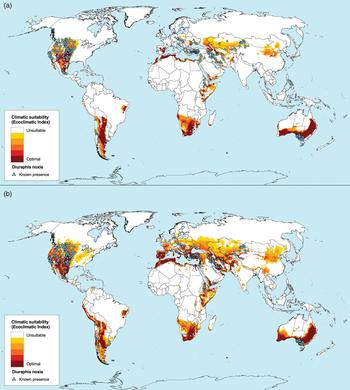
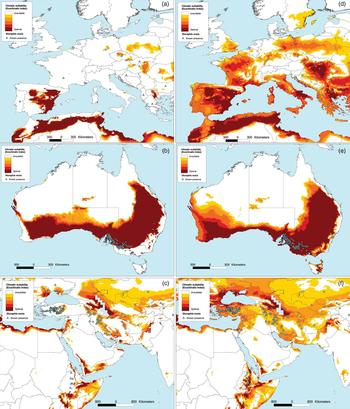
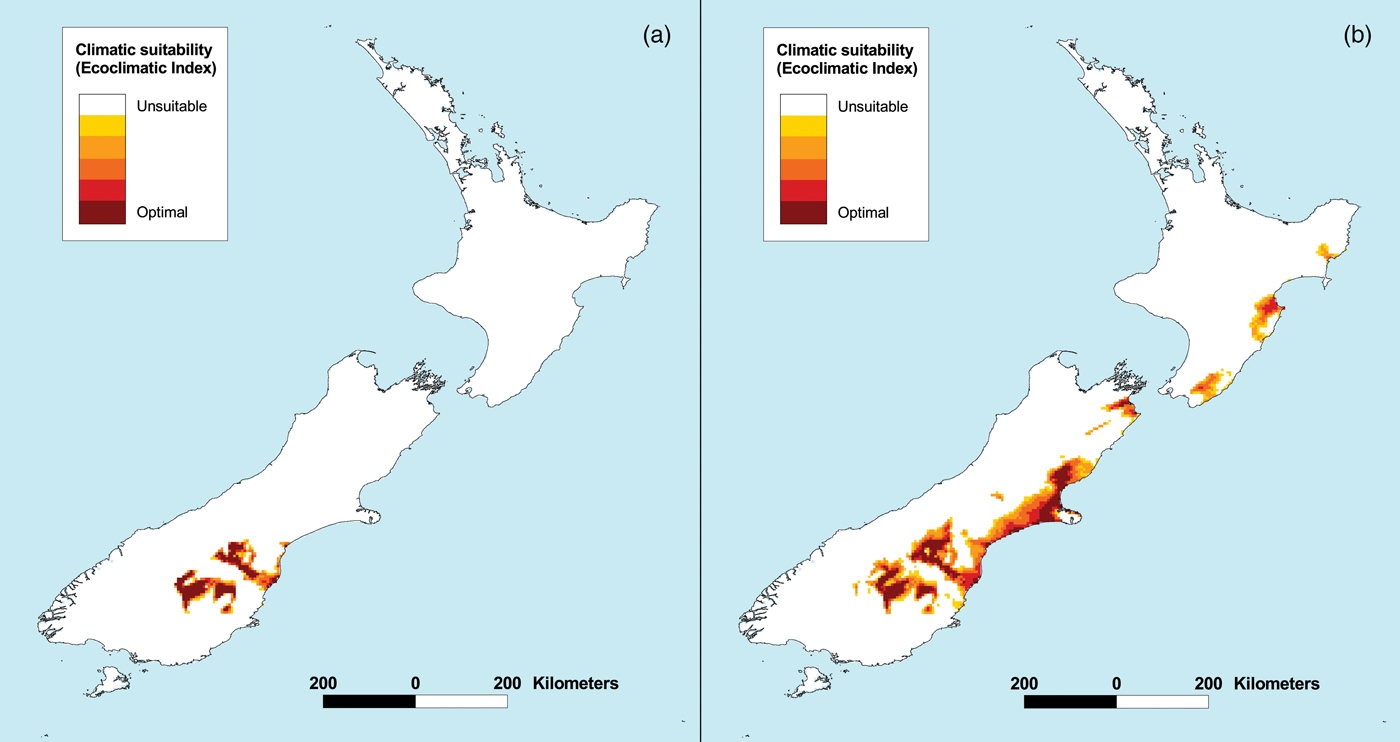
With our adjusted model, the area climatically suitable for D. noxia is greater than Hughes and Maywald's model (fig. 1a, b). Differences arise from the relaxation of wet stress and the addition of hot–wet stress parameters (Table 1). The predicted climatic suitability in Europe and Australia was more restricted using the Hughes and Maywald model parameters (fig. 2a, b), mainly as a result of their modelled wet-stress accumulating rapidly at a moderate soil moisture level, well within the bounds designated as suitable for population growth. The restricted potential distributions of D. noxia in the Middle East and north-eastern Africa, when using Hughes and Maywald model parameters (fig. 2c), are probably due to the excessive heat-stress accumulation rate used. The adjusted heat-stress and wet-stress parameters used in our model greatly improve the overall fit of the current distribution of D. noxia in all the aforementioned geographic areas (fig. 2d–f). Our model also predicted that D. noxia could establish in south-western regions of England (fig. 2d) where wheat and barley are grown (Department for Environment Food & Rural Affairs UK, 2000). However, there are no records yet of D. noxia from the UK, despite its proximity to France, where established aphid populations occur.
Modelled global climatic suitability for Diuraphis noxia to persist as a permanent population as predicted by (a) Hughes & Maywald (Reference Hughes and Maywald1990) original parameters under natural rainfall, and (b) as composite of natural rainfall and irrigation based on areas identified by Siebert et al. (Reference Siebert, Döll, Hoogeveen, Faures, Frenken and Feick2005) using the adjusted parameters given in Table 1. Blue triangles represent current records of D. noxia.

Modelled climatic suitability for Diuraphis noxia to persist as a permanent population under natural rainfall conditions in Europe, the Middle East, North-eastern Africa and Australia as predicted by Hughes & Maywald (Reference Hughes and Maywald1990) original parameters (a–c), and as predicted by the adjusted parameters given in Table 1 (d–f). Blue triangles represent current records of D. noxia.

Irrigation practices
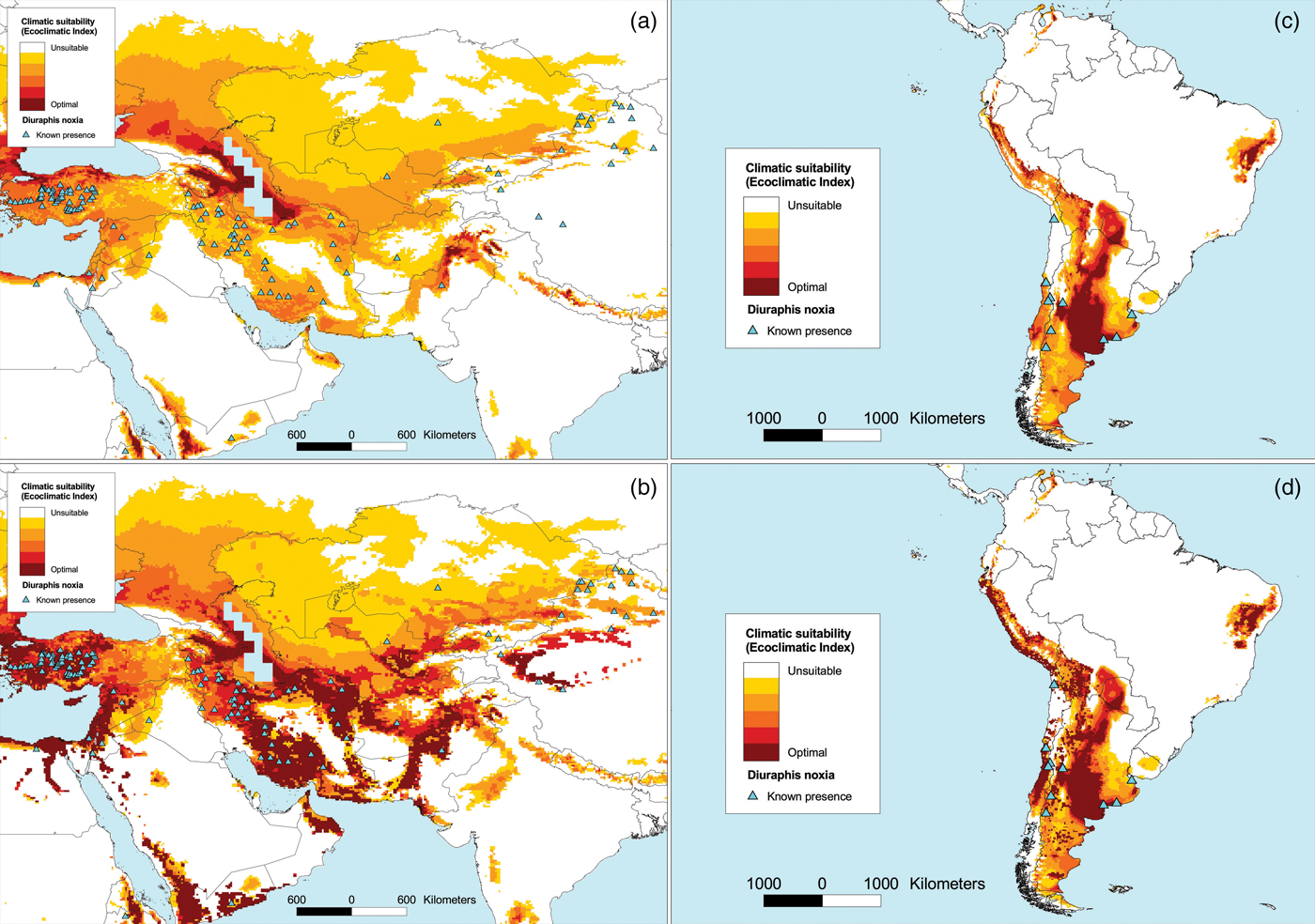
Even a moderate amount of irrigation will have an effect on the potential distribution of D. noxia. For example, in areas where the pest is known to occur in the Middle East (e.g. Turkey and Iran; Fig. 3b), North America (e.g. the USA; Fig. 1b) and South America (e.g. Chile; Fig. 3d), dry locations modelled with a natural rainfall plus irrigation scenario increased the suitability for D. noxia to establish in these areas. In northern Chile and in several locations in north-western China where the aphid is known to occur, under natural rainfall conditions, the relatively dry conditions in those areas preclude the establishment and survival of D. noxia (fig. 3a, c). However, once irrigation is added all those locations are then projected as suitable for the establishment of D. noxia (fig. 3b, d).
Modelled climatic suitability for Diuraphis noxia in the Middle East, China and South America using adjusted parameters under natural rainfall conditions in (a, c), and as a composite of natural rainfall and irrigation based on the irrigation areas identified by Siebert et al. (Reference Siebert, Döll, Hoogeveen, Faures, Frenken and Feick2005) (b, d). Blue triangles represent current records of D. noxia.

Projection for New Zealand
In New Zealand, around 97% of wheat and 90% of barley crops are grown in the South Island where the Canterbury region grows the greatest area of wheat and barley, followed by Southland, then Otago. With our adjusted model, the area climatically suitable for D. noxia is greater than the one predicted by using Hughes and Maywald's model (fig. 4a). The composite (i.e. natural rainfall plus irrigated conditions) suitability map generated with our adjusted CLIMEX model predicts the major wheat- and barley-growing region in Canterbury has a moderate to optimal climatic suitability for the establishment of D. noxia (fig. 4b).
Modelled climatic suitability for Diuraphis noxia to persist as a permanent population in New Zealand as predicted by (a) Hughes & Maywald (Reference Hughes and Maywald1990) original parameters under natural rainfall and (b) as a composite of natural rainfall and irrigation based on the irrigation areas identified by Siebert et al. (Reference Siebert, Döll, Hoogeveen, Faures, Frenken and Feick2005) using the adjusted parameters given in Table 1.

Discussion
Given the current distribution of D. noxia globally, and based on updated parameters for the development and survival of D. noxia reported here, the risk of this pest potentially establishing in New Zealand as well as a number of other key cereal producing areas in Australia and worldwide is greater than predicted by the previous Hughes and Maywald's model (figs 1, 2 and 4). Although there are limitations to such climate-based models, the previous Hughes and Maywald's CLIMEX model predicted that D. noxia would be able to establish in Australia and this has been borne out with the recent incursion and establishment of this species in Australia (Yazdani et al., Reference Yazdani, Baker, DeGraaf, Henry, Hill, Kimber, Malipatil, Perry, Valenzuela and Nash2017). The updated model reported here encompasses areas in a number of countries (e.g. Portugal, France, Italy, Albania, Greece, Turkey, Ethiopia, Australia, etc.) where D. noxia has been recorded outside of the original Hughes and Maywald model's boundaries, making this updated model more precise than the original model. Conversely, the updated model predicts suitable areas where D. noxia has not yet been reported (e.g. south-west England, Poland, parts of Australia, etc. – fig. 3b). This may due to the aphid having not yet been detected in these regions, or because it has not yet arrived, or because these areas are in fact not suitable due to variables not taken into account by the CLIMEX model. The current risk assessment of D. noxia in the UK has a relatively high likelihood of entry score (4 out of 5), but its risk of the establishment is considered relatively low (2 out of 5) (Anonymous, 2017). In New Zealand, the recent incursion of D. noxia in Australia lead to an alert being sent out to border staff by the Ministry of Primary Industries in 2016 (Anonymous, 2016), although no strategies appear to be in place to monitor risk areas that may be subject to passive wind dispersal with which the data presented here could easily assist.
A greater effort was made in Australia to assess and mitigate the risk posed by D. noxia (Edwards & Migui, Reference Edwards and Migui2005; Moir et al., Reference Moir, Szito, Botha and Grimm2008; Plant Health Australia, 2012) and this may have been due in part to the Hughes and Maywald's model predicting its establishment in Australia. The updated model in the present study suggests the distribution of D. noxia could become much more widespread in Australia than previously predicted. Thus, quarantine conditions imposed on farmers and operators to prevent human-assisted movement of the pest between regions in Australia may prove ineffective where the model suggests it will be able to disperse naturally. Presently, D. noxia is causing the greatest damage to areas in Australia where rainfall is below 400 mm, and volunteer cereal plants such as those emerging in summer in irrigated crops seem the main summer refuge (van Helden, personal observation). The updated model provides more accurate estimates of the risk of D. noxia in these drier regions of Australia. The present model could, therefore, be developed further to predict where and when populations of the pest could become economically damaging.
The information provided in the current updated model may alter the perception of the risk that D. noxia could establish in places such as England and New Zealand, and result in greater vigilance for this pest at the border or in areas predicted as suitable for it to establish. Whether the predicted distribution using the updated model becomes a reality for those countries and regions where D. noxia has not yet been reported, will require further surveillance information regarding the response of D. noxia to abiotic and biotic factors (e.g. overwintering temperature, rainfall, natural enemy abundance and diversity).
With regard to overwintering temperature, increased crop losses have been linked with localised populations of D. noxia surviving over the winter period (Merrill et al., Reference Merrill, Holtzer and Peairs2009a). Aalbersberg et al. (Reference Aalbersberg, Toit, Westhuizen and Hewitt1987) observed populations of viviparous D. noxia increasing throughout the winter in South Africa, even with average daily temperatures of 1.5–2.8°C. Such average winter temperatures are similar or higher in many parts of Canterbury, where a large proportion of wheat and barley is grown in New Zealand, and where the updated CLIMEX model predicted the aphid could establish.
Precipitation is likely a key factor influencing D. noxia population growth. Models to predict D. noxia intensity on winter wheat crops have indicated the aphid's density is negatively related to autumn and spring precipitation, although the duration and amount of such precipitation were not elucidated (Merrill & Peairs, Reference Merrill and Peairs2012). In a laboratory study simulating flooding events, 50% of apterous D. noxia survived by floating on the water surface for up to 5.5 h, while 50% of submerged aphids survived for nearly 2 h (Araya & Fereres, Reference Araya and Fereres1991). Evidence of the actual impact of precipitation on D. noxia field populations from published literature is sparse. Kriel et al. (Reference Kriel, Hewitt and Westhuizen1986) observed a rapid increase in D. noxia numbers following a sharp decline after isolated rainfall events of at least 30 mm. Field observations in South Australia reported a decline in D. noxia numbers after heavy rain events (duration and amount not specified) (South Australia Research & Development Institute, 2016). Hughes & Maywald (Reference Hughes and Maywald1990) reported that areas in South Africa and the USA with high rainfall (duration and amount not specified) were unfavourable for D. noxia infestation, and that wheat or barley growing in dry areas with 300–400 mm summer rainfall or wetter areas experiencing seasonal droughts were heavily infested by the aphid. Given the average summer rainfall in New Zealand's main wheat- and barley-growing areas is between 40 and 55 mm per month (NIWA, 2017), this is unlikely to be a limiting factor for the establishment of Russian wheat aphid in New Zealand.
The updated CLIMEX model incorporated an irrigation simulation component, a useful tool to help to refine distribution models, particularly for species where irrigation increases survival in dry areas. With regard to the impact of irrigation rates on populations of D. noxia, more aphids were recorded on plants maintained in a rain shelter at 15% soil water-holding capacity than on plants at 50 or 100% (Archer et al., Reference Archer, Bynum, Onken and Wendt1995). Archer and colleagues suggested D. noxia was much more tolerant to severe drought stress than other aphid species found on cereals (e.g. Rhopalosiphum maidis, Schizaphis graminum, Sitobion avenae). In our irrigation scenario in the updated model, a moderate amount of irrigation was enough to allow persistence of D. noxia in all dry areas located in north-western China and also in northern Chile, where the aphid is known to be present, that were previously predicted by the Hughes & Maywald (Reference Hughes and Maywald1990) model as unsuitable for the aphid's establishment.
With regard to host plants, there is no shortage of areas in New Zealand which the updated CLIMEX model has predicted as potentially suitable for D. noxia establishment. In addition to barley and wheat, other cultivated cereals considered primary host plants of D. noxia include rye (Secale cereale), oats (Avena sativa) and triticale (Triticosecale spp.). Volunteer plants of cereals, such as wheat and barley, are considered important hosts for D. noxia especially when cereal crops are senescing (Hewitt et al., Reference Hewitt, Niekerk, Walters, Kriel and Fouché1984; Armstrong et al., Reference Armstrong, Porter and Peairs1991; Brewer et al., Reference Brewer, Donahue and Burd2000). Other host plant species found throughout the cereal-growing regions in New Zealand that have been shown to maintain reproducing females or were found with D. noxia on them include: Bromus willdenowii, Cynondon dactylon, Dactylus glomerata, Echinochloa cruss-galli, Festuca rubra, Lolium multiflorum, L. perenne, Panicum capillare, Poa pratensis, Vulpia myuros (Kindler & Springer, Reference Kindler and Springer1989; Armstrong et al., Reference Armstrong, Porter and Peairs1991; Edgar & Connor, Reference Edgar and Connor2000; Champion, Reference Champion2012). Thus, availability of host plants is unlikely to be a limiting factor for the establishment of D. noxia in New Zealand.
Natural enemies may also play an important role in the success of an insect species establishing populations in a new region (Hopper et al., Reference Hopper, Coutinot, Chen, Kazmer, Mercadier, Halbert, Miller, Pike, Tanigoshi, Quisenberry and Peairs1998). The natural enemies associated with D. noxia (Halbert & Stoetzel, Reference Halbert, Stoetzel, Quisenberry and Peairs1998) which are already present in New Zealand include the hymenopteran parasitoids: Diaeretiella rapae, Aphelinus asychis, Aphidius colemani, A. rhopalosiphi and Ephedrus plagiator. Of the natural enemies known to be associated with D. noxia, D. rapae was the most commonly found parasitoid attacking Russian wheat aphid in the USA (Pike et al., Reference Pike, Star, Miller, Allison, Boydston, Graf and Gillespie1997; Bosque-Pérez et al., Reference Bosque-Pérez, Johnson, Schotzko and Unger2002) and Australia (Heddle & van Helden, Reference Heddle and van Helden2016). Amongst the coccinellids associated with D. noxia, Adalia bipunctata and Coccinella undecimpunctata are extant in New Zealand. In addition, native insect predators present in New Zealand may adapt to predating on D. noxia. These include the brown lacewing (Micromus tasmaniae), syrphids (Melangyna novaezelandiae and Melanostoma fasciatum) and nabids (Nabis capsiformis, N. kingbergi and N. maoricus) (Stufkens & Farrell, Reference Stufkens, Farrell, Cameron, Hill, Bain and Thomas1989; Thomas, Reference Thomas, Cameron, Hill, Bain and Thomas1989; Fagan et al., Reference Fagan, McLachlan, Till and Walker2010).
A good understanding of the variables that define the geographical distributions of invasive species is essential for accurately predicting their future dispersal, establishment and range (Taylor & Kumar, Reference Taylor and Kumar2012). Furthermore, abiotic factors and dispersal mechanisms play an important role in predicting the rate of colonisation of invasive alien species into new areas (Taylor & Kumar, Reference Taylor and Kumar2012). In these respects, CLIMEX may have some restrictions because it uses only climate-related features and meteorological data (Kriticos et al., Reference Kriticos, Maywald, Yonow, Zurcher, Herrmann and Sutherst2015) and it does not incorporate non-climatic factors (Baker et al., Reference Baker, Sansford, Jarvis, Cannon, MacLeod and Walters2000). However, most of these factors are implicit in the distribution of the species being modelled. Inferential modelling can sometimes reveal evidence of these range-modifying factors. For example, CLIMEX modelling of the native range distribution data for Essigella californica conducted by Wharton & Kriticos (Reference Wharton and Kriticos2004) revealed evidence of the existence of biotic stress factors distinguishing the aphid's fundamental and realised niches. Furthermore, the significant importance of irrigation as a pest risk-modifying factor has recently been revealed for weeds (Kriticos et al., Reference Kriticos, Maywald, Yonow, Zurcher, Herrmann and Sutherst2015), insects (Yonow et al., Reference Yonow, Kriticos, Ota, Van Den Berg and Hutchison2017) and plant diseases (Pardey et al., Reference Pardey, Beddow, Kriticos, Hurley, Pardey, Beddow, Hurley, Pardey, Beddow, Kriticos, Hurley, Burdon, Pardey, Park, Duveiller, Hodson and Sutherst2013). Nevertheless, the present CLIMEX study has provided us with important updated information about the potential geographical distribution of D. noxia worldwide and in New Zealand.
The new potential geographic distribution model for D. noxia using our updated CLIMEX parameters can be used to identify areas susceptible to invasion by D. noxia, to assist with biosecurity planning (e.g. focusing surveillance effort, identifying potential pathways and undertaking industry risk assessment). Despite the foreknowledge provided by a model predicting its establishment in Australia, D. noxia was not detected in time to eradicate (Yazdani et al., Reference Yazdani, Baker, DeGraaf, Henry, Hill, Kimber, Malipatil, Perry, Valenzuela and Nash2017). Thus, detection technology and strategies for species such as D. noxia will need to improve to increase the chances of preventing establishment in new regions. Should D. noxia become established, the updated CLIMEX model could also aid in its management by providing knowledge of where the aphid could have the greatest economic impact. The updated CLIMEX model suggests D. noxia would be able to establish in all major wheat- and barley-growing regions in New Zealand. However, local abiotic and biotic factors such as high precipitation and natural enemies could limit the ability of D. noxia to establish permanent populations in some areas of New Zealand; further study is warranted to elucidate their impacts. Likewise, further examination of these factors could help to determine whether D. noxia may establish in the other regions predicted by the updated model where this species has not yet been found allowing producers, industry and governments time to take preventative actions.
Acknowledgements
We wish to thank the Department of Agriculture and Fisheries Queensland; South Australian Research and Development Institute; Department of Economic Development, Jobs, Transport and Resources, Victoria; Department of Primary Industries, Parks, Water and Environment Tasmania; Department of Primary Industries and Regional Development, Western Australia; and MyPestGuide™ and PestFax e-surveillance teams for Diuraphis noxia data from Australia. We also extend our thanks to Plant Health Australia for obtaining permission to use these distribution data. This work was funded in part by the Better Border Biosecurity (B3) (http://www.b3nz.org) research collaboration and The New Zealand Institute for Plant & Food Research Limited Strategic Science Investment Fund.