


For a period of time, advocates of consociationalism could point to Northern Ireland as one of the most successful examples of post-conflict power-sharing. Despite early problems, by the 10th anniversary of the 1998 Good Friday Agreement (GFA),Footnote 1 former bitter enemies were jointly administering a power-sharing government with remarkable cordiality, and Northern Ireland shone as ‘the brightest star’ in the consociational universe (Taylor Reference Taylor and Taylor2009: 7). Subsequent anniversaries have been less celebratory. When the GFA marked its 20th anniversary in 2018, its power-sharing institutions lay in paralysis, having collapsed the previous year. This situation repeated in 2023 when, to mark the 25th anniversary of the GFA, international luminaries gathered for ‘celebrations’ in Belfast against the backdrop of a collapsed government that had not functioned for over a year. The metaphors used to describe Northern Ireland have therefore changed: once regarded ‘the brightest star’ in the consociational universe, the region’s government has been likened more recently to Schrödinger’s Cat, neither dead nor alive (Kane Reference Kane2025). The restoration of power-sharing in early 2024 has not abated criticism. A High Court judge has publicly rebuked the power-sharing coalition for constant infighting (BBC 2025), whilst a public inquiry has concluded the system of power-sharing weakened Northern Ireland’s response to the COVID-19 pandemic.Footnote 2
These difficulties have sparked debate about whether and to what extent Northern Ireland’s consociation should be reformed. Debates about institutional (re)design in Northern Ireland have been aired before. In a previous volume of this journal, a team of scholars considered a range of potential reforms to the power-sharing system but were ultimately persuaded by none of them (McCrudden et al. Reference McCrudden, McGarry, O’Leary and Schwartz2016). In an article titled ‘Why Northern Ireland’s Institutions Need Stability’, those scholars argued that institutional reform was unnecessary and potentially unwise, and instead advocated ‘cautious system maintenance’ (McCrudden et al. Reference McCrudden, McGarry, O’Leary and Schwartz2016: 54). This conservative approach to institutional reform prevailed when, after conducting an official review into the subject, a Northern Ireland parliamentary committee recommended no substantial changes to the power-sharing infrastructure (Northern Ireland Assembly 2013). In that regard, Northern Ireland appeared to exemplify a common problem with consociational systems, which is that once they have been established, they become ‘sticky’ and difficult to modify (Horowitz Reference Horowitz2014: 11–12).
Scholars of power-sharing should, however, pay closer attention to more recent institutional developments in Northern Ireland. In the past decade, the ethos of ‘cautious system maintenance’ has been sporadically punctured by modest reforms, some of which have had positive effects on the region’s governance. The consociation has therefore shown some capacity to evolve, albeit in an ad hoc and piecemeal way. Given evidence that citizens in Northern Ireland remain broadly supportive of the GFA but recognise it may require modifications (Garry et al. Reference Garry, O’Leary, Pow, Agarin and Taylor2025), this article makes the case for further reform to the power-sharing institutions to improve their functionality and stability. To support our case, we first canvass elite political opinion in relation to a series of potential reforms and demonstrate that some minds have changed on the issue of reform since this debate was last seriously aired over a decade ago. We then turn to public opinion, using original survey data (N = 2,034) to highlight and explore levels of support for reform across Northern Ireland’s ethnonational spectrum. We show, inter alia, that citizens across all three blocs – unionist, nationalist and Other – are supportive of changes to the power-sharing institutions. Crucially, we find that the current executive veto, which allows a party to unilaterally collapse the government, commands low levels of public support. We then test support for alternative arrangements in the event of party withdrawal, demonstrating that these options are more popular. In doing so, the paper identifies potential institutional reforms that could enhance the long-term stability – and thus viability – of the consociation. In the closing section, we argue that the optimal path towards institutional change involves a convergence of civic, elite and external actor participation.
Before doing so, the next section highlights the wider relevance of the Northern Ireland case-study to scholars interested in the evolution and reform of consociational systems (McCulloch and McEvoy Reference McCulloch and McEvoy2020; Mikhael and McCulloch Reference Mikhael, McCulloch, Aboultaif, Keil and McCulloch2024; Palani Reference Palani2025).
Reforming consociations: Northern Ireland as an example of ‘living consociationalism’?
Political systems regularly amend their core democratic features, such as parliamentary procedure, electoral law or the composition of the legislature. However, some political systems are less prone to amendment than others (Bedock Reference Bedock2017). Consociational power-sharing systems, used for the governance of divided societies, fall into the harder-to-amend category. Whilst advocates of consociationalism claim that power-sharing systems may evolve, even biodegrade, over time (McGarry and O’Leary Reference McGarry, O’Leary and Taylor2009: 68), a common theme in the literature is that they suffer from ‘institutional rigidity’ (Jung Reference Jung2012: 490) and ‘immobilism’ (Horowitz Reference Horowitz2014: 11). ‘Rather than transformation and change’, as John Nagle has put it (Reference Nagle2020: 138), ‘consociations tend to develop ossified properties rendering them resistant to practically any reform’. This problem can be acute in post-conflict contexts, where those in political control can leverage the risk of a return to violence as a powerful reason not to tamper with power-sharing institutions (Bassuener Reference Bassuener, Ramet, Hassenstab and Listhaug2017). It can appear, therefore, that the choice is either to keep the system as it is or to abandon it and face unknown consequences (Jung Reference Jung2012).
Yet, as Allison McCulloch (Reference McCulloch, Crawford and Abdulai2021) notes, whilst some power-sharing systems have indeed ended in abrupt failure (as was the case in Cyprus, for example), others have evolved and survived. Northern Ireland’s consociation is one such case. Agreed in 1998 as part of a peace process, Northern Ireland’s political institutions continue to exhibit the core features of a consociational democracy (Lijphart Reference Lijphart1977): there is executive power-sharing between Irish nationalists and British unionists, proportionality is secured in the executive and legislature, veto mechanisms (ostensibly) protect minority rights, and there is a degree of segmental (cultural) autonomy. However, the consociation has been modified through several exercises of institutional reform, some of which have improved how key power-sharing mechanisms operate. Reform of the Petition of Concern (PoC), a minority veto, is a key case in point. Designed to protect each community’s ‘vital’ interests (McCulloch Reference McCulloch2018), repeated deployment of PoCs became one of the single biggest contributors to public frustration with the consociation. The most flagrant abuse involved the use of PoCs to shield politicians from misconduct proceedings (e.g. BBC 2014). Such abuse, however, has been curtailed following reforms in 2020, which tightened veto rules.
There have been other reforms to Northern Ireland’s consociation to address perceived shortcomings. Whilst the current power-sharing government is held to account by an official parliamentary opposition, this is a relatively recent innovation enabled by 2016 reforms granting speaking rights, financial resources and official status to sufficiently large non-governing parties.Footnote 3 Prior to this, Northern Ireland operated without any officially constituted parliamentary opposition to scrutinise the government,Footnote 4 giving rise to accountability concerns (Wilford and Wilson Reference Wilford and Wilson2006). The facilitation and financing of an official opposition is particularly notable because it occurred despite scholarly advice to the contrary which warned that, in the context of a deeply divided society, it would be a mistake to incentivise adversarial politics (McCrudden et al. Reference McCrudden, McGarry, O’Leary and Schwartz2016: 45). In the event, the opposition reform has enhanced the rigour and transparency of parliamentary scrutiny in the Assembly (Irish News 2025; McBride Reference McBride2019) without exacerbating ethnonational divisions (Haughey Reference Haughey2023: 158).
Despite the adoption of these and other reforms,Footnote 5 Northern Ireland would not yet qualify as an example of ‘living consociationalism’. Conceptualised by Feargal Cochrane, Neophytos Loizides and Thibaud Bodson (Reference Cochrane, Loizides and Bodson2018: 65–69), living consociationalism provides a corrective to the notion of consociations as inflexible and immobile. Focussing on the Brussels Capital Region (BCR) case, Cochrane et al. depict a successful, flexible and evolutionary model of consociationalism in which institutions adapt in response to the changing circumstances of the divided society. Key to the success of living consociationalism is not merely that reforms occur, but that established processes exist for reforms to be considered, debated and implemented. In the Brussels case, the more significant the reform, the more demanding the process: ‘minor institutional reforms’ are adopted through ‘less demanding procedures’; ‘medium institutional reforms’ are adopted through procedures with a ‘medium level of stringency’; and ‘major institutional reforms’ are adopted through ‘highly demanding procedures’ (Reference Cochrane, Loizides and Bodson2018: 67).Footnote 6 These established processes, which blend flexibility with stringency, have enabled the BCR consociation to repeatedly reform itself without provoking inter-communal tensions between the linguistic groups which share power.Footnote 7
It is in the area of process where Northern Ireland falls short of living consociationalism criteria. Whilst the consociation has undergone several bouts of reform, the approach has been problematically ad hoc, with a tendency for reforms to be negotiated behind closed doors during time-sensitive periods of crisis (such as institutional collapse). The unravelling of language reforms, ostensibly agreed in 2006, illustrate the problem with this approach. When the power-sharing institutions were restored in 2007 after a period of abeyance,Footnote 8 it soon transpired that two of the main negotiators of the restoration deal – the Democratic Unionist Party (DUP) and Sinn Féin – held markedly different views as to what the deal entailed for the Irish language. Whereas Sinn Féin informed its supporters that legislation to finally recognise Irish as an official state language had been agreed, the DUP vehemently denied this and, subsequently, deployed a range of tactics to frustrate Irish language initiatives (see Nic Roibeaird and Haughey Reference Nic Roibeaird and Haughey2026). Due to the secretive nature of the negotiations, the exact truth remains contested (BBC 2017; cf. Bell Reference Bell2017).Footnote 9 In any event, Irish language reform (or lack thereof) proceeded to become one of the most contested issues within the power-sharing regime, eventually contributing to the resignation of Sinn Féin’s deputy First Minister (dFM) in 2017. The ensuing collapse of the institutions lasted until 2020 because, on account of the power-sharing rules, it was impossible to form a government whilst Sinn Féin maintained a boycott.
With Northern Ireland’s institutions paralysed from 2017 to 2020, a fresh crisis precipitated further reform via the New Decade, New Approach (NDNA) agreement.Footnote 10 Whilst reform of the minority veto proved effective, the potentially more significant reform aimed at insulating power-sharing from collapse has not delivered the hoped-for stability. The power-sharing administration formed in 2020 lasted barely two years before the DUP First Minister (FM)’s resignation triggered another institutional crisis (see Edgar and Flanagan Reference Edgar and Flanagan2022). Whereas previously the resignation of an FM or dFM would have collapsed the government almost immediately,Footnote 11 the ‘safety net’ reform of NDNA enabled ministers with portfolio to remain in office as ‘caretakers’ for up to 24 weeks during which – it was hoped – a resolution to the boycott could be negotiated and thereby avert full-blown system collapse. In the event, the DUP maintained its boycott, the statutory safety net period expired and a full-blown collapse of the government ensued. The safety net reform not only failed to avert crisis but also had unforeseen accountability consequences, which,Footnote 12 once again, highlighted the problem of negotiating institutional reforms in an ad hoc way.
The debate in Northern Ireland is therefore not only about whether and to what extent the consociation should be reformed but also about the process through which this occurs. On process, the difficulty is that the GFA does not provide adequate guidance. Whilst the Agreement anticipated reform (referring to institutional ‘review’ and ‘remedial action’), the text is sparse and ambiguous on how this should be achieved. Consequently, approaches to reform have varied. Some reforms, such as those flowing from NDNA, have emerged from multiparty negotiations coordinated by the British and Irish governments, whilst others, such as those emanating from the St Andrews Agreement of 2006, were negotiated in a less inclusive fashion. More recently, some have argued that reform could be imposed from above by the British and Irish governments,Footnote 13 whereas others have advocated a bottom-up approach which centres civic and public input (Haughey and Pow Reference Haughey and Pow2022).
Others might point to the Assembly and Executive Review Committee (AERC) as a vehicle for reform. As a permanent ‘review’ committee, its existence could give the impression that Northern Ireland already approximates ‘living consociationalism’ à la the BCR, with an embedded mechanism for reform. A cursory glance at the committee’s paper trail, however, cautions against this reading (see also Wilford Reference Wilford2015). With rare exceptions, the AERC has tended to catalogue the strengths and weaknesses of competing reform proposals while stopping short of prescribing any change: variants of the phrase ‘the committee could not secure consensus’ recur throughout its reports, even on proposals – such as the creation of an official opposition – where consensus appears not to have been so elusive.Footnote 14 In short, whereas the BCR has institutionalised a reform system, Northern Ireland has, at most, a review forum. In the BCR’s case, a rules-based ex ante approach has normalised reform as a healthy (or ‘dynamic’) feature of a power-sharing polity, creating an expectation of reform (Cochrane et al. Reference Cochrane, Loizides and Bodson2018; Popelier Reference Popelier2020). In the case of the AERC, no such expectation exists, and reforms have proceeded via alternative, and usually more secretive, avenues such as elite negotiations during moments of crisis.
Reform proposals and the attitudes of the ‘elite cartel’
Consociational theory would place significant weight on the role of local political leaders, the ‘elite cartel’, vis-à-vis the potential redesign of a power-sharing system. After all, attempts to change the rules of power-sharing without involving the power-sharers could undermine norms of consensus and cooperation upon which the system rests. When examining the potential for reform in Northern Ireland, therefore, the first question begged is whether – and to what extent – local political elites are prepared to countenance changing the rules of the consociational game. This question is worth asking, since more focus is needed on the circumstances under which power-sharers might agree to transition to different institutional arrangements (McCulloch and McEvoy Reference McCulloch and McEvoy2020: 114).
In Northern Ireland’s case, most political parties have evolved in their attitudes towards institutional reform. Whilst, overall, this evolution has tilted in the direction of reform, there has also been movement in the opposite direction, whereby support for reform has dissipated in the face of changing electoral and ethnonational fortunes. Broadly speaking, discussions about reform have centred on three aspects of the region’s consociation: The Executive Office (TEO); cross-community voting; and so-called ‘mandatory coalition’.
The Executive Office (TEO)
Northern Ireland’s government is headed by two premiers, an FM and a dFM who, despite the difference in title, exercise equal power. This ‘dual premiership’ (O’Leary Reference O’Leary2019) gives concrete expression to the concept of power-sharing. The FM is nominated by a political party in one communal bloc – the GFA recognises three blocs (nationalist, unionist and other) – and the dFM is nominated by a party in another bloc, the specifics of which are determined by parliamentary arithmetic.Footnote 15 The appointment of premiers by party nomination is itself an institutional reform: the GFA prescribed that the FM and dFM be elected on a ‘cross-community vote’ in the Assembly (see below), but the St Andrews Agreement of 2006 ended this practice. Together, the premiers occupy the TEO, the lead department of the coalition. Crucially, the premiers are vested with the power of mutual destruction: if one resigns their position, their co-premier also loses their position. It is in TEO where the consociation’s most powerful veto resides: if a party resigns their premier and refuses to appoint a replacement, the government collapses, and a new one cannot form unless and until the resigning party rejoins TEO. The rules therefore concentrate an inordinate amount of power in two political parties, either of which can collapse the government for as long as it wishes. Sinn Féin collapsed the government in this way from 2017 to 2020, and the DUP did likewise from 2022 to 2024. In addition to creating serious problems for public service delivery, these prolonged collapses have called into question a core assumption of the consociational model: that elites remain committed to maintaining the power-sharing system (Lustick Reference Lustick1979).
Reform proposals vary as to how to avert indefinite government collapse following a TEO resignation. The Ulster Unionist Party (UUP 2022) and the Social Democratic and Labour Party (SDLP 2023) advocate open nominations for the FM and dFM positions. Rather than particular parties holding exclusive rights to nominate a premier based on electoral strength, the UUP–SDLP alternative would permit any party to nominate a premier, after which the nominee could be ratified by a special procedure known as a cross-community vote.Footnote 16 Whilst this idea has certain resonance, not least because it would restore the consociation to the original 1998 rules,Footnote 17 it would not necessarily avert gridlock: it is quite possible that a party could resign its premier and possess sufficient votes in the legislature to prevent ratification of a successor. Some would also object to further usage of the cross-community vote procedure, which unfairly disadvantages non-ethnonational parties (see below). A more promising proposal is supported by the Alliance Party, Northern Ireland’s largest party representing those who do not identify with either of the ethnonational blocs. This proposal would make the right to nominate to TEO a transferable right. That is to say, if a party of sufficient electoral strength is eligible to nominate to TEO but refuses to do so, the right to nominate would simply transfer to the next qualifying party (see Haughey Reference Haughey2019: 708). In such circumstances, parties would be deterred from resigning in the first place, given the undesirability of ceding a powerful position to a party rival. The stability of the consociation, therefore, would likely improve.
The most powerful ethnonational parties within the institutional status quo – Sinn Féin and the DUP – have historically been the least enthusiastic about TEO reform. For Sinn Féin’s part, until recently the party has been wary of reforms which might constitute significant deviation from the GFA, often arguing instead that governance problems have been caused by the reluctance of unionism to embrace the spirit of the GFA (Kelly et al. Reference Kelly, Renwick and Whysall2025). However, the party has been open to persuasion. Sinn Féin initially voiced concern about the creation of an official opposition, for example, but eventually supported the reform (McCallister Reference McCallister2016). On the much more significant question of reforming the TEO veto – which the party has previously wielded to its considerable advantage – Sinn Féin’s long silence on the matter (interpreted, perhaps correctly, as resistance) has recently given way to support for change (Sinn Féin Reference Sinn2026). The DUP’s reform journey has evolved in the opposite direction. Having once advocated ambitious reforms to power-sharing (DUP 2016), the party now appears overtly opposed to institutional change (Kula Reference Kula2026).
A changing electoral and ethnonational landscape is the likely explanation for the DUP’s new-found attachment to the consociational status quo. In the 2017 Assembly election, for the first time in Northern Ireland’s history, the proportion of unionist representatives fell below 50% of the legislature. Further blows followed. In the 2022 Assembly election, Sinn Féin surpassed the DUP to become the largest party, a development which led to the appointment of an Irish nationalist FM. This, too, was historic: until this point in the consociation’s history, every FM had been unionist, and every dFM had been nationalist. Whilst these roles are technically co-equal, the symbolic value of ‘First’ compared to ‘deputy’ is obvious, and so this changing of the guard has been perceived in some quarters as a nationalist triumph and, by extension, a unionist defeat. Of course, in the context of power-sharing, conceptions of winners and losers are unhelpful, and in that regard, the differentiated titles of First Minister and deputy First Minister represent a design flaw in the GFA: the positions are co-equal but, problematically, their styling suggests otherwise.
A sensible proposal to address this design flaw is to retitle the positions of FM and dFM to ‘Joint First Ministers’. This reform was initially proposed by Sinn Féin in 2015, when its minister occupied the position of dFM (Irish News 2015), and it has subsequently been supported by the SDLP and Alliance Party. The UUP, too, has been using the terminology of ‘Joint First Ministers’, albeit sometimes mischievously, since at least 2009 (Gordon Reference Gordon2009). Since 2022, however, with Sinn Féin (symbolically) elevated to the position of FM, the party has been less vocal about the ‘Joint First Ministers’ reform – so much so that it has been challenged by the Assembly’s official opposition to re-state, unequivocally, that it still supports what it proposed in 2015.Footnote 18 Conversely, since the party’s (symbolic) demotion to dFM, the DUP has gravitated towards the terminology of First Ministers (i.e. plural), emphasising the jointness of the positions more so now than in the recent past (McBride Reference McBride2024). The symbolic importance of First Minister has facilitated a zero-sum, ethnically charged race to the top during Assembly election campaigns (e.g. News Letter 2016). No party in the Assembly disputes this, nor have any offered justification for maintaining the differentiated titles of FM and dFM. Moreover, as far as the public is concerned, ‘Joint First Ministers’ is the preferred styling (Garry et al. Reference Garry, O’Leary, Pow, Agarin and Taylor2025).
Communal designation and cross-community (bloc) voting
‘Cross-community consent’ is a procedural requirement for ‘key’ decisions within Northern Ireland’s legislature. To decide important matters such as the election of Speaker or the passing of the budget, a simple majority vote of 50% + 1 will not suffice. Rather, it must be demonstrated that a sufficient number of nationalist Members of the Legislative Assembly (MLAs) and a sufficient number of unionist MLAs consent. Cross-community consent can be demonstrated via ‘parallel consent’ (the support of a majority of MLAs, including a majority of unionist MLAs and a majority of nationalist MLAs) or via a weighted majority (the support of 60% of MLAs, including 40% of nationalist and unionist MLAs, respectively). If 30 or more MLAs sign a ‘Petition of Concern’ in relation to a specific issue,Footnote 19 cross-community consent rules apply. To operationalise cross-community voting, MLAs must officially designate as ‘nationalist’, ‘unionist’ or ‘other’ upon their election to the Assembly. Critics attack these arrangements on two grounds. Firstly, it is argued that the official designation requirement – nationalist, unionist and other – entrenches ethnonational division (Farry Reference Farry and Taylor2009). Secondly, the parallel consent and weighted majority methods are characterised as undemocratic because they do not treat all votes equally (O’Flynn Reference O’Flynn2003). This is true: MLAs designated as ‘other’ have weaker voting power, compared to designated nationalists and unionists, when key issues are decided (Schwartz Reference Schwartz2010).
The electoral rise of the Alliance Party, whose MLAs are designated as ‘other’, has brought these criticisms into sharper focus. After more than doubling its seats in 2022 to become the Assembly’s third-largest party, Alliance has used its profile to mainstream institutional reform (Tonge et al. Reference Tonge, Braniff, Hennessy, McAuley, Rice and Whiting2024). Chief amongst the party’s arguments is that communal designation is divisive and should be abolished, and that a fairer and more democratic method for measuring cross-community consent should be implemented. On the latter, the party proposes that key decisions be taken by a difference-blind weighted majority (DBWM) of around two-thirds of MLAs, removing the need for ethnonational designation (Alliance Party 2024). There is a surprising degree of cross-party support for the DBWM alternative, albeit this has been expressed by different parties at different points in time. Characterising designation as ‘fundamentally undemocratic’, the DUP has previously proposed a DBWM of 65% (DUP 2013: 159). Similarly, whilst the party has not specified a threshold, the UUP has voiced support for DBWM to ‘normalise’ politics (UUP 2013: 182). Whilst nationalist parties have historically been more reluctant to depart from cross-current community voting arrangements, attitudes are changing. Following the SDLP (2023), which now supports DBWM for some key decisions, recent signals from Sinn Féin suggest openness to change. One party spokesperson has characterised cross-community voting as unfair to ‘others’,Footnote 20 and, most significantly, the party’s latest publication on institutional reform indicates a willingness to explore alternative arrangements (Sinn Féin Reference Sinn2026).
A lesser-known fact about the institutional status quo is that a DBWM procedure is already facilitated within the consociation’s original legal framework. The Northern Ireland Act (1998), which gives legal effect to the GFA, permits certain matters – such as early dissolution of the Assembly and the removal of the Auditor General – to be decided by a simple weighted majority of two-thirds of MLAs.Footnote 21 Moreover, MLAs have endorsed DBWM as an acceptable safeguard for matters pertaining to the Assembly Commissioner for Standards.Footnote 22 Whilst extending that simplified weighted majority procedure to include ‘key’ issues would be a significant step, the logic of the argument has become more compelling since the last institutional collapse. In May 2022, following the Assembly election, a popular candidate was unsuccessful in his bid to become Speaker despite securing support from all three blocs – nationalist, unionist and other – and finishing with an impressive overall vote tally of 71%. Whilst the outcome was technically legitimate under existing cross-community rules,Footnote 23 it was met with widespread exasperation given the candidate’s evident cross-community credentials. With the failure to elect a Speaker, the Assembly was unable to sit for the next 21 months, and so the episode is cited by supporters of reform to highlight the (perceived) inadequacy and unfairness of the system (Alliance Party 2022).
Mandatory coalition
Although the phrase was not used in the GFA negotiations, the coalition formation mechanism in Northern Ireland is known colloquially as ‘mandatory coalition’.Footnote 24 The d’Hondt mechanism uses a mathematical formula to allocate executive departments – Education, Health, the Economy, etc. – to political parties in proportion to their number of seats. For a divided society, this maximally inclusive approach has obvious appeal because it ensures that a diversity of political and ethnonational opinion is represented in government, usually via a grand coalition.Footnote 25 It also has the advantage of automaticity: parties do not need to agree on policies (or much else)Footnote 26 in advance of forming a government – the d’Hondt formula is operationalised using election results and each party is apportioned their share of ministerial portfolios, with parties selecting departments one-by-one in arithmetic order. The system’s advantages, however, come with serious side effects. The region is governed via large and unwieldy multiparty coalitions, ministers who are ostensibly part of the same ‘team’ publicly undermine each other, and policy outcomes are often very poor (Birrell and Heenan 2013; Kelly Reference Kelly2025). The extent of discord and discoordination within the current Executive has led one High Court judge to warn it is fast becoming ‘a laughing stock’ (BBC 2025).
Whereas nationalist parties are open-minded to TEO and cross-community voting reform, there is reluctance to depart from the mandatory coalition model. In that regard, the nationalist parties stand alone. Both main unionist parties have advocated a more voluntary form of coalition, in which parties would have more agency over the composition of the government (DUP 2022; Moriarty Reference Moriarty2017): parties who want to govern together would do so, and those who do not would form the opposition. Even the DUP, which at one time opposed the very concept of power-sharing, recognises that certain safeguards would be required in a voluntary coalition scenario to ensure a degree of cross-community legitimacy. In their view, this could be achieved through a confirmatory vote in the Assembly, whereby a weighted majority of MLAs could ratify the coalition before it takes office. The Alliance Party takes a similar position, advocating a voluntary form of coalition accompanied by the safeguard of a confirmatory weighted majority vote of two-thirds of MLAs (Alliance Party 2022). The DUP and Alliance Party are also in agreement that adoption of a voluntary model of coalition in the short-term is unlikely, but that this should be planned for as a longer-term objective (DUP 2022: 41; Tonge et al. Reference Tonge, Braniff, Hennessy, McAuley, Rice and Whiting2024). The UUP has been less cautious: in 2017, amid a period of institutional collapse, the party leader urged the British government to change the consociation’s rules so that a voluntary coalition could take office and end the gridlock (Moriarty Reference Moriarty2017). It is open to question, however, how long unionist support for a more voluntary form of coalition will persist. For the DUP in particular, increasing isolation in the Assembly – e.g. on Brexit and social issues – may make the security of a mandatory system, in which exclusion from government is not possible, a more attractive prospect (Ó Dochartaigh Reference Ó Dochartaigh2021).
Twentieth-century history likely explains the reluctance of Irish nationalists to depart from d’Hondt-style mandatory coalition. From 1921 to 1972, when Northern Ireland operated as a majoritarian political system, nationalist representatives were excluded from government, and their constituents faced endemic anti-Catholic discrimination. This experience casts a long shadow, and the standout appeal of mandatory coalition for nationalists, especially Sinn Féin, is that it provides a check against history repeating itself.Footnote 27 Whilst recent electoral and demographic changes make a repeat of history unlikely, a change in nationalist opinion on mandatory coalition is hard to envisage in the short to medium term.
Public opinion and institutional reform
This section examines public opinion on reform of Northern Ireland’s consociation using original data from the 2024 Northern Ireland General Election Survey.Footnote 28 In total, 2,034 respondents were interviewed between 19 July and 27 August 2024. Fieldwork took place across 120 sampling points (electoral wards) using face-to-face Computer Assisted Personal Interviewing. The survey used quota sampling for age, sex and social class, stratified by parliamentary constituency, making the results representative of electors across all 18 constituencies.Footnote 29
In terms of survey design, our questions build on public opinion research carried out by John Garry et al. (Reference Garry, O’Leary, Pow, Agarin and Taylor2025). Firstly, we do not ask about general attitudes towards the GFA, since Garry and his colleagues establish that citizens across the ethnonational spectrum remain broadly supportive of the 1998 accords.Footnote 30 Secondly, we probe their conclusion that the public recognise ‘changes may be needed’ to the Agreement (Garry et al. Reference Garry, O’Leary, Pow, Agarin and Taylor2025: 60). Whilst this is an interesting finding, it leaves open the question of which elements of the Agreement the public believe may require change. The GFA comprises three strands, only one of which relates to consociational power-sharing. As such, we cannot extrapolate public attitudes towards reform of power-sharing specifically from a broader question about attitudes to the GFA in its entirety. A citizen might, for instance, support changing the GFA so that the conditions for holding a referendum on Irish unification are clarified – an issue unrelated to consociational governance.Footnote 31 Rather than ask about changes to the GFA, we therefore ask specifically about attitudes towards changing the power-sharing system of governance. Thirdly, we go further and test public opinion on two potential alternatives to the current mechanism, which enables one party to unilaterally collapse the government. As a precursor to this question, we also ask about public confidence in the stability of the institutions and about general satisfaction – or dissatisfaction, as the case may be – with the Assembly.Footnote 32
Firstly, regarding public confidence in the power-sharing system, Table 1 illustrates that even amid auspicious circumstances – when the government has been freshly restored and is receiving favourable media coverage – the public mood remains doubtful about political stability. In response to the statement ‘I am confident that the Assembly will not collapse again in the future’, only 19.3% of respondents agreed. Nearly three times as many respondents disagreed, resulting in a net disagreement score of −35.2%. Although net disagreement is strongest (−48.2%) among those who identity as neither nationalist nor unionist (the ‘neithers’ or ‘others’), there is evident pessimism within both unionism and nationalism concerning the stability of the power-sharing system. Given the timing of our fieldwork in summer 2024, this pessimism is particularly notable. Power-sharing was restored only a few months earlier, and in the subsequent months, the government – and the new FM and dFM in particular – enjoyed favourable press coverage (e.g. BBC 2024; Tunney Reference Tunney2024). Moreover, in September, the new Executive achieved a feat that had eluded previous administrations for almost a decade when it agreed a draft Programme for Government (Purdy Reference Purdy2024). Evidently, however, this positive backdrop failed to convince citizens of political stability.
Public Confidence in the Stability of Power-Sharing (%)

Table 1 Long description
The table reports how confident people are that the Assembly will not collapse again, shown as percentages for all respondents and by political identity (unionist, nationalist, neither). Overall, 3.4 percent strongly agree and 15.9 percent agree, while 29.3 percent disagree and 25.2 percent strongly disagree; 26.3 percent are neutral. Unionists show 4.0 percent strongly agree and 17.3 percent agree, compared with 29.2 percent disagree and 23.6 percent strongly disagree. Nationalists have the highest combined agreement (2.4 percent strongly agree and 20.2 percent agree) and the lowest strongly disagree (15.4 percent), but disagreement still outweighs agreement (33.4 percent disagree). Those identifying as neither are most negative, with 35.4 percent strongly disagree and 26.6 percent disagree, and only 10.4 percent agree. Net agreement is negative for every group, indicating more disagreement than agreement, and is most negative among the neither group. Percentages exclude people who did not answer or were unsure, so results reflect only those giving a view.
Question: ‘I am confident that the Assembly will not collapse again in future’ (excluding NA/unsure).
To capture views on institutional reform specifically (as opposed to the GFA more generally),Footnote 33 respondents were asked the following question: ‘Which of the following comes closest to your view about the power-sharing system of government in Northern Ireland?’. The results are displayed in Table 2 and are broken down by communal identity and party support.
Public Attitudes to Institutional Reform of Power-Sharing (Row %)

Table 2 Long description
The table reports row percentages for views on Northern Ireland’s power-sharing government, split by communal bloc and by party, across four options: no changes, some changes, substantial changes, or replacement. Overall, 56.9 percent favour some changes, 26.1 percent favour no changes, 8.2 percent favour substantial changes, and 8.7 percent favour replacing the system. By communal bloc, “some changes” is the majority view for unionists at 53.9 percent, nationalists at 62.5 percent, and those identifying as neither at 55.1 percent. Replacement is highest among those identifying as neither at 12.9 percent, compared with 9.4 percent among unionists and 4.1 percent among nationalists. By party, support for some changes is highest among Alliance voters at 75.3 percent and lowest among DUP voters at 52.7 percent. The highest support for no changes is among DUP voters at 34.5 percent, while the lowest is among Alliance voters at 15.7 percent. Substantial change and replacement remain minority positions across all groups, with the highest replacement share among UUP voters at 8.5 percent and the highest substantial-change share among unionists and those identifying as neither at around one in ten.
Question: Which of the following comes closest to your view about the power-sharing system of government in Northern Ireland? Answers: The power-sharing system remains the best basis for governing Northern Ireland and requires no changes/The power-sharing system remains the best basis for governing Northern Ireland but requires changes to work better/The power-sharing system is no longer the best basis for governing Northern Ireland and should be substantially changed/Power-sharing has never been a good basis for governing Northern Ireland and should be replaced.
The Northern Ireland public is clearly supportive of institutional reform (Table 2). Only a quarter of respondents endorse the institutional status quo (excluding non-responses and unsures), which is to say that the power-sharing system requires no changes. Noticeably more people support institutional change, although opinion is divided as to the extent of change required. The majority view among the public (56.9%) is that the power-sharing system ‘requires changes’ in order to function better, and this represents the most popular view among unionists (54%), nationalists (63%) and neithers (55%) respectively. However, these are not radical sentiments: only 8.2% support ‘substantial changes’, and a further 8.7% would replace the power-sharing system altogether. The obvious question begged, of course, is what constitutes change versus substantial change. Whilst there will always be room for subjectivity, the full wording of the question and the available answers are instructive. Since the ‘requires changes’ option is accompanied by a statement of support for power-sharing (it ‘remains the best basis for governing’), it is reasonable to regard it as encompassing reforms that could be accommodated within the consociational framework (e.g. modifying the process for demonstrating cross-community support). Those who back ‘substantial changes’, on the other hand, think that power-sharing ‘is no longer the best basis for governing Northern Ireland’ and, as such, would be supportive of more ambitious reforms that depart from consociational principles (e.g. removing the process for demonstrating cross-community support). In short, supporters of ‘some change’ want to amend consociationalism, whereas supporters of ‘substantial change’ are prepared to move away from consociationalism.
In terms of party supporters, there is a surprising degree of consensus on the question of reform. For all of the five main parties, the idea that the power-sharing system ‘requires changes’ is the majority view of their voters, ranging from 52.7% of DUP voters to 75.3% of Alliance voters. Whilst support for the institutional status quo – ‘no changes’ – is most pronounced among unionist voters (a noteworthy finding in itself when we consider unionism’s historical ambivalence about power-sharing),Footnote 34 the balance of opinion within this bloc still tilts towards reform. For the dominant unionist party, our data points to something of a disconnect between political elites and their followers. As we note above, the DUP is now reluctant to endorse changes to the institutional status quo; however, that stance appears out-of-step with their voters, who are more likely to be supportive of institutional change.
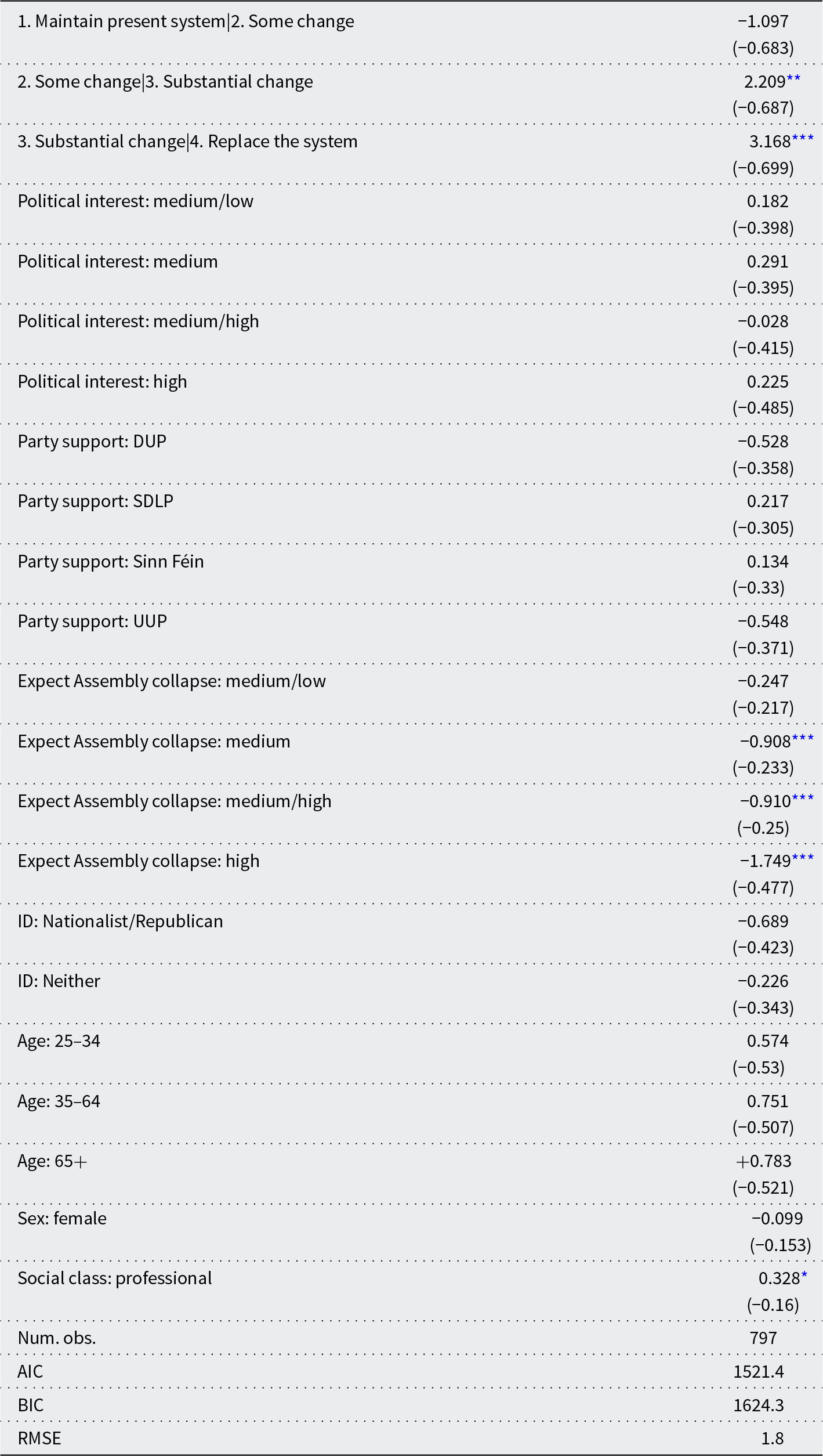
To identify drivers of attitudes to reform, in Table 3 we present the results of an ordinal logistic regression in which we use the survey question on reform options as the outcome variable: ‘Which of the following comes closest to your view about the power-sharing system of government in Northern Ireland?’. In the model, we include age, gender and social class as standard demographic control variables, alongside interest in politics, party support and communal identity. We also include confidence in the stability of power-sharing (see Table 1) to test support for our first hypothesis, which posits that perceptions of institutional instability will be associated with support for institutional reform:
H1: Those who believe that the Assembly is more likely to collapse in the future are more likely to be supportive of institutional reform.
Our second hypothesis anticipates support for the Alliance Party to be associated with support for institutional reform. As a party designated as ‘Other’, Alliance has been disadvantaged by the institutional status quo from its inception – for instance, when it comes to cross-community voting rules (see Schwartz Reference Schwartz2010) – and it has long advocated for reform. We therefore expect Alliance voters to be more supportive of institutional change than voters of other parties:
H2: Alliance supporters will be more likely to support institutional reform than supporters of other parties.
Taking these hypotheses in reverse order, our logistic regression does not find support for H2, revealing no statistically significant differences between supporters of different parties (or, indeed, between communal groups) in terms of attitudes towards reform. In short, therefore, reform of power-sharing is not an issue strongly structured along party political or communal lines. We do, however, find support for H1. The regression results in Table 3 reveal that those who are more confident in the stability of the power-sharing institutions are less likely to support reform. Specifically, for those who have reasonable confidence in the stability of power-sharing (i.e. agree that the Assembly will not collapse again), the odds of supporting substantial reform are smaller by 60% compared to those who strongly doubt the stability of power-sharing (i.e. strongly disagree that the Assembly will not collapse again). For those who have strong confidence in the stability of power-sharing (strongly agree the Assembly will not collapse), the odds of supporting substantial reform are smaller by 83% compared to those who strongly doubt the stability of power-sharing. Social class is also shown to have a statistically significant impact on attitudes towards reform: for professionals, the odds of believing the institutions should be reformed are greater by 34% compared to those in working-class occupations. Overall, the average predicted probability of preferring to maintain the institutional status quo (no changes) is 26%; preferring some changes is 63%; preferring substantial changes is 6%; and replacing the system altogether is 5%.
Ordered Logistic Regression on Public Attitudes Towards Institutional Reform

Table 3 Long description
Ordered logistic regression estimates how respondent characteristics relate to attitudes toward institutional reform on a four-step scale from maintaining the present system to replacing it. The clearest pattern is for expectations that the Assembly will collapse: compared with the reference group, medium, medium-high, and high expectations are linked to substantially lower odds of favoring more reform, with the high category showing the largest negative association. The model’s threshold estimates indicate the biggest separation occurs between “some change” and “substantial change,” and between “substantial change” and “replace the system,” while the first threshold is not statistically clear. Political interest categories show small coefficients and none are statistically clear. Party support indicators for DUP, SDLP, Sinn Fein, and UUP are also not statistically clear. Identity categories (Nationalist or Republican, and Neither), age groups, and being female are not statistically clear, while professional social class shows a modest positive association that is statistically significant. Model summary reports 797 observations, with AIC 1521.4, BIC 1624.3, and RMSE 1.8. Results are associations from an observational model and should not be interpreted as causal effects.
• p< 0.1, *p < 0.05, **p < 0.01, ***p < 0.001.
The Outworking of a TEO Resignation under Alternative Institutional Rules (2017–2022 Assembly)

Table 4 Long description
The table lists five parties with their communal designation, seat totals, and the associated TEO leadership position. DUP is designated Unionist, has 38 seats, and holds the First Minister role. Sinn Féin is designated Nationalist, has 28 seats, and is identified as the resigning deputy First Minister. Under alternative rules, UUP, also Unionist, with 16 seats is shown as the new deputy First Minister under Proposal A, while SDLP, Nationalist, with 14 seats is shown as the new deputy First Minister under Proposal B. Alliance is designated Neither, has 8 seats, and has no TEO position listed. The entries for UUP and SDLP represent alternative outcomes rather than simultaneous appointments.
We finally turn to attitudes towards a specific institutional reform proposal. As has been noted in qualitative public opinion research (Haughey and Pow Reference Haughey and Pow2022), and as we discuss above, the unilateral ability of a party to collapse the power-sharing system – by resigning from TEO – is a source of widespread, cross-community frustration. Under the status quo rules, one party’s resignation and subsequent boycott of TEO can effectively end the government and prevent its re-establishment for as long as the resigning party desires. To end the cycle of boycott and collapse, academic and public commentators have explored the merits of reforming TEO so that one party’s boycott need not necessarily result in government collapse. This would involve making the right to nominate to TEO a transferable right: i.e. in the event of a party’s refusal to nominate an FM or dFM, the entitlement to do so would pass to the next qualifying party (Haughey Reference Haughey2019; Kelly et al. Reference Kelly, Renwick and Whysall2025). Opinions differ as to what should constitute the ‘next qualifying party’. Some argue that party size is sufficient qualification – i.e. that the next largest party (in terms of seats) should be entitled to fill a TEO vacancy in the event of a larger party’s refusal (Proposal A). Others argue that size and communal designation must be factored into the transfer process – i.e. that the next largest party of the same communal designation as the resigning party should be entitled to fill the TEO vacancy (Proposal B).
In Table 4, we illustrate the outworking of both proposals using the example of Sinn Féin’s 2017 TEO resignation. Under the status quo rules, the resignation of the Sinn Féin dFM collapsed the Executive and Assembly since no other party was entitled to fill the arising vacancy. Under Proposal A, the entitlement to nominate the dFM would have transferred to the next largest party at that time, the UUP, preventing the collapse of the system subject to UUP acceptance of the TEO role. Under Proposal B, the entitlement to nominate the dFM would have transferred to the next largest party of the same designation as the resigning party. Since the resigning party (Sinn Féin) was of a nationalist designation, the next largest party qualified to nominate the dFM would have been the SDLP.
In the context of a divided society, Proposal B is the more cautious reform option. In the scenario of Sinn Féin’s TEO resignation, the outworking of reform Proposal A is problematic: a unionist FM (DUP) and a unionist dFM (UUP). By taking communal designation into account in the transfer of TEO nomination rights, Proposal B avoids the prospect of two premiers drawn from the same tradition. In the 2017 scenario, Proposal B would have resulted in a unionist FM (DUP) and a nationalist dFM (SDLP), thereby preserving power-sharing within TEO. The disadvantage with Proposal B, however, is that it relies upon a communal designation system viewed by critics as divisive and outdated. Proposal B would also disadvantage the non-ethnonational Alliance Party. Consider, for example, the hypothetical scenario of the DUP dFM resigning her position during the current Assembly (2022–2027). Under Proposal A, Alliance would benefit from such a resignation as the next largest party (Table 5). Under Proposal B, however, the right to nominate a dFM would pass to the UUP (the next largest unionist party), bypassing Alliance despite its larger size and democratic mandate.
The Outworking of a TEO Resignation under Alternative Institutional Rules (2022–2027 Assembly)

Table 5 Long description
The table lists five Northern Ireland Assembly parties with their communal designation, seat totals, and the Executive Office role assigned under alternative rules following a deputy First Minister resignation. Sinn Féin, designated Nationalist, has 27 seats and holds the First Minister position. The DUP, designated Unionist, has 26 seats and is the party from which the deputy First Minister is hypothetically resigning. Under Proposal A, Alliance, designated Other, with 17 seats would become the new deputy First Minister. Under Proposal B, the UUP, designated Unionist, with 9 seats would become the new deputy First Minister. The SDLP, designated Nationalist, has 8 seats and no TEO position listed. The table contrasts how different institutional rules could shift the deputy First Minister role to a party with fewer seats than the DUP, depending on the proposal.
Public Opinion and Options for Reform of TEO (Column %)

Table 6 Long description
Column percentages compare preferred reforms for what happens to the TEO post, shown for all respondents and by party support. Overall, the most selected option is transferring the post to the next largest party within the same bloc or designation (Proposal B) at 33.6 percent, followed by transferring regardless of bloc or designation (Proposal A) at 19.8 percent. Ending the Executive and calling a new election is 15.6 percent overall, and abolishing the Assembly and Executive is 6.6 percent. Nearly a quarter give no response or do not know at 24.4 percent. Preferences vary sharply by party: Sinn Féin and the UUP strongly favor Proposal B at 58.8 percent and 52.4 percent, and the DUP also leans to Proposal B at 42.5 percent. Alliance is the outlier, with Proposal A highest at 45.5 percent and Proposal B much lower at 19.6 percent. The SDLP is split, with Proposal A at 41.6 percent and Proposal B at 27.3 percent. Because values are column percentages, each party column sums to 100 percent and comparisons reflect differences in preference distributions across party supporters.
To investigate the level of public support for TEO reform options, survey participants were asked the following question: ‘If the First Minister or deputy First Minister resigns, what do you think should happen next?’. The results, displayed in Table 6, are indicative of public support for TEO reform. The institutional status quo, through which a TEO resignation can end the government and trigger a fresh election,Footnote 35 finds only a low level of public support at 15.6%. More than twice as many people (33.6%) would support reform Proposal B, and a further 19.8% support Proposal A. In other words, a majority of the public (53.4%) would support making TEO nomination rights transferable in the event of an FM or dFM resignation, but there is a difference of opinion as to which party the entitlement to nominate should transfer to, with the plurality favouring a within-bloc (i.e. consociational) transfer.
For voters of the dominant ethnonational parties, the most popular view is that, in the event of a TEO resignation, the entitlement to fill the vacancy should pass to the next largest party within the same communal designation: this is the majority preference of Sinn Féin voters (58.8%) and the plurality preference of DUP voters (42.5%). Support for a within-bloc transfer is also the most popular reform option among UUP voters (52.4%). Unsurprisingly, voters of the Alliance Party are more likely to favour TEO nomination rights transferring to the next largest party regardless of communal designation. Alliance voters are not alone, however, as SDLP voters are also more likely to favour nomination rights transferring regardless of designation. Whilst support for some degree of TEO reform is evident across all five voter bases, so too is support for the continuation of devolved government in Northern Ireland: less than 5% respectively think that the Assembly and Executive should be abolished in the event of another TEO resignation.
Conclusion
Increasing recognition of the need for institutional reform, among both the public and (most) political elites, provides no guarantee that reform will in fact happen. In this final section, we argue that the optimal pathway to institutional change requires a convergence of elite, civic and external participation.
Whilst there have been shifts in elite attitudes towards reform, support for change is unevenly distributed across the ethnonational spectrum. With Sinn Féin having joined the SDLP in support of reform, nationalist political opinion appears broadly receptive to rethinking and redesigning the power-sharing institutions. The same cannot be said for unionist political opinion. Support for modest reform among the UUP is outweighed by hardening resistance from the DUP. In that regard, DUP behaviour is consistent with elite interest theories of institutional change (Acemoglu and Robinson Reference Acemoglu and Robinson2012). Against a backdrop of declining party fortunes, the DUP has a strategic incentive to preserve an institutional status quo which affords it veto power. Ex-DUP leader Arlene Foster has also warned of growing suspicion among grassroots unionists that reform is being used as a vehicle to weaken community safeguards and ‘tilt the constitutional balance’ against unionism (McCarthy Reference McCarthy2026). This is worth exploring, perhaps via qualitative research. From a constitutional perspective, unionism certainly has an incentive to reform the institutions, as their vulnerability to collapse undermines Northern Ireland’s viability. Irish nationalists face a similar logic, since a dysfunctional state will be less attractive to voters in the South in a future unification referendum. Whether this reasoning prevails within Sinn Féin is unclear, but its evolving stance on reform – not least its recent characterisation of cross-community voting as unfair – is significant.Footnote 36
If (some) elites are reluctant to engage with an institutional reform agenda, the question begged is whether encouragement from civil society could change this. It is hard to refute the growing salience of reform as a topic of public discussion in Northern Ireland. By our count, the issue of reform has featured at least four times on mainstream political television programmes within the last year alone. Grassroots and NGO engagement with reform debates is also gathering pace. After conducting extensive public consultation on a wide range of social and economic issues, Civic Initiative (2025: 45), a project involving a diverse spectrum of community-based organisations in Northern Ireland, has concluded that two specific issues are ripe for consideration by a Citizens’ Assembly, one of which is institutional reform. The capacity of these bottom-up processes to influence consociational elites is debatable. For the DUP, the elite actor which requires the most convincing, its opposition to the Civic Forum established by the GFA and more recent reservations it has expressed about the creation of a similar civic consultation body (Manley Reference Manley2025) raise doubts in this regard. What could hold more sway, however, is that the DUP’s own voters are supportive of reform, as this would be harder for the party to dismiss.
As co-guarantors of the GFA, the British and Irish governments have a role to play in an institutional reform process. However, herein lies one of the difficulties. At present, neither government has shown much interest in reform, and their broadly similar view is that amending governance structures is primarily an internal matter for political parties. Whilst this elite-centred view may be appropriate for a consociational system, it overlooks the role and potential of an increasingly confident civil society in Northern Ireland. A more useful role for the governments would be to articulate the value of widening the reform conversation in a way that incentivises and elevates contributions from civil society. This could be achieved by supporting ventures such as Citizens’ Assemblies, for example. Since reform is a potentially complex subject, the appeal of a deliberative approach is that citizens are afforded time and space to consider, alongside expert advice, the trade-offs that could arise when reforming a power-sharing system. Acting jointly, the governments have an interest in promoting calm, rational and inclusive discussion about governance reform in Northern Ireland, and the approach of the 30th anniversary of the GFA offers an appropriate context.
Data availability
Data from the Northern Ireland General Election Survey (2024–2025) are publicly available via the UK Data Service (study number 9341).
Acknowledgements
The authors thank three anonymous peer reviewers for their constructive feedback on an earlier draft of this paper.
Financial support
We acknowledge financial support from the UK Economic and Social Research Council, grant no. ES/Z503058/1.
Ethics statement
The research using human subjects has been approved by the School of Histories, Languages and Cultures Research Ethics Committee at the University of Liverpool (reference 13771).
Disclosure statement
The authors report that there are no competing interests to declare.




 Open access

