

1 Introduction
Since the 1980s, healthcare sectors in many OECD countries have become increasingly concentrated as a result of mergers (Garside, Reference Garside1999; Gaynor and Haas-Wilson, Reference Gaynor and Haas-Wilson1999; Bazzoli et al., Reference Bazzoli, LoSasso, Arnould and Shalowitz2002; Fulop et al., Reference Fulop, Protopsaltis, Hutchings, King, Allan, Normand and Walters2002). The Netherlands are no exception to this (Noordegraaf et al., Reference Noordegraaf, Meurs and Montijn-Stoopendaal2005; Fabbricotti, Reference Fabbricotti2007). Both in the Netherlands and internationally, merger activity has fuelled a public and scientific debate about the consequences of mergers and the desirability of further concentration of healthcare sectors (see e.g. Gaynor and Town, Reference Gaynor and Town2012: Postma et al., forthcoming). Although there is an increasing amount of research on the effects of healthcare mergers (see e.g. Gaynor and Town, Reference Gaynor and Town2012), detailed empirical insights in why providers merge and how mergers are influenced by health policy, are lacking. Our study aims to fill this gap in the literature by answering the following research questions: (1) Why do healthcare providers merge? and (2) How do (changes in) health policy influence motives for merger? The answer to these questions is important as a growing number of European healthcare systems are in the midst of reforms (Saltman et al., Reference Saltman, Allin, Mossialos, Wismar and Kutzin2012), often including measures to increase competition either on the delivery side, on the insurance side or on both (Propper, Reference Propper2012). In practice, this means that organisations that first operated in a more or less regulated and sheltered environment are now increasingly exposed to competition and financial risks. It is likely that these reforms influence merger activity, but little is known how and to what extent. The Netherlands provides an excellent case for such research as the Dutch healthcare sector is consolidating rapidly while important reforms are implemented.
We answer the research questions by conducting a survey study among Dutch healthcare executives (i.e. end-responsible managers). We focus on providers, so mergers between healthcare insurers, pharmaceutical companies and other organisations that are part of the healthcare sector are not included in the study. The contribution of our study to the literature is threefold. First, it provides empirical evidence on motives for healthcare mergers, which have received little scholarly attention so far. Second, it presents findings on merger motives from different healthcare sectors, while the focus of most studies so far has been limited to hospital mergers. Third, our study contributes to a better understanding of the relation between motives for healthcare mergers and health policies.
This paper proceeds as follows. First, we provide an overview of literature on merger motives. We then describe the most important policy changes in the Dutch healthcare sector that occurred during our study period (2005–2012). Third, we specify the methodology used. After that, we present the findings of our empirical study and we finish with a conclusion and a discussion of the implications of our study.
2 Motives for mergers in healthcare
This study is about motives for mergers. A merger differs from an acquisition in the sense that in the former, two or more previously independent organizations consolidate into a single legal entity. In the latter, an organization acquires ownership rights of a second organization. The terms ‘merger’ and ‘acquisition’ are often used interchangeably (Angeli and Maarse, Reference Angeli and Maarse2012). Because the term ‘acquisition’ is hardly used in Dutch healthcare, we use the term ‘merger’ in this paper to describe both mergers and acquisitions.
2.1 Theoretical perspectives on motives for merger in healthcare
The current literature on health policy posits multiple theories to account for mergers. The first is improved efficiency by realizing economies of scale, for example, by reallocating resources between different locations in response to excess capacity or other changing conditions (Barro and Cutler, Reference Barro and Cutler1997; Spang et al., Reference Spang, Bazzoli and Arnould2001; Vogt and Town, Reference Vogt and Town2006; Cutler, Reference Cutler2009). Also, by reducing management and administrative overhead, concentrating care in a smaller number of locations, sharing expertise and increasing volume of treatments within locations, mergers may increase efficiency (Dranove and Shanley, Reference Dranove and Shanley1995; Barro and Cutler, Reference Barro and Cutler1997; Robinson, Reference Robinson1998; Harrison et al., Reference Harrison, McCue and Wang2003; Choi and Brommels, Reference Choi and Brommels2009; Hayford, Reference Hayford2012).
The second theory is that mergers represent strategic attempts by organisations to gain market power (Bogue et al., Reference Bogue, Shortell, Sohn, Manheim, Bazzoli and Chan1995; Barro and Cutler, Reference Barro and Cutler1997; Brooks and Jones, Reference Brooks and Jones1997; Gaynor and Haas-Wilson, Reference Gaynor and Haas-Wilson1999). This explanation posits that a merger leads to a greater market share of a provider, for example, by merging with a competitor, and consequently strengthens its market position. Healthcare providers with greater market power have an enhanced ability to set prices as they are likely to be in a stronger bargaining position vis-à-vis payers and other stakeholders (Bogue et al., Reference Bogue, Shortell, Sohn, Manheim, Bazzoli and Chan1995; Dranove and Shanley, Reference Dranove and Shanley1995; Barro and Cutler, Reference Barro and Cutler1997; Fulop et al., Reference Fulop, Protopsaltis, Hutchings, King, Allan, Normand and Walters2002).
In addition to the two theories discussed above, a third reason for healthcare mergers can be distinguished in the literature, namely pressure from a third party. For example, in a national health system like the National Health Service in the United Kingdom, government may force providers to merge for a variety of reasons, including the reduction of capacity (Harris et al., Reference Harris, Ozgen and Ozcan2000; Fulop et al., Reference Fulop, Protopsaltis, Hutchings, King, Allan, Normand and Walters2002; Gaynor et al., Reference Gaynor, Moreno-Serra and Propper2013). Although governmental pressure is likely to be less important in competitive healthcare systems, it is possible that other external stakeholders, such as health insurers, influence merger decisions. Also, pressure from internal stakeholders (such as physicians and management) may be considered as a potential reason for merger. Oldenhof et al. (Reference Oldenhof, Postma and Putters2014) and Witman et al. (Reference Witman, Smid, Meurs and Willems2011) show that internal stakeholders are key players in the governance of healthcare providers and therefore likely influence strategic decisions such as mergers.
2.2 Empirical studies on motives for merger in healthcare
Only few studies empirically examine merger motives in healthcare, and these studies mainly focus on hospital mergers. The findings of these studies are mixed. Barro and Cutler (Reference Barro and Cutler1997) provide empirical evidence for the two main theories on merger motives, based on interviews with executives of all major hospitals in the Boston area of the United States. They find that both the need for a stronger market position and efficiency concerns motivate hospital mergers. In contrast, Brooks and Jones (Reference Brooks and Jones1997) find in their study on 17 US hospital merger cases no proof of either market power or efficiency considerations in hospital mergers. Furthermore, Harrison (Reference Harrison2007) suggests that the primary goal of consolidation is to increase market power rather than decrease inefficiencies. Fulop et al. (Reference Fulop, Protopsaltis, Hutchings, King, Allan, Normand and Walters2002) study nine mergers between hospital trusts in the United Kingdom and find a variety of motives, including cost savings, safeguarding the quality and amount of services provided, external pressure for concentration of healthcare services, and lobbying from stakeholders (including national government and pressure groups).
In the survey studies of Bogue et al. (Reference Bogue, Shortell, Sohn, Manheim, Bazzoli and Chan1995) and Bazzoli et al. (Reference Bazzoli, LoSasso, Arnould and Shalowitz2002), hospitals rated strengthening the financial position, achieving operating economies, consolidating services, expanding scope of services provided, expanding market share and obtaining access to new technology as the top six most important reasons for merger. A few of these rationales can be regarded as efficiency and market considerations, for example ‘consolidating services’ and ‘expanding scope of services provided’. However, Bogue et al. (Reference Bogue, Shortell, Sohn, Manheim, Bazzoli and Chan1995) and Bazzoli et al. (Reference Bazzoli, LoSasso, Arnould and Shalowitz2002) show that distinguishing a ‘healthcare services’ category is consistent with how healthcare providers motivate mergers. For example, Bazzoli et al. (Reference Bazzoli, LoSasso, Arnould and Shalowitz2002) show that 54% of the healthcare providers reported that expanding market share was among the most important reasons for merger, while 44% of the providers reported that expanding the scope of services provided was among the most important reasons. These reasons are closely related, but providers apparently perceive them differently. Also other studies show that providers motivate mergers with reasons that are related to the provision of healthcare services (Fulop et al., Reference Fulop, Protopsaltis, Hutchings, King, Allan, Normand and Walters2002; Hayford, Reference Hayford2012). Finally, Bogue et al. (Reference Bogue, Shortell, Sohn, Manheim, Bazzoli and Chan1995), Robinson (Reference Robinson1998), Bazzoli et al. (Reference Bazzoli, LoSasso, Arnould and Shalowitz2002), Harrison et al. (Reference Harrison, McCue and Wang2003) and Choi and Brommels (Reference Choi and Brommels2009) suggest that ‘strengthening the financial position’ may be a motive for merger.
In sum, empirical studies on motives for hospital mergers identify efficiency, market power and pressure by stakeholders as important drivers for mergers, but also distinguish a range of other motives, including motives related to the provision of healthcare services and financial considerations. Still, a sector-wide, systematic understanding of why healthcare providers merge is missing. Also, little is known about the relation between merger motives and health policies, although several studies suggest that such a relation is present (Barro and Cutler, Reference Barro and Cutler1997; Fulop et al., Reference Fulop, Protopsaltis, Hutchings, King, Allan, Normand and Walters2002).
3 Policy changes in Dutch healthcare
In order to answer the question how merger motives relate to policy changes, we describe the most important developments in Dutch healthcare policy that took place during our study period (2005–2012). The year 2005 served as a starting point because of major healthcare reforms that were enacted in the Netherlands since that year. Until 2005, Dutch healthcare organisations operated in a strictly regulated environment in which hospital care and long-term care (LTC) were financed by different social insurance schemes. Social health insurance carriers were obliged to contract with any willing provider and faced limited risk for expenditures on hospital care and were at no risk for expenditures on LTC. Also, most healthcare providers received fixed budgets for delivering care. Since 2005, the environment of providers is rapidly changing due to a series of policy measures aimed at strengthening competition and increasing financial risk for providers. The goals of the market-oriented reform are to stimulate entrepreneurship, increase the system’s efficiency and improve its responsiveness to patients’ needs, while maintaining equal access (Helderman et al., Reference Helderman, Schut, Van der Grinten and Van de Ven2005; Van de Ven and Schut, Reference van de Ven and Schut2009).
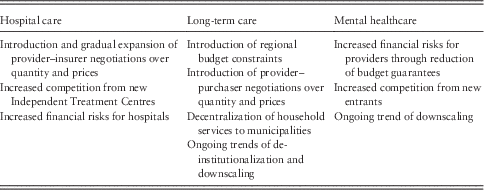
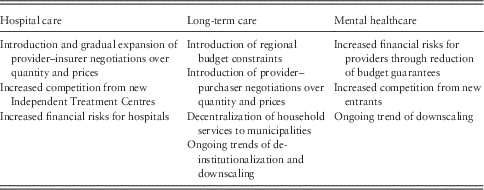
Besides the market-based reforms, healthcare is undergoing a variety of other changes that possibly influence mergers. These include de-institutionalisation of LTC and mental care and decentralisation of home care to municipalities (Putters et al., Reference Putters, Grit, Janssen, Schmidt and Meurs2010; Kroneman et al. Reference Kroneman, Cardol and Friele2012; Oldenhof et al., Reference Oldenhof, Postma and Putters2014). In the sections that follow, we describe the policy changes that were enacted between 2005 and 2012 in the sectors that we included in our study: hospital care, LTC, and mental healthcare. We focus on the consequences that those developments might have had on mergers. The policy changes are summarized in Table 1.
Policy changes in Dutch healthcare (2005–2012)
3.1 Hospital care
In 2006, the Dutch health insurance system was reformed by the introduction of the Health Insurance Act (Zvw), comprising a mandatory basic health insurance scheme. The aim of the reform was to encourage health insurers to increase the efficiency of healthcare provision by becoming prudent buyers of health services on behalf of their enrolees (Van de Ven and Schut, Reference van de Ven and Schut2009). Since then, health insurers and hospitals have been provided with incentives and tools to negotiate over the price and quality of hospital care. For example, in 2005, prices for elective hospital care products (e.g. knee, hip and cataract surgeries), jointly accounting for on average 10% of hospital revenue, became freely negotiable. The prices for the remaining products were regulated. After 2005, the share of freely negotiable hospital services increased to 20% of hospital revenues in 2008, 34% in 2009 and 70% in 2012. Furthermore, health insurers were allowed to selectively contract with hospitals and to reimburse only part of the care provided by non-contracted hospitals. Around 2010, health insurers started using minimum volume standards for a limited number of treatments (such as complex cancer surgery) as an instrument for selective contracting. Only hospitals providing a certain number of treatments are being contracted for these services. The uptake of selective contracting for other treatments has been limited so far.
In addition to growing pressure from health insurers, competition between providers increased. In particular, Independent Treatment Centres (ITCs)Footnote 1 were allowed access to the hospital market in 2006, resulting in a rapid growth of the number of ITCs from 149 in 2007 to 288 in 2012 (NZa, 2012a, 2013). These small-scale providers typically focus on non-complex elective procedures, such as varices surgery and cataract surgery, for which health insurers and hospitals are allowed to freely negotiate prices.
Finally, hospitals became exposed to financial risks for capital expenses. Until 2008, hospitals were not at risk for their capital expenses since these were fully reimbursed once the hospital acquired permission by the government to build or renovate hospital facilities. Starting in 2008, however, the compensation of capital expenses will be phased out in 10 years’ time.
As a result of these policy changes, hospitals are increasingly exposed to financial risk and under pressure from health insurers and competitors. This became evident in several cases of hospitals that got into serious financial problems over the last years, even leading to the first ever bankruptcy of a general hospital in the Netherlands in 2013. In the past decades, the Dutch hospital sector also consolidated rapidly. As a result of mergers, the number of hospitals decreased from 160 in 1985 to ∼100 in 2007 and 80 in 2012 (Blank et al., Reference Blank, Haerlermans, Koot and van Putten-Rademaker2008; RIVM, 2013). In this paper, we aim to study to what degree mergers between 2005 and 2012 were motivated by the changing context. Changes may have increased the need to strengthen market/bargaining power vis-à-vis health insurers and other providers, to meet insurers’ requirements of a minimum volume of certain treatments or to strengthen the hospitals’ financial position.
3.2 LTC
Similar to hospitals, inpatient and outpatient LTC providers (nursing homes, disability care providers and home care providers) are under increasing competitive and financial pressure, albeit less strongly than in the hospital sector. In the Netherlands, LTC is financed through a separate public LTC insurance scheme (AWBZ). The scheme is carried out by regional insurance carriers or contracting entities. Regional insurance carriers contract with LTC-providers within a regional budget constraint, which was set in 2005 by the national government to contain the fast rising LTC expenditures (Schut and Van den Berg, Reference Schut and van den Berg2010). By the end of 2004, the government repealed the legal requirement for regional insurance carriers to contract with any willing licensed provider of outpatient LTC (e.g. home care providers). As a result, since 2005, regional insurance carriers are allowed to selectively contract with outpatient LTC providers. To accommodate the transition to competition for a share of the regional budget, all regional insurance carriers started with high budget guarantees (on average about 95%) for existing outpatient LTC providers (Varkevisser et al., Reference van de Ven and Schut2007). These guaranteed budgets were gradually reduced in subsequent years.
Furthermore, the Social Support Act was introduced in 2007. Household services – comprising about 30% of total home care expenditure – were carved out of the public LTC insurance scheme and transferred (decentralised) to municipalities. This is in line with decentralisation trends in other European countries (Kroneman et al., Reference Kroneman, Cardol and Friele2012). Facing budget constraints, most municipalities introduced competitive bidding procedures for household services. As a result, municipalities saved about 12% of the original expenditures on household services (about 1.2 billion euros) and many home care providers faced a substantial drop in revenues or were not contracted at all (Pommer et al., Reference Pommer, van der Torre and Eggink2009). The reduction of budget guarantees for incumbent providers and the tendering of household services by municipalities attracted many new providers. As a result, the number of home care providers increased by more than 60% between 2007 and 2012 (Actiz, 2012).
Finally, the LTC sector is undergoing trends of de-institutionalisation and ‘downscaling’. As a result of de-institutionalisation, the number of people that live in institutions like nursing homes and facilities for disability care has steadily declined over the past decades. For example, the number of available places in nursing homes dropped by 20% between 1980 and 2010, despite the fact that during this period the number of people over 80 years of age more than doubled from about 300,000 to about 650,000 (Tweede Kamer, 2013). Furthermore, LTC is downscaling: institutional care is increasingly provided in small-scale homes (Oldenhof et al., Reference Oldenhof, Postma and Putters2014). For example, in 2010, 25% of the people with dementia that received institutional care lived in small-scale homes, marking a 178% increase from 2005 (Te Boekhorst, Reference Te Boekhorst2010). The trends of de-institutionalisation and downscaling reflect a changing societal attitude towards LTC. Values like self-determination, social integration and quality of life in regular domestic settings have replaced the traditional model of LTC that was aimed at seclusion, protection and quality of care in large-scale institutions (Oldenhof et al., Reference Oldenhof, Postma and Putters2014).
Also LTC providers engaged in mergers. As a result, between 1998 and 2004, the number of standalone nursing homes decreased from 100 to 21, the number of standalone residential homes decreased from 599 to 222 and the number of home care providers decreased from 107 to 55 (Fabbricotti, Reference Fabbricotti2007). In light of the policy changes presented above, mergers may offer a way out for LTC providers: they may help outpatient care providers to enhance their market/bargaining position vis-à-vis regional insurance carriers, municipalities and competitors, and they may offer inpatient care providers opportunities for improving efficiency by reducing overcapacity and investing in small-scale homes.
3.3 Mental healthcare
Also mental healthcare providers face increasing pressure from purchasers and competitors. Until 2008, mental healthcare was largely covered by the public LTC insurance scheme (AWBZ). Since then, the majority of mental health services – with a treatment period of less than one year – was transferred from the LTC-insurance scheme to the mandatory basic health insurance scheme (Zvw) that was introduced in 2006. Approximately two-thirds of mental care is now financed through the Zvw (Trimbos-instituut, 2011). In contrast to the other providers covered by the Zvw (e.g. hospitals), mental care providers have to negotiate a budget with a representative of all health insurers rather than individual health insurers. Hence, they are still confronted with a single buyer. Although health insurers guaranteed to maintain budgets at the level of the preceding year in 2008, over time they gradually reduced these budget guarantees (Mosca and Heijink, Reference Mosca and Heijink2013).
Furthermore, new entrants have entered the market for mental care during our study period. New entrants providing mental health services have to negotiate contracts with individual health insurers, including the price per service. While new entrants had a market share in terms of expenditure of only 0.3% in 2008, this increased to 10% in 2012 (NZa, 2012b; Mosca and Heijink, Reference Mosca and Heijink2013). Nevertheless, the market for mental healthcare is highly concentrated. In 2009, the average regional market share of the largest mental healthcare provider was 62% (NZa, 2010). After a range of mergers between inpatient and outpatient mental care providers in the 1990s, about 85% of mental care in the Netherlands is now provided by 31 regionally organised mental care providers (Trimbos-instituut, 2011).
Finally, the mental healthcare sector is undergoing a trend of downscaling. Although the number of inpatient places for patients with mental disabilities has not decreased during our study period (NZa, 2012b, 2014a), inpatient mental care is increasingly provided in small-scale ‘protected homes’ instead of large-scale psychiatric hospitals. Protected homes are often located in regular neighbourhoods and comprise clustered apartments, often with a shared living room. The number of places in protected homes increased from 4.000 in 1993 to 7.000 in 2004 and 14.000 in 2009, now comprising over 60% of inpatient places (Trimbos-instituut, 2011).
Hence, similar to hospitals and LTC providers, mental care providers face increasing pressure from purchasers and competition with other providers. Furthermore, they are in a transition from inpatient mental care in psychiatric hospitals to protected homes. It is therefore possible that mergers between mental care providers are motivated by an urgency to strengthen their market/bargaining position vis-à-vis health insurers and competitors, and a need to improve efficiency by reducing overcapacity in psychiatric hospitals.
4 Methods
To study why healthcare providers merge, we sent a survey to Dutch healthcare executives. The survey contained questions on the background of executives, the characteristics of the providers involved in mergers and merger motives. The survey was sent out electronically in April 2012 (with two reminders in May) to all 740 members of the Dutch Association of Healthcare Executives (NVZD) and another 108 executives whose contact details were obtained from a Dutch consultancy firm (BMC). We focused on healthcare executives because they are key players in merger processes and have unique inside information on why mergers are initiated. To limit the risk of social desirability bias (respondents may wish to provide a preferred image and answer questions accordingly), the survey was processed anonymously.
In the Netherlands, there is no public information on the total number of healthcare executives. Based on undisclosed documents of the NVZD, we estimated that we have sent the survey to about 70% of Dutch healthcare executives. In the same documents, the NVZD analyzed the representativeness of their membership list. They concluded that their sample is fairly representative for all healthcare executives. They only seemed to slightly overrepresent executives of large healthcare organizations within some healthcare sectors. We attempt to extend the reach of the survey by also using the contact details that we received from BMC. BMC provides consultancy services to (small and large) healthcare organizations. By that, we were able to survey a unique population. The healthcare executives in our study worked throughout the field of healthcare in private not-for-profit organisations that provide (a combination of) mental care, disability care, nursing home care, hospital care and other forms of care (including home care and primary care).
The final sample consisted of 239 respondents, of which 155 (64.9%) had been involved in at least one merger case between January 2005 and April 2012.Footnote 2 To limit the risk of recall bias, we asked the executives that participated in more than one merger (i.e. 42.6% of all executives that participated in mergers) to focus on the most recent merger case. The executives that participated in the survey are mostly male (n=163; 73.1%). The mean age of our respondents is 55.6 years (SD: 5.44; minimum: 32; maximum: 70). The executives’ length of career varies strongly in the sample. On average, respondents have 13 years of experience in end-responsible positions in healthcare, but the standard deviation is 8.89 and there are also respondents that have less than one year or over 40 years of experience.Footnote 3 Our findings on the executives’ age and gender are similar to those in a previous survey study among Dutch healthcare executives (Van der Scheer et al., Reference van der Scheer2007).
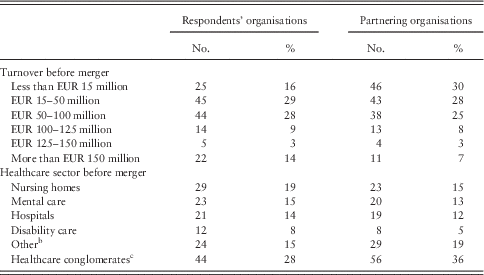
Table 2 displays information on the executives’ healthcare organisations that were involved in a merger during the study period.
Background characteristics of the executives’ organisations that were involved in a merger (n=155)Footnote a
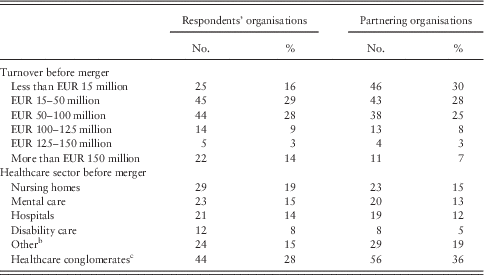
a Notice that the unit of observation is the executive and not the organisation. Since several executives may have been involved in the same merger, the number and type of organisations does not refer to unique organisations.
b Healthcare sector ‘other’ includes organisations providing youth care, home care and rehabilitation care. The number of providers in these healthcare sectors was too small to perform meaningful analysis on the sectors separately.
c Healthcare conglomerates are organisations that provide different types of care (e.g. both mental care and disability care)
Almost three quarters of executives were involved in mergers between providers with a turnover of less than EUR 100 million (most of which less than EUR 50 million). Furthermore, executives were primarily involved in mergers between healthcare organisations that provide (partly) the same type of care (n=141, 81%). Over half of the executives took part in single-sector mergers (i.e. mergers that do not involve healthcare conglomerates; n=77). Finally, only 9% (n=14) of the executives were involved in mergers between two or more healthcare providers that are not active in the same healthcare sector(s). Hence, we find that most mergers between Dutch healthcare providers between 2005 and 2012 were aimed at integration: mergers involving organizations in the same or an adjacent stage of service delivery (Angeli and Maarse, Reference Angeli and Maarse2012). Only a limited number of mergers is aimed at diversification (mergers between organizations in other markets; Angeli and Maarse, Reference Angeli and Maarse2012).
4.1 Questions about merger motives
We asked the respondents: ‘What was (were) the most important motive(s) to engage in a merger?’ Respondents were able to tick one or more of the answer categories that followed from the literature: (i) efficiency; (ii) market/bargaining position; (iii) pressure from internal and/or external stakeholders; (iv) healthcare provision; and (v) financial reasons.
The five main categories were subdivided into 23 motives. The motives were based on the reasons for merger that Bogue et al. (Reference Bogue, Shortell, Sohn, Manheim, Bazzoli and Chan1995), Bazzoli et al. (Reference Bazzoli, LoSasso, Arnould and Shalowitz2002) and others found and supplemented with merger motives that were identified in a discourse analysis of newspapers texts about organisational scale in Dutch healthcare (Postma et al., forthcoming). For each category of motives, we also provided an open answer category (which we named ‘other’). The five categories and the list of motives can be found in Table 5.
5 Results
5.1 Merger motives
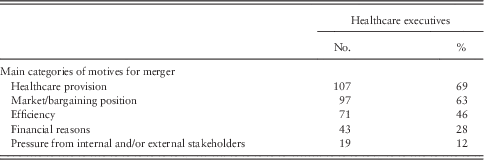
In Table 3, we present what categories of motives healthcare executives rate as the most important one(s) for engaging in a merger.
Main categories of merger motives (multiple response question)
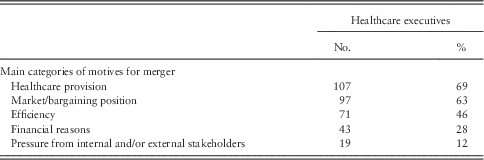
Of the five categories of merger motives, healthcare executives most often mention the category related to healthcare provision (n=107; 69%). This indicates that executives regard merger as an instrument to change the organisation and delivery of healthcare services. By realising a broader/more specialised range of services or by providing services to new groups of clients or in other geographical areas, they seem to aim at attracting new patients and/or offer more or better services to their existing patients. Almost equally frequently mentioned is the category of motives related to strengthening the market or bargaining position. The fact that this category was mentioned by more than 60% of all executives supports the expectation that policy changes aimed at increasing competition are important drivers for mergers in the Netherlands. Furthermore, although efficiency and financial reasons are less frequently mentioned, these considerations were still important in almost 50% and 30% of executives’ decisions to merge. This is consistent with policy changes aimed at improving efficiency of healthcare provision and increasing financial risk for providers. Remarkably, pressure from internal or external stakeholders did not play an important role in executives’ merger decisions. Less than 10% of the executives indicated this reason. This suggests that healthcare executives have a large degree of autonomy in merger decisions.
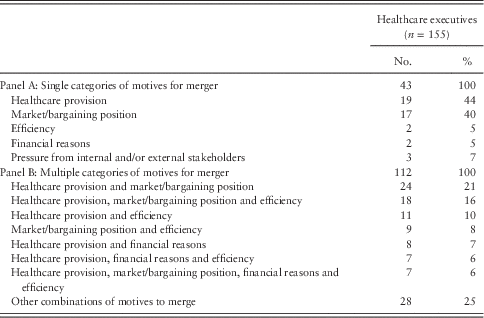
The majority of healthcare executives (72%) mentioned more than one category of merger motives. Table 4 distinguishes between executives who mentioned a single category (panel A) and those who reported multiple categories (panel B).
Single (panel A) or multiple (panel B) categories of motive(s) for merger

Among those who mentioned a single category, the vast majority (84%) mentioned healthcare provision or bargaining position as drivers to merge. For those who mentioned multiple motives, the same two categories were the most important. In total, healthcare executives reported 22 combinations of categories, of which 20 include the category ‘healthcare provision’, the category ‘market/bargaining position’ or both.
5.2 Merger motives across sectors
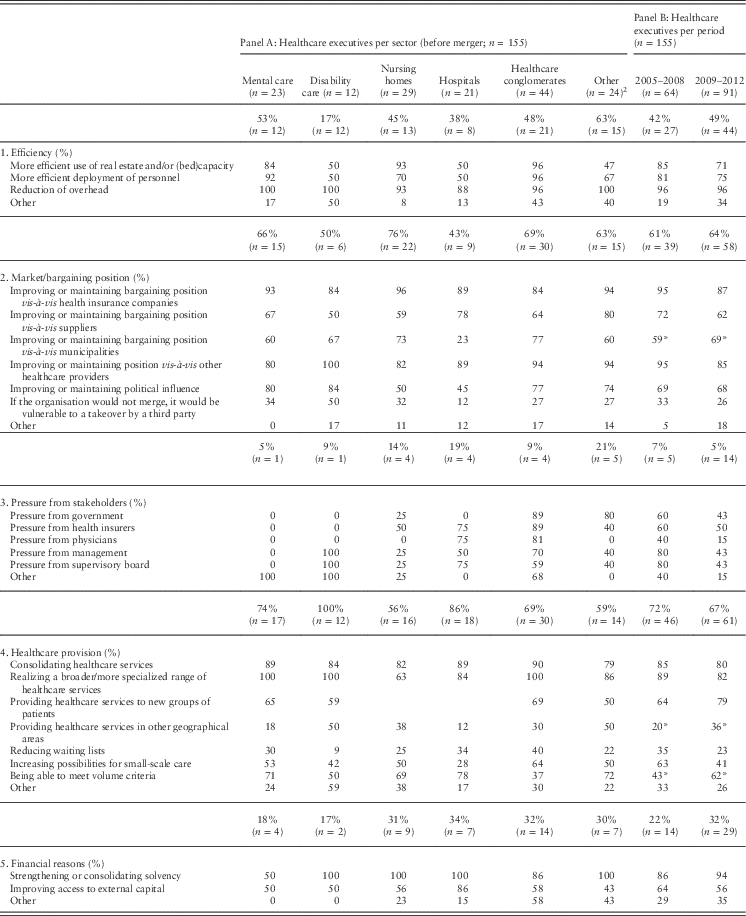
Within each of the categories of merger motives, a number of more specific motives were distinguished. Table 5 reports the relative importance of these motives within the five main categories. We first focus on the importance of merger motives across sectors (panel A).
Merger motives per category per healthcare sector (panel A) and per period (panel B)Footnote a
a These were all multiple response questions. On the multiple response sets, we performed χ2 tests of independence and pairwise comparison within each of the five categories of proportions with Bonferroni-adjusted p-values for multiple comparisons. Null hypothesis: no significant difference between time periods or healthcare sectors (α=0.05 and 0.10).
* Significant difference between time periods (between 2005 and 2007 and 2008 and 2012 in the case of ‘Improving or maintaining bargaining position vis-à-vis municipalities’).
Within the category ‘efficiency’, the three motives – more efficient use of capacity, more efficient deployment of personnel and a reduction of overhead – are almost equally important. However, although the number of observations is low, more efficient use of production capacity seems to be more important for mergers involving nursing homes and healthcare conglomerates (93% and 96% of the executives, respectively) than in hospitals (50% of executives). This is in line with the observed trends of de-institutionalisation and downscaling and the resulting pressure on inpatient LTC providers to reduce overcapacity.
Within the category ‘market/bargaining position’, almost all executives mention improving the market/bargaining position vis-à-vis health insurers. This is not surprising since the financing of providers depends on a contract (hospitals, mental health and home care providers) or a budget (nursing homes and disability care providers) to be negotiated with either competing health insurers or regional insurance carriers. Also, the rapid consolidation of the health insurance market (the four largest insurers currently have a combined market share of ∼90% (NZa, 2014b)), might have urged providers to develop countervailing power by merging. For LTC-providers, strengthening their market/bargaining position vis-à-vis municipalities is also found to be important. This is in line with the growing importance of municipalities as purchaser of home care.
Furthermore, almost all executives mention fortifying or maintaining a strong position vs competitors, thereby illustrating the increasingly competitive environment in which healthcare providers operate. Despite the increasing role of the market, however, executives still seem to perceive the government as an important player: about two-thirds of the executives within this category reports that improving or maintaining political influence was a motive to merge.
Within the category ‘healthcare provision’, mergers are particularly motivated by consolidation and specialisation of healthcare services. Expanding services to new patient groups and new areas is also frequently mentioned, though more often in case of mergers between LTC-providers than in case of hospital mergers. Increasing possibilities for small-scale care is a motive in almost half of the LTC and mental care mergers. This is consistent with the trend of downscaling.
Within the category ‘financial reasons’, clearly the most important motive for merger is strengthening or consolidating solvency. This motive is dominant across all types of healthcare providers. This likely reflects the increasing financial pressure that was discussed earlier, which urges providers to find partners with a better solvency rate to achieve more financial stability. For the partner with the better solvency rate, the merger might be valuable for other reasons, for example because of the portfolio of the other organization, despite its worse financial situation. Acquiring or safeguarding access to external capital is also important, perhaps because of the stricter requirements of banks – in response to the increasing financial risk of providers – as primary source of external capital.
5.3 Changing merger motives
We now turn to the changes in merger motives over time and the relation with policy developments. Since the number of observations is too low to investigate changes per year and per healthcare sector, we split our study period in two equal time periods – 2005–2008 and 2009–2012 – and aggregated merger motives of the executives of the various healthcare sectors. The results are shown in panel B of Table 5. Using a χ2 test we find no significant dependence between merger period and main categories of merger motives. Nevertheless, it is interesting to note that especially ‘financial reasons’ and ‘efficiency’ seem to be mentioned more frequently in the second period (albeit not significantly), pointing to the increasing financial pressure on healthcare providers. A reason for the absence of differences in the main categories between the two time periods could be an anticipation effect: providers foresee changes in health policies and decide to merge before the actual changes are effectuated.
Within categories we find that executives that were involved in mergers in the second period (2009–2012) significantly more often report ‘providing healthcare services in other geographical areas’ and ‘being able to meet volume criteria’ as a motivation to merge (p<0.05) than in the first period (2005–2008). The first change possibly points to the ambition of healthcare providers to expand their market share in reaction to incentives for competition. The second change is consistent with the growing importance of volume criteria in selective contracting by health insurers. Although selective contracting of healthcare services is limited, the threat of the use of volume criteria for selective contracting may have had influenced mergers already. When we split the study period in 2005–2007 and 2008–2012, we find that in the second period significantly more executives indicate ‘improving or maintaining market/bargaining position vis-à-vis municipalities’ as an important motive for merger (p<0.05). This is consistent with the decentralisation of household services from public LTC-insurance towards municipalities in 2007.
6 Conclusion and discussion
This study is the first to systematically analyse motives for merger over a period of time and across different healthcare sectors, using a rich and unique dataset from a survey among Dutch healthcare executives. We analysed why healthcare providers merge and how these merger motives relate to (sector-specific) policy changes.
Our study shows that healthcare mergers are motivated by a variety of reasons. We find that the dominant motives for merger were improving healthcare provision and strengthening market/bargaining power. Also efficiency and financial reasons are important drivers of merger activity in healthcare. Our study thereby confirms findings from earlier studies that emphasize the importance of market power and, to a lesser extent, efficiency and financial considerations as motive for healthcare mergers (e.g. Bogue et al., Reference Bogue, Shortell, Sohn, Manheim, Bazzoli and Chan1995; Barro and Cutler, Reference Barro and Cutler1997; Gaynor and Haas-Wilson, Reference Gaynor and Haas-Wilson1999; Bazzoli et al., Reference Bazzoli, LoSasso, Arnould and Shalowitz2002). Pressure from external or internal stakeholders is rarely a reason for Dutch healthcare providers to merge. This result does not support earlier studies that indicate that pressure from third parties is an important motive for merger (e.g. Fulop et al., Reference Fulop, Protopsaltis, Hutchings, King, Allan, Normand and Walters2002; Gaynor et al., Reference Gaynor, Moreno-Serra and Propper2013).
The importance of motives related to the provision of healthcare also confirms findings from earlier studies (Bogue et al., Reference Bogue, Shortell, Sohn, Manheim, Bazzoli and Chan1995; Bazzoli et al., Reference Bazzoli, LoSasso, Arnould and Shalowitz2002). In most studies on healthcare mergers, however, motives regarding the provision of healthcare are not identified as a separate category. Although it might be argued that these motives are related to market power and/or efficiency considerations, the fact that the majority of healthcare executives indicate these reasons as relevant, strengthens the idea that executives perceive this category as different from market power and efficiency. We therefore argue for incorporating reasons regarding healthcare provision as a separate category in theories on healthcare mergers.
With regard to policy changes, we find that between 2005 and 2012 healthcare providers increasingly merge because of motives related to their market position (‘providing healthcare services in other geographical areas’), selective contracting of hospital care by health insurers (‘being able to meet volume criteria’) and decentralisation of LTC (‘improvement or maintenance of market/bargaining position vis-à-vis municipalities’) as the pressure from competitors, health insurers and municipalities is increasing. We also find that providers tend to merge with providers from the same healthcare sector (integration), which likely creates more opportunities for specialisation and strengthening their market position. These findings indicate that changes in health policy have an impact on merger motives, but further research is required to understand how this relation exactly works.
This study contributes to the literature by empirically showing what motives for merger executives in Dutch healthcare have and how these relate to health policies. However, although we tried to minimize the risk of social desirability bias by processing the survey anonymously, we cannot rule out the possibility that in some cases the answers of executives to our survey questions are ex post justifications to hide other types of motives. These could for example be ‘mimicking’, i.e. uncritically copying business practices (such as merger) from the private sector (Bigelow and Arndt, Reference Bigelow and Arndt2000; Kitchener, Reference Kitchener2002; Comtois et al., Reference Comtois, Denis and Langley2004) or the personal ambition of management or executives (Angwin, Reference Angwin2007). We recommend future studies, for example ethnographic research, to investigate in detail whether these other types of motives play a role and to study to what degree the goals of mergers are achieved in practice.
Acknowledgments
The survey was conducted under aegis of the Dutch Association of Healthcare Executives (NVZD) and BMC consultancy and was financially supported by the Erasmus Centre for Healthcare Management Development (Erasmus CMDz). We kindly thank the NVZD and BMC consultancy for providing us with their contact lists. We furthermore like to thank Kim Putters, PhD.; Erik Schut, PhD.; Hester van de Bovenkamp, PhD.; Marco Varkevisser, PhD.; Trea Laske-Aldershof, PhD.; Maarten Janssen, MSc. (all affiliated to Erasmus University Rotterdam); BMC consultants and former healthcare executives for their valuable comments on this paper and previous versions of the survey. We also thank the participants to the Healthcare Governance meeting (25 March 2013, Rotterdam The Netherlands), the CBMO/TiasNimbas paper development workshop ‘Hybrids in Public Management’ (19 March 2013, Tilburg The Netherlands) and the EGOS Colloquium ‘Bridging Continents, Cultures and World views’ (4-6 July 2013, Montréal Canada) for their useful comments on earlier versions of the paper.