


Although the influence of the Supreme Court on policymaking in undisputed, interest groups devote the bulk of their efforts to influence legislators. This asymmetry is largely due to a comparatively easier access to elected politicians. Interest groups can readily enter the political process by influencing legislators via campaign contributions, or by providing information with electoral saliency. These instruments are either directly absent or less effective with a nonelective body such as the court. In this paper, we focus on two intimately related questions arising as a result of this asymmetry. How do the interactions between a legislature and a formally independent judiciary shape the incentives for interest groups to engage in costly lobbying activities? Under what conditions will lobbying effectively influence policy outcomes in separation of power systems?
Answering these questions is important for three main reasons. First, it will allow us to reassess the stability of the separation of powers' system in response to outside pressures. In particular, do potentially active interest groups reinforce or weaken judicial independence? Second, by explicitly modeling the interactions between the legislature and the courts in the policymaking process, our framework clarifies the biases that result from putting the emphasis solely on the link between lobbying and legislative outcomes, and allows us to improve on this benchmark.1
This, in fact, has been the approach in both models of vote buying through campaign contributions (Baron 1994; Denzau and Munger 1986; Snyder 1990, 1991) and informative lobbying (Ainsworth 1993; Austen-Smith 1993; Lohmann 1995; Rasmusen 1993).
LOBBYING UNDER SEPARATION OF POWERS
The asymmetric impact of lobbying on the payoffs of the court and the legislature shapes its effectiveness in affecting policy in equilibrium, and as a result, impacts interest groups' incentives to engage in costly lobbying activities in the first place. The overall effect of this asymmetry rests crucially on the extent of effective judicial independence. Were the court completely insensitive to outside pressures, the asymmetry would induce meager incentives for lobbying efforts. This degree of court seclusion, however, is unusual. Although most judiciaries are isolated from direct public approval, they are not immune from elected politicians' influence. Indeed, in most democracies, judicial decisions are not the last word. Legislatures can normally reverse judicial statutory rulings with a simple majority, although overturning constitutional rulings normally requires a higher level of political consensus. The legislature can, furthermore, affect the court's incentives by imposing sanctions such as court enlargements (Gely and Spiller 1992), impeachments (Iaryczower, Spiller, and Tommasi 2002), and in some countries simply by not reappointing them.3
This is, for example, the case of El Salvador, where justices must be reappointed by the legislature. The budget could also serve as an instrument of influence. See Toma 1991.
In this paper we consider the separation-of-powers logic within a standard model of informative lobbying. An interest group is privately informed about the distribution of voters in the interest-group-specific policy space. Lobbying is costly, but the cost of a given level of lobbying effort decreases with the voters' support to the interest group's position. As a result, the level of lobbying chosen by the interest group can convey information to politicians in equilibrium.4
Note that we are not assuming that the union's messages are informative per se, and we are not assuming that the union represents the median voter. We are, however, assuming that the union has private information regarding the preferences of the electorate. This would be the case, for example, if the interest group could observe, ex ante, the cost of undertaking different levels of lobbying effort. Note also that we not referring to transmission of technical information, which would generate a symmetric response of legislators and the court. Our focus is instead on the asymmetric impact of lobbying on the payoffs of the court and the legislature caused by information that can be linked to the support of citizens to a particular policy. This includes, in fact, a broad range of interest groups (Ainsworth 1993; de Figuereido 2002).
As we mentioned above, we assume that this information is not directly relevant for the court. For arguments along this line, see Staton 2006 and Vanberg 2001.
In the next sections, we develop these arguments formally, and derive empirical implications of our analysis. We then apply this framework to empirically study the politics of labor law constitutional interpretation in Argentina from 1935 to 1998.
The Model
There are two individual players, the court and the interest group, and a legislature populated by a continuum of legislators with total size one. To fix ideas, in what follows we will refer to the interest group simply as the union. Policy space is X = [0, 1], and given ideal policy zi, player i has preferences over policies x∈X represented by a utility function
.6
All results would go through employing Euclidean preferences with the usual properties. We present the analysis with specific functional forms to illustrate the nature of the results in closed form solutions.
Legislators and the court differ in their responsiveness to voters. In particular, we assume that the court is completely unresponsive to the position of voters in the policy space, and denote its preferred policy by zc∈X. We assume, though, that legislators are at least partially responsive to voters' stance on the issue. Assuming for simplicity that the distribution of voters in the policy space can be characterized by a single parameter θ∈X, we let the ideal policy of legislator j be given by zL j(θ; βj)≡βj + hθ, where for all j, βj>0 and βj + h < 1. The parameter h allows us to capture varying degrees of voters' influence on legislators' preferred policies. The degree of conflict in the legislature is captured by the distribution of points βj among its members, which we describe by the cumulative distribution G(·); that is, for any point β, G(β) denotes the proportion of legislators for which βj < β.
Policy outcomes result from the interaction of the court and the legislature. Although the precise form of this interaction depends on specific institutional details, in most polities the elective body can ultimately impose its will under some sufficiently demanding procedure. This final stage is the one we represent in the model: the court chooses a ruling xc∈X, which the legislature can reverse with the votes of a majority m∈[1/2, 1] of legislators. We say that a court's ruling is “stable” in the legislature—and therefore final—if there exists no alternative policy that a majority m of legislators would prefer to it in a binary choice, and denote the set of stable rulings given the majority rule m by Sm.
Legislators and the court are uninformed about the realization of θ, and have common prior beliefs represented by the cumulative distribution function F(·) with density f(·). We assume that f(·) has full support (i.e., f(θ)>0 for all θ∈X), but otherwise allow prior beliefs to be completely arbitrary. Informally, this means that legislators can potentially be very well (but not perfectly) informed about the realization of θ. In contrast, the union is perfectly informed about the realization of θ, and can potentially credibly transmit this information through lobbying (organizing strikes and public demonstrations). In particular, given a realization θ′, the union can organize an observable level a of demonstrations bearing a cost C(a, θ′). We will assume that C(·) is twice differentiable, that for every realization of the median voter θ, C(0, θ) = 0, Ca(a, θ)>0, and that Caθ(a, θ) < 0; that is, the marginal cost of lobbying is decreasing in the pro-labor stance of the population. For simplicity of exposition, we will further assume that C(a, θ) = a(k−θ), k>1.
The timing of the game can thus be described as follows: (i) θ is realized and privately observed by the union; (ii) the union decides a publicly observable level of lobbying intensity a; and (iii) the court chooses a ruling xc in the set of stable policies in the legislature Sm.7
For completeness, there is a fourth stage in which the legislature reviews the court's decision, but given that courts would only make policy choices that are stable, we can without any loss, discard this last stage.
An equilibrium is a triplet Γ ={γ(·), xc(·), F(·|a)} consisting of (i) a strategy for the union,
mapping “types” θ to levels a of lobbying intensity a, (ii) a strategy for the court,
mapping observations of lobbying levels a to stable rulings xc∈Sm, and (iii) beliefs F(|a) by the court and the legislators, such that:

In addition, we supplement this equilibrium concept with a refinement restricting beliefs off the equilibrium path known as criterion D1 (Banks and Sobel 1987; Cho and Kreps 1987).8
See the Appendix for a formal statement. Intuitively, this criterion requires that on observing a deviation (an action not taken with positive probability by any type of agent in the candidate equilibrium), the uninformed agents (court and union) will infer that the deviating party belongs to the class of agents who had the greatest incentive to make the observed deviation (Bernheim 1994).
The Symmetric Information Benchmark
We first characterize, as a benchmark, the symmetric information equilibrium. Note that in this case legislators are perfectly informed about the value of θ, and the union derives no benefit from lobbying, irrespective of the preferences of the electorate. Hence, there will be no lobbying in equilibrium. The relationship between preferences of the electorate and policy outcomes in the symmetric information environment, however, is the key element determining the amount and effectiveness of lobbying in the incomplete information environment.
We start by characterizing the set of stable policies in the legislature given majority rule m. Letting
and
, it is easy to see that
. That is,
is the critical legislator for a pro-labor coalition, in the sense that any policy x to the left of her preferred policy would be replaced by a more pro-labor policy. Similarly,
is the critical legislator for an anti-labor coalition, in that any policy to the right of her preferred policy will be replaced by a more anti-labor policy. Note that βL(m)≤βH(m), and βL(m) = βH(m) only with simple majority rule (m = 1/2), in which case Sm(θ) collapses to the preferred policy of the median voter in the legislature, and the court has no policy making power. It follows that for m>1/2, the set of possible court's ideal policies that would be stable given θ has positive measure.9
Note that this framework allows us to accommodate different procedures for legislative approval. For example, consider the case in which a policy has to be approved by two collective bodies (House and Senate, a committee and the floor, etc) by simple majority. In this case, βL and βH would be given by the median voters in each chamber, S(θ) would not in general be a singleton, and the court would face a nontrivial strategic problem. To simplify the presentation, however, we continue with the benchmark interpretation of a unicameral legislature with a supermajority rule unless it is otherwise noted, and drop the m subscript when there can be no confusion.
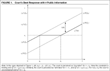
The court will then select its ideal policy unless it is constrained either for being “extremely” pro-labor or anti-labor in relation to the relevant players in the legislature. In particular, since the preferred policy of every legislator is strictly increasing in θ, a higher value of θ results in a pro-labor shift of the entire set of stable policies. A court with a fixed policy preference zc may then become a “pro-labor” court for a legislature observing a low realization θ′(zc > zL(θ′; βH)), or an “anti-labor” court for a legislature observing a high realization θ″(zc < zL(θ″; βL)). Figure 1 depicts in bold the resulting court's equilibrium rulings as a function of the state of nature, θ. The two parallel lines in the figure represent the preferences of the critical legislators as a function of the state of nature, zL(θ; βL) = βL + hθ and zL(θ; βH) = βH + hθ. For each θ, the set of stable policies S(θ) is the segment between these lines, the interval [βL+ hθ, βH + hθ] in the vertical axis. If, for some θ, the court's ideal point zc is in S(θ), the court will be able to rule according to its preferred policy, facing no effective legislative constraints. In the example depicted in the figure, this occurs for all states between the (interior) points θ0 and θ1. In this region, then, the flat portion of the bold line represents the court's equilibrium ruling. For θ < θ0, however, S(θ) is entirely below zc. Thus, if it were common knowledge among legislators that public sentiment is strongly anti-labor, the ideal point of the court would not survive the challenge of a more anti-labor legislation. The best choice for the court in such states is, therefore, to enact the most pro-labor stable ruling; that is, βH + hθ. For θ < θ0, then, the bold line representing the court's equilibrium rulings coincides with βH + hθ. Similarly, for θ > θ1, S(θ) is entirely above zc. In this subset of states the legislature is too pro-labor compared to the court, and thus the best choice for the court in such states is to enact the most “anti-labor” stable ruling; that is, βL + hθ. Proposition 1 below summarizes the preceding discussion.

Court's Best Response with θ Public Information
Proposition 1
Assume that the realization of θ is public information. Then (i) γ(θ) = 0 for all θ, and (ii) there exist θ0, θ1 ∈ [0, 1], θ0 ≤ θ1, such that:

Specifically, θ0= 0 for zc < βH, θ0= 1 for zc> βH+ h, and θ0 =(zc−βH)/h otherwise. θ1 is similarly defined, with βL in place of βH.
The legislature thus effectively constrains the court for some realizations of public opinion when the set K ={θ:θ≤θ0∨θ≥θ1} is nonempty. In other words, the court will be able to rule its preferred policy independently of public opinion only if this policy is both (i) pro-labor relative to the preferences of the critical legislator for a pro-labor coalition before a pro-labor electorate (zc>zL(1; βL) = βL+h) and (ii) anti-labor relative to the preferences of the critical legislator for an anti-labor coalition before an anti-labor electorate (zc < zL(0; βH) = βH). Note that, as in Gely and Spiller 1990, this condition is more likely to be satisfied when there is significant dissent in the legislature (the critical legislators for a pro- and anti-labor coalitions are far apart, βL[Lt ]βH) and legislators are not too responsive to public opinion (h is small).
Moreover, it follows from proposition 1 that, in general, the size of K increases with βL and decreases with βH. Thus, the set of realizations of public opinion for which the court is effectively constrained is always smaller the higher dissent in the legislature is. Proposition 1 does not imply, however, that the size of K should be generically lower the less responsive legislators are to public opinion. To see this, note that the set of values of θ for which a sincere ruling by the court wouldn't be reversed by a more anti-labor policy increases with h (the court benefits, in this regard, from a more eager response of legislators to public opinion). Hence, the overall effect of legislators' responsiveness to public opinion on judicial independence depends on the relative position of the court in the policy space.
Informative Judicial Lobbying
The previous analysis showed that when the court is constrained for some (publicly known) preferences of the electorate, an increase in θ induces a more pro-labor ruling, and thus, a more pro-labor policy outcome in equilibrium. The first goal of this section is to show that, when policymakers are uncertain about the realization of θ, lobbying by the interest group restores the complete information mapping between the preferences of the electorate and policy outcomes. Suppose, for example, that the court would be constrained for some known preferences of the electorate. Then in the presence of lobbying, the court would be forced to adjust its behavior to reflect this constraint, even if it would be independent to rule according to its preferred policy given the prior beliefs of uninformed legislators. Similarly, suppose instead that the court would be independent to rule according to its preferred policy for some known preferences of the electorate. Then the court would indeed be able to rule freely in the presence of lobbying, even if it would be constrained given the prior beliefs of uninformed legislators. The result is stated formally in the next proposition (lemma 1 in the appendix provides a detailed characterization of equilibrium strategies):
Proposition 2
In the unique D1 equilibrium:
- Lobbying γ (θ) increases with θ in K, and does not change with θ in [θ0, θ1];
- Court's (stable) rulings xc(a) satisfy x for every θ, where (θ) is given in Proposition 1. In particular, the pro-labor tendency of rulings increases with the level of strikes; i.e., xc (a) is increasing in a.
That is, in equilibrium the level of strikes will reflect the preferences of the electorate up to the extent that this information can influence a binding constraint for the court (and thus policy outcomes). We say, then, that strikes are effectively fully informative. As long as (informed) policy is responsive to the electorate's preferences, two union types facing different pro-labor dispositions of the electorate will always choose different levels of lobbying, allowing the reproduction of the complete information link between policies and the preferences of the electorate.
This does not imply, however, that the equilibrium will necessarily involve transmission of information. In fact, lobbying will be completely unresponsive to the preferences of the electorate if (and only if) the court is unconstrained for every possible realization of θ. Conversely, there will be a complete separating equilibrium if (and only if) the court is constrained for every realization of public preferences. That is, only if the court's ideal policy is “extremely anti-labor” (i.e., zc < βL), or “extremely pro-labor” (i.e., zc > βH + h) by Proposition 1 standards.
Proposition 2 allows us to study the response of the expected level of strikes and pro-labor rulings to changes in the composition of the legislature. Note that for our purposes changes in the composition of the legislature are relevant only to the extent that they affect the boundaries of the stable set of policies in the legislature, zL(θ; βL)= βL + hθ and zL(θ; βH)= βH + hθ. Moreover, recall from the analysis of the symmetric information benchmark that the set of realizations of public opinion for which the court is effectively constrained decreases with the degree of dissent in the legislature. That is, in general, the size of K increases with βL and decreases with βH. Proposition 2 then directly implies the following result, and its corollary:
Proposition 3
A pro-labor shift in the preferred policy of the critical legislator for a pro-labor coalition βL (anti-labor coalition, βH), increases the expected pro-labor tendency of the court' rulings level Eθ[xc], and increases (reduces) the expected level of lobbying, Eθ[γ].
Corollary 1
A mean preserving increase in the size of the set of stable policies in the legislature reduces the expected level of strikes in equilibrium.
Proposition 3 also has direct implications over the response of equilibrium outcomes to changes in court's preferences. First, it is clear from the previous analysis that the expected level of pro-labor rulings will increase following a pro-labor change in the court's preferences unless the court is constrained for every realization of θ both preceding and following this change. The change in the expected level of strikes is, however, ambiguous.10
This should come as no surprise, however, since for this purpose, increasing xc with βL and βH given is qualitatively similar as simultaneously reducing both βL and βH taking xc as given, and we know from Proposition 3 that βL and βH have opposite effects on the expected level of strikes.
Empirical Implications
The model has direct and empirically refutable implications. The first two implications are unique to this model. First, Proposition 2 states that, in equilibrium, the “pro-labor” level of judicial decisions is increasing in the extent of the union's political activity. Thus, we should observe more “pro-labor” decisions when facing a higher level of union strikes. Second, the expected level of lobbying decreases the more effective the separation of powers between the court and the legislature is (i.e., the more divided the legislature is on the relevant issues). Specifically, as the corollary to Proposition 3 points out, we expect the level of strikes to be decreasing in the amplitude of the set of stable policies in the legislature.
Our model also has more standard separation of powers empirical implications. As in most separation of powers models, Proposition 3 implies that the equilibrium level of “pro-labor” judicial decisions depends on the political composition of the legislature. In equilibrium, a more “pro-labor” legislature will trigger more “pro-labor” decisions provided that the court is effectively constrained by the legislature. Thus, our model provides unique, as well as standard empirical implications concerning separation of power models. The unique implications allow a direct test of the signaling value of interest groups lobbying.
THE POLITICS OF LABOR LAW CONSTITUTIONAL INTERPRETATION IN ARGENTINA
In this section we apply the model to study the politics of labor law constitutional interpretation in Argentina, and provide an evaluation of its empirical implications using data on strikes and supreme court's decisions between 1935 and 1998.
This case presents a natural application of the proposed framework. On the one hand, although formally independent, Argentina's supreme court has faced both implicit and explicit threats from the political powers, and has adjusted its behavior accordingly (see Helmke 2002 and Iaryczower, Spiller, and Tommasi 2002). On the other hand, following the consolidation of Peronism, the unions controlled an institutional and physical structure that allowed them to organize large public demonstrations effectively. As a result, the unions broadened their scope of interest from industry level to national labor policies, and organized demonstrations became instruments of political influence.
In this environment, the relevant assumptions we impose to the analysis translate into the following mild requirements. First, legislators are at least somewhat responsive to (but not perfectly informed about) the preferences of the electorate.11
This will generally be the case even in systems as the Argentinean, where legislators' reelection rates are low, since the electoral connection constitutes an asset for other elective posts such as governors, majors and provincial legislatures. Moreover, this will generally also be the case even if, as in Argentina, party bosses control the nomination to party lists, since party bosses need to maintain the support of party members to retain the command of the party (see Iaryczower 2005).
The Political Environment
According to our framework, the relative position of the court with respect to the set of stable policies in the legislature is a major factor determining both court rulings and the level of lobbying. Our first task in defining the relevant independent variables, then, is to obtain an assessment of the distribution of preferences within the legislature along a pro-labor/anti-labor policy space.
Throughout most of the twentieth century, Argentina had a strong presidential system with two dominant political parties (Jones 2002; McGuire 1995) characterized by a relatively sharp contrast in their stance with respect to labor policies and the regulation of organized labor (Fernandez 1988; McGuire 1997; Rotondaro 1971; Torre 1983). Although all presidents have sought, to some extent, support from (at least some of) the unions, the strong association between unions and the Peronist party, and the Peronist/anti-Peronist division of Argentine society defined Argentina's political reality in the second part of the twentieth century. Relying on these facts, we classify each president (and its party in the legislature) as pro- or anti-labor, and use this classification, along with the partisan composition of the legislature, to obtain an assessment of the pro-labor composition of the Argentine legislature.
We start by classifying Argentina's presidents between 1935 and 1997 as pro-labor or anti-labor, following to the greater extent possible the “stylized facts” presented by previous studies. Presidents Farrel, Peron, and all presidents who governed representing the Peronist Party (Campora, Lastiri, and Martinez in 1973–1976, Menem between 1989 and 1999) were classified as pro-labor. President Frondizi (1958–1962) did not represent the Peronist party but was also classified as pro-labor.12
Peronism was banned from participating in the 1958 elections, and President Frondizi was elected with the explicit support of Peron (see, e.g., McGuire 1997).
Taking this classification as given, we use parties' representation in the legislature to compute the distribution of preferences for the upper and lower chambers in each period t,
and
. We assume, first, that legislative parties are perfectly cohesive, and that parties in the opposition have the opposite stance in the labor policy space than the president's party. The distribution of imputed preferences for legislators of chamber j in period t is in this case given by
for 0≤x < 1 and
, where
denotes the proportion of seats held by the anti-labor's party in chamber j in period t (we assume here that
during periods of military interruptions to the democratic regime). We also let parties be imperfectly aligned with the president, and refer to this as a noisy representation of legislative parties. Specifically, for both the anti-labor and the pro-labor party, we assume that the proportions of party members with ideal policy closer to the extreme anti-labor (0) and pro-labor (1) policies are given by a beta distribution B(α, β) with support in [0, 1], for β = 1 and α = 0.1 and α = 0.2.13
This family of distributions is stochastically increasing in α and reduces to the uniform distribution when α=β=1. Thus, the “noise” in the identification of the legislative parties with the President increases with α.
.14
To clarify the second term in this expression, note that due to the symmetry of treatment, the proportion of legislators of the pro-labor party to the left of (more anti-labor than) a given point x in [0, 1] is equal to the proportion of legislators of the anti-labor party to the right of (more pro-labor than) the point 1−x, 1−Bα(1−x).
Dependent Variables
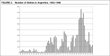
The dependent variables in our study are supreme court's pro-labor rulings and the amount of union strikes. We define the variable strikes as the number of strikes per year.15
Since these data were not available from a single source for our entire period (1935–1998), we selected what we considered to be the best possible source in our sample and generated the remaining data using the percent variation in the next best available series. The most comprehensive and reliable source is O'Donnel 2000, covering the period 1955–1972. For 1935–1955 we used data from Rotondaro 1971, which independently covers the period 1935–1968. For the period 1972–1998 we used Fernandez 1988, Nueva Mayoria 2001, and Torre 1983.
By norms, we mean laws, presidential decrees, administrative decisions and resolutions. Cases in which the constitutionality of a lower court decision was questioned (arbitrariedad), and cases in which the constitutionality of the interpretation of a norm by a lower court was questioned, but not the norm in itself, were excluded. Moreover, we also excluded those cases in which the supreme court decided not to opine over the constitutionality of the challenged norm alleging formal or technical reasons. Finally, to avoid duplications in substance arising from the fact that the Argentine court does not have the ability to determine a law as unconstitutional per se, but rather has to deal with the unconstitutionality of its application to a particular case (person), we limit the pool of cases to those published in extenso in La Ley, the main judicial publication in Argentina.
Independent Variables
The pro-labor composition of the legislature is relevant for our purposes for two reasons. First, the appointment of a president's nominee to the supreme court requires the approval of the senate (by simple majority until 1994). Thus, the pro-labor composition of the senate affects directly the preferences of the court. To reflect the influence of the senate in a simple manner, we use the midpoint between the ideal point of the president and the median voter of the senate at the time of appointment as an estimate of the pro-labor disposition of each justice. The pro-labor disposition of the court in each period, pro-labor court, is then defined as the policy preference of the court's median justice.17
We do this for the cohesive and noisy representations of the legislature. Note that the median voter in the Senate at the time of appointment, T, is computed from the distributions
and
, respectively, and that therefore the measure of pro-labor court changes with each specification.
Second, the pro-labor compositions of the upper and lower chambers determine the set of stable policies in the legislature in any given period. A ruling is stable if it does not trigger a response by a pro- or an anti-labor coalition in the legislature. Because until 1994 Argentina's Constitution allowed the legislature to enlarge the supreme court with a simple law, we focus primarily on the critical legislators for simple majority rule in a bicameral legislature. These are denoted pro-labor critical and anti-labor critical and defined—for both the cohesive and noisy representations of legislative parties—as the minimum and maximum among the median legislators of the upper and lower chambers.18
We do, however, also include a model specified for two-thirds supermajority required in both chambers. Denoting the critical legislator for a pro-labor (anti-labor) coalition in chamber j=U, L by
(
, the critical legislator for pro-labor and anti-labor coalitions in this case are given by
and
, respectively.
The equilibrium level of pro-labor rulings and strikes depend, however, on the relative position of the court with respect to the set of stable policies in the legislature. Consider first the court. Justices will rule based solely on their preferences provided that their preferred policies are stable policies in the legislature, and will otherwise adjust their rulings so that these fall within the set of acceptable policies in the legislature. As a result, court's preferences will influence Justices' behavior directly only to the extent that the court is unconstrained. If instead an anti-labor court is constrained by the legislature, changes in the critical legislator for a pro-labor coalition—and not in court's preferences—will influence court's decisions (we call this a pro-labor constraint). Similarly, if a pro-labor court is constrained by the legislature, changes in the critical legislator for an anti-labor coalition will influence court's decisions (we call this an anti-labor constraint). We then define the following variables. Pro-labor constraint equals pro-labor critical if an anti-labor court is constrained (i.e., if pro-labor court < pro-labor critical) and zero otherwise. Similarly, anti-labor constraint equals anti-labor critical if a pro-labor court is constrained (if pro-labor court > anti-labor critical) and zero otherwise. Finally, court unconstrained is defined as pro-labor court if the court is unconstrained, and zero otherwise.
The union, on the other hand, will only engage in lobbying if policy outcomes are responsive to lobbying efforts. This implies that the expected level of lobbying (strike activity) increases the more constrained the court is, and decreases (corollary 1) with the length of the set of stable policies in the legislature. We then define the variable binding as the distance between pro-labor court and the set of stable policies, and length as the distance between pro-labor critical and anti-labor critical.
We also define two control variables related to the political environment. First, we introduce the variable dictator, taking the value 1 in periods of interruptions to the democratic regime, to allow for possible direct effects of military governments on both rulings and strikes.19
Recall that we also treat military governments as completely unified, anti-labor governments, controlling both houses.

Number of Strikes in Argentina, 1935–1998
Estimation
As indicated by Proposition 2, court's pro-labor rulings are increasing in the observed level of strikes. The equilibrium level of strikes is in itself a response to the political environment and the relative positioning of the court in the (labor) policy space. It is not, however, a function of actual rulings by the court, which only happen after the level of strikes is observed. Specifically, for our main specification, the variables in the right-hand side of the equation for pro-labor judicial decisions are given by court unconstrained, pro-labor constraint, anti-labor constraint, post-Peron, and dictator. The variables in the right-hand side of the strikes equation are given by length, binding, pro-labor court, post-Peron, dictator, along with three lagged observations of the growth of GDP, included as controls.
Thus, the model we estimate is a triangular system of two equations. We then test the hypothesis that the variance-covariance matrix is diagonal with the data arranged on a case-based unit of analysis. Employing the Breusch and Pagan 1980 test (see Greene 2000, 621), we conclude that the system is indeed fully recursive, and thus proceed to estimate it equation by equation (678). Furthermore, because pro-labor ruling is a categorical variable, we use a logit model to estimate the conditional probability of a pro-labor ruling. Also, because the data for the number of strikes are only available yearly, we use the number of strikes in the year in which the supreme court decided the case in the court's decision equation. We use average annual values for the right hand side variables of the strikes equation.
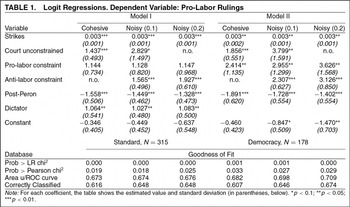
Table 1 presents the results of the pro-labor rulings equation under the cohesive and noisy representations of the legislature for the complete sample (Model I), and for only democratic periods (Model II).20

The results are consistent with the predictions of the model. As in separation of power models, the probability of a pro-labor ruling increases with the pro-labor disposition of unconstrained courts (court unconstrained) and when a binding constraint for a pro-labor court is relaxed (an increase in anti-labor constraint),21
Recall that the relative positions of the court and of the critical legislators in the legislature vary with each specification. Thus, although there are no instances in which the political constraint is binding for a pro-labor court for “cohesive” parties, this event does indeed occur under a noisy representation of the legislature.
Moving toward the more unique implications of our model, we find that, consistent with Proposition 2, pro-labor rulings increase with the level of strikes. This result stands for both the cohesive and noisy representations of the legislature, and for the whole or only the democratic period samples. In particular, setting the value of all variables at their sample average, a 1 SD increase in the number of strikes—152.6 and 180.4 for the complete and democratic samples—increases the probability of a pro-labor ruling by 12% to 13% for both samples and models.
We also find that the pro-labor tendency of court rulings increases during breakdowns of the democratic regime, and decreases following President Peron' s first two terms in office.22
The effect of dictatorships on pro-labor rulings should be considered in addition to the effect brought by a unified government (as we assume dictatorships imply unified governments). The results, however, may also reflect the nature of cases that come up for decision to the court in dictatorship periods (more intensively anti-labor) and in post-Peron periods (more intensively pro-labor).
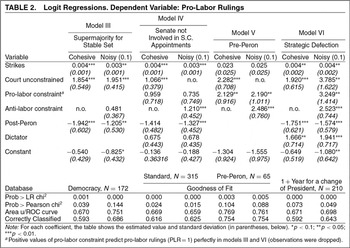
Table 2 presents the results of four exercises that complement the previous analysis. In Model III, we consider the model under the assumption that the relevant majority determining the constraints for the court is a supermajority of two thirds of the members of each chamber. We find that the coefficients of strikes and the preferences of unconstrained courts (court unconstrained) are statistically significant of the same order of magnitude as in Table 1. Political constraints with supermajority, however, seem to be less significant as explanatory variables for court's behavior.23
The evidence, however, is not conclusive. On the one hand, although there are no instances of a pro-labor court being constrained by the legislature in the cohesive representation of the legislature, the coefficient of anti-labor constraint is not statistically significant in the noisy representations of the legislature (this is accentuated with α = 0.2, with a p-value of 0.729). On the other hand, however, rulings are always pro-labor when the constraint for an anti-labor court is binding. In this case, these observations carry no statistical information with respect to the likelihood function and have to be removed from the estimation. This is not to say that this variable is not relevant for the outcomes, but instead that its contribution can be replaced by the rule: “if a supermajority constraint is binding for an anti-labor court, the court will rule in favor of labor.”

Model IV considers an alternative method to capture the preferences of the court. Although the appointment of the president's nominees to the supreme court requires the approval of the senate, part of the literature suggests that the senate has only a formal role in this procedure. In this case, our measure of court's preferences would be improved by simply removing the influence of the senate. Thus, in Model IV we assume that the pro-labor stance of each justice equals that of the nominating president.24
We thank an anonymous referee for suggesting this exercise.
Alternatively, we could have assumed that the courts are able to perfectly anticipate the identity of the future government with some proximity to the date of change of government. The approach we employ in the paper, although lending support to that hypothesis, does not impose any particular assumption regarding these beliefs.
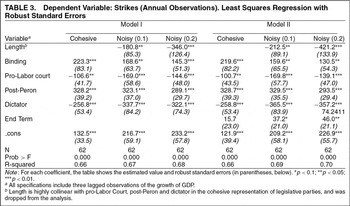
Table 3 presents the results obtained from the estimation of the strikes equation. The independent variables in Model I include length, binding, pro-labor court, post-Peron, dictator, and three lagged observations of the growth of GDP, included as controls. The results are consistent with the model's empirical implications. First, according to Proposition 3 (and its corollary), we expect the level of strikes to increase the more constrained the court is, and decrease with the size of the stable set (the “pooling” area). Table 3 supports these implications, as the coefficients of binding and length are of their predicted signs (positive and negative respectively) and all are statistically significant.26
We note, however, that length was highly collinear with pro-labor court, post-Peron and dictator in the cohesive representation of legislative parties, and was dropped from the analysis.
We also find that the level of strikes decreases the more pro-labor the court is. As noted in the previous section, however, the empirical implication regarding the position of the court is ambiguous in general. Thus, although intuitive, this finding does not provide evidence in favor or against the model.

CONCLUSIONS
Due to the comparatively easier access to elected politicians, interest group lobbying has an asymmetric impact on the payoffs of the legislature and the supreme court. The overall effect of this asymmetry rests crucially on the extent of effective judicial independence from elective bodies. As a result, even if lobbying can't affect the court's payoffs directly, it can do so indirectly, by altering the political constraints under which the court operates. The first contribution of the paper is then to show that the empirical work on the impact of lobbying has been looking at the wrong policy dimension. Rather than affecting policy by impacting on the nature of legislation, lobbying may be affecting policy via judicial decisions.
Identifying this mechanism, moreover, allows us to reconsider the determinants and effectiveness of lobbying in separation-of-powers systems by putting together two observations. First, as we established above, lobbying influences court rulings only indirectly, by affecting the political constraints faced by the court. Second, an interest group will undertake lobbying efforts only if, by doing so it can effectively influence policy outcomes. We show, in fact, that in equilibrium the level of lobbying will reflect the preferences of the electorate up to the extent that this information can influence a binding constraint for the court (and thus policy outcomes). Thus, a key determinant of lobbying is the extent by which the information so generated can sway decisive majorities in the legislature to tighten the political constraints faced by an anti-interest group court, or relax the constraints faced by a pro-interest group court. To sum up, policy outcomes are monotonic with respect to the level of lobbying, but the expected level of lobbying decreases the more divided the legislature is on the relevant issues (the wider the set of stable policies in the legislature).
The model has direct and refutable empirical implications. The first two implications are unique to this model. First, in equilibrium, the higher the level of lobbying, the more court decisions will favor the interest group policies. Second, the expected level of lobbying decreases the more effective the separation of powers between the court and the legislature is (i.e., the more divided the legislature is on the relevant issues). Specifically, we expect the level of lobbying to be decreasing in the amplitude of the set of stable policies in the legislature. Our model also has more standard separation of powers empirical implications. As in most separation of powers models, the extent of the court's opposition to political bodies depends on the political composition of the legislature. In the context of this paper, this implies that a more “pro-interest-group” legislature will trigger more “pro-interest-group” judicial decisions, provided that the court is effectively constrained by the legislature. Thus, our model provides unique, as well as standard empirical implications concerning separation of power models. The unique implications constitute direct tests of the signaling value of interest groups lobbying.
Our empirical results for the interactions among unions, courts, and the legislature in Argentina are consistent with this description. Argentine courts tend to side more with unions the more unions strike. Unions, in turn, strike more when courts face a more unified legislature. It is in these situations that unions' lobbying makes the legislature more pro-labor, triggering, then, more pro-union judicial decisions. Our paper, then, suggests that analyses of lobbying should pay closer attention to the actual nature of the policy making process, and in particular, to the interaction of the bureaucracy, the courts and the legislature.
APPENDIX
Definition (Ramey 1996)
Fix a sequential equilibrium Γ, and denote the payoff in Γ of a type-θ union by U(θ). Fix an off-the-equilibrium-path action a by the union; that is, a ∉γ([0, 1]), and suppose there is a nonempty set X′⊂X such that: for all θ∉X′ there exists θ′∈X′ such that U(a, x, θ)≥ U(θ) implies U(a, x, θ′) > U(θ'). Then the equilibrium is said to violate criterion D1 unless it is the case that the support of F(θ | a) is included in X′. A sequential equilibrium is a D1 equilibrium if it does not violate criterion D1 for any a ∉γ([0, 1]).
Lemma 1
Coupled with beliefs satisfying Bayes' rule, the following strategies constitute a sequential equilibrium: (i) court's strategy xc(a) is defined by
for all a such that γ −1(a) ∈ K, and xc(γ0(θ0)) = zc, where
θ0 and θ1 are given in Proposition 1; and (ii) union's strategy γ(·) is defined by

Proof of Lemma 1
First note that if beliefs satisfy Bayes' rule, then (i) for all a such that γ−1 (a) ∈ K, f(θ | a) = 1 ifθ =γ−1(a), and f(θ | a) = 0 ifθ≠γ−1(a), and (ii) for a = γ0(θ0), f(θ | a) = f(θ)/[F(θ1)−F(θ0)] if θ∈[θ0, θ1], and f(θ | a) = 0 otherwise. Hence, it follows directly from Proposition 1 that the Court's proposed strategy specifies is a best response given these beliefs. It remains to show the optimality of union's strategy given f(|a) and xc(). To do so it is enough—by the revelation principle—to consider direct mechanisms in which every type has the incentive to make truthful announcements. Suppose first that θ0 > 0. Our initial step is to show that if the restriction of the union strategy to [0, θ0] is given by γ0(θ), as defined above, then a union of type θ≤θ0 does not have the incentive to misrepresent its type by claiming that its type is θ′∈[0, θ0], θ′≠θ. To see this, consider an arbitrary strategy
and its restriction to [0, θ0]. Truth telling is then optimal for θ in this range only if:

Note that the FOC for a maximum at θ can be written as

From this it follows immediately that
is strictly increasing in θ in [0, θ0] (the second order condition, assuring that
is incentive compatible across [0, θ0], follows from the assumption that Caθ(a, θ) < 0. See Fudenberg and Tirole 1998, 262). Moreover, for the functional forms specified, we can obtain

Note that we have made use of the fact that γ(0) = 0. For suppose not; that is, suppose γ(0) = a > 0, and consider a deviation by type θ = 0 to action a=0. Equilibrium policy following the observation of lobbying level
results in the complete information policy corresponding to the lower type in the distribution; that is,
. But after a deviation, uninformed agents will respond with strategies that are optimal given some beliefs with support in [0, 1]. Then policy following a deviation cannot possibly be worst for the union than equilibrium policy. Hence, the deviation is profitable for type 0, because it reduces costs but can't adversely affect outcomes.
An identical argument shows that if θ1 < 1, a θ-type union, θ ≥ θ1, does not have an incentive to play γ1(θ)″ for θ″≠θ, θ″∈[θ1, 1]. Furthermore, it follows from the previous argument that a type θ < θ0 does not have an incentive to play γP = γ0(θ0); that is, every type θ∈[0, θ0] prefers (γ0(θ), zL(θ; βH)) to (γP, zc). Similarly, when θ1∈(0, 1), there is no type θ > θ1 with an incentive to play γP = γ1(θ1). We continue by showing that when 0 < θ0 < θ1 < 1, no type in θ ∈ [0, θ0] has an incentive to play γ(θ′) for θ′∈[θ1, 1] (and the opposite). That is, we want to show that u(zL(θ; βH)) − C(γ0(θ), θ) ≥ u(zL(θ′; βL)) − C(γ1(θ′), θ) for θ ≤ θ0, θ′ ≥ θ1. Since θ ≤ θ0 prefers (γ0(θ), zL(θ; βH)) to (γP, zc) =(γ1(θ1), zL(θ1; βL)), we have, for θ ≤ θ0:

Also, we know that θ″ ≥ θ1 prefers (γ1(θ″), zL(θ″; βL)) to (γ1(θ′), zL(θ′; βL)) for θ′ ≥ θ1, θ″ ≠ θ′, θ″ ≥ θ1. In particular, with θ″ = θ1, this implies, for θ′ > θ1:

Now by (2), for θ ≤ θ1,

so that for θ ≤ θ1 ≤ θ′,

The result then follows from (1) and (3). In addition, (3) also shows that any type in the pool [θ0, θ1] prefers the pool than to announce θ′ ≥ θ1. A similar argument establishes that when 0 < θ0 < θ1 < 1, no type θ ∈ [θ1, 1] has an incentive to play γ(θ′) for θ′ ∈ [0, θ0], and that no type in the pool prefers to announce θ′ ≤ θ0. Finally, it is easy to see that γ can have no discontinuities at γ0(θ0), for in this case there would exist θ < θ0 sufficiently close to θ0 for which a deviation by θ0 would be profitable (involving a marginal loss in policy, but a discrete reduction in lobbying costs). Similarly, it can be shown that when θ1 < 1, γ1(θ1 = γ0(θ0) when θ0 > 0. That γ1(θ1) = 0 if θ0 = 0, as we argued above, is covered in the claim that γ(0) = 0.
Proof of Proposition 2
That there exists an equilibrium where (i) and (ii) hold follow immediately from Lemma 1. It remains to show that this is indeed the unique equilibrium satisfying criterion D1. So let
be an equilibrium satisfying criterion D1. We will show (drawing from Ramey 1996) that if θ0 > 0, then
. The same argument can then be applied to show that if θ1 < 1, then
.
From the proof of lemma 1, we only need to show that
is strictly increasing in [0, θ0]. So suppose that this is not the case. That is, for a > 0, let
denote the inverse image set of a under
, and suppose that there exists an aP > 0 such that
is not a singleton. Since
must be monotonically (weakly) increasing,
must then be an interval
. Let
, and
denote the preferred policies of the critical legislators βL and βH given beliefs
. As in the case with complete information, we can now show that the set of stable policies is given by
. But if
, then Bayes' rule and the full support assumption imply that
for every
and
otherwise. This in turn implies that
. And since
, then
. Thus the constraint is binding for the Court, and
. Next, choose
sufficiently close to
so that
. Since by assumption Caθ < 0, the slope of a union's indifference curve in the (a, x) space is decreasing in the type θ, and we can always find a pair
such that
(1), and for any
(2). Furthermore, we can as well find one such pair for
. Suppose first that
. Since
is an equilibrium, this implies that
(IC for θ). But then (2) implies that
. Then supp
and hence
, which is a contradiction. Now suppose instead that
. Then if
for
, (2) implies that
, so that, by (1),
. Thus criterion D1 requires supp
But in this case type
has an incentive to deviate from the proposed equilibrium behavior.
Please send all correspondence to Pablo Spiller. We would like to thank Andy Atkeson, Juliana Bambaci, Rui de Figueiredo, Christian Hellwig, David K. Levine, Leeat Yariv, and seminar participants at MPSA, UCLA, and Berkeley for helpful comments.



Comments
No Comments have been published for this article.