Implications
Red clover polyphenol oxidase (PPO) has the potential to protect lipids against lipolysis in silage and lipolysis and biohydrogenation in the rumen, leading to higher concentrations of polyunsaturated fatty acids in ruminant meat and milk. PPO is a stress-activated enzyme, which is active in red clover. The goal of this paper was to study the effect of PPO activity due to damaging after mowing, measured as an increase in protein-bound phenols, and wilting duration on lipid metabolism in the silage, mainly lipolysis, and lipolysis and biohydrogenation in the rumen.
Introduction
Fatty acids (FAs) in ruminant products are of interest as particular FA can be considered beneficial, neutral or harmful for human health. Feed, including forages, can have a major influence on the FA composition of ruminant products. The FA composition of forages and effect of wilting and/or ensiling has been studied before (Dewhurst et al., Reference Dewhurst, Scollan, Youell, Tweed and Humphreys2001; Boufaied et al., Reference Boufaied, Chouinard, Tremblay, Petit, Michaud and Belanger2003a; Van Ranst et al., Reference Van Ranst, Fievez, De Riek and Van Bockstaele2009a). However, not only the FA content and composition can be of importance, also the lipid metabolism in the forage between harvest and feeding might play an important role in the FA composition of ruminant products. Feeding red clover (Trifolium pratense L.) silages instead of ryegrass (Lolium perenne L.) silages leads to a higher polyunsaturated fatty acid (PUFA) content of ruminant products (Lee et al., Reference Lee, Harris, Dewhurst, Merry and Scollan2003; Vanhatalo et al., Reference Vanhatalo, Kuoppala, Toivonen and Shingfield2007). The lipid protecting role of protein-bound phenols, originating from polyphenol oxidase (PPO) activity often has been solicited. PPO is a diphenol oxidizing enzyme, which is particularly active in red clover (Lee et al., Reference Lee, Winters, Scollan, Dewhurst, Theodorou and Minchin2004). It is stress activated as it is normally present in a latent form and thus activation due to damaging could be necessary to ensure sufficient activity and provoke sufficient amounts of protein-bound phenols for a protective effect toward lipolysis (Lee et al., Reference Lee, Tweed, Minchin and Winters2009; Van Ranst et al., Reference Van Ranst, Fievez, Vandewalle, De Riek and Van Bockstaele2009b). Wilting could be of importance because PPO needs oxygen to oxidize diphenols to quinones; presumably, not enough oxygen is present after ensiling in well-sealed silages. PPO activity can inhibit in silo lipolysis (Lee et al., Reference Lee, Winters, Scollan, Dewhurst, Theodorou and Minchin2004; Van Ranst et al., Reference Van Ranst, Fievez, De Riek and Van Bockstaele2009a), which is a prerequisite to biohydrogenation (Harfoot and Hazlewood, Reference Harfoot and Hazlewood1997) and as generally no accumulation of free C18:3 n-3 (C18:3) in the rumen is observed (e.g. Chow et al., Reference Chow, Fievez, Moloney, Raes, Demeyer and De Smet2004), lipolysis can be assumed the rate-limiting step. Therefore, a lower lipolysis in the silage, induced by limiting silage duration and by increasing protein-bound phenols, could lead to lower biohydrogenation of PUFA in the rumen. It can be hypothesized that the lower in vitro biohydrogenation of red clover compared with grass PUFA (Loor et al., Reference Loor, Hoover, Miller-Webster, Herbein and Polan2003) would be the result of a direct protection of the red clover lipids, for example, by enscapsulation of lipids in protein–phenol complexes (Lee et al., Reference Lee, Scott, Tweed, Minchin and Davies2008; Lourenço et al., Reference Lourenço, Van Ranst, Vlaeminck, De Smet and Fievez2008) and not (only) due to plant lipase inhibition.
The goal of this paper was to study the effect of damaging and wilting on lipid metabolism in the silage and the effect of differences in damaging before wilting and in preruminal lipid metabolism in labscale silages, induced by differences in ensiling time (4 and 60 days), on the biohydrogenation during in vitro batch rumen incubations.
Material and methods
Plant material
Red clover cv. Lemmon was sown in three replicates (fields of 1.3 × 7 m) on 12 September 2006, and mowed on five occasions in 2007 (location: 50°59′5″N/3°46′27″E). The cut used for this experiment was harvested on 5 August 2008 using a Haldrup harvester. This was the third cut of 2008, the two former cuts were taken on 19 May 2008 and 30 June 2008, however, and these were not used in these experiments. At harvest red clover was at the early blooming stage. The three replicates sown in the field were kept as replicates throughout the experiment.
Silages
Each of the three replicates was further separated into three parts. One part was not damaged (ND), the second was crushed by hand (squeezing and turning) and the third part was quickly frozen using liquid nitrogen and thawed at room temperature frozen/thawing (FT). The forages were left on the floor at approximately 16°C for 4 or 24 h before ensiling by vacuum packing in thick polyethylene bags (200 μm) using a commercial inoculant (105 CFU Lactobacillus plantarum, 105 Lactobacillus casei and 104 CFU Saccharomyces cerevisiae per milliliter inoculant; EM-Agriton, Roeselare, Belgium; 4 ml of inoculant diluted in 200 ml of distilled water per 3 kg of wilted material). This resulted in silages of approximately 500 g of wilted material. Samples of approximately 150 g were taken of fresh and wilted forages and after 1, 2, 4, 10 and 60 days of ensiling. A separate silage was made in triplicate for every time point, adding up to a total of 90 silages.
In vitro rumen incubations
Samples were taken for in vitro rumen incubations from fresh, wilted (24 h; ND or FT) and ensiled (4 or 60 days of 24 h wilted; ND or FT) forages and stored at −20°C until freeze-drying. Consecutively, the samples were ground in a mill with a 1 mm sieve (Brabender Technologie, Duisburg, Germany). The possible effect of freeze-drying on the proportion of FAs in the lipid fractions was tested because this could be of importance when interpreting results related to lipid metabolism in the in vitro incubations.
In 125-ml glass flasks, 0.25 g of freeze-dried and ground plant material, 20 ml phosphate buffer (per liter distilled water: 28.8 g Na2HPO4·12H2O; 6.1 g NaH2PO4·H2O; 1.4 g NH4Cl and adjusted to pH = 6.5) and 5.0 ml of rumen fluid that was strained through four layers of cheese cloth after blending for 1 min, was added. Rumen content samples were blended to make sure both liquid and solid associated bacteria were in the rumen fluid used as inoculum. Rumen content was taken before morning feeding from two fistulated wethers on a standard diet at maintenance. The flasks were flushed with CO2 to obtain anaerobic conditions and incubated under continuous shaking at 39°C. After 1, 2, 4, 8 and 24 h, an incubation flask of each treatment was removed from the incubator and incubation was stopped by quickly cooling the flask in an ice bath. In vitro incubations were performed in three runs, in three subsequent weeks. Each run included one repetition of each treatment. After opening the incubation flask, pH was measured (692 pH/ion, Metrohm, Herisau, Switzerland), 1.5 ml rumen fluid was taken and acidified with 30 μl of 98% formic acid (J.T. Baker B.V. Deventer, the Netherlands) for volatile fatty acid (VFA) analysis. To the remainder of the incubation fluid, 15 ml chloroform/methanol (2/1; vol/vol) was added before storage in the freezer (−18°C) until further extraction.
Analysis
Samples were taken from fresh and wilted forages for determination of protein-bound phenols as an indication for PPO activity during wilting. Therefore, samples were immediately frozen in liquid nitrogen, ground in a mortar, while kept frozen and stored at −80°C until analysis. Analysis was performed according to Winters and Minchin (Reference Winters and Minchin2005).
Lipid fractions
For FA analyses of fresh, wilted and ensiled red clover, samples were extracted on the day of sampling with chloroform/methanol (2/1, vol/vol) according to Lourenço et al. (Reference Lourenço, Van Ranst, De Smet, Raes and Fievez2007), using C19:0 as an internal standard. Incubation fluid was stored at −18°C with chloroform/methanol (2/1; vol/vol) before extraction according to Boeckaert et al. (Reference Boeckaert, Vlaeminck, Mestdagh and Fievez2007), using C13:0 as an internal standard. Extracts were stored at −18°C until further analysis. Lipid extracts of forages were separated into lipid fractions using solid phase extraction sequentially over two different kinds of columns (silica gel (Burdge et al., Reference Burdge, Wright, Jones and Wootton2000) and aminopropyl column (Dreyfus et al., Reference Dreyfus, Guerold, Freysz and Hicks1997)). The three lipid fractions were membrane lipids (ML) containing the polar lipid classes (mainly, glycolipids, phospholipids, sulpholipids); free fatty acids (FFA) containing the unesterified FAs; neutral fraction containing the triacylglycerols (TAG), diacylglycerols (DAG) and monoacylglycerols (MAG). For this separation 10 ml of extract was dried under nitrogen stream, re-dissolved in 300 μl of chloroform and transferred to a glass solid phase extraction column (Sigma, Bornem, Belgium) with 600 mg silica gel 60, 220 to 240 mesh (Fluka, Bornem, Belgium). This was washed twice using 2 ml of chloroform before sample application. The first eluate (TAG + DAG + MAG + FFA) was eluted using 10 ml of chloroform/acetic acid (99/1, v/v). The second eluate (membrane lipids; ML) was eluted using sequentially 10 ml of acetone/methanol (9/1; v/v) and 5 ml of methanol. The eluate containing the TAG, DAG, MAG and FFA had to be further separated into FFA and neutral (TAG + DAG + MAG) fraction. Therefore, this eluate was dried under a stream of nitrogen, re-dissolved in a small amount of hexane/chloroform/methanol (95/3/2, v/v/v) and transferred to an aminopropyl column, which was previously activated by eluting with 7.5 ml hexane before sample application. The first eluate from the aminopropyl columns, which was the neutral fraction was eluted with 8 ml of chloroform. The second eluate (FFA fraction) was eluted using 5 ml of diethylether/acetic acid (98/2, v/v) and the last eluate (which contained the residual ML) using 2.5 ml methanol/chloroform (6/1, v/v) and 2.5 ml 0.05 M sodiumacetate in methanol/chloroform (6/1, v/v). This last eluate was added to the last eluate of the first column (ML fraction). To the three lipid fractions 10 mg of internal standard (C21:0) was added.
FA analysis
Total FA content and composition of silages and incubations and FA in the lipid fractions of the silages were analyzed after methylation (Raes et al., Reference Raes, De Smet and Demeyer2001) and gas chromatography (GC; Hewlett–Packard 6890 gas chromatograph, Hewlett–Packard, Brussels, Belgium) with a Solgel–wax column (30 m × 0.25 mm × 0.25 μm; SGE Analytical Science, Victoria, Australia). The temperature program was as follows: 150°C for 2 min; increased at 3°C/min until 250°C; injector temperature: 250°C; detector temperature: 280°C. GC-analysis did not allow separation of cis and trans C18:1 isomers. Therefore, the reported C18:1 FA are a combination of cis and trans.
Silage characteristics
After opening of the silages, samples were taken and stored vacuum packed at −18°C for determination of pH, total volatile alkaline compounds and fermentation acids (lactic, acetic, propionic and butyric acid) (Fraser et al., Reference Fraser, Fychan and Jones2004). For determination of fermentation acids 5 g of fresh silage was mixed for 1 min (Ultra-turrax T25, Janke & Kunkel, Staufen, Germany) in 50 ml of distilled water with 20 ml formic acid/l and shaken for 2 h (Unimax 2010, Heidolph instruments, Schwabach, Germany). In this extract, lactic acid was oxidized to acetaldehyde in Conway microdiffusion chambers and measured spectrophotometrically (224 nm; Conway, Reference Conway1957). For analysis of VFA, gas chromatography was performed on a Shimadzu GC-14A (Shimadzu Corporation, ′s-Hertogenbosch, The Netherlands) equipped with a stainless steel column (0.6 × 120 cm). The filling of the column was prepared as follows: to 2 g Tween 80, 0.2 g H3PO4, 8 g Chromosorb HW 60/80 mesh and 200 ml acetone was added. This mixture was boiled for 30 min under reflux, left overnight and finally the acetone was removed using a rotavapor. Oven temperature was 131°C; injector and detector temperature were 150°C. N2 was used as the carrier gas at a flow of approximately 50 ml/min. Rumen VFA were analyzed with the same protocol using acidified, centrifuged and filtered rumen fluid.
Silage pH was determined in a water extract. Therefore, 5 g of fresh silage was mixed for 1 min (Ultra-turrax T25, Janke & Kunkel, Staufen, Germany) in 50 ml of distilled water and shaken for 2 h (Unimax 2010, Heidolph instruments, Schwabach, Germany) before pH was measured (692 pH/ion, Metrohm, Herisau, Switzerland) and total volatile alkaline compounds (mainly ammonia and volatile amides), which are an indication for protein degradation, were measured using a steam distillation (Vapodest 20, Gerhardt, Köningswinter, Germany), which added 120 ml of a ±30% NaOH/water (v/v) solution before steam distillation. The distillate was collected in boric acid and consequently titrated with acid.
For determination of water-soluble carbohydrates (WSC) and DM content of the forages, samples were dried for 48 h at 75°C. Dry matter content was determined by weighing before and after drying; for silage samples a correction was made for the fermentation acids by including the amount of determined VFA in the DM. Determination of WSC was performed in a water extract using Somogyi’s reagent after hydrolysis with 0.05 N sulfuric acid (Wiseman et al., Reference Wiseman, Mallack and Jacobson1960). The water extract was made from oven-dried samples that were ground in a Brabender grinder (Brabender Technologie, Duisburg, Germany) trough a 1 mm sieve. Oven drying can result in minor losses of WSC, therefore the results presented are an indication of the concentration rather than the exact concentration.
Calculation
In silo lipolysis was calculated as the difference in amount of total FA (DM mg/g) that was occurring in the ML between the wilted and the ensiled forages divided by amount of total FA (DM mg/g) in the ML of the wilted forage. In vitro rumen biohydrogenation of C18:3 was calculated as (proportion of C18:3 on total C18 FA)0 h – (proportion of C18:3 on total C18 FA)x h)/(proportion of C18:3 on total C18 FA)0 h. Biohydrogenation of C18:2 n-6 (C18:2) was calculated similarly. These calculations assume that degradation to non-C18 FA and synthesis of C18 FA are insignificant (Wu and Palmquist, Reference Wu and Palmquist1991).
Statistics
All results were analyzed using the general linear models of SPSS 15.0 for Windows (SPSS Inc., Chicago, USA). For the silages the following model was used: Yij = μ + Si + Dj + Wk + Si × Dj + Si × Wk + Dj × Wk + Si × Dj × Wk εij, with Si the effect of ensiling duration (i = 0, 1, 2, 4, 10 or 60 days); Dj the effect of forage damaging before wilting (j = ND, crushed or FT) and W the effect of wilting (k = 4 or 24 h) were added as fixed factors. Interactions between the main effects were tested in the same model. Multiple comparisons were performed using a Tukey test.
For the incubation the following model was used: Yijk = μ + Ii + Tj + Dk + Ii × Tj + Ii × Dk + Tj × Dk + Ii × Tj × Dk + εijk, with Ii, effect of incubation time (i = 0, 1, 2, 4 or 8 h); Tj, the effect of treatment (j = fresh, wilted (24 h), wilted forages after ensiling for 4 days (silage 4) or wilted forages after ensiling for 60 days (silage 60)) and Dk, the effect of damaging (k = ND or FT; fresh red clover was only ND) as fixed factors. Interactions were tested in the same model. Multiple comparisons were performed using a Tukey test.
All mentioned differences were assigned at P < 0.05, unless stated otherwise.
Results
Silages
Protein-bound phenols are a measure for the PPO activity that occurred during wilting. Van Ranst et al. (Reference Van Ranst, Fievez, Vandewalle, De Riek and Van Bockstaele2009b) report these measurements on the same forages as used in the experiments of the current paper. To facilitate discussion of the current results, these findings are summarized here. Wilted red clover showed higher protein-bound phenols (4.77 ± 0.349 and 9.69 ± 1.893 nmol of tyrosine equivalent per mg of protein, respectively) compared with fresh or ND wilted (4 h) red clover (0.764 ± 0.3606 and 0.874 ± 0.4295 nmol tyrosine equivalent per mg of protein, respectively). Amount of protein-bound phenols increased further during wilting to 24 h (2.19 ± 0.448, 7.38 ± 0.617 and 20.6 ± 2.31 nmol tyrosine equivalent per mg of protein for ND, crushed and FT red clover, respectively).
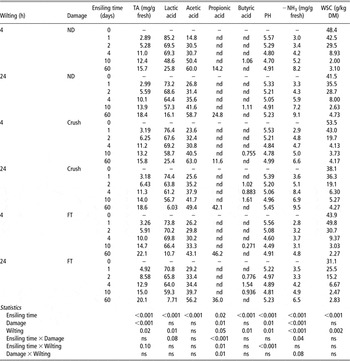
Fermentation acid content and composition, pH, total volatile alkaline compounds, DM and WSC content of the silages (Table 1) were considered silage quality measures. Until 4 to 10 days of ensiling, quality was acceptable. The increase in pH and decrease in lactic acid, increase in acetic acid and appearance of propionic acid from 10 to 60 days of ensiling shows that silages were of inferior quality. There was an increase in concentration of total volatile alkaline compounds during ensiling. Total volatile alkaline compound concentration was lowest in FT silages. The WSC content after wilting was generally lower in red clover wilted for 24 h (48.6 ± 2.79 and 36.9 ± 3.06 g WSC per kg DM for 4 or 24 h wilted, respectively) and lowest for 24 h wilted and FT red clover (31.1 ± 2.26 g WSC per kg DM). However, during ensiling WSC content was strongly decreased in all silage to an average over all treatments of 3.56 ± 0.394 g WSC per kg DM.
Silage parameters (lactic, acetic, propionic and butyric acid (g per 100 g of total fermentation acids) TA, volatile alkaline compounds (−NH3), DM content, pH and WSC content of damaged (ND), crushed (crush) and FT, wilted (4 and 24 h) and ensiled red clover (n = 3)

TA = total fermentation acid; DM = dry matter; WSC = water-soluble carbohydrate; ND = not damaged; FT = frozen/thawed; ns = non-significant at P ⩾ 0.1; nd = not detected.
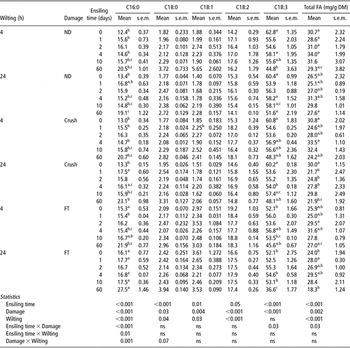
The FA content and composition of red clover was clearly affected by ensiling. Damaging and wilting had variable effects (Table 2). Total FA content increased during the first days of ensiling, followed by a decrease for all treatments. Damaging before wilting resulted in a lower total FA content in the silage, especially in FT forages. Wilting for 24 h compared to 4 h also resulted in a lower total FA content of the silages. The proportion of C18:3 was higher in ND and crushed (61.0 ± 1.45 g per 100 g of total FA) compared with FT forages (52.1 ± 2.71 g per 100 g FA). The C18:3 proportion decreased slightly during the first 10 days of ensiling, except for FT forages, where a slight increase was observed. Between 10 and 60 days of ensiling, there was a strong decrease in proportion of C18:3 to 36.6 ± 1.77 g per 100 g total FA for FT and 24 h wilted red clover and to 47.7 ± 2.69 g C18:3 per 100 g of total FA for all other treatments. Ensiling affected all FA except for C18:1 and C18:2. The C18:2 proportion was affected by damaging (with an average 15.9 ± 0.63, 16.5 ± 0.70 and 17.9 ± 0.41 g C18:2 per 100 g of total FA for ND, crushed and FT silages, respectively) and by wilting (with an average 17.3 ± 0.42 and 16.2 ± 0.38 g C18:2 per 100 g of total FA for 4 and 24 h wilted forages, respectively). C18:1 and C18:0 were only slightly affected by ensiling, damaging and wilting.
FA content and composition for the most abundant FA (g/100 g of FA methyl esters) of red clover damaged to a different degree (ND), crushed (crush) or FT, wilted (4 or 24 h) and ensiled (n = 3)

FA = Fatty acid; ND = not damaged; FT = frozen/thawed; ns = non-significant at P ⩾ 0.1.
a,b,c indicate difference between treatments within ensiling time when interactions with damage or wilting occured at P < 0.05.
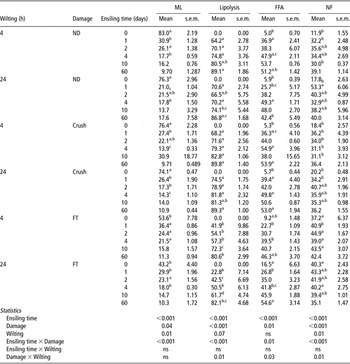
After wilting, ML was highest in the ND (4 h) and lowest in the FT forages (4 and 24 h) (Table 3). Because FT, FFA and neutral fractions were strongly increased; the ND after 24 h of wilting and both crushed and FT forages wilted for 4 or 24 h showed a higher neutral lipid proportion compared with ND after 4 h of wilting. All fractions were strongly affected by ensiling, except for the neutral fraction in the FT forages. ML decreased and FFA increased in all treatments. However, after 10 and 60 days of ensiling the proportion of total FA in the ML, FFA and neutral fraction were similar for all treatments. In silo lipolysis was lower in silages of FT red clover compared with crushed and ND and was not affected by wilting, or only to a low extent.
Distribution of total FA over the three lipid fractions (ML, FFA and NF) and lipolysis of red clover damaged to a different degree (ND, crushed (crush) or FT), wilted (4 or 24 h) and ensiled (n = 3)

FA = Fatty acid; ML = membrane lipids; FFA = free fatty acids; NF = neutral fraction; ND = not damaged; FT = frozen/thawed; ns = non-significant at P ⩾ 0.1.
Lipolysis was calculated as ((percentage of total FA present in the ML after wilting) − (percentage of total FA present in ML after ensiling))/(percentage of total FA present in the ML after wilting).
a,b,c indicate difference between treatments within silage duration at P < 0.05.
In vitro incubations
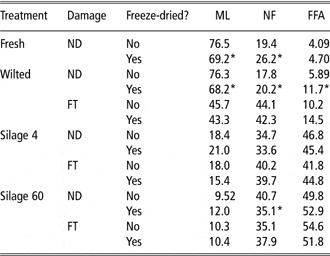
Forages used for in vitro incubations were freeze-dried. Therefore, the effect of freeze-drying on the proportion of FA in the lipid fractions was tested. For fresh, wilted and ND 60 days ensiled red clover, there was a minor effect of freeze-drying, for silages there was no effect (Table 4).
Influence of freeze-drying of fresh, wilted or ensiled (4 and 60 days after wilting) red clover ND or FT before wilting on percentage of total fatty acids present in the lipid fractions (ML, NF and FFA) (n = 3)

ND = not damaged; FT = frozen/thawed; ML = membrane lipids; NF = neutral fraction; FFA = free fatty acids.
*Indicates significant (P < 0.05) difference from not freeze-dried within treatment and damage.
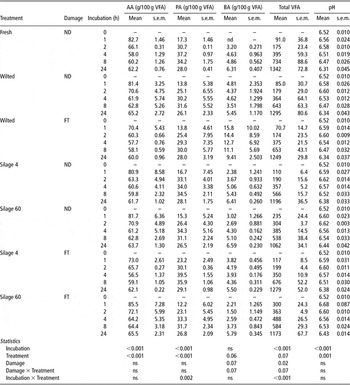
The pH of the rumen fluid, total VFA produced and proportion of acetic, propionic and butyric acid produced during incubation are presented in Table 5. Proportion of acetic and propionic acid were influenced by the treatment. Nevertheless, differences between treatments were numerically small. The interaction between incubation time and treatment for the total VFA production was mainly caused by the difference after the first hours of incubation between fresh or wilted, 4- and 60-day silages (82.2 ± 10.4, 113 ± 5.4 and 267 ± 45.9 μmol per incubation flask, respectively). However, after 8 and 24 h of incubation, no difference in total VFA production between treatments occurred.
VFA production (μmol/incubation flask), proportion of most important VFA (AA, PA and BA in mol/100 mol VFA) and pH during batch incubation in rumen fluid in vitro at different times of freeze-dried red clover (fresh, wilted without damaging or FT and ensiling after wilting and damaging or not (4 or 60 days)) (n = 3)

AA = acetic acid; VFA = Volatile fatty acid; PA = propionic acid; BA = butyric acid; ND = not damaged; FT = frozen/thawed; nd = not detected; ns = non-significant at P ⩾ 0.1.
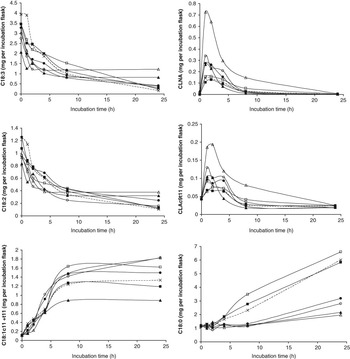
Owing to the pretreatment of the forages the content of C18:3 was already lower in the incubation flasks of ND 4-day silage compared with the fresh forage (2.74 ± 0.362 and 3.93 ± 0.292 mg C18:3 per incubation flask) and of FT 60-day silage (2.07 ± 0.356 mg C18:3 per incubation flask) compared with the fresh and wilted forages (3.45 ± 0.408 mg C18:3 per incubation flask) before the start of the incubations (Figure 1). During incubation a strong decrease in C18:3 and C18:2 occurred in all treatments. After 24 h of incubation the content of C18:3 was highest with ND 60-day silage (1.22 ± 0.339 mg C18:3 per incubation flask) although not significantly different from FT 60-day silage. The latter differed from incubations with fresh and wilted forages (0.167 ± 0.041 and 0.275 ± 0.066 mg C18:3 per incubation flask), but not from incubations of 4-day silage (0.402 ± 0.052 mg C18:3 per incubation flask). The content of C18:2 was also highest in incubations with ND 60-day silages after 24-h incubation, however not differing from FT 60-day silage and ND 4-day silage incubations. Both C18:2 and C18:3 content were numerically lowest after 24-h incubation of fresh forage, although not significantly differing from wilted and 4-day silage incubations.
Most abundant FA of the biohydrogenation pathway of C18:2 and C18:3 (CLA = conjugated linoleic acid, CLNA = conjugated linolenic acid, C18:1c11 + t11 and C18:0) in mg per incubation flask during clover (fresh, wilted without damaging or freeze thawed (FT)) and ensiling after wilting (4 or 60 days) of freeze-dried red clover (fresh, ×; wilted (24 h) without damaging (ND, □) or (FT, ▪) followed by ensiling during 4 days (ND, ○ and FT, ●) or 60 days (ND, ▴ and FT, ▵) (n = 3).

A transient, increase in conjugated linoleic acid (CLA) and conjugated linolenic acid (CLNA) during the first hours of incubation was observed. After 24 h of incubation almost all CLA and CLNA had disappeared. However, the content of CLNA after 1 h of incubation was higher with silages compared with the fresh and wilted forages (0.39 ± 0.085, 0.14 ± 0.022 and 0.13 ± 0.020 mg per incubation flask, respectively). After 1 h of incubation the content of C18:1c11 + t11 was lower in incubations with silages compared with fresh (0.19 ± 0.017 and 0.36 ± 0.091 mg per incubation flask, respectively). The content of C18:0 also increased during the incubation in all treatments, however, after 24 h of incubation, the C18:0 content was 6.01 ± 1.18 mg per incubation flask with fresh and 6.2 ± 0.83 mg per incubation flask with wilted forages and only 2.5 ± 0.56 mg per incubation flask with silages. After 24 h of incubation there was no difference in C18:0 content between 4- and 60-day silages.
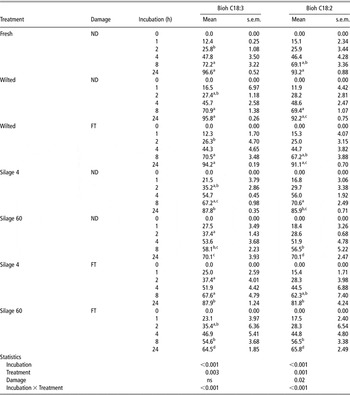
Biohydrogenation was not consistently affected by wilting or ensiling and damaging at all incubation times (Table 6). For C18:3, this was due to the higher biohydrogenation during the first hours of incubation of silages, which only reached significance for some silages after 2 h of incubation. After 24 h of incubation with 4-day silages 87.8% ± 0.82% and with 60 day only 67.3% ± 2.93% of C18:3 was biohydrogenated, compared with 95.0% ± 0.25% with wilted and 96.6% ± 0.52% with fresh forages. C18:2 biohydrogenation did not show differences between treatments during the first hours of incubation. However, after 24 h of incubation biohydrogenation of C18:2 was also lower with silages compared with fresh material.
Biohydrogenation of C18:3 and C18:2 during batch incubation in rumen fluid in vitro at different times of freeze dried red clover (fresh, wilted without damaging or FT) and ensiling after wilting (4 or 60 days) (n = 3)

ND = not damaged; FT = frozen/thawed; ns = non-significant at P ⩾ 0.1.
a,b,c indicate difference between treatments within incubation duration at P < 0.05.
Discussion
Silages
In all red clover silages, an increase in pH and a degradation of lactic acid occurred between 10 and 60 days of ensiling. This shows that silages never got to the stable phase, which is characteristic for silages of inferior quality (Pahlow et al., Reference Pahlow, Muck, Driehuis, Oude Elferink and Spoelstra2003). This lower quality was most probably due to the low dry matter content of the forages at ensiling (177 to 212 g DM per kg) in combination with low WSC contents after wilting (31.1 to 53.5 g/kg DM) and a possible high buffering capacity (Buxton and O’Kiely, Reference Buxton and O’Kiely2003). The lack of silages of acceptable quality could impair the extrapolation of these results to farm level. Nevertheless, results could still add to the insight in the link between lipid metabolism in red clover silages and in vitro rumen metabolism.
The increase in silage pH and degradation of lactic acid were accompanied by a decrease in FA content, mainly due to the disappearance of C18:3. A concomitant increase in unidentified peaks in the GC chromatogram was observed. Three peaks, which were most likely FA and were individually higher than 0.50 g per 100 g of total FA were included in the total FA sum and represented up to 7.74 g per 100 g of total FA. Injection of these samples on a 100 m CPSill 88 confirmed that this were most probably trans–trans C18:2 isomers (data not shown). This could suggest a metabolism of unsaturated FA to trans-FA and/or FA that are usually not observed in these silages. Nonetheless, a decrease in total FA was measured, indicating also a degradation of mainly C18:3 to non-FA. A shift in the FA composition toward a higher proportion of saturated FA in silages of a lower quality has been postulated before by Van Ranst et al. (Reference Van Ranst, Fievez, De Riek and Van Bockstaele2009a) and seems to be confirmed by these results.
The lipid fractions were changed during ensiling, showing the importance of lipid metabolism in the silage. FFA became the largest fraction mainly due to the hydrolysis of lipids from the ML fraction, which was extensive as up to 74.5% was hydrolyzed after 1 day of ensiling. As discussed extensively in Van Ranst et al. (Reference Van Ranst, Fievez, Vandewalle, De Riek and Van Bockstaele2009b), a higher degree of damaging resulted in higher amounts of protein-bound phenols in the forages after wilting. Therefore, the lower in silo lipolysis in silages of FT forages could indicate the importance of protein-bound phenols in lipolysis inhibition, as has been suggested before (Lee et al., Reference Lee, Winters, Scollan, Dewhurst, Theodorou and Minchin2004; Van Ranst et al., Reference Van Ranst, Fievez, Vandewalle, De Riek and Van Bockstaele2009b). Despite the higher amount of protein-bound phenols in crushed compared with ND forages, an effect on in silo lipolysis was lacking. This suggests that severe damaging, as provoked by freezing followed by thawing, induces higher amounts of protein-bound phenols, which is needed to limit in silo lipolysis.
Even though the difference between the lowest and the highest lipolysis after 60 days of ensiling was limited (80.6% for FT and 4 h wilted silages v. 89.8% for crushed and 4 h wilted silages), lipolysis during the first 2 days of ensiling in FT silages was only half to one third of the lipolysis in silages of crushed and ND red clover. This might be explained by the lipase inhibiting role of protein-bound phenols (Van Ranst et al., Reference Van Ranst, Fievez, Vandewalle, De Riek and Van Bockstaele2009b). A reduced plant lipase activity, due to the binding of phenols, led to a lower lipolysis in the first days of ensiling. However, microbial lipases, which only become abundant during ensiling, were not affected by bound phenols, as protein-bound phenols originate mainly during wilting (Lee et al., Reference Lee, Tweed, Minchin and Winters2009). Microbial lipases become more abundant with increasing microbial activity during ensiling, and therefore could be responsible for the decreasing difference in lipolysis between FT and other silages. After 1 day of ensiling fermentation acid production was still rather low suggesting only minor microbial activity, and thus only minor microbial lipolysis.
The neutral lipid fraction increased dramatically in all silages except for the FT silages in which the neutral fraction was already high after wilting. The neutral fraction mainly consists of DAG, TAG and MAG. Therefore, an increase in the neutral fraction can be caused by two processes: first, an increase in DAG due to galacto- and phospholipases, as they hydrolyze the bound between the galactose-group or the phosphorus-group and the glycerol in digalacto- and monogalactodiacylglycerols and phospholipids, respectively (Dörmann, Reference Dörmann2005). Second, diacylglycerol acyltransferase (DGAT) activity can result in an increase in TAG. The DGAT is responsible for the incorporation of FFA in mono- and digalactosyl glycerides resulting in TAG (Kaup et al., Reference Kaup, Froese and Thompson2002; Lung and Weselake, Reference Lung and Weselake2006). The activity of DGAT has been reported before in silages (Fievez et al., Reference Fievez, Ensberg, Chow and Demeyer2004; Van Ranst et al., Reference Van Ranst, Fievez, De Riek and Van Bockstaele2009a). The lack of increase in the neutral fraction in the FT silages could be due to an inhibition of these enzymes, similar to lipase inhibition. However, it can not be excluded that a steady-state occurs, meaning that neutral fraction was formed due to DGAT, galacto- and phospholipase activity, but are at the same time degraded due to lipase activity, and that about 40% neutral fraction and 50% FFA represents the steady state of this process under our specific conditions. Despite the intensive lipid metabolism, no differences in lipid fractions between ND, crushed and FT red clover were apparent after 60 days of ensiling.
In vitro incubations
Forages were freeze-dried and ground to obtain a sufficiently uniform substrate, suitable for the in vitro incubations. For fresh and wilted forages, there was only a minor effect of freeze-drying on lipid fractions. In silages, there was no effect. Nevertheless, caution should be taken in quickly freezing before freeze-drying, as enzymes still have shown activity during the storage and/or freeze-drying process. It cannot be excluded that other parameters were also influenced (e.g. physical form, protein degradability), however the quick freezing before freeze-drying should have prevented major changes. Grinding of the forage has been found needed to avoid major variation in lipid metabolism due to differences in forage physical structure (own observations).
For the in vitro batch rumen incubations only fresh, wilted (24 h), 4- or 60-day silages of ND or FT forages were used. No major differences occurred in VFA and pH between treatments during the incubations, indicating that no differences in bacterial activity occurred between treatments during the incubations.
Ruminal biohydrogenation of C18:3 and C18:2 involves the formation of conjugated intermediates that are further hydrogenated to C18:1t11 and finally C18:0 as the main end product. With all treatments an extensive biohydrogenation of C18:3 and C18:2 occurred. However, the higher formation of CLNA and CLA with 4- and 60-day silages (Figure 1) during first hours of incubation indicated that biohydrogenation of FA in silages was higher compared with fresh and wilted forages during these first hours of incubation. These indications for a difference in biohydrogenation between fresh and ensiled forages was confirmed by the results of the apparent biohydrogenation, which could be explained by the higher concentration of FFA in the silages compared with fresh and wilted forages (Table 6). Because lipolysis is a prerequisite of biohydrogenation, FFA are more prone to biohydrogenation than esterified FA (Harfoot and Hazlewood, Reference Harfoot and Hazlewood1997).
A higher proportion on total C18 FA of C18:3 and C18:2 remains after 24 h of incubation in 60 and to a lower degree in 4-day silages compared with wilted and fresh (4.9%, 2.8%, 1.2% and 1.1% for C18:2 and 14.1%, 5.5%, 2.6% and 1.8% for C18:3, respectively, expressed as a percentage of C18 FA). This indicates an effect of ensiling on rumen biohydrogenation. However, in contrast to what is generally accepted both in vitro (Boufaied et al., Reference Boufaied, Chouinard, Tremblay, Petit, Michaud and Belanger2003b) as well as in vivo (French et al., Reference French, Stanton, Lawless, O’Riordan, Monahan, Caffrey and Moloney2000; Whiting et al., Reference Whiting, Mutsvangwa, Walton, Cant and McBride2004), a lower biohydrogenation with ensiled compared with fresh forages was found in this study. Although, the explanation for this contradiction is not unambiguously clear, it might be linked to the presence in silages and to a lower extent in fresh or wiled forages of bound phenols. Indeed, protein-bound phenols have been suggested to protect lipids by encapsulation of lipids in protein–phenol complexes (Lee et al., Reference Lee, Scott, Tweed, Minchin and Davies2008; Lourenço et al., Reference Lourenço, Van Ranst, Vlaeminck, De Smet and Fievez2008), which would be similar to the protection of lipids against biohydrogenation using formaldehyde (Gulati et al., Reference Gulati, Garg and Scott2005). Nevertheless, differences in protein-bound phenols after wilting of ND and FT silages did not result in differences in biohydrogenation in in vitro incubations. Thus more extensive damaging, resulting in a higher amount of bound phenols, did not lead to a lower biohydrogenation.
A possibility for the lower biohydrogenation in incubations of silages compared with fresh or wilted forages is that the process of ensiling caused lower biohydrogenation. This could be due to the low quality of the silages, although, no support for this could be found in the literature. Furthermore, a lower biohydrogenation was also found with 4-day silages in which no indication for a lower quality in silage parameters (Table 2) could be found. It cannot be excluded that the ensiling process promoted the gradual formation of certain compounds (e.g. polyphenols) or further binding of quinones and phenols to proteins and/or lipids which could influence rumen biohydrogenation. Obviously, further research is needed to elucidate the role of protein-bound phenols and PPO activity in lipid protection against lipolysis and biohydrogenation.
Not only biohydrogenation of C18:3 was lower but also the proportion of C18:1c11 + t11 to total C18 FA was higher after 24 h of incubation of silages compared with wilted and fresh forages, indicating an accumulation of biohydrogenation intermediates. Therefore, not only an inhibition of the biohydrogenation of PUFA occured, but also of the biohydrogenation intermediates. Once C18:3 and C18:2 were hydrogenated to CLNA and CLA, it can be assumed that these FA were no longer protected by protein-bound phenols. This implies that a reduced efficiency of the subsequent biohydrogenation steps could not have been due to lipid protection owed to protein-bound phenols. However, the accumulation of biohydrogenation intermediates (mainly C18:1t11) in incubation of silages could also be due to the plant secondary compounds and/or volatile organic compounds (Lee et al., Reference Lee, Huws, Scollan and Dewhurst2007), potentially originating during ensiling, as mentioned before. As the last step of biohydrogenation has been found to be the most sensitive to inhibition, it is not surprising that plant secondary metabolites and volatile organic compounds would mainly induce the accumulation of C18:1t11. Finally, in our incubations up to 0.1 mg free C18:3 per milliliter of incubation fluid was present in the silage added to an incubation flask. This was most likely not sufficient to influence in vitro biohydrogenation rate because a relatively high proportion of C18 PUFA (>0.5 mg/ml) in the form of FFA is needed to result in an accumulation of biohydrogenation intermediates (Fievez et al., Reference Fievez, Vlaeminck, Jenkins, Enjalbert and Doreau2007), particularly C18:1t11.
Conclusions
Ensiling dramatically reduces the amount of membrane lipids. Freezing and thawing before wilting, which resulted in a higher amount of protein-bound phenols, strongly inhibited lipolysis in the first days of ensiling. This suggested inhibition of plant lipases in FT silages. The decrease of the difference in lipolysis between frozen/thawed and other silages between 4 and 60 days of ensiling suggests that increases in protein-bound phenols due to damaging inhibited plant lipases, but did not seem to protect lipids against microbial lipases. The higher observed biohydrogenation in the first hours of incubation of 60 days silages compared with fresh forages indicated that higher concentrations of FFA increase the biohydrogenation rate. However, the lower biohydrogenation after 24-h incubations of 4- and 60-day silages, regardless of damaging before wilting, compared with incubations of fresh and wilted forages could be due to (compounds originating during) ensiling or lipid protection due to further binding of quinones to proteins and/or lipids in the silage.
Acknowledgments
The PhD Grant of G. Van Ranst is funded by the Institute for Agriculture and Fisheries Research (ILVO) – Belgium. Research is partially funded by IWT – Institute for the Promotion of Innovation by Science and Technology in Flanders. The authors highly appreciate the technical assistance of the staff of LANUPRO (UGent) and more in particular An Ovyn and Sjarai Deschildre.