Introduction
Bipolar disorder is a severe and chronic disorder (APA, 2000) ranked as a leading cause of medical disability worldwide (WHO, 2001). Despite advances in the treatment of bipolar disorder, recurrence rates remain high (Gitlin et al. Reference Gitlin, Swendsen, Heller and Hammen1995) and many patients continue to experience subsyndromal symptoms and functional impairments even after recovery (e.g. Coryell et al. Reference Coryell, Scheftner, Keller, Endicott, Maser and Klerman1993; Robb et al. Reference Robb, Cooke, Devins, Young and Joffe1997; Joffe et al. Reference Joffe, MacQueen, Marriott and Trevor Young2004). These persistent concerns highlight the need to better understand the predictors of illness course.
The literature suggests that life stress has an important role in triggering and sustaining episodes in bipolar disorder (for a review see Johnson & Roberts, Reference Johnson and Roberts1995). Most of this research focuses on acute stressors, such as negative life events. In longitudinal studies of bipolar disorder, severe negative life events have been found to predict poor illness course, including increased depressive symptoms (Johnson et al. Reference Johnson, Winett, Meyer, Greenhouse and Miller1999), higher risk of relapse (Ellicott et al. Reference Ellicott, Hammen, Gitlin, Brown and Jamison1990; Hammen & Gitlin, Reference Hammen and Gitlin1997) and a threefold increase in episode duration (Johnson & Miller, Reference Johnson and Miller1997).
Chronic stressors have received less attention in mood disorders research, and when examined, definitions vary across studies. The omission, or inconsistent assessment, of this form of stress interferes with accurate estimation of the contribution of stress to psychopathology (Hammen, Reference Hammen2005). Findings suggest that chronic stressors are strongly predictive of illness course, and in some cases, more so than acute stressors. For example, Kim et al. (Reference Kim, Miklowitz, Biuckians and Mullen2007) found that, among bipolar youth, severe chronic stressors in intimate relationships (family and romantic) and with peers predicted more severe mood symptoms. By contrast, severity of acute stressors did not predict mood symptoms in this study (Kim et al. Reference Kim, Miklowitz, Biuckians and Mullen2007). Such findings highlight the importance of assessing chronic stressors, but few studies have done so in bipolar disorder.
As suggested by Kim et al. (Reference Kim, Miklowitz, Biuckians and Mullen2007), there is also evidence that interpersonal stressors may have particular importance for the course of bipolar disorder. Interpersonal stressors have been associated with faster depression relapse within bipolar samples (Johnson & Fingerhut, Reference Johnson, Fingerhut, Jones and Bentall2006). For example, low social support (Cohen et al. Reference Cohen, Hammen, Henry and Daley2004) and conflictual relationships (Yan et al. Reference Yan, Hammen, Cohen, Daley and Henry2004) predict faster depressive recurrence among persons with bipolar I disorder.
Exposure to trauma is also important to consider within bipolar disorder. Alarmingly high rates of trauma have been documented among people with bipolar disorder and other mental illnesses. For example, in a study of 782 patients diagnosed with schizophrenia, major depression or bipolar disorder, more than 80% reported lifetime physical trauma and over half reported lifetime sexual trauma (Meuser et al. Reference Meuser, Salyers, Rosenberg, Essock, Osher, Swartz and Butterfield2004). Similar rates of trauma have been documented in purely bipolar samples (Garno et al. Reference Garno, Goldberg, Ramirez and Ritzler2005; Maguire et al. Reference Maguire, McCusker, Meenagh, Mulholland and Shannon2008). Beyond its high prevalence, trauma may predict a more difficult course including more severe mood symptoms and increased suicidality (Leverich et al. Reference Leverich, McElroy, Suppes, Keck, Denicoff, Nolen, Altshuler, Rush, Kupka, Frye, Autio and Post2002; Garno et al. Reference Garno, Goldberg, Ramirez and Ritzler2005; Maguire et al. Reference Maguire, McCusker, Meenagh, Mulholland and Shannon2008).
With regard to bipolar disorder, we are aware of only two studies that have conjointly considered the influence of trauma and other stressors in bipolar disorder (Dienes et al. Reference Dienes, Hammen, Henry, Cohen and Daley2006; Pavolva et al. Reference Pavlova, Uher, Dennington, Wright and Donaldson2011). Studies that consider trauma and other stressors are needed, in part, because exposure to trauma has been associated with higher levels of psychosocial stressors (Leverich et al. Reference Leverich, McElroy, Suppes, Keck, Denicoff, Nolen, Altshuler, Rush, Kupka, Frye, Autio and Post2002), and specifically interpersonal stressors (Maguire et al. Reference Maguire, McCusker, Meenagh, Mulholland and Shannon2008), in bipolar samples. It is possible that exposure to trauma amplifies reactivity to other stressors (Hammen et al. Reference Hammen, Henry and Daley2000). Supportive of this view, persons with a history of childhood trauma have been shown to be more vulnerable to developing depression following other life stressors (Hammen et al. Reference Hammen, Henry and Daley2000; Kendler et al. Reference Kendler, Kuhn and Prescott2004; Rudolph & Flynn, Reference Rudolph and Flynn2007). In bipolar disorder, adults with a history of trauma were more likely to relapse after recent stressors than were those without a trauma history (Dienes et al. Reference Dienes, Hammen, Henry, Cohen and Daley2006). History of trauma also predicted increased affective reactivity to a stressful laboratory task among remitted bipolar adults (Pavlova et al. Reference Pavlova, Uher, Dennington, Wright and Donaldson2011). Thus, there is evidence that, among bipolar adults, trauma may amplify reactivity to stressors in both naturalistic and laboratory settings.
To summarize, exposure to stressors, particularly interpersonal stressors, and also to trauma has been shown to have deleterious effects on the course of bipolar disorder. Despite the strength of these findings, most studies have focused on acute stressors, with few examinations of the effects of chronic stressors or trauma on bipolar illness course. Furthermore, we are aware of only one study in bipolar disorder that conjointly examined the effects of trauma and chronic stressors on course of illness (Dienes et al. Reference Dienes, Hammen, Henry, Cohen and Daley2006).
The aim of the present study was therefore to use longitudinal data to examine whether trauma and chronic stressors are prospectively associated with course of illness among bipolar patients. We hypothesized that: (1) exposure to trauma would intensify the adverse effects of chronic stressors on illness course; that is, we predicted an interaction between trauma and chronic stressors on illness course; and (2) exposure to trauma would be related to a greater propensity towards chronic stressors, and particularly interpersonal stressors. In this study, we consider chronic stressors overall, along with more specific indices, including interpersonal chronic stressors and ‘independent’ chronic stressors (stressors that are independent of the behavior or characteristics of the participant).
Method
Participants
Analyses focused on 131 adults between 18 and 65 years of age with a diagnosis of bipolar disorder type I who completed measures of trauma and chronic stressors as part of a larger study (Johnson et al. Reference Johnson, Cuellar, Ruggero, Winett-Perlman, Goodnick, White and Miller2008). Diagnoses were confirmed using the Structured Clinical Interview for DSM-IV (SCID; First et al. Reference First, Spitzer, Gibbon and Williams1995). Participants were recruited from two sites (South Florida and Rhode Island) during hospital admissions for bipolar disorder, and also through out-patient treatment centers, support groups and community advertising. Participants were excluded from participation on the basis of: (1) neurological disorders; (2) substance abuse or dependence within the past year (assessed using the SCID); and (3) English language difficulties, mental retardation or developmental disabilities that were severe enough to interfere with ability to independently complete self-report measures.
Procedure
All procedures for this study were approved by the relevant institutional review boards. All participants gave signed informed consent, and their diagnostic status and clinical history were assessed using the SCID. The SCID was administered by trained clinical psychology graduate students and supervised by S.L.J. Medication levels were assessed. At study entry and monthly follow-ups, participants were assessed for severity of depressive and manic symptoms using the Modified Hamilton Rating Scale for Depression (MHAMD; Miller et al. Reference Miller, Bishop, Norman and Maddever1985) and the Bech–Rafaelsen Mania Rating Scale (BRMS; Bech et al. Reference Bech, Bolwig, Kramp and Rafaelsen1979). Symptom interviews were administered by telephone or in person (depending on participant preference). Telephone interviews have been shown to be a reliable and valid manner of gathering symptom data (Potts et al. Reference Potts, Daniels, Burnam and Wells1990; Simon et al. Reference Simon, Revicki and VonKorff1993). Chronic stressors were assessed at 2-, 6-, 12-, 18- and 24-month follow-up intervals using the Bedford College Life Event and Difficulty Schedule (LEDS; Brown & Harris, Reference Brown and Harris1978). Interviewers were trained by S.L.J. Exposure to trauma was assessed at the first LEDS interview. LEDS interviews were completed by in-person visits. The 131 participants included in the analyses completed a total of 3013 symptom severity interviews, with a mean follow-up length of 23.6 months (s.d. = 10.8, range 2–45 months).
Measures
Diagnosis
The SCID (First et al. Reference First, Spitzer, Gibbon and Williams1995) was used to assess Axis I psychiatric disorders. Reviews of audiotaped interviews were performed repeatedly and inter-rater reliability estimates were consistently high, with intraclass correlations for specific symptoms >0.92.
Mood symptom severity
Current depressive symptoms were assessed using the 17-item version of the MHAMD (Miller et al. Reference Miller, Bishop, Norman and Maddever1985). This version was developed to improve the instrument's validity and reliability by incorporating standardized prompts and behavioral anchors for rating points. Each item is rated from 0 to 2 or 4. Items are summed to yield a possible total score of 52. Scores ⩽7 indicate remission. Scores above 17 indicate clinically significant depression. The MHAMD correlates highly with the original HAMD and with clinician ratings of depression (Miller et al. Reference Miller, Bishop, Norman and Maddever1985). Current manic symptoms were assessed using the BRMS (Bech et al. Reference Bech, Bolwig, Kramp and Rafaelsen1979), which consists of 11 items rated on a five-point scale. Scores below 7 indicate remission. Scores above 15 indicate clinically significant mania. The scale has high inter-rater reliability and internal consistency and is sensitive to changes in mania symptoms (Bech et al. Reference Bech, Baastrup, de Bleeker and Ropert2001). Both scales were used to capture the most severe week of the past month. Intraclass inter-rater reliability coefficients were high for the MHAMD (r = 0.93) and the BRMS (r = 0.92). The internal consistencies were also high (α = 0.90 and α = 0.96 respectively, n = 131).
Medication treatment adequacy
The Somatotherapy Index (Bauer et al. Reference Bauer, McBride, Shea and Gavin1997) was used to quantify medication adequacy. This index is tailored for bipolar disorder, but based on the National Institute of Mental Health (NIMH) Collaborative Program on the Psychobiology of Depression-Clinical Studies, Project Medication Coding (Mueller et al. Reference Mueller, Leon, Keller, Solomon, Endicott, Coryell, Warshaw and Maser1999). Participants provided information about dosage, compliance and blood serum levels for mood-stabilizing, antidepressant, antipsychotic, anxiolytic and other psychotropic medications. Medical records were requested and reviewed for verification where available. Overall somatotherapy score is rated on a six-point scale, ranging from 0 to 5. Scoring is based on a fairly detailed set of tables, but as an example of the maximal rating, a patient must maintain a minimum of 4 weeks of lithium levels ⩾0.8 mEq/l or carbamazapine levels ⩾8 μg/dl or valproate levels ⩾75 μg/dl or ⩾300 mg/day of imipramine hydrochloride or its equivalent. Dose equivalencies are computed for traditional and atypical antipsychotic medications and benzodiazepine. Complex or novel regimens were rated by consensus. Analyses here focused on the overall somatotherapy score, and because of the large proportion of patients who were taking lithium (48%), the lithium somatotherapy code. Medication adequacy could not be estimated reliably for 26 individuals because of their poor memory coupled with difficulties obtaining medical records requested. Because missing data patterns were random and unrelated to key indices, multiple imputation was conducted for missing values on lithium.
Occupational status
The Occupational subscale of the Hollingshead Index (Hollingshead, Reference Hollingshead1957) was used to measure occupational status. The Hollingshead Index is one of the most widely used measures of socio-economic status, with high inter-rater reliability, in addition to strong external validity with academic and cognitive measures (Cirino et al. Reference Cirino, Chin, Sevcik, Wolf, Lovett and Morris2002). Ratings were only calculated for those with recent workforce participation. Of those rated, 53.4% were rated as clerical or higher.
Severity of chronic stressors
Stressors were assessed using the LEDS (Brown & Harris, Reference Brown and Harris1978). In the LEDS system, chronic stressors are referred to as ‘difficulties’ and defined as problematic situations that last a minimum of 4 weeks. Chronic stressors are assessed across a variety of life domains (e.g. health, work, housing, relationships). Reliability was established before the first interview was conducted, and audiotapes of the interviews were routinely reviewed to ensure reliability. Interviewers prepared a narrative summary of stressors that excluded information relating to the participant's symptom status and subjective responses to the stressors. These summaries were presented to a panel of independent raters. All raters completed extensive LEDS training, which included documented reliability with gold standard ratings, before contributing to the database. The LEDS system uses extensive manuals to provide anchoring examples and standardization. Each rater independently provided their ratings of the severity of chronic stressors, and all discrepancies were resolved through group discussion and consensus. LEDS rater reliability was monitored at every rating meeting. Rater discrepancies were reviewed regularly, and any rater with consistent discrepancies received additional training to restore reliability.
Chronic stressors were rated on a seven-point severity scale. Severe chronic stressors are those rated 1–4 and are typically unemployment, severe financial circumstances or major problems in core personal relationships. For ease of interpretation, traditional LEDS scores were reversed, such that higher chronic stressor scores reflected greater severity throughout this article. An overall chronic stressor score was computed for each participant. Three specific stressor indices were also computed: (1) independent chronic stressors, defined as stressors rated as independent of the behavior or characteristics of the participant (e.g. a mother's ongoing illness, a husband's unemployment); (2) dependent chronic stressors, defined as stressors rated as at least partly dependent upon the behavior/characteristics of the participant (e.g. relationship difficulties); and (3) interpersonal chronic stressors, or stressors that involve a significant interaction between the participant and another person, or directly affect the relationship between the participant and another person. Interpersonal chronic stressors did not include independent chronic stressors. In addition, to control for the possibility that symptoms could create stress, each chronic stressor was rated as ‘definitely’, ‘possibly’ or ‘unrelated’ to an episode of psychiatric illness. Chronic stressors rated as ‘definitely’ (e.g. loss of employment due to manic behaviors) or ‘possibly’ (e.g. debts that were partially related to manic overspending) related to psychopathology were excluded from analyses.
Trauma
Questions regarding lifetime trauma were embedded in the LEDS interview, and included coverage of relationship with parents, exposure to sexual trauma, incidents of physical injury, assault or threats of assault, and witnessing of violence. Participants were asked to broadly describe their relationship with both parents, and the nature of discipline and arguments. Participants were asked specifically about sexual trauma, including pressure, coercion or non-physical threats to have sexual contact, and also sexual contact with persons at least 5 years older than they were before the age of 13. Participants were asked about whether they were ever attacked with a weapon during their lifetime, and whether they had ever witnessed someone else being killed or seriously injured.
All traumatic events reported were coded by a trained staff member who did not receive information about the subjective effect of such events on the person. Traumatic events were only coded if considered objectively severe and, as with chronic stressors, were rated by consensus. Twenty-one participants reported exposure to sexual trauma, 10 participants reported being attacked with a weapon, 25 participants reported non-physical trauma (including neglect, deprivation and non-physical threats), and no participant reported witnessing a death or serious injury. Because base rates for specific forms of trauma were low, we collapsed across categories to examine all forms of trauma.
Data analysis
Before testing the hypotheses, we conducted two preliminary sets of analyses. First, we conducted bivariate correlations to examine whether severity of overall chronic stressors or exposure to trauma (presence/absence) was related to demographic or illness characteristics variables that could be potential confounds (age, gender, education, occupational status, overall somatotherapy code, lithium somatotherapy code, and number of months completed in the study). Spearman correlations were used for analyses with dichotomous variables. Second, given that our stressor indices (i.e. overall chronic stressors, independent chronic stressors, dependent chronic stressors, interpersonal chronic stressors) were not mutually exclusive, we conducted correlations to examine the extent to which various forms of stress related to each other.
We tested hypotheses by conducting two sets of analyses. First, we conducted correlations to examine whether severity of chronic stressors was related to trauma. Second, we conducted regression models to test for the effects of trauma, severity of overall chronic stressors, and the interaction of trauma by severity of overall chronic stressors on course of illness while controlling for the effects of confounds identified in our preliminary analyses. Separate parallel regression models were computed to consider outcome variables of depressive symptom severity, manic symptom severity and suicidality. The broad variable of overall chronic stressors was used in regression models, and follow-up correlational analyses were conducted to examine the effects of specific forms of stressors. All tests were completed using SPSS for Windows version 20.0 (IBM Corp., USA).
Results
Study attrition and sample characteristics
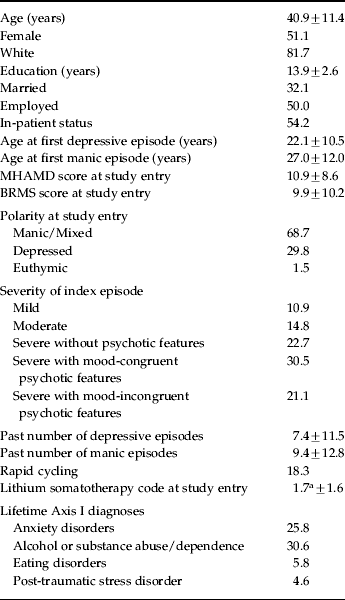
Two hundred and eighteen participants completed the diagnostic assessment and were enrolled in the study. After study entry, some people declined participation, were rediagnosed with schizo-affective disorder, moved, or were unable to provide enough detailed information for life stress coding, yielding a sample size of 166. Of these, 35 participants were not interviewed about trauma history, yielding a final sample size of 131. Those who did not complete the study did not differ from the study sample in age, gender, occupational status (coded using the Hollingshead Index), age at first depressive or manic episode, number of previous depressive or manic episodes, or severity of depressive or manic symptoms at study entry. However, those who did not finish the study had completed fewer years of education (mean = 13.0, s.d. = 2.1) than those in the study sample (mean = 13.9, s.d. = 2.6, t 176 = − 2.14, p = 0.034). The number of months in the study was negatively correlated with the severity of manic symptoms (BRMS; r = − 0.197, n = 130, p = 0.025). Demographic and clinical characteristics of the 131 study participants are displayed in Table 1.
Demographic and clinical characteristics of the 131 study participants

MHAMD, Modified Hamilton Rating Scale for Depression; BRMS, Bech–Rafaelsen Mania Rating Scale.
Values given as percentage or mean ± standard deviation.
Valid percentages are reported. One person was missing age, two were missing ethnicity, and three were missing employment. Thirty people were missing age at first depressive episode, five people were missing age at first manic episode, one person was missing MHAMD score at study entry, one person was missing BRMS score at study entry, three people were missing severity of index episode, 25 were missing number of depressive episodes, 13 were missing number of manic episodes, 26 were missing medication information at study entry, 34 were missing anxiety disorders diagnostic information, 46 were missing alcohol/substance or eating disorders diagnostic information, and 44 were missing post-traumatic stress disorder (PTSD) diagnostic information.
a Represents lithium levels that fall below 0.5 mEq/l.
Study participants were recruited from two sites: South Florida and Rhode Island. Compared with participants from Rhode Island, participants from South Florida reported near significantly more years of education (t 129 = 1.92, p = 0.057), were less likely to have in-patient status at study entry (χ21 = 44.8, p < 0.001), reported an earlier age at first manic episode (t 124 = − 2.20, p = 0.029), and had a lower lithium somatotherapy code at study entry (t 103 = − 4.02, p < 0.001). Rhode Island and South Florida participants were matched in age, gender, occupational status and age at first depressive episodeFootnote 1Footnote †.
Preliminary analyses
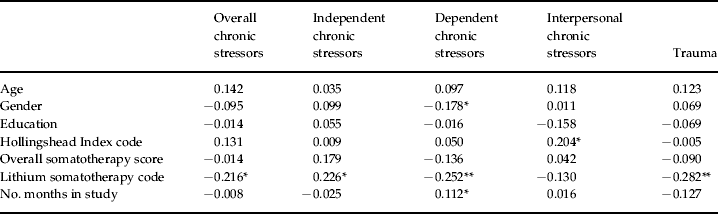
We conducted bivariate correlations to examine whether severity of overall chronic stressors or exposure to trauma was related to potential confounds. As shown in Table 2, of the 35 correlations considered, only seven were statistically significant. Gender was related to severity of dependent chronic stressors (with females experiencing less severe dependent chronic stressors). Higher occupational status was related to more severe interpersonal chronic stressors. A higher lithium somatotherapy code was related to lower severity of overall chronic stressors and dependent chronic stressors, and greater severity of independent chronic stressors. The lithium somatotherapy code was inversely related to the presence of trauma. A greater number of months in the study was related to more severe dependent stressors.
Correlations of severity of chronic stressors and exposure to trauma with potential confounds
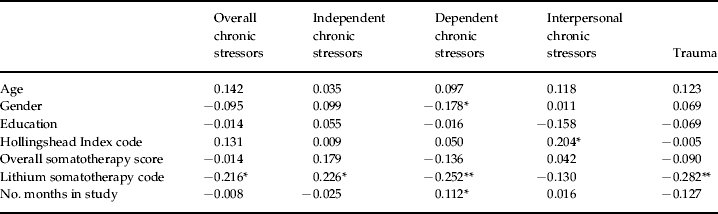
For ease of interpretation, traditional Life Event and Difficulty Schedule (LEDS) scores were reversed, such that higher chronic stressors scores reflect greater stressors severity. Correlations are based on n = 131.
* Statistically significant at p < 0.05. ** Statistically significant at p < 0.01.
Correlations were conducted to examine the extent to which various forms of stress related to each other, and also to their stability over time. As expected, the four chronic stressor indices demonstrated moderate correlations with each other (r's = 0.14–0.64, p's ranging from 0.11 to <0.001, n = 131). To examine the stability of stressors, we correlated the severity of overall chronic stressors at the first and final interviews within subjects. Test–retest reliability was high (r = 0.95, n = 131, p < 0.001). Given this, we focused on the severity of overall chronic stressors assessed at the first LEDS interview as a predictor of course of illness. The limited change precluded examining how changes in severity of overall chronic stressors influenced change in symptoms. Other publications have examined the role of acute stressors as predictors of mania and depression (Johnson et al. Reference Johnson, Cuellar, Ruggero, Winett-Perlman, Goodnick, White and Miller2008). As neither overall chronic stressors nor trauma were correlated with the severity of acute stressors (r = 0.06 and r = − 0.01 respectively, n = 131), we did not consider the role of acute stressors in this study.
Relationship between trauma and chronic stressors
We calculated bivariate correlations to examine whether those exposed to trauma were more likely to experience severe chronic stressors. Those who had a history of trauma had more severe interpersonal chronic stressors (r = 0.22, p < 0.05, n = 131), but trauma was not significantly correlated with other forms of stressors.
Effects of trauma and chronic stressors on illness course
Hierarchical multiple regression models were conducted to examine whether exposure to trauma amplified the effects of overall chronic stressors in predicting course of illness. Based on preliminary analyses, the confounds of gender and the lithium somatotherapy code were entered in the first block of each regression model using forward selection. Trauma and severity of overall chronic stressors were entered in the second block using the forced entry selection method. To test whether trauma amplified the effects of overall chronic stressors, the interaction of trauma with overall chronic stressors was entered in the final block using the forced entry selection method.
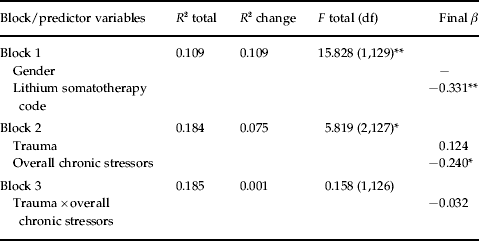
Trauma did not amplify the effects of overall chronic stressors on depressive symptoms. After controlling for gender, lithium somatotherapy code [β = −0.252, t = − 3.971, p < 0.001, confidence interval (CI) for β −1.651 to −0.552] and severity of overall chronic stressors (β = −0.240, t = − 2.407, p = 0.017, CI for β −1.321 to −0.133) were related to depressive symptom severity. Trauma did not exert a direct effect on depressive symptom severity. The final model accounted for 7.5% of explained variance (Table 3).
Hierarchical multiple regression using exposure to trauma and severity of overall chronic stressors to predict severity of depressive symptoms across 24 months of follow-up
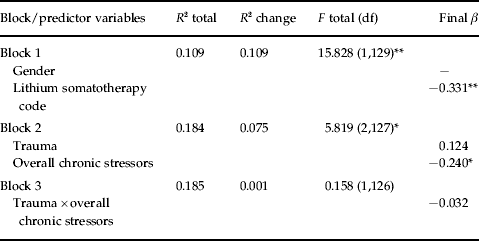
df, Degrees of freedom.
* Statistically significant at p < 0.01. ** Statistically significant at p < 0.001.
Partial correlations were conducted to examine the role of specific forms of chronic stressors (independent, dependent and interpersonal chronic stressors) on the severity of depressive symptoms, controlling for potential confounds identified in the preliminary analyses (gender, lithium somatotherapy code). Severity of depressive symptoms were significantly related to more severe interpersonal chronic stressors (partial r = 0.27, p = 0.004, n = 126). There was no significant relationship between severity of independent or dependent chronic stressors and depressive symptoms (r = 0.047 and r = 0.124 respectively, n = 126).
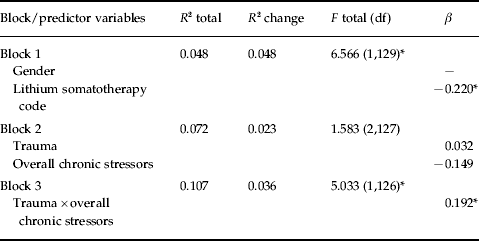
As shown in Table 4, trauma did not amplify the effects of overall chronic stressors on manic symptoms. Although a significant effect of trauma × overall chronic stressors emerged, analyses to partition this interaction term indicated that overall chronic stressors were not related to manic symptoms among those exposed to trauma (r = 0.03, p = 0.85, n = 64). Examining main effects, only the lithium somatotherapy code (β = −0.220, t = − 2.562, p = 0.012, CI for β −1.246 to −0.160) was a significant predictor of manic symptoms. That is, neither trauma nor severity of overall chronic stressors was directly related to manic symptoms.
Hierarchical multiple regression using exposure to trauma and severity of overall chronic stressors to predict severity of manic symptoms across 24 months of follow-up
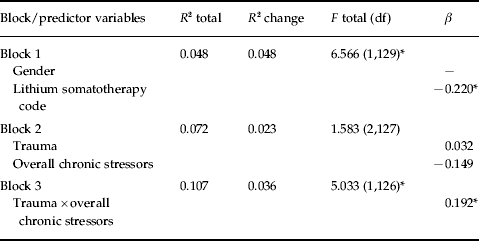
df, Degrees of freedom.
* Statistically significant at p < 0.05.
After controlling for gender and the lithium somatotherapy code, the severity of overall chronic stressors and the effect of trauma × overall chronic stressors were marginally significant predictors of more severe suicidality (R 2 total = 0.065).
Discussion
Although much of the research in bipolar disorder has focused on acute stressors, the findings of this study suggest that it is important to consider multiple stressors across the life course in bipolar disorder. Exposure to trauma predicted greater severity of interpersonal chronic stressors. The severity of overall chronic stressors predicted greater depression severity, accounting for 7.5% of the variance. Effects were apparent after controlling for gender and lithium treatment. Follow-up analyses indicated that interpersonal stressors were predictive of depressive symptoms. Neither independent nor dependent stressors uniquely related to depression symptoms. Our finding of the contribution of stressors to depression but not mania lends support to accumulating evidence for an overlap between the psychosocial predictors of bipolar and unipolar depression (Cuellar et al. Reference Cuellar, Johnson and Winters2005) and suggests that the two disorders may share common triggers.
Several limitations are worth considering. First, the generalizability of our findings may be limited, in that recruitment of the sample included community advertisement and convenience sampling from treatment centers. In addition, participants who completed the study were more educated than those who withdrew from the study. Second, the exclusion of participants with current substance-related diagnoses further decreases generalizability. The rates of current co-morbid substance use range from 4% (McElroy et al. Reference McElroy, Altshuler, Suppes, Keck, Frye, Denicoff, Nolen, Kupka, Leverich, Rochussen, Rush and Post2001) to 39% (Cassidy et al. Reference Cassidy, Ahearn and Carroll2001) among patients with bipolar disorders. Third, we were unable to gather informant data to validate reports of trauma exposure. However, the trauma rates found in our sample parallel those found in other investigations of bipolar disorder (e.g. Garno et al. Reference Garno, Goldberg, Ramirez and Ritzler2005). Fourth, the current study was limited in power, particularly for examining the interaction of trauma and overall chronic stressors. The smaller sample size also precluded examination of specific forms of trauma. Fifth, the majority of study participants entered the study during an acute phase of illness, which may have increased their susceptibility to subsequent stressors. Our use of the LEDS methodology, however, allowed coding for the extent to which stressors may have been a direct result of illness. Any stressor coded as potentially related to illness was excluded from analyses. Sixth, mood-related memory biases might have artificially inflated links between illness severity and stressor severity. However, memory for lifetime events has been found to be fairly accurate in extensive research on depression (Brewin et al. Reference Brewin, Andrews and Gotlib1993). To minimize potential reporting biases, we waited until participants’ symptoms had remitted to complete LEDS interviews; the LEDS system includes objective ratings of stressors and trauma that have greater reliability than self-rated stressor indices (McQuaid et al. Reference McQuaid, Monroe, Roberts, Kupfer and Frank2000).
Finally, although findings are consistent with the idea that social environmental factors intensify symptoms, it remains possible that family history plays a hidden role in these effects, such that some parents who are struggling with more pernicious forms of the disorder provide poorer modeling and coping for their offspring (Foster et al. Reference Foster, Garber and Durlak2008), but also pass on more severe forms of the disorder genetically. Indeed, we found that persons with a history of trauma were more prone to interpersonal chronic stressors, and interpersonal chronic stressors related to more severe depressive symptoms, consistent with models of stress generation (Hammen, Reference Hammen1991).
Despite these limitations, the current study is one of the largest longitudinal studies to conjointly examine the roles of chronic stressors and trauma in adult bipolar disorder. It is also one of the few studies to use the rigorous LEDS interview methodology to measure stressors and trauma. Our findings are supportive of the idea that trauma may be central in setting the stage for chronic stressors. Trauma did not exert a direct effect on course of illness but did contribute to the severity of interpersonal chronic stressors. As such, the effects of trauma and chronic stressors need to be considered conjointly for understanding the course of bipolar disorder. If replicated, our findings suggest that, within bipolar disorder, those with trauma histories might be candidates for more intensive treatment to help prevent depression. One aim might be to consider trauma history as part of clinical assessment in bipolar disorder. The findings also add to a growing literature suggesting that bipolar depression shares many parallels with unipolar depression (Cuellar et al. Reference Cuellar, Johnson and Winters2005). Given these strong links, many of the treatment programs developed for unipolar depression may have applicability in addressing the symptoms of bipolar depression, particularly when the depression occurs in the context of powerful psychosocial stressors. For example, trauma exposure may set the stage for cognitive biases. Trauma exposure also seemed to intensify the risk of chronic interpersonal stressors, suggesting that interpersonal psychotherapy might also be helpful. Evidence shows that cognitive and interpersonal therapies are efficacious in bipolar disorder (e.g. Lam et al. Reference Lam, Hayward, Watkins, Wright and Sham2005; Miklowitz et al. Reference Miklowitz, Otto, Frank, Reilly-Harrington, Kogan, Sachs, Thase, Calabrese, Marangell, Ostacher, Patel, Thomas, Araga, Gonzalez and Wisniewski2007). To address the effects of chronic interpersonal stressors or trauma exposure, specific components of treatment, such as those focused on modifying core assumptions about relationships or enhancing social problem-solving skills, may prove most effective. To support this type of treatment development, future research examining the potential mediators of the relationship between severe stressors and symptoms would be helpful. The contribution of stressors to anxiety and other common co-morbid diagnoses within bipolar disorder also warrants further investigation.
Declaration of Interest
None.
Acknowledgments
We thank R. Fingerhut, W. Greenhouse, B. Meyer, D. Rosenberg and C. Winett-Perlman for their assistance in gathering the data, and A. Chang for her feedback on the topic. This study was supported by NIMH grant R29MH55950 (S.L.J.). Preparation of the present report was supported by a Ruth L. Kirschstein National Research Service Award (NRSA) F32MH76339 and by the Office of Academic Affiliations, Advanced Fellowship in War Related and Unexplained Illness, Department of Veterans Affairs (A.G.).