Introduction
Neospora caninum is one of the most commonly diagnosed causes of infectious bovine abortion, worldwide (Dubey et al., Reference Dubey, Schares and Ortega-Mora2007) resulting in estimated annual losses to the cattle industry of over US$1 billion (Reichel et al., Reference Reichel, Alejandra Ayanegui-Alcerreca, Gondim and Ellis2013). Natural infections in cattle can occur through the ingestion of sporulated oocysts (shed by infected canids) in contaminated water, pasture or feed (horizontal transmission). This point source exposure of naïve animals to the parasite can lead to abortion storms and is considered to be associated with an epidemic pattern of disease spread (McAllister et al., Reference McAllister, Bjorkman, Anderson-Sprecher and Rogers2000). Alternatively, transplacental (vertical) transmission occurs when the parasite is passed from a dam to fetus and is considered the major route of infection in cattle (Dubey, Reference Dubey2003). Infected dams may vertically transmit N. caninum over several successive generations (Bjorkman et al., Reference Bjorkman, Johansson, Stenlund, Holmdahl and Uggla1996), allowing the parasite to be maintained within a herd, without the introduction of any further infected animals.
There are currently no commercially available vaccines or chemotherapeutic agents which are licenced to treat bovine neosporosis (Hemphill et al., Reference Hemphill, Aguado-Martinez and Muller2016), so controlling the spread of Neospora is based on farm management and bio-security practices, such as limiting the access of dogs to cattle feed and water, clearing aborted fetuses/placenta and if financially viable removing known Neospora-positive animals from breeding stocks within herds (Reichel et al., Reference Reichel, McAllister, Pomroy, Campero, Ortega-Mora and Ellis2014).
Neospora has been identified as causing abortion and reproductive losses in ruminants all over the world (Dubey et al., Reference Dubey, Buxton and Wouda2006). Though cattle are the most economically important host for N. caninum, natural infections (abortions and early neonatal mortality) have also been reported in other ruminants such as sheep (Gonzalez-Warleta et al., Reference Gonzalez-Warleta, Castro-Hermida, Regidor-Cerrillo, Benavides, Alvarez-Garcia, Fuertes, Ortega-Mora and Mezo2014), goats (Barr et al., Reference Barr, Anderson, Woods, Dubey and Conrad1992) and deer (Basso et al., Reference Basso, More, Quiroga, Balducchi, Schares and Venturini2014). These losses in small farmed ruminants though not as significant as those seen in the cattle industry can still have a profound economic impact on the farmers and communities reliant on them.
Previous studies of neosporosis in cattle in the UK have predominantly looked at the seroprevalence of anti-Neospora antibodies (Trees et al., Reference Trees, Guy, Low, Roberts, Buxton and Dubey1994; Davison et al., Reference Davison, French and Trees1999; Brickell et al., Reference Brickell, McGowan and Wathes2010). In Scotland previous studies were carried out using either bovine fetal serology (Buxton et al., Reference Buxton, Caldow, Maley, Marks and Innes1997), or a combination of histopathology and PCR on aborted bovine fetuses (Schock et al., Reference Schock, Buxton, Spence, Low and Baird2000). These previous studies demonstrated a prevalence of 15.9 and 10.5%, respectively. Molecular studies have also been carried out on other mammalian hosts of Neospora in the UK, which may act as sentinel species for environmental contamination with the parasite. Neospora DNA was detected in 10.5% (6/57) of rabbits (Oryctolagus cuniculus) (Hughes et al., Reference Hughes, Thomasson, Craig, Georgin, Pickles and Hide2008), while in another study Neospora DNA was detected in 18.6% (13/70) polecats (Mustela putorius), 10.9% (7/64) badgers (Meles meles), 10.1% (10/99) ferrets (Mustela furo), 4.8% (4/83) foxes (Vulpes vulpes) and 4.6% (3/65) mink (Neovison vison) (Bartley et al., Reference Bartley, Wright, Zimmer, Roy, Kitchener, Meredith, Innes and Katzer2013). These previous studies demonstrate that Neospora is found widely across the UK and more up to date information is required regarding the prevalence of Neospora associated with bovine and ovine abortion in Scotland.
This study used a nested ITS1 PCR to detect Neospora DNA in tissues from aborted bovine and ovine fetuses collected by the Scotland's Rural College (SRUC) disease surveillance centres across Scotland. The aim of this study was to determine the prevalence of Neospora DNA in aborted bovine and ovine fetuses, to further our understanding of the role Neospora plays as a potential causative agent of infectious abortion in ruminants in Scotland.
Materials and methods
Sample collection
Four hundred and ninety-five samples [brain (n = 449), heart (n = 25) and placenta (n = 21)] were collected (one region of tissue per sample) following the necropsies of 455 individual aborted bovine fetuses. Three hundred and eight (n = 308) samples [brain (n = 118), heart (n = 119) and placenta (n = 71)] were collected from I19 aborted ovine fetuses, all of which were submitted to SRUC in the South-West of Scotland for investigation. All tissue samples were stored at −20 °C prior to DNA extraction and subsequent PCR analysis.
DNA extraction
DNA was extracted from approximately 1 g of each tissue sample using the protocol previously described (Bartley et al., Reference Bartley, Wright, Zimmer, Roy, Kitchener, Meredith, Innes and Katzer2013). In brief, tissues were defrosted and finely chopped using sterile scalpel blades and placed into a CK22 tissue homogenizer tube (Stretton Scientific Derbyshire, UK) containing 1 mL nuclei lysis buffer (Promega, Madison, WI, USA). Tissues were homogenized at 6500 rpm for 2 × 50 s (Precellys 24® tissue homogenizer). The tissue homogenate was then processed to DNA using the Promega Wizard® genomic DNA purification protocol, with the final DNA elution in 200 µL of DNase/RNase-free water. All DNA samples were stored at −20 °C prior to PCR analysis. Extraction controls were also processed with every batch of samples; these were used as indicators of contamination and were used as additional negative controls for the ITS1 PCR analysis.
ITS1 PCR analysis
Analysis of all DNA samples was carried out using a nested ITS1 PCR. The PCR reaction mixture (20 µL final volume) and amplification conditions used in this study have been previously described (Bartley et al., Reference Bartley, Wright, Zimmer, Roy, Kitchener, Meredith, Innes and Katzer2013). In brief, PCR primers NN1 and NN2 were used for the primary amplification. The primary amplicons were diluted with 100 µL of DNase/RNase-free water, 2 µL of the diluted amplicon was used as a template in the secondary reactions where primers NP1 and NP2 were used (Holmdahl and Mattsson, Reference Holmdahl and Mattsson1996). Following the second round of amplification, 10 µL of PCR product was analysed by agarose gel electrophoresis [2% agarose in 1x Tris Acetate EDTA (TAE) buffer], stained with gel red (1: 10 000) (Biotonium, Hayward, CA, USA) and visualized under UV light. To increase the sensitivity of the assay, each DNA sample was tested in triplicate, with a sample being considered positive if at least 1/3 replicates gave an amplicon of 249 bp. Multiple water and extraction controls were analysed with each batch of samples along with N. caninum NC1 isolate tachyzoite DNA which was used as a positive control. The results from each batch of samples were only accepted if the appropriate results were achieved from all of the positive and negative controls.
Statistical analysis
The prevalence of Neospora DNA was calculated for each tissue type, with 95% confidence intervals (95% CI). The relationships between positive PCR results and tissue types (brain, heart and placenta) and the use of both PCR and immunohistochemistry (IHC) was determined using Cohen's κ coefficient, the significance of these results was determined using a Pearson χ 2 or a χ 2 test of independence, with a P ⩽ 0.05 being considered significant. All calculations were determined using minitab software (v17.1.0).
Results
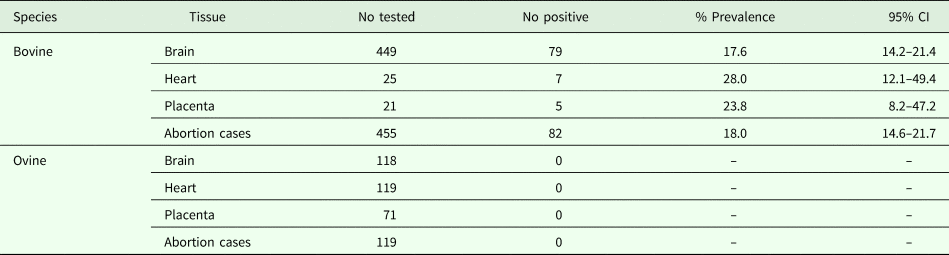
Multiple samples were available from 26 bovine fetuses. Screening of multiple tissues from individual fetuses demonstrated a prevalence of parasite DNA in brain [7/26 (26.9%; 95% CI 11.6–47.8)], heart [7/25 (28.0%; 95% CI 12.1–49.4)] and placenta [5/21 (23.8%; 95% CI 8.2–47.2)] (see Table 1). Positive samples were seen in ten (10/26) of the fetuses. Five of the fetuses tested positive for all available samples, two fetuses were positive for brain only, two were positive for heart only, while one fetus tested PCR positive for placenta, but was negative for both brain and heart.
Samples collected from aborted bovine and ovine fetuses from across South-West Scotland

No = number.
When the relationships between PCR-positive results and different tissue types were compared, it was seen that the strongest association was between brain and placenta (κ = 0.814, P = 0.009) while heart and placenta (κ = 0.650, P = 0.016), heart and brain (κ = 0.603, P = 0.003) showed weaker associations, although still statistically significant. These results indicate there is a good to very good agreement between the use of all three tissues.
A further 423 brain samples were tested, 72/423 tested Neospora positive for at least one replicate. When all of the data from the brain samples are collated, it shows that the overall prevalence in brain samples was 17.6% (95% CI 14.2–21.4%) with 79/449 positive samples.
Pathological data were available for 160 of the bovine abortion cases where only brain samples were collected, of these 37 were PCR positive. Sixteen of the samples gave positive results for N. caninum using IHC, the remaining 146 samples were IHC negative for Neospora. When the PCR and IHC results were compared, 13 (13/160) abortion cases were positive for both PCR and IHC, 24 (24/160) were only PCR positive, three (3/160) were only IHC positive and 123 (123/160) were negative for both PCR and IHC. When comparing the relationship between PCR and IHC, a κ value of 0.408 (P ⩽ 0.0001) was determined, this indicates a moderate level of agreement between the two methods. However, PCR is more sensitive than IHC.
A further six individual placental samples were also submitted, all of which tested negative. When the data from all samples (brain, heart and placenta) are combined, 82/455 [18.0% (95% CI 14.6–21.7%)] of the abortion cases tested positive for the presence of Neospora DNA in at least one replicate from at least one sample (Table 1).
None of the 308 (0/308) samples (brain, heart or placenta) collected from the 119 ovine abortion cases tested positive for the presence of Neospora DNA (Table 1).
Discussion
The results from this study show that Neospora was associated with 18.0% (82/455) of the bovine abortions submitted to the SRUC Veterinary Services for investigation. As these samples were collected from farms from all over the South-West of Scotland, it demonstrates that the parasite is widely distributed throughout the cattle in this region of the country.
It must be noted that during this study for a majority of the samples we only determined the presence of Neospora DNA in the placenta and fetal tissues and the presence of parasite DNA alone is not conclusive evidence that Neospora was the cause of the abortion. To gain more conclusive evidence of the causative agent, techniques like IHC would need to be used to demonstrate parasites associated with lesions (Sanchez et al., Reference Sanchez, Banda, Sahagun, Ledesma and Morales2009). In our study, 13 samples gave positive results for both PCR and IHC, strongly suggesting Neospora as the cause of abortion in these cases. However, conducting pathological examinations on aborted fetuses can be problematic, as samples can often be autolytic or in an advanced state of decay which may preclude them from microscopic analysis. Molecular methods such as PCR offer an opportunity to examine samples that may otherwise be untestable, PCR also appears to be a more sensitive method of detecting Neospora in aborted bovine fetuses than IHC.
The results from this present study would also indicate that testing more than one fetal tissue whenever possible would aid in the diagnosis of bovine neosporosis. Had only brain samples been tested then three of the ten bovine cases (two heart and one placenta) for which multiple samples were available would have been considered Neospora PCR negative.
No distinction was made between samples submitted from beef or dairy herds, so no conclusions can be made about the possible effects on each industry in Scotland. However, in a comprehensive review of the worldwide economic impact of Neospora on the cattle industry, it was suggested that the dairy industry suffered 2/3 of all of the Neospora-associated losses compared with only 1/3 seen in the beef cattle. In monetary terms this is thought to equate to annual loses to the UK dairy industry of over GB£20 million (US$27 million) (Reichel et al., Reference Reichel, Alejandra Ayanegui-Alcerreca, Gondim and Ellis2013). These losses show that there is a real need for the development of improved diagnostics and a vaccine or other effective control measures to limit the spread and impact of bovine neosporosis, which are currently based on farm management and bio-security practices (Reichel et al., Reference Reichel, McAllister, Pomroy, Campero, Ortega-Mora and Ellis2014).
Currently there is very little data regarding the prevalence of natural Neospora infections in sheep in the UK. A report in 2015 by the Animal and Plant Health Agency (APHA) demonstrated (by IHC) a case of ovine neosporosis in a deformed new born lamb (APHA Disease Surveillance Report January/February 2015). A serological study of 660 serum samples collected from aborted ovine fetuses in England and Wales demonstrated anti-Neospora antibodies (by ELISA) in 28/660 (4.24%) of samples (Helmick et al., Reference Helmick, Otter, McGarry and Buxton2002). While studies in New Zealand and Spain have identified Neospora DNA in the brains of aborted lambs (Howe et al., Reference Howe, Collett, Pattison, Marshall, West and Pomroy2012) as well as in heart, liver and lung samples (Gonzalez-Warleta et al., Reference Gonzalez-Warleta, Castro-Hermida, Regidor-Cerrillo, Benavides, Alvarez-Garcia, Fuertes, Ortega-Mora and Mezo2014). Interestingly, none of the 308 fetal samples from 119 ovine abortion cases examined during the study tested positive for the presence of Neospora DNA. This would suggest that Neospora is not a major cause of reproductive losses in sheep in Scotland.
In conclusion, this study demonstrates that Neospora DNA is routinely identified in brain, heart and placental samples collected from aborted bovine fetuses in Scotland. However, no evidence of Neospora association with ovine abortions was found during this current study. More work is required to identify the scale of Neospora-associated abortions in both the Scottish beef and dairy herds.
Author ORCIDs
P. M. Bartley, 0000-0002-3351-7319
Acknowledgements
The authors would like to thank Scottish Government's Rural and Environment Science and Analytical Services Division (RESAS) for supporting this work.
Financial support
Scottish Government's Rural and Environment Science and Analytical Services Division (RESAS). SRUC Veterinary Services receives support from Scottish Government Veterinary Advisory Service programme.
Conflict of interest
None.
Ethical standards
Not applicable.