

Bufonid toad (family Bufonidae) bones are commonly found in pit features and other contexts in precontact and contact period Native American village and mound sites in the Appalachian Summit (Compton Reference Compton2014; Runquist Reference Runquist1979; VanDerwarker and Detwiler Reference VanDerwarker and Detwiler2000; Vavrasek Reference Vavrasek and Angst2012; Whyte Reference Whyte2017). Sometimes their bones occur in the thousands. Clearly, it is important to explain the presence of toad remains in any archaeological context. Identifying toad bones as subsistence remains permits their inclusion among other subsistence remains in evaluations of dietary composition/breadth and seasonality. Identifying them as by-products of extraction and use of toad venom or as ritual deposits may permit a clearer view of shamanistic practices, ritual behaviors, or medicine. Recognizing them as remains of naturally entrapped animals prevents erroneous cultural explanations and potentially provides insight into site seasonality, the life histories of features that contained the remains, and the former nature of the surface environment of an archaeological site. This study examines the archaeological record of toad remains on Appalachian Summit late precontact and contact period sites and presents a new experimental study undertaken to identify agencies of accumulation.
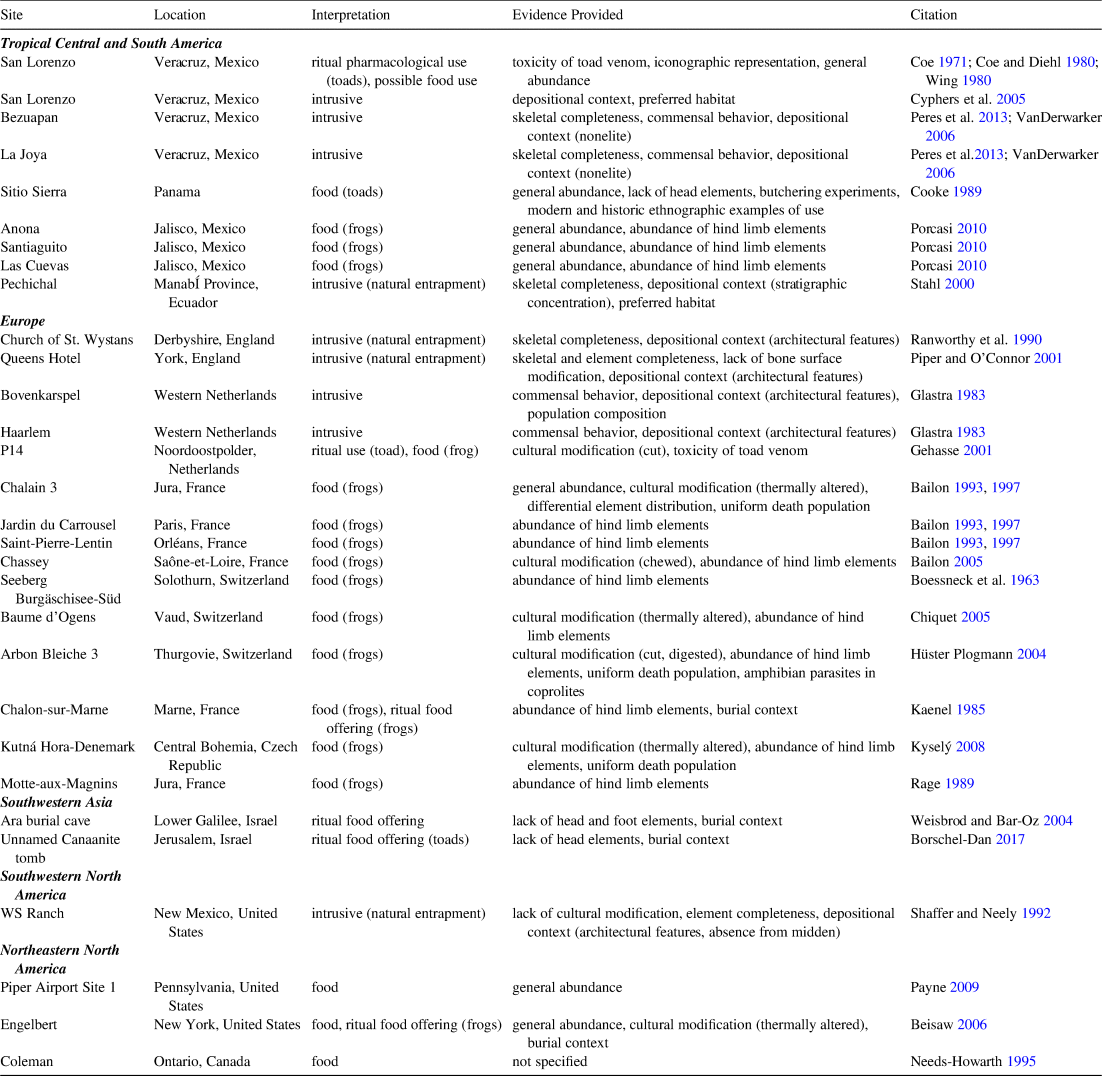
Toad bones, especially those of the family Bufonidae (true toads), are often found in trace amounts in archaeological sites wherever toads naturally occur. Occasionally, they are found in abundance, especially among the contents of pit features on permanent residential sites (Runquist Reference Runquist1979), and sometimes in ritual contexts (Borschel-Dan Reference Borschel-Dan2017; Weisbrod and Bar-Oz Reference Weisbrod, Bar-Oz, O'Day, Neer and Ervynck2004; Whyte Reference Whyte2017). They are often recovered along with—and difficult to distinguish from—bones of other types of frogs and toads, and they are collectively labeled “anuran” (order Anura) bones. The following is a review of some of these discoveries (Table 1).
Archaeological Sites with Notable Anuran Remains outside the Southern Appalachian Region.

Anuran Remains from Archaeological Deposits
Tropical Central and South America
Abundant anuran remains are reported from several sites in the tropical Americas from Mexico to Ecuador. Excavations at the Olmec capital of San Lorenzo in Veracruz, Mexico, in the 1960s recovered a sample of cane toad (Rhinella marina, formerly Bufo marinus) remains dating to the Early Preclassic period (1150–900 BC). These account for 9.5% (NISP = 82) of the faunal remains recovered, despite the relatively small size of the sample. Noting the toxicity of cane toad skin and the potential hallucinogenic properties of bufotenine—an active ingredient in toad venom—Coe (Reference Coe1971), Coe and Diehl (Reference Coe and Diehl1980:390), and Wing (Reference Wing, Coe and Diehl1980:383) suggest that the toads may have been employed in shamanistic practices by the San Lorenzo Olmec during the Early Preclassic period. Wing (Reference Wing, Coe and Diehl1980:378, 383) does, however, offer the caveat that carefully prepared toads may have been consumed without suffering the effects of toad venom. Cyphers and colleagues (Reference Cyphers, Zúñiga and Di Castro2005) challenge these explanations for the San Lorenzo toad remains based on their own more recent work at San Lorenzo. The authors note that despite their seven years of excavations covering more area and contexts than previous work, very few additional cane toad remains (NISP = 1) have been recovered. Contrary to Coe, Diehl, and Wing (Coe and Diehl Reference Coe and Diehl1980; Wing Reference Wing, Coe and Diehl1980), Cyphers and colleagues do not believe the area where the toad remains were recovered represents primary refuse dating to the Early Preclassic. Instead, they suggest that the area contains secondary deposits of slump and slope wash, making a strong association with the Early Postclassic occupation unwarranted. Furthermore, they posit that the ravine in which the remains were recovered was an attractive habitat for cane toads, which may have died in place and were then naturally buried. VanDerwarker (Reference VanDerwarker2006) and colleagues (Peres et al. Reference Peres, VanDerwarker, Pool, Götz and Emery2013) come to a similar conclusion regarding anuran remains recovered from two additional Preclassic period (1400 BC–AD 300) Olmec sites in the region. Located approximately 60 km from San Lorenzo in Veracruz, Mexico, the sites of La Joya and Bezuapan produced abundant anuran remains (La Joya NISP = 441, Bezuapan NISP = 232). At both sites, bufonid toads are the most abundant anurans present (La Joya NISP = 345, Bezuapan NISP = 200). Although not identified to species, the authors suggest that the remains are likely those of the cane toad, a species noted as being attracted to disturbed habitats such as human settlements. The authors further comment that the species is even known for burrowing under houses (Peres et al. Reference Peres, VanDerwarker, Pool, Götz and Emery2013; VanDerwarker Reference VanDerwarker2006:128, 156). The commensal nature of these toads along with the recovery of “nearly complete skeletons in nonelite domestic contexts” is provided by the authors as evidence of intrusive natural accumulation rather than food or ritual use of toads at the Olmec sites of La Joya and Bezuapan (Peres et al. Reference Peres, VanDerwarker, Pool, Götz and Emery2013:117; see also VanDerwarker Reference VanDerwarker2006:128).
Also working in the tropical Americas, Cooke (Reference Cooke1989) notes the presence of anuran remains from multiple precontact sites in Panama and Costa Rica. Challenging the provocative interpretation that anuran remains from precontact sites in the region represent the use of these animals as hallucinogens (e.g., Coe and Diehl Reference Coe and Diehl1980:390; Wing Reference Wing, Coe and Diehl1980:383), Cooke (Reference Cooke1989) argues that the most parsimonious interpretation of these remains is that they were used as food. He presents the Sitio Sierra site in Panama as a case study for this interpretation. Anuran remains from Sitio Sierra include 529 anuran specimens representing three species: cane toad (Rhinella marina), Caribbean ditch frog (Leptodactylus insularum, formerly Leptodactylus bolivianus), and veined tree frog (Trachycephalus venulosus, formerly Phrynohyas venulosa). Of these, the cane toad is the most abundant (79.4% of anuran remains). Examination of the body portions represented by skeletal elements reveal that the bones of the head are underrepresented compared to other portions of the body. Cooke interprets this as evidence of skinning in order to remove the toxic skin of the toads. He bases this interpretation on butchering experiments he performed in which he found that complete removal of the head, where the skin was tightly attached to the bones, followed by complete removal of the remaining skin was the easiest skinning method. Ethnographic examples of tropical American groups’ use of anurans, some of them toxic, and their varied preparation techniques are cited as further evidence for the consumption of anurans at precontact sites in the American tropics.
Nontoxic bigfoot leopard frog (Lithobates megapoda) remains from three sites (Anona, Santiaguito, Las Cuevas) in the Laguna de Magdalena Basin of Jalisco, Mexico, spanning from the Postclassic to colonial era are also interpreted as food remains (Porcasi Reference Porcasi2010). Anuran remains (NISP = 128) from the sites are primarily made up of bigfoot leopard frog specimens, but spadefoot (Scaphiopus sp.) remains are present as well. The author cites the high proportion (67.6%) of meaty hind-limb elements as evidence that the bigfoot leopard fog was eaten.
In his examination of faunal remains from a large bell-shaped pit from the Pechichal site (M3B4-011) in northern Manabí Province of western Ecuador, Stahl (Reference Stahl2000) attributes the presence of abundant anuran remains (NISP = 323) to natural accumulation as a result of pitfall capture. He arrives at this conclusion based on the relatively complete body portions represented and the stratigraphic concentration of anuran remains within the feature, particularly in the lower levels of the pit. A similar profile was observed for the numerous small rodent remains (NISP = 1,086), which he also attributes to natural entrapment.
Europe
European sites with abundant anuran remains are relatively uncommon considering the vast number of zooarchaeological assemblages that have been analyzed from the region. Many European researchers emphasize the utility of archaeological anuran remains as proxies for reconstructing past human environments (Bailon and Rage Reference Bailon and Rage1992; Gehasse Reference Gehasse, Buitenhuis and Premmell2001; Glastra Reference Glastra1983), but others explicitly tackle the problem of how anuran bones became incorporated into the archaeological record and whether or not they represent food, some other use, or natural accumulations.
Toad and frog remains recovered from excavations at the Church of St. Wystans at Repton, Derbyshire in England, dating from the eighth to sixteenth centuries, are attributed to natural accumulation (Ranworthy et al. Reference Ranworthy, Byf-Biddle and Biddle1990). Frog and toad species identifications were limited to the ilium, of which the researchers report 147 European frog (Rana temporaria) and 11 European toad (Bufo bufo) ilia. The authors note that skeletal part representation among materials dating to the eighth- and ninth-century samples “contained all skeletal components,” but a full accounting of skeletal element representation is not provided (Ranworthy et al. Reference Ranworthy, Byf-Biddle and Biddle1990:505). Ultimately, the authors conclude that the anuran remains recovered were the result of frog and toad entrapment within architectural features from which the animals could not escape.
Piper and O'Connor (Reference Piper and O'Connor2001) also suggest anuran pitfall entrapment for a probable well feature (Context 2061) associated with the Anglo-Scandinavian period occupation of the Queens Hotel site in York, England. Ninety-eight percent of the faunal remains identified from the feature were identified as anuran remains (NISP = 348). The assemblage is dominated by European frog (Rana temporaria) remains, but European toad (Bufo bufo) specimens are present as well. Most portions of the body are represented and the bones are largely intact, exhibiting little surface modification or fracturing. The authors interpret this pattern as evidence for natural accumulation due to pitfall capture. The authors contrast this pattern with mammalian remains from the site that exhibit substantial fracturing and surface modification, consistent with “a complex taphonomic history including sub-aerial weathering and movement both before and after deposition” (Piper and O'Connor Reference Piper and O'Connor2001:342).
Toad remains reported from European sites are most often those of European toad (Bufo bufo) or other members of the bufonid toad family (Bufonidae). When encountered, toad remains are most often considered intrusive to cultural deposits (e.g., Glastra Reference Glastra1983; see previously discussed Piper and O'Connor Reference Piper and O'Connor2001; Ranworthy et al. Reference Ranworthy, Byf-Biddle and Biddle1990). An exception to this is provided by a nutterjack toad (Epidalea calamita, formerly Bufo calamita) tibiofibula with cutmarks from the P14 site in Noordoostpolder, Netherlands, which Gehasse (Reference Gehasse, Buitenhuis and Premmell2001) interprets as evidence of human use. Gehasse rejects, however, the possible use of the nutterjack toad as food based on the toxicity of the skin and offers the possibility that the toad was instead used for ritual purposes.
Frog remains from European archaeological sites, most commonly the nontoxic European frog (Rana temporaria) and other members of the ranid frog family (Ranidae), are more often encountered in large numbers than are toad remains and are typically interpreted as food refuse (Bailon Reference Bailon, Desse and Audoin-Rouzeau1993, Reference Bailon and Pétrequin1997, Reference Bailon and Thevenot2005; Bailon and Rage Reference Bailon and Rage1992; Boessneck et al. Reference Boessneck, Jéquier and Stampfli1963; Chiquet Reference Chiquet2005; Gehasse Reference Gehasse, Buitenhuis and Premmell2001; Hüster Plogmann Reference Hüster Plogmann, Jacoment, Leuzinger and Schibler2004; Kaenel Reference Kaenel1985; Kyselý Reference Kyselý2008; Rage Reference Rage and Pétrequin1989; for exceptions, see the previously discussed Ranworthy et al. Reference Ranworthy, Byf-Biddle and Biddle1990; Piper and O'Connor Reference Piper and O'Connor2001). Evidence provided to support the interpretation that humans were using frogs includes human modifications of bones, such as burning (Bailon Reference Bailon, Desse and Audoin-Rouzeau1993, Reference Bailon and Pétrequin1997; Chiquet Reference Chiquet2005; Kyselý Reference Kyselý2008) and cutmarks (Gehasse Reference Gehasse, Buitenhuis and Premmell2001; Hüster Plogmann Reference Hüster Plogmann, Jacoment, Leuzinger and Schibler2004), as well as differential body part representation. Nearly all of the researchers who interpret the presence of frog remains in European archaeological contexts as evidence of frog consumption report an overrepresentation of bones of the meaty hind limbs in the assemblages (Bailon Reference Bailon, Desse and Audoin-Rouzeau1993, Reference Bailon and Pétrequin1997, Reference Bailon and Thevenot2005; Bailon and Rage Reference Bailon and Rage1992; Boessneck et al. Reference Boessneck, Jéquier and Stampfli1963; Chiquet Reference Chiquet2005; Hüster Plogmann Reference Hüster Plogmann, Jacoment, Leuzinger and Schibler2004; Kyselý Reference Kyselý2008; Rage Reference Rage and Pétrequin1989). This pattern was also observed in a funerary context: 110 cosce di rana (frog legs) were evidently interred as grave offerings in a Celtic grave in France dating to the first millennium BC (Kaenel Reference Kaenel1985:159). Further evidence provided by researchers supporting the use of frogs as food includes a uniform anuran death population most often consisting of a single species with a high proportion of large adult (and sometimes male) individuals (Bailon Reference Bailon, Desse and Audoin-Rouzeau1993, Reference Bailon and Pétrequin1997; Hüster Plogmann Reference Hüster Plogmann, Jacoment, Leuzinger and Schibler2004; Kyselý Reference Kyselý2008). Kyselý (Reference Kyselý2008) and Hüster Plogmann (Reference Hüster Plogmann, Jacoment, Leuzinger and Schibler2004) speculate that this pattern may result from the collection of adult male European Frogs that would have been easily captured during their spring breeding aggregations where they gathered in small puddles and pools to attract mates. Perhaps the most direct lines of evidence for frog consumption by ancient Europeans are the presence of chewed (Bailon Reference Bailon and Thevenot2005) and digested (Hüster Plogmann Reference Hüster Plogmann, Jacoment, Leuzinger and Schibler2004) frog bones as well as coprolites containing amphibian parasites (Hüster Plogmann Reference Hüster Plogmann, Jacoment, Leuzinger and Schibler2004).
Southwestern Asia
Two remarkably similar discoveries of anuran remains from separate burial contexts in Israel provide evidence for the use of toads and/or frogs as ritual food offerings in this part of southwestern Asia. At the Late Bronze Age Ara burial cave in Lower Galilee, Weisbrod and Bar-Oz (Reference Weisbrod, Bar-Oz, O'Day, Neer and Ervynck2004) report hundreds of anuran bones recovered from ceramic vessels (they make no distinction between frog and toad remains). Noting the absence of bones of the head, and a paucity of certain axial elements and most foot elements, Weisbrod and Bar-Oz (Reference Weisbrod, Bar-Oz, O'Day, Neer and Ervynck2004:23) posit that “decapitation and skinning of anurans as part of their preparation as food offerings could account for the observed pattern of skeletal representation.” More recently, a 4,000-year-old Canaanite tomb was found that contained a ceramic jar with bones of “nine decapitated toads” (Borschel-Dan Reference Borschel-Dan2017). These also were interpreted as a food offering to the deceased.
Southwestern North America
Zooarchaeological assemblages with abundant anuran remains in the American Southwest are rare. An exception to this is the numerous toad (Anaxyrus sp.) bones (NISP = 162) recovered from pithouse floors at the WS Ranch site in Catron County, New Mexico (Shaffer and Neely Reference Shaffer and Neely1992). None of the specimens shows evidence of cultural modification such as burning or cutmarks, and most bones are complete, sometimes retaining their articular cartilage capsules. Skeletal part representation is not reported, but Shaffer and Neely (Reference Shaffer and Neely1992) interpret these remains as evidence of natural entrapment due in part to their concentration in pithouse features that may have served as natural traps.
Northeastern North America
As in the American Southwest, sites with abundant anuran remains are not common in northeastern North America. Three sites reported from the region, however, do contain large numbers of frog and toad remains. Among these is the Piper Airport Site 1 (36CN210) in Clinton County in central Pennsylvania (Payne Reference Payne2009), which consists of 596 specimens identified as frogs/toads (Anura) and an additional 49 that were positively identified as American water frogs (Lithobates sp.). The anuran remains were concentrated in two features dating from the fifteenth to early sixteenth centuries. The author notes the abundance of anurans as unusual and suggests that they were likely food remains rather than incidental inclusions; however, no justification for this interpretation is provided (Payne Reference Payne2009).
In nearby Tioga County in south-central New York, Beisaw (Reference Beisaw2006) reports 2,269 toad (Anaxyrus sp.) and 653 frog (Lithobates sp.) bones recovered from feature contexts at the Engelbert site. In 86 of the site's 600 features (excluding burials), toad remains predominate, but they occur along with remains of large subsistence taxa such as white-tailed deer. Skeletal portions occur in relatively expected amounts. Only 1% of toad bones as opposed to 27% of deer bones shows evidence of burning. Beisaw considers the possibility that the toad remains may represent natural entrapment. The “thermally altered” bones of seven green frogs (Lithobates clamitans) found in a ceramic vessel accompanying a human burial, however, are interpreted as evidence of a food offering (Beisaw Reference Beisaw2006:11).
A third site from northeastern North America with abundant anuran remains—the Coleman site, a longhouse village likely occupied from the late fifteenth to early sixteenth century—is located in the Regional Municipality of Waterloo in Ontario, Canada (Needs-Howarth Reference Needs-Howarth1995). Anuran remains account for 21.4% (NISP = 174) of vertebrate remains identified beyond class. American water frogs (Lithobates sp.) predominate, but toads belonging to the Anaxyrus genus are also present. Amphibian remains from the Coleman site are interpreted as food remains.
Southern Appalachians of North America
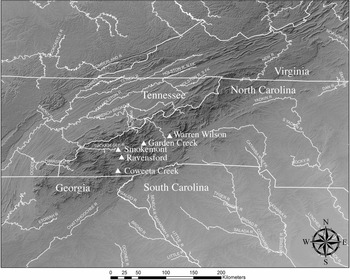
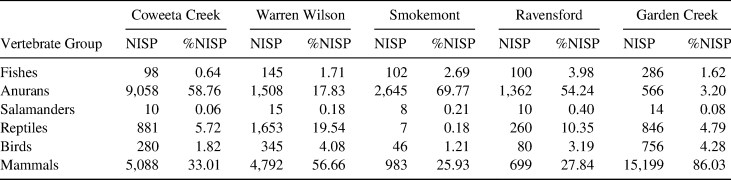
Several sites in western North Carolina's Appalachian Summit dating to between AD 1200 and 1800 have yielded remarkable numbers of anuran bones, and they are the focus of this study (Figure 1). These include Garden Creek Mound No. 1 (31HW1) in Haywood County (Whyte Reference Whyte2017), Warren Wilson (31BN29) in Buncombe County (Runquist Reference Runquist1979), Ravensford (31SW78/31SW136) in Swain County (Compton Reference Compton2014), Smokemont (31SW393) in Swain County (Vavrasek Reference Vavrasek and Angst2012), and Coweeta Creek (31MA34) in Macon County (Runquist Reference Runquist1979; Table 2). Toad remains are rarely found in abundance on sites at lower elevations in neighboring areas of the Southeast (e.g., Runquist Reference Runquist1979; Whyte Reference Whyte1988), even though toads are equally common in those areas (Beane et al. Reference Beane, Braswell, Mitchell, Palmer and Harrison2010).
Locations of western North Carolina archaeological sites discussed.

Vertebrate Remains from Five Southwestern North Carolina Sites.

The Mississippian period Garden Creek Mound No. 1 (31HW1) in Haywood County, North Carolina, was excavated by the University of North Carolina Research Labs of Anthropology (UNCRLA) from 1965 through 1967 (Keel Reference Keel1976). Radiocarbon dates indicate mound construction and use in the early to mid-fifteenth century (Schubert Reference Schubert2017). Whyte (Reference Whyte2017) recently analyzed a sample (37,707) of animal remains recovered by these excavations. These include 566 bones of anurans, 91% of which are toads of the genus Anaxyrus. The only cranial bones (including the jaw) identified were those of the eastern spadefoot (Scaphiopus holbrookii). Most of the bones of the genus Anaxyrus (NISP = 344) were recovered from an earthen bench within one of the mound's two earth lodges. The bones in this context account for a minimum of 19 individuals. Only one of the bones is burned (calcined), breakage is minimal, and none of the bones is from the head. All except the calcined specimen show evidence of tannic staining, which indicates that the toads had decomposed in the flesh or that the bones had been deposited in a periodically saturated context (Pokines and Baker Reference Pokines, Baker, Pokines and Symes2013).
The Warren Wilson site (31BN29), a Mississippian period village in Buncombe County, North Carolina, was excavated by the UNCRLA from 1965 through 1969 (Dickens Reference Dickens1976). Archaeofaunal remains from this site, analyzed by Runquist (Reference Runquist1979), include 1,422 toad (Anaxyrus sp.) remains, 424 of which were found in Feature 229 (Whyte Reference Whyte1988). Runquist (Reference Runquist1979:45) refers to this feature as “an irregularly shaped stratified deposit located along the inner margin of a palisade.” Ward (Reference Ward, Dickens and Ward1985) and Dickens (Reference Dickens, Dickens and Ward1985) identify the function of this feature as a borrow pit for obtaining and processing daub in village palisade construction. In a later publication by Ward and Davis, this feature is assigned a different function, and its contents misrepresented:
This large, shallow pit, which may have been used as an earth oven, was frequently filled with refuse from food preparation and consumption activities. The uppermost fill zone of the feature contained what appeared to be a single deposit of almost 14,000 toad radii/ulnae (Runquist Reference Runquist1979:322). These forearm bones were found concentrated in a small area, mixed with numerous other animal bones, particularly deer [Ward and Davis Reference Ward and Stephen Davis1999:171].
In fact, there were only 424 toad bones identified by Runquist for this feature, and only 100 radio-ulnae were included among the 1,422 bones from the whole site (Runquist Reference Runquist1979:53). According to Runquist, “All bony elements of the toad skeleton were recovered, indicating that however the animal was utilized, the entire skeleton was discarded” (Runquist Reference Runquist1979:52). According to Table 10 (Runquist Reference Runquist1979:53), however, the only head bones identified were 27 squamosal bones.
The Ravensford site (31SW78/31SW136) in Swain County, North Carolina, was excavated by TRC Environmental from 2004 through 2008 and was occupied off and on for several millennia with major occupations dating from the mid-twelfth to early eighteenth centuries AD (Compton Reference Compton2014). Animal remains dating to the later occupations of the site include 1,275 remains of toads (Anaxyrus sp.) representing 116 individuals, which were recovered primarily from feature contexts (Compton Reference Compton2014). Noting a lack of bones of the head and citing a recipe from a Cherokee cookbook (Ulmer and Beck Reference Ulmer and Beck1951:51), Compton offers the possibility that the toads were decapitated and skinned in order to remove the toxic parotoid glands before boiling and consumption. This suggests that the heads and skin were deposited in surficial contexts or off-site, where they were lost to scavengers and decomposition, whereas the boiled dregs (including postcranial elements) were often deposited in pit features. The fact that 28% of anuran bones are burned indicates frequent initial deposition in hearths or surficial contexts subsequently subjected to combustion.
Protohistoric Cherokee contexts at the Smokemont site (31SW393) in Swain County, North Carolina, excavated by the University of Tennessee Archaeological Research Laboratory from 2008 to 2010, yielded about 4,000 faunal specimens, 70% of which were toad and frog bones accounting for 113 individuals (Vavrasek Reference Vavrasek and Angst2012). And as at Ravensford, a disparity between head (0.5%) and body parts was noted. Most of the anuran remains were recovered from the floor midden of Structure 1. Only five specimens were burned, two showed signs of digestion, and one was rodent gnawed. Vavrasek (Reference Vavrasek and Angst2012) proffers that the Cherokee residents of the site may have consumed frogs and toads, but she cannot rule out a ritual-based explanation due to the toxicity of toad skin.
Coweeta Creek (31MA34), in Macon County, North Carolina, was excavated by the UNCRLA from 1965 through 1971 (Ward and Davis Reference Ward and Stephen Davis1999). This Qualla phase (AD 1300–1700) town contained a platform mound and numerous structures and features. Runquist (Reference Runquist1979:44) identified 9,032 toad (Anaxyrus sp.) bones, representing a minimum of 587 individual toads, most of which were recovered from Feature 65, “a large circular pit with sloping walls and a level bottom.” Feature 65 is located southeast of the site's plaza and between two domestic structures (Rodning Reference Rodning2008). The diameter of the pit was 3.7 m and maximum depth was 30 cm below plow zone. Carbonized wood from Feature 65 was dated to AD 1240–1290, which identified it as one of the earliest contexts on the site. For both Warren Wilson (Feature 229) and Coweeta Creek (Feature 65), Runquist suggests that the bones may represent naturally entrapped fauna or food remains. She reports (Reference Runquist1979:45) that the “configuration of these two features was such that animals accidentally trapped probably could have extricated themselves” (Reference Runquist1979:45) and that “these data strongly suggest that . . . toads were utilized by the Cherokees for ceremonial purposes,” most likely in relation to the pharmacological properties of their skin secretions (Runquist Reference Runquist1979:337).
In response to this, Whyte suggested that “certain of Runquist's points are justified; however, the possibility of this pit having filled with rainwater and served as a temporary breeding pond for toads must be considered” (Whyte Reference Whyte1988:136). He showed through experimentation that toads could not escape from a water-filled pit unless the water filled the pit to its rim (an excavator of the Coweeta Creek site had informed Whyte [1988] that, due to the clayey soil of the site, excavated pit features retained water after heavy rains). Whyte (Reference Whyte1988) suggested that some large pit features, especially ones on site peripheries, may have repeatedly served as temporary breeding ponds during spring downpours, in which many toads became trapped and died. Toads are naturally adapted to breeding in shallow rain puddles and ponds where vegetation and a gradually sloping substrate facilitate their egress (Jensen et al. Reference Jensen, Camp, Gibbons and Elliott2008). Artificially constructed pits with relatively vertical walls that become filled with rainwater are attractive breeding places but provide no means of escape (Whyte Reference Whyte1988). All toad remains found in Feature 65 at Coweeta Creek and the majority of the toad remains from the other sites discussed above are of larger individual toads that may have been breeding-age adults. It is noted, however, that human collectors may have selected only adults, whether captured on land or in water. Furthermore, Runquist (Reference Runquist1979) identified no bones of the head—an unexpected pattern for naturally entrapped toads.
Summarizing Previous Interpretations of Archaeological Toad Remains
In sum, toad bones have been found in a variety of archaeological contexts in the Appalachian Summit region and elsewhere. When bones of the head are absent, the favored interpretation is that humans had skinned them for consumption (Compton Reference Compton2014; Cooke Reference Cooke1989). When found in mound or burial contexts, they are interpreted as remains of offerings (Borschel-Dan Reference Borschel-Dan2017; Weisbrod and Bar-Oz Reference Weisbrod, Bar-Oz, O'Day, Neer and Ervynck2004; Whyte Reference Whyte2017). When found in extraordinary numbers, they have been interpreted as evidence of medicinal or ritual uses of toads (Runquist Reference Runquist1979). When found in small numbers in pit features, they are more apt to be interpreted as intrusive (Shaffer and Neely Reference Shaffer and Neely1992; Stahl Reference Stahl2000; Whyte Reference Whyte, Purdue, Klippel and Styles1991). The near absence of head bones in some assemblages is intriguing, and it demands further archaeological and experimental investigation. Perhaps, as some researchers have suggested (Borschel-Dan Reference Borschel-Dan2017; Compton Reference Compton2014; Cooke Reference Cooke1989), it is a result of decapitation and skinning of toads in order to remove the toxic parotoid glands and skin prior to consumption of the meat or for use of the heads and skins for some other purpose (Runquist Reference Runquist1979).
Toads in Eastern North American Native Ethnozoology
Before discussing the anuran taxa present in the region and human interaction with these animals, a discussion of the terms “frog” and “toad” is warranted. The terms “frog” and “toad” are imprecise, and they do not specifically refer to any one subgroup of anurans. In general, the term “frog” is used to refer to anurans that have long hind limbs adapted for long leaps and that have relatively moist and smooth skin (Dorcas and Gibbons Reference Dorcas and Gibbons2008). Two families of anurans are typically referred to as frogs in the southeastern United States. These include the ranid or “true frogs” family (Ranidae) and the hylid frog family (Hylidae, treefrogs and relatives). The term “toad” is typically applied to anurans with shorter hind limbs adapted for short hops. “Toads” generally have drier and more warty skin than their “frog” counterparts. In the scientific literature, “true toads” is used to refer to the bufonid toad family (Bufonidae), but the term “toad” is also used in a general sense in the southeastern United States to refer to spadefoots (family Scaphiopodidae) and narrow-mouthed toads (family Microhylidae; Beane et al. Reference Beane, Braswell, Mitchell, Palmer and Harrison2010; Dorcas and Gibbons Reference Dorcas and Gibbons2008).
Of the five anuran families native to the southeastern United States, four occur in the southern Appalachians. The hylid frog family (Hylidae) is represented by five species: Cope's gray tree frog (Hyla chrysoscelis), northern cricket frog (Acris crepitans), and three species of chorus frog—mountain chorus frog (Pseudacris brachyphona), spring peeper (P. crucifer), and upland chorus frog (P. feriarum; Beane et al. Reference Beane, Braswell, Mitchell, Palmer and Harrison2010; Dorcas and Gibbons Reference Dorcas and Gibbons2008). Members of the family are generally small, and they include climbing tree frogs as well as the nonclimbing cricket and chorus frogs. Although hylid frogs are the most speciose group and relatively common in the region today, they are seldom found in archaeological assemblages of the southern Appalachians, even among archaeological assemblages with abundant anuran remains (Compton Reference Compton2014; Runquist Reference Runquist1979; Vavrasek Reference Vavrasek and Angst2012; Whyte Reference Whyte2017).
The ranid or true frogs family (Ranidae) is represented by four species in the southern Appalachian region. All four species belong to a single genus, Lithobates, and include the American bullfrog (Lithobates catesbeianus), green frog (L. clamitans), pickerel frog (L. palustris), and wood frog (L. sylvaticus; Beane et al. Reference Beane, Braswell, Mitchell, Palmer and Harrison2010; Dorcas and Gibbons Reference Dorcas and Gibbons2008). Members of the genus are relatively large, and include the largest of North American frogs, the familiar American bullfrog. Species are highly aquatic and seldom found far from bodies of water. Remains of ranid frogs are regularly recovered from archaeological contexts in the Appalachian Summit region, but they are rarely as abundant as bufonid toad remains.
Three species referred to as “toads” are found in the southern Appalachians—American toad (Anaxyrus americanus), Fowler's toad (Anaxyrus fowleri), and eastern spadefoot (Scaphiopus holbrookii). The American and Fowler's toads belong to the bufonid or “true toads” family (Bufonidae), whereas the superficially similar eastern spadefoot is a member of the spadefoot family (Scaphiopodidae). The eastern spadefoot is the only member of its family found east of the Mississippi River, and it is considered rare or uncommon in the uplands of its range (Beane et al. Reference Beane, Braswell, Mitchell, Palmer and Harrison2010; Jenson et al. Reference Jensen, Camp, Gibbons and Elliott2008). Indeed, its remains are few or lacking compared to those of the genus Anaxyrus in archaeofaunal assemblages (Compton Reference Compton2014; Runquist Reference Runquist1979; Vavrasek Reference Vavrasek and Angst2012; Whyte Reference Whyte2017). It prefers the loose sandy soils of the lower Piedmont and Coastal Plain, and it breeds in shallow, temporary waters after heavy rains (Beane et al. Reference Beane, Braswell, Mitchell, Palmer and Harrison2010). According to Beane and colleagues, “Spadefoots produce a musty, peppery skin secretion irritating to mucous membranes and evoking an allergic reaction in some people; wash hands thoroughly after handling” (Beane et al. Reference Beane, Braswell, Mitchell, Palmer and Harrison2010:120).
Two species of bufonid toad (Bufonidae), the American toad (A. americanus) and Fowler's toad (A. fowleri), are found in the Appalachian Summit, although the latter is less common in the higher elevations. They breed in March and April and, like the eastern spadefoot (S. holbrookii), prefer shallow, temporary waters formed after heavy rains (Beane et al. Reference Beane, Braswell, Mitchell, Palmer and Harrison2010). Parotoid glands of toads of the genus Anaxyrus contain the toxic chemical compounds bufogenin and bufotoxin that, when ingested, may cause an increase in heart rate, parasthesia (tingling), and cyanosis (bluing of the skin; Chen and Kovaříková Reference Chen and Kovaříková1967; Davis Reference Davis1988). There is some evidence that when smoked as a powder, toad venom causes hallucinations (Davis Reference Davis1988; Weil and Davis Reference Weil and Davis1994). Toad venom, often mixed with other ingredients, has been used by many cultures for medicinal and ritual purposes (Davis Reference Davis1988; Lyttle et al. Reference Lyttle, Goldstein and Gartz1996; Runquist Reference Runquist1979; Weil and Davis Reference Weil and Davis1994). Because of this ethnographic fact, large accumulations of toad bones in archaeological deposits in Mexico (Coe Reference Coe1971; Coe and Diehl Reference Coe and Diehl1980:390; Wing Reference Wing, Coe and Diehl1980:383) and the Appalachian Summit (Runquist Reference Runquist1979) have been interpreted as evidence of ritual or medicinal use of toads (as noted above, evidence from the Olmec site of San Lorenzo cited by Wing [1980] has since been challenged [Cyphers et al. Reference Cyphers, Zúñiga and Di Castro2005]). Cooke (Reference Cooke1989), however, observes that some contemporary American tropical forest tribes regularly eat toads (Rhinella marina) and that the presence of their remains in archaeological middens should not be interpreted as evidence of their use for hallucinogenic purposes.
Historical accounts describing traditional uses of frogs and toads by Native Americans in eastern North America are relatively rare compared to other taxa. One reason is that toads and frogs may have been considered one and the same by early European chroniclers of the region. For example, John Lawson (Reference Lawson1709:132), who traveled among native villages of the Carolina Piedmont, states:
There are several other colour'd small Frogs; but the Common Land-Frog is likest a Toad, only he leaps, and is not poisonous. He is a great Devourer of Ants, and the Snakes devour him. These Frogs baked and beat to Powder, and taken with Orrice-Root cures a Tympany.
Although Lawson does not credit any particular human group with this medicinal recipe, it is assumed that it was learned from the native peoples he encountered in his travels. Lawson was probably describing the eastern narrow-mouthed toad (Gastrophryne carolinensis), a member of the microhylid family (Microhylidae), which is a great devourer of ants. Although it is common throughout the southeastern United States, it does not occur in the high elevations of the Appalachian Summit.
Perhaps of more relevance to the present study is a reference in Schwarze (Reference Schwarze1923:55) that the Lower Cherokees (Chickamauga) referred to the Upper Cherokees (Lower, Middle, and Out-Town Cherokees) as “frog eaters.” This reference is undoubtedly derogatory, but it is suggestive that at least the Chickamaugas refrained from eating “frogs.” Late nineteenth-century accounts by Mooney (Reference Mooney1902) seem to confirm the consumption of frogs and toads by the Eastern Cherokees. In his account of frog and toad use, he states that “the smaller varieties are sometimes eaten, and on rare occasions the bullfrog also” (Reference Mooney1902:306). This practice apparently continued into the mid-twentieth century, as documented by a Cherokee cookbook: “catch toads, twist off their heads, pull off the skin while all the time holding the animals under running water lest the meat become very bitter. Parboil, then cook as any other meat” (Ulmer and Beck Reference Ulmer and Beck1951:51). Witthoft (Reference Witthoft1946) describes frogs as being gathered by the Eastern Cherokees and “either eaten on the spot or carried home for a meal” (Reference Witthoft1946:374). He also describes the taking of frogs and toads with a blowgun by the Eastern Cherokees.
These accounts indicate that some Native Americans in the Southern Appalachian region consumed frogs and toads, and the way in which they were prepared for consumption may account for a relative paucity of cranial elements in archaeofaunal assemblages. Alternatively, bones of the head may be less likely to remain preserved in archaeological contexts due to taphonomic processes. Whyte (Reference Whyte1988:70), for example, undertook an experiment in which an adult pickerel frog (Lithobates palustris) was naturally entrapped in a pit feature and died. After the pit was left to erode for one year, it was excavated, and the fill was wet screened through 1.6 mm mesh. The only bones recovered were postcranial—a humerus, a vertebra, a femur, and an ilium.
It is also possible that cranial bones are less likely to be recovered in the process of screening sediment (see Partlow Reference Partlow2006; Quitmyer Reference Quitmyer2004; Shaffer and Baker Reference Shaffer and Baker1999), or less likely to be observed in the process of sorting bones from other materials and sediment in the laboratory. In other words, it is possible that many—or most—toad bones recovered from pit feature contexts represent natural accumulation and that the skeletal part disparity may be a product of taphonomy, recovery bias, or sorting bias.
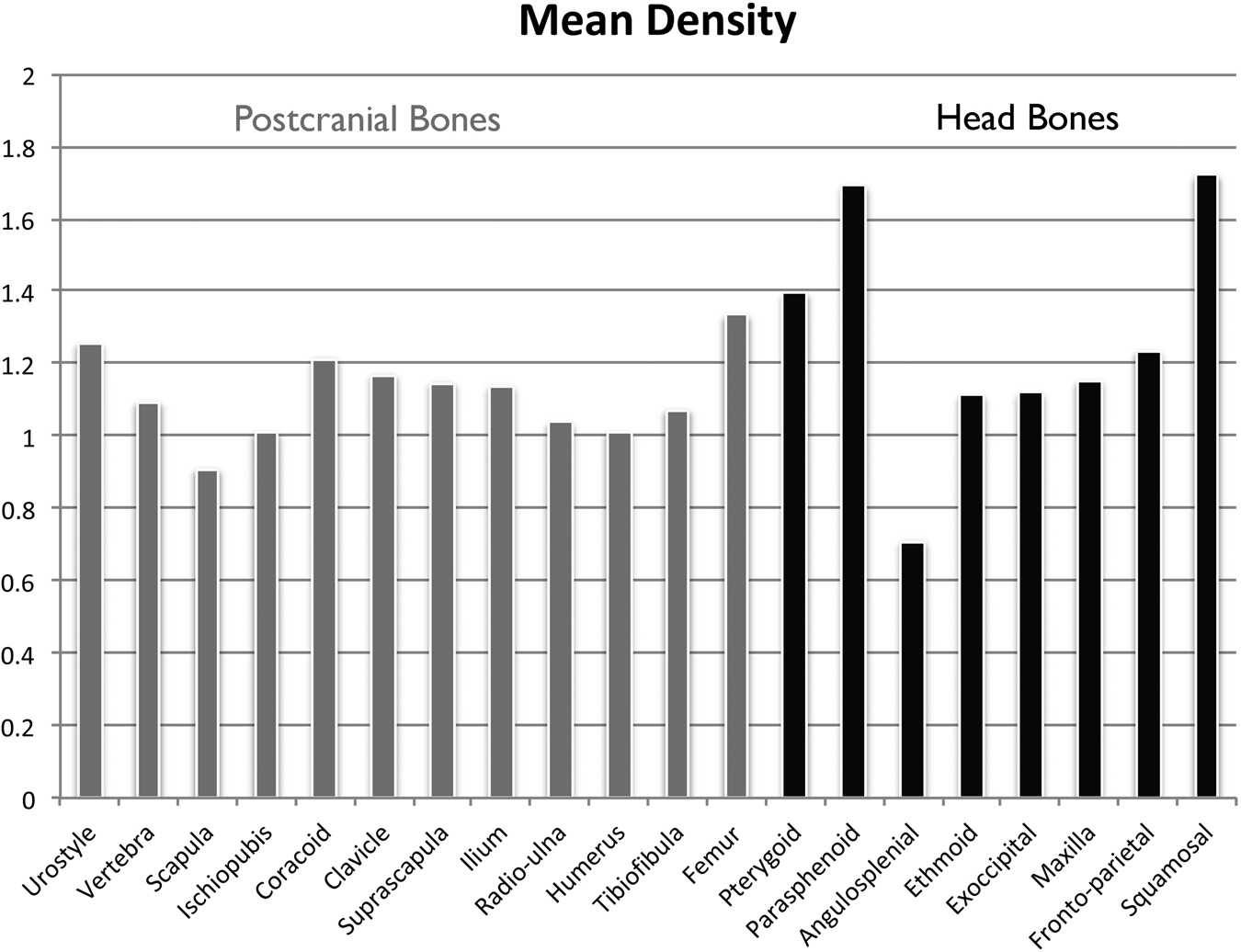
Anuran Bone Taphonomy
Recognizing that a disparity between bones of the head and bones of the postcranium in archaeological assemblages may be due to variable decomposition rather than human agency, the densities of the major bones of the skeleton were measured by means of liquid displacement. Results (Figure 2) indicate that there is little variation in density among the skeletal elements and between the head and postcranial bones collectively. This measure of density, however, is affected by variability in the capacity for bones to trap air. Furthermore, variable preservation may be affected as much or more by bone shape rather than density. For example, the structurally durable cylindrical shapes of long bones may benefit their preservation over certain of the thin flat bones of the head, such as the dentary, parasphenoid, pterygoid, and maxilla. In addition, the thin flat bones of the head may provide a greater ratio of surface area to volume than more compact postcranial elements thereby providing more surface area that is subject to microbial, chemical, and physical degradation.
Mean density of American Toad (Anaxyrus americanus) bones.

Remains of toads and other amphibians are commonly found in paleontological deposits resulting from predation and thanatocoenosis. Studies of these remains have identified a disparity between cranial and postcranial elements (e.g., Sampson Reference Sampson2003; Stoetzel et al. Reference Stoetzel, Denys, Bailon, el Hajraoui and Nespoulet2012). One explanation for this is that predation and consumption (coprocoenosis) of amphibians by owls and mammals variably affect different skeletal elements (Pinto Llona and Andrews Reference Pinto Llona and Andrews1999; Rey and Sanchiz Reference Rey and Sanchiz2005; Slater Reference Slater2002). A study of amphibian remains from a paleontological deposit at the Acheulean site of Duinefontein 2, South Africa, reveals that some natural deposits of anuran remains exhibit a marked disparity between cranial and postcranial elements, whereas others do not (Sampson Reference Sampson2003). The implication of these studies is that taphonomic processes such as digestion as well as microbial and chemical decomposition may impart a disparity in anuran body-part representation, favoring the preservation of postcranial elements.
Window-Well Experiments
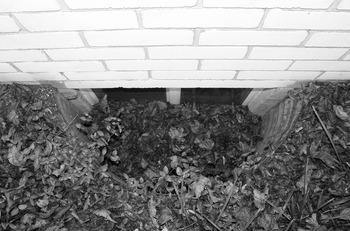
In order to provide an analog for natural entrapment of toads, three (out of six) window wells of a rural house in Howard County, Maryland, were excavated in October 2017 to recover bones of toads that had accumulated since its construction in 1952. Modern house window wells are considered an appropriate analog for ancient features such as subterranean food storage pits because they have similar depths and straight walls, they are in immediate proximity to domestic dwellings, and they are known to frequently entrap small animals. The wells of this particular house had never been cleaned out, and the owner reported that she frequently rescued toads from her window wells. The three chosen for excavation include one on the southwest side (Window Well 1), one on the southeast side (Window Well 2), and one on the northeast side (Window Well 3) of the house (Figure 3). Window Well 1 is adjacent to a large expanse of lawn, but it is surrounded by a small shrub garden that is, in turn, surrounded by a concrete sidewalk. A large maple tree, approximately 5 m to the southwest, provides shade. Window Well 2 also is adjacent to a large expanse of lawn, and it is flanked by ornamental shrubs that provide shade. Window Well 3 is surrounded by a concrete patio, but it is immediately bordered by a narrow shrub garden. Secondary forest growth is located approximately 25 m to the northwest. The tops of all window-well encasements are level with the exterior ground, thereby facilitating entrapment of toads and other vertebrates as well as the ingress of terrestrial snails. The encasements are hemispherical corrugated steel abutted against concrete block walls that surround the glass windows. The depths of the wells from the exterior ground surface to the interior surface prior to excavation ranged between 50 and 55 cm. The goals of this experiment were to (1) recover toad bones from various depths to evaluate preservation bias, (2) wet-screen recovered sediments through various mesh sizes to evaluate recovery bias, and (3) determine if laboratory technician sorting of wet-screened sediments is biased in favor of postcranial elements.
Window Well 1 (61 × 46 cm) prior to excavation.

Methods
Each well was photographed, and then loose leaves were removed to expose humic soils. They were then excavated in 5 cm levels using trowels. Soil was bagged for wet screening through nested 6.4, 3.2, and 1.6 mm mesh. Three levels (to 15 cm) were excavated in Window Wells 2 and 3 until the original layer of drainage pebbles was encountered. Window Well 1 was excavated in four levels (to 20 cm) until very compact clay was exposed.
In the process of leaf removal, one young live toad was recovered from Window Well 2. Many bones of toads and other vertebrates, as well as modern artifacts, were observed while excavating.
Wet screening produced three size lots for each window well (6.4, 3.2, and 1.6 mm). Each size lot was dried, and then faunal remains and artifacts were sorted from sediment and plant debris. At the time of this writing, the 1.6 mm lot was sorted only for Window Well 1. As a sample, the 3.2 mm size lot from Window Well 1 was sorted by inexperienced volunteers who were instructed to separate bones from other debris. This was done under normal laboratory lighting with the aid of a 10-power hand lens. Then, the senior author, who had 34 years of experience as a zooarchaeologist, sorted through what the volunteers had deemed “debris” in order to recover and record any bones they may have missed. This was done to determine if sorting by inexperienced laboratory personnel results in biased skeletal part representation.
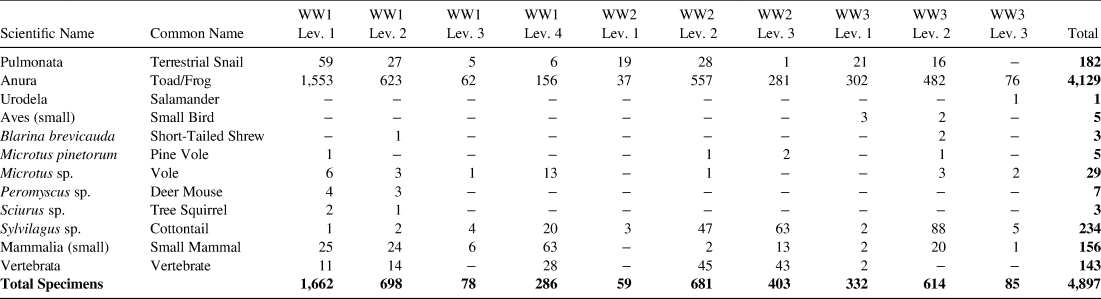
Thousands of small animal bones and dozens of terrestrial snail shells were recovered (Table 3). These include primarily bones of Nearctic toads (Anaxyrus sp.), but also bones of the eastern spadefoot (S. holbrookii), frogs (Lithobates sp.), salamanders (Caudata), infant eastern cottontails (Sylvilagus floridanus), pine voles (Microtus pinetorum), tree squirrels (Sciurus sp.), short-tailed shrews (Blarina brevicauda), deer mice (Peromyscus sp.), and passerine birds (Passeriformes). Bones of toads of all terrestrial sizes were recovered. The pH level of soil from Window Well 2, Level 2 was determined to be 7.7, which explained the excellent bone preservation. Artifacts recovered indicate deposition between 1962 and the present.
Animal Remains Recovered from the Window Well Excavations.

Anuran bones were recovered from all levels of each window well. The 6.4 mm and 3.2 mm mesh screens recovered 2,394 specimens (a minimum of 99 individuals) from Window Well 1, 875 (a minimum of 29 individuals) from Window Well 2, and 860 (a minimum of 32 individuals) from Window Well 3. Specimens recovered by 1.6 mm mesh from Window Well 1 include another 1,510 anuran specimens, especially the smaller bones of small individuals.
Overall, the Window Well entrapment data, along with evidence from Whyte's (Reference Whyte1988, Reference Whyte, Purdue, Klippel and Styles1991) entrapment experiments, indicate that natural entrapment of anurans in the archaeological record will be indicated by the presence of individuals of all sizes, accompanied by remains of other commensal fauna such as shrews and mice, and a prevalence in the lower levels of deep features such as food storage pits. An exception to this pattern concerns pits that may have contained rainwater and that were attractive to breeding adult toads and frogs. These would most likely contain more adult anuran remains and fewer commensal micromammals.
Preservation Bias
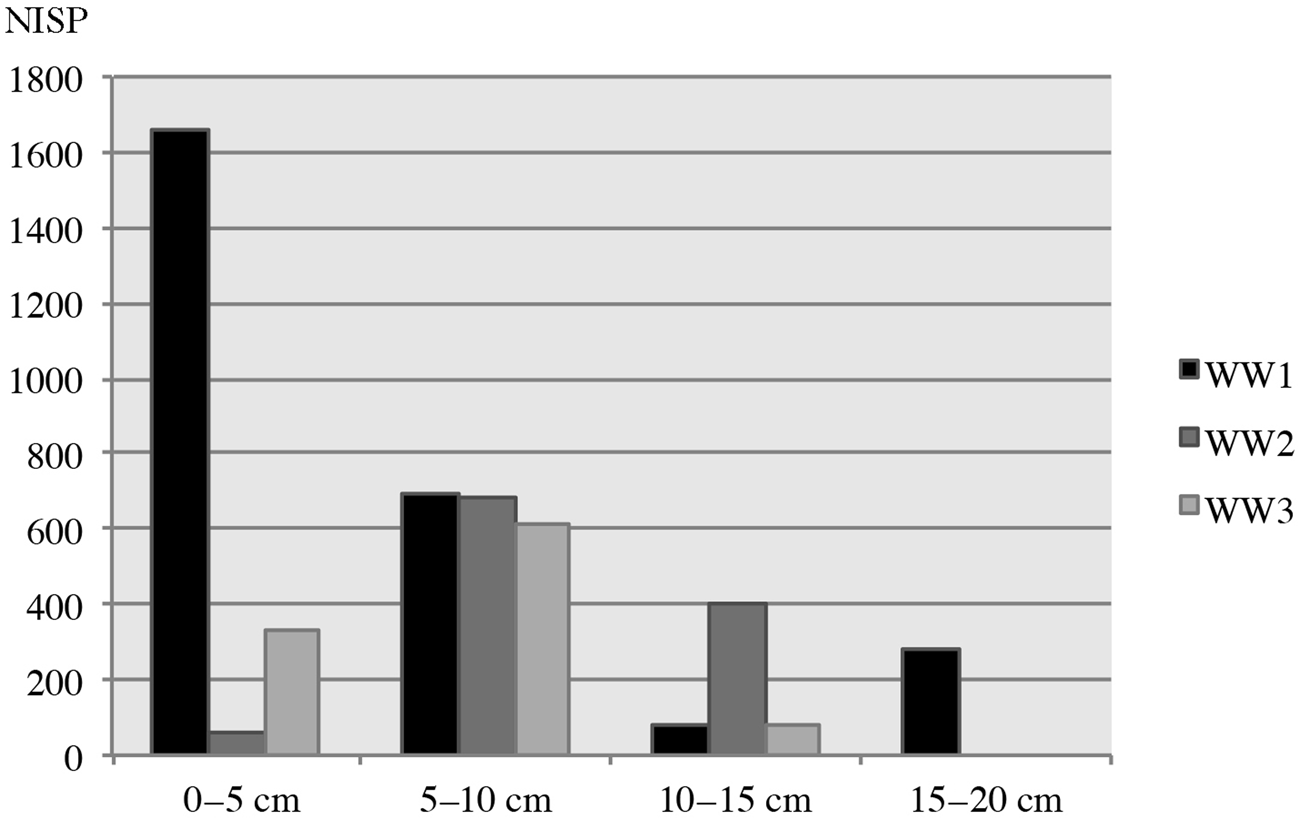
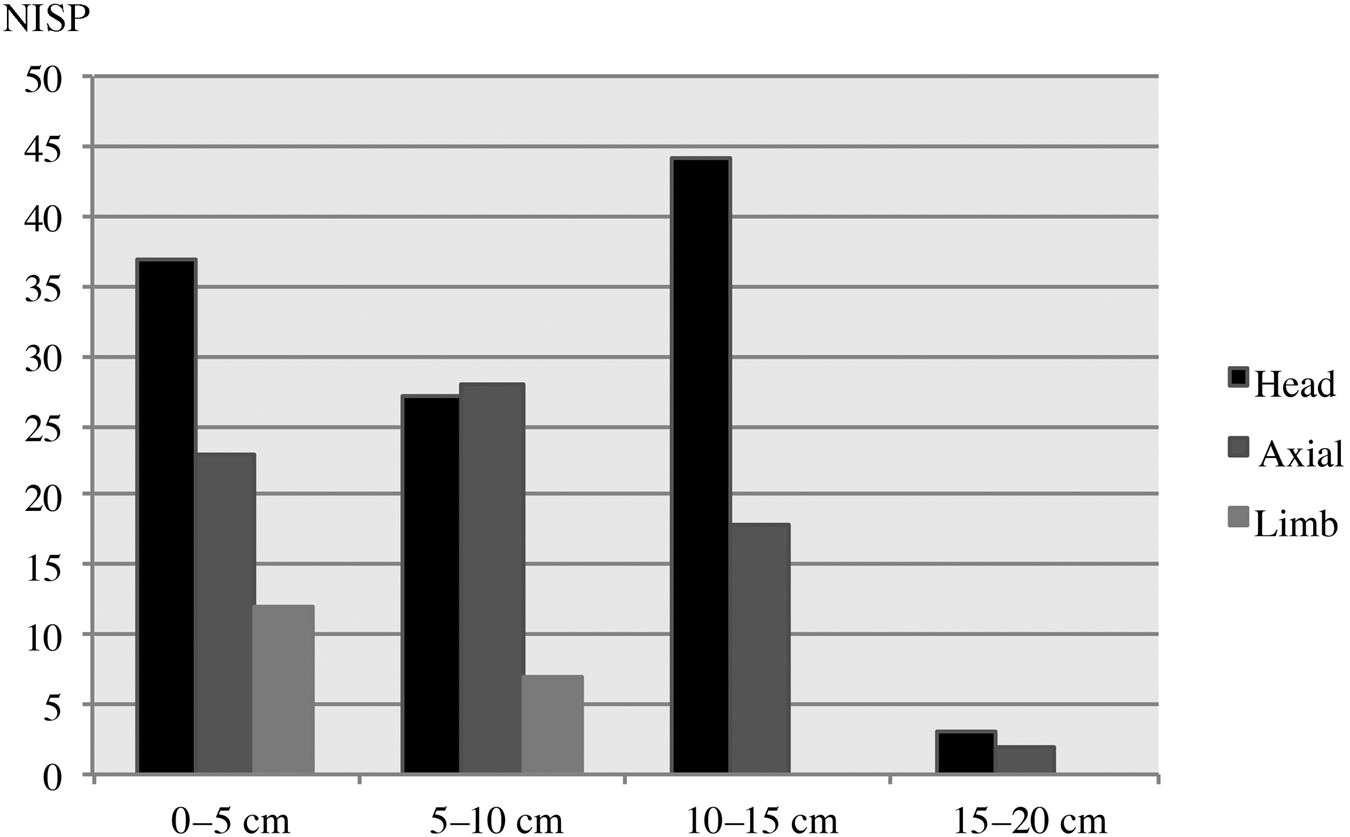
The window wells were excavated in 10 cm levels to determine if there was vertical variation in the numbers of anuran remains and in skeletal part representation. The lowest level of each window well is presumed to represent deposition beginning in 1952 when the house was built, 65 years prior to excavation. Due to compression via decomposition of organics, especially plant debris, the deepest 10 cm level of each window well represents a longer period of accumulation than subsequent levels. Level 1, which contains a significant portion of organic debris relative to soil, represents a much shorter period of deposition. It was expected, therefore, that the lower levels would contain more bones per unit of soil. This, however, is not the case (Figure 4), possibly indicating that, over time, bones have become fewer in the lower levels despite the neutral pH of the soil. But if this were the case, one would expect that bones in the lowest level would be more degraded than those above. Although anuran bones recovered from Levels 3 and 4 appear to be no more degraded or fragmentary than those from Levels 1 and 2, delicate shells of terrestrial snails are abundant in upper levels of the window wells but nearly absent in the lowest.
Numbers of animal remains recovered from each level of each window well (only Window Well 1 included a fourth level).

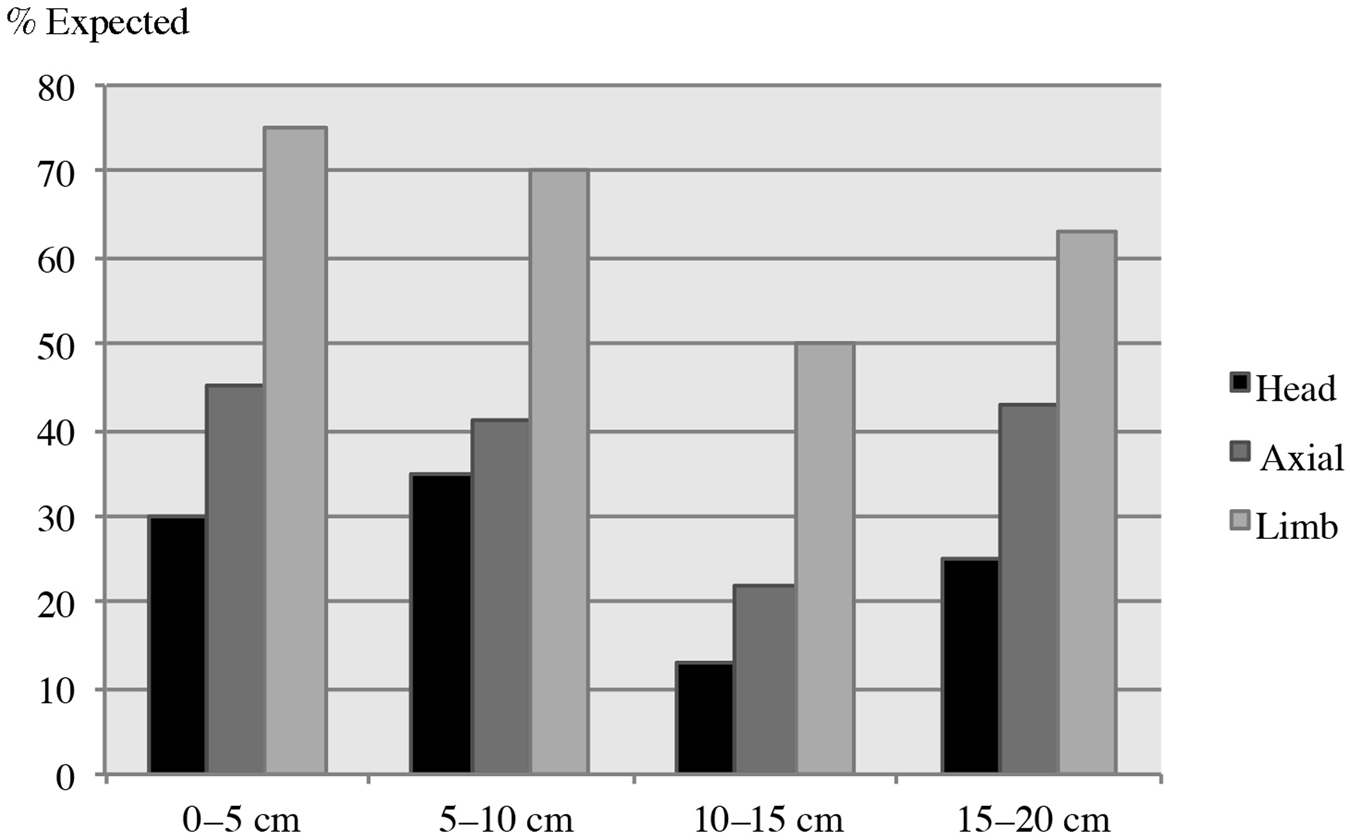
The minimum number (MNI) of anuran individuals was calculated on the basis of the greatest number among singular elements, or the greatest number among paired elements divided by two. Based on the number of anuran ilia recovered, an MNI was determined for each level. Based on this MNI, the expected number of bones of the head is far lower than the expected number of bones for the axial and limb portions (Figure 5). This indicates that bones of the head, when averaged, are less likely to preserve than bones of the body. The data from Window Well 1 provide another indication of preservation bias. Note that although the numbers of bones recovered by the larger mesh sizes increase with depth, those recovered by 1.6 mm mesh decrease (Figure 6). This indicates that the smaller bones of the skeleton and bones of smaller individuals have decomposed more rapidly over time. It is also possible, however, that entrapment was less frequent in the first decades due to environmental factors or because the window-well encasement rims were higher and presented a barrier, especially to smaller toads.
Percent of expected numbers of anuran bones per skeletal part recovered by level.

Anuran bones recovered by 1.6 mm mesh from Window Well 1.

Recovery Bias
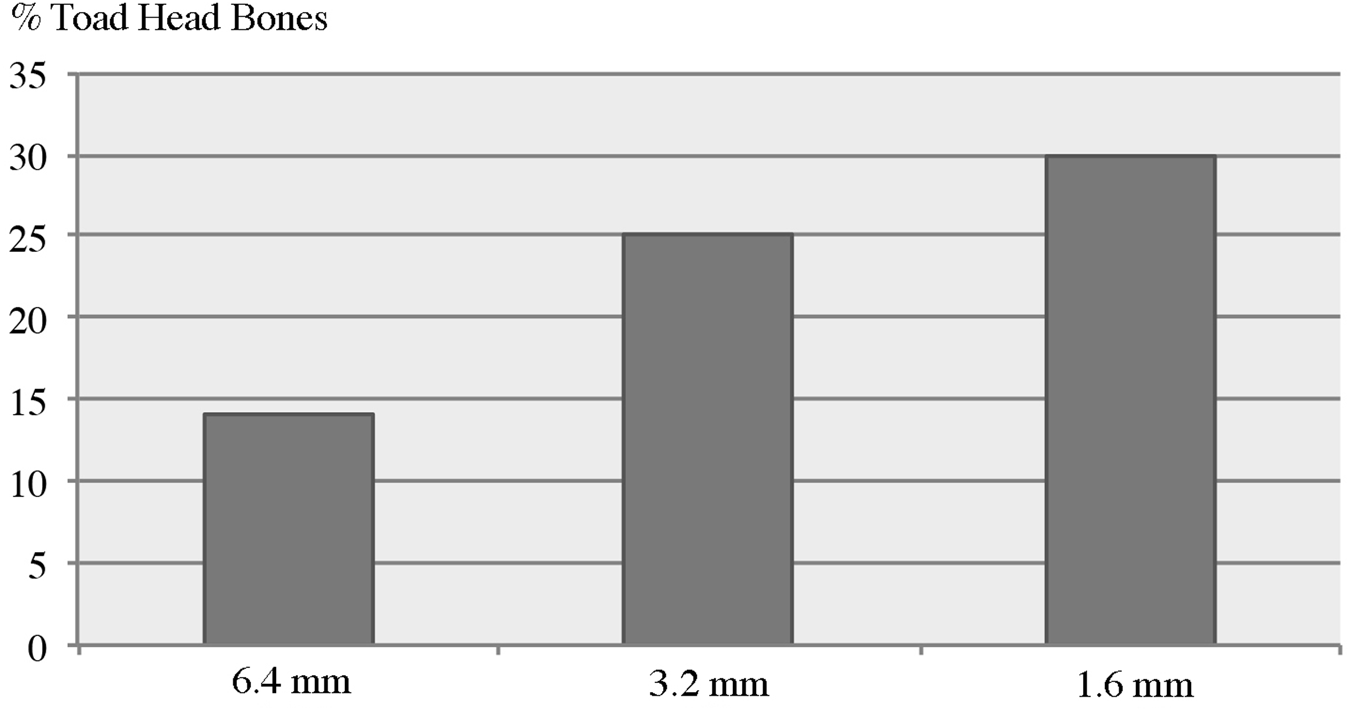
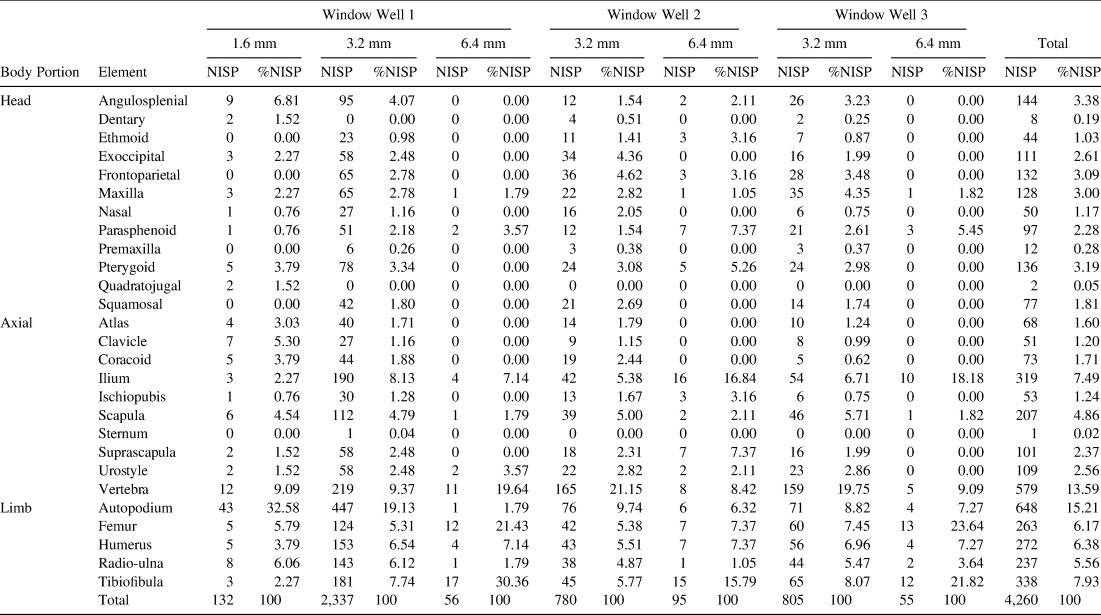
Anuran skeletal part representation also varies among the three mesh sizes used in recovery (Table 4). Even when small foot bones are removed from the equation, bones of the head were recovered more frequently as mesh size decreased (Figure 7). Toads entrapped in the window wells, however, varied in size from very small subadult to large adult terrestrial forms, whereas those represented in the archaeofaunal assemblages discussed above were largely breeding-age adults. With this in consideration, the complete but disarticulated skeleton of an adult American toad (A. americanus) that in life measured 84 mm in total length and weighed 86 g was gently screened separately through 6.4, 3.2, and then 1.6 mm mesh. Excluding very small foot and epiphyseal bones, 100% of bones were recovered by the 1.6 mm mesh. The 3.2 mm mesh recovered 100% of postcranial elements, but only 75% of cranial elements (small cranial bones including the premaxillae, quadratojugals, and one angulosplenial) had passed through. The 6.4 mm mesh recovered 43% of cranial and 44% of postcranial elements. In sum, screen mesh size influences anuran skeletal part representation in resulting data.
Anuran skeletal part disparity among recovery mesh size groupings.

Anuran Skeletal Element Representation for Each Mesh Size and Window Well.

Laboratory Sorting Bias
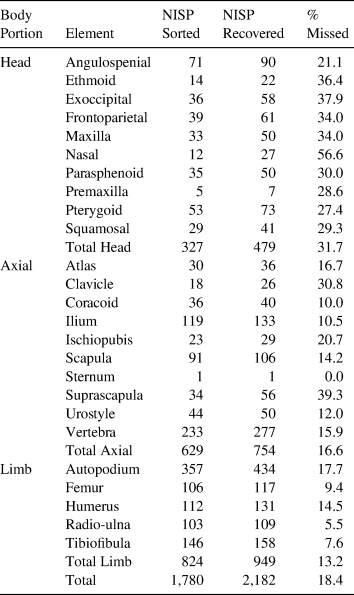
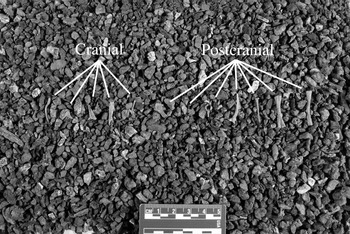
Anuran skeletal part representation also was affected by employment of inexperienced laboratory technicians assigned the task of sorting bones from other debris. The sample from Window Well 1—recovered by 3.2 mm mesh, sorted by inexperienced laboratory personnel, and then reexamined by the senior author—includes 2,182 specimens. The inexperienced sorters missed 31.7% of the elements of the head, but only 16.6% of axial and only 9.8% of limb elements (Table 5). A logical explanation for this disparity is the fact that vertebrae and limb bones of anurans look like what bones are expected to look like, whereas many of the head elements—such as the angulosplenial, nasal, parasphenoid, pterygoid, and squamosal—look more like plant debris, of which there was an abundance in the recovered sediments. In essence, the bones of the head were difficult to recognize as bones, especially when camouflaged against a backdrop of dried plant matter. But it is also difficult to distinguish them from other debris when sorting through archaeological sediments that contain little plant debris. Figure 8 shows several head (left) and postcranial (right) toad bones against a backdrop of unsorted 3.2 mm wet-screened sediment from a Middle Woodland period (AD 400–600) pit feature. Postcranial limb elements clearly stand out from the sediment, whereas bones of the head do not. Indeed, there was a lesser disparity in the recognition of bones of the head versus those of the postcranium in the lowest window-well excavation levels that contained very little plant matter.
Sorter Bias in Anuran Bone Identification for Window Well 1, 3.2 mm Mesh.

Toad cranial and postcranial bones against a backdrop of archaeological sediment.

In summary, the window-well data indicate that bones of the head are less likely to remain preserved over time, less likely to be recovered using mesh sizes larger than 1.6 mm, and less likely to be recognized as bones by inexperienced laboratory personnel in the sorting process. This discovery presents the undesirable condition of equifinality, in which processing toads for consumption, laboratory processing of archaeological sediments, and taphonomy produce the same result.
Another Look at Coweeta Creek
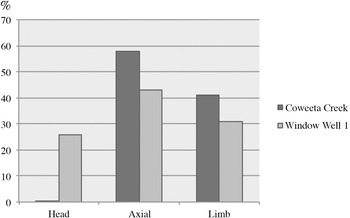
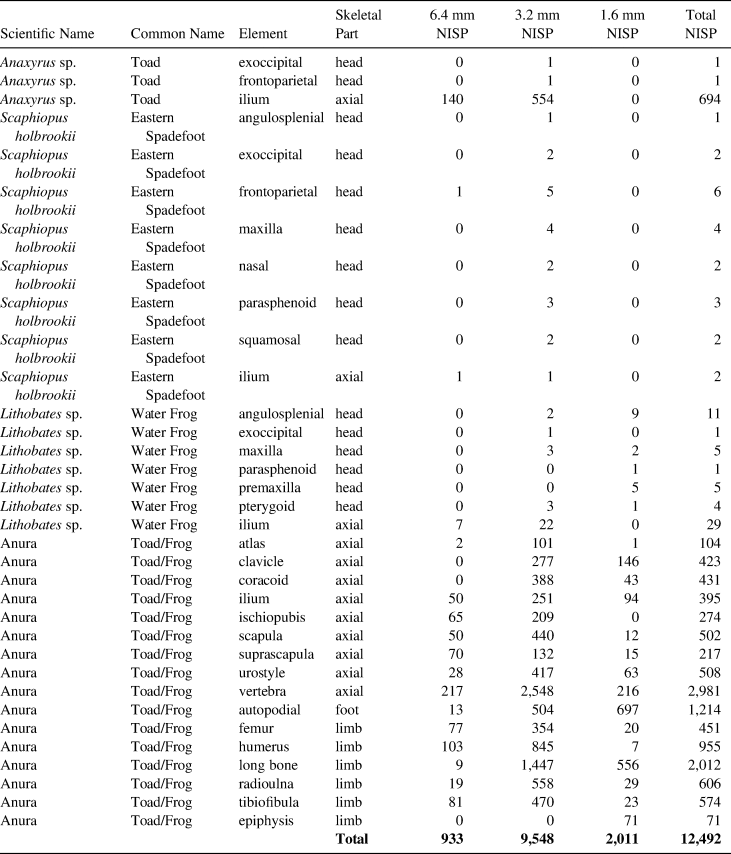
Recently, several unsorted samples of wet-screened material from the 1965 excavations of Feature 65 at the Coweeta Creek site (31MA34) were discovered in storage at the UNCRLA. These amount to over 10 kg of materials, including 2 kg of faunal remains that were recovered by wet screening through 6.4, 3.2, and 1.6 mm mesh. This discovery afforded the opportunity to verify the paucity of toad skull and mandible elements in Runquist's (Reference Runquist1979) data. Animal bones were sorted from other sediments by student volunteers and then checked by the senior author, who then sorted out anuran bones for identification and analysis. All specimens (10,481 in total) recovered by 6.4 and 3.2 mm mesh were sorted and identified, and a sample (2,011 in total) of the 1.6 mm mesh fraction was sorted and identified (Table 6). Anuran bones in this sample amount to 12,492 specimens, bringing the total count for Feature 65 to 19,598. Using the ilium for more specific identification, a minimum (MNI) of 394 Nearctic toads (Anaxyrus sp.), two eastern spadefoots (S. holbrookii), and 15 frogs (Lithobates sp.) are represented in this sample. Only 49 bones of the head (0.4% of anuran bones excluding small foot bones, which often pass through 1.6 mm mesh), and only 104 atlases (28% of the expected number based on the MNI) were found. Figure 9 compares anuran skeletal part representation between the new Coweeta Creek Feature 65 sample and that of Window Well 1 discussed above. Although the window-well experiments indicate that skeletal part representation is biased due to preservation and laboratory processing, this extreme disparity cannot be explained exclusively due to these processes. Indeed, toad bones from a much earlier site in the same region—the Biltmore Mound, which dates to AD 400–600 (Kimball et al. Reference Kimball, Whyte and Crites2010)—include a far greater proportion (12%) of head bones, indicating that preservation bias is a minimal contributor to the overall disparity. And the recently discovered sample from Coweeta Creek was sorted and analyzed by a veteran zooarchaeologist who is very familiar with toad osteology. The residents of Coweeta Creek, Warren Wilson, Garden Creek, Ravensford, and Smokemont were almost certainly decapitating and consuming toads.
Comparison of anuran skeletal part frequency among the Coweeta Creek (Feature 65 new sample) and Window Well 1.

Anuran Remains from Coweeta Creek.

Of further note is that many specimens from Feature 65 at Coweeta Creek are fragmentary and 16% were burned. None readily exhibits evidence of digestion or perimortem breakage. This indicates that prior to consumption, the meat was removed from the bones, perhaps by boiling. Some of the dregs were deposited in Feature 65, whereas others got burned and broken in other contexts prior to secondary deposition in the feature.
Another interesting fact about the 49 head bones identified is that only two are from Nearctic toads (genus Anaxyrus). The rest are from nontoxic frogs and less toxic eastern spadefoots. This suggests the possibility that Nearctic toads with toxic parotoid glands and skins were preferentially decapitated and skinned, whereas other anurans were not. The greater frequency of head bones, however, may be explained if the spadefoot, a notorious burrower, was intrusive to the deposits.
Summary and Conclusions
In conclusion, although the window-well experiment indicates that bones of the head are less likely to be preserved, recovered, and identified, the disparity in some assemblages is extreme and more restricted to Nearctic toads containing toxins. Many of the toads represented at the archaeological sites discussed above were breeding-age adults. If toads were collected while foraging for other resources, only larger individuals were targeted. A more likely procurement strategy—one that would yield more toads with minimal effort, and one that would explain the representation of nearly a thousand toads in one feature at Coweeta Creek—would have been to collect toads from springtime breeding aggregations in ponds and puddles using nets. Perhaps the toads were beheaded and skinned at the collection site to facilitate their transport back to the village. The toad bones in Feature 65 at Coweeta Creek and Feature 229 at the Warren Wilson site may represent the remains of meals, a feast, or rituals associated with palisade construction. Feature 65 dates to the initial occupation of Coweeta Creek, and it is located at the eastern gateway of the village palisade. Feature 229 at Warren Wilson is interpreted as a daub-processing pit, also associated with the palisade, and it also dates to the initial occupation of the village. Palisade construction may have been undertaken in the spring when the soil was softened by heavy spring rains, which facilitated posthole excavation. Toads and other foraged foods would have provided a ready source of meat that could have been procured by foraging parties, including children, while able-bodied adults were engaged in construction.
The numerous toad remains recovered from the Smokemont site, however, were primarily found in a midden area around the central hearth of a structure (Vavrasek Reference Vavrasek and Angst2012), whereas those recovered from the Ravensford site occurred primarily in an assortment of pit features (Compton Reference Compton2014). This indicates that toads also may have been consumed indiscriminately and whenever they were available for capture.
Consumption of toads at the five southwestern North Carolina sites may also have been associated with ritual. This is suggested by the numerous toad bones recovered from the earthen bench of an earth lodge, arguably a ritualized context, at Garden Creek Mound No. 1. The hydric staining observed on these bones and the lack of head bones may indicate that headless skinned toads were placed on the bench as an offering. Claassen (Reference Claassen and Peres2014:136) argues that the toad remains in Feature 65 at the Coweeta Creek site may represent a “rain/fertility ritual deposit,” presumably on the basis that such rituals were practiced in Mesoamerica and in the larger Mississippian cultural region. But since toad remains are not particularly common on Mississippian sites outside of the Appalachian Summit, ritual influenced by way of cultural eddies of Mesoamerica and the greater Southeast is untenable. Furthermore, there are no references to a ritual significance of toads in the ethnohistorical writings describing the Native Southeast—only a recipe for their preparation and consumption by the Cherokees (Ulmer and Beck Reference Ulmer and Beck1951:51).
All of the sites mentioned above are in the Appalachian Summit and postdate AD 1200. And most of them contain Pisgah and Qualla phase components, suggesting that toad consumption was common among pre- and postcontact Cherokees in the region. Toad remains are few on contemporaneous Late Mississippian (Dallas phase) and Overhill and Tuckaleechee sites to the west in the Valley and Ridge province of Eastern Tennessee (Baden Reference Baden1983; Bogan Reference Bogan1983; Bogan and Bogan Reference Bogan, Bogan, Schroedl, Stephen Davis and Boyd1985; Bogan and Polhemus Reference Bogan, Polehemus and Polhemus1987; Bogan et al. Reference Bogan, LaValley, Schroedl and Schroedl1986; Hollenbach et al. Reference Hollenbach, Sichler, Vavrasek and Marcoux2012; Russ and Chapman Reference Russ and Chapman1983) and on Late Woodland and Contact period sites on the Carolina Piedmont to the east (Holm Reference Holm, Dickens, Ward and Stephen Davis1987; Runquist Reference Runquist1979; Whyte Reference Whyte1988). This geographical restriction of more intensive toad consumption does not appear to be correlated with natural toad abundance, but rather with subsistence ethnicity.
Pre-Pisgah phase faunal assemblages of sufficient size for comparison in the Appalachian Summit are few, and they include Middle Woodland period Connestee phase remains from Garden Creek Mound No. 2 (31HW2; Whyte Reference Whyte2011) and the Biltmore Mound and Village site (31BN174; Kimball et al. Reference Kimball, Whyte and Crites2010). These assemblages date to between AD 400 and 800. The assemblage from Garden Creek Mound No. 2 includes only 1,496 specimens. It is poorly preserved, it was recovered using mostly 6.4 mm mesh, and it contains no amphibian remains. The assemblage from Biltmore Mound is very well preserved, and it was recovered by finer meshes and flotation. Of the 34,532 specimens analyzed, only 127 are bones of Anura (0.4% NISP). The Biltmore assemblage, however, was recovered almost exclusively from the mound; toad remains may have been more regularly deposited in pit features such as those at the Coweeta Creek, Warren Wilson, and Ravensford sites, or on house floors such as Structure 1 of the Smokemont site. If the Biltmore Mound assemblage is approximately representative of Connestee-phase village sites, the paucity of toad remains may be related to the fact that Connestee villages explored to date did not have palisades. If consumption of large numbers of toads was necessitated only by village populace construction activities in spring, when toads are obtainable in great numbers due to their breeding habits, toad remains would be fewer on earlier sites lacking palisades. In conclusion, regular consumption of toad meat may have been limited to specific ethic groups of the southern Appalachian region, such as the “Upper Cherokees” as implied in Schwarze (Reference Schwarze1923:55), and may have been limited in time to the late Mississippian Pisgah and Historic Qualla phases. This potential recognition of subsistence ethnicity is something to consider as additional faunal assemblages in the region come to light.
Acknowledgments
We are especially grateful to Margaret Hirsch Whyte for allowing us to excavate her window wells. Thanks are also due to Appalachian State University students Rachel Colby, Evan Batchelor, Christopher Hartman, Heather Duffey, Caleb Jeck, and Gabriela Neufeld. Steve Davis generously loaned faunal remains from the Research Labs of Archaeology at the University of North Carolina, Chapel Hill. Brett Riggs and Heather Lapham offered much appreciated sage advice. The abstract was translated into Spanish by René Harder Horst of the Department of History at Appalachian State University. Special thanks to Paul Webb and Tasha Benyshek of TRC Companies Inc. for the opportunity to study the Ravensford zooarchaeological materials. Funding for zooarchaeological analysis of the Ravensford materials was provided by TRC Companies Inc. through a contract with the Eastern Band of Cherokee Indians.
Data Availability Statement
Data and archaeofaunal remains pertaining to the Window Well Experiments are maintained by the Department of Anthropology, Appalachian State University, Boone North Carolina. Data and archaeofaunal remains pertaining to the Coweeta Creek (31MA34), Garden Creek (31HW1), and Warren Wilson (31BN29) sites are maintained by the Research Labs of Archaeology, University of North Carolina, Chapel Hill.