Karmen Geï (2002)Footnote 2 is a stunning remake of the nineteenth-century myth of Carmen. The film was released by the Senegalese filmmaker Joseph Gaï Ramaka. In this version, the heroine, Karmen, escapes from a prison, where she has a relationship with the prison guard, Angélique, and rejoins her gang of smugglers. Angélique is heart-broken and commits suicide while Karmen moves on to another lover, Lamine, who is a police officer. Lamine is forced to take Karmen prisoner when she disrupts a public event, which happens to be his own wedding. Karmen escapes without too much trouble, and Lamine eventually joins her gang in his pursuit of her love. We learn that Karmen has had other lovers, such as the fatherly Samba and the attractive singer Massigui. Despite the various additions to the cast and the reinvented plot that Ramaka accomplishes, the film imaginatively reproduces Bizet’s Carmen, remaining true to the operatic text in Wolof translation. It also thus remains in fidelity to the tragic ending of the well-known Carmen story, which was written by Prosper Mérimée. Karmen Geï is a provocative interrogation of the notion of freedom in a form that defies recuperation via feminist or postcolonial theory; it is a utopian reflection that challenges our interpretive methods. Ramaka gives us a terrific film that I recommend well beyond the classroom. I have used it in an advanced French seminar on postcolonial African literature and culture, in a film studies seminar for French majors, as well as a postcolonial film studies class taught in English and French. To date, I have reserved it for upper-level classes rather than beginners in any framing.
In this essay, I show how I introduce the film in these classes, and I provide a supple interpretive template that might be adapted by instructors who could include it in any advanced class on postcolonialism and related fields. I also propose this essay to instructors who are thinking of using film in nonfilm classes in postcolonial studies. To this end, I provide specific strategies for teaching (this) film as film rather than have it lapse into a source of “information.” The medium itself would thus offer richness to the nonfilm class curriculum.
All classes at my institution are attached to an electronic “Sakai” site specific to each course. The site includes an electronic discussion board (a “Forum”) that functions somewhat like a Google discussion group, whereby students and the instructor can post announcements, initiate discussions, and comment on one another’s postings. It is also possible to have students respond under another feature of the site, which houses “Assignments,” where they would not be able to view one another’s postings. The site has other useful features that allow instructors to post assignments with timed opening and closing dates and times, as well as web-based resources. In addition, a media gallery gives students access to multimedia for specific use in the class. All films are available for individual viewing by students through this site gallery, although I restrict the open date until the film has been screened in the auditorium or film room, a practice becoming increasingly difficult due to scheduling conflicts with student work and other activities outside of class time. The “Resources” section attached to the site might include additional readings; film glossariesFootnote 3 ; links to interviews of the writer, artist, (or here) filmmaker; to online essays; and to film blogs, for example.
Introductory Session (Fifteen Minutes)
I recommend introducing the film at the end of the class session prior to the one dedicated to the film. This is assuming a screening for the students between this introductory session and the subsequent dedicated session. The opening scene (Karmen1.mov—a, b, c, d)Footnote 4 allows discussion of Laura Mulvey’s idea of “visual pleasure,” or scopophilia: here, the spectator is presented with a long take of a seated Karmen in a sexually charged pose, keeping time to the drumbeat by the slapping movement of her thighs coming together and apart (Karmen1a.mov).
This is disrupted as the shot cuts to capture the actual viewer within the diegesis: the lighter skinned, uniformed prison guard, Angélique (Karmen1a.mov and Karmen1b.mov). Students have agreed in their discussions that “we” (as spectators) are transformed into provisional male onlookers in the position that the camera offers us (following traditional framing and focus recognizable in cinema as the male gaze). We watch Karmen through culturally coded images and processes of viewing that are opened up in the cinematic experience. The sudden cut to a viewer who is brought within the frame destabilizes a seamless experience of the scene in which “we” were watching the character dancing. Suddenly, as a result of the cut, the spectator is aware of a woman with the visible accouterments of power, who has been watching the first dancing woman. The spectator-position as one of powerful watching (or voyeurism) is also harshly destabilized when we realize the performance has not been, so seamlessly, for “us.” Our own attraction to the first woman’s image is also underscored by the harshly experienced rupture of our viewing position by the cut to Angélique’s blatant desire. Discussion of these modulations operated by the camera in the introductory session will allow for unpacking of a feminist analysis of the film that can follow in the full class session.
The viewer is spirited across the short time of this scene by the drumming, vibrant colors and “exotic” setting that cannot yet be fully discerned though it is evidently somewhere in “Africa.” Overt lesbianism and female sexuality are suggested in a defiant manner by the way the two women subsequently dance together with Karmen being the seductress, clearly dominating the scene and controlling the guard with Angélique submitting willingly. The dancing becomes an expression of unwilling desire by Angélique and playful enjoyment of power by Karmen while the crowd of women around, all prisoners, go into a frenzy of excitement and abandon with the drums and jazzy tones of the sax adding irreverence (Karmen1c.mov). Then the dancing is cut short and the two women, surrounded by other dancers of different sizes and shapes, disengage to go back to the quarters in the background. The camera reveals that we have been watching women in a prison. The camera cuts to a downward tilt shot of the dispersing women before panning over the prison wall, atop which we see armed guards, to provide a view of the ocean beyond it (Karmen1d.mov).
As mentioned, I show this first scene in class before the scheduled screening that students would attend prior to the session dedicated to the film. This prepares students for the viewing while I also take care not to reveal the plot or development. I ask only that students explain in careful vocabulary every movement of the camera, the framing of the actors and their relationship to one another and to the scene within the frame, the use of sound, the color and light as well as the progression from shot to shot. This quick exercise is done by running through the clip a few times rapidly, and then when students are ready to describe it, we pause every time there is a cut and describe the shot and its transition with reference to a glossary of cinematic terms. In this way, when students discuss the film in the next session after their viewing, they already use cinema-specific vocabulary. Rather than saying, for example, “When we see Karmen and Angélique looking at each other across the open yard,” they might say “the filmmaker uses shot-reverse-shots to set up the scene between Karmen and Angélique before they dance,” and they might further note that “unlike in a conversation the long-shot is used because the conversation is through body language.” Instead of something like “Karmen turns away from Angélique” they might, instead, note with care that: “When a quick cut from Angélique captures Karmen in center frame via a medium shot and considerable depth of field, we see the drummers and crowd behind her as she turns to them….” Such ability is essential to the more complex discussion that is to follow. For instructors better acquainted with text-specific language, it would be essential to also employ the vocabulary and concepts particular to film if they want the film to function beyond being background material to “talk about” postcolonialism or Africa and women.
Instead of drawing out immediate and more general reactions as I might do for a different film, I structure the dialogue very carefully and maintain tight control of the themes and questions we discuss, often needing to gloss over interesting comments or observations for optimal usage of the limited time for this short introduction (usually about fifteen minutes beyond the clip). It is useful to pick up these comments on our electronic discussion board so that students don’t become reticent to keep thinking along different lines through their own associative processes. I orient the class discussion toward a meticulous engagement of aesthetics because the plot of this film is adventurous, fluid, and exciting enough for any spectator to be carried away on the wave of action and excitement. It is easy to lose oneself in the overdose of pure visual and sensory beauty. The aim of the initial discussion is that students discover, themselves, a rudimentary aspect of criticism that is central to a postcolonial approach: that the politics of the film cannot be separated from the aesthetics, something that is not as evident as one might think. Although we might agree that this is an aspect of criticism more generally, its importance to postcolonial studies is the latter’s very essence. Breaking away from the mentality of art for art’s sake, postcolonial criticism has blasted out from tightly aesthetic formulations, the psychical violence of colonized and dominated subjects inherent in the most anodyne texts or works of art. Here, it is too easy to ascribe revolutionary, feminist politics to a larger-than-life female character, something that I get students to interrogate thoroughly through this fascinating film. This intellectual experience has revolutionized numerous students in their very view of the task of interpretation well beyond film, and, anecdotally, dozens have been drawn into doing postcolonial studies, cultural criticism, or film studies as a quite direct result.
In this preliminary session, I am able to attend to theme, content, form, and structure.
Theme: women’s spaces, incarceration, and power dynamics, Africa and the suggestion of slavery (once students are told where the film has been shot: on the island of Gorée in one of the old slave holdings that has, for the purposes of the film, been converted into a prison); but also the shadow of men, the lovers’ story, and the looming death of the heroine.
Content: the Carmen myth, contemporary Africa through Senegal, women in (this fictional) Africa, prison, indoor, outdoor, and liminal spaces, thresholds.
Form: Carmen, Bizet’s opera (music students have been interested in comparing the text of the opera with the text in the musical parts of the film), incorporation of dance with the operatic Wolof text, adherence to the myth, usage of French and Wolof, stylized story-telling or narrative.
Structure: exaggerated central (or monumental) presence of the heroine, Karmen, with reference to plot and the dominant logic of each scene that is cinematically describable.
These are just suggestions of overlapping rubrics that allow the instructor to guide students in thinking more systematically about the film. Some simple questions that subsequently set up their viewing might be:
What do you expect in this story (plot)?
Who are other characters we might expect to meet?
How do you foresee the attraction between the two women?
What associations do the visual backgrounds incite?
Make a prediction for the plot based on this clip and justified by some element in it.
This last is often assigned as a short written paragraph to be completed in class as the final exercise. It is crucial, again, for students to understand that the importance of the exercise is not the correctness in the prediction but in the ability to read the cinematic text as a meaning-making web of interrelations among its different elements.Footnote 5
I guide the students as they answer these questions by referring back to concrete moments of the first sequence we have just viewed together. For example, a student might volunteer that there will likely be men who will woo Karmen. I would ask for a point in the clip that gestures to the presence of men. The entire sequence takes place in an all-women’s prison, where the guards are also women. The student might volunteer that at the very end we see what appear to be male guards and become aware of a particular form of masculinity that is reiterated by the long guns they carry. These are phallic in both iconic and symbolic terms. This suggestion offers the opportunity to review the final moments of the sequence when the camera offers a downward tilt shot of the dispersing crowd of women before sweeping upward and out to the ocean. The panning movement captures the guards who are atop the high prison wall that separates it from the town on one side and the sea on the other. We can introduce cinematic form regarding not just the angle of the shot or the movement of the camera but also notions like “depth of field” to describe the shots in which the two women are the focus. This exercise prepares for a very specific endeavor key to the success of presenting film: relating form and content. It also gives students the tools to understand how to conceive of a scene as part of the whole in a meaningful way. The “predictions” question is always fun for students and very exciting for the instructor. For students, it is a relaxed way to end the class but also whets their appetite for the whole film. For instructors, it is exciting to be able to build on students’ reactions and get a sense of their individual ways of thinking in order to pitch the next class.
Setting Up the Main Session
Readings to enhance understanding of the film, beyond articles on this film itself, might touch upon the following themes being treated: feminist criticism and feminist film criticism; sabbar dancing in Senegal; women’s traditional dress in Senegal, modern fashion in Senegal/Africa; Senegalese history; censorship of the press; religious culture in Senegal.Footnote 6 These give students the necessary arsenal for a proper reading of the film as film while understanding that its politics cannot be reduced to what it is taken to be “saying” more simplistically. What I mean is that the power of the moving image is so great that the message conveyed the most directly could overshadow other interesting meanings within the time-space of the film that can be accessed only through a discussion of the medium. Just as analyzing narrative involves going further into the “pleasure of the text” via a system of codes, so too, discussing film is richly enhanced when its medium is fully appreciated through a recognition of the elements that make it up and how they come together through the particular movement through time it initiates.
Alongside readings to be done ahead of time, students receive the isolated clips that will provide the opening for class discussion. These are edited in the versions available for this article. Students are assigned randomly to the clips (each one lasting about three minutes or less) and asked to post descriptions of their clips in cinematic terms to the electronic discussion board. These must be as complete as possible, accounting for literally every second, and must be as strictly descriptive as possible. At this time, students will discover how difficult it really is to talk about the film in purely technical terms. That is, they find that how the scene is presented has to do with an argument or perspective that they have to resist articulating in the abstractly “neutral” terms I have asked them to use. They must constantly step back to review their work and delete all signs of analysis or argument. This exercise proves eye-opening for them yet again, and I have had a lot of playful resistance to the exercise with students “cheating” and slipping in interpretation or analysis.
Main Session
Students present the various scenes to which they have been assigned. I often include among the assigned clips the scene in which Karmen attends her lover Lamine’s wedding because it offers examples of various interesting types of framing, camera movement, angle of shots, lighting, and music, all of which work to give Karmen a magical sort of power (Karmen2a.mov).
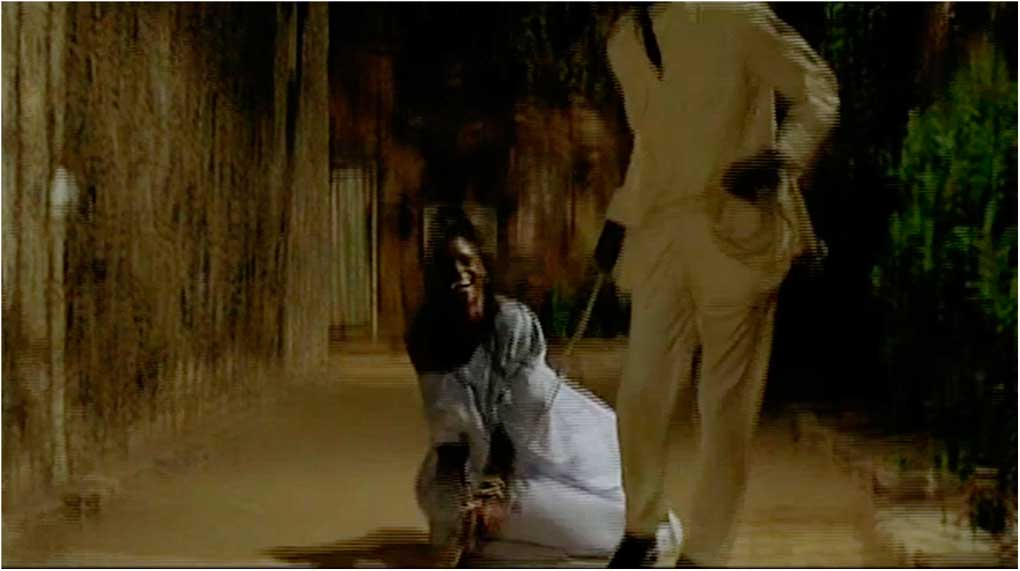
Karmen insults Lamine and the elite and provokes the bride Majiguène, makes accusations against Lamine and the entire government and its power structure, and then challenges Majiguène to a dance that is full of tension and acrobatics (Karmen2b.mov, Karmen2c.mov). The scene ends with Karmen overpowering the woman in a “dance off” when the latter is forced to the floor (Karmen2d.mov). The next scene also offers rich possibilities for description. Karmen becomes Lamine’s willing prisoner. He is called up to his official role on the police force, handcuffs her for her slander of the state, and leads her down a dark alleyway by a rope. Karmen is irrepressible in her operatic singing and defiant attitude. Lamine comes across as a weakling while Karmen is “monumentalized.” This scene offers a particularly striking mise-en-scène of the monumentalizing of the character, Karmen, and an array of other interesting points to discuss, such as the chiaroscuro (lighting), shot-reverse-shots, varying depth of shots, and tricky camera position and bold movements of both camera and actors (Karmen3.mov).
I provide a description of parts of this scene much as my students would present them, in order to illustrate how they arrive at recognizing for themselves the way Karmen emerges as a monument through the cinematography that works to construct the plot. I have not, however, split the “description” from the “analysis” as I insist they begin by doing; rather I have folded them together here for brevity.
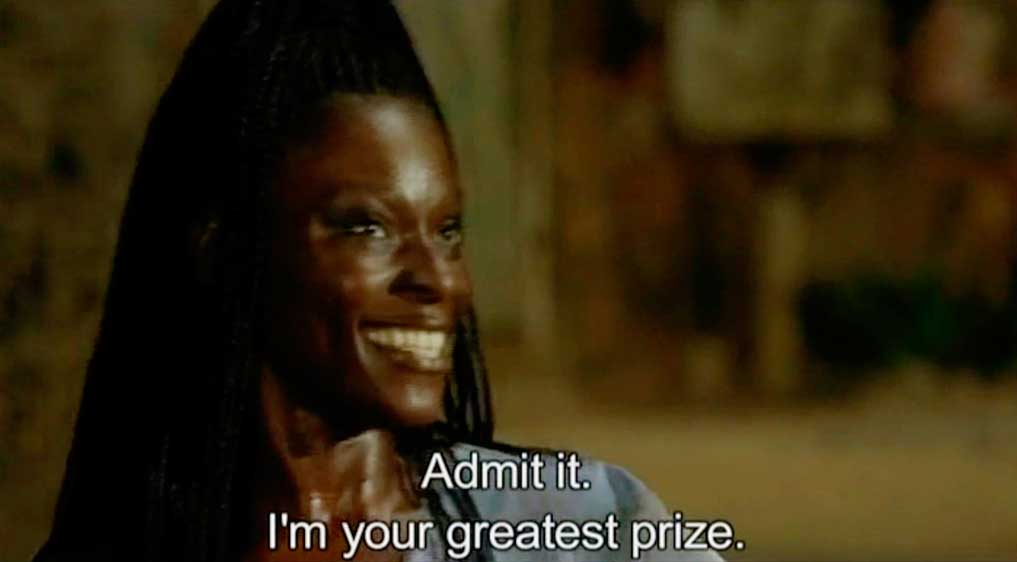
Although Karmen is ostensibly in a subjugated position because she is bound in ropes and is being dragged along the street by Lamine, the image transforms the latter into a nonentity. His head is severed by the framing, while Karmen dominates the shot, occupying the center of the frame and looming up against the length of the alley (Figure 1—Lamine head severed by frame). The angle of the camera places the spectator at the same level as Karmen rather than giving us what might be Lamine’s perspective of her if we were looking down at her with him.
Lamine head severed by frame

The angle of the camera consistently “lies” by refusing to acknowledge the physically higher positioning of Lamine in this scene, preferring always to match Karmen’s eye level (Figure 2—Karmen medium shot false eye-line matching).
Karmen medium shot false eye-line matching

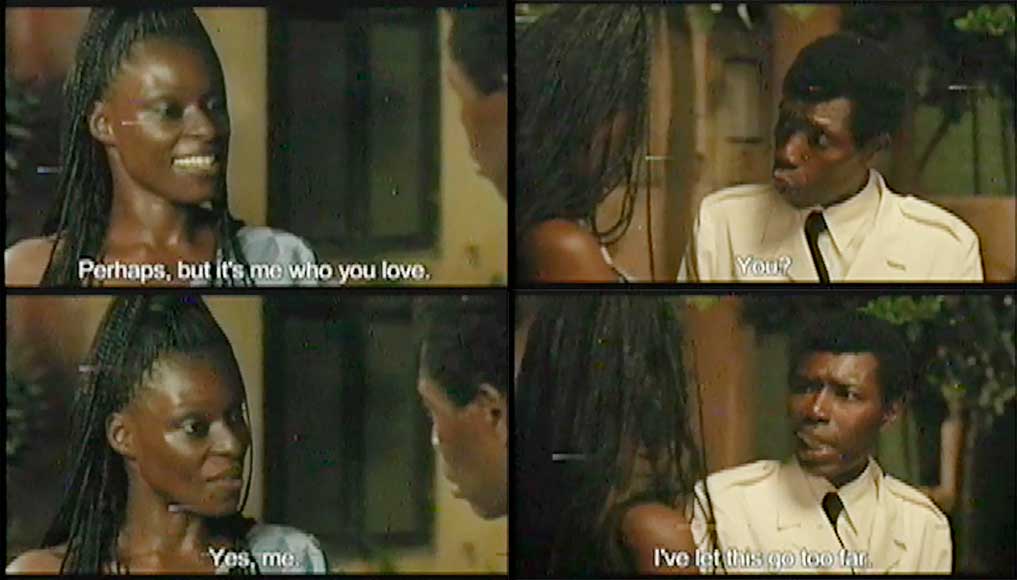
The usage of shot-reverse-shots between the two characters, Karmine and Lamine, also works to privilege Karmen (Figure 3—Karmen Lamine shot-reverse-shots). Although the shot reverses to Lamine when he speaks, Karmen’s shoulder seductively distracts from Lamine’s somewhat comical responses to Karmen’s taunts. When Karmen is center frame, Lamine’s figure is reduced to one side of his face. Karmen retains visual control of the viewer by the almost imperceptible differences in framing the shot that is reversed from her to Lamine.
Karmen Lamine shot-reverse-shots

The film’s “work” thus can be shown, through a close cinematic study or explication de texte of a variety of different scenes, to monumentalize Karmen. This becomes the central argument of the film and proves to give aesthetic coherence to its totality. Students are able to see this themselves when their many individually written descriptions of different scenes reinforce this central feature of the film when we come together as a class. Reviewing some of these scenes (with the students in question presenting each scene) while allowing the descriptions to now be put to use to analyze and argue proves to be a very enriching experience because of the interweaving of form and content that by now occurs utterly naturally. This is a powerful example to students of the benefits of artificially splitting form from content only to show how the two are interdependent and far more revealing when truly considered together. The fact that either making claims without proper substantiation or giving copious descriptions alone does not make for the notion of argument comes to light in a very vivid way through this exercise and stands them in good stead in their analyses of any materials going forth.
In shifting the notion of monumentalization from the individual scenes presented by students (first as description, then analysis) to the entire diegesis, we discuss how even though Karmen’s power becomes an all-consuming force through the mise-en-scène, a feminist vocabulary becomes more difficult when we go beyond the image. That is, although this character dominates men and defies prescriptive notions of heterosexuality or monogamy, her monumental status accomplished through stylization in the film resists such interpretation. For example, the transformation of the sabar dance into a more athletic and acrobatic exercise at the expense of the traditional taasu that accompanies it,Footnote 7 although spectacular, ends up diminishing the dance’s feminist possibilities. The lack of any social fabric for the stylized creation of Karmen does not allow for any statement on Senegalese women by extrapolating from this character. Similarly, adherence to the myth’s prescribed ending undermines the film’s many revolutionary aspects such as the lesbian relationship, the postcolonial setting, or the stylized heroine in the role of a bandit. The study and appreciation of Karmen Geï as film becomes an opportunity for students to engage in complex interpretive work while becoming very conscious of the entirety of the experience of film art. The role of narrative in their analyses becomes very revealing for their interpretation of different kinds of narrative across media. Study of still images and insertion of the stills within the moving image from which they were isolated also gives students a sense of the suppleness of their own analyses in the simple way in which their vocabulary adapts to the movement or stasis. Discussing postcolonialism in Senegal, the rise of African cinema, and the contrast between art film and the more recent success of popular film made on the continent are all avenues that can begin with attention to the film work, which I have offered as demonstration in this piece.
***
This short essay on teaching Karmen Geï via explication de texte illustrates the importance of modeling ways of entering complex materials and providing students with paradigms for systematic analysis. The latter consists of separating elements of a totality in order to reveal the dialectical nature of the relationships among those elements. Further, I have briefly shown how we might consider those relationships in contingency while following the authority of the completed whole. Reflecting upon this exercise, it occurs to me that it is also important for fields in the humanities to bring more explicit awareness of the sometimes implicit methodologies germane to them, particularly when we are interested in making judgments regarding why some analyses might be better or more worthy, more complete, or more ethical than others. Having method in the humanities does not immediately imply a positivist approach to the aesthetic and creative materials we work with; that is, we can go beyond what we can observe and measure. Simultaneously, creativity and innovative thinking are not necessarily utterly distinct from or antagonistic to rigorous thought, that is, observing and “measuring” very carefully. We might consider them stages in our inquiry as we proceeded through the artificial separation between form (description) and content (analysis). It is becoming increasingly urgent for students to recognize these processes and, as a welcome result, appreciate the value of pursuing the kinds of analysis that are opened up through humanistic inquiry. The many realizations that such an explication de texte has provided to my students in this direction are what I hope to share, through you, with yours.
Supplementary Material
To view supplementary material for this article, please visit http://dx.doi.org/10.1017/pli.2014.30.