Introduction
This is the first Canadian research study to investigate the issue of on-scene ambulance times by giving a voice to those most involved in prehospital care: the paramedics themselves. Further, it is the first Canadian study to do so from a complex, adaptive systems perspective.
The time it takes to get a patient to definitive care in a hospital has been researched extensively in terms of patient outcomes. Standard Emergency Medical Services (EMS) prehospital intervals include an activation interval (time from when call is received by dispatch to alarm activation at station), a response interval (time from alarm activation to response vehicle arriving on scene), an on-scene interval (time from vehicle arriving on scene to leaving the scene), and a transport interval (time from vehicle leaving the scene to arriving at hospital).Reference Newgard, Schmicker and Hedges 1 This paper will focus on the on-scene interval for trauma calls, which has been the subject of much discussion in both the research literature and practice settings.Reference Cudnik, Newgard, Sayre and White 2 - Reference Eckstein and Alo 8
According to Ontario, Canada’s Basic Life Support Patient Care Standards, 9 EMS on-scene times (OSTs) for trauma calls should be limited to less than 10 minutes, unless there are extenuating circumstances. In practice, OSTs are often much longer than the suggested standard.Reference Carr, Caplan, Pryor and Branas 10 Although it is recommended that OSTs be less than 10 minutes, the relationship between lower OSTs and patient outcomes is still unclear. In some studies, longer OSTs have been associated with higher mortality rates;Reference Funder, Petersen and Steinmetz 3 , Reference McCoy, Menchine, Sampson, Anderson and Kahn 11 however, it remains unresolved whether an increase in OST directly increases the risk of mortality.Reference Newgard, Schmicker and Hedges 1 , Reference Cudnik, Newgard, Sayre and White 2 , Reference Aydin, Overwater and Saltzherr 4 This relationship may be dependent on the type of traumatic injury. For example, OST seems to be particularly important with penetrating trauma.Reference Funder, Petersen and Steinmetz 3 , Reference McCoy, Menchine, Sampson, Anderson and Kahn 11 McCoy and colleagues found that patients with OSTs of greater than 20 minutes and penetrating trauma had greater odds of mortality, whereas with other blunt force trauma, OSTs did not have a relationship with mortality.Reference McCoy, Menchine, Sampson, Anderson and Kahn 11
As part of their assessment, paramedics determine whether the patient meets the Field Trauma Triage (FTT) guidelines published in the Basic Life Support Patient Care Standards. 9 Patients who do meet these guidelines are to be transported to a Level 1 trauma center, by land or by air, if this can be achieved within a 30-minute transport window. In addition, the standard indicates that patients must be evaluated for injuries that would indicate the need for immediate transport. The 10-minute standard referred to above applies regardless of whether the patient meets FTT guidelines or has injuries requiring rapid transit.
In the literature, several factors contributing to OST delays have been identified. Patient entrapment, the number of patches to hospital, transport by helicopter, geographical location, inebriated patients, and involvement of additional health care providers (such as anesthesiologists) have been shown to be significant factors in increased OSTs.Reference Aydin, Overwater and Saltzherr 4 , Reference Hoyer, Christensen and Andersen 5 , Reference Ringburg, Spanjersberg, Frankema, Steyerberg, Patka and Schipper 12 , Reference Nagata, Abe, Nakata and Tamiya 13 Inserting intravenous (IVs) on scene has also been shown to increase OSTs.Reference Gonzalez, Cummings, Phelan, Mulikar and Rodning 14 - Reference Turner, Nicholl, Webber, Cox, Dixon and Yates 16
Several studies have demonstrated that it is possible to reduce OSTs. Targeted quality improvement programs for paramedics have significantly reduced OST for trauma patients,Reference Eckstein and Alo 8 , Reference O’Connor and Megargel 17 with one quality improvement program, documented by O’Connor and Megargel, dramatically reducing unjustified, prolonged OSTs.Reference O’Connor and Megargel 17 In another study, a protocol change where IVs were inserted on route decreased OSTs from an average of 19.8 minutes to 13.9 minutes and improved the success rate of IV insertion from 79% to 93%.Reference Gonzalez, Cummings and Rodning 15
In spite of existing literature on OSTs, the focus on organizational factors such as communication, personnel, equipment, and paramedic attitudes and behaviors have not been examined in relation to this topic. Further, paramedics who have a deep understanding of the system from the inside have not been consulted. If the goal is to achieve shorter OSTs, then it is apparent that a systems theory approach that examines the dynamics of a system in its entirety is helpful. This allows for better understanding of what is occurring that may impact the desired shorter OSTs. Using a complex, adaptive science lens allows one to examine patterns and relationships among the agents, actors, and environment that impact quality of care.Reference Jordon, Lanham, Anderson and McDaniel 18 This analysis would then enable organizations to identify factors seen as barriers or facilitators to achieving these standards.
To address the dearth of literature in this area, as well as lack of understanding that OSTs may be impacted by local contextual features of EMS policy and practices, this project used a qualitative methodology to examine facilitators and barriers to achieving 10-minute OSTs on trauma calls, from the perspective of paramedics.
The study was conducted by Brock University (St. Catharines, Ontario, Canada) and the Niagara EMS (NEMS) in the Niagara Region of Ontario, Canada. The Regional Municipality of Niagara is in the southern part of the province, located between Lake Ontario and Lake Erie, and contains the Canadian portion of Niagara Falls. It has a population of approximately 450,000 persons living in 12 municipalities. The area is served by Niagara Health, which manages six sites, three of which have emergency departments. Nearby Level 1 trauma centers are in Hamilton, Ontario (Canada) and Buffalo, New York (USA). 19 , 20
The NEMS covers the region; it has 17 bases, 41 ambulances, one gator utility vehicle, one bike medic team, one community response unit, supervisory vehicles, one incident command vehicle, and one logistical support unit. The service receives 80,000 calls each year, and 130,000 procedures are performed by approximately 300 primary and advanced care paramedics. 21
Methods
A descriptive, qualitative design was used for this study as it allowed the researchers to describe the phenomena of interest (OSTs) while examining influential factors such as knowledge, experiences, attitudes, and behaviors of those interacting with these phenomena.Reference Hall and Getchell 22 Both Brock University’s Research Ethics Board and the NEMS’ Research Ethics Board approved this study.
Study Participants
A purposeful sampling strategy was used to select participants for the current study.Reference Patton 23 , Reference Yin 24 The selection of participants was based on trauma call characteristics.Reference Richards and Morse 25 All trauma calls that were priority one or two on the Canadian Triage and Acuity ScaleReference Bullard, Chan and Brayman 26 , 27 and met the FTT guidelines were selected. 28 In all, there were 33 such trauma calls over an eight-month period, identified using EDGE, an internal NEMS database. These higher acuity calls, requiring transport to a Level 1 trauma center, were used as these are the calls in which the detrimental effects of increased time to definitive care have been examined in the literature. Furthermore, these calls are more complex to manage.
The OSTs for these trauma calls were assessed as either being over or under the 10-minute standard. To assess this, OSTs were recorded twice: once by the ambulance vehicle locator and also manually by the crew. Times were congruent.
The researchers were then provided with a list of all 33 trauma calls and contact information for paramedics involved in each case. The researchers used this participant list to identify and contact paramedics (OST <10 min, n=19; OST >10 min, n=20). Of those, 15 paramedics agreed to participate in interviews (OST <10 min, n=5; OST >10 min, n=10). The paramedics were contacted by email and provided with a letter of invitation, a consent form, and the NEMS Patient Care Report from their respective calls. In order to elicit candid responses, paramedics were ensured confidentiality.
Interviews
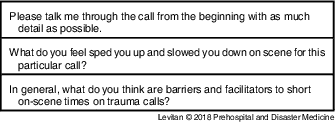
Patton’s work on qualitative research proved to be a particularly useful resource throughout the interview process.Reference Patton 23 Following his methods, an interview guide with open-ended questions was used for discussions with participants. This format allowed the interviewer to address core elements of importance to the study, but also allowed the paramedics to discuss additional key points which affected OSTs.Reference Patton 23 The interview began in an open-ended fashion to allow the paramedic to reflect on the case in question and discuss elements of performance that may have contributed to the OST.Reference Patton 23 Throughout, the researcher explored relevant concepts gleaned from the literatureReference Patton 23 in relation to clinical factors (ie, type of trauma or patient characteristics) and organizational factors (ie, communication, equipment, and personnel) that may have affected OSTs. In addition to these steps outlined by Patton, a pilot exploratory interview was conducted with a senior administrator to ensure that proposed interview questions were clear, appropriate, and would elicit information related to the study.Reference Olson 29 , Reference Seidman 30 After this pilot, adjustments were made to questions. The interviews began with the three items listed in Table 1. Further questions were asked based on the answers that were given, in order to explore the research question in depth.
Components of the Interview

All paramedics were interviewed individually by the same researcher in a location and at a time that was convenient for them. Following best practices recommended by such researchers as Olson,Reference Olson 29 Seidman,Reference Seidman 30 and Yin,Reference Yin 24 the interviews were recorded, transcribed, and entered into NVivo for Mac (QSR International; Victoria, Australia) software that supports qualitative research, for ease of data analysis.
Analysis
The interview data were analyzed inductively.Reference Patton 23 This allowed patterns, themes, and categories to emerge during the analysis, leading to the development of key themes, as described by Glaser and Strauss, and more recently, Corbin and Strauss.Reference Glaser and Strauss 31 , Reference Corbin and Strauss 32 A constant comparative method was used during the analysis. This method allowed researchers to develop key themes through continually creating and assessing “meaning units” (ie, words and phrases that described the same themes) and comparing the data to examine relationships between themes.Reference Glaser and Strauss 31 , Reference Corbin and Strauss 32 The two participant groups (OST <10 minutes and OST >10 minutes) were analyzed separately to determine if there were major points of divergence or convergence in the findings.
In order to ensure the credibility of the data, researcher triangulation was used. This approach uses multiple analysts to independently analyze the same data and compare findings.Reference Patton 23 In the current study, a researcher trained in qualitative data analysis, in addition to the primary researcher, analyzed the same collected data and then compared findings. The two researchers met once they had completed their analysis and this allowed for a productive discussion about the themes and categories where there was a high level of agreement. Small discrepancies in the naming and description of the themes were found and resolved between the researchers.
Results
It was revealed through the constant comparative method that those factors identified as facilitators in the OST <10 minutes sample (ie, cooperative patient, strong teamwork, and communication) were identified as barriers in the OST >10 minutes sample (ie, uncooperative patient, lack of teamwork, and lack of communication). The analysis also identified factors that were discussed across both sample groups (ie, policy-related issues).
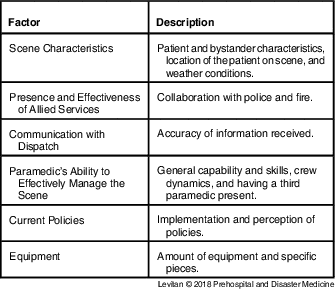
Six key themes emerged throughout the interviews with the paramedics as factors impacting the duration of OSTs. These themes were identified when answers were reported consistently by multiple paramedics. They are outlined in Table 2 and are further elaborated upon below in the interest of providing context and clarity, and in presenting the voices of the paramedics themselves.
Factors That Impact Duration of OST

Abbreviation: OST, on-scene time.
Scene Characteristics
Participants said that scene characteristics such as patient and bystander characteristics, location of the patient on scene, and weather conditions impacted OSTs. Patient characteristics included the number of patients and bystanders on scene, the weight of the patient, the type of injury they had, and how cooperative they were. Participants indicated that each additional individual on scene requiring assistance increased OSTs due to extra on-scene tasks and waiting for additional ambulances to transport the patients. These factors were further described by a participant:
As soon as you add another patient, until that second response vehicle gets there, it’s kind of like the clock hasn’t started yet, because they’re managing the scene and the two patients and so they can’t take off and leave one patient, they need to hang out on scene. … One of the biggest problems with trauma calls, and it varies on the trauma call, is that single versus multi-patient.
Bariatric patients were also described as contributing to an increase in OSTs as they were more difficult to transport to the ambulance due to their weight. This was particularly problematic when only two paramedics were on scene. Additional tasks that were outlined as factors leading to an increase in the OSTs were immobilizing or resuscitating a patient, performing a needle thoracostomy, or dealing with airway complications. The patient’s level of cooperation was also a factor in OSTs. If a patient was uncooperative, this was seen as contributing to an increase in OSTs due to treatment difficulties and transport delays. Paramedics said that patients often presented with an apparent altered mental status, which was reflected in forms of combativeness, inebriation, and unconsciousness.
When describing other scene characteristics, participants indicated that if there was a large crowd of bystanders, the OST increased as it often took longer to locate and get to the patient to begin treatment. Participants who had OSTs under 10 minutes said that cooperative bystanders were helpful as they were able to provide good information and assist in specific non-clinical tasks on scene. However, bystanders in other cases were often seen as a distraction or even physically interfered with paramedic tasks. This was described by a participant:
The father was there as we’re assessing him…I remember him yelling at us to help his son and he was actually kind of getting into the way - at one point we had to raise our voices to him and have the police kind of escort him away.
An interesting point suggested that paramedics have to be more conscious of public perception as there are a number of recording devices, such as phones, that are now present on scene. These distractions were perceived by some participants as contributing to the increase in OSTs. A participant explained:
Scene dynamics are a huge issue, because in this day and age where we’re so concerned about public perception, everyone has their iPhone out, videotaping, putting it on YouTube. Everyone is in your face and wants to be helping. Those are definitely barriers that slow you down, because you have to try to be a little bit more polite, right, in your approach to things.
Location of the patient on scene and entrapment were described as influencing OSTs. The patient was sometimes difficult to locate if unconscious. Working conditions around the patient were also sometimes challenging. During certain trauma calls, there were issues with sharp rocks and vast numbers of mosquitoes within the Canadian landscape. Also, the route between the patient and ambulance was perceived as a significant factor for OSTs. In most emergency situations reviewed, the ambulance could not drive directly to the victim. When this occurred, both the distance and obstacles between the ambulance and patient were important, as equipment (and often the patient) needed to be carried. Examples of obstacles included stairways or elevators in a high-rise building or the casualty being at the bottom of a ravine.
Finally, adverse weather conditions were said to contribute to longer OSTs in a number of ways. First, darkness made it more difficult to work when the area was not properly illuminated. Second, hot or cold temperatures were distracting and there could be issues where the paramedics’ hands become numb and patients wear multiple layers during the winter months, acting as a barrier to treatment. In addition, wind and precipitation were distracting and made working conditions difficult (ie, it was difficult to work quickly on an icy surface).
The Presence and Effectiveness of Allied Services
Participants discussed the collaboration between police and fire personnel and how this contributed either positively or negatively to the OSTs. At times, allied services arrived late or did not arrive at all. Participants reported the importance of being able to quickly transport patients, and the need for police and fire to quickly perform their own roles. This includes extrication, crowd control, and ensuring scene safety.
The actual number of allied workers on scene was described as influencing OSTs. Firefighters are able to help EMS with transport, equipment preparation, and treatment. Participants indicated that to quickly and effectively manage a complex scene, more than the two-person ambulance crew is required. Nevertheless, having too many workers on scene was described as detrimental as these extra individuals could get in the way or block the ambulance’s egress. One participant reported, “When I left, they had cruisers blocking out front so I could not go forward anymore.”
Coordination between the allied services was reported by participants in some situations as poor due to lack of familiarity and conflicting priorities. Participants believed that the lack of familiarity with roles and responsibilities between the services was, in part, due to separate training exercises. This was viewed as particularly problematic for new staff and volunteer firefighters who do not have as much experience in the field. Participants further elaborated on this issue:
I think sometimes with the police, it does complicate things, and I’m just trying to see if there was anything noticeable about it, I don’t know in this particular case or not, because they’re trying to get their information, we’re trying to get our information, and then to a certain degree, we trip over each other, and that’s even--that’s also true with the fire department on general trauma scenes, right. There’s not much coordination, ‘cause we don’t work--we don’t practice together. We work together, we don’t practice together.
What needs to happen to improve scene times, in my opinion, is a more coordinated effort on scene between all the agencies involved, police, fire, and EMS. That’s A. First and foremost.
Communication with Dispatch
In order for paramedics to be able to plan effectively and bring the right equipment from the ambulance to the scene, information received from dispatch must be accurate. This includes the number of patients, the patient’s condition, mechanism of injury, and specific location. Participants indicated that not having to turn around to obtain more equipment and being able to create a plan in advance would help decrease OST. A participant stated:
I have difficulty with some of our dispatchers because we’ll get calls for people falling down stairs but they don’t specify as to where they’ve fallen down a flight of stairs, to a main floor which is different from getting - it’s quite easy getting someone out from a main floor of a house to your cot versus somebody who’s down in a basement. Sometimes, I believe that dispatchers need to ask a few more questions: “Okay, where is he located in the house? Is it in a basement? What’s the access?”
Dispatch gave us as the call, right, but I’m pretty sure the information we got was “a man fell 15 stairs at the bottom, unconscious” so we know… this is what we need, we need to bring our backboard in, we need to bring our… full immobilization kit, … so we came up to that call with everything with us.
Participants said that having this information before arriving on the scene allowed them to formulate a plan and be prepared, both mentally and with the right equipment for the call.
Managing the Scene
The paramedic’s ability to effectively manage a scene was perceived as a factor that would help to decrease OSTs. Managing the scene was viewed as including a crew’s general capability and skills, crew dynamics, and having a third paramedic present.
The paramedic’s capability was defined as the individual’s training and experience, as well as physical capacity. Many paramedics felt that scenario-based training would be beneficial, even for the most experienced paramedics, since certain trauma skills are very rarely used on the job. In addition to technical skills, the physical capacity of a crew was important to the participants, who said that a crew’s physical skills should also be complementary. In addition to this, a paramedic explained, “We’re very careful in our movement, you have to be safe. So that may eat into some of the on-scene time and trying to get the patient out.”
All participants outlined the importance of good crew dynamics and teamwork. They discussed the importance of good verbal and nonverbal communication developed over time, and opportunities to work together. The crew composition of one primary care paramedic and one advanced care paramedic was seen as helpful to foster quick decision making. The availability of a third paramedic was perceived as facilitating decreased OSTs. On these calls, a third paramedic was often present in the form of a student or supervisor. This was advantageous as it provided not only an extra medically-trained individual, but someone also able to aid in scene management. A participant explained:
My own personal opinion is that we’re to the point where a two-man crew is a thing of the past, we need to start looking at a three-man crew because the care is becoming more specialized.
Perception of Policy and Implications for Practice
The implementation and perception of policies was outlined by paramedics as being challenging to deal with and, in turn, perceived to increase OSTs. For example, the expectation of the number of procedures to be performed, as well as immobilizing patients with “potential” spinal injuries, were seen as factors which impacted OSTs. Several participants felt that spinal motion restriction was not always necessary and required a substantial amount of time. It was suggested by paramedics that receiving feedback and information on their performance and the patient outcomes after delays would help them to identify core issues and, in turn, help to reduce their OSTs in the future.
The paramedics’ perception of the 10-minute OST standard was also raised as an issue. Some participants said that this standard is only a “guideline,” and it was described by some as an “unrealistic timeframe in a non-perfect scenario.” Paramedics sometimes decided the patient did not, in fact, fit the “load and go” criteria for seriously injured patients, which decreased the level of urgency at the scene. For certain calls, they believed it was in the patient’s best interest to go more slowly instead, in order to provide the best care or to do additional procedures like inserting an IV on scene. A participant elaborated:
I have to gauge it. Is the extra couple of minutes that we’re going to get him there sooner going to count, or is getting his pain level under control, relaxing him, and getting him to stop thrashing around in the stretcher going to help, and it was. I definitely judged that the latter was more important.
In interviews, paramedics said they understood policies but pointed out potential disconnects with policy when making decisions about patient care on the scene.
Equipment
For trauma calls, the amount of equipment, and certain pieces of equipment, were seen as detrimental to achieving short OSTs. Many paramedics felt there is now too much equipment for trauma calls. Paramedics said having more equipment increases the likelihood that paramedics will use it. In turn, this requires additional transporting of equipment to and from the patient and storing equipment.
Specific types of equipment impacted OSTs. In off-road situations at night, it was difficult to work while using handheld flashlights. As well, there was a reported lack of pediatric equipment, which meant paramedics spent time “MacGyvering” a solution. There were several concerns raised about the equipment paramedics were required to wear, including neoprene winter gloves (seen as ineffective), cumbersome safety equipment, and one uniform year-round, regardless of the weather conditions. The stair chair was difficult to use in old homes with narrow corridors and there were mixed reviews on new backpacks that had been provided. Technical equipment posed challenges too. Having to transport a patient to the US could increase OSTs as paramedics needed to plan their routes in advance since the mapping system did not work in the US. In summary, the equipment that was used by the paramedics, in many situations, was seen as a barrier to achieving the required OSTs.
Discussion
The purpose of the current study was to examine facilitators and barriers to achieving 10-minute OSTs on trauma calls, from the perspective of the paramedics. The results of this study give paramedics a voice and have highlighted the importance of examining the technical, organizational, and individual characteristics that impact OSTs. From the perspectives of paramedics with OSTs both under and over 10 minutes, it was clear that there was agreement on factors they believed impacted their performance. The focus on complex, adaptive systems in patient safety and quality of care is not new in the health care literature.Reference Jordon, Lanham, Anderson and McDaniel 18 However, it is new in its application here when addressing OSTs. Often in professional practice, and as identified in the literature, falling short of performance targets is attributed incorrectly to the health professional staff.Reference Kohn, Corrigan and Donaldson 33 This study has helped highlight the importance of individual factors (ie, level of training or physical requirements) in relation to technical aspects (ie, equipment and policies), together with organizational dynamics (ie, communications with dispatch, number of personnel on scene, and presence and assistance of allied emergency response personnel). When taken together, this provides a more accurate depiction of the reasons why the targeted OSTs are or are not met. All these factors must be understood within the very complex and fluid conditions of both the patient and the environment. For this reason, this study brings into question the feasibility of the 10-minute OST standard. Clearly, there are areas identified here that could be improved (ie, communications and other areas described above); however, scene characteristics are clearly non-modifiable and beyond the control of the paramedic. Thus, when attributing OST delays, it is essential to not only examine the paramedics’ performance, but to ensure the whole system in which they were asked to perform is understood.
Limitations
Limitations of the study include the sample size at a regional EMS station. It has been noted in prior literature that paramedics are sometimes resistant to participating in research protocols.Reference Myers, Slovis and Eckstein 34 , Reference Burges Watson, Sanoff and Mackintosh 35 It is possible that paramedics who participated in the current study may not be representative of their cohort. However, two co-authors of this study work at a senior level at NEMS and, based on their knowledge of the cohort, were satisfied it was representative. However, further research might involve larger sample sizes and focus on other EMS systems in Canada and internationally to determine if the findings are widely applicable. Research should also be done to determine which of the variables identified in this study have the most significant effect on the duration of OSTs. The effects of OSTs on outcomes for specific types of patients should also be further examined.
Conclusion
The following six categories were outlined by paramedics as impacting the duration of OSTs: (1) scene characteristics; (2) the presence and effectiveness of allied services; (3) communication with dispatch; (4) the paramedics’ ability to effectively manage the scene; (5) current policies; and (6) the quantity and design of equipment. These findings demonstrate the complexity of the prehospital environment and bring into question the feasibility of the 10- minute OST standard.