

The ‘León Antiphoner’, Archivo Capitular de la Catedral de León, MS 8 (henceforth ‘L8’), is the most complete surviving manuscript containing the Old Hispanic liturgy.Footnote 1 This liturgy was in use on the Iberian Peninsula before the imposition of the Franco-Roman chant, officially adopted at the Council of Burgos in 1080.Footnote 2 As is common in manuscripts preserving the Old Hispanic liturgy, L8 contains chants for both the Mass and Office.Footnote 3
The Antiphoner’s importance for musicological and palaeographical studies can be fully appreciated if we consider that with its 278 fully notated folios, L8 encompasses by far the largest quantity of !preserved in any manuscript of the Old Hispanic rite.Footnote 4 Thus, L8 is the main witness of Old Hispanic notation (also called ‘Visigothic’) and it is representative of the so-called ‘vertical’ style of notation, commonly found in manuscripts from northern Spain.Footnote 5 Old Hispanic notation represents just the outline of a melody, without specifying the intervals or pitches.Footnote 6 Later developments in music notation led to a more precise way of marking the pitch and the melodic intervals on the page, but Old Hispanic notation never reached that stage of precision because the adoption of the Franco-Roman chant in Iberia caused the abandonment of the Old Hispanic notation and its replacement with Aquitanian notation, imported by the monks who arrived from southern France to support the adoption of the new liturgy.Footnote 7 As a consequence, our modern understanding of the Old Hispanic chant is limited to the information conveyed by the non-pitch-readable neumes found in the c. forty surviving Old Hispanic manuscripts with music.Footnote 8 Among them, L8 stands out not only as the most complete Old Hispanic manuscript but also for the overwhelming quantity of graphic details in the notation. In fact, the variety of neume shapes found in L8 has no parallel in the other Old Hispanic manuscripts, even though similar palaeographical features can be recognised in the other tenth-century Old Hispanic manuscripts.
L8 can be considered a privileged object of investigation for palaeographical and musical analysis of the Old Hispanic Chant, but it is also a resource for studying scribal habits. In fact, the Antiphoner contains enough content to make it possible to identify and isolate specific hands.Footnote 9 A palaeographical analysis of the neume shapes written by each scribe and the comparison of the duplicated chants in L8 (either written by the same or different scribes) reveal an outstanding level of detail and care, where tiny graphical details seem to have been written purposefully and carried a very specific meaning. The scribes of the Antiphoner put extra care into following the model from which they were copying but the differences found among cognate versions of the same chant show how orality and personal preferences permeated the copying. Understanding the scribal habits in L8 can clarify the extent to which orality and scribes intervened in the dissemination (and modification) of the Old Hispanic melodies found in the Antiphoner. This information can be of great help when we compare these same melodies in other Old Hispanic codices and fragments.Footnote 10 Finally, L8 draws one’s attention visually, not only because of the neatness and complexity of the musical notation, but also because of the quality of the decoration.Footnote 11
1. THE SCHOLARLY DEBATE ON THE DATE AND CRYPTOGRAPHY OF THE ‘LEÓN ANTIPHONER’
Despite being the most studied Old Hispanic manuscript, recent hypotheses of L8’s dating extend from c. 906 (Menéndez Pidal) up to the eleventh century (Zapke).Footnote 12 The prologue is the most studied part of L8.Footnote 13 Scholars have based their understanding of the whole manuscript mainly on the information found there.Footnote 14 The special attention given to the prologue is due to the presence of references to the ‘Abbot Ikilanus’ and the ‘scribe Arias’. On fols. 1v and 6r are, respectively, a miniature and an ex libris featuring the Abbot Ikilanus.Footnote 15 On fol. 1v a miniature represents a ‘scene where an “ille”, usually understood as a reference to the copyist, presents a book to the figure called ‘abba’, who has its [sic] distinctive crosier’.Footnote 16 The latter figure in the miniature is widely accepted as representing an abbot, although Louis Brou noted the oddity of an abbot appearing in an antiphoner for the cathedral rite (the model is that of Toledo), and claimed that the figure represented a bishop-abbot, as such individuals existed in Galicia in the tenth century.Footnote 17 On fol. 1v there is also an epigram indicating that Abbot Teodemundo gave the manuscript to the Abbot Ikilanus as a gift.Footnote 18 On fol. 6r there is an ex libris ‘Librum Ikilani Abbati’; the page resembles a tapestry and is shaped in the form of a labyrinth, as is common for an ex libris in Visigothic manuscripts.Footnote 19 The identification of Ikilanus as abbot of the monastery of San Cipriano has been crucial for dating the manuscript to the tenth century.Footnote 20 Ikilanus also founded the Monastery of Santiago, located in León, not far from the bishop’s see, and it included a monastic community of men and women.Footnote 21 A charter dated 26 June 917 reveals that, when Ikilanus founded the Monastery, he provided the monastic community with the resources to survive: villas, vineyards, a mill, two churches (San Martín in Pajares and Santa María near the Cea, with annexed court and land properties), the monastery of San Cipriano itself, two courts (one in Oncina, the other in León), ornaments and liturgical books;Footnote 22 these included an antiphoner.Footnote 23 Although it cannot be claimed with certainty that L8 was ‘the’ antiphoner donated to the abbess Felicia in 917 by Ikilanus, this possibility has stimulated scholars’ imagination about the early history of L8.Footnote 24
The third gathering of the prologue (fols. 20–7) is codicologically and stylistically distinct from the rest of the manuscript, in which it is now inserted. This section is attributed to the scribe Arias, who provided his own name in certain notes on the computus treatises and mentions here anni praesentes ranging from 1062 to 1069. In those years, this new material was gathered and added to the manuscript.Footnote 25 Arias also left some biographical information on fol. 12r, but this inscription has now almost completely disappeared.Footnote 26 Since this eleventh-century gathering has portions of text written in Visigothic minuscule and others in Visigothic cursive, scholars have debated the attribution of this gathering: to one scribe capable of mastering both Visigothic minuscule and cursive, or to two scribes? Brou distinguished two scribes: ‘Arias 1’ and ‘Arias 2’.Footnote 27 Thomas Deswarte believed it was one scribe, who was a polygraphist, capable of writing both in minuscule and Visigothic cursive.Footnote 28
Ikilanus and Arias have played a considerable role in the scholarly reconstruction of L8’s early history. While Ikilanus is referred to for the tenth-century datings, Arias is usually invoked by those who prefer an eleventh-century dating. The majority consider that L8 was written in the middle or second half of the tenth century. Based on L8’s illuminations, Jacques Guilman declared that ‘surely its decorated initials are no earlier than the 960–970 period, and perhaps later’.Footnote 29 A similar dating was proposed by Brou and José Vives.Footnote 30 Scholars dating L8 to the mid-tenth century are Carlo Agustín Millares, Deswarte, and Susanna Zapke in Hispania Vetus (her eleventh-century dating, noted above, is a more recent development).Footnote 31 Recently, I have reviewed the attribution of the royal monograms found on fol. 4v, and set a terminus ante quem for the Antiphoner’s compilation to c. 960.Footnote 32 Other scholars prefer, instead, a more general tenth-century dating.Footnote 33
Scholars have provided various justifications for proposing an eleventh-century dating for L8. While acknowledging that L8’s script is more characteristic of the first third of the tenth century, Zacarías García Villada claimed that the entire codex was written in 1069 by Arias; he explained this incongruity saying that in the León region the decline of Visigothic writing was slower than in the rest of Spain.Footnote 34 A similar dating was proposed by Manuel Gómez Moreno, who said that ‘it is not impossible, but very unlikely’ that the manuscript was from the early tenth century and, basing his hypothesis on the style of decoration, he dated L8 to the eleventh century.Footnote 35 In a recent article, Zapke proposed an eleventh-century dating for L8 but without explanation.Footnote 36 Among the scholars who dated L8 to the eleventh century was also the young Manuel Cecilio Díaz y Díaz, who dated L8 to the second half of the eleventh century in 1954.Footnote 37 In 2007 he changed his opinion to an early tenth-century dating and thus went against the scholarly tradition, which took for granted the essential role played by Ikilanus in the production of the manuscript, and he provided a thorough explanation for this shift.Footnote 38
Díaz y Díaz untangled the assembly of L8 and made a careful codicological analysis of the first twenty-seven folios, demonstrating that L8 is a composite manuscript which reached its present form in several stages, comprising two main codicological periods. The body of the manuscript itself (fols. 4–11 and 28 to the end) is, on palaeographical grounds, from the first third of the tenth century (p. 99). Afterwards, the original body of the manuscript was supplemented at different stages with additional material arranged autonomously and placed in the prologue. The additional material consisted of fols. 1, 2, 3 and the gathering comprising fols. 20–7.Footnote 39 Díaz y Díaz claimed that ‘it is undeniably true that an Ikkila abba became at a certain time the fortunate owner of the codex’ (p. 101). However, ‘all of the speculation about Ikilanus seems utterly worthless with respect to the dating or location of the writing of the manuscript’Footnote 40 because
there is a distinction in the Antiphonary in its oldest form between two different sections: an original, very old section comprising fol. 28 to the end, which Ikilanus merely owned, and another which resulted from Abbot Teodemundo generously deciding to agree to answer Ikilanus’ pleas to obtain this magnificent copy. Later on there were people such as Arias or the author of the office of St. James who wanted to complete aspects.Footnote 41
In other words, Díaz y Díaz realised that all the references to Ikilanus were added to the so-called ‘basic manuscript’.Footnote 42 In order to mark the change of ownership, someone painted Ikilanus’s ex libris on fol. 6r (which belonged to the ‘basic manuscript’; its recto was originally left blank). A codicological examination of fol. 1 led Díaz y Díaz to surmise that it was originally inserted elsewhere.Footnote 43 He suggested that fol. 1 (with the miniature of the donation to Ikilanus and the epigram on the verso) was added to the ‘basic manuscript’: it was inserted between fols. 5 and 6 to create a sense of continuity with Ikilanus’s ex libris painted on fol. 6r.Footnote 44 Díaz y Díaz explained that the stylistic difference existing between the decoration of L8 and Ikilanus’s miniature and ex libris (which are clumsier and less refined) demonstrates that Ikilanus did not have a scriptorium of the same quality as that where L8 had been produced.Footnote 45 In Díaz y Díaz’s words, in the main part of L8 (from fol. 28 to the end) ‘the capitals are decorated and the writing is drawn in a uniform way, to such an extent that it even seems to be the work of a single hand, with certainly early features, but definitely written in the first decades of the tenth century’.Footnote 46 In addition to this, he explained that
the main body of the codex was produced and finished in a place and time in which there was a fine, highly skilled copyist and, more important, this copyist had the benefit of a top-quality model. The main body was then supplemented by introductory material that was not originally part of the manuscript and was arranged autonomously, although this does not mean it might not have appeared in the same model.Footnote 47
Díaz y Díaz’s codicological findings match the results of my analysis of L8’s cryptography: L8 was not produced for Ikilanus and it was written in a first-class scriptorium at the beginning of the tenth century.
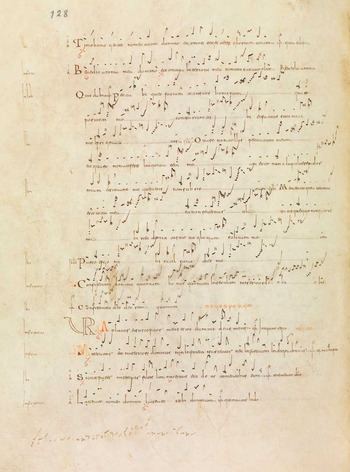
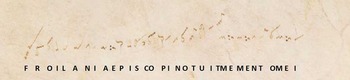
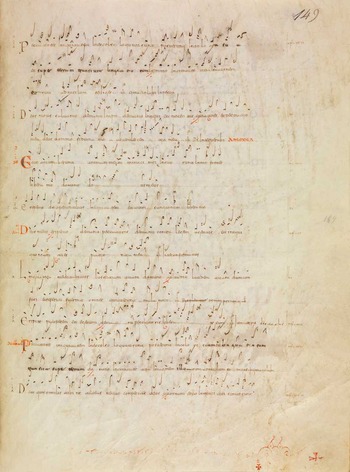
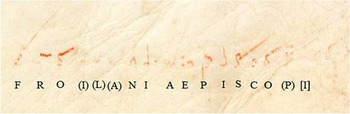
It is possible to reassign the dating of L8 to the years 900–5 and reconstruct its early history on the evidence of the two cryptographic inscriptions found on fols. 128v and 149r.Footnote 48 Among all the scholars who engaged with the Antiphoner, only Maria Elena Gómez Moreno and Gonzalo Menéndez Pidal acknowledged the presence of musical cryptography and incorporated this element into the wider discussion of the Antiphoner’s date.Footnote 49 Both Gómez Moreno and Menéndez Pidal transcribed the cryptographic inscriptions in the same way: ‘Froilani aepiscopi notuit memento mei’ (fol. 128v; see Figs. 1 and 2) and ‘Froilani aepiscopi notuit ego Aia memento mei’ (fol. 149r; see Figs. 3 and 4), although Gómez Moreno and Menéndez Pidal used this evidence, in combination with other arguments, to date L8 respectively to 1069 and c. 906. As I demonstrate below, the transcription provided by the two scholars is almost correct; the only mistake consists in the fact that both misread ‘ego Aia’ for ‘memoria’ on fol. 149r, in a portion of the cryptography where the ink is partially faded (see Fig. 4b). The interpretation of the cryptography on fol. 149r as containing a reference to ‘Aia’ was probably conditioned by the debate on the identity of ‘Arias’ and ‘Aia’, which had direct implications for the Antiphoner’s datings proposed by Gómez Moreno and Menéndez Pidal.Footnote 50
L8, fol. 128v, L8. Courtesy of the Archivo Capitular de la Catedral de León (Imagen M.A.S.)

Cryptographic inscription on fol. 128v with modern transcription
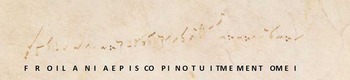
L8, fol. 149r. Courtesy of the Archive of the Cathedral of León (Imagen M.A.S.)

Detail of the cyphers for ‘Froilani aepiscopi’ with modern transcription

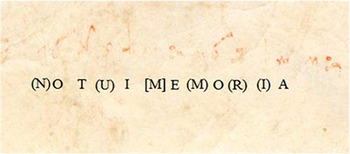
Detail of the cyphers for ‘notui memoria’ with modern transcription

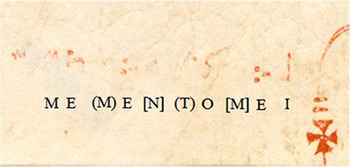
Detail of the cyphers for ‘memento mei’ with modern transcription

Digital restoration of the cyphers of fol. 149r

Gómez Moreno’s major contribution to the debate on L8 consists in her description of L8’s initials and miniatures. Despite admitting that the style of the decoration, especially the clothes in the miniatures, clearly belongs to the tenth century, she used the cryptography as crucial evidence and proposed that the whole of L8 was written by Arias/Aia in 1069. She believed that the shorter cryptography (‘Froilani aepiscopi notuit memento mei’) was in the tenth-century manuscript which served as a model for Arias/Aia in 1069, whereas the longer inscription (which contains the extra words ‘ego Aia’) was conceived by the eleventh-century scribe Arias/Aia, who wanted to leave a mark of his own work and also added his monogram next to the cryptography.Footnote 51 According to Gómez Moreno, L8 would then be the (almost) exact copy of a manuscript commissioned by Bishop Froilan (900–5) but with the addition of the computus treatises; moreover, she explained that the reason why L8 could not be a tenth-century manuscript with later interpolations was the fact that its writing is homogeneous and uniform.Footnote 52 As we have seen, Gómez Moreno’s understanding of the codicology of L8 was totally rejected by Díaz y Díaz, who demonstrated that L8 reached its present form in different chronological layers.Footnote 53
At the other end of the chronological spectrum is Menéndez Pidal, who in 2003 proposed the earliest date for L8 as c. 906. He recognised that the style of the decoration of L8 belonged to the tenth century and claimed that the scribe ‘Aia’ who left his memento in the cryptography of fol. 149r also wrote his name on fol. 12 and gave a reference to year 906 on fol. 20r.Footnote 54 According to Menéndez Pidal, the Bishop Froilán of the cryptography was – sin duda – without doubt, San Froilán, the Bishop of León who died in 905, and the scribe ‘Aia’, who lived at the time of Bishop Froilán, was the first miniaturist in Spain whose name and date are securely known.Footnote 55 He did not explicitly say that 906 is the dating of L8, but this can be inferred from his reasoning; in fact, he stressed that the year 906 mentioned on fol. 20 matches both Abbot Ikilanus and San Froilán’s era.Footnote 56 Menéndez Pidal created an apparently plausible historical reconstruction, but he did not support his hypothesis with the necessary documentary evidence and left too many obscure points. First of all, his reconstruction did not take into account the fact that the 906 date (‘DCCCCVI’) on fol. 20 is a scribal mistake, as already acknowledged by Alfred Cordoliani.Footnote 57 Moreover, fol. 20 belongs to the third gathering of the prologue, widely accepted as being an eleventh-century addition. Secondly, the claim that ‘Aia’ is an early tenth-century scribe different from the eleventh-century ‘Arias’ was based on (1) an ambiguous signature ‘Aia’ left in pale ink on fol. 12 (on whose interpretation scholars disagree)Footnote 58 and (2) on a misreading of the cryptography on fol. 149r, where there is no trace of ‘ego Aia’.Footnote 59 Finally, Menéndez Pidal did not clarify the connection between L8, Ikilanus, Bishop Froilán (who had died in 905) and the manuscript’s supposed production.
2. VISIGOTHIC MUSICAL CRYPTOGRAPHY
Visigothic musical cryptography is not an element commonly found in liturgical manuscripts. Instead, it belongs to the world of charters, and it requires some introduction and contextualisation before its use in L8 can be fully appreciated. The phenomenon of medieval music cyphers is still relatively unknown and only a small body of scholarly literature has been devoted to the topic.Footnote 60 Visigothic cryptography is usually mentioned en passant in the context of other discussions of textual palaeography or charters, and scholars have generally reiterated the same basic information.Footnote 61 Articles focused on Visigothic cryptography date from 1867 (Foradada y Castán) and 1871 (Muñoz y Rivero).Footnote 62 After these two studies the topic was entirely neglected until Juan Carlos Galende Díaz made an extensive study of cryptography in the modern era, with a short introduction to the same phenomenon in the Middle Ages.Footnote 63
In medieval Iberia Visigothic scribes used various cryptographic systems, all of which modified the appearance of letters, allowing communication to happen only between those familiar with the cryptographic system applied.Footnote 64 The Visigothic cryptographic systems consisted of: (1) Greek letters used to write Latin words;Footnote 65 (2) dots and lines used to replace vowels; (3) Roman numerals used to replace vowels (a=‘x’; e=‘xx’; i=‘xxx’ etc.);Footnote 66 (4) signs related to musical notation used to create a new alphabet. This last system is used in L8.
In Visigothic musical cryptography the letters of the alphabet could be replaced both by neume shapes and by ‘other signs’. These ‘other signs’ were neither neumes nor letters but distorted representations of the text letters made in the style of musical notation. These ‘other signs’ could easily be confused with genuine neumes by someone not familiar with musical notation. Sometimes, a cryptographic inscription can include genuine text letters.
A study of the existing Visigothic documents containing musical cryptography shows clearly that there existed a basic set of symbols commonly used to represent certain letters of the alphabet.Footnote
67
For example ‘A’ is commonly found with the cypher  , ‘B’ is represented by
 , ‘D’ by
 , ‘M’ by
 , etc. Despite the existence of a shared basic cryptographic alphabet, musical cryptography was not a rigid system: the shape and choice of cyphers used to represent each letter of the alphabet changed according to the scribe’s flair and talent.Footnote
68
In some cases, scribes used more than one cypher to represent the same letter of the alphabet within the same cryptographic inscription, making reading the cryptography trickier.
Visigothic musical cryptography is usually found in tenth- to twelfth-century charters for subscription formulae.Footnote 69 The use of musical cryptography was limited to the scribe who compiled the charter and used it for his subscription; e.g. ‘Petrus notuit’. Occasionally, the same scribe would write musical cyphers within monograms belonging to high-level people; cyphers were used to give some or all letters of the person’s name.Footnote 70
In the Visigothic era (from the eighth to the twelfth century) the majority of the population was illiterate and written culture was almost exclusively the prerogative of the clergy, who also acted as public notaries.Footnote 71 According to José Antonio Fernández Flórez, there is no evidence of a layperson writing a charter; instead, the scribes signed themselves as ‘presbiter’, ‘sacerdos’, ‘diaconus’ or ‘subdiaconus’ and sometimes they used the general label ‘clericus’ or ‘monacus’.Footnote 72 As the scribes of charters were clerics or monks, one can surmise their familiarity with liturgical books and, at least sometimes, also with musical notation.Footnote 73 This familiarity with liturgical books may explain the use of neumes in the cryptographic system found in charters.
It is important to highlight that there were different kinds of scribes, according to the place where they had gained scribal knowledge and experience. The scribes who learned the art of writing in scriptoria annexed to a cathedral or an important monastery were more skilled than those who learned to write in a rural parish.Footnote 74 Not all Visigothic scribes were capable of writing and understanding cryptography. Instead, cryptography seems to have been an elitist code used only by skilled and particularly highly trained notarial scribes. Finally, the fact that musical cryptography is commonly found in charters rather than manuscripts strongly indicates that at least some of the scribes capable of mastering Visigothic cursive (the script found in charters, as opposed to Visigothic minuscule, commonly found in codices) were also familiar with neume shapes, and may have notated liturgical books as well.Footnote 75
The use of musical cryptography in charters is strictly limited to subscription formulae and monograms.Footnote 76 The two most common Visigothic subscription formulae were ‘notuit’ and ‘scripsit’, which seem to have been used interchangeably; occasionally also ‘notavit’, ‘exarabit’, ‘pinxit’ and ‘titulavit’ are found.Footnote 77 One exception is the scribe Adulfus, a deacon, who wrote royal charters between 918 and 930. He used ‘scripsi’ to mean that he both wrote and also prepared the charter’s text. He used ‘notuit’ to mean that he signed a charter whose text had been drawn up by a notary.Footnote 78 It is only from the end of the thirteenth century – when the notarial profession was secularised – that the subscription formulae changed and became longer.Footnote 79 Even before the subscription formulae changed in the thirteenth century, cryptography had fallen into disuse. This happened during the twelfth century, due to the gradual abandonment of Visigothic writing, as the examples of the scribes Munio of Sahagún and Juan of León illustrate. Presbyter Munio worked in the monastic scriptorium of Sahagún between 1102 and 1115 and he was capable of reading cryptography. He wrote the ‘Becerro Gótico of Sahagún’, a digest of ninth-century documents and charters. The ‘Becerro’ is the last dated manuscript written in Visigothic script. In the ‘Becerro’, Munio translated into Visigothic script all the cryptography he came across in the ninth-century charters he was copying.Footnote 80 By contrast, Juan of León (notary of Bishop Diego), finished the ‘Tumbo Legionense’ in 1124, in Carolingian script. The ‘Tumbo Legionense’ is a digest of ancient charters and served the purpose of defining clearly which estates belonged to the bishop and which were assigned to monasteries. Juan was not a skilled calligrapher; he had problems in reading tenth-century documents in Visigothic cursive and semicursive and he did not understand cryptography at all. In fact, in the ‘Tumbo Legionense’, he omitted all the cryptographic passages he found in the original documents.Footnote 81 These two examples suggest strongly that cryptography is a hallmark of Visigothic culture, and when Carolingian writing started to replace Visigothic script, the scribes started to lose their ability to write and understand cryptography.
The use of musical cyphers in charters has been considered both as a kind of protection against forgery (because only very few people could understand them) and also as a distinctive mark of ‘high’ culture; functionally, cryptography was also a way of making a signature stand out from the rest of the document.Footnote 82
3. CYPHERS IN THE ‘LEÓN ANTIPHONER’
At first glance, L8’s cryptographic inscriptions look like two rows of neumes without words (see above, Figs. 1 and 3). Further palaeographical analysis shows that these signs are, instead, cyphers used to conceal words: ‘Froilani aepiscopi notuit memento mei’ (fol. 128v, Fig. 2 above),Footnote 83 and ‘Froilani aepiscopi notui memoria memento mei’ (fol. 149r, Fig. 4).Footnote 84 In the two cryptographs the ‘i’ endings of Froilani aepiscopi indicate that the bishop was not the person who materially wrote the cyphers, but he was the one to whom the cryptography was referring; the scribes, instead, left themselves in a secondary position, ‘memento mei’.Footnote 85 The translation of the cryptograph on fol. 128v is ‘Bishop Froilán is responsible, remember (i.e. pray for) me’.Footnote 86 The cryptograph on fol. 149r contains the extra word ‘memoria’ and it is followed by a monogram and a cross, absent on fol. 128v.Footnote 87 The translation is ‘Of Froilán bishop became known the memoria; remember me’.Footnote 88 The meaning of ‘memoria’ is determined by the historical and textual context, and, in this case, even if it is true that the cryptograph could be translated as ‘Bishop Froilán’s commemoration became known: remember me’, it is important to recall that scholars have explained that Visigothic scribes and miniaturists were accustomed to leaving a record of their work with formulae containing the words ‘memoria’, ‘memento mei’ and ‘mementote’.Footnote 89 Furthermore, there is an example of musical cryptography found in a charter in which the scribe used the word memoria: ‘Ruderigus diagonus noduit memoria’.Footnote 90 In this charter it is the scribe Ruderigus who wrote the cryptographic inscription, while on fol. 149r the scribe who wrote the cyphers pointed explicitly to ‘Froilani aepiscopi’ and his ‘memoria’, hinting that he was the patron of the manuscript.Footnote 91
The cryptography on fol. 128v is written in brown ink, and has a different tone quality from the colour used for the text and notation on the rest of the page. The cryptography on fol. 149r is written in red ink and is very faded.Footnote 92 The ductus of the two inscriptions is different: regular and flat on fol. 149r, more clumsy on fol. 128v. It is not possible to see at which points of the quire gatherings the two inscriptions are placed.Footnote 93
The L8 cyphers that reproduce musical notation signs are: ‘I’, ‘L’, ‘N’, ‘R’, ‘O’, ‘T’, ‘U’, ‘E’, ‘S’ and ‘M’.Footnote
94
On fol. 149r the scribe represents the letter ‘I’ with a NH neume  .Footnote
95
On fol. 128v in the first three occurrences of the letter ‘I’ the scribe writes the same neume shape as the cypher on fol. 149r, but with a different inclination of the pen-stroke. In the remaining three occurrences of the letter ‘I’ he uses a different cypher
 .Footnote
96
In both cryptographs ‘L’ and ‘N’ are represented by two-note neumes, (‘L’
 ) and (‘N’
 ). Three-note neumes representing a melodic movement NHL are found in L8 with a great variety of forms and some of them are used as cyphers, for ‘R’ (
 ),Footnote
97
‘O’ (
 ) and ‘U’ (
 ). ‘T’ is given in both cryptographs with a neume which begins with upward steps
 but on fol. 128v) (on ‘memento’) ‘T’ is instead given as
 , omitting the steps. ‘E’ is given with a three-note neume
 ‘M’ (
 ) and ‘S’ (
 ) are both given with a four-note neume.
In the two cryptographs there are four cyphers which are distorted representations of text letters made in the style of music notation (‘F’, ‘A’, ‘P’ and ‘C’). ‘F’ resembles a neume with initial steps sometimes found in L8. However, the cypher differs from the neume in the length of the intermediate pen-stroke after the steps, and in the overall inclination.Footnote
98
‘A’ is given with the sign  . In musical notation this sign is always found as the second graphical element of a neume made of two separated pen-strokes (
 or, more rarely,
 ).Footnote
99
‘C’ is represented by
 , used in musical notation as the first element of a compound neume (
 ,
 ,
 ,
 ,
 , etc.) and never appearing alone. ‘P’ resembles (but is not identical to) some L8 neumes which have a similar vertical beginning and continue with an analogous zigzag movement, like
 .
Two palaeographical idiosyncrasies can be recognised in the cryptograph of fol. 128v: on ‘aepiscopi’ and notuit’. On ‘aepiscopi’ the scribe wrote the second ‘P’ and then partially erased it, rewriting it further to the right. No hesitation or traces of second thoughts can be seen in the same ‘P’ on 149r. Subsequently, on ‘aepiscopi notu’ the scribe of fol. 128v wrote first the cypher ‘O’, then changed his mind, partially erased the original cypher and added the cypher ‘U’ above the erasure. If he had not changed the cypher, the final word would have been ‘noto’, rather than ‘notuit’. The ductus of the cryptography on fol. 128v ascends on ‘notuit’. On fol. 149, the text is ‘notui’ and the ductus is plain and regular.
Some letters (F, R, O, I, L, A, N, E, P, S, C T, U and M) are represented in the two cryptographs with identical or almost identical cyphers. However, the graphical appearance of those cyphers is not identical in the two cryptographs; for example R,Footnote 100 I,Footnote 101 PFootnote 102 and OFootnote 103 are written in the two cryptographs with different degrees of inclination of the pen-stroke. In some cases, the same letter (‘I’, ‘T’) is represented by two different cyphers on fol. 128v while on fol. 149r the scribe is consistent in the choice of the same cypher for all the occurrences of the letter.
This close palaeographical analysis demonstrates that there is no trace of ‘ego Aia’ in the cryptograph on fol. 149r and the only possible reading where the ink has partially vanished is ‘memoria’.
4. BISHOP FROILÁN AND HIS AFTERLIFE
According to the Chronica Albeldense, in 881 there were twelve episcopal sees in the Kingdom of Astur: three in Portugal (Coimbra, Lamego and Oporto), four in Galicia (Lugo, Santiago, Mondoñedo and Orense), three in the Astur-León area (Oviedo, Astorga, León) and two in the eastern part of the Kingdom (Osma and Álava).Footnote 104 Among the bishops who occupied these sees from the second half of the ninth century to the middle of the eleventh century, there were several named Froilán. Potentially, any of these bishops could be the one mentioned in L8’s cryptography. However, if we take into account the reattribution of the royal monograms on fol. 4v of the Antiphoner, which sets a terminus ante quem for manuscript production to c. 960 – we can restrict the list of bishops to those whose episcopate falls before c. 960.Footnote 105 Hence, we can exclude Froilán, Bishop of León (992–1006),Footnote 106 Froylano, Bishop of León during Ferdinand I’s reign (1035–65),Footnote 107 and Froilán, Bishop of Oviedo (1036–63).Footnote 108 There are only two bishops called Froilán whose episcopate is dated before 960 and they occupied respectively the episcopal sees of Lugo and León.
Very little is known of Froilán, Bishop of Lugo; even the date of his episcopate is debated (possibly c. 871–5).Footnote 109 Indeed, the chronology of all bishops of Lugo between 783–842 and 842–905 is considered a grey area.Footnote 110 The historical reconstruction of the episcopal see of Lugo in those years is based on patchy documents dated to different centuries, and some of them are forged.Footnote 111 Apparently, Bishop Froilán of Lugo seems to be remembered only for having gone to Braga (north of Portugal) to encourage the repopulation of that area, where he probably died soon after his arrival.Footnote 112
Contrary to this, Froilán, Bishop of León, was very famous and later on became patron saint of both León and Lugo.Footnote 113 Froilán was born in Lugo c. 832 and, before he became a bishop, he and his companion Atilano put great effort into founding new monasteries, such as those of Tabara and Moreruela, near Zamora.Footnote 114 King Alfonso III invited Froilán to become Bishop of León in 900 (and also invited Atilano to become Bishop of Zamora in the same year). Bishop Froilán died on 5 October 905 and he was buried in the León Cathedral in a sepulchre erected for him by the king.Footnote 115
It is overwhelmingly likely that Froilán, Bishop of León (900–5) is the one mentioned in L8’s cryptography. Froilán of León was a rich bishop and he had a close connection with King Alfonso III.Footnote 116 The Antiphoner was such a lavish manuscript that only a very important patron could afford its production, and Froilán of León easily may have had the resources to commission the manuscript, considering his role and royal connection. The manuscript could only have been produced in a major centre, and León was the only significant urban centre in northern Spain in this period, the rest being primarily rural. Finally, the presence of the elitist cryptographic code connects the Antiphoner with the León area at the time of Bishop Froilán, as the comparison with the other manuscripts containing musical cryptography seems to demonstrate. In fact, the examination of the date, provenance and contents of these manuscripts suggests that the addition of musical cryptography in codices could be restricted to a specific geographical, chronological and cultural milieu; that is, the León area c. 902–20.Footnote 117
The surviving medieval documentation demonstrates that soon after Bishop Froilán’s death a growing cult was associated with him. Early evidence of the cult can be found in the 920 ‘León Bible’ (León, Catedral, Archivo Histórico, MS 6).Footnote 118 The ‘León Bible’ was written in the Monastery of Santa Maria de Albares, west of León, in 920.Footnote 119 The manuscript was written by the scribes Juan and Vimara, who left their signatures on many folios; on fol. 101rv scribe Juan added Froilán’s vita (Joannes Diaconus scripsit).Footnote 120 This vita was probably written between 910 and 920 and it is the earliest document providing information on Bishop Froilán’s life.Footnote 121 The vita is incomplete because it was interrupted when Froilán is appointed Bishop of León by the king; thus, it does not provide any information on his death.Footnote 122 Luckily, the full text of the vita can be found in another manuscript, a lectionary-homiliary from the end of the twelth century to the beginning of the thirteenth century which contains details of the lives of saints and sermons (Archivo Capitular de la Catedral de León, MS 52; Froilán’s vita is on fols. 258rb–260va).Footnote 123 The text of Bishop Froilán’s vita matches in MSS 6 and 52 and, additionally, it resembles the office for San Froilán as found in two other medieval manuscripts. In the Liber breviarius sanctus (Lugo, Archivo de la Catedral, MS s.n., fols. 352v–357r) we can read the office for San Froilán with nine lessons and some musical notation under the rubric In festo sancti Froilani episcopi ad vesperas.Footnote 124 The second manuscript containing San Froilán’s office is a breviary for the military order of Santiago coming from the Convent of Uclés (Cuenca) dated to the end of the fifteenth century (Madrid, Biblioteca Nacional, MS 240, fols. 495vb–497ra);Footnote 125 San Froilán’s office has nine lessons and is found under the rubric In festo sancti Froylani episcopi et confessoris.Footnote 126 These two breviaries, along with other archival evidence, confirm the existence of a consolidated liturgical tradition for San Froilán, despite the fact that it was not until 1604 that Pope Clement VIII declared Bishop Froilán patron of León and authorised his cult in the León diocese.Footnote 127 Documents from this time tell us that the Chapter of León Cathedral was not satisfied with the papal decision and asked for San Froilán’s cult to be extended to the whole Spanish Church.Footnote 128 However, it was only at the beginning of the eighteenth century that the request of the Chapter of León was eventually accepted. Bishop Froilán was officially declared saint of the Catholic Church and added to the Roman Martyrologium by Pope Clement XI in 1716.Footnote 129 The chronological gap between Bishop Froilán’s early cult and the moment when he officially became a saint should not be considered a symbol of his insignificance. On the contrary, it proves that for a long time no one felt the need to ‘declare’ Bishop Froilán’s holiness because he was de facto regarded as a saint and venerable figure, as indeed is confirmed by several pieces of evidence and clues found in written documents from the Middle Ages up to the modern era.Footnote 130 Early proof of the special devotion of the people of León to San Froilán can also be found in the Chronicle of Alfonso X el Sabio, where he mentions the translation of Froilán’s body made at the time of Almanzor to preserve his remains from the Moorish incursions.Footnote 131 At the end of the twelfth century, Lucas de Tuy, a historian from León, described a solemn rogation with a procession of the relics of San Froilán in the city of León pleading for rain.Footnote 132 The feast of San Froilán on 5 October can be found in the liturgical calendars of León Cathedral, Saint Isidoro of León and Sahagún from the twelfth century onwards.Footnote 133 Traces of the devotion of the Leonese to San Froilán can also be found in the story of the religious institutions of the dioceses. The earliest known foundation consecrated to San Froilán is the ‘Hospital of San Froilán’, which accepted both the poor and pilgrims, and it was under the direct control of the abbot of San Isidoro.Footnote 134 The date of the foundation of the ‘Hospital of San Froilán’ is unknown but it certainly existed by 1166; at that time, King Ferdinand II supported the Collegiate Church of San Isidoro in León as an alternative route to the Way of St James and the ‘Hospital of San Froilán’ was a strategic institution which served this purpose. The Hospital benefitted from several donations from the city of León and other churches as well, which were forced to make annual donations to the ‘Hospital of San Froilán’.Footnote 135 Further clues as to the popularity of San Froilán in León can be found at the time of the Council of Trent. In fact, when the Council requested the creation of a Conciliar Seminar in each diocese, the one built in León was placed under the patronage of San Froilán and inaugurated on 5 October 1606, the feast of San Froilán.Footnote 136 There are also records of chaplaincies placed under the patronage of San Froilán in the wider area of the diocese.Footnote 137 It is important to highlight that San Froilán was venerated in Lugo as well, his place of birth. Froilán was declared Patron Saint of Lugo on 12 June 1605 and, from this time onwards, there was a growing cult associated with the new patron, as demonstrated, for instance, by the institution of the confraternity of San Froilán in 1610.Footnote 138
5. CRYPTOGRAPHERS AT WORK
The cryptograph on fol. 149 is followed by a monogram and a cross, which were probably written at the same time since they all show the same ink colour.Footnote 139 Unfortunately, the overall appearance of the inscription is quite pale as the ink is partially faded, and the bottom part of the monogram is unreadable because the page has been trimmed.
Like cryptography, monograms and crosses had a standardised use in charters, where they were used for subscription. Specifically, they functioned as a personal mark and as a symbol of official approval and confirmation. The use of monograms in Visigothic charters seems to respond to a specific rule: those who subscribed a deed with either a monogram or a highly decorated signum, instead of a simple cross, belonged either to the ecclesiastical hierarchy, or were members of the royal family or the royal court.Footnote 140 Disappointingly, the several signs used to subscribe charters in the Iberian Peninsula have not yet been exhaustively described and classified.Footnote 141 Although I have not been able to locate the monogram inscribed on fol. 149 in any other Visigothic charter or related research, there are some palaeographic elements within the monogram that suggest its attribution to Bishop Froilán.Footnote 142 Furthermore, it is likely that Bishop Froilán could have had a monogram, since one of his successors, Bishop Anserico, certainly used a monogram to subscribe a charter as early as 12 January 923.Footnote 143
The letters placed within the monogram on fol. 149r prove that the person’s name started with ‘FR’ (see Fig. 4d above). The letter ‘R’ placed under the first of the three letter Ss (which stand for ‘subscripsi’) is easily recognisable. The stylised ‘F’ is less visible, inscribed at the same height as ‘R’, but on the left. The ‘F’ is made of two horizontal lines, below which is a cross; the vertical line of the cross is a stylised representation of the vertical bar of the ‘F’. This way of stylising and inscribing the first few letters of people’s names in their monograms can be recognised in King Vermudo II (982–99) and Vermudo III (1028–37)’s monograms.Footnote 144 These monograms show the two letters ‘VE’ placed on the left of the monogram – under the prolongation of the lambda shape crossed by a wavy line; Vermudo III’s monogram has the ‘R’ placed under the first of the three ‘Ss’. Similarly, the monogram of Pelagus, Bishop of Lugo at the end of the tenth century, has the first ‘P’ inscribed on the left of the monogram as part of the frame of the monogram, while the other letters are written using cryptography.Footnote 145 Regrettably, the poor condition of the monogram on fol. 149 does not allow us to verify whether the letters ‘—oilán’ were written in cyphers, as in the monogram of Pelagus, Bishop of León in 1081, where the initial ‘PE’ is written in capital letters while ‘–lagus’ is in cyphers.Footnote 146
Despite of the lack of documentary evidence of Bishop Froilán’s monogram, the palaeographic analysis of the monogram itself inscribed on fol. 149r hints towards an attribution to Froilán, Bishop of León 900–5. Furthermore, the combination of ‘cryptography+monogram + cross’ placed at the bottom of fol. 149r represents, in my opinion, a clear message left by a scribe familiar with the world of Visigothic charters. Each of these three elements plays a role in the construction of the information the scribe wanted to leave. In both cryptographs the scribes used the cyphers both to mark Bishop Froilán’s responsibility for the manuscript and to leave a personal memento. On fol. 149 the cryptographer wrote the cyphers and then inscribed Bishop Froilán’s monogram as a symbol of official confirmation and, finally, he added a cross, standing as his own final authentication seal. In fact, the combination of ‘cryptography + monogram + cross’ makes perfect sense in the symbolic language of Visigothic charters as a gesture of official validation plus final scribal subscription.
As we have seen above, the palaeographic differences existing between the two inscriptions indicate that the cryptographs were written by two different scribes, while the similarity of text and choice of symbols suggest that one scribe copied from the original cryptograph but altered some features of the original message. In my opinion, the inscription on fol. 149 is most likely to be the original one, since it includes the two validation marks standing for Froilán (the monogram) and the scribe himself (the cross).Footnote 147 It is plausible to hypothesise that the scribe who wrote the oldest cryptograph was also one of the notators of L8. No palaeographical evidence supports this claim; it is instead a hypothesis based on the standard use of musical cyphers in charters transposed to L8. As explained above, the use of cryptography in charters was strictly limited to the notary scribe who wrote the deed and used cyphers to write his final subscription or, occasionally, to provide some letters of monograms belonging to high-class people.Footnote 148 In fact, no charter survives with cryptography written by someone other than the notary scribe who compiled the deed.Footnote 149 In other words, a cryptographic subscription was the last act of a skilled notary scribe who wanted to leave a ‘special’ signature after completing the copy of the document. In both L8 cryptographs we can read a personal reference to the scribe ‘memento mei’. The notation of fols. 128v and 149r was written by the same scribe, who also notated the majority of L8 and – among L8 music scribes – was the one with the most elegant and calligraphic music script.Footnote 150 If my hypothesis is correct, when ‘Scribe D’ finished his copy of the Antiphoner, he used musical cyphers to leave at the bottom of fol. 149r both a memento of his scribal contribution and a reference to the patron of the manuscript, Bishop Froilán.
On the other hand, there are no clues about the identity of the scribe who wrote the cryptograph on fol. 128v. However, it is unlikely that it was added to L8 when Ikilanus was the owner of the codex because (1) this would not have contributed to Ikilanus’s ownership claim and (2) Ikilanus did not have a scriptorium of the same quality as that where L8 had been produced; thus, it is unlikely there were scribes there who could write and understand the elitist cryptographic code.Footnote 151 If the addition of the cryptograph on fol. 128v is not contemporary with the writing of the cyphers on fol. 149, the scribes who added the royal monograms in the prologue of L8 are the most likely candidates for the reiteration of the cryptographic message, given their proven familiarity with the symbolic language of charters.
6. MUSICAL CYPHERS AND THE SCRIPTORIUM OF THE LEÓN ANTIPHONER
The proliferation of monasteries in the León diocese in the tenth and eleventh century was the result of the economic and administrative decentralisation of León Cathedral, where the monasteries benefitted from a certain degree of autonomy but were all dependent on the Bishop of León.Footnote 152 In fact, Bishop Froilán could have commissioned the copy of L8 from any of the monasteries of the diocese.Footnote 153 Regrettably, there is little documentary evidence about the monasteries that were active prior to 905.Footnote 154 Furthermore, when it comes to understanding where the Antiphoner was produced, there are no clues within L8 that point towards any specific institution. However, despite the lack of any direct evidence, it is again the cryptography that may help reconstruct this very early stage of L8’s history. If we linger on the analysis of the other three manuscripts containing cryptographs, we can see that there are plausible reasons to believe that the scriptorium of the Monasterio de los santos Cosme y Damian de Abellar is a likely candidate for the production of the Antiphoner.
The presence of musical cyphers in a codex is a very unusual feature and the presence of two cryptographs in L8 can be considered quite exceptional.Footnote 155 Other than L8, I have come across three more examples of musical cryptography in manuscripts. One is in Madrid, Biblioteca Nacional, MS 10007, fol. 207r and the others are in two manuscripts kept in the same archive as L8, the 920 ‘León Bible’ (MS 6, fol. 3v) and the Miscellany of Spanish Councils, Treatises by Holy Fathers, etc. (MS 22, fol. 90rb). The five cryptographs found in the four manuscripts appear to be written by different hands.Footnote 156 The cyphers in MS 10007 look in particular rather different from those used in the other manuscripts, which share instead a certain degree of similarity. The hand that added the cryptography in MS 10007 was a corrector/editor who used cryptographs for a very unusual purpose: to provide the author of an epistle. The few cyphers written on MS 6 seem to be written hastily on a page left unfinished. Conversely, the cryptograph on fol. 149 on L8 and that written by Monk Samuel in MS 22 are both neat and calligraphic, written in red ink by a secure and elegant hand; in both cases, it is evidently a precise demonstration of the cryptographic art.
MS 10007 is a Vitae Patrum dated to 902 and produced in the León area; the codex is the result of team work but it does not show excellence either in the quality of the parchment or in the script.Footnote 157 Several scribes wrote the codex; the first scribe wrote fols. 1–44, then scribe Armentario took over and wrote fols. 44v–263. Scribes 3 and 4 started writing on fols. 45v and 185, but apparently they were soon excluded from the copying of the codex, probably because of the poor quality of their script. Another scribe, probably a later hand, wrote some text on fol. 229v. On the last folio (263r) immediately after the end of the last text, is Armentario’s subscription ‘Explicit liber in era DCCCCXL regnante domno adefonsum princeps armentarius indignus et graue onus peccatorum depressus scripsit. hora pro me. sic inueniad requiem anime tue. amen’.Footnote 158 On the verso is an ex libris in a labyrinth shape which says ‘TRASMVNDI ABTI’. This name probably corresponds to the Trasamundo who, in 917, received from Ordoño II and Queen Elvira the Monastery of San Andrés de Pardomino, en Boñar (León).Footnote 159 The cryptograph in MS 10007 reads ‘Ioannis constantinopolitani aep[iscop]i’. The cryptograph is one of the changes made by a further scribe appearing to be a corrector/editor; this scribe added titles on many folios and, specifically, he wrote the title of an epistle in musical cyphers on fol. 207.Footnote 160
The cryptographic message in the ‘León Bible’ is ‘c?ina ? nocte / an gallus cante ??? / ?d mane in ebum / rir repente’.Footnote 161 On the same folio, scribe Juan left his signature ‘Iubanes p ptrs scip amen memento’ over the big miniature, while the cryptograph is written on the left side of the page and it could also have been written by Juan.Footnote 162 Unfortunately, the cryptographic message is unclear and it contains lacunae (as the left border of the page is trimmed). The text resembles the famous episode where Christ tells Peter that he will thrice deny him, but the texts do not perfectly match.Footnote 163 The manuscript is famous for containing the earliest document providing details of Bishop Froilán’s life.Footnote 164 This manuscript also contains the treatise ‘de genealogiis’ on fols. 216v–217r, which connects this codex with two other Visigothic manuscripts containing cryptographs: Léon MS 22 (the treatise was added on fols. 88v–90r) and Córdoba, Archivo de la Catedral, MS 123, fol. 196v (written in the León area at the end of the tenth century).Footnote 165
MS 22 of León Cathedral Archive is dated to c. 840 and it came from Córdoba; the codex contains texts of Toledan origins, seventh-century texts from Zaragoza (Braulio, etc.), the epitaphion Antoninae, etc. and it also received later additions.Footnote 166 The cryptographic memorandum was added by monk Samuel and reads ‘sanctorum cosme et damiany sum liber in terrytorio legionense in flumen toriu yn ualle abeliare ibi est monasterium fundatum et qui yllum extraneum inde fecerit extraneus fiat a fide sancta catholica et ad sanctum paradisum et ad regno celorum et qui illum aduxerit aut yndigauerit abeat partem in regno christi et dei’. The cryptograph states that the manuscript belonged to the Monastery of Sts. Cosmas and Damian, in the province of León, in the valley of Abellar, near the river Torio.Footnote 167 At the top of fols. 1v and 33v–34v the same monk Samuel wrote in red letters samvel librvm ex spania veni (here, ‘Spania’ means al-Andalus, whose main cities were Seville, Córdoba and Toledo), but the inscription on fol. 1v is shortened to samvel librvm. On fol. 15r sanctorvm cosme et damiani svm liber is written in red ink.Footnote 168 The cryptography added by Samuel on MS 22 cannot be dated, but we know that on 3 April 905 Alfonso III donated the Monasterio de los santos Cosme y Damian de Abellar and other properties to Abbot Cixila and his friars, where they could pray under the Benedictine rule.Footnote 169 María José Carbajo Serrano explained that this document does not represent the foundation of Abellar, but simply a legal recognition of its existence; in fact, the monastery already existed as a material entity (‘monasterio Sanctorum Cosme et Damiani cuius baselica [sic] fundata esse dinoscitur super ripam fluvio Turio territorio legionense’) and as a spiritual entity as well, as the donation was addressed to ‘Cixilani presbitero vel ad omnem congregationem fratrum’; finally, as early as 905, the monastery seems already to have had control over real estate, as orchards, mills, fields, water piping, etc. are mentioned in the donation.Footnote 170
There is no direct information about the scriptorium in the Monasterio de Abellar, but palaeographic analysis of the documents written there, and now kept in the Archivo Capitular de la Catedral de León, has demonstrated the importance of this institution as a writing centre.Footnote 171 The scripts found in charters written in Abellar in the tenth century show features of both Visigothic cursive and minuscule, mirroring the image of a scriptorium where scribes were trained for different tasks; in other words, it seems likely that in the scriptorium of Abellar, both codexes and charters were copied and/or written.Footnote 172
The presence of Mozarabic features seems to be an element characteristic of the scriptorium of Abellar.Footnote 173 These features are particularly important in this reconstruction of the early history of the Antiphoner because – if my hypothesis is correct – they can be related to the Mozarabic features found in L8’s decoration and contents. Furthermore, the Mozarabic imprint of Abellar’s scriptorium can provide an interpretative key and explain why a southern model (from Beja, south of Portugal) was used for L8’s copying.Footnote 174 The Mozarabic features in Abellar are due to the fact that the monastery was established by a group of monks who arrived from the south of Spain.Footnote 175 These monks may easily have brought some manuscripts with them from the south; indeed, Monk Samuel wrote not only the cryptography in MS 22 but also, in the same red ink, that the manuscript was brought from al-Andalus. Díaz y Díaz identified Samuel as the same monk who helped the Toledan presbyter Dulcidio, who was sent by Alfonso III to the court of the Caliph Mohamed in Córdoba in 883 to receive the relics of the martyrs Eulogio and Leocricia, and bring them to Oviedo.Footnote 176
Further proof of the presence of Mozarabic elements in the cultural context of Abellar is provided by Abbot Cixila’s donation dated 5 November 927. The donation contains a detailed list of manuscripts belonging to the abbot and formerly donated to the monastery.Footnote 177 This donation is well known among palaeographers and historians as it is one of the rare extant examples of a detailed explanation of the contents of a Visigothic library and, importantly, it shows a strong Mozarabic influence in Cixila’s library.Footnote 178 Abbot Cixila was certainly close to León Cathedral: in 911 he was Bishop of León; afterwards, he returned to the Monasterio de Abellar and later on he acted again as Bishop of León.Footnote 179
In my opinion, it is not just the geographic proximity to León Cathedral that suggests L8 was produced in the scriptorium of the Monasterio de los santos Cosme y Damian de Abellar, but also the concurrence of the following pieces of evidence: Abellar was a rich monastery which benefitted from royal donations and could afford the production of an important manuscript such as L8; it had an important scriptorium where scribes were capable of copying manuscripts as well as writing charters; the presence of scribes capable of writing cryptography (Samuel in MS 22, Martinus in charters) is demonstrated in Abellar; and, finally, the Mozarabic origins of the monastic community of Abellar mixed with the presence of Mozarabic manuscripts in the monastery provides a convincing context for the use of a southern model for L8, and its other Mozarabic features.
7. THE EARLY HISTORY OF THE ‘LEÓN ANTIPHONER’
In accordance with what is demonstrated above, the Antiphoner appears to have been commissioned by Bishop Froilán between the years 900 and 905. It is likely that L8 was commissioned for use in León Cathedral, but there are no specific liturgical or musical contents that indisputably connect the Antiphoner to the Cathedral.Footnote 180 In spite of the lack of direct evidence, if we consider the history of León Cathedral from the end of the ninth century onwards, it makes perfect sense to suppose that Bishop Froilán could have commissioned the luxurious Antiphoner to supplement the liturgical assets of the Cathedral. León Cathedral is first mentioned in 874, when Frunimio, Bishop of León, donated some liturgical objects and other goods to it; these items were among the very first possessions of the Cathedral, which was at that time the most important church of the newly reconquered city of León.Footnote 181 From this time onward, and especially in the tenth century, León Cathedral is frequently mentioned in charters as being the recipient of donations and, especially in the years 916–35, Kings Ordoño II and Ramiro II made many generous donations to the Cathedral.Footnote 182
L8 may have been used as a model for copying for other churches and monasteries of the diocese, which had to follow the ordo of their metropolitan see.Footnote 183 Possibly the Antiphoner was lent to Ikilanus’s scriptorium to be used as model for copying liturgical books there.Footnote 184 In any case, we know that there was a connection between the two Benedictine monasteries of Abellar and Santiago, both under the jurisdiction of the Bishop of León:Footnote 185 in the famous donation made by Cixila in 927, Ikilanus appears among the subscribers.Footnote 186 Furthermore, if we take into account Bishop Froilán’s impact on the diocese of León and the fact that soon after his death he was already regarded as a saint, we can hypothesise that there were deeper reasons for Ikilanus’s attempt to secure the possession of the luxurious manuscript written on the account of the former Bishop of León. Bishop Froilán’s patronage may have had an impact not only on L8’s production but also on its later history, and the Antiphoner may have benefitted from the association with its patron and shared his ‘holiness’. This association could also be one of the reasons that can explain the unusual addition of royal monograms in the Antiphoner.Footnote 187 In fact, even if it is not clear exactly when and how Ikilanus obtained L8, it is obvious that at a certain point the manuscript changed ownership again, as the monogram of King Sancho I found on fol. 4v demonstrates. Furthermore, it is possible to surmise the continuous presence of the Antiphoner within a royal context until at least the time of Ferdinand I (1035–65), when his monogram was added on fol. 1r.Footnote 188 The bond between L8 and the royal family might be further confirmed by the presence of the office for Saint James, added by a later hand on fol. 5r of the Antiphoner.Footnote 189 In fact, ‘the evolution of the cult of Saint James was officially supported by the royal family and the intellectual circles of the Asturian Kingdom (e.g. Beatus of Liebana) and it reached the whole territory of the León-Castile region by the end of the tenth century’.Footnote 190
8. CONCLUSION
Re-examination of L8’s cryptography has allowed us to identify the word ‘memoria’ on fol. 149 and eliminated the possibility of ‘Aia’ being the scribe of this cryptographic inscription. Analysis of the use of musical cryptography in the Visigothic written world allows us (1) to identify San Froilán, Bishop of León, as the patron of the Antiphoner, (2) to date the manuscript’s production between 900 and 905, and (3) to propose the scriptorium of the Monasterio de los santos Cosme y Damian de Abellar as the most likely place of copying of the Antiphoner.
The early cult of the Saint-Bishop Froilán soon after his death in 905 was probably the reason why Abbot Ikilanus attempted to secure the possession of the precious Antiphoner. Similarly, later kings may have exploited the holy association of the Antiphoner with the Saint-Bishop to benefit from its sacredness through the symbolic addition of their monograms in the prologue.
The prestigious patronage of L8 and the interest of the León-Astur royal family in the Antiphoner explain why this manuscript has been treated with great respect; to this day, L8 is the only Old Hispanic Antiphoner which remains almost intact; others survive only as fragments.
Understanding the exact meaning of L8’s cryptography and placing its use in the right context add the last tesserae to the mosaic of the early history of the beautifully decorated ‘León Antiphoner’. The dedicatory memento was concealed behind cryptographic cyphers, intended to reveal the long-lasting memory of Bishop Froilán’s patronage only to those capable of understanding their elitist code.Centro de Estudos de Sociologia e Estética Musical (CESEM) Faculdade de Ciências Sociais e Humanas - Universidade Nova de Lisboa
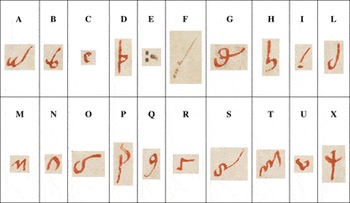
APPENDIX 1
Musical Cyphers in Visigothic Manuscripts
The table shows the most common cypher used in Visigothic manuscripts to represent the letters of the alphabet.
APPENDIX 2
Visigothic Notarial Deeds containing Musical Cryptography
All notarial documents in the Archivo Capitular de la Catedral of León are catalogued in the monumental Colección documental del Archivo de la Catedral de León.Footnote 1 In the table below it is possible to have three different references to the same document, e.g. ‘doc. n. 530. ACL 21. ACL MS 11 fols. 184v–185r’. The first reference corresponds to the cataloguing number in the standard edition, the second is the shelf-mark of the charter and the third reference corresponds to the folio number where the charter can be read in the Tumbo legionense.Footnote 2
Information on the deed is not always exhaustive. In some cases articles/books (e.g. Foradada y Castán, Riaño, etc.) provide images of cryptograms or cryptographic inscriptions omitting reference to the library/archive where the original document is kept, while in other cases the shelf-mark is missing. For example, Riaño said that the cryptograms he provided all come from documents kept in the Archivo Historico Nacional and ‘they are facsimiles of the specimens hitherto known’;Footnote 3 apparently, they all come from signatures attached to documents of the tenth, eleventh, twelfth centuries.Footnote 4 Unfortunately, no further information about these documents is provided.
The abbreviations used in the ‘context’ column correspond to:
SS scribal signature
C cryptogram
BC bishop cryptogram
SC scribal cryptogram
AC abbot cryptogram
NC notarial cryptogram
PC presbyter cryptogram
If the cryptography or the subscription preceding the cyphers are written transversally on the charter, these are given in italics in the table. If the cryptography is followed by text letters, these are given in square brackets in the column ‘cryptography’, e.g. ‘Lanlio presbiter [notuit]’ means that ‘Lanlio presbiter’ is given as cyphers, and ‘notuit’ in text letters on the original document. Similarly, if a cryptogram also contains text letters, these are given in square brackets in the same column. An uncertain date is underlined. The following abbreviations for libraries and archives are used in the table:
ACL León, Archivo Capitular de la Catedral
AHN Madrid, Archivo Historico Nacional
ALU Lugo, Archivo de la Catedral
AOL León, Archivo Obispado
BED Madrid, Biblioteca de la Escuela Diplomática

 .
 is often found near the text, either below or before a syllable (e.g. fols. 32r/4, 56v/4, 150r/11, 206v/10, etc.) and more rarely is found near the neumes, as on fol. 229v (near the long melisma on the side of the page). The significance of this other non-musical use of