

Introduction
Emergence of severe acute respiratory syndrome (SARS) (2002–2003) created the impetus for enhanced global and regional pandemic influenza planning.Reference Naylor, Basrur and Bergeron1 Severe acute respiratory syndrome infected more than 8,000 people in more than 29 countries, with more than 800 deaths, predominantly in China, Canada, Singapore, Hong Kong, and Taiwan.2 The SARS outbreaks were followed closely by outbreaks of an extremely virulent influenza virus (A/H5N1), which re-emerged in the Hong Kong population in 2003 after crossing the avian-human species barrier for the first time in 1997.Reference Korteweg and Gu3 Laboratory confirmed cases (445) of H5N1 influenza have been reported in 15 countries with 263 deaths as of 11 December 2009.4 Countries with significant numbers of cases include Indonesia, Vietnam, Egypt, and China.4 In April 2009, a new global response was initiated in response to numerous cases of influenza A/H1N1 emerging from Mexico,5 with an influenza pandemic declared on 11 June 2009 by the World Health Organization (WHO).6 As of 06 December 2009, the WHO Regional Offices reported approximately 9,596 deaths in more than 208 countries/territories.7 Each infectious respiratory disease outbreak has fostered increased global awareness of the need for pandemic influenza preparedness planning, particularly to establish occupational health and safety guidelines for the response community that includes healthcare workers. In Canada, healthcare workers represented over 40% of SARS infections, including three deaths,Reference Naylor, Basrur and Bergeron1 thereby emphasizing the need to consider potential health impacts for response groups.Reference Amaratunga, O'sullivan and Phillips8 As most healthcare workers are female,Reference Shields and Wilkins9 gender-specific susceptibility to infectious agents may include negative pregnancy outcomes.Reference Amaratunga, Phillips, O'sullivan, Tyshenko and Paterson10
Historically, pregnant women were among the most susceptible to virulent infectious respiratory diseases.Reference Smith and Bresee11 During the 1918–19 Spanish influenza (H1N1) pandemic,Reference Harris12 and again during the 1957–58 Asian influenza A /H2N2 pandemic,Reference Greenberg, Jacobziner, Paketer and Weisel13,Reference Freeman and Barno14 maternal mortality rates ranged from 30–50%. Indeed, following the 1968–69 pandemic, (“Hong Kong flu” A/H3N2)15 an interdepartmental conference convened at the University of California, Los Angeles in 1970 noted that pregnant women were more likely to contract influenza, experience spontaneous abortion and stillbirth, with increased risk of death following development of pneumonia.Reference St. Geme, Bradley and Torrance16 A total of 1,988 Swine Influenza cases in Wisconsin produced a single fatality, notably an infected pregnant woman and also resulted in the infection of attendant healthcare workers.Reference Wells, Hopfensperger and Arden17
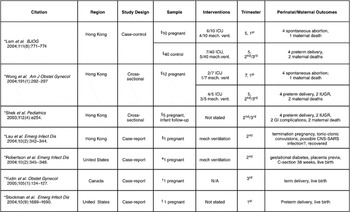
More recently, there are several published reports of pregnant women infected with SARS that describe maternal and immediate pregnancy outcomes (Table 1).Reference Lam, Wong and Leung18–Reference Stockman, Lowther and Coy24 Perinatal and maternal outcomes are more likely to include severe maternal morbidity and mortality and preterm delivery when women are infected in late pregnancy (2nd/3rd trimester). Women infected with SARS in the first trimester tended to survive, however spontaneous abortion was common.Reference Lam, Wong and Leung18,Reference Wong, Chow and Leung19 Reports of H5N1-infection in pregnant women describe the clinical courses of laboratory confirmed H5N1 infection during 2nd/3rd trimester for two women who ultimately died (Table 2). These case studies represent valuable data to better understand the clinical course of these infectious respiratory diseases in pregnant women and strategies for case management.
Severe acute respiratory syndrome (SARS) and pregnancy

*Polymerase chain reaction (PCR) and/or severe acute respiratory syndrome-Corona Virus (SARS-CoV) antibody confirmed; § broad spectrum antibiotics, ribavirin/steroid (standard protocol);
¥broad spectrum antibiotics, oseltamivir, †broad spectrum antibiotics. (CNS = central nervous system; GI = gastrointestinal; ICU = intensive care unit; IUGR = intrauterine growth restriction; mech vent = mechanical ventilation)
Infl uenza A/H5N1-infections during pregnancy

*Polymerase chain reaction (PCR) and/or A/H5N1 antibody confirmed; ¥oseltamivir, †broad spectrum antibiotics. (ICU = intensive care unit; mech. vent = mechanical ventilation
It is well established that healthcare workers involved in collection of blood, sputum, and respiratory medical interventions are at risk from airborne transmission of infectious respiratory agents.Reference Lange25 Beyond the biomedical risks, infectious disease outbreaks often are accompanied by psychological stress, including fear, anxiety, and dread, particularly if the outbreak is perceived as not under personal control, or associated with adverse, irreversible outcomes.Reference Covello, Peters, Wojtecki and Hyde26 Organizational social supports previously have been proposed as mechanisms to buffer the stress of emergency response by providing clear and consistent guidelines, training and resources that address the emotional, informational, and instrumental needs of workers.Reference Amaratunga, O'sullivan and Phillips8,Reference Heaney, Israel, Glanz, Rimer and Lewis27
In the context of Canada's experience with SARS and the emergence of influenza A/H5N1 (“avian influenza”), the aim of this study was to describe emergency and critical care nurses' perceptions of occupational reproductive-related risks during infectious respiratory disease outbreaks.
Methods
Design
This qualitative study was designed to increase awareness of the occupational needs of Canadian healthcare workers in the post-SARS era of infectious disease outbreaks. Focus groups, using a structured interview matrix (SIM) formatReference O'sullivan, Amaratunga and Phillips28 were conducted to allow nurses to express their needs, experiences and recommendations. The use of focus groups for data collection is recognized as generally well suited for studies of work culture, cross-cultural populations, and both shared and common knowledge.Reference Kitzinger29
Participants
As part of a larger study designed to examine perceptions of emergency preparedness among Canadian nurses following the SARS outbreak, a purposeful sample of Canadian nurses was recruited to participate in focus groups to discuss their occupational experiences and perceptions of infectious disease outbreaks. Recruitment was facilitated by the Canadian Federation of Nurses Unions, Registered Nursing Association of Ontario, College of Registered Nurses of Nova Scotia, British Columbia Registered Nurses Association, local newspapers, and e-mail listservs using a brief summary of the project objectives and details of their participation. Respondents were reimbursed $50 for participation time in focus groups.
Data Collection
Focus groups were conducted using the SIM formatReference O'sullivan, Amaratunga and Phillips28 with two rounds of research questions, beginning with one-on-one interviews, small group synthesis discussions, and larger plenary group discussions. A pilot SIM focus group initially was held with 10 participants, at which time it became apparent that a minimum number of 16 participants optimized functional group dynamics and ease of facilitation. Five SIM focus groups, including the pilot, ultimately were conducted between November 2005 and February 2006 in major cities in eastern Ontario (n = 10, n = 25), southwestern Ontario (n = 15), British Columbia (n = 27), and Nova Scotia (n = 23) for a total of 100 participants.
A series of eight questions was posed to each focus group by a designated facilitator and included participants' perceptions of infectious disease outbreaks with emphasis on psychological impacts, bioterrorism, recommendations for organizational supports, stigma, willingness to work, gendered work-life challenges, and quarantine. Field notes were comprised of notes taken by participants (one-on-one discussions, group synthesis flip chart) and notes taken by the research team who were strategically placed within each small group (group discussion and synthesis, larger plenary group discussion). The facilitator's role was limited to leading the discussion and did not involve field note taking.
Ethical Considerations
This study was approved by a university institutional ethics review board. All participants signed informed consent forms. A description of the purpose of the study, source of funding and research team was made available to the participants at the time of recruitment, reiterated verbally at the onset of each focus group and in writing as part of the consent forms. Participants were made aware that they were free to withdraw from the study at any time without personal consequence and that their participation would remain confidential.
Data Analysis
The data (field notes) were analyzed using thematic content analysis, supported by NVIVO-TM software. Field notes from each focus group were coded within the context of instrumental, informational and emotional supports for nurses.Reference Heaney, Israel, Glanz, Rimer and Lewis27 Emergent themes were established by consensus of three associates on the research team. The data from five focus groups reached saturation, both across and within geographical regions.Reference Morse, Denzin and Lincoln30–Reference Morse32 DependabilityReference Miles and Huberman33 was ensured by the consistent use of common research questions, trained facilitators who adapted the SIM focus group design and the participation of a conserved team of researchers in both data collection and analysis. Credibility was achieved through the design of focus groups, which required participants to document peer-interviews and group synthesis discussions.Reference Morse, Denzin and Lincoln30,Reference Toma, Conrad and Serlin34
Results
Participant Characteristics
Five focus groups held in Canada were comprised of 100 nurses representing a range of specialties (emergency and critical care, management, infection control) and unions, work classifications (full-time, part-time, and casual) and years of work experience. “Nurses” were predominantly female (94 women), with six male participants.
Perceptions of Reproductive Risks by Canadian Nurses
Four major reproductive themes emerged as specific and unique occupational health and safety concerns for nurses.
Theme 1: Apprehension About Occupational Risks to Pregnant Nurses
The first theme relates to the nurses' perception of the occupational risks faced by pregnant workers responding to infectious disease outbreaks. Nurses were greatly concerned about the risk posed to pregnant workers and the unborn child. This was reflected by a nurse from Nova Scotia who related that if a nurse was “… newly pregnant, how will she feel about exposing herself and the fetus?” A British Columbia nurse simply stated that if she was pregnant “… I'm not going to put myself and my baby at risk”. These comments made by health professionals well aware of the potential for vertical transmission of viruses do illustrate an important consideration for pregnant healthcare workers and occupational responsibilities. A Nova Scotia nurse considered this a conflict between personal risk and child protection. She reflected on how she would feel if she was pregnant and her duty was to respond during an outbreak. “If I'm pregnant do I assume the risk? Is this analogous to not going to work to protect a child?” Concerns expressed by nurses were not limited to biological risks, but also included the stress and anxiety anticipated to accompany an infectious disease outbreak. As discussed, Canada's healthcare community was directly impacted by the 2003 SARS outbreaks. A British Columbia nurse noted that “women who are pregnant have more anxieties, and valid health risks to a fetus”. Anxieties also were anticipated by a nurse from the focus group in Ontario, “Pregnancy brings fear for an unborn child, and guilt of harm to a baby”. Thus, psychological stress and its impacts on pregnancy in association with SARS infection or infection with other viral agent were identified as important occupational concerns by Canadian nurses. Several nurses expressed concerns that fertility would be impacted with both the acute loss of a pregnancy and unknown long-term effects, as expressed by a nurse from Ontario who noted that workers “exposure to infections while pregnant means nurses are faced with the possibility of not being able to have children”. There currently is no evidence to suggest that infection with these viruses is related to long-term fertility in men or women.
Theme 2: Unknown Pregnancy Risks of Anti-Infective Therapy and Prophylaxis
The second emergent theme identified by focus group participants related to perceived reproductive risks associated with anti-infective therapy/prophylaxis. The nurses reflected with concern on emergency planning policies, which recommended that antiviral medications would be prioritized for nurses and other front line responders, in particular were concerned about the unknown reproductive risks to men and women associated with such medications. An Ontario nurse remarked that “female workers, who are pregnant or trying to conceive a child, may not want to take the prophylactic medication. Men may become sterile as a result of this.” It is important to note that there is no evidence to support an association between male or female infertility, acute or long-term, following use of currently available anti-infective therapies. The concerns about fertility expressed by the nurses in this sample seem to reflect a misconception about the risks posed by these drugs and an important subject for future risk communication/education. Women who are pregnant or breastfeeding would be at risk as “prophylaxis, meds/vaccines would have constant effect” exclaimed a British Columbia nurse, suggesting that not only in utero exposure to anti-infective therapies was risky, but also exposure of neonates via drug metabolites expressed in breast milk. Nurses' lack of knowledge of the safety of anti-infective therapies for breastfeeding represents an important topic for future research initiatives and occupational risk education.
Theme 3: Occupational Risk Communication for Pregnant Nurses
The third emergent theme pertained to the need for occupational safety information related to pregnancy. Focus group participants recognized that the field of health care has a high proportion of female employees, and therefore, the pregnancy risks must be considered. Nurses from all four cities expressed the need for more information. An Ontarian nurse identified that not only pregnant nurses, but also women who were actively trying to conceive or “potentially pregnant nurses also have concerns” that would benefit from opportunities to receive health risk information specific to pregnancy and occupational exposures. The need to provide health risk information to workers in healthcare settings was essential due to the “large numbers of females … and unknown effects on pregnancy”, as expressed by a nurse from Nova Scotia. As discussed, participants perceived that respiratory infections and anti-infective therapies were somehow associated with male and female infertility, an association that is not supported by the literature.
Theme 4: Human Resource Strategies Required for Pregnant Nurses during Outbreaks
The final theme related to the perception by focus group participants that pregnant nurses needed to redeployed during infectious disease outbreaks. Recognizing the occupational health risks faced by pregnant nurses, an Ontario nurse argued that “You wouldn't assign the pregnant or potentially pregnant nurses to patients with a communicable disease”. This perception was echoed by most participants who believed that redeployment of pregnant workers during the outbreak was reasonable and should be required as a precautionary measure. Reassignment of pregnant workers is not necessarily mandated across different jurisdictions and healthcare settings. An Ontario nurse emphasized that “staff, particularly those who are pregnant… there should be a process that they are aware of where they can be transferred or reassigned so they feel safe” This issue of reassignment is complicated, dependent on union, human resource and regulatory agency policies and recommendations. The perception that nurses need to“feel safe” seems to reflect the psychological stress and anxiety that is anticipated in the event of a widespread infectious disease outbreak. An Ontarian nurse also perceived that pregnant workers would be unduly stressed physically and emotionally by “long work hours, the added stress of wearing PPE (personal protective equipment) and psychosocial issues”, which of course would be faced by all health care workers. Emotional and physical stress can contribute negatively to pregnancy outcomes, and it does seem likely that workers throughout their pregnancy would require routine adjustments to PPE fit testing and refinements to occupational ergonomics.
Discussion
Canadian nurses anticipate significant reproductive risks associated with occupational healthcare response to infectious disease outbreaks in this qualitative study. Although these perceptions have been informed to some extent by nurses' training, experience and education in emergency response and infection control, there are limitations of this study that must be considered. The participant sample included nurses from a range of healthcare positions, including management, union and emergency-critical care that were not disaggregated for this study. Unfortunately perceptions of reproductive risks voiced by these nurses were not related to specific occupational scope of practice or their personal and occupational experiences with SARS or other infectious disease outbreaks in Canada. The personal experiences of nurses also were not documented and it may be possible that family members or close friends of some of the participants were impacted by SARS or other infectious disease outbreaks. Further, the individual personal reproductive histories of the participants were not obtained, which also may have influenced perceptions of risk, particularly related to fertility. The recruitment strategy employed necessarily targeted actively working nurses who identified themselves as members of this profession. Thus, individuals who had changed professions, outside the healthcare field, because of SARS or other unrelated reasons are not represented in this data. Finally, focus groups inherently are limited by the tendency for group perceptions and norms to overshadow or silence individual voices.Reference Kitzinger29 The SIM designReference O'sullivan, Amaratunga and Phillips28 used here did enable individual interviews that may have mitigated this limitation somewhat, but this is still an important consideration.
The study is applicable to other healthcare settings outside of Canada and healthcare workers in general; however, the emphasis and concern regarding risks to pregnancy and fetus during an infectious disease outbreak may reflect the high participation of women in this sample. Finally, in the intervening time between the SARS outbreak in Canada (2003) and the study period (November 2005 and February 2006), the issue of SARS was discussed nationally through a public inquiry,Reference Naylor, Basrur and Bergeron1 media coverage of the negative experiences faced by nurses in particular, and culminating with the creation of the Public Health Agency of Canada. Therefore, The timeframe of this study limits the participants' risk perceptions within the context of SARS and “avian influenza” H5N1, a new virus and topical subject during the time of the interviews. Participants were well aware of the gaps in Canada's SARS response and shared a professional outrage because of their colleagues' susceptibility and ultimately high morbidity/mortality during Canada's experience with SARS,Reference Naylor, Basrur and Bergeron1 which could have influenced the perceptions of personal risk, fear, anxiety, and vulnerability.Reference O'Connor, O'sullivan and Amaratunga35
Understanding Reproductive Risks Posed by Infectious Respiratory Diseases
It has been reported previously that nurses require a range of supports during infectious disease outbreaks, including informational supports (accurate, appropriate and timely communication), emotional supports (addressing distress) and instrumental supports (such as PPE and vaccines).Reference Amaratunga, O'sullivan and Phillips8,Reference Amaratunga, Phillips, O'sullivan, Tyshenko and Paterson10,Reference O'sullivan, Amaratunga and Phillips28Reference O'Connor, O'sullivan and Amaratunga35 This analysis of nurses' perceptions of reproductive risks posed by occupational exposures to infectious respiratory agents identified two important areas that could be effectively addressed by occupational supports: (1) emotional supports to address fears and anxieties related to pregnancy and (2) informational supports to provide specific information regarding pregnancy risks following exposure to specific infectious agents and exposure to anti-infective therapies.
The unknown pregnancy risks of exposure to SARS or other infectious agents were critical concerns for Canadian nurses who anticipated that significant guilt, anxiety and fear would accompany exposure to an infectious agent during pregnancy. This is consistent with the anticipatory concerns expressed by pregnant women during the Hong Kong SARS outbreak including risk of contracting SARS, transmission to fetus, and risk of teratogenicity with drug treatment.Reference Lee, Sahota and Leung36 Perinatal stress and anxiety are associated with intrauterine growth restriction (IUGR), preterm labor and shorter gestation.Reference Glover and O'Connor37 The trauma induced in pregnant women who were near the World Trade Center during the terrorist attacks on 11 September 2001 was associated with decreased infant head circumference, birth weight, birth length, gestational duration and increased risk of IUGR.Reference Lederman, Rauh and Weiss38,Reference Engel, Berkowitz, Wolff and Yehuda39 Healthcare organizations should provide emotional support options for pregnant healthcare workers to help buffer anticipatory concerns, fears, and anxiety.
Canadian nurses also perceived a significant risk for pregnancy upon exposure to SARS or other infectious disease agents. These pregnancy risk perceptions are supported by the published case studies of SARS and H5N1 (Tables 1 and 2). Whereas the mother's health is certainly at risk from these infections and pregnancy viability may indeed be compromised, liveborn infants may not necessarily experience infection or disease complications, demonstrated by several case reports.Reference Shek, Ng and Fung20,Reference Yudin, Steele and Sgro23Reference Stockman, Lowther and Coy24,Reference Ng, Leung and Chiu40Reference Rebmann41 In cases of SARS infections, anti-SARS antibodies have been detected in maternal blood, umbilical blood, and amniotic fluid from a pregnant SARS patient, suggesting that the fetus may be protected by the immune response.Reference Jiang, Gao and Zheng42
Nurses also were concerned about the potential reproductive risks posed by anti-infective therapies and prophylaxis during an infectious disease outbreak. Two standard protocols for patients infected with SARS emerged during the outbreak: first, with patients who were treated in Hong Kong with antibiotics, corticosteroids, and ribavirin and second, with patients treated in Toronto with broad-spectrum antibiotics and intravenous ribavirin.Reference Yudin, Steele and Sgro23,Reference Koren, King, Knowles and Phillips43 Ribavirin is a broad spectrum nucleoside analogue used against ribonucleic acid viruses and coronaviruses,Reference Koren, King, Knowles and Phillips43,Reference Rezvani and Koren44 and also is an established reproductive toxicant, demonstrated in animal studies.Reference Ferm, Willhite and Kilham45–Reference Clark, Banwatt and Croy47 Its use as an antiviral agent has prompted the creation of the Ribavirin Pregnancy Registry in the US, which has reported more than 70 pregnancy outcomes since January 2004.Reference Lindsay, Greene and Jones48 This cross-sectional study of 12 pregnant women reported that patients were informed of the embryocidal risks of ribavirin and speculated that treatment with ribavirin (11/12 patients) may be related to spontaneous abortions observed in their sample.Reference Wong, Chow and Leung19 Indeed, it is recommended for patients treated with ribavirin in early pregnancy be given the option for termination of pregnancy because of the potential for reproductive toxicity.Reference Wong, Chow and Leung19 Subsequent to the SARS outbreak, it has been recommended that ribavirin be introduced only after clinical efficacy has been demonstrated, particularly due to its reproductive toxicity and lack of in vitro antiviral effects on SARS-CoV.Reference Muller, Dresser and Raboud49,Reference Tai50 Oseltamivir is a neuraminidase inhibitor recommended for use against H5N1,Reference Ward, Small and Smith51 and more recently it has been recommended together with zanamivir for cases of H1N1 influenza.52 Although animal studies and human case reports do not suggest significant reproductive toxicity for these antivirals,Reference Ward, Small and Smith51,Reference Rasmussen, Jamieson and Bresee53 the US Centers for Disease Control CDC has included a discussion of the gaps in knowledge in its interim guidelines for H1N1 treatment.52 Both oseltamivir and zanamivir are classified by the US Food and Drug Administration (FDA) as “Pregnancy Category C” agents as there have been no clinical studies to assess safety during pregnancy.Reference Tanaka, Nakajima and Murashima54
Canadian nurses also expressed concerns regarding the risks of both infectious disease exposure and anti-infective therapies on fertility for both men and women. No association between exposure to infectious respiratory agents (e.g. SARS, influenza) and infertility has been reported. It appears that this is a misperception held by nurses in this sample that could be addressed through information supports. Similarly, no evidence exists to link exposure to anti-infective therapies and prophylaxis to infertility. Indeed, the Practice Committee of the American Society for Reproductive Medicine (2008) recommends only that influenza and other vaccines be administered prior to conception if possible. Finally, nurses' perceptions that breastfeeding may be dangerous during infection or upon exposure to anti-infective therapies are also not well supported. Only one study has assessed the safety of oseltamivir during breastfeeding and reports no clinically significant levels of drug metabolites transmitted to the nursing infant.Reference Wentges-van Holthe, van Eijkeren and van der Laan55 Based on the Wentges-van Holthe study and pharmacokinetics data, the Canadian Medical Association Journal reported that oseltamivir and zanamivir are compatible with breastfeeding.Reference Tanaka, Nakajima and Murashima54
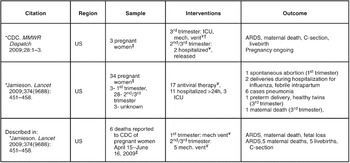
Notable changes in risk communication and the identification of pregnant women as a vulnerable group are evident since the emergence of H1N1 influenza. The WHO, CDC, and the Public Health Agency of Canada (PHAC), among other organizations, recognized that pregnant women infected with H1N1 are at increased risk for complications, with detailed Web pages and directives specifically discussing the treatment, priority vaccination and management of H1N1 infections during pregnancy.52,56,57 Further, the CDC recommends that mothers continue to breastfeed even if they suspect they are infected with H1N1, due to the beneficial immune protection conferred.58 However, it is unknown if this information was received by pregnant women and the extent to which the information alleviated anxiety and stress. Case histories for 34 confirmed or probable cases of H1N1 infections in pregnant US women59–Reference Jamieson, Honein and Rasmussen61 were published at the time of this article (Table 3), with a more comprehensive clinical portrait of H1N1 infection in pregnant women undoubtedly to emerge as more cases are published.
Infl uenza A/H1N1-infections during pregnancy

*confirmed cases: real-time reverse-transcriptase PCR/viral culture; probable case: acute febrile respiratory illness/positive for inf luenza A, but negative for H1 and H3; ‡Cases described in CDC, 2009. MMWR Dispatch 58:1–3 are included in the 34 cases described in Jamieson, 2009. Lancet 2009; 374(9688):451–458. The single mortality (CDC, 2009. MMWR Dispatch 58:1–3) is also included in the 6 deaths reported to the CDC April 15-June 16, 2009. ¥oseltamivir, †broad spectrum antibiotics. (ICU = intensive care unit; mech. vent = mechanical ventilation
Human Resource Issues Related to Pregnant Healthcare Workers
The global SARS outbreak in 2003 revealed the occupational risks posed to healthcare workers.2 Nurses in this study made strong arguments for the redeployment of pregnant workers during infectious disease outbreaks. The issue of work reassignment for pregnant workers is a complex occupational issue with implications for unions, hospitals, and regulatory and national health agencies, and is beyond the scope of this paper. However, it is important to note nurses' perceptions that human resource supports for pregnant healthcare workers may not be available on demand and that different policies are in place across healthcare institutions and unions. The WHO published a position paper on the ethics of pandemic influenza health care response which contains recommendations for establishing the scope of healthcare workers' obligations and to also consider workers fragile health status, including pregnancy, in their work assignments.62
Another important human resource issue is the tracking of occupational exposures versus community exposures. Nurses in this study focused almost exclusively on occupationally derived exposures. However it also is possible that healthcare workers may be infected through personal and community contacts. This distinction is important from an occupational perspective and sound public health contact tracing principles. During the SARS outbreak, both Canadian and US healthcare facilities put in place a series of strategies to track occupational exposures and limit the spread of infections among staff and patients which included controlled entry and access to healthcare facilities, daily contact records with patients, assignment logs and patient/healthcare worker surveillance.63 As with any occupational exposure, the responsibility is for the worker to report occupational exposures and injuries to appropriate bodies, including institutional occupational health departments. Occupational health and infection control should design educational interventions related to pregnancy and infectious disease response for workers who have part-time or casual employment contracts and may not have routine access to occupational health services. No information is currently available on the total proportion of health care workers infected with H5N1 or H1N1 globally, as a result of occupational exposure however three of the 34 pregnant women infected with H1N1 reported to the CDC were health care workers.60 Health professionals were not overrepresented among H1N1-infections in the US,64 possibly due to vaccine prioritization.
Conclusions
Infectious respiratory disease during pregnancy is potentially life-threatening, representing complicated management issues for mother and fetus. Therefore, pregnant healthcare workers should be advised regarding the potential risks posed by infectious disease outbreak response. Occupational directives should detail reproductive consequences upon exposure to specific infectious agents and anti-infective therapies along with the efficacy of anti-infective prophylaxis. Importantly, gaps in knowledge or information should also be provided to healthcare workers, such as the “Pregnancy Category C” classification of most anti-infective therapies. It is imperative that reproductive risks be assessed, documented, and communicated to healthcare workers, as lack of knowledge and misinformation may be barriers to effective infectious disease outbreak response.
Acknowledgements
Funding support for this project was provided by Defense Research and Development Canada, through the Canadian Chemical, Biological Radiological Nuclear and Explosive Research and Technology Initiative (CRTI; CA Amaratunga Principal Investigator). The authors acknowledge the contributions of the Institute of Population Health Caring About Health Care Workers project research team, particularly Louise Lemyre, Wayne Corneil, Eileen O'Connor and Daniel Krewski who are co-investigators on the project.
Abbreviations:
CDC = [US] Centers for Disease Control and Prevention
IUGR = intrauterine growth restriction
PPE = personal protective equipment
SARS = severe acute respiratory syndrome
SIM = structure interview matrix
WHO = World Health Organization