Migration scholars have recently posited a connection between crime and emigration (Hiskey et al. Reference Hiskey, Montalvo and Orcés2014; Ríos Contreras Reference Ríos Contreras2014) and have begun to explore how connections with migrants abroad influence how those left behind view and respond to rising fear and insecurity in Latin America and the Caribbean (Acevedo Reference Acevedo2019; Doyle and López García Reference Doyle and Ana2019; Ley et al. Reference Ley, Ibarra Olivo and Meseguer2019; López García Reference López and Ana2020; López García and Maydom Reference López, Ana and Barry2019; Pérez Armendáriz and Duquette-Rury Reference Duquette-Rury2019). In public opinion surveys, a growing number of citizens support the idea of crime being countered through violent means (Cohen et al. Reference Cohen, Noam and Zechmeister2017). Civil and human rights are violated when real or suspected criminal suspects are tortured on arrest, abused in detention, sentenced to death, killed by the military, or lynched by fellow citizens themselves. Are Latin American and Caribbean migrants contributing to a growing set of undemocratic and unconstitutional attitudes in their countries of origin?
This article examines how the receipt of financial remittances from abroad shapes individual support for the use of violence in crime-fighting activities in contexts of emigration. We define “violent responses to crime” as the use or threat of violence in response to a (potential) criminal act. These responses can be perpetrated by both state actors (when the police or the military use brutal or lethal force to apprehend or execute real or suspected criminals) and nonstate actors (when individuals engage in acts of self-defense, vigilantism, or lynching).
We propose that remittance recipients are more likely to support the use of violence in response to crime than are nonrecipients. We attribute this to remittance-receiving individuals’ concentration in the middle class and, among their peers, to their greater propensity to make investments and purchase durable goods—goods that are vulnerable to crime and its externalities—its extended effects in society (Galiani et al. Reference Galiani, Jaitman and Weinschelbaum2020). Remittance recipients are more likely to experience and to fear crime compared with nonrecipients, and as a result, they are more likely to approve of violent measures in response—especially in Latin America and the Caribbean, where crimes are very often accompanied by violence.
To test this argument, this study uses survey data from the 2010 to 2018–19 waves of the AmericasBarometer. In line with our theoretical expectations, the quantitative analysis shows that remittance recipients are more likely to report being victims of, and afraid of, crime than nonrecipients. Furthermore, such recipients are more likely to approve of citizens’ taking justice into their own hands, to support the police bending the law to apprehend criminals, and to endorse the armed forces’ involvement in crime fighting than nonrecipients are. These findings are robust to controlling for a range of variables and matching individuals on observable characteristics. The evidence confirms that receiving remittances can make individuals more supportive of violence as a response to crime. This finding has important implications for attitudes toward the rule of law, the expansion and consolidation of human rights, and democratic development in countries in Latin America and the Caribbean.
This article makes a series of contributions to the literature. It adds to the growing body of research on the consequences of international migration for political development in migrant-sending countries.1 In particular, it contributes to the study of the relationship between migrant transnationalism and violent origin-country democracies (Pérez-Armendáriz Reference Pérez-Armendáriz2019). The study also brings new perspectives and insights to current scholarly work on popular support for violent approaches to tackling crime in Latin America and the Caribbean (Bateson Reference Bateson2012; Buchanan et al. Reference Buchanan, DeAngelo, Ma and Taylor2012; Malone Reference Malone2012; Nivette Reference Nivette2016; Pion-Berlin and Carreras Reference Pion-Berlin and Manuel2017; Singer et al. Reference Singer, Cecilia, Lehmann, Stevens and Marc2019; Visconti Reference Visconti2019; Zizumbo-Colunga Reference Zizumbo-Colunga2017).
EXISTING LITERATURE
Individuals’ economic anxieties and exposure to crime have often been associated with greater support for using violence against alleged criminals (Bateson Reference Bateson2012; Costelloe et al. Reference Costelloe, Ted and Marc2009; Hogan et al. Reference Hogan, Ted and Marc2005; Nivette Reference Nivette2016; Singer et al. Reference Singer, Cecilia, Lehmann, Stevens and Marc2019; Visconti Reference Visconti2019). The scholarship shows that the receipt of remittances lowers economic anxieties, specifically in the form of more positive evaluations of the household and national economy (Ahmed Reference Ahmed2017; Germano Reference Germano2018; Tertytchnaya et al. Reference Tertytchnaya, De Vries, Solaz and Doyle2018). Since remittance income arrives from abroad, recipients are less vulnerable to fluctuations in the national economy—mainly because remittances tend to be stable and countercyclical. The extra income provided by remittances also allows recipients to buy public goods (such as security protection) on the private market, so they have less incentive to demand them from the state (Doyle and López García Reference Doyle and Ana2019). If remittance recipients hold positive perceptions of the household and the national economy and have greater resources to access crime prevention measures than nonrecipients do, then we might expect that the receipt of remittances would lower individual support for the use of violence in crime-fighting activities.
But while remittances can provide recipients with greater resources to ensure their own private security, investments therein can sometimes generate violence and run counter to the rule of law (Malone Reference Malone2012). This is the case, for example, when citizens buy and carry a gun for self-defense or fund or organize themselves into peasant patrols, militias, self-defense forces, or vigilante movements. Recent work by Pérez-Armendáriz and Duquette-Rury (Reference Duquette-Rury2019) shows that vigilante organizations are more likely to emerge in Mexican municipalities where migrants finance and implement public goods projects through (collective) remittances from the United States. Ley et al. (Reference Ley, Ibarra Olivo and Meseguer2019) report similar findings when analyzing the relationship between the share of households receiving remittances from abroad and the emergence of self-defense groups at the municipal level in Mexico.
Further accounts show that remittances do not make recipients immune or indifferent to the lack of public insecurity in the society in which they live. We have found elsewhere (López García and Maydom Reference López, Ana and Barry2019) that even though remittances depress voter turnout, recipients are more likely to go to the polls in contexts of crime and violence in sub-Saharan Africa and Latin America—behavior spurred by the desire to influence government policies on the provision of public security. Likewise, Acevedo (Reference Acevedo2019) explores survey data from Latin America and demonstrates that in hypothetical scenarios of rising corruption and rising criminality, remittance recipients would be more supportive of military coups than nonrecipients. From existing studies, therefore, it is unclear how the receipt of remittances from abroad influences individual support for the use of violence in crime fighting across Latin America and the Caribbean.
THEORY
This study argues that remittance recipients are more likely to approve of the use of violence against crime than nonrecipients. International migration is a costly, risky, and selective process, and therefore most migrant and remittance-receiving house-holds do not belong to the poorest of society (De Haas Reference De Haas2007; McKenzie and Rapoport Reference McKenzie and Hillel2010). This is important, since the relationship between income and crime victimization is not linear (Gaviria et al. Reference Gaviria, Medina, Morales, Núñez, di Tella, Galiani and Schargrodsky2010; Gaviria and Pagés Reference Gaviria and Carmen2002; Justus and Kassouf Reference Justus and Ana2013; Di Tella et al. Reference Di Tella, Galiani, Schargrodsky and Di Tella2010). Wealthier individuals are the most attractive to criminals because of their capacity to make investments and purchase durable goods. At the same time, however, the affluent are more capable than lower-income groups of protecting themselves and their assets from criminality. They can insure their goods, pay premiums, and even afford replacements. With lower levels of security protection than the rich, but greater resources than their poorer peers regarding investments and durable goods, middle-income citizens are most likely to fall victim to crime. Members of remittance-receiving households are thus part of a crime-anxious middle class. Among peers, however, remittance recipients are more likely than nonrecipients to fall victim to and fear crime.
Various studies have shown that relative to other sources of income, remittances are more likely to be spent on investments and durable goods than to finance everyday consumption (Adams Reference Adams1991; Adams and Cuecuecha Reference Adams and Cuecuecha2010; Durand et al. Reference Durand, Kandel, Parrado and Massey1996; Massey and Parrado Reference Massey and Parrado1998; Woodruff and Zenteno Reference Woodruff and Zenteno2001; Yang Reference Yang2008). Asset accumulation is more likely among migrant households, due to the temporary and uncertain nature of remittance income. This idea is consistent with the tenets of the “new economics of labor migration” theory (Stark Reference Stark1991; Stark and Bloom Reference Stark and David1985). According to this approach, families strategically send one or more members to live in a labor market abroad that is not correlated with the one at home. Through the financial remittances that migrant family members send home, households over-come restricted access to labor, insurance, or credit markets—thereby promoting investment in durable goods and in physical as well as financial assets (such as vehicles, farming equipment, housing, land, new businesses, or other capital goods).
Durable goods are more valuable than consumables because of their longer lifespan and the greater returns or services they yield. Recent work by Galiani et al. (Reference Galiani, Jaitman and Weinschelbaum2020) has posited a connection between the durability of a good and the likelihood that it will be subject to a crime. Because criminals can get more utility from them, and even resell them on secondary (illegal) markets, durable goods are more likely to be stolen than nondurable ones. If the receipt of remittances is linked to a greater individual propensity to make investments and purchase durable goods, it follows that the receipt of remittances increases the supply side of goods that can be stolen from a given person.
Let us now take two households that are similar in their income, rely on the same crime prevention measures, and are equal in all other relevant characteristics, but that vary in their receipt of remittances. A criminal (or group) prefers to steal durable goods and has two choices: stealing from the nonrecipient household or stealing from the remittance-receiving one. At the same level of income, the nonreceiving household is more likely to purchase consumables (e.g., food, clothing, entertainment), whereas the remittance-receiving one is more likely to make investments and buy durable goods (e.g., a car to use as a taxi, a bicycle to get to work, or a new tractor or water pump for the family farm). In this scenario, the remittance-receiving household will be more attractive to the criminal (or group) than the non-receiving one.
Besides being more likely to be targeted by criminals, investments and durable goods—and thereby remittance-receiving households—are more vulnerable to suffer from the externalities caused by crime (Galiani et al. Reference Galiani, Jaitman and Weinschelbaum2020). Crime can endanger the value and returns of property and hinder business development and opportunities—sectors in which remittances are often invested (Jaitman Reference Jaitman2017; Soares Reference Soares2015). For instance, the returns of a small grocery store or market stall acquired through remittance income can be affected due to declining customer security; similarly, the value of a house bought with remittance income can plunge due to rising neighborhood insecurity.
If remittance recipients are more vulnerable to crime, they are also more likely than nonrecipients to fear its occurrence. In Latin America and the Caribbean, the most violent region on earth, crime often involves violence (Galiani et al. Reference Galiani, Jaitman and Weinschelbaum2020; UNODC 2014). According to the United Nations Office on Drugs and Crime (2014), six out of ten robberies in the region involve violence, and the share of homicide victims who are killed during a robbery, assault, or a theft is larger in Latin America and the Caribbean than in other parts of the world. The likelihood of being killed during a crime’s occurrence can have important psychological consequences for (potential) victims. When facing a violent threat, potential victims are more likely to react with violence. In sum, although members of remittance-receiving households may have fewer economic grievances, they are more likely to suffer from the physical, psychological, and economic anxieties and dislocations produced by crime.
As noted, previous research shows that crime and fear are important factors driving individuals to support the use of violence against alleged criminals, including vigilantism, harsh policing, and the militarization of public security (Bateson Reference Bateson2012; Nivette Reference Nivette2016; Visconti Reference Visconti2019). In the specific context of Latin America and the Caribbean, where people are more likely to die during the course of a crime being committed, we therefore expect that the receipt of remittances is linked to greater support for the use of violence in response to crime at the individual level. We attribute this to the propensity of remittance-receiving households to invest and to purchase durable goods, and the sensitivity of these to crime and its externalities, all else being equal. We also argue that remittance recipients will be more tolerant of state authorities’ using violence, such as police brutality and torture in the course of arrest and detention or the militarization of policing functions.
Remittances can provide recipients with extra resources to provide security for themselves. It is unlikely, however, that these flows of money allow recipients to take full ownership of their own security. Remittances cannot easily or effectively substitute private security for the full range of security issues potentially affecting recipients. Therefore, we posit that the receipt of remittances will also increase individual approval of giving extra power to state forces to counter crime. This idea is in line with the results of previous research showing that crime and violence scenarios increase the incentives of remittance recipients to participate in elections, as well as their tolerance for military coups in scenarios of rising criminality (Acevedo Reference Acevedo2019; López García and Maydom Reference López, Ana and Barry2019).
We see vigilantism, police brutality, and the militarization of public security as different expressions—or “repertoires”—of the same phenomenon; namely, support for the use of violence in reaction to “alleged” crime and insecurity. Instead of being fixed or mutually exclusive, these reactions to crime are fluid and overlap in a gray zone between the legal and the extralegal (Bateson Reference Bateson2020). Our claims are thereby consistent with qualitative accounts of Brazil and the Dominican Republic showing that those who support the use of vigilantism and other forms of citizen-administered justice are also more likely to endorse the implementation of so-called mano dura (iron fist) policies (Bobea Reference Bobea2011; Caldeira and Holston Reference Caldeira and Holston1999; Hume Reference Hume2007; Moser and Rodgers Reference Moser and Rodgers2005). They are also in line with evidence on collaboration between citizen security groups and public security forces in cracking down on crime (Bargent Reference Bargent2015; Davis and Pereira Reference Davis and Pereira2003; Malone Reference Malone2012) and on state authorities’ enabling and fostering the use of citizen justice in the face of crime (Casado and Londoño Reference Casado and Ernesto2020; Hockstader Reference Hockstader1991; Moser and Rodgers Reference Moser and Rodgers2005; Payán Reference Payán2015). As Moncada (Reference Moncada2017) notes, it is difficult to define and theorize vigilantism and other forms of citizen-provided justice in comparison with state forms—especially in Latin America and the Caribbean, where vigilantism has often been instrumental for, rather than opposed by, those responsible for upholding state authority.
In sum, we argue that in the specific context of Latin America and the Caribbean, where most crimes are accompanied by violence, the receipt of remittances is linked to greater support for the use of violence in response to crime by both citizens and state forces. This argument leads to the following hypotheses:
H1: Remittance recipients are more likely to experience crime than are nonrecipients.
H2: Remittance recipients are more likely to fear crime than are nonrecipients.
H3: Remittance recipients are more likely to approve of citizens’ engaging in acts of citizen-administered justice than are nonrecipients.
H4: Remittance recipients are more likely to approve of the police bending the law to capture criminals than are nonrecipients.
H5: Remittance recipients are more likely to endorse military intervention in crime fighting than are nonrecipients.
Although support for violent approaches to countering crime represents a challenge to democracy in Latin America (and elsewhere), this argument is not inconsistent with recent studies that attribute the positive impact of remittances on democratization to recipients’ demands for property rights, since such guarantees are essential for remittance investments to be protected and to thrive (Bastiaens and Tirone Reference Bastiaens and Tirone2019; Bearce and Park Reference Bearce and Park2019). However, we suggest an alternative outcome in the context of democracies in Latin America. To protect themselves and the value and returns of their investments and durable goods against crime and its externalities, remittance recipients will support concrete and tougher mechanisms to counter crime, including the use of violence. This idea echoes theories about the growing use of violence (nonstate and state) and coercion to protect property rights against crime in contemporary Latin America (Foweraker and Kznaric Reference Foweraker and Roman2002; Pearce Reference Pearce2010; Pereira and Davis Reference Pereira and Davis2000).
DATA
We test the proposed hypotheses using survey data from Latin America and the Caribbean. Data were gathered from the 2010–2018/19 waves of the Americas-Barometer (LAPOP 2019). Since the key questions that we are interested in remained the same throughout the different waves, we pooled the data and included country and wave fixed effects to control for cross-national and -temporal variation.
The main independent variable in this study is individuals’ status as remittance recipients. This is a binary variable, coded 1 if respondents answered affirmatively to the question, “Do you or any members of your household receive remittances from abroad?” and 0 otherwise. To capture respondents’ exposure to crime, we use a dichotomous variable measuring whether they themselves or a member of their household had been the victim of a crime in the 12 months prior to the survey. To measure respondents’ fear of crime, we use a variable measuring how unsafe the persons in question consider the neighborhood they live in. This is an ordinal variable ranging from 0 to 3, with higher levels indicating more acute perceptions of a lack of safety in the immediate neighborhood.
While perceptions of insecurity in the neighborhood indicate that respondents are aware of the security risks where they live, this variable does not necessarily capture their personal fear of crime. A better measure of how fearful people are of crime is modified behavior because of insecurity. In this regard, we employ an index variable constructed from a battery of questions asking whether, in response to fear of crime, respondents had restricted their movements to safe places or certain times of day, avoided activities such as walking at night or through dangerous areas, felt the need to move to a different neighborhood, changed jobs, or organized with neighbors. Our index ranges from 0 to 1, with higher levels indicating a greater propensity to take crime prevention measures, suggesting more acute fears of crime.
To measure citizen support for violent responses to crime, we use three dependent variables. The first is based on the question, “Of people’s taking the law into their own hands when the government does not punish criminals, how much do you approve or disapprove?” This is an ordinal variable ranging from 0 (strongly disapprove) to 9 (strongly approve). The second measure is a dichotomous variable in response to the question, “In order to apprehend criminals, do you think that police authorities should always respect the law, or that occasionally they can operate on the margins of the law?” Those who selected “they can operate at the margins of the law, occasionally” were coded 1, and all those who disagreed were coded 0. The third measure captures support for military involvement in crime-fighting activities and is based on the question, “To what extent do you support the involvement of the armed forces to combat crime and violence (in the country)?” This is an ordinal variable, ranging from 0 (strongly disapprove) to 6 (strongly approve). 2
We also include in our models a range of control variables that could also be related to stronger preferences for the use of violence against crime. Besides respondents’ preoccupation with crime as a national problem and experiences with and fear of it, our models account for levels of trust in neighbors and trust in law enforcement agencies (the police, the courts, and the military). Since support for violent approaches to tackling crime might be driven by economic insecurities (Costelloe et al. Reference Costelloe, Ted and Marc2009; Hogan et al. Reference Hogan, Ted and Marc2005; Nivette Reference Nivette2016; Singer et al. Reference Singer, Cecilia, Lehmann, Stevens and Marc2019), models also include respondents’ evaluations of their personal economic situation and of the national economy. To address the possibility of remittance recipients’ being more likely to support violent responses to crime when they intend to stay in (i.e., not emigrate from) their country of origin, a variable measuring individuals’ intentions to work or live abroad in the future is included as well.
Additionally, we control for other socioeconomic and demographic characteristics likely to affect individual support for the use of violence in crime fighting: gender, age, rural or urban residence, education (with the reference category being primary/no schooling) and employment status. All models control for a wealth index (constructed additively from responses to a series of questions about respondents’ possession of various durable goods). Any correlations we identify between remittances and support for violence in the face of crime are therefore unlikely to be driven purely by a resource effect, wherein those with greater amounts of resources (including from remittances) are more likely to support tougher crime-fighting measures. Instead, as suggested, one of the reasons why remittance-receiving individuals are more likely to support these approaches is their greater propensity to make investments and purchase durable goods. A full description of all the variables used in the models is available in the online supplementary material.
In our sample, 15 percent of respondents in Latin America and the Caribbean reported receiving remittances from abroad—ranging from less than 5 percent in Brazil to over 45 percent in Haiti and Jamaica. The average proportion who approved of police operating outside the law to apprehend criminals was 36 percent, ranging from 25 percent in Jamaica to 47 percent in El Salvador. Meanwhile, the mean score of individual support for citizens’ taking justice into their own hands (recoded to a scale of 0–1, with poles of strongly disagree and strongly agree) was 32 percent, ranging from 20 percent in Costa Rica and Brazil to 42 percent in El Salvador. The mean score of support for giving the military a role in providing domestic security (recoded to a scale of 0–1, with poles of strongly disagree and strongly agree) was 75 percent, ranging from 60 percent in Uruguay to 85 percent in El Salvador. How the proportions of remittance recipients and their levels of support for violent responses to crime vary across the different countries surveyed by LAPOP are displayed graphically in the online supplementary material.
EMPIRICAL STRATEGY
To test the hypothesis that the receipt of remittances leads individuals to be more supportive of the use of violence against crime, we estimated a series of regression models. We used linear and (ordered) logit estimators, depending on the dependent variable. Two of our dependent variables are skewed: support for the militarization of public security leans toward the higher end of the spectrum, whereas support for vigilantism leans toward the lower end. The supplementary material illustrates the distribution of these variables.
As a preliminary check, we ran a series of partial proportional odds models. Unlike ordered logit models that are based on the “parallel lines assumption”—that is, the coefficient of an explanatory variable is the same across the various cumulative logits that can be estimated—partial proportional odds models constrain only those variables that meet the parallel lines assumption but do not impose that constraint for those variables where it is violated. The results of these models are reported in the supplementary material. The models confirm that remittance receipt meets the parallel lines assumption when estimating support for vigilantism. However, they reveal that the receipt of remittances leads to higher probabilities of support for militarization only among those individuals situated in the highest categories of support for the military. That is, the receipt of remittances is effective in driving people from strong to very strong support for militarization, but ineffective in moving people from zero to very little support for it. Since the proportional odds assumption is not fulfilled in this case, we instead report a series of binary logistic regression models estimating support for militarization based on cumulative probabilities.
As noted, all our models include dummies for every country and every wave of the LAPOP survey to control for any unobserved or unmeasured differences across countries over time.3 To avoid bias from dropping observations, regression models using only observations that have nonmissing values on the relevant variables are reported.
Addressing Threats to Causal Inference
As we have seen, members of remittance-receiving households are not a random demographic. To mitigate the problem of “selection of observables,” we used matching so that treated and control groups had similar covariate distribution (Ho et al. Reference Ho, Kosuke, Gary and Stuart2007). We employed the Coarsened Exact Matching (CEM) method (Iacus et al. Reference Iacus, Gary and Giuseppe2012). CEM is a nonparametric matching method that helps to reduce the imbalance between treated and untreated groups. In this study, the treatment group is made up of respondents who receive remittances. They were matched on the pretreatment variables of age, gender, size of place of residence, years of education, employment status, and wealth. By adjusting for the distribution of covariates between recipients and nonrecipients, matching can allow us to separate the effect of remittances from other factors shaping individuals’ support for violent crime control measures—and thereby create comparisons that are more valid.
One caveat is the loss of observations to obtain balance. After matching, our sample shrank from 81,215 to 58,971 observations. However, this ensures that self-selection is not the main driver of the results. The matching solution reduces the overall imbalance between treatment and control groups (measured by the L1 statistic) from 0.67 to 0.50. We adjusted for the remaining imbalance by including the pretreatment variables in our models. In our matched sample, 47,911 individuals were in the control group and 11,060 in the treatment group. To compensate for the different sizes of the two groups, we used weighted regressions.
RESULTS
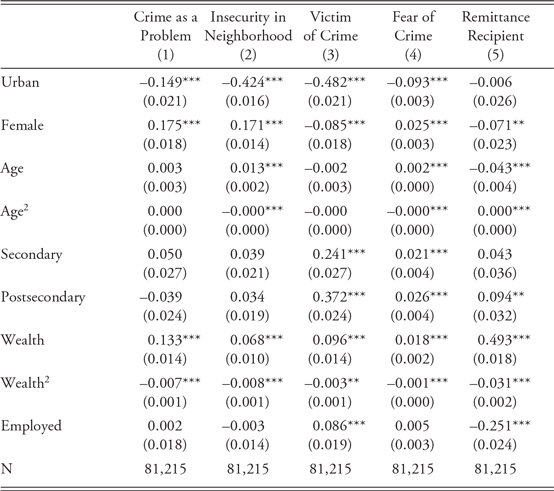
As shown in table 1, wealth is nonlinearly related to views about crime as the main problem afflicting the country, perceptions of insecurity in the neighborhood, fear of crime, and experiences with it. There is also a quadratic relationship between the receipt of remittances and wealth. That is, the majority of remittance recipients are members of the middle class. These preliminary results thus lend support to our initial assumptions.
Socioeconomic Characteristics of Crime Victims and Remittance Recipients

***p < 0.001, **p < 0.01, *p < 0.05
Notes: Models 1, 3, and 5 are binary logit models; model 2 is an ordinal logit model; and model 4 is a linear model. Year and country dummies are included, but omitted here for ease of presentation. Standard errors in parentheses.
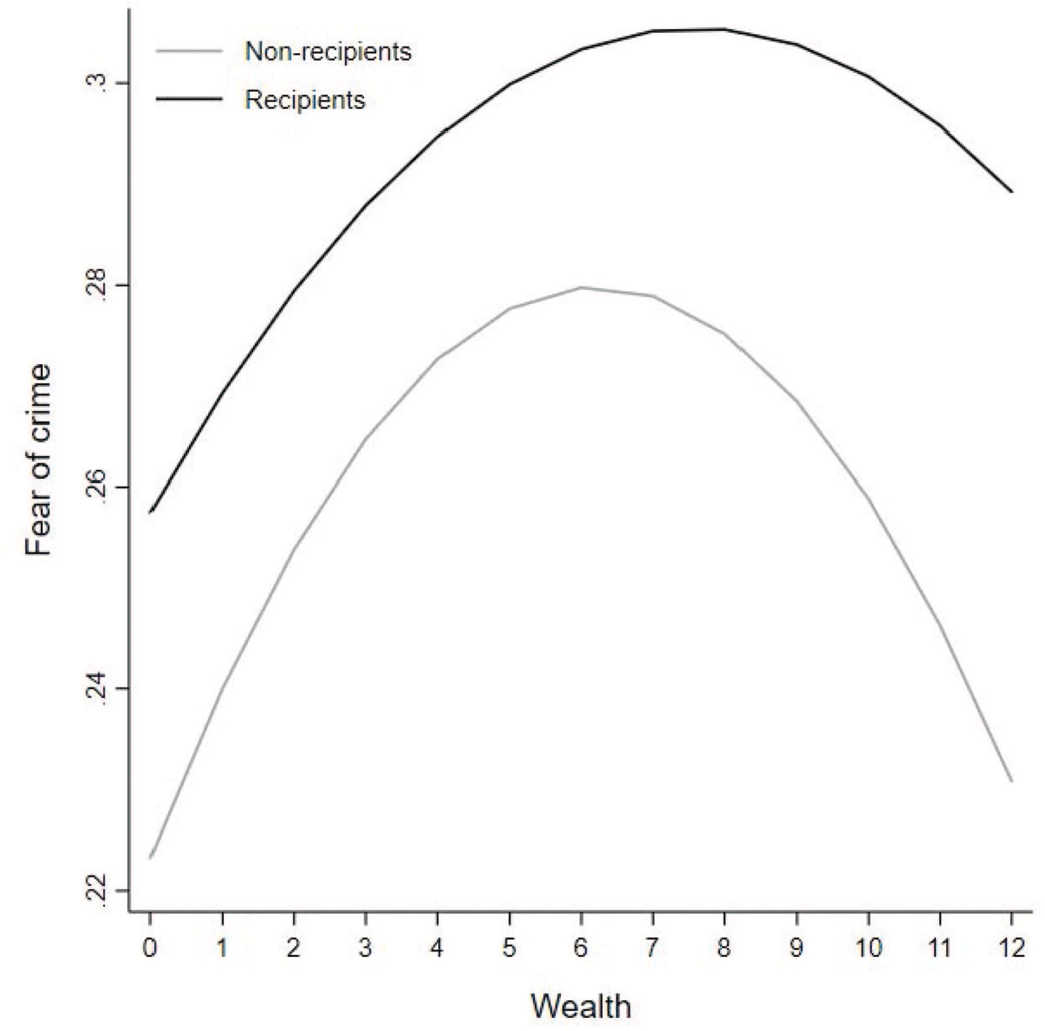
Figure 1 reveals that for all wealth levels, remittance recipients are more likely to act out of fear of crime than are nonrecipients. Even among remittance recipients, the middle class is most likely to act out of fear of crime. The next step is to explore whether the receipt of remittances has an effect on (fear of) victimization above and beyond being in the middle class.
Wealth and Fear of Crime, by Remittance Receipt

We examine whether remittance recipients differ from nonrecipients in their experiences with and fear of crime and their support for the use of violence in response, conditional on wealth. The models presented in tables 2 and 3 show the coefficients obtained after matching. Results of the statistical models using unmatched data are reported in the online supplementary material.
Remittance Receipt and Experiences with and Fear of Crime

***p < 0.001, **p < 0.01, *p < 0.05
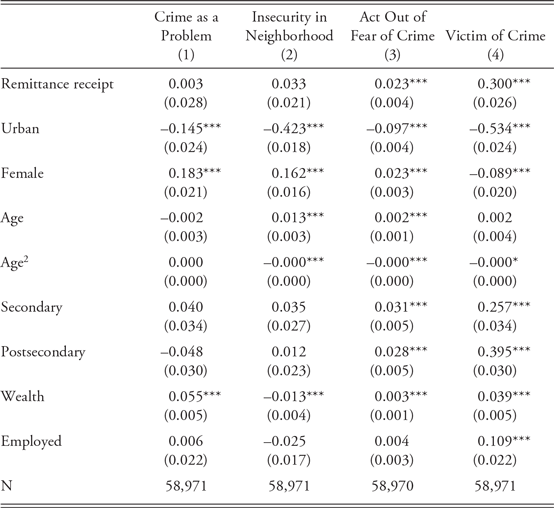
Notes: Models 1, 2, and 4 are logit models; model 3 is a linear model. Matched sample. Year and country dummies are included, but omitted here for ease of presentation. Standard errors in parentheses.
Remittances and Support for Violence Against Crime (Logit Models)

***p < 0.001, **p < 0.01, *p < 0.05
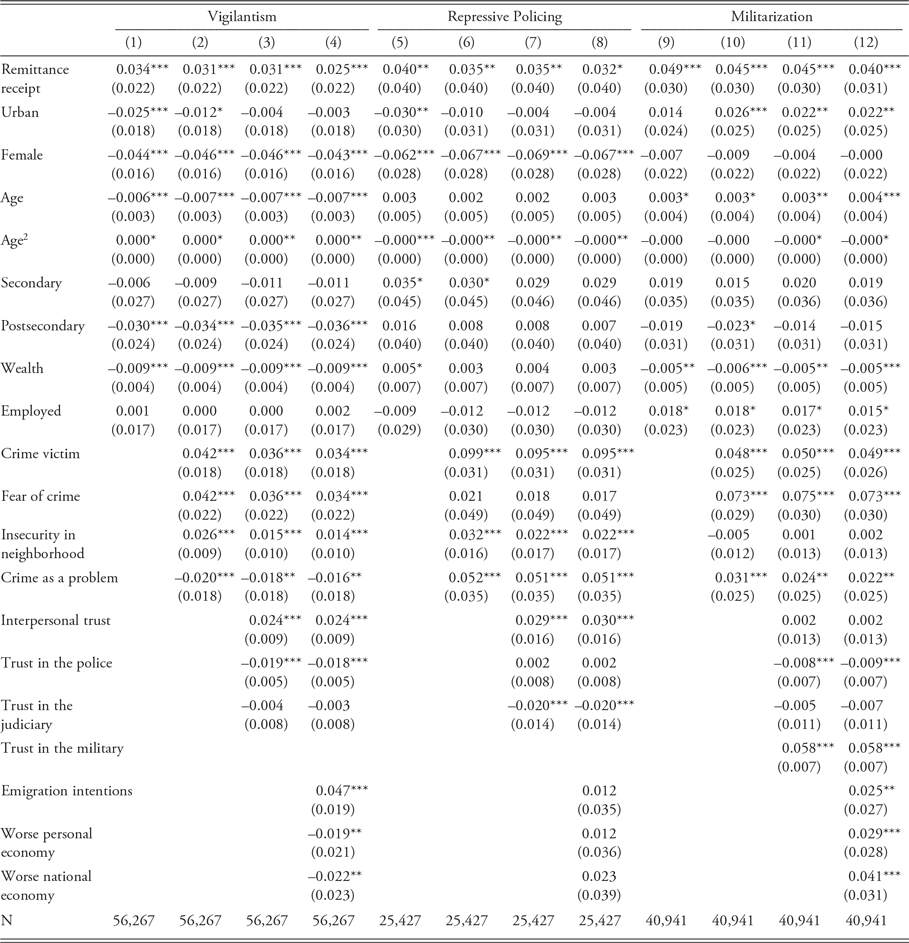
Notes: Matched sample. Models in Panel 1 are ordinal logit models, and models in panels 2 and 3 are logit models. Country and year dummies are included but omitted from the table for ease of presentation. Y-standardized coefficients. Standard errors in parentheses.
As table 2 reports, remittance recipients do not differ from nonrecipients in their views about crime as the most important problem in their country. Perceptions of insecurity in one’s own neighborhood do not vary between remittance recipients and nonrecipients, either. However, the regression analysis confirms that compared to nonrecipients, remittance recipients are more likely to act out of fear of crime. They are also more likely to experience it: the change from nonrecipient to remittance recipient increases the predicted probability by 22 percent. This provides evidence for the main hypothesis of this study. The online supplementary material reports additional models estimating, as outcome variables, experiences with different types of crime—robbery, burglary, theft and threats of theft, assault, and extortion. The results indicate that relative to nonrecipients, remittance recipients are more likely to experience all types of crime.4
In a third step, we examined the relationship between the receipt of remittances and support for violent responses to crime. We estimated four models for each dependent variable. The first represents a baseline, including basic socioeconomic and demographic control variables; the second adds crime-related variables; the third adds measures of trust in citizens and state authorities; and the fourth model includes measures of emigration intentions and economic insecurity. Table 3 reports the results from these models. Since odds ratios are sensitive to the inclusion of additional variables, Y-standardized coefficients are displayed.
The coefficient of remittance receipt is positive and statistically significant across all models. These results suggest that a remittance recipient—as compared with a nonrecipient—is more likely to support citizens’ taking criminal justice into their own hands, to approve of military intervention in policing tasks, and to tolerate police bending the law to capture criminals. Once we control for crime-related variables, the coefficient for remittance receipt remains positive and statistically significant but decreases across models. This is consistent with our hypothesis of remittances working through that channel. It is not, however, the full story. Our models suggest that migrant remittances influence individual support for violence against crime in other ways—consistent with our hypotheses. Regarding crime-related variables, our models corroborate the findings of recent studies showing that those individuals who have experienced and fear crime are more likely to support violent approaches being used as part of activities undertaken to combat it (Bateson Reference Bateson2012; Nivette Reference Nivette2016; Visconti Reference Visconti2019).5
The conditional correlation between remittance receipt and support for the use of violence to tackle crime is also robust to the inclusion of variables measuring respondents’ levels of trust in law enforcement agencies and trust in neighbors. It even remains significant when respondents’ pocketbook and sociotropic economic evaluations and emigration intentions are included in the models. These are interesting findings: as noted above, the receipt of remittances is usually linked to more positive economic views (Ahmed Reference Ahmed2017; Doyle Reference Doyle2015; Germano Reference Germano2018; Tertytchanaya et al. 2018), and economic insecurities are commonly related to increased support for iron fist crime reduction policies and vigilantism (Costelloe et al. Reference Costelloe, Ted and Marc2009; Hogan et al. Reference Hogan, Ted and Marc2005; Nivette Reference Nivette2016; Singer et al. Reference Singer, Cecilia, Lehmann, Stevens and Marc2019).
Since favoring violent approaches to crime might also be driven by support for the national executive, the online supplementary material reports a series of additional models, including as control variables measures of trust in the executive, presidential approval, and evaluations of the government’s job in providing security. The conditional correlation between remittance receipt and support for the use of violence to counter crime remains positive and meaningful above and beyond individuals’ backing of the executive. Again, these findings are consistent with those of the baseline models.
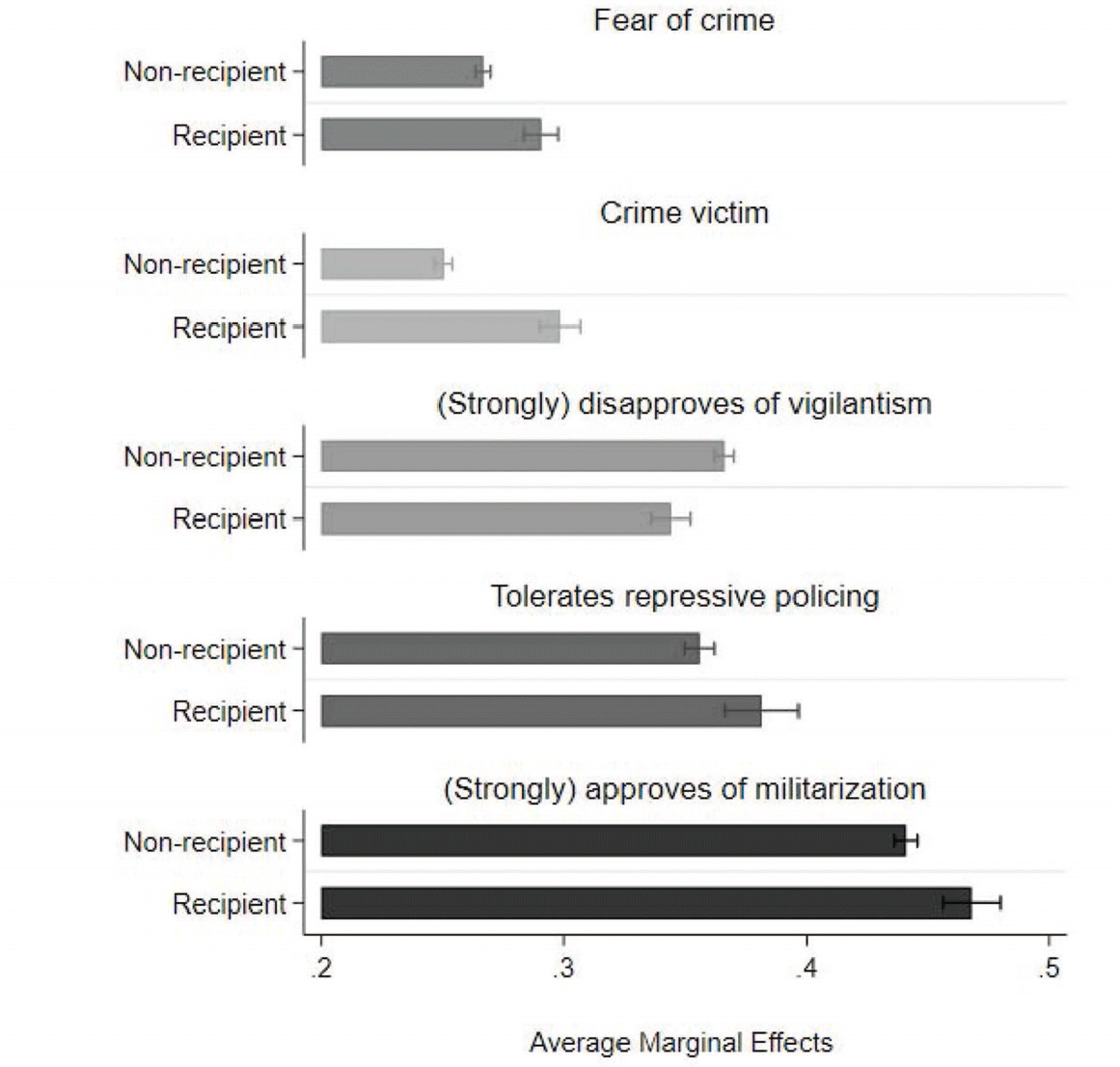
Figure 2 displays the predicted probabilities across remittance recipients and nonrecipients based on the models in tables 2 and 3. In relative terms, the results tell us that for an otherwise average individual, the change from nonrecipient to recipient status leads to a 7 percent decline in the likelihood of strongly opposing vigilantism, to an 8 percent increase in the probability of tolerating the police bending the law in the course of fighting crime, and to a 6 percent increase in the likelihood of strongly approving of the militarization of countermeasures to crime.
Average Marginal Effects by Remittance Receipt with 95 Percent Confidence Intervals

ADDITIONAL CHECKS
Heterogeneity Analysis
The regression models described above assume that crime and fear and support for the use of violence in crime fighting and individual attributes are similarly associated across all countries. However, crime experiences and support for the use of violence against crime might be context-dependent. For instance, the militarization of public security might mean different things to respondents in different countries. Similarly, the violence with which crime is committed might differ across emigration settings.
To control simultaneously for the individual-level characteristics and country-level factors that may influence the probability of approving of violent responses to crime and therefore allow for more precise articulation, we estimated a series of multilevel models, with individual respondents nested in countries across which intercepts vary. The models include the following country-level predictors: remittance inflows as a percentage of gross domestic product from the World Bank’s World Development Indicators (as a proxy for both country levels of economic development and dependence on remittances); and homicide rates from the Igarapé Institute (as a proxy for the incidence of crime). We use the latter as a measure of crime, given that data on other types (such as robbery, theft, assault, or burglary) may vary according to citizens’ propensity to report or not to report crimes to state authorities. Differences also exist in the classification and collection of crime statistics by state agencies (Fearon Reference Fearon2011). The online supplementary material illustrates how remittance dependence and homicide rates vary across the different countries surveyed.6
Results from these mixed models are reported in the online supplementary material. The variance is statistically meaningful across models, indicating that there is a significant amount of between-country variability in the outcome. Yet the coefficient for the receipt of remittances is nonetheless positive and significant across models. This indicates that remittance recipients are more likely to support vigilantism, the militarization of public security, and police ability to bend the law, even after accounting for an economy’s level of dependence on remittance inflows and the homicide rate in a given country.
To assess how variations in the propensity of remittance recipients to be victims of crime or to support the use of violence in tackling it relate to other (unobserved) contextual or country-specific factors, the online supplementary material reports the coefficients of the main variable of interest (receiving remittances) obtained when models are estimated for each of the countries under study. Although the statistical significance of the results does indeed differ across countries, there is a tendency for the receipt of remittances to be positively associated with both experiences of crime and support for the use of violence in crime fighting (vigilantism, police brutality, and militarization)—similar to our baseline specifications. For instance, remittances drive variations in support of the militarization of public security in countries with relatively low levels of violence, such as Suriname and Paraguay (at the 0.05 level) and Peru (at the 0.1 level), as well as in highly violent countries, such as Honduras and Guatemala (at the 0.05 level). Therefore, it is fair to say that our main results are not influenced just by particular countries.
Alternative Outcomes
So far, the evidence suggests that remittance recipients are (on average) more likely to support the use of violence in countering crime. However, one might also reasonably ask whether the receipt of remittances influences individual support for nonviolent responses to crime, such as penal welfarism or preventive social policy. Although support for these policies makes sense in the longer term, there is strong evidence linking individual experiences with and fear of crime (which recipients are more likely to have) with support for tougher short-term policing measures rather than long-term crime reduction strategies (Bateson Reference Bateson2012; Nivette Reference Nivette2016; Visconti Reference Visconti2019).
To verify this, we ran a series of logit models estimating the likelihood that individuals think the main cause of crime is poverty and the lack of youth and social programs, that homicides should be reduced through investment in jobs and education, and the likelihood that individuals think that crime should be countered through preventive measures.7 The results of these models are reported in the online supplementary material. We find no evidence that the receipt of remittances increases support for social or preventive measures to reduce crime.
Additionally, we explore whether the receipt of remittances is associated with individual support for gun ownership out of fear of crime.8 The results of these models are reported in the online supplementary material. We find that in countries where firearm ownership is allowed, remittance recipients are more likely than non-recipients to carry a gun out of fear of crime and to live in households in which at least one member owns a gun. Even in countries where firearm ownership is banned, remittance recipients are more likely than nonrecipients to support the idea of owning a gun for self-protection—should they have this opportunity. While these findings do not tell us whether remittance recipients engage in violence themselves, they are, nevertheless, consistent with our argument.
In sum, the results of the statistical analysis are in line with our main hypotheses. Migrant remittances have a positive influence on individuals’ fear and crime experiences and support for the use of violence to counter crime. This finding holds true after matching individuals on observable characteristics and using different dependent variables measuring support for violence in crime-fighting activities. It is also robust to the inclusion of a range of control variables. Results are valid after accounting for heterogeneous effects associated with different levels of (economic) development and violence. All in all, these findings are telling in regard to how the receipt of remittances influences individuals’ tolerance of what Latin American and Caribbean governments and societies choose to do as part of tackling crime.
CONCLUSIONS
This article has examined how the receipt of remittances shapes individuals’ support for the use of violence in crime fighting across Latin America and the Caribbean. Using survey data from the 2010–2018/2019 waves of the AmericasBarometer, a statistical analysis has revealed that the receipt of remittances is positively and significantly related to individual support for the use of violence in response to crime by both citizens and state actors. Specifically, we find that remittance recipients are (on average) more likely to approve of citizens’ taking matters into their own hands, more likely to endorse military intervention in policing tasks, and more likely to tolerate the police bending the law to apprehend criminals than nonrecipients are. We attribute this to remittance recipients’ greater propensity to make investments and purchase durable goods, coupled with the vulnerability of these kinds of goods to violent crime (Galiani et al. Reference Galiani, Jaitman and Weinschelbaum2020). Remittance recipients are found to be more likely to fear crime and to have experienced it.
What do the results of this study tell us about the contribution of migrant remittances to crime control and democratic development in Latin America and the Caribbean? If the proportion of remittance-receiving households continues to rise across the region, as it has done over the past few years (Orozco Reference Orozco2019), these findings suggest that popular support for violent responses to crime will only increase. Through their influence on citizens’ support for the use of violence in crime fighting, remittances may contribute to civil rights violations that stem from the use of coercion and repression by state and nonstate actors alike (Cruz Reference Cruz2016; Flores-Macías and Zarkin Reference Flores-Macías and Jessica2019; Muggah Reference Muggah, Shaw, Mahrenbach, Modi and Yi-Chong2019; Pérez Reference Pérez2015). The microlevel results also speak to recent work showing that respect for human rights is negatively related to remittance inflows in developing countries (Bang et al. Reference Bang, Arindam and Aniruddha2019; Carneiro and Figueroa Reference Carneiro and Ana2019).
The evidence and propositions advanced here can, therefore, help us to refine our understanding of the role that migrants and the remittances they send home play in the patterns of coercion and violence in contemporary democracies in Latin America and the Caribbean—where violence is constantly reproduced as an integral part of how rights are perceived, experienced, and defended (Cruz Reference Cruz2016; Pearce Reference Pearce2010; Pérez Armendáriz Reference Pérez-Arméndariz and Lauren2019; Santamaría and Carey Reference Santamaría and Carey2017). By illustrating how remittances incentivize support for the use of violence to tackle crime, this study also contributes to the emerging literature on the individual determinants of preferences for punitive and violent measures toward crime in Latin America and beyond.
That said, this study has a number of limitations. The results presented here should be corroborated using alternative data, as well as alternative quantitative research designs. For instance, scholars could go deeper and investigate how the frequency and amount of remittances affect households’ consumption and investment patterns, as well as preferences in crime-fighting approaches. Longitudinal survey data (with time-invariant respondent heterogeneity) could also be used to test how support for violent countermeasures to crime varies before and after the receipt of remittances or across time. Exploring this topic further is vital, since violent approaches to combating crime have proved ineffective in reducing fear and insecurity across the region.
Longitudinal survey data could additionally help to address endogeneity concerns. For example, individuals who receive remittances may be more supportive of the use of violence in addressing crime because their relatives abroad originally emigrated due to rising fears and violence—and thus they themselves developed such attitudes. Unfortunately, lack of data availability prevented us from addressing these key issues in this particular study. Another potential source of endogeneity is omitted variables affecting remittance receipt and support for violence. Further studies should deal with potential endogeneity and the causal effects of remittances on support for violent approaches against crime.
Another limitation of this study is that it focuses on only one region: Latin America and the Caribbean (where crimes are often accompanied by violence). As such, these results might be highly context-specific. Most Latin American and Caribbean migrants tend to concentrate in the United States, where vigilantism and gun ownership are well rooted and where the militarization and brutality of police forces have intensified in recent years. Further research should explore how support for violence to counter crime relates to a transfer of norms across countries. This study has explored only how these attitudes are influenced through the income channel of migrant remittances. Relevant data from other world regions and countries of origin and destination are therefore needed to better understand how the receipt of remittances affects individual support for violent approaches to tackling crime.
In sum, analyzing the ways that transnational migrants—and the financial resources that they send back home—shape individual support for the use of violence in tackling crime can add nuance to an area of research that has hitherto mostly conceived of migrant-to-country-of-origin engagement as conducive to peace, democratization, and human rights (Escribà-Folch et al. Reference Escribà-Folch, Covadonga and Wright2015; Pérez Armendáriz Reference Pérez-Armendáriz2014, Reference Pérez-Armendáriz2019; Pérez Armendáriz and Crow Reference Pérez-Armendáriz and David2010, Reference Pérez-Armendáriz and David2018).
NOTES
We would like to thank the anonymous reviewers, Corinne Bara, Sarah Berens, Paul Dolfen, Sandra Ley, Katrina Maydom, Hilde van Meegdenburg, Enzo Nussio, James Powell, and Thomas Rixen for their excellent comments and suggestions on previous versions of this article. Preliminary versions of it were presented at the Peace and Security Section of the 2020 Annual Conference of the Swiss Political Science Association at the University of Lucerne, the IR Section of the 2020 German Political Science Association at the University of Freiburg, and the Politics of Crime Control and Social Protection Workshop at the University of Cologne (October 15–16, 2020). We acknowledge the use of data made publicly available by the Latin American Public Opinion Project (LAPOP). All errors remain our own.
For recent examples, see Acevedo Reference Acevedo2020; Ahmed Reference Ahmed2020; Careja and Emmenegger Reference Careja and Patrick2012; Córdova and Hiskey Reference Córdova and Jonathan2015, Reference Córdova and Jonathan2019; Doyle Reference Doyle2015; Duquette-Rury Reference Duquette-Rury2019; Escribà-Folch et al. Reference Escribà-Folch, Covadonga and Wright2015, Reference Escribà-Folch, Meseguer and Wright2018; Germano Reference Germano2018; López García Reference López and Ana2017, Reference López and Ana2018; Maydom Reference Maydom2017; Pérez-Armendáriz Reference Pérez-Armendáriz2014; Pérez-Armendáriz and Crow 2010, 2018; Pfütze Reference Pfütze2012, Reference Pfütze2014; Tertytchnaya et al. Reference Tertytchnaya, De Vries, Solaz and Doyle2018.
This question is available only starting in the 2012 wave. Excluded from this item are the cases of Costa Rica, Haiti, and Panama, since they lack traditional military institutions.
In our models, Mexico serves as the reference category.
Data for extortion victimization indicators are available only for Costa Rica, Guatemala, Honduras, Mexico, Nicaragua, Panama, and El Salvador for the LAPOP survey waves 2008, 2010, 2016–17, and 2018–19. Questions on experiences with robberies, burglary, theft, and assault were asked in the 2014 wave only in the Bahamas, Barbados, Jamaica, Suriname, and Trinidad and Tobago.
Since, in various countries, heavy-handed approaches to crime have been implemented in response to gang crime and violence, the online supplementary material reports a series of additional models, including the presence of gangs in the respondent’s neighborhood as a control variable. Results are still consistent with those reported above. For every measure of support for the use of violence to counter crime, the coefficient of remittance receipt remains positive and statistically significant.
Complete data for these country-level indicators were available for only 17 countries. In the models, continuous predictors at the country and individual levels center on the population average.
The question about the lack of youth and social programs was asked in the 2008 and 2012 waves of the LAPOP survey only in Belize, Costa Rica, El Salvador, Guatemala, Honduras, Nicaragua, and Panama. The item about jobs and education was asked in El Salvador, Guatemala, Honduras, and Mexico in the 2016–17 and 2018–19 waves of the LAPOP survey. The question about preventive measures was asked in 22 countries in the 2012 and 2014 waves of the LAPOP survey. It was measured as an ordinal variable, coded 2 if respondents reported that preventive measures should be implemented to reduce crime, 1 if they reported that both preventive measures and higher penalties were needed to reduce crime, and 0 if they reported that increasing the punishment of criminals suffices to reduce crime.
To examine this, we used three variables. The first is a dichotomous variable based on the question, “Have you ever carried a gun out of fear of crime?” The second is a binary variable based on the question, “Does someone in your household own a gun?” These two items were surveyed in the Bahamas, Barbados, Suriname, and Trinidad and Tobago, where firearm ownership is allowed. The third variable is a dichotomous one based on the question, “If you could, would you have your own firearm for protection?” This question was posed in the remaining LAPOP countries, where there are bans on firearm ownership.
SUPPORTING INFORMATION
Additional supporting materials may be found with the online version of this article at the publisher’s website: Supplementary Material.