Generalised Anxiety Disorder (GAD) has a chronic course (Wells & Carter Reference Wells and Carter2001) with significant impairment, and is characterised by excessive and uncontrollable worry about a variety of topics (APA, 2000). GAD is one of the most common anxiety disorders (Huppert & Ryan, Reference Huppert, Ryan and Stein2004), with general population prevalence estimates of 5–6% (Kessler et al., Reference Kessler, Berglund, Dewit, Ustun, Wang and Wittchen2002).
Cognitive behavior therapy (CBT) is currently the most effective intervention for GAD (Covin, Ouimet, Seeds, & Dozois, Reference Covin, Ouimet, Seeds and Dozois2008), yet only 50% of GAD treatment completers and about 40% of intend-to-treat samples achieve high-end state functioning after CBT (Hunot, Churchill, Silva de Lima, & Teixeira, Reference Hunot, Churchill, Silva de Lima and Teixeira2007; Westen & Bradley, Reference Westen and Bradley2005). The relative effectiveness of the individual elements of CBT packages when treating GAD also remains unclear (Borkovec, Newman, Pinkus, & Lytle, Reference Borkovec, Newman, Pincus and Lytle2002), although exposure treatments are generally recognised as the most effective in treating anxiety disorders (Rubin, Spates, Johnson, & Jouppi, Reference Rubin, Spates, Johnson and Jouppi2009).
The avoidance model of worry (Borkovec, Reference Borkovec, Davey and Tallis1994; Borkovec, Alcaine, & Behar, Reference Borkovec, Alcaine, Behar, Heimberg, Turk and Mennin2004) states that chronic worriers engage in worry to reduce the likelihood of low probability future events occurring, and as a form of experiential avoidance. The model states that GAD individuals worry about minor matters to alleviate internal distress (Borkovec & Roemer, Reference Borkovec and Roemer1995; Freeston, Rhéaume, Letarte, Dugas, & Ladouceur, Reference Freeston, Rhéaume, Letarte, Dugas and Ladouceur1994).
Intolerance of uncertainty (IOU) also appears to maintain GAD (Dugas & Koerner, Reference Dugas and Koerner2005). The IOU model (Dugas & Robichaud, Reference Dugas and Robichaud2007) suggests that positive beliefs about worry, negative problem orientation, and cognitive avoidance all interact to create an intolerance of uncertainty in GAD (Craske, Reference Craske1999). CBT treatments relying upon the above conceptualisations of GAD have been successfully tested in randomised controlled trials (e.g., Borkovec & Costello, Reference Borkovec and Costello1993; Borkovec et al., Reference Borkovec, Newman, Pincus and Lytle2002; Dugas et al., Reference Dugas, Ladouceur, Léger, Freeston, Langlois, Provencher and Boisvert2003; Ladouceur et al., Reference Ladouceur, Dugas, Freeston, Leger, Gagnon and Thibodeau2000).
Treatment with exposure alone has not been widely researched for GAD (Hoyer & Beesdo, in press). Despite exposure treatments being routinely applied in multimodal CBT programs, it is not clear to what extent exposure contributes to the effective treatment of GAD treatment, and which variants of exposure are most successful (Hoyer & Beesdo, in press).
Increasingly, the manipulation of, and exposure to, mental imagery has been used to successfully treat psychological disorders, as evidenced by techniques such as imaginal desensitisation (Wolpe, Reference Wolpe1958), cognitive therapy imagery techniques (Holmes, Arntz, & Smucker, Reference Holmes, Arntz and Smucker2007), and image-rescripting for post-traumatic stress disorder (PTSD; Wild, Hackman & Clark, Reference Wild, Hackmann and Clark2007). Conceptualising worry as a form of avoidance and as a process that increases intolerance of uncertainty, together with treatment protocols that use imagery, may improve the effectiveness of exposure treatments for GAD.
Worry as a Verbal–Linguistic Activity
Worry has been conceptualised as an abstract, verbal–linguistic activity that prevents access to emotionally laden images and thoughts that constitute the fear structure (Borkovec, Shadick, & Hopkins, Reference Borkovec, Shadick, Hopkins, Rapee and Barlow1991). Such a conceptualisation maintains worry by negative reinforcement as the emotional processing of fear-related stimuli or full network activation (Foa & Kozak, Reference Foa and Kozak1986) does not occur.
Worry Exposure
A specific variant of imaginal exposure entitled ‘worry exposure’ (Craske, Barlow, & Leary, Reference Craske, Barlow and Leary1992) is a common component of CBT treatment packages for GAD (e.g., Barlow, Rapee, & Brown, Reference Barlow, Rapee and Brown1992; Borkovec & Costello, Reference Borkovec and Costello1993). Few studies have examined the effectiveness of worry exposure as a stand-alone treatment for pathological worry, despite other anxiety disorders responding to exposure conducted through imagination (Foa, Steketee, Turner, & Fischer, Reference Foa, Steketee, Turner and Fischer1980).
Using worry exposure, cognitive avoidance is addressed by being imaginally exposed to the most feared outcome image for a prolonged period (25 to 30 minutes), and introducing response-prevention instructions about neutralising the image (e.g., by seeking distraction or by thinking about/doing something else). Worry exposure purportedly facilitates habituation to the feared image and the accompanying arousal and changes the meaning of the feared situation (Hoyer, van der Heiden, & Portman, Reference Hoyer, van der Heiden and Portman2011).
Two detailed treatment plans for implementing worry exposure for GAD have recently been proposed (van der Heiden & ten Broeke, Reference van der Heiden and ten Broeke2009; Dugas & Robichaud, Reference Dugas and Robichaud2007). Both approaches are similar, yet differ in the manner in which the feared image is presented during exposure. Dugas and Robichaud (Reference Dugas and Robichaud2007) recommend that the scenario containing the feared image is read aloud and then recorded to audio-recording equipment, and played repeatedly during the exposure. Van der Heiden and ten Broeke (Reference van der Heiden and ten Broeke2009), however, recommend directly imagining the feared image for the duration of the exposure. Two studies are relevant in exploring the effectiveness of the above differing methodologies.
In the first randomised controlled trial (RCT; Hoyer et al., Reference Hoyer, Beesdo, Gloster, Runge, Hofler and Becker2009), 73 GAD-diagnosed community outpatient participants were treated with either worry exposure or applied relaxation. Participants in the worry exposure condition directly imagined their feared worry, consistent with van der Heiden and ten Broeke's (Reference van der Heiden and ten Broeke2009) protocol. Treatment was conducted over 15 sessions. The mean reduction in general worry for participants in the worry exposure condition, measured by the Penn State Worry Questionnaire (PSWQ), was pre-61.1 (+/−10.4) to post-treatment 54.33 (+/−10.13). The proportion of participants reaching high-end state functioning was 48% for the worry exposure condition, and 56% for the applied relaxation comparison condition. Both treatment conditions had comparable drop-out rates and the treatment effects were stable at 6-month and 1-year follow-up. These findings were the first to position worry exposure as an efficacious stand-alone treatment for GAD (Hoyer et al., Reference Hoyer, Beesdo, Gloster, Runge, Hofler and Becker2009).
In the second RCT, a worry exposure protocol using audio recording similar to Dugas and Robichaud's (Reference Dugas and Robichaud2007) protocol was compared with expressive writing, audio-photic stimulation and a wait-list control, across 113 college students with academic worries (Wolitzy-Taylor & Telch, Reference Wolitzky-Taylor and Telch2010). Academic worry and general worry were monitored throughout the study using the PSWQ. Treatment was self-directed and participants were instructed to practice their intervention three times per week for a month.
Academic and general worries were significantly reduced in all conditions after treatment. The pre- to post-treatment effect sizes for reductions in academic worry were large and all treatment condition effect sizes were significantly larger than for the control condition. General worry also reduced significantly from pre- to post-treatment for worry exposure; however, decreases were only moderate for the expressive writing and audio-photic stimulation conditions. General worries did not change significantly for the control condition. Across the conditions, 36% of the worry exposure participants reported reliable pre- to post-treatment reductions in general worry, compared to 18% and 21% for the expressive writing and audio-photic stimulation conditions respectively (Wolitzy-Taylor & Telch, Reference Wolitzky-Taylor and Telch2010).
The Current Study
Worry exposure research to date has not directly compared treatment outcomes when presenting the feared image to participants using either audio-recording equipment or directly imagining the feared images during exposure treatments. The impact upon IOU has also been ignored during worry exposure, although IOU is believed to be responsible for the interpretational bias of threat from ambiguous information that leads to elevated worry and a pathway to GAD (Dugas & Robichaud, Reference Dugas and Robichaud2007).
The aim of the current pilot study is to conduct a preliminary investigation of general worry and IOU outcomes using the above two methods of presenting the feared image in a brief worry exposure treatment. This study will target hypothetical worries in a sample of university students who fulfill criteria for GAD.
It is hypothesised that participants will experience decreases in both self-reported worry and IOU, that the directly imagined technique will be no less effective in decreasing worry and IOU than the audio recording methodology, and the relationship between self-reported worry and IOU will be observable across the study given its conceptualised status as a causal risk factor for GAD.
Material and Methods
Participants
Twenty-six university introductory psychology students responded to an advertisement recruiting individuals with ‘excessive and uncontrollable worry’. Individuals were screened using electronic versions of the Penn State Worry Questionnaire (PSWQ; Meyer, Miller, Metzger, & Borkovec, Reference Meyer, Miller, Metzger and Borkovec1990) and the Generalised Anxiety Disorder Questionnaire, Fourth Edition (GAD-Q-IV; Newman et al., Reference Newman, Zuellig, Kachin, Constantino and Cashman-McGrath2002). Individuals were excluded if they were: taking psychotropic medication for depression and/or anxiety and were not willing/able to maintain a stable dosage throughout the study; starting or were in psychotherapy for worry, stress or anxiety; did, or had in the last 12 months, met criteria for substance abuse or dependence; or were experiencing a severe mood disorder or psychosis.
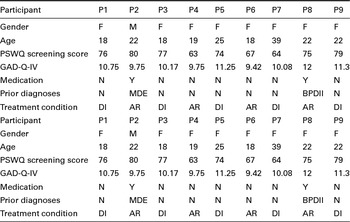
Scores greater than 62 using the PSWQ in a student population (Behar, Alcaine, Zuellig, & Bokovec, Reference Behar, Alcaine, Zuellig and Borkovec2003), and 5.7 using the GAD-Q-IV (Newman et al., Reference Newman, Zuellig, Kachin, Constantino and Cashman-McGrath2002) indicated a clinical GAD diagnosis. Ten individuals met both of the above minimum criteria and were invited to participate in the current study. One participant was excluded after they failed to attend the first treatment session. Participants were assigned to the two conditions by using a table of random numbers, and were awarded partial course credit for participating until the post-treatment results were obtained. Table 1 contains additional participant characteristics.
Participant Characteristics

Note: Gender: M = Male, F = Female; PSWQ = Penn State Worry Questionnaire; GAD-Q-IV = Generalised Anxiety Disorder Questionnaire, Fourth Edition. Medication (per day): Participant 2, Lovane 20 mg; Participant 8, Cymbalta 60 mg, Lithium 1800 mg, Lamotrigine 200 mg, Agomelatine 25 mg, and Modavigil 100 mg when attending work (but not prior to treatment sessions in this study). Prior diagnoses: MDE = Major Depressive Episode-Recurrent, BPDII = Bipolar disorder II. Treatment condition: DI = Directly Imagined; and A = Audio Recording/playback.
Participants 2 and 8 reported diagnoses of major depression — recurrent in 2006 and Bipolar II disorder in 2010 respectively after screening. Their mood was established as being stable by the researcher and supervisor and the participants committed to adhering to their prescribed medications during the course of the study. Both individuals completed the treatment program for this study.
Research Design
A pre-, post-, and 3-month-treatment follow-up design was used. All participants were assigned to no-treatment baseline periods until stable trends in the primary dependent variables, general worry and IOU, were observed.
Following the pre-treatment baseline period, brief worry exposure therapy was administered to participants individually on a weekly basis for 4 weeks. One condition was instructed to visualise their feared image using audio-recording equipment (AR) and the other condition directly imagined their feared image during the treatment phase (DI). Each treatment session lasted a maximum of 60 minutes. No treatment was delivered to any participant after treatment concluded; however, self-initiated practice was encouraged. The follow-up data were collected electronically.
Self-report general worry and IOU were the main dependent variables, and were collected throughout the 3-week baseline, 4-week treatment, 2-week post-treatment periods and 3 months after the final treatment session. All data were collected at least 4 weeks prior to the university examination periods. The treatment effects were primarily analysed through visual inspection of the graphed data (Parsonson & Baer, Reference Parsonson, Baer, Kratochwill and Levin1992).
Materials
Primary Measures
The Penn State Worry Questionnaire
(PSWQ; Meyer et al., Reference Meyer, Miller, Metzger and Borkovec1990). The PSWQ was administered to measure pathological worry. The PSWQ is typically used for the assessment of worry (Dugas & Robichaud, Reference Dugas and Robichaud2007), displaying high internal consistency (alpha = .86–.95), good 4-week test–retest reliability (r = .74–.93), and robust convergent and divergent validity due to its stronger correlation with worry than with depression or anxiety measures (Molina & Borkovec, Reference Borkovec, Davey and Tallis1994). Scores range from 16 to 80. A cut-off score of 62 had a specificity of 0.86 and sensitivity of 0.75, in identifying individuals with a GAD diagnosis in a student sample (Behar et al., Reference Behar, Alcaine, Zuellig and Borkovec2003).
The Intolerance of Uncertainty Scale
(IUS; Original French version: Freeston et al., Reference Freeston, Rhéaume, Letarte, Dugas and Ladouceur1994; English translation: Buhr & Dugas, Reference Buhr and Dugas2002). The IUS measures beliefs about uncertainty. Scores range from 27 to 135. Both the French and English versions of the IUS are sound psychometrically, with internal consistency alpha = .94, good test-retest reliability over 5 weeks, r = .74, and good convergent and divergent validity measured against worry, anxiety and depression (Buhr & Dugas, Reference Buhr and Dugas2002).
Secondary Measures
The Generalized Anxiety Disorders Questionnaire, Fourth Edition
(GAD-Q-IV Newman et al., Reference Newman, Zuellig, Kachin, Constantino and Cashman-McGrath2002). The GAD-Q-IV is designed to screen for the diagnosis of GAD and is comparable with the gold standard Anxiety Disorder Interview Schedule, Fourth Edition (DiNardo, Brown, & Barlow, Reference Di Nardo, Brown and Barlow1994) in a non-clinical undergraduate sample (Newman et al., Reference Newman, Zuellig, Kachin, Constantino and Cashman-McGrath2002). A score of 5.70 provided an optimal balance of specificity (97%) and sensitivity (69%), and an overall predictive power of a GAD diagnosis of 91% (Newman et al., Reference Newman, Zuellig, Kachin, Constantino and Cashman-McGrath2002).
The Depression, Anxiety and Stress 21-Item Scale
(DASS21; Lovibond & Lovibond, Reference Lovibond and Lovibond1995). The DASS21 was used to assess and monitor levels of general depression as a necessary part of the comprehensive assessment of GAD (Dugas & Robichaud, Reference Dugas and Robichaud2007). The Depression and Anxiety subscales of the DASS21 constitute valid measures of the constructs they were intended to represent (Crawford & Henry, Reference Crawford and Henry2003; Lovibond & Lovibond, Reference Lovibond and Lovibond1995).
The Credibility/Expectation Scales
(CES; Borkovec & Nau, Reference Borkovec and Nau1972). The CES was administered prior to treatment, after a verbal and written explanation of the relevant treatment protocol. The CES assessed the extent to which clients viewed the specific therapy package as suitably credible, and whether it induced significant expectancy for change. The CES derives the two predicted factors and is stable across populations (Devilly & Borkovec, Reference Devilly and Borkovec2000). The researcher was blind to participants’ CES responses until post-treatment.
The Quality of Life Inventory
(QOLI; Frisch, Reference Frisch1994). The QOLI measures overall satisfaction with life and is recommended in studies that target a reduction in DSM-IV (APA, 1994) defined symptoms (Dugas & Robichaud, Reference Dugas and Robichaud2007). The QOLI has scales related to satisfaction and importance. Scores between 43 and 58 fall in the average range. The QOLI had adequate test–retest reliability, internal consistency reliability, and acceptable convergent validity (Frisch, Reference Frisch1994).
Homework compliance was collected at the commencement of treatment sessions 2, 3, 4, one week after treatment session 4, and at follow-up. Subjective units of distress (SUDS; Wolpe, Reference Wolpe1958) ratings on a scale of 0 (not worried at all) to 100 (excessively worried) were collected from participants prior to, every 5 minutes during, and at the end of all exposure treatments in session. Participants were also asked to nominate whether they thought the treatment had been effective in reducing their worry at post-treatment, and where they responded positively, they were asked to identify an active mechanism.
Treatment Protocols
Treatment followed that devised by Craske, Barlow, and Leary (Reference Craske, Barlow and Leary1992) and outlined by van der Heiden and ten Broeke (Reference van der Heiden and ten Broeke2009). Participants were randomised to one of two imaginal exposure conditions: either exposure via an audio-recorded version of a personally developed worry script (AR), or directly imagining the personally feared outcome for the other (DI). The number of exposure sessions were reduced from previous studies to produce a brief form of the intervention. Treatment sessions occurred in a private academic office within the school of psychology on the university campus. The office contained a desk and two chairs, filing cabinets and one external window. During each of the four individual face-to-face weekly treatment sessions, participants chose their most feared hypothetical worry, from which a feared scenario script was drafted by the researcher and participant.
The downward arrow technique (Provencher, Freeston, Dugas, & Ladoucer, Reference Provencher, Freeston, Dugas and Ladoucer2000) was used to elicit the most feared worry image. In all cases, the image generated was suitably vivid but not too far-fetched for the individual. The aim was to develop a script that prompted a pre-exposure SUDS rating of greater than 70, or the script generation ceased if the participant could no longer provide relevant additional details.
In the AR condition, the researcher read the participant's individual script aloud while recording it onto an Apple MacBook Pro laptop via a headset. The looped recording was played from the laptop via the headset repeatedly to participants during the exposure task. The recording was transferred to a USB drive and was provided to the participant for homework tasks each week.
Participants in the DI condition were instructed to directly imagine their most feared image and this was transcribed. During the exposure task the researcher recounted the details from the script for up to the first 5 minutes. Participants were then instructed to hold the image in their mind for the duration of the exposure task. The written script was provided to these participants for them to refocus their attention as required and for homework.
All participants spent 25 minutes in each treatment session undertaking the exposure task. The researcher collected SUDS ratings every 5 minutes during the exposure. After asking for the SUDS ratings, the researcher instructed participants to return to the image, to cease any cognitive avoidance strategies, and to be conscious of visual and non-visual stimuli present in their feared image. At the conclusion of each in-session exposure task, all participants were asked to: clear their mind of their feared image and write down possible alternative explanations or outcomes; first, if they were confronted by their most feared scenario; and second, to avoid that scenario from developing. During all treatment sessions, the researcher explained the danger assessment formula (Salkovkis, Reference Salkovskis and Salkovskis1996) prior to requesting the final SUDS rating, to encourage participants to examine the probability of their most feared image occurring, and the cost to them if it did. All participants were treated by the first author, who had appropriate training in worry exposure. The second author provided training and weekly supervision in worry exposure for GAD.
Results
General worry
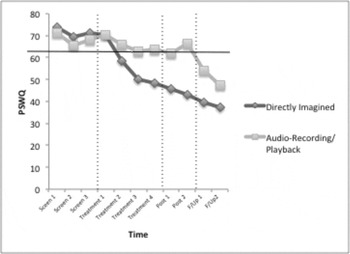
The combined participants’ PSWQ scores by condition during baseline, treatment, post-treatment and follow-up are shown in Figure 1. All of the participants in the DI condition and half of the AR condition participants reported reductions in general worry that placed them in the sub-linical GAD range, below 62 on the PSWQ, at post-treatment. These gains were maintained at 3-month follow-up. General worry was reduced from an average of 70.9 (SD = 7.01) pre- to 53.4 (SD = 14.22) post-treatment, representing a 24% decrease across all participants. With reference to the specific methodologies, the combined DI condition participants reduced from 71.6 (SD = 7.83) pre-treatment to 45.6 (SD = 13.62) at post-treatment, which was a 37% reduction, and the combined AR condition participants decreased 6% from 68.33 (SD = 7.19) pre- to 64.4 (SD = 14.44) at post-treatment.
General worry scores for both conditions across baseline, treatment, post-treatment, and follow-up phases. Note: General worry scores above 62 indicate a clinical GAD diagnosis.

All of the treatment-responsive participants experienced a flattening or increasing of the trend-line or a stepped increase in general worry during the post-treatment phase compared to the treatment phase, suggesting that the cessation of treatment impacted their general worry reporting negatively. All participants, with one exception, recorded improvements in general worry from their post-treatment to follow-up results. This corresponded with reports that the majority of participants practised their worry exposure treatment technique at least once per week between the post-treatment and follow-up phases. One DI participant did not practise during the final two reporting phases, and two AR participants provided no response on that measure. Notably, the two AR participants that were responsive to treatment are responsible for the decline in general worry (and IOU) during the follow-up phase.
Intolerance of Uncertainty (IOU)
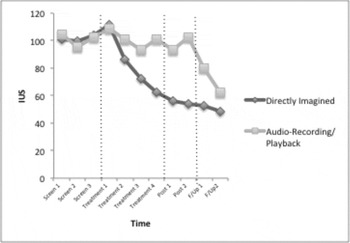
IOU was reduced by an average of 27% from pre- to post-treatment across all participants; 24% in the DI; and 28% in the AR conditions, as shown in Figure 2. Again these results were maintained at follow-up. The IOU score trends were consistent with general worry reports across the participants and phases of the study, with the exception of one DI individual, whose IOU increased at follow-up, despite their general worry declining. Overall, these results suggest that IOU results mirrored general worry, supporting Dugas and Robichaud's (Reference Dugas and Robichaud2007) hypothesis that improvements in general worry using worry exposure only occurs in the presence of decreasing IOU.
Intolerance of Uncertainty scores for both conditions across baseline, treatment, post-treatment, and follow-up phases.

Depression, Anxiety and Stress
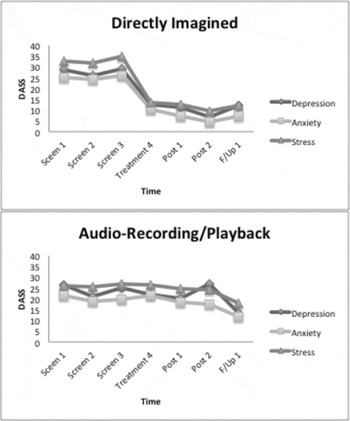
Figure 3 illustrates the pre-, post-treatment, and follow-up scores across both conditions on the DASS21. All of the general worry and IOU treatment responders reported improvements on the depression, anxiety and stress scales by at least one severity rating (the DASS21 has five severity ratings ranging from normal to extremely severe) between pre- and post-treatment, and these results were maintained at follow-up, except for one DI participant.
The Depression, Anxiety and Stress 21-item Subscale (Lovibond & Lovibond, Reference Lovibond and Lovibond1995) results reported by condition across baseline, treatment, post-treatment, and follow-up phases.

Overall, the DASS21 domain results corresponded to the general worry and IOU results across participants throughout the phases of the study. Taken together, the above results suggest that the DI participants experienced decreases in general worry, IOU, and DASS21 domains that were superior to the results reported by the participants in the AR condition.
Quality of Life
Six of the eight participants who reported on the QOLI, including all four QOLI respondents from the DI condition, showed stability or improvements in their quality of life across pre- and post-treatment periods.
Credibility and Expectancies
Credibility and expectancies scores were standardised using the GAD sample reported in Devilly and Borkovec, (Reference Devilly and Borkovec2000). Prior to treatment, only one AR participant perceived the treatment to be more positively credible than the normal range, indicating strong held beliefs that the treatment could reduce that individual's worry symptoms. The two AR participants with a previous diagnosis and treatment for mood disorders reported an outcome expectancy in the profoundly low range.
Subjective Units of Distress
SUDS ratings from all four treatment sessions, taken after developing the worry script, at 5-minute intervals during the exposure, and again after using the danger assessment formula (Salkovkis, Reference Salkovskis and Salkovskis1996) following each exposure were comparable across the conditions for all participants. At least one weekly homework session was requested of participants during the treatment phase. Although subjects generally reported compliance with homework exposure, one AR participant failed to complete home-based exposure on four occasions and one DI participant failed to complete homework on two occasions.
Perceived Active Mechanism
Two participants from each condition stated the primary active mechanism decreasing their worry was habituation. Two DI and one AR participant reported the consideration of alternatives to escape/avoid the most feared situation, and one DI participant stated that the downward arrow technique was the primary mechanism decreasing worry.
Discussion
Overall, general worry was reduced by an average of 24% from pre- to post-treatment across all participants. The DI condition participants reported an average reduction in general worry of 37%, which was superior to the 6% average reduction reported by the AR condition. These findings were also maintained at follow-up. All of the DI, and half of the AR, condition participants reported general worry in the subclinical GAD range at both post-treatment and 3 month follow-up. Similar results were reported for IOU, with visual inspection revealing an alignment between IOU and general worry results across all participants.
All participants, except two from the AR condition, reported improvements in their depression symptoms. Similarly, only two participants, again from the AR condition, reported a reduction in quality of life from pre-treatment to follow-up. These findings reinforce the positive results on the primary measures, as a corresponding decrease in worry and improved mood and functioning is reflective of an effective treatment for GAD (Dugas & Robichaud, Reference Dugas and Robichaud2007).
The results in the current study compare favourably with the results from Wolitzky-Taylor and Telch (Reference Wolitzky-Taylor and Telch2010) and Hoyer et al. (Reference Hoyer, Beesdo, Gloster, Runge, Hofler and Becker2009). A meaningful comparison can be made as the PSWQ was used to measure general worry in all three studies. In Wolitzky-Taylor and Telch (Reference Wolitzky-Taylor and Telch2010), 36% of the worry exposure participants reported reliable reductions in general worry, with a 14% decrease in pre- to post-treatment general worry means. An 11% improvement in general worry was found across the entire worry exposure group in Hoyer et al. (Reference Hoyer, Beesdo, Gloster, Runge, Hofler and Becker2009). In the current study, 78% of participants reported subclinical GAD symptoms, with a 24% improvement in the average pre- to post-treatment reports of general worry.
A comprehensive recent review of the treatment outcome literature for GAD found that 46% of participants assigned to CBT treatment showed a clinical response at post-treatment, compared to 14% in waitlist/treatment-as-usual groups (Hunot et al., Reference Hunot, Churchill, Silva de Lima and Teixeira2007). However, questions remain as to which individual interventions are the most effective for the treatment of GAD, both as stand-alone interventions and for inclusion in multimodal CBT treatment strategies (Olatunji, Cisler, & Deacon, Reference Olatunji, Cisler and Deacon2010).
Currently, applied relaxation is the lone efficacious stand-alone treatment for GAD, although one study has suggested worry exposure may meet criteria if validated by further research (Hoyer et al., Reference Hoyer, Beesdo, Gloster, Runge, Hofler and Becker2009). In Hoyer et al. (Reference Hoyer, Beesdo, Gloster, Runge, Hofler and Becker2009), the pre- to post-treatment means for general worry reduced by 11% for the worry exposure, and 13% for applied relaxation conditions. In the current study, however, general worry decreased across all participants by 24%, and by 37% in the DI condition.
In addition to the pre- to post-treatment reductions in general worry being larger in the current study than found by Hoyer et al. (Reference Hoyer, Beesdo, Gloster, Runge, Hofler and Becker2009), the reductions moved seven of the nine participants, including all of the DI-condition participants, from the clinical GAD range on the PSWQ (Behar et al., Reference Behar, Alcaine, Zuellig and Borkovec2003) to the subclinical range. Taken together, the above results provide preliminary evidence that the brief protocol used in the current study, and in particular the DI protocol, has the capacity to reduce general worry, which is the core symptom of GAD.
It is noteworthy that a DI protocol was used by Hoyer et al. (Reference Hoyer, Beesdo, Gloster, Runge, Hofler and Becker2009), and that a similar protocol was employed for the condition that returned superior results in the current study. The current study differs from Hoyer et al., most notably in the length of the treatment provided and the homogeneity of the sample.
In Wolitzky-Taylor and Telch's (Reference Wolitzky-Taylor and Telch2010) study, they found that 36% of participants showed reductions in general worry, which is comparable with the current study result where 50% of the participants in the AR condition reported subclinical GAD at post-treatment. Another similarity between these studies was that both used a 1-month treatment phase; however, Wolitzky-Taylor and Telch directed participants to undertake three self-directed treatment sessions per week. The AR condition in the current study resulted in a 6% reduction in general worry at post-treatment, as compared to the 14% reported in their study. The current study utilised face-to-face rather than self-directed treatment sessions, and Wolitzy-Taylor and Telch's sample were not identified as meeting GAD criteria, and their exposure scenarios were developed prior to formal treatment.
While comparable reductions in pre- to post-treatment means were found in Wolitzy-Taylor and Telch (Reference Wolitzky-Taylor and Telch2010) and Hoyer et al. (Reference Hoyer, Beesdo, Gloster, Runge, Hofler and Becker2009), the key difference remains the method used to present the feared stimuli during exposure tasks. The current study is the first to specifically use both DI and AR protocols within the same study. The current study provides preliminary support for the superiority of the DI protocol used by Hoyer et al. (2010) for worry exposure.
Despite the small number of participants, the superiority of the DI protocol in the current study is in keeping with the avoidance model, where verbal-linguistic mental activity and explicit cognitive-avoidant strategies maintain clinical levels of general worry in GAD (Borkovec, Reference Borkovec, Davey and Tallis1994; Borkovec et al., Reference Borkovec, Alcaine, Behar, Heimberg, Turk and Mennin2004). Directly imagining the most feared scene may have disrupted the avoidance strategies typically used in GAD, allowing participants to process the feared scene. In contrast, the AR condition participants were exposed to the looped recording throughout the treatment sessions and may have needed to divert greater cognitive resources to either attend to and process, or ignore, the verbal stimuli, possibly facilitating verbal-linguistic processing.
Such an explanation would be consistent with Sloan & Telch (Reference Sloan and Telch2002), where 46 claustrophobic students were treated with exposure therapy, either solely, with the addition of safety-behaviour use, or with focused attention on the threat and gathering of disconfirming evidence. The latter condition experienced the greatest fear reduction during treatment. The authors suggested that the latter condition facilitated more effective access to the central core threat, and disrupted the diversion of cognitive resources from processing threat-relevant information as a result of safety behaviour engagement. They also noted that such a process occurred primarily in-between sessions.
The SUDS results revealed that participants in both conditions of the current study routinely reported scores of greater than 70 during each in-session exposure task, suggesting minimal use of verbal-linguistic processing or other cognitive avoidance strategies at that time. However, the DI condition returned larger reductions in general worry when measured approximately 6 days after each treatment session. The DI protocol may have had a more sustainable post-session effect on managing verbal-linguistic processing or the use of other avoidance strategies. Such an explanation preserves the avoidance model's key tenets. The current study suggests support for the use of the DI feared image methodology proposed by van der Heiden and ten Broeke (Reference van der Heiden and ten Broeke2009) and successfully deployed in Hoyer et al. (Reference Hoyer, Beesdo, Gloster, Runge, Hofler and Becker2009). Moreover, these results suggest that further studies may extend previous findings (Wolitzky-Taylor & Telch, Reference Wolitzky-Taylor and Telch2010; Hoyer et al., Reference Hoyer, Beesdo, Gloster, Runge, Hofler and Becker2009) on the effectiveness of worry exposure. The results of this case series provide preliminary evidence that when the feared image is directly imagined by GAD sufferers during worry exposure, reductions in general worry and IOU appear superior to presenting the image via the more resource intensive audio recording methodology. The current study also provides preliminary support for the use of a brief form of worry exposure. These findings add to Hoyer et al.'s (Reference Hoyer, Beesdo, Gloster, Runge, Hofler and Becker2009) suggestion that worry exposure may, with further supporting evidence, meet criteria for a stand-alone treatment of GAD.
Measurements of IOU revealed that neither general worry nor IOU moved independently of the other across the participants. This finding supports the cognitive model of GAD which suggests that IOU has a sensitive and specific relationship to the primary symptom of GAD, that is excessive and uncontrollable worry (Dugas & Robichaud, Reference Dugas and Robichaud2007).
Limitations
First, the generalisability of the results is compromised by the small number of relatively homogenous participants.
Second, the entry criteria for this study allowed comorbid disordered participants, to reflect a more valid community sample. The two non-responders on the primary outcomes, both of whom were in the AR condition, were the only participants who had been clinician diagnosed, currently medicated, and previously treated for comorbid psychological disorders. Consequently, it is possible that their GAD diagnoses may be secondary to their other conditions or that their comorbid conditions interfered with the implementation of the treatment. Additionally, as all data were self-report, social demands may have been imposed by the researcher or the participants themselves. Finally, the treatment in this study was administered by one therapist.
Conclusions
The results of this preliminary investigation indicate that randomised controlled trials of the relative efficacy of the methods in which the feared stimuli is presented to individuals during worry exposure for GAD are required. Future studies would need to consider the following: using a broad treatment-seeking GAD sample; augmenting self-report with clinician assessments; using multiple therapists; varying the length of treatment phases; exploring the relationship between uncertainty and general worry both within the design of worry scripts and across worry exposure treatment; investigating whether worry exposure decreases verbal-linguistic processing, cognitive avoidance, and/or other maintaining mechanisms of GAD; and including a plausible control condition to manage demand characteristics.
In conclusion, this study presents additional support for treating GAD with worry exposure. It also provides promising preliminary evidence that instructing patients to directly imagine their most feared image during worry exposure may be more effective than using the more resource intensive AR method in reducing the core symptom of GAD.