INTRODUCTION
Species of Sarcocystis have obligatory two-host life cycles. Definitive hosts are infected by eating parasitized tissues from intermediate hosts, and these become infected by ingesting sporocysts excreted by the definitive host into the environment (Dubey et al. Reference Dubey, Speer and Fayer1989). Pigs are intermediate hosts of at least two species of Sarcocystis, Sarcocystis miescheriana and Sarcocystis suihominis. Dog (Canis familiaris), raccoon (Procyon lotor), wolf (Canis lupus), red fox (Vulpes vulpes) and jackal (Canis aureus) are definitive hosts for S. miescheriana (Dubey et al. Reference Dubey, Speer and Fayer1989).
Clinical fatal sarcocystosis attributed to S. miescheriana has been reported once in a naturally infected pig (Caspari et al. Reference Caspari, Grimm, Kühn, Caspari and Basso2011). The affected pig was a 2-year-old boar that had fever, anorexia and died after a short period of illness. Histopathological examination revealed severe myocarditis associated with S. miescheriana-like schizonts; sarcocysts were not seen. Molecular characterization of DNA extracted from paraffin-embedded myocardium indicated S. miescheriana infection (Caspari et al. Reference Caspari, Grimm, Kühn, Caspari and Basso2011). In experimental infections, S. miescheriana is pathogenic for pigs, with clinical signs including weight loss, anorexia, dyspnea, purpura of the skin, muscle tremors, weakness, thrombocytopenia, fever, abortion and death (Barrows et al. Reference Barrows, Prestwood and Green1982b ; Reiner et al. Reference Reiner, Eckert, Peischl, Bochert, Jäkel, Mackenstedt, Joachim, Daugschies and Geldermann2002).
Unlike S. miescheriana, S. suihominis is zoonotic. Humans and nonhuman primates (Macaca mulatta, Macaca irus, Pan troglodytes and Papio cynocephalus) are definitive hosts for S. suihominis (Dubey et al. Reference Dubey, Speer and Fayer1989). Humans who ingested raw pork containing S. suihominis sarcocysts became ill, some with severe symptoms (diarrhoea, nausea, anorexia, fever, headache, dizziness and rapid pulse) (Piekarski et al. Reference Piekarski, Heydorn, Aryeetey, Hartlapp and Kimmig1978; Li et al. Reference Li, Lin, Du and Qin2007). It is also pathogenic for pigs and may cause similar clinical signs to those caused by S. miescheriana (Heydorn, Reference Heydorn1977).
Although Sarcocystis infections in pigs have been reported in several countries such as Uruguay, India, Japan and China (Saleque and Bhatia, Reference Saleque and Bhatia1991; Freyre et al. Reference Freyre, Chifflet and Méndez1992; Saito et al. Reference Saito, Shibata, Ohno, Kubo, Shimura and Itagaki1998; Yan et al. Reference Yan, Qian, Li, Wang, Ding and Huang2013), we are only aware of few old reports from the USA. In USA, Sarcocystis bradyzoites were found in trypsin digests of 8 (3·4%) of 235 domestic sows from Ohio (Dubey, Reference Dubey1979), in pepsin digests of 28 (16·5%) of 168 domestic sows from Georgia (Prestwood et al. Reference Prestwood, Cahoon and McDaniel1980), and in 163 (18·2%) of 893 adult sows from Iowa (Dubey and Powell, Reference Dubey and Powell1994); all of these pigs were destined for human consumption. In addition, Coombs and Springer (Reference Coombs and Springer1974) detected sarcocysts in five feral swine (feral pig crossed with European wild boar) from Texas; and Barrows et al. (Reference Barrows, Smith, Prestwood and Brown1981) found Sarcocystis bradyzoites in pepsin digests of 62 (32%) of 192 feral swine from 11 southern US states. Most of the above citations diagnosed the infections as S. miescheriana by bioassay in dogs (Prestwood et al. Reference Prestwood, Cahoon and McDaniel1980; Barrows et al. Reference Barrows, Smith, Prestwood and Brown1981) or histological examination (Dubey and Powell, Reference Dubey and Powell1994).
Current molecular methodologies allow us to detect and type the specific species in meats, meat products (Moré et al. Reference Moré, Pantchev, Skuballa, Langenmayer, Maksimov, Conraths, Venturini and Schares2014) and animal samples (Yang et al. Reference Yang, Li, Zuo, Chen, Chen, Nie, Wei, Zen, Attwood, Zhang and Zhang2002); moreover, PCR methods open avenues of knowledge on parasite–host relationship, epidemiology and phylogenetic studies (Kia et al. Reference Kia, Mirhendi, Rezaeian, Zahabiun and Sharbatkhori2011; Yan et al. Reference Yan, Qian, Li, Wang, Ding and Huang2013).
The aim of this study was to determine the prevalence of Sarcocystis species in feral pigs from the USA, study possible pathological changes associated to infections, and provide molecular characterization and phylogenetic analyses of the isolates collected. Because feral swine may be hunted as a food source, or may serve as a reservoir for infection for domesticated herds, we were especially interested to determine whether feral swine, might be infected with the form of porcine sarcocystosis established as a zoonotic agent, S. suihominis.
MATERIALS AND METHODS
Samples collection
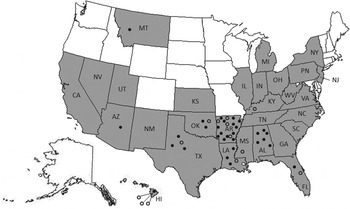
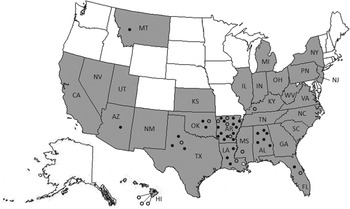
During an epidemiological investigation of Toxoplasma gondii infection in feral pigs (Sus scrofa), hearts from 1006 individuals sampled from throughout the country (29 states; Fig. 1) were collected and submitted to the Animal Parasitic Diseases Laboratory (APDL), United States Department of Agriculture, Beltsville, Maryland (Hill et al. Reference Hill, Dubey, Baroch, Swafford, Fournet, Hawkins-Cooper, Pyburn, Schmit, Gamble, Pedersen, Ferreira, Verma, Ying, Kwok, Feidasf and Theodoropoulos2014). A piece (5×2 cm) of each heart was fixed in 10% buffered neutral formalin for subsequent examination. Information concerning gender, and age class of the animals based on lower jaw tooth eruption criteria (incisor #2 absent = juveniles, less than 2 month old; incisor #2 erupted, deciduous canine = sub-adults, between 2 months and 1 year old; permanent canine = adults, over 1 year old; Matschke, Reference Matschke1967) were recorded for each collected sample.
Sampling areas in the USA. Shaded areas corresponding with those US states in which feral swine were collected: Alabama (AL), Arkansas (AK), Arizona (AZ), California (CA), Florida (FL), Georgia (GA), Hawaii (HI), Illinois (IL), Indiana (IN), Kansas (KS), Kentucky (KY), Louisiana (LO), Michigan (MI), Montana (MT), Mississippi (MS), North Carolina (NC), New Jersey (NJ), New Mexico (NM), Nevada (NV), New York (NY), Ohio (OH), Oklahoma (OK), Pennsylvania (PN), South Carolina (SC), Tennessee (TN), Texas (TX), Utah (UT), Virginia (VA), West Virginia (WV). Spots are referred to Sarcocystis spp. PCR positive animals; black dots correspond to samples from which sequencing was successful.
Histopathological examination
Tissue samples were cut into sections (1·5×0·7 cm), embedded in paraffin and sectioned 5 μm thick; the sections were stained with haematoxylin and eosin (H and E) and observed under the microscope. Intensity of infection was estimated as number of sarcocysts per tissue section.
Pepsin digestion examination
Samples of 147 myocardium (50 g) were homogenized and digested in acidic pepsin (Dubey, Reference Dubey2010). To test for the presence of bradyzoites of Sarcocystis, 50 μL of digested tissue were placed on a slide, covered with a coverslip and screened under the microscope at 400× magnification. Approximately 300 μL were stored in microtubes, labelled and maintained at −70°C until the molecular processing.
Molecular characterization
DNA was extracted from each of the above digests using the DNeasy Blood and Tissue Kit (Qiagen Inc., Valencia, California, USA) according to manufacturer's instructions. DNA quantification and quality were determined using a NanoDrop Lite Spectrophotometer (Thermo Scientific, Waltham, Massachusetts, USA). PCR was performed using the Sarcocystis spp. specific primers amplifying a 915 bp portion of the 18S ribosomal RNA gene, 2L and 3H (2L forward 5′-GGATAAACCGTGGTAATTCTATG-3′ and 3H reverse 5′-GGCAAATGCTTTCGCAGTAG-3′) as described previously (Holmdahl et al., Reference Holmdahl, Mattsson, Uggla and Johansson1994; Yang et al. Reference Yang, Zuo, Yao, Chen, Yang and Zhang2001). Briefly: initial denaturation at 95°C for 5 min; 40 cycles of amplification (94°C for 1 min, 55°C for 1 min and 72°C for 1 min) and final extension at 72°C for 10 min.
The PCR products were subjected to restriction endonuclease digestion using SspI to reveal the polymorphism between S. miescheriana and S. suihominis as described by Yang et al. (Reference Yang, Li, Zuo, Chen, Chen, Nie, Wei, Zen, Attwood, Zhang and Zhang2002). After SspI digestion, the 915 bp PCR product of S. miescheriana generates two fragments (650 and 265 bp), while with the S. suihominis amplicon no digestion occurs. Digestion was performed in a 20 μL reaction mixture containing 6 μL of 18S PCR product and SspI enzyme (5U) at 37°C for 12 h. The amplified and digested PCR products were run on 2·5% (w/v) agarose gel with ethidium bromide stain and visualized using Gel Logic 212 Imaging Systems (Eastman Kodak Company, Rochester, New York, USA).
PCR products of 31 samples, derived from various geographic locales, were selected and sequenced directly using the same primers by Macrogen Corporation (Rockville, Maryland, USA). Sequencing was performed in both directions. These sequences were trimmed and edited in Geneious prior to being compared to each other, and to related sequences identified through BLAST from the non-redundant GenBank database.
After alignment using the MUSCLE algorithm, these sequences were subjected to phylogenetic analysis under the criterion of maximum likelihood using PHYML as implemented by Geneious assuming the HKY substitution model and allowing estimation of the transition/transversion ratio and the gamma distribution parameter.
Statistical analyses
Statistical analyses were performed with SPSS software, version 15·0 (SPSS Inc., Chicago, Illinois, USA). According to data, appropriate parametric or non parametric tests were employed. A P value of ⩽0·05 was considered significant.
RESULTS
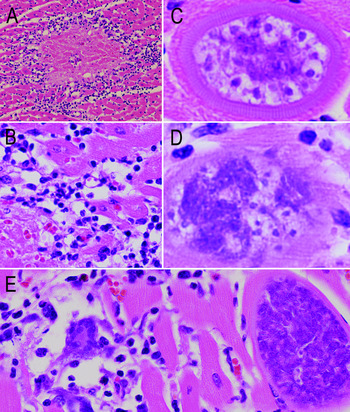
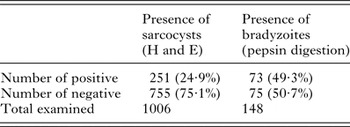
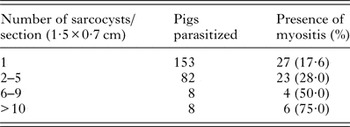
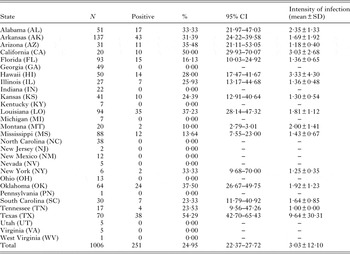
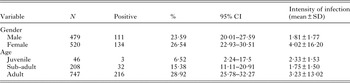
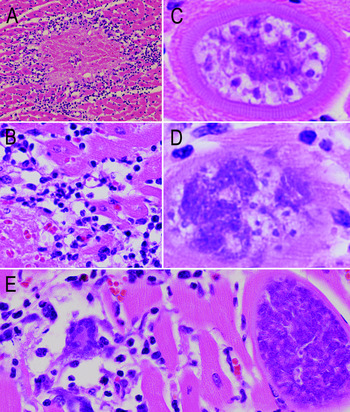
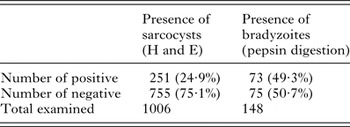
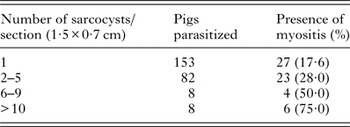
Sarcocysts were detected in 24·95% (251/1006) of myocardial sections examined histologically; bradyzoites were found in 49·0% (72/147) of digested tissues (Table 1). Infection intensity varied by over two orders of magnitude (range 1–184 sarcocysts/section). The average parasitic load was 3·03±12·10 sarcocysts/section (n = 251); a maximum of 35 foci of myocarditis in the same section were detected; degenerated sarcocysts were found in only one section, seven sarcocysts were found in the centre of a focus of necrosis with mononuclear cell infiltration (Fig. 2A–E); higher prevalence of myocarditis was found in severe infections (r=0·974) (Table 2).
Sarcocystis infection in myocardium of feral pigs. H and E stain. (A) Mononuclear cell infiltration surrounding a focus of necrosis in an adult female from Louisiana. (B) Higher magnification of the periphery of lesion in Fig. 1A. (C) Cross-section of an immature sarcocyst with a radially striated sarcocyst wall and metrocytes, detected in an adult male from Kansas. (D) Degenerating immature sarcocyst with metrocytes, the sarcocyst wall is no longer visible, detected in an adult male from Florida. (E) Focal inflammatory focus with mononuclear and giant cell on left and an intact intramuscular sarcocyst on the right, detected in an adult female from Texas.
Prevalence of Sarcocystis sarcocysts and bradyzoites detected in the feral pigs surveyed in the USA
Intensity of infection and frequency of myositis associated to Sarcocystis sarcocysts detected in myocardium of feral pigs from the USA
Statistically significant differences were detected among prevalence of infection detected in feral pigs from particular US states (Fig. 1; Table 3); the highest prevalence was observed in Texas (54·29%; 38/70) and the lowest prevalence in Mississippi (13·64%; 12/88). Slightly lower prevalence was observed in male swine (23·59%) than in female swine (26·54%); prevalence increased with age (juvenile: 6·52%; sub-adults: 15·38%; adults: 28·92%) (Table 4); finally, higher parasitic loads were detected in adult individuals (3·23±13·02 sarcocysts/section) and in females (4·02±16·20 sarcocysts/section) (Table 4).
Geographical distribution of Sarcocystis infection detected in feral pigs from the USA
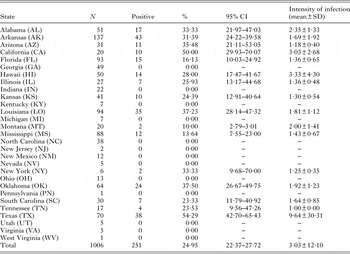
CI, confidence interval; SD, standard deviation.
Study of variables on the prevalence and intensity of infection of Sarcocystis infection in feral pigs from the USA
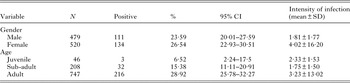
CI, confidence interval; SD, standard deviation.
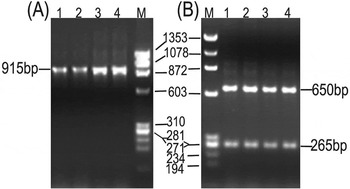
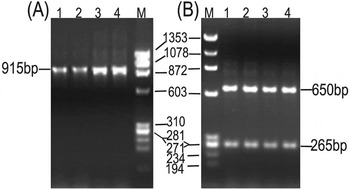
A region of the Sarcocystis 18S rRNA gene was amplified in 44 samples from 11 US states (AL, AR, AZ, FL, HI, KY, LA, MT, MS, OK and TX) which yielded approximate 915 bp PCR product (Fig. 3A). Digestion of 18S PCR products with restriction enzyme SspI generated two distinct fragments of 650 and 265 bp, belonging to S. miescheriana, in all positive samples studied (e.g., Fig. 3B). No product failed to be digested, which would have suggested the presence of S. suihominis. PCR-RFLP analysis of all Sarcocystis spp. positive samples revealed only S. miescheriana infection in feral pigs from the USA.
Restriction pattern of Sarcocystis miescheriana revealed for the feral pigs sampled in the USA. PCR amplification of Sarcocystis 18S rRNA gene and digestion of 18S PCR product with restriction enzyme SspI. Visualized on 2% agarose gel with ethidium bromide stain. (A) Lanes 1, 2, 3 and 4: 18S PCR products of four different feral pigs, Lane M: DNA Ladder, size 915 bp band corresponding to 18S rRNA gene of Sarcocystis spp. (B) Digestion of 18S PCR product. Lane M: DNA Ladder; Lanes 1, 2, 3 and 4: digested products of four feral pigs. The two bands with size 650 bp and 265 bp of digested 18S PCR products represented S. miescheriana.
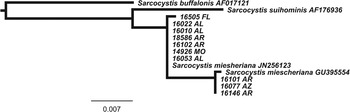
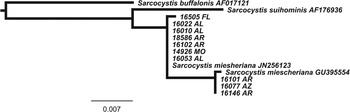
Thirty one isolates from nine US states (AL, AR, AZ, FL, HI, LA, MT, OK and TX) were subjected to sequencing (Fig. 1) and phylogenetic analyses, a neighbour joining tree (Fig. 4) illustrates the correspondence of feral swine isolates from USA with either of two sequences previously reported for S. miescheriana (GenBank accession GU395554, JN256123). Each of these was distinct from a sequence representing S. suihominis (AF176936) (Fig. 4).
Maximum likelihood 18S rRNA sequence phylogenetic tree for the 31 isolates of Sarcocystis spp. studied in feral pigs from the USA.
DISCUSSION
This represents the first comprehensive Sarcocystis survey of feral swine from the USA. Prevalent infection was also documented previously (60·0%, Coombs and Springer, Reference Coombs and Springer1974 and 32·0%, Barrows et al. Reference Barrows, Smith, Prestwood and Brown1981). Prevalence estimated are strongly influenced by the methodology used; our prevalence estimate doubled (from 24·9 to 49%) when using pepsin digestion rather than microscopical examination of histological sections. Our study surveyed a wide area and documented infection in 16 of 29 US states. A previous survey developed by Barrows et al. (Reference Barrows, Smith, Prestwood and Brown1981) over an area of 11 US states showed animals infected in most of them, but failed to document infection in Florida and rarely found infection in the lower coastal plains of Georgia, Mississippi and South Carolina. The current situation continues to reflect that distribution. We detected no infection in Georgia, and lower rates in Florida and Mississippi. On the other hand, we estimated higher prevalence in the Southern states of Alabama, Arkansas, Arizona, Louisiana, Oklahoma and Texas, consistent with the findings over 30 years ago (Barrows et al. Reference Barrows, Smith, Prestwood and Brown1981).
We also confirmed the earlier finding that older animals are more likely to be infected and more likely, if infected, to harbour greater parasitic loads. This has been reported for feral swine (Barrows et al. Reference Barrows, Smith, Prestwood and Brown1981) and domestic pigs (Hinaidy and Supperer, Reference Hinaidy and Supperer1979; Ohino et al. Reference Ohino, Shinzato, Sueyoshi, Tominaga, Arakaki, Shiroma, Ohshiro, Saitou and Itagaki1993; Avapal et al. Reference Avapal, Sharma and Juyal2003).
The average parasitic load detected in 251 feral pigs in our study was 3·03 sarcocysts/section, with maximum parasitization of 184 (in an adult female from TX); this far exceeded the maximum of four sarcocysts/section observed in heart from Iowa sows (Dubey and Powell, Reference Dubey and Powell1994). The markedly greater intensity of infection identified, in certain feral swine, may indicate that feral pigs have greater contact with sporocysts contaminating environment; alternatively, this may reflect a greater accumulation of infection in longer-lived feral swine. Notably, parasitic load was 2·2 times higher in females than in male feral swine; perhaps periodic gestational stress may depress immunity, thereby accounting for this difference. High intensity of infection in female (ratio: 0·54) was also observed in wild boars from the Slovak Republic (Hvizdošová and Goldová, Reference Hvizdošová and Goldová2009). According to Caspari et al. (Reference Caspari, Grimm, Kühn, Caspari and Basso2011), naturally occurring Sarcocystis infections in pigs are usually unapparent, presumably due to natural immunization by repeated, low-dose infections, more common in free-ranging pigs. Even so, cases in wild swine may have more varied clinical outcomes.
According to Avapal et al. (Reference Avapal, Sharma and Juyal2004), little information is available concerning pathological changes in natural infections of swine with Sarcocystis. Recently, Kia et al. (Reference Kia, Mirhendi, Rezaeian, Zahabiun and Sharbatkhori2011) and Yan et al. (Reference Yan, Qian, Li, Wang, Ding and Huang2013) did not found inflammatory reactions around sarcocysts of S. miescheriana in tissues from wild boar or domestic pigs, respectively. But in previous studies in experimentally infected pigs, Barrows et al. (Reference Barrows, Prestwood, Adams and Dykstra1982a , Reference Barrows, Prestwood and Green b ) detected various stages of cystic development between 35 and 92 days post-infection, and also, dissolution and reabsorption. Later, Yan et al. (Reference Yan, Qian, Li, Wang, Ding and Huang2013) reported the occurrence of atrophy, degeneration and necrosis of the myosites with sarcocysts present. Our findings agree with these two reports in the sense that sarcocysts undergoing destruction were accompanied by focal areas of mononuclear cell infiltrates and eosinophils. In several individuals, foci of myositis without apparent presence of parasites were detected, in those cases it is no longer possible to know with exactitude the aetiology of such lesions, owing to likely reabsorption of Sarcocystis sarcocysts. Also, in several cases, oedema, fibrinous exudates and hyaline degeneration was observed according to Avapal et al. (Reference Avapal, Sharma and Juyal2004) in pigs from India. No signs of acute infections, as reported by Caspari et al. (Reference Caspari, Grimm, Kühn, Caspari and Basso2011), were detected.
Sarcocystis species can be identified based on the morphology of their sarcocysts wall, but specific morphological diagnosis often requires transmission electron microscopy (Dubey et al. Reference Dubey, Speer and Fayer1989). The sarcocysts of S. miescheriana have walls 3–6 μm thick that appear radially striated; the villar protrusions on the sarcocysts walls are up to 5 μm long and 1·3 μm wide. While for S. suihominis, the wall is 4–9 μm thick and appears hirsute, with villar protrusions up to 13 μm long (Dubey et al. Reference Dubey, Speer and Fayer1989). Also, bioassay can be useful in their differential diagnosis. Saito et al. (Reference Saito, Shibata, Ohno, Kubo, Shimura and Itagaki1998) detected sarcocysts morphologically consistent with S. suihominis in pigs from Japan; confirmation was done by bioassay in dogs and cats, which did not shed sporocysts.
Molecular methods are useful to identify Sarcocystis species; 18S rRNA sequences are of special interest because they contain conserved regions that are easy to target via PCR, interspersed by more variable regions that differ among related species (Yang et al. Reference Yang, Li, Zuo, Chen, Chen, Nie, Wei, Zen, Attwood, Zhang and Zhang2002; Dahlgren and Gjerde, Reference Dahlgren and Gjerde2007). Our results confirm the presence of S. miescheriana in the 44 isolates studied from 11 US states. S. miescheriana is a ubiquitous parasite whose presence has been confirmed molecularly in different countries as China (Yan et al. Reference Yan, Qian, Li, Wang, Ding and Huang2013), Iran (Kia et al. Reference Kia, Mirhendi, Rezaeian, Zahabiun and Sharbatkhori2011) and Switzerland (Caspari et al. Reference Caspari, Grimm, Kühn, Caspari and Basso2011). The absence of zoonotic S. suihominis from any animal in our sample provides some reassurance that this zoonotic parasite continues to occur at low or negligible frequencies in feral swine in the United States. Assuming our sample of 44 is representative of the US population of feral swine, we can conclude with 95% of probability that the true prevalence of S. suihominis is less than 1·4%. Further studies should be focused in organic pigs that are raised in free or semi-free conditions, and would need to enrol thousands of individuals in order to have statistical power to evaluate, with precision, the true prevalence of this infection here.
Sequence analysis and phylogenetic results showed that genetic variability of S. miescheriana is very low; our sequences were compared with available sequences in GenBank, and found to correspond almost perfectly to either GU395554 reported by Kia et al. (Reference Kia, Mirhendi, Rezaeian, Zahabiun and Sharbatkhori2011) in Iran or JN26523 reported from Lithuania. Gene sequence analysis is also very useful to define the identity of morphologically similar species (Yang et al. Reference Yang, Zuo, Yao, Chen, Yang and Zhang2001).
Recently, zoonotic Sarcocystis species have become a major concern for food safety in many countries; e.g., European Food Safety Authority stimulates efforts on the development of harmonized schemes for the monitoring and reporting of Sarcocystis in animals and foodstuffs in the European Union (Taylor et al. Reference Taylor, Boes, Boireau, Boué, Claes, Cook, Dorny, Enemark, van der Giessen, Hunt, Howell, Kirjušina, Nöckler, Pozio, Rossi, Snow, Theodoropoulos, Vallée, Vieira-Pinto and Zimmer2010). At present, there is no report if S. suihominis occurs in the United States. It constitutes a risk for the safety of pork, and a risk assessment should be developed, especially for swine raised in organic or non-biosecure pig farms. S. suihominis is a parasite that thrives in poor hygienic conditions; humans act as definitive hosts, supporting development of the parasite in the intestines; current systems of water purification, and control of human feces, allow the cycle of transmission to be broken. Also, according to Dubey and Powell (Reference Dubey and Powell1994), the management of pigs and cultural habits of humans affect the prevalence of Sarcocystis. For example, the highest prevalence of S. suihominis has been reported in pigs from Germany and Austria, where people commonly eat undercooked or raw pork (Hinaidy and Supperer, Reference Hinaidy and Supperer1979; Boch et al. Reference Boch, Hennings and Erber1980); absence of this habit could be a cause of the apparent absence of this species in the USA.
ACKNOWLEDGEMENTS
The authors would like to thank to the USDA's Animal and Plant Health Inspection Service, Wildlife Services unit (APHIS-WS) for collection of samples for this project.
FINANCIAL SUPPORT
Rafael Calero-Bernal is a postdoctoral fellow (ref. PO12010) funded by the Department of Employment and Innovation of the Regional Government of Extremadura (Spain) and the European Social Fund, and Yurong Yang is a visiting scientist from Henan Agricultural University, Peoples Republic of China and funded by China Scholarship Council.