

Introduction
Attempts have been made in recent scholarship to destabilize the category of medicine, imposed as it is onto Asia since colonial modernity. This imposition reflects a form of cultural, if not political, authority which has far reaching implications in the way we understand ‘medicine’ and ‘medical knowledge’. In the illuminating introduction of the volume Asian Medicine and Globalization, Joseph Alter thus calls attention to the limits of a definition of medicine in Asia that is constrained ‘by the bracketing forces of medicine itself—conceptualised across time as a naturally delimited system dealing with illness and disease—as against a history of health that encompasses much more. (. . .) What counts as medicine [in Asia]’, he writes, ‘blurs into other things—martial arts, beauty regimen, alchemy, aesthetic surgery, diet and yoga’.Footnote 1 Indeed, like many specialized forms of knowledge and practices in Asia, medicine unfolds on different registers. Learned Tibetan medicine, sowa rigpa (gso ba rig pa Footnote 2), is a case in point. The principles of the Buddhist doctrine played an important role in the construction of this medicine, in particular as a basis for medical ethics and a number of theoretical aspects.Footnote 3 The remarkable synthesizing effort made by Tibetan scholars over several centuries, integrating other influences as ayurveda and Chinese medicine, gave rise to an original medical art, for which the Tibetan Buddhist tradition served as the religious matrix. Sowa rigpa was thus formulated within the framework of the scholastic sciences.Footnote 4 However, the medical domain is relatively little concerned with Buddhism when it is a matter of learning the theory, of preparing medicines, of making a diagnosis, or of treating patients. But the practitioners insist on the fundamental role of Buddhism in improving their medical practice and more broadly the fate of each of them. They also underscore the moral dimension in the act of healing, a dimension that is expressly a matter of Buddhism.Footnote 5 The ‘science of healing’ is differentiated but not isolated from Buddhism, not only from its most organized religious forms but also from other related practices such as divination, exorcism, or ritual healing.Footnote 6
Joseph Alter's contribution, however, does not simply reside in the study of the ‘links’ medicine has to religion, philosophy, or even cosmology, but also and more importantly in the study of those links ‘as diagnostic of a problem of modern delineation’.Footnote 7 Modernity has imposed a certain idea of medicine which continues, implicitly if not explicitly, to shape the study of Asian therapeutic forms. Whilst specialist literature abounds in historical and anthropological works that closely examine the relationships between religion and therapeutic knowledge and practice, scant attention has been given to these relationships as a means to rethink what is medicine—as a category—in different times and places. To achieve this aim, it is not advisable to think of them as links between ‘medicine’ and ‘something else’ because the latter, be it religion or martial arts, may well be constituting medicine itself.Footnote 8 The links in question should be understood as being part of the architecture of a given medicine in Asia.
The study of the relationship between medicine and religion raises a second set of questions. There is a tendency in South Asian scholarship to coalesce medical practice with a fixed religious environment, in spite of the many influences that led to the emergence of these practices: ayurveda is part of the Hindu culture, Tibetan medicine is associated to Buddhism and unani to Islam. There is some truth in this, of course, but these associations are complex and not always linear, embedded as they are in transnational histories of medical knowledge production.Footnote 9 What further complicates matters is the fact that these links, which may constitute the architecture of medicine, are not established once and for all. They may shift or be transformed without profoundly altering the epistemological core of medical practice. There are, for instance, practitioners of traditional South Asian medicine who move across or stand outside the religious boundaries that tend to delimit their medical practice. Some therapists practice a medicine irrespective of the fact that it may be embedded in a different religious environment than their own and others convert to a new religion whilst maintaining their, often hereditary, therapeutic practice.
The history of South Asian medical traditions, brought into contact by trade routes, military and political conquests, colonialism or religious proselytism, clearly shows instances of knowledge transfer and the way in which a variety of forms of therapeutic knowledge have influenced each other.Footnote 10 In these assumedly traditional contexts, therapists may be innovative, integrating therapeutic materials, theoretical elements, and fragments of the culture in which a medicine is rooted, and rejecting others, often leading to peculiar combinations. The century-old coexistence of unani tibb and ayurveda, for example, has generated a host of exchanges, involving the writing of erudite texts in Persian, Urdu or Sanskrit, on clinical practice, surgery, pharmacopoeias and in the fields of healthcare administration and development. Introduced in India with the Muslim conquest and developed especially during the Mogul period (1526–1858), unani tibb, the ‘Graeco-Arabic’ medicine, forms an integral part of Indian Islamic culture, but that does not prevent the existence of Hindu therapists.Footnote 11 These practitioners incarnate a form of heterodoxy, which is sometimes contested in regions where communalist agendas encourage the merging of medical and religious identities.Footnote 12
Elsewhere, in the Central Asian region of Buryatia, where Tibetan medicine has been practiced since the eighteenth century, numerous physicians converted to Russian orthodoxy.Footnote 13 Their new religion and the pressure exerted by the Soviet and Russian regimes had implications on the practice of Tibetan medicine, in that they subjected ‘the possibility of a discourse on medicine’Footnote 14 to a profound reorganization. In other words, the framework to ‘what counts as medicine’ accounts for both a political process and a moral enterprise. The ‘superstition and mysticism’ of the Buddhist lamas has been carefully set aside for Tibetan medicine to match particular ideas of both secularism and science.Footnote 15 This kind of transformation and the adaptability of learned Tibetan medicine to new sociopolitical environments accounts for a perseverance of the theoretical principles, but also to a flexibility in the practice of medicine, two qualities that define what Vincanne Adams and her colleagues have chosen to call a ‘sowa ripga sensibility’.Footnote 16
Whilst medicine in Asia may include elements such as religion or landscape, the nature of these elements is however, unsettled. This paper retains as a case study the shifting of the links from one religion to another in the medical domain in the case of a Muslim practitioner of Tibetan medicine in Ladakh, a region in north-western Himalayan India that borders Indian Kashmir, Pakistan and China. The essentially ethnographic nature of this paper, the elements of which were collected during various stays at the amchi's home between 2001 and 2004, intends to document in detail a situation that is as rare as it is heuristic.Footnote 17 Its genealogy will be explored by tracing the history of a Buddhist family that converted to Islam and the ambivalent status of these Muslim medical practitioners in a region torn by religious conflicts. The way medicine is performed in practice in this context, the physical regimes of bodily care, and the meaning and social consequences of these practices, provide empirical materials to study the paradigms that both structure and confer motion to Tibetan learned medicine. The paper will contrast the actual possibility for a Muslim practitioner to practice Tibetan medicine (due to the relative plasticity of its internal structure) to the difficulties he experiences on a daily basis (the social inscription of medicine) to maintain a medical practice considered to be Buddhist. This will shed light on the way the external and internal delineation of Tibetan medicine takes place and operates. These considerations will help to explain how, and what in, Tibetan medicine is or is not re-delineated in practice by modernity. First, as a contextual introduction to these matters, the socio-political environment in Ladakh and its consequences on the relationship between religious groups will be presented.
Religions in the socio-political context of Ladakh
Ever since 1947, when Ladakh became part of the State of Jammu and Kashmir,Footnote 18 the political space of the region has been animated by a series of official demands aiming towards regional autonomy. Representatives of the Youth Men Buddhist Association—an organization founded in 1934 and reformed in the 1960s as the Ladakh Buddhist Association—expressed their desire to be separated from Jammu and Kashmir. They hoped that Ladakh would be placed under the administrative power of the State of Punjab (which was then covering the present States of Himachal Pradesh, Punjab and Haryana) or that their region would be directly administered by the central government. Since 1949, several delegations led by some of the most prominent political figures of Ladakh have submitted various memoranda to the authorities in New Delhi. For instance, the Venerable Kushok Bakula Rinpoche—a respected religious and political person—visited Prime Minister Jawaharlal Nehru repeatedly in the 1950s to demand autonomy for Ladakh. For nearly two decades, Ladakhi politicians have thus objected to the political and administrative organization of their region.
These separatist movements, however, were not directed against the Indian Union. Rather, they expressed a religious radicalism that opposed the administration of Ladakh by Muslim Kashmir.Footnote 19 The non-compliance of central government and Kashmir's grip on Buddhist Ladakh caused various agitations between 1969 and 1973, and especially in 1989. That year, the violence of the conflict reached its climax in a series of clashes between Buddhist groups and the police, in which several people died. These clashes were accompanied and followed by a general boycott of Muslim shops by Buddhist populations.Footnote 20
These agitations were orchestrated by the Ladakh Buddhist Association, an organization heavily involved in Ladakh social and political life.Footnote 21 Representatives of the association made claims aimed at obtaining Union Territory status for Ladakh. The religious nature of these claims, then presented as communal,Footnote 22 contributed to diffusing particulars ideas on the relationship between religious groups and, to some extent, worsened these relationships.
This event led to negotiations with central government which, despite opposition from the Chief Minister of Jammu and Kashmir, granted partial autonomy to Ladakh. Demand for the Union Territory status was thus rejected. The signing of a tripartite agreement between the central government of India, The State of Jammu and Kashmir, and the Ladakh Buddhist Association ended the hostilities, for a time, by offering a compromise solution. Autonomy took its current form on 3 September 1995 during the first elections of the Ladakh Autonomous Hill Development Council (Council). It became operational in 1996. However, the Council was only concerned with the district of Leh, the population of which is predominantly Buddhist. Until 2004, the Chief Executive Councillor was none other than Thupstan Chhewang, the president of the Ladakh Buddhist Association in 1989. The Kargil district, largely populated by Muslims, refused the offer until July 2003, when a Ladakh Council for Kargil was established.
However, the social climate was not pacified as a result. Disillusionment followed the joys of ‘independence’ and obtaining partial autonomy engendered new social tensions. Populations became fragmented and the religious differences in Ladakh itself were exacerbated.Footnote 23
These events contributed to the emergence of a homogeneous, ‘virtual’ identity which reflected the regionalist political and ideological discourse. Power was ‘staged’ by hiding religious particularities and heterogeneous identities that characterize Ladakh. Indeed, strategies pertaining to fictitious or ideal identities are generally used as instruments for political identification.Footnote 24 Virtual identities have clear political implications and should not, therefore, be relegated to the realm of illusion.Footnote 25 This is an ‘art of representation’,Footnote 26 which transforms social reality.
Demands for autonomy from central government were in fact ethnicized in Ladakh and were not, as shown by Martijn van Beek,Footnote 27 a product of ethnicity. In this context, these political strategies gave the image of a unified Ladakh to the outside world. As Marc Abélès adroitly remarks, ‘the protagonists of the political game introduce themselves as mandated by the whole society. Legitimacy, whether it is rooted in immanence or transcendence, is a quality assumed by power. It is up to this power to give to the community which it represents an image of coherence and cohesion’.Footnote 28 Political leaders have indeed pursued a strategy of erasing difference.
On 25 August 2002, at an event unprecedented in Ladakh, the regional branches of the national political parties were dissolved to create the Ladakh Union Territory Front (LUTF/Union), a single regional party created with the explicit purpose to liberate Ladakh from Kashmir. The main meeting that led to this decision was organised by Ladakh Buddhist Association.Footnote 29 The terms of the demand, however, changed. The president of the association, Tsering Samphel, remarked, ‘We also thought that the issue [of Union Territory] should not remain on the Ladakh Buddhist Association stage anymore. Rather it should move on the political stage to make it a secular regional issue’.Footnote 30 Religion was carefully set aside and the political argument in the official discourse on the Union was built around matters of geography, culture and history.Footnote 31 Thupstan Chhewang, as already mentioned, became the head of the party, along with a group of leaders, including Tsering Samphel. The case of Islam was, of course, raised. Muslims in Leh District accepted these new provisions, but the people of Kargil (the Buddhist inhabitants of Zangskar set apartFootnote 32) remained reluctant, because of their relationship with Kashmir. The creation of the Union was again a disguise for Ladakh; it retained the same objectives as those of 1989, but it did not reflect the plural nature of identities and the differences between communities.
In autumn 2004, former Ladakh Union Territory Front officers (Tsering Samphel, Rigzin Jora and Rigzin Spalbar) left this regional party to revive the Indian Congress. They held the Union responsible for being unable to include representatives of Kargil despite the support of Leh Muslims. Tsering Samphel remarked, ‘When we needed unity of heart and mind, LUTF leaders failed miserably’.Footnote 33 He blamed the failure of Thupstan Chhewang to achieve the objectives set by the Union, despite his election as a Member of Parliament in May 2004. According to Tsering Samphel, Thupstan Chhewang used the demand for Union Territory simply to win the regional elections of 2005; he led the Union in a dictatorial manner and made the party undemocratic. The current members of the Congress hope to obtain the status of Union Territory with the support of their national party. Naturally in this context, Union leaders answered with the same virulence.Footnote 34
Although the official discourse of the Ladakh Buddhist Association concerning the Union tended towards the secular, this organization had in fact always positioned its activities in a communal (religious) register.Footnote 35 In this vein, the president of the Association spoke of the ‘fashion of secularism’ in Ladakh.Footnote 36 In reality, however, since 2000, its leaders have tightened the bonds of their relationship with the Sangh Parivar, a group adhering to national-Hinduism (Hindutva), and especially with the radical branches Rashtriya Swayamsevak Sangh and Vishwa Hindu Parishad.Footnote 37 These new alliances have been carefully negotiated by the Ladakh Buddhist Association to strengthen its political weight against Islam ‘[and] to keep pressure on the Centre for its demands, while at the same time avoiding being swallowed up by the Hindu nationalists’.Footnote 38 This attitude reflects a defensive strategy against perceived threats weighing on local interests. Thus, although religious radicalism in Ladakh is not an exogenous phenomenon, the influence of external political dynamics is crucial to its emergence and development. According to Martijn van Beek, this approach certainly will not lead to the Hinduization of Ladakh, as was the case in the neighbouring region of Lahaul, but it tends instead to poison relations between Buddhists and Muslims.Footnote 39
These tensions are pervasive and tend to penetrate many aspects of everyday life in Ladakh, from casual relationships and acquaintances, to trade, friendship, love and marriage. Indeed, according to Sara Smith, geopolitics must also be read at the level of body.Footnote 40 The remainder of this paper shows that the difficult geopolitics and religious antagonisms of Ladakh are also felt and objectified in the medical realm.Footnote 41 Religious boundaries are at the same time embodied and contested at the level of the individual healers, but also reproduced and solidified in their relationship to others.
Such is the case for Aba Jaffar, the main character in this paper, an elderly man of Shiite persuasion. This practitioner of Tibetan medicine and his family live in Tambis, a village in western Purig in the lower Suru valley, located in the territory of Sanku (Sankhoo), about 20 kilometres from Kargil.
The lineage of Aba Jaffar
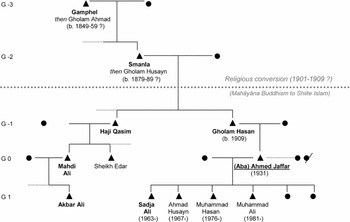
The family of Aba JaffarFootnote 42 set great store by the long history of its amchi—a term that designates the practitioners of sowa rigpa. They even claimed that the family already included practitioners at the time of the Kingdom of Ladakh, before the latter was annexed definitively by the Dogras in 1842. They stressed this in order to set their Buddhist identity as far back in the past as possible. In fact, the family's first amchi was born under a Buddhist name, Gamphel, between 1849 and 1859.Footnote 43 He became Gholam Ahmad at the time of his conversion, after the birth of Jaffar's grandfather, who came into the world with the Buddhist name of Smanla (later Gholam Husayn). Jaffar's father was born a Muslim in 1909, with the name of Gholam Hasan, and Jaffar himself was born in 1931.
According to the villagers, families in Tambis converted gradually and the households of Gamphel and Smanla would have been the last two to have done so. Family members also said that all the related households converted during the same period. A report written by Clarke concerning the tehsil of Kargil shows that Tambis had only a single Buddhist family in 1901.Footnote 44 This family was most probably that of Smanla, Jaffar's grandfather. Its members therefore converted to Shiite Islam between 1901 and 1909, the year when Jaffar's father was born.
Jaffar's extensive family counts four generations (mi rabs bzhi) of amchi—noted in bold characters in the family tree below (Figure 1). If one includes his oldest son Sadja Ali and his cousin Akbar Ali, two men whose practice of Tibetan medicine assumes quite an elementary form, near herbalism and magic (‘breath healing’), there were eight amchi in the family, each characterized by the heterogeneity of their practice, five of whom were deceased at the time of this research.
Genealogical tree representing the amchi lineage in Tambis.

Aba Jaffar is a gyud-pa (rgyud-pa, syn. brgyud-pa) amchi, a therapist who received his teaching and his title through hereditary lineage. Despite their conversion to Shiite Islam, none of the healers in the family abandoned their practice of Tibetan medicine, or forewent their right to practise it. Jaffar said that he wanted to preserve this tradition because he had understood ‘that medicine was useful from watching his father [Gholam Hasan] and his grandfather [paternal, Gholam Husayn] practise it’. He added, ‘Medicine helps people. By practising medicine one can be useful to others. One has to have a good heart (sems bzang), otherwise it is impossible.Footnote 45 Anyone can practise [implying Muslims], but one must learn correctly, completely’. The status conferred by the presence of amchi in the family is also reproduced in the process of transmission of medical knowledge, which is certainly connected to the fact that the lineage has never been broken. The familial basis of the practice, the long dependence of the villagers on the services of these therapists, and their social heritage has ensured the continuation of the medical art. The family's conversion to Islam has had no radical consequences for the medicine.
Jaffar says, however, that he is the one and only amchi in Tambis. He underscores his monopoly to be better able to use it for personal ends. I will return to this point later. Jaffar has had no need whatsoever to convince the villagers of his place in the community. His medical legitimacy is established in Tambis and his exclusivity never questioned. For example, when this amchi left between 1996 and 1998 to settle for more than two years in a hamlet in the area of Sanku, the villagers asked another amchi to come. They preferred to call upon a Buddhist amchi from the village of Sapi to replace him, rather than trusting other practitioners in the family.
This situation also throws light on the ambiguous medical status of the fifth generation of amchi (G1, Figure 1). Their medical apprenticeship is quite weak and their knowledge rather vague. The irregularity and approximation of their practice implies a certain process of dilution.Footnote 46 But the medical identity of these therapists is forcefully asserted; the status of amchi is coveted in the family, as is indicated in an exemplary manner by Akbar Ali, the grandson of Jaffar's paternal uncle. This middle-aged man said that he had received his medical knowledge from his father, Haji Qasim.Footnote 47 By way of confirming his role as practitioner, he listed a series of activities he conducted together with Jaffar, such as the preparation of medicines; he also said that he belonged to the amchi association in Mulbek,Footnote 48 and that he had numerous patients. However, all his assertions were subsequently refuted, as much by Jaffar as by Ngawang Tsering, the president of the aforementioned association. Jaffar's household is, moreover, very harsh as to Akbar's medical pretensions, which all repudiate outright. According to Jaffar, Akbar's medicine is ‘a practice without knowledge’. This idea is in fact widely shared in the village. Although on occasion he treats a few patients, Akbar Ali is nevertheless not recognized as a competent amchi. Akbar's lineage is slowly coming to an end, since he has not yet been able to ensure the transmission of the knowledge he claims to have.
Despite this, Akbar seems to enjoy a certain social recognition: he is placed in the third place in the row (gral) at the time of assemblies, after the religious head and Jaffar.Footnote 49 The position in the row does not reflect individual social power, which is generally shared quite equally in the villages. Nor does it weigh for much in the occasional village conflicts, which are concealed amongst both Muslims and Buddhists by ‘an ideology of unity and agreement’.Footnote 50 The position of Akbar in the row is due to his family's status (and lineage), and not to his recognition as a therapist. The status of the family is a result of it comprising amchi since the second half of the nineteenth century.
However, it is undeniable that the special status the family enjoys in the village community has a flip side. As we shall see below, being an amchi is inseparable, in the minds of the people in the village, from being somehow Buddhist. At the same time, abandoning amchi practice is tantamount to relinquishing the social status that comes with it. It was not surprising, therefore, that at the time of this research, Jaffar and his sons firmly rejected the thought of giving up their practice.
Medical identity and village ambiguity
In Tibetan scholasticism, the ‘science of healing’ (sowa rigpa, gso ba rig pa) is considered to be an ‘ordinary’ domain of knowledge (thun mong rig gnas) in Buddhism as well as in other religious traditions, such as Brahmanism. Whilst this ‘ordinary’ character does not specifically signify that medicine would be accessible to non-Buddhists, the elite Tibetan medical practitioners of Ladakh retain this characteristic to explain that some practitioners can have religious persuasions distinct from their own.Footnote 51 Whilst the amchi accept the possible existence of a non-Buddhist therapist they firmly insist on the fact that such a person would nevertheless have to find the means to develop the moral qualities required to practise the medicine and must feel respect for the Buddha Master of Remedies. For the common Buddhist inhabitants of Ladakh, the idea of a Muslim practitioner seems to combine highly contradictory elements, due to a presumed incompatibility between Buddhist and Muslim practices and doctrines. One of them remarked, ‘Earlier there were Muslim amchi. There was one in Phey [a village in the Indus valley populated by Buddhists and Muslims], but he died in 1999. I am not sure that you would be able to meet any today. Or else [my interlocutor added with a boisterous laugh] you would have to go to Pakistan to meet one!’ Indeed, according to Abdul Gani Sheikh, Tibetan medicine is still practised by some Muslims in Baltistan, a former Buddhist region on the Ladakhi border.Footnote 52 But this is not exactly (or not only) what my interlocutor meant. By directing me to Pakistan to find Muslim practitioners of sowa rigpa, this man underscored the uneasy relationship between Buddhists and Muslims in his region. In the local idiom, ‘going to Pakistan’ is a euphemism for ‘going to the toilet’, which is always expressed as a joke in Hindi (‘chalo Pakistan’) whether one speaks Ladakhi or English. In this case, aside from their everyday implication that Muslim amchi are not available within Ladakh, my interlocutor's words might have been a muted expression of the hostility that had sprung up between the two communities at that time.
It is not possible at this stage to specify with certainty the period of conversion of the inhabitants in Tambis, apart from Jaffar's family. Whilst this region, situated on the main trade routes between Ladakh, Baltistan (Skardu), and Kashmir, had been converted en masse well before the end of the nineteenth century,Footnote 53 there is little to indicate when Tambis itself underwent a similar change.Footnote 54 Be that as it may, Jaffar's family was for a long time (but how long?) the only Buddhist family in a space that had become quasi exclusively Muslim. The villagers however, disapproved of the family's attachment to its original religion. The community's collective representations could not escape the fallout of such a confrontation. According to Jaffar, the conversion of the members of his family was not unconnected with the social (and religious) pressure to which they were subjected when they were the only Buddhists in a Muslim village. Even today, the family claims that it is spied on and viewed with suspicion, and the practice of a medical art stemming from Tibet does nothing to help matters.
It was by penetrating more deeply into their family life that I was able to discern the problems Jaffar and his household had with the villagers. The reception this family accorded to me matched my experiences elsewhere in Buddhist Ladakh; they were very hospitable contrary to a common sentiment amongst the Buddhist Ladakhis and to the portrayal of Muslim Ladakhis one finds in some travel accountsFootnote 55 or academic works. For instance, Patrick Kaplanian distinguishes in quite unflattering terms the Baltis from the Ladakhis ‘properly speaking’, that is, according to him, from the Buddhist communities.Footnote 56 He presents the inhabitants of Kargil as ‘Ladakhis of Tibetan race [sic!] converted to Islam’Footnote 57 and remarks on the subject of their religion that
‘this adherence to Shiism radically differentiates them from the Sunnis of Leh; while the latter have conserved the greater part of the traditional customs, the Baltis claim to be strict, verging on fanaticism, or anti-Sunni sentiment. [. . .] A detail well marks the profound break that distinguishes them from the other inhabitants of Ladakh: they neither drink nor eat from the same plates as the non-Muslims, or the non-Shiites. In fact, they never offer hospitality and this feature often serves to define them.Footnote 58
Kaplanian reproduces a number of discriminatory preconceptions that one sometimes hears in Leh, the regional capital, and thus succumbs to partisan politics.Footnote 59 As Siddiq Wahid pointed out, the idea that Muslim Ladakhis are strangers in their own country has long remained dominant in academic works.Footnote 60
I was told, however, that the family could be criticized for this proximity. Jaffar again emphasized the doubts of the villagers concerning them:
Normally, when we receive non-Muslim visitors, we should keep the cups aside for a few days, but we do not do that. The villagers think that this is not a good attitude; they think we have remained Buddhists.
Later, whilst I was questioning Jaffar about the way he reconciled the practice of Islam with certain rituals specific to Tibetan medicine (such as the use of mantra, or the invocation of Sangye Smanla), a villager unexpectedly entered the room. I detected a certain tension in my interlocutor, a discomfort similar to my initial time there. His youngest son, who was listening to our discussion, suddenly said that, ‘in any case, in Tambis, there are no problems between the Muslims and the Buddhists’. But, ‘in any case’, who is a Buddhist in Tambis? His remark said much about the manner in which his family was perceived.
To express the unease of the family, Jaffar later made the following remark:
There is too much jealousy in Muslim society. The people are only occupied with their own interests. Among the Buddhists, the people help one another in a more sincere manner. People do not tell lies in the Buddhist villages. If they do lie, they do so less than the Muslims; they are also less jealous.
His remarks reflect the way Jaffar regards his grandfather, who was born a Buddhist, and about whom he always spoke in very laudatory terms, underlining his uprightness and his honesty. He did not make this remark so much to underscore the (idealized) qualities of Buddhists, as to accentuate the nature of his difficulties in the village. According to him, his status provokes jealousy. Jaffar always receives visitors from the village at his house and does not differentiate (enough) between Buddhists and Muslims. In fact, he has many more relations with Buddhists than all his fellow villagers and the network that he gradually developed is of direct benefit to him. The visit of notables from Leh, for example, in a certain way confirms the status of the family, and such recognition can be seen in the granting of government posts to members of his household or in other forms of social or economic advantage. In this way, for instance, Jaffar became a government official. He was retained as a government amchi and, at the time of research, received for this a meagre monthly allocation of 300 rupees and a few ready-made pills for an equivalent of 1,500 rupees per year.Footnote 61 The reception of visitors at his house, as in my case, also symbolizes the recognition the host enjoys beyond his village and underscores his social status. This ‘social benefit’ is also combined with possible material and, in particular, financial benefits.Footnote 62
This situation is all the more remarkable as the inhabitants of the district of Kargil are generally less well-off in this respect than those in Leh. Government jobs, which one keeps for life, are rarer there, and those invested with official posts in Ladakh are less obliging towards the inhabitants of the valleys of Purig and Kargil.Footnote 63 Jaffar's exceptional situation in his village generates repeated conflicts. Aba Jaffar observed:
Above all do not send me photographs that we took together, otherwise someone will steal them from me. It will be necessary to bring them to me. Here, some even think that I could use the plants to poison people! (. . .) Even though I am a pure and a good Muslim [he stopped a moment and then specified: ‘we are Shiites [Shias] and not Sunnis’, to underscore what he saw as a hierarchy], I never go to other houses to borrow anything. I stay at home. In the villages where I do my rounds, it is different; but here, the villagers do not understand. They think that we are not good Muslims. . . They see us practise medicine [sowa rigpa] and think that we are Buddhists because of that. But that has nothing to do with it. My sons are learning medicine and they do not for all that become Buddhists.
Three of his sons were present and they agreed. One of them added:
If you speak English, you do not automatically become a Christian, or I don't know what other religion. [Jaffar continued:] When they are sick, the people come to see me. Some patients stay at my place when they are too sick. They stay until they recover. (. . .) But not everyone feels resentment towards us. Some of the villagers insist that I transmit my knowledge to my sons, so that there will still be amchi in our village when I die. Because I am old now. (. . .) We are nevertheless respected, that is certain, because we are a big [high-standing] family. For example, we do not need to participate in certain village duties.Footnote 64 Our family [he included Akbar Ali's household] was not requisitioned in 1999 [he was referring to the Indo-Pakistani conflict in Kargil] and it was the villagers who decided. Also, at important events, such as marriages, the mulbi (religious head) is at the front of the line (gral mgo) and Akbar and I come immediately behind him. On the women's side, our family is at the head of the line.
Aba Jaffar thus explains the status of his family, whilst referring to tensions that exist with some of the villagers. The medical monopoly he has in the village—there is in fact a health centre, but its efficacy is very limited (chronic lack of medicines and under-trained personnel)—makes his presence and his therapeutic practice imperative. The villagers are largely dependent on Jaffar. The manner in which he is perceived varies between feelings of necessity and distrust.
For the inhabitants of Tambis, however, the Buddhist character of Jaffar's household is mainly asserted by the practice of a medicine that is known to have Buddhist overtones. In fact, as the next section will show, the boundaries between Buddhism and Islam are blurred in Jaffar's medical practice as he navigates between local ecologies, cosmologies and worldviews.
The practice of medicine in Tambis
Making Medicines
When Jaffar is not on his rounds, patients continually come to his house. Jaffar examines them, makes the diagnosis and treats them in the kitchen. He said that he had around 2,000 patients, ranging from Tambis to the borders of Zangskar and Kashmir (Dras). Jaffar travels a great deal; his post as a government amchi assigns him to a multitude of villages and isolated hamlets. ‘I am now in the habit of going here and there, even though the 300 rupees the government gives me each month does not even cover travel expenses.’Footnote 65 His travels are also an occasion to train his sons.
Medicines had to be prepared for Jaffar's next tour. I was given an aluminium trunk, which I carried onto the roof the house. Sadja Ali took another and Muhammad Ali carried fabrics. Jaffar had an impressive quantity of dried plants, collected in the mountains by his sons, and diverse raw materials and powders. Amchi from Mulbek and Leh occasionally also come to him to buy plants directly, such as ma nu (Inula racemosa). Outside lies an immense flat stone, worn by years of abrasion, on which the plants are spread out to be ground into powder. Jaffar was the conductor. He ordered his sons to bring him this or that raw material. To this purpose he employed Tibetan names to designate, for example, the part of the plant he required (roots, flowers, etc.). From time to time he questioned one of his sons about the properties of the plants. The sons quietly did as they were told.
It was genuine team work. Everyone was seated in a circle around the bags of raw materials, powders and utensils. Jaffar placed precise quantities of various products on square pieces of paper that the youngest son had cut from the pages of a newspaper. Once the fine mixtures had been prepared, Jaffar held the Koran on his knees for a moment. Then, Muhammad Ali, the youngest son, poured the mixtures his father had made, one by one onto the large stone, before starting to reduce them to powder using a sizeable round pebble tool. Ahmad Husayn began to read the Koran to consecrate the medicines being prepared. He also said that the reading of the Koran could ward off diseases specific to malevolent spirits in the region—which would be impervious to other, Buddhist rituals. Whilst passing out small pieces of dried myrobalan fruit (a ru ra)Footnote 66 to his grandsons, who were playing on the terrace, Jaffar then read aloud passages from the Gyud-zhi (rGyud-bzhi), or the Four Tantras, a canonical text written in Tibetan, his hands joined on his chest.
This classical text is known and used by all amchi in Ladakh. It is almost exclusively concerned with medical theories and techniques and contains but a few statements alluding to the strictly Buddhist domain. These centuries-old writings, however, have considerable repercussions on today's Buddhist therapists. They mark out their medical practice, shape their ideal type and, to a lesser extent, their daily religious practice.Footnote 67 The Buddhist amchi turn daily to the Buddha Master of Remedies whom they hold to be at the origin of their medicine and of this text in particular. The supposedly divine origin of this work and the historical facts that gave rise to it are reconciled by the amchi,Footnote 68 who consider this text to be a terma (gter ma), that is, a text that was hidden and then rediscovered, as a classical Indo-Tibetan tradition would have it.Footnote 69 The period of the ‘rediscovery’ of the terma generally corresponds to the historical period of the compilation of the text in question, which is then retrospectively attributed to religious masters of the past. The text is in this way invested with a very great antiquity, with an authority little open to discussion, and with a sacred character. The practitioners thus give the Gyud-zhi the status of ‘words of the Buddha’. This sometimes disputed idea is still very widespread in the Tibetan world.
At this point, Sadja Ali held out to me the Gyud-zhi his father had read, probably having noticed my inquisitive gaze. I took it deferentially and leafed through it. I was astounded to see that the first ten pages had been torn out. These are the pages containing invocations to the Buddha Master of Remedies and describes the Land of Medicine (Lta-na-sdug) as being entirely provided with medicinal materials, which, when judiciously employed, are suitable for eliminating all kinds of disease. This place harbours at its centre a palace in which the ‘Spiritual Master of Medicine, King of the Lapis Lazuli Radiance’ sits enthroned. It is said to be here that Sangye Smanla originally transmitted medical science to those who were assembled, including gods, inspired sages, Buddhists (nang-pa, ‘insiders’) and non-Buddhists (phyi-ba, ‘outsiders’).
I try discreetly to find Chapter 31 of the Explanatory Tantra, which constitutes a kind of ethic and moral code for the therapist and contains references to the Buddhist religion and to the beneficial effects of its application in the practice of medicine. This section was also missing. Aba Jaffar then removed a second work from his bag; it was also a Gyud-zhi. Holding it out to me, he said: ‘This one contains only the second Tantra [Bshad-pa ‘i rgyud, the Explanatory Tantra], and again, a part is missing. It is in a pitiful state, the animals have eaten nearly all of it. The other is more complete; it was relatively conserved’. I thought jokingly to myself that the situation had made the amchi resourceful. He did not comment on my surreptitious investigation and I, for my part, blamed those disgusting animals for attacking such valuable works. The situation was resolved. Jaffar also said that he possessed a third, ‘original’ and complete copy, which he had received from his father and which he himself would bequeath to other members of his family. He said that he valued it greatly, but did not show it to me.
During this time, Sadja Ali and Muhammad Ali were sifting the grainy mixtures in a large coarsely woven cloth like muslin. Each powder obtained is a medicine. On this particular day, the preparation lasted around three hours, during which time the sons alternated roles: the youngest also read the Koran and his brothers produced the mixtures. Grandchildren and sisters sometimes gave a helping hand. The reading of the Gyud-zhi, however, was a matter for Jaffar alone.
Whereas the process of the preparation of the plants reveals how Jaffar and his sons reconcile, to a certain extent, Islam and Tibetan medicine, its Buddhist underpinnings do not show through as clearly. For this, one must turn to the practice proper.
Practising medicine
Jaffar often referred to the ‘Buddhist’ supernatural universe.Footnote 70 Thus, when a child came to consult Jaffar with a badly swollen and apparently very infected hand, the latter lectured him, saying that he had caught too many fish in the river. He told me later that the child's problem was certainly due to the klu, deities of subterranean and aquatic worlds. In fact, the klu are generally described as being zoomorphic. They can appear to men in the form of fish.Footnote 71 Thus, even though they belong, as do the otter, the crane, and the stork, to the group of aquatic animals in the classification of meat given in the Gyud-zhi,Footnote 72 fish (nya) are generally proscribed food for the Buddhist populations in Ladakh. If it is necessary to eat animal meat, these populations prefer yak, because a single dead animal feeds an entire family, which is obviously not the case with fish. The Buddhist Ladakhis also consider fish to be pure beings. This quality reflects the inherent purity of the klu.Footnote 73 However, the klu can react violently to any kind of human pollution, such as blood or excrement, and to contact with iron, which harms them.Footnote 74 They are held responsible for the appearance of certain diseases.Footnote 75 Although the consumption of fish is not, to my knowledge, common in the popular aetiological categories of Buddhist Ladakh—perhaps because it is not a common practice—according to Jaffar, catching fish was without doubt the cause of the young patient's suffering.Footnote 76 He correlates the affliction of the child to the klu which deities classically depicted in Ladakh amongst the Buddhist population.
According to Richard Eaton, this type of situation corresponds to the accretion phase in the process of conversion to Islam, in which ‘people [are] either adding new deities to their cosmological stock, or identifying new deities or agencies with existing entities in their cosmology. (. . .) But in either case, the original cosmology is essentially retained’.Footnote 77 This aspect of conversion means in particular that Islam is not exclusive insofar as the inhabitants can, for example, perform rites propitiating local deities. The phase of accretion is distinct from a later phase of ‘reform’, in which ‘Islamic supernatural agencies are not only distinguished from the pre-existing cosmological structure, but the latter is firmly repudiated’.Footnote 78 In the reform phase, the Muslim populations refuse to participate in non-Muslim rites, which is what one of the interlocutors in Nawang Tsering Shakspo's study of a partially converted village in Purig seems to have been saying: ‘Muslims now attend the [religious] festivals only as spectators and [are] gradually dissociating themselves from village customs’.Footnote 79 I have retained Eaton's model (elaborated in 1985, then reprinted in 2004) because it allows me to describe Jaffar's situation in a sufficiently simple and typical manner. But a warning is necessary: this model seems to suggest a form of ‘complete’ conversion that would follow the first phase of accretion. Islam in an accretionary phase, as in our case, would thus lead in the course of its evolution to a reform phase, which would have to be verified, at least for Jaffar's household. Islam in this context does not lead to the eradication of pre-existing local beliefs. In the context of this study, it may well be that the persistence of ‘Buddhist’ ecologies and supernatural associations in Jaffar's worldview play a role in maintaining his own practice.
But let us return to Jaffar's practice. The amchi then took the child's hand that had been affected by the klu, upon which he blew with therapeutic intent. He had received this practice from his grandfather Gholam Hasan and had transmitted it to his oldest son. Sadja Ali said in this respect that, ‘when the treatment is wrong or has no effect, the people do not get better. As for me, I blow, and then they are cured.’Footnote 80 The ‘breath’ in question can be applied directly to the patient or to oil or butter, which the patient must then apply until completely cured. This technique is neither described in the medical texts nor commonly practised by the amchi in Ladakh. It is quite current in the Tibetan world, but I have never seen it practised in such a systematic manner by the amchi. How does the breath act? It is not the breath alone that heals the patient. Jaffar and his son blow the power of certain performative phrases.
Let us take a few examples. Sadja Ali muttered words under his breath and blew them into a small vessel of butter that had been brought by a patient suffering from lower back pain. He counselled the patient to apply the butter to the afflicted area should pain return. Later, Sadja Ali very discreetly told me that this was a matter of Buddhist mantra (sngags). He thus prepared butter consecrated by the power of mantra (nags mar, sngags mar). The use of such mantra by Muslims assumes a singular character—which is not the case with the references made by Jaffar and Sadja Ali to the Buddhist supernatural universe—and this is certainly due to the medicine and its original anchorage in Buddhist culture. The second example concerns Aba Jaffar. After having blown on a young child who suffered from a toothache, Jaffar said that he had used a mantra specific to dental problems. There is, in his practice, a multitude of mantra (mantra for humoral disturbances, such as bad khan, mantra for moxibustion, etc.).Footnote 81 According to him, Muslims ‘accept’ the mantra relating to Mañjuśrī, Avalokiteśvara and Vajrapāṇi.Footnote 82 One should recall that part of his teaching was transmitted to him by his grandfather, who had learned and practised Tibetan medicine whilst he was still Buddhist. This certainly had repercussions on Jaffar's knowledge. When villagers are in the room, Jaffar pronounces his formulae by scarcely opening his lips and no one can guess what he is saying. Like his son, Jaffar recites without spelling things out, in a way that his words cannot be recognized as ‘Buddhist’. The ‘acceptance’ of mantra by the villagers is therefore of a passive nature. This technique of recitation by these amchi did not resemble any other that I had heard before. They said they took precautions because of the suspicion reigning in the village with respect to the supposedly Buddhist practices of the household.
This healing technique offers proof of the power that Jaffar received from his ancestors which to the eyes of the villagers is of a highly esoteric nature. If the amchi awakens suspicion in Tambis, this power also keeps his detractors at a distance. Some villagers describe him as a potential ‘poisoner’; they distrust him. One of them said: ‘Aba Jaffar can treat people, he knows thing[s]. My family does not consult him because he can also do harm’ (Ahmed S.). The ambiguities of Jaffar's power are an expression of his knowledge. For some, whilst Jaffar can heal illnesses and soothe the wrath of certain deities (the klu), he also has the power to do harm. I have never heard a remark of this kind about any other practitioner in Ladakh.Footnote 83 The suspicion entertained by some villagers regarding Jaffar's family does not concern his proximity to Buddhism alone, but also his practice, which is judged to be equivocal, or malevolent.
Jaffar was now feeling more confident in my presence. Whilst preparing to make a remedy for one of his patients, he recited without restraint a series of oṃ-maṇi-pad-me-hūm and of oṃ-vajra-pad-me-hūm. He then recited three mantra, blew them into a glass of oil, put it down and said: ‘I also add Muslim mantra so that it will be more efficacious’. He takes the glass again and utters: ‘Alzak balzak narut barut gartse garldap naru kochok konut’ [?] (phonetic transcription). Jaffar insisted on this by repeating that he combines Tibetan mantra with the formulae of unani medicine, even though he thinks that Tibetan medicine would be more efficacious.
But how does this kind of combination sound to other amchi? How do they perceive this heterodox practitioner?
Jaffar in the Buddhist world
One of Jaffar's sons, Muhammad Ali, leafed through a journal for Tibetan medical education I had brought for the occasion. He gazed for a long time at the photographs illustrating an article that described a seminar organized in 2000 in Ladakh, which showed nearly one hundred amchi. He was very impressed and asked if all the amchi were Buddhists. I answered in the affirmative. The father was listening in another corner of the room and rounded off his son's question.
‘Do you know other Muslim amchi?’
‘No, none.’
Aba Jaffar never speaks of amchi, but of ‘Buddhist amchi’. He complains about not being held in high esteem by the latter. ‘They do not listen to me, although I am quite able to teach the medicine to another’, he said. Wanting to integrate Aba Jaffar into the world of Ladakhi amchi, a friend of mine invited him to participate in a seminar organized by the Ladakh Society for Traditional Medicines, which was to be held in Leh a few months later in 2002 on the theme of AIDS. My friend, who was actively involved in the development of Tibetan medicine in Ladakh, came once with me to Tambis and stayed a few days at Jaffar’s. Since then, he had done everything in his capacity to do what he thought would help Jaffar (either through training or networking). The latter accepted the invitation, which represented an opportunity to return to the regional capital.
The following autumn, Jaffar arrived at the seminar wearing a beautiful white turban, his beard freshly dyed with henna. He appeared a day late, at the end of the morning, in the hall in which the amchi were assembled. At the sight of Jaffar, whose appearance left no doubt as to his religious persuasion, the amchi showed a certain excitement. Their glances were interrogatory. The speaker stopped mid-presentation.
Jaffar was received as an amchi of repute; he was placed in the row in a very good position, after a monk and a couple of senior amchi. He was introduced as an amchi from Kargil. Jaffar silently took his place; the seminar again followed its course. Later, Jaffar intervened and said that he, like most of the participants, had never heard of AIDS. He continued his speech, which also served to state his legitimacy, by speaking of the individual qualities required to practise the medicine well. Below are extracts of the speech.
It is imperative to know in detail the diseases and the kind of medicines to be prescribed. For this, education is essential. Without the appropriate education, one cannot claim to be an amchi. Until today, and I have practised since the age of 16 years, no patient has complained about me. To know this, it suffices for a third person to go to the villages and to ask if the people believe in our ability or not. (. . .) It is important to be endowed with compassion (snying rje) [the amchi listen with attention]. If we do not have a good heart (sems bzang po), the medicines are not effective. An amchi who does not have a good heart is not an amchi. But one cannot penetrate his spirit [sems, heart-spirit]. He must be able to change it on his own. His friends, his brothers or his mother can however offer him advice. (. . .) At the school in Leh [he was referring to an institutional organization], it is the teacher who must advise his students in a manner to improve their spirit. For this, much determination is needed. Determination is important. (. . .) The Gyud-zhi provides the means to be a good amchi.
The conference hall was won over. Aba Jaffar's speech could have been given by any one of the assembled amchi. Jaffar made no clear allusion to Islam, except to point out that the Kargil region was worthy of greater attention, which is a very obvious social reality in Ladakh. His discourse even seemed to be rather Buddhist, in particular his remark about compassion. However, snying rje is a very common term in Ladakh, in other words, it is not exclusive to Buddhists. In fact, a number of his comments also find a place in the interpretative framework of Islam.
During the lunch break, conversations soon turned to Jaffar. Few had heard about him and still fewer had seen him. Everyone undertook to glean information. Amchi Ngawang Tsering, the president of the Mulbeck association, remarked that Jaffar was a good amchi because there were two generations of ‘originally Buddhist’ amchi behind him. He added that Jaffar worked very hard and was determined, but that he was nevertheless limited because he did not take complete refuge in dharma, even if it were possible that he would have recourse to certain Buddhist techniques.
Tashi Bulu, an amchi in Hanu, also knew Jaffar. He belongs to the group of ‘brogpa—sometimes called ‘Dards’—whose relations with Muslims are, because of their geographic location, much more frequent than those of other amchi in Ladakh. According to him, Muslims would pay better for the services of amchi than their fellow Buddhist citizens. He then said the following to an amchi whilst sitting in the garden where a few of us ate our lunch together:
A Muslim person can become an amchi. But there are two possible attitudes: those who want to become amchi for the sake of money and those who want to help the people thanks to Sangye Smanla. This applies to all amchi. (. . .) It seems to me that Aba Jaffar believes in Sangye Smanla, not very strongly, but he does believe. There is no other solution. He is poor; he does not do this for money. For example, when I take the pulse, it is not I but rather Sangye Smanla who takes the pulse. Does one not depend on him? (. . .) Aba Jaffar already told me that he performs Muslim pūjā and Buddhist pūjā. It must be difficult to not be a Buddhist while being an amchi. (. . .) Recently, I saw people in Kargil who used amchi medicine. This is because they were Buddhist before they converted. They have kept the faith [dad pa].
The amchi interpret Jaffar's practice according to their own religious framework. They do accept, in the final analysis, that an amchi can be Muslim, but it is impossible for them to think that the practice could be exercised without a more or less sustained relationship with the Buddha Master of Remedies, or worse still, that the latter would be replaced by Allah or any other non-Buddhist deity. They are very clear on this point. One of them said: ‘The amchi accept Aba Jaffar because he practises with the help of Sangye Smanla’. In this, the amchi concur with the villagers of Tambis, for whom certain aspects and symbols of Buddhism are consubstantial with the practice of Tibetan medicine.
Although medicine consequently appears as a relatively tolerant social institution, it is also interesting to note that, for the amchi, Islam is also quite flexible. No one mentioned the incompatibility between the obligatory recourse to Sangye Smanla and Islam. And for them, Sangye Smanla intervenes in the life of a Muslim without any difficulty. They do not reserve the Buddha Master of Remedies exclusively for Buddhists.
Since that time, the question of Muslim amchi has become more recurrent, although in a very relative manner, amongst the therapists in Leh. This situation has opened a debate on the relationship between medicines and religions in Ladakh. This debate assumed a formal appearance at the seminar ‘Health and Social Harmony’, organized in Leh by the same Ladakh Society for Traditional Medicines, from 25 to 29 October 2004. The scholar Abdul Ghani Sheikh, as well as other learned Ladakhis, came to express their opinions on the role of medicine in social equilibrium, along with political and associative representatives from all religious parties and practitioners from diverse health systems (biomedicine, Tibetan medicine, ayurveda) from Ladakh, South India or Tibetan refugees. However, those in attendance consisted mainly of rural amchi, for whom this seminar was intended. The papers brought to light various aspects of the established or potential role of the amchi in Ladakhi society.
This seminar was an occasion for the political authoritiesFootnote 84 to ‘stage their power’, to use the phrase of Georges Balandier,Footnote 85 in particular by considering this meeting as germane to a fundamental issue in their country. The discourses concerned, carefully avoided allusion to religious tension and particularities by uniting individual and communitarian identities around the medicine and culture of Ladakh. As in the case of regional politics, the heterogeneity of identities that characterizes the region was concealed. Indeed, the propagation of a homogeneous regional identity is a fundamental characteristic of political action.
The seminar also constituted a unique opportunity to collectively discuss Muslim amchi. A short extract from the discussions pertaining to the education of these particular amchi, between the government Chief Amchi (CA), the person responsible for the research unit on amchi medicine in Ladakh (RU) and Abdul Ghani Sheikh (AGS), delineates the terms involved:
CA: In Kargil, there were a few amchi, Muslim amchi, even though the people think that this medical system stems only from Buddhists or that it is only used by Buddhists. A long time ago in Kargil, I met a Muslim amchi who had five children. He wanted one of his sons to become an amchi and to be properly educated. I then undertook everything so that the amchi would be admitted to the [medical department of the] CIBS [Central Institute for Buddhist Studies in Choglamsar]. But the father had to refuse because his son would have had to learn the basic principles of Buddhist philosophy. This idea was not acceptable to him.
RU: How is it possible to give Muslims greater opportunities to study sowa rigpa so as to be able to offer their services to the Muslim community? The advantage today is that we must all learn the Tibetan alphabet at school. But despite this, no Muslim amchi are learning the science of healing.
AGS: When I was a child, I learned Urdu and Farsi. We did not have the opportunity to learn bodyig [Tibetan alphabet] and there was thus no question of mastering its written form. Today, all Ladakhi children must learn bodyig at school, even at the Islamia School. Consequently, they will have a greater capacity to study the science of healing (sowa rigpa). Many educated Muslims cannot find work. They have successfully completed the twelfth class [an examination that certifies twelve years of schooling and is necessary to enter college], but they find themselves sweeping the streets! The amchi have a high social status; they are of value to our society. Why do not more Muslims learn this medicine? I think that that would be good for Ladakh.
The response to the above question is found in the statement of the Chief Amchi. It is quite evidently not merely a problem of reading or of language. The disinterest of the Muslims cannot be simply explained, as is the case for Buddhists, by the fact that the practice of the medicine would not generate income or would not be valued in Ladakhi modernity. No one is fooled. Tibetan medicine is too substantially characterized by religion for a young Muslim to think about learning it, a fortiori when there are no amchi is his family and consequently no heritage to perpetuate. Neither of the last two speakers approached the real problem: the Buddhist anchoring of amchi medicine is scarcely compatible with the social existence of a Muslim practitioner.
That the practice of Tibetan medicine by Muslim amchi would be welcome in Ladakh is one matter, that the latter would be favourably received is quite another.
At the end of this research, Sadja Ali and his brothers had all forsaken the practice and apprenticeship of Tibetan medicine. The dilution to which I referred earlier seems to have reached a point of no return.
Conclusion
The difficult position of the Muslim practitioners that I have presented in this paper accounts for this social antagonism. In order to go beyond these contradictions, the actors concerned must face numerous obstacles. They must be innovative in their medical practice and accept that they have to conserve a heritage, the social burden of which becomes more ponderous over the course of generations. The case of Jaffar and his household is exceptional in the Tibetan world. His medical practice is ambivalent. It confronts ideas of social and medical legitimacy and their contrasting scenarios in the modern socio-political context of Ladakh. There, legitimacy appears to be the expression of a particular field where the legitimation challenges are constantly framing and exploring the question of legitimacy itself.Footnote 86 On the one hand, Tibetan medicine stigmatizes because it has religious overtones in the Tambis community; it generates malicious gossip and suspicions with regard to the practitioners. On the other hand, it confers medical legitimacy and a social status, the genesis of which is historical and its contemporary perpetuation stems mainly from the medical power (monopoly) of the therapists. As I have tried to show, where these lines get drawn and for whom is a question of individual criteria, but it is also a question of regional politics and history. Legitimacies and identities, both fluid and contingent, are essentially about social practices.
Buddhism gives sowa rigpa a framework, but the latter can also be expressed in a new religious framework. Buddhism remains a very strong marker of the identity of this medicine, whereas the latter can exist relatively independently of Buddhism. However, whereas medicine can work in a transformed religious framework, as the lasting practice of Jaffar for over half a century indicates, the social existence of Muslim amchi in today's Ladakh is increasingly complicated. This first remark contrasts the actual possibility for these atypical healers to practise medicine and the difficulties they face to sustain their medical practice. Two aspects of Tibetan medical practice are thus highlighted. The first concerns the social environment of medicine—termed earlier as the external delineation of medicine—and the second concerns the structure of medicine itself—the internal delineation: it is a paradigmatic matter.
The practice of Buddhism can be defined as an ensemble of supportive paradigms for Tibetan medicine. The aim of this notion of ‘ensemble’ is to avoid the reduction of a socio-cultural reality as diverse as Tibetan Buddhism (or, in our case, Ladakhi Buddhism) to a single paradigm—some authors press this even further by choosing to use the phrase ‘morally charged cosmology’ rather than the term ‘Buddhism’.Footnote 87 This type of interpretation makes it possible, on the one hand, to observe the compatibility and proximity of medical practice and Buddhism and, on the other hand, to underscore the differentiation of one from the other. Medicine can function without religion being fully expressed: the supportive paradigms are not entirely constitutive paradigms, as, for example, medical theory is. Supportive paradigms can be modified in their content (by replacing, for example, one religion by another) without radically transforming the medicine, whereas constitutive paradigms do not allow profound change. That is not to suggest, however, that constitutive paradigms constitute the very heart of medicine or that the two types of paradigms are hierarchically ordered. They are both fundamental and imperative for the practice of medicine, but the supportive paradigm has a higher degree of tolerance to change.
The association of supportive and constitutive paradigms actually is medicine in practice. The distinction between these various types of paradigms may be a helpful device to frame the discussion by Joseph Alter introduced at the beginning of this text—as if modernity had excluded supportive paradigms from the realm of medicine itself. This distinction is also useful to explain the adaptability or ‘sensibility’ of sowa rigpa to new contexts—especially to new practitioners, and some of the contemporary transformations which characterize and revitalize this medical system today. The study of a heterodox medical practice in the Himalayas could indeed provide a methodological definition for a new understanding of the changing patterns of global Asian scholarly medicine. The supportive paradigms can be thus replaced by Western practitioners of Tibetan medicine with ideas that are substantially different from Tibetan or Ladakhi Buddhism, for example, relating to the New Age trend.Footnote 88 These new healers practise one, or many, form(s) of Tibetan medicine, bringing in new religiosities. They create a kaleidoscopic ‘religious’ environment. They thus renew the supportive paradigms. Generally, aspects of Buddhism remain but they are combined with other ways of understanding the universe, other ways of transcending existence. These forms of Tibetan medicine convey a morality of being and well-being that is well integrated in the contemporary landscape of alternative healing in the West. The moral dimension of healing, which rests classically on Buddhism, is not only inspired by Buddhism but also by spiritualizing interpretations of holism, bodily energies, or even environmentalism.
Elsewhere, in the Tibetan Autonomous Region, the religious practices traditionally surrounding medicine are diminishing or indeed disappearing.Footnote 89 The practitioners and students of Tibetan medicine have therefore reformulated their medicine—or more precisely, its supportive paradigms—in a political language in line with the expectations of the Chinese government. The use of science is here exemplary. This reconstruction ‘entails transforming religious cultural pasts into secular socialist futures, but in medicine it also involves transforming religious cultural pasts into socialistically acceptable pasts—that is, into secular and scientific pasts’.Footnote 90 Still, today, those aspects of Tibetan medicine which are not controlled by the Chinese authorities and which are viewed as a religious heritage in the medical domain are carefully transformed or set aside. This transformation is allowed by the relative flexibility of the supportive paradigms.
In his discussion on the paradigmatic plasticity that characterizes traditional medicines, Fernand Meyer examines what he calls ‘the fundamental paradigms of medical systems’ (les paradigmes de base des systèmes médicaux)—by which he means the theoretical foundations of medicine such as the humoral theory in Tibetan medicine.Footnote 91 Although Meyer provides insightful arguments on the structure and construction of Tibetan medicine, he fails to indicate what the other, non-fundamental paradigms could be. Moreover, the plasticity to which he alludes applies not only to theory and technique. In the case of Tibetan medicine, it also concerns the religious environment, a fundamental structural element of Tibetan medicine. It is thus that Tibetan medicine stricto sensu tolerates a certain degree of innovation and change. To be sustainable, however, these transformations must be accepted in society. This is what the study of Jaffar's household has to tell us, whilst showing that the flexibility of medical paradigms does not always account for the tolerance of the social world with respect to these atypical practitioners. The social field that makes a medical paradigm more or less flexible in certain historical contexts is the same social field that makes tensions between Buddhist and Muslim practitioners more or less salient. Transformation is social and historical—whether or not this transformation is ‘accepted’ has to do with the mediations that made that transformation comprehendible. However, Jaffar's case tells us something more than whether or not a flexible medical paradigm like Tibetan medicine can withhold the weight of a marked ‘other’—it tells us what criteria of sameness and difference, technique and genealogy, make that marked ‘other’ an amchi.