1 Introduction
In [Reference Milnor23], it was proved that any complex n-dimensional Stein manifold X admits a proper Morse function with all critical points of index
 $\leq n$
(also, see [Reference Andreotti and Frankel1], [Reference Lefschetz22], [Reference Serre25]). Therefore, X has the homotopy type of a CW complex of dimension
 $\leq n$
. More generally, in [Reference Hamm19], the author proved that any Stein space of complex dimension n has the homotopy type of a finite CW complex of dimension
 $\leq n$
. The analytic space corresponding to an affine variety is Stein. Therefore, a similar result holds for affine algebraic varieties over
 $\mathbb C$
.
We define a special class of groups in Section 2.2, and show that such groups cannot be fundamental groups of certain varieties over
 $\mathbb {C}$
. The members of such class of groups are examples of groups having negative deficiencies. We first prove the following result for general topological spaces.
Theorem 1.1. Let X be a topological space that is homotopic to a finite CW complex K of dimension at most
 $2$
. If
 $H_2(X;\mathbb Q)=0$
, then
 $\operatorname {Def} (\pi _1(X))\geq 0$
.
Complex algebraic varieties over
 $\mathbb {C}$
have a deformation retract to a finite CW complex. Hence the above theorem implies the following corollary.
Corollary 1.2. Let V be a quasi-projective complex variety, homotopy equivalent to a finite CW complex of dimension at most
 $2$
, with
 $H_2(V,\mathbb Q)=0$
. Then
 $\operatorname {Def} (\pi _1(V))\geq 0$
. In particular, if V is an affine surface with
 $H_2(V,\mathbb Q)=0$
, then
 $\operatorname {Def} (\pi _1(V))\geq 0$
.
In particular, this shows that groups occurring in Proposition 2.12 and Example 2.13 cannot occur as fundamental groups of quasi-projective varieties with vanishing second homology taken with
 $\mathbb Q$
coefficients.
Given a projective morphism from a smooth projective surface to a smooth projective curve of positive genus, we study in completeness, the homology groups of the universal cover of the surface by a case-by-case analysis depending on the map of fundamental groups induced by the inclusion of a general fiber inside the surface and the nature of singular fibers. The resulting theorem is as follows.
Theorem 1.3. Let
 $f: X \rightarrow C$
be a morphism from a minimal smooth projective surface X onto a smooth projective curve C with
 $g(C)>0$
. Let F be a general fiber of f. Let
 $\widetilde {X}$
be the universal cover of X. Then
-
1.
 $H_3(\widetilde {X})=0$
.
-
2. If the image of the map
$\pi _1(F) \rightarrow \pi _1(X)$
is finite, then if the general fiber of f has genus zero, then
$H_2(\widetilde {X}) \simeq \mathbb Z$
, otherwise
$H_2(\widetilde {X})$
is a free abelian group of infinite rank. -
3. If the image of the map
$\pi _1(F) \rightarrow \pi _1(X)$
is infinite, then:-
(a) If for some irreducible component of some singular fiber of f, say
$Z\subset X$
, the image of the map
$\pi _1(Z) \rightarrow \pi _1(X)$
is finite, then
$H_2(\widetilde {X})$
is free abelian group of infinite rank. -
(b) Suppose for any irreducible component Z of any singular fiber of f, the image of the map
$\pi _1(Z) \to \pi _1(X)$
is infinite. If the map
$\pi _1(F) \to \pi _1(X)$
is injective, then f has no singular fibers when taken with reduced structure, and
$\widetilde {X}$
is contractible. If the map
$\pi _1(F) \rightarrow \pi _1(X)$
is not injective, then f has singular fibers when taken with reduced structure. In this case, either
$\widetilde {X}$
is contractible or
$H_2(\widetilde {X})$
is a free abelian group of infinite rank.
-


As a corollary, we obtain the following.
Corollary 1.4. With f as in above theorem, if Hypothesis (2) is satisfied, then if the general fiber of f has genus 0, then
 $\pi _2(X)$
and
 $\pi _3(X)$
are isomorphic to
 $\mathbb {Z}$
while if the genus of the general fiber is positive,
 $\pi _2(X)$
and
 $\pi _3(X)$
are free abelian groups of (countably) infinite rank. If Hypothesis 3(a) is satisfied, then again
 $\pi _2(X)$
and
 $\pi _3(X)$
are free abelian groups of (countably) infinite rank. If Hypothesis 3(b) is satisfied, either
 $\pi _2(X)$
and
 $\pi _3(X)$
are both zero, or both are free abelian groups of infinite rank, depending on whether
 $\pi _1(F) \rightarrow \pi _1(X)$
is injective or not.
The proof follows immediately from the fact that
 $\widetilde {X}$
is a Moore space
 $M(G,2)$
(Definition 2.1) along with Theorem 1.7.
Recall that the Shafarevich conjecture (abbreviated as (SC) for future use) says that the universal cover of a smooth projective variety is holomorphically convex, i.e., given any sequence of points in the universal cover which has no limit point there is a holomorphic function on the universal cover which is unbounded on this sequence (see [Reference Shafarevich26, Chapter IX, Section 4]). In [Reference Gurjar and Shastri17] it was shown that if (SC) is true in dimension two then there is an affirmative answer to a conjecture of M. Nori ([Reference Nori24, §6]). In [Reference Gurjar13], the author proved another consequence of an affirmative answer to (SC).
Proposition 1.5. Let X be a smooth, connected, projective surface whose universal cover is holomorphically convex. Then the homotopy group
 $\pi _2(X)$
is torsion-free.
In [Reference Biswas and Mj6, Proposition 3.4], the authors prove that under the same hypothesis as in Proposition 1.5, the second homotopy group of a smooth minimal projective surface is free abelian.
Using similar ideas as in the proof of Theorem 1.3, we indicate a very different proof of the following result proved in [Reference Gurjar and Pokale18].
Theorem 1.6. Let X be a smooth projective surface. Let
 $\widetilde {X} \rightarrow X$
be its universal cover. If
 $\widetilde {X}$
is holomorphically convex, then
 $H_3(\widetilde {X})=0$
.
Holomorphic convexity in conjunction with the above theorem yields the following theorem.
Theorem 1.7. Let X be a smooth, connected, projective surface whose universal cover,
 $\widetilde {X}$
is holomorphically convex. Then
-
1.
$\pi _2(X)$
and
$\pi _3(X)$
are free abelian groups. -
2. If
$b_2(\widetilde {X})$
is finite then the free rank of
$\pi _i(X)$
is positive and finite for every
$i>1$
. -
3. If
$b_2(\widetilde {X})$
is infinite then the free rank of
$\pi _i(X)$
is infinite for every
$i>1$
.


We also discuss a very general condition under which the second homology group of the universal cover of a smooth projective surface is infinitely generated (free abelian group).
Theorem 1.8. Let X be a smooth, projective surface with infinite fundamental group which does not contain a smooth rational curve. Let
 $\widetilde {X}$
be the universal cover of X. Suppose
 $\widetilde {X}$
is holomorphically convex but not Stein. Then
 $H_2(\widetilde {X})$
is infinitely generated.
2 Preliminaries
2.1 Results related to Moore spaces and CW complexes.
Let G be any abelian group. We take a presentation
 $G=F/R$
, where F is free abelian and
 $R\subset F$
is a normal subgroup. We choose bases
 $\{x_{\alpha }\}_{\alpha \in A }$
and
 $\{r_{\beta }\}_{\beta \in B }$
of F and
 $R,$
respectively. Let
 $S^n$
be the n-spheres indexed by
 $\alpha \in A$
and define
 $L^n$
to be the wedge of
 $\vee _{\alpha \in A} S^n_{\alpha }$
. Then it can be verified that the Hurewicz homomorphism
 $h_n:\pi _n(L^n)\to H_n(L^n)$
is an isomorphism for
 $n\geq 2$
and an epimorphism for
 $n=1$
. If
 $\beta \in B$
, then
 $r_{\beta }\in R\subset F\cong H_n(L^n)$
. We choose a map
 $k_{\beta }:S^n_{\beta }\to L^n$
such that
 $h_n[k_{\beta }]=r_{\beta }$
. Using
 $k_{\beta }$
, we attach
 $(n+1)$
-cells
 $e^{n+1}_{\beta }$
to
 $L^n$
and form
 $L=L^n\cup \bigcup _{\beta \in B}e^{n+1}_{\beta }$
. One can show that L is a CW complex such that
 $$\begin{align*}H_i(L)= \begin{cases} G, & \text{if } i=n\\ 0 & otherwise. \end{cases} \end{align*}$$
For details see [Reference Arkowitz2, Lemma 2.5.2]. Motivated by the above construction we define the following.
Definition 2.1 (Moore Space of Type
$(G,n)$
).

Let G be an abelian group and
 $n\geq 2$
be an integer. A pointed
 $CW-$
complex X is called a Moore space of type
 $(G,n)$
if X is
 $1-$
connected and
 $$\begin{align*}H_i(X)= \begin{cases} G, & \text{if } i=n\\ 0 & otherwise. \end{cases} \end{align*}$$
X is then denoted by
 $M(G,n)$
.
Proposition 2.2 [Reference Arkowitz2, Proposition 6.4.16].
If X and Y are Moore spaces of type
 $(G,n)$
, then X and Y are homotopic.
Recall from [Reference Hatcher20, Corollary 1.28] how we associate to each presentation
 $P = \langle g_{\alpha } ~|~ r_{\beta }\rangle $
of the a group G, a
 $2$
- dimensional cell complex
 $X_P$
with
 $\pi _1(X_P)=G$
by taking a wedge-sum of circles, one for each generator
 $g_{\alpha }$
, and then attaching a
 $2$
cell for each relator
 $r_{\beta }$
. The
 $CW$
-complex
 $X_P$
is called the presentation complex corresponding to the presentation P of G.
For a given group G and two presentations
 $P_1$
and
 $P_2$
of G, the presentation complexes
 $X_{P_1}$
and
 $X_{P_2}$
will have the same fundamental group isomorphic to G. However, they need not be homotopic, and therefore, many topological invariants (e.g., higher homotopy groups, singular homology/cohomology) may differ.
Definition 2.3 (Smash Product).
Let
 $X,Y$
be topological spaces. Let
 $j : X\vee Y \to X \times Y$
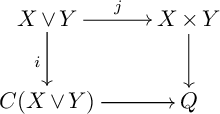
be the inclusion map. The smash product Q of X and Y, denoted as
 $X\wedge Y$
, is obtained from the pushout square (see Figure 1).
Figure 1

Here
 $C(X\vee Y)$
denotes the cone of
 $X\vee Y$
and
 $i:X\vee Y \to C(X\vee Y)$
is the natural inclusion.
Definition 2.4 (Suspension).
For any space A, define the reduced suspension
 $\sum A$
to be the identification space
 $$ \begin{align*}A\times I/(A\times \{0\}\cup \{\ast\}\times I \cup A\times \{1\}).\end{align*} $$
Definition 2.5. For a space B with a marked point
 $\ast $
, the loop space
 $\Omega B$
based at
 $\ast $
is the subspace of
 $B^I$
consisting of all paths l in B such that
 $l(0)=\ast =l(1)$
. The loop space
 $\Omega B$
has the subspace topology of the space of paths
 $B^I$
with the compact-open topology.
2.2 Group theory background
All the groups considered here are finitely presented.
Definition 2.6. Let
 $P=\langle X|| R \rangle $
be a presentation of a group. Then deficiency of P, denoted as
 $\operatorname {Def} P$
, is defined as the number of generators minus the number of relations, i.e.,
 $|X|-|R|$
.
The deficiency of a finitely presented group denoted as
 $\operatorname {Def} G$
, is defined as
 $$ \begin{align*}\operatorname{Def} G=\max_{P} \operatorname{Def} P.\end{align*} $$
A presentation P of a group G is called minimal if
 $\operatorname {Def}(G)=\operatorname {Def} P$
.
For a group G, let
 $d(G)$
denote the minimal size of a generating set for G. The homology groups
 $H_{\ast }(G)$
are implicitly taken with trivial
 $\mathbb Z$
-coefficients, where
 $H_{\ast }(G)=H_{\ast }(K(G,1))$
. In particular, the abelianization
 $G/[G,G]$
is isomorphic to
 $H_1(G)$
.
The deficiency of a group G is bounded above by (see [Reference Gardam11, §2])
 $$ \begin{align} \operatorname{Def}(G)\leq rk(H_1(G))-d(H_2(G)), \end{align} $$
where
 $rk$
denotes the torsion-free rank of an abelian group:
 $rk(G)=rk_{\mathbb Q}(G\otimes \mathbb Q)$
.
If a group achieves equality in 2.1, then it is called efficient.
Definition 2.7. Let
 $\mathcal {G}_p$
denote the class of finite p-groups G such that G is efficient and admits a minimal presentation.
Remark 2.8. Note that not every finitely generated group possesses a minimal presentation. See [Reference Bieri, Cornulier, Guyot and Strebel5, Remark 5.15] for details.
Lemma 2.9 [Reference Gardam11, Lemma 3].
Let
 $G,H\in \mathcal {G}_p$
then
 $G\times H\in \mathcal {G}_p$
.
Definition 2.10. Define groups by the presentations
 $$ \begin{align*}A_p:=\langle a,b~|~a^p=b^p,~[a,b]=a^{p}\rangle\end{align*} $$
 $$ \begin{align*}B_p:=\langle a,b~|~a^p,~b^p,~[[a,b],a],~[[a,b],b] \rangle\end{align*} $$
 $$ \begin{align*}C_p:=\langle a~|~a^p \rangle\end{align*} $$
except when
 $p=2$
, where we define
 $B_2:=\langle a,b~|~a^4,~b^4,~(ab)^2,~(a^{-1}b)^2\rangle $
.
Lemma 2.11 [Reference Gardam11, Lemma 5].
 $A_p,B_p,$
and
 $C_p$
are all elements of
 $\mathcal {G}_p$
and above presentations are minimal.
Proposition 2.12 [Reference Gardam11, Theorem A].
Let p be a prime and
 $n\in \mathbb N$
. Then there are natural numbers
 $r,s,$
and t such that the finite p-group
 $A_p^r\times B_p^s \times C_p^t$
has deficiency
 $-n$
.
We denote the sub-class of negative deficiency groups in
 $\mathcal {G}_p$
by
 $\mathcal {G}^-_p$
.
Example 2.13. Here are some examples and non-examples of groups that lie in
 $\mathcal {G}^-_p$
.
-
1. Proposition 2.12 gives a large class of examples of groups in
$\mathcal {G}^-_p$
. -
2. As
$C_p\in \mathcal {G}_p$
, from Lemma 2.9, it follows that the group
$G=(\mathbb Z/p\mathbb Z)^n\in \mathcal {G}_p$
. One can easily show that for the groups
$G= (\mathbb Z/p\mathbb Z)^n$
where p is prime and
$n>1$
$d(H_2(G))\neq 0$
. So
$\operatorname {Def} (G)=- d(H_2(G))<0$
and so
$G\in \mathcal {G}_p^-$
. -
3. Theorem 1.1 gives many examples of topological spaces whose fundamental groups do not lie in
$\mathcal {G}^-_p.$


For a finitely presentable group G with a presentation P, let
 $X_P$
denotes the presentation complex as mentioned in Section 2.2.
2.3 Results related to presentation complex and deficiency
Before proving Theorem 1.1, we give some preliminary results related to the presentation complex and deficiency of a group.
Proposition 2.14. If G is a finitely presented group with
 $\operatorname {Def} G<0$
, then rank of
 ${H_2(X_P;\mathbb Z)}$
is non-zero, for any presentation P of G.
Proof. Let
 $P=\langle g_{\alpha }~|~r_{\beta }\rangle _{\alpha \in A,\beta \in B}$
be a presentation of G and
 $X_P$
be the presentation complex of G with respect to P. Thus
 $X_P$
is a finite CW complex of dimension
 $2$
. As
 $\operatorname {Def} G<0$
we have,
 $|B|>|A|$
, here by
 $|Z|$
we mean the cardinality of Z. Let
 $X^i_P$
be the i-th skeleton for
 $X_P$
. Consider the portion of the homology long exact sequence for the pair
 $(X^2_P,X^1_P)$
with rational coefficient
 $$ \begin{align*}0=H_2(X^1_P;\mathbb Q)\to H_2(X^2_P;\mathbb Q)\to H_2(X^2_P,X^1_P;\mathbb Q)\to H_1(X^1_P;\mathbb Q) \to \ldots\end{align*} $$
Now
 $H_1(X^1_P;\mathbb Q)=\mathbb Q^{|A|}$
. Also as
 $(X^2_P,X^1_P)$
is good pair we have
 $$ \begin{align*}H_2(X^2_P,X^1_P;\mathbb Q)=H_2(X^2_P/X^1_P;\mathbb Q)=\mathbb Q^{|B|}.\end{align*} $$
Therefore, as
 $|B|>|A|$
, after passing to
 $\mathbb Q$
-coefficients the map
 $$ \begin{align*}\mathbb Q^{|B|}=H_2(X^2_P,X^1_P;\mathbb Q)\to H_1(X^1_P;\mathbb Q)=\mathbb Q^{|A|}\end{align*} $$
has non-zero kernel and this kernel is isomorphic to
 $H_2(X_P;\mathbb Q)$
. Thus, rank of
 $H_2(X_P;\mathbb Z)$
is non-zero.
Proposition 2.16. All finite connected CW complexes are homotopy equivalent to a CW complex with only one
 $0$
-cell.
Proof. Let X be a finite connected CW complex. Consider the
 $1$
-skeleton
 $X^1$
of X. Since X is path connected, the cellular approximation theorem shows that
 $X^1$
is path connected. We have finitely many
 $0$
-cells
 $\{x_i\}$
,
 $i=1,\ldots , m$
. If
 $m=1$
, we are done. If
 $m>1$
, there exists a path from
 $x_m$
to
 $x_1$
. Hence there must exists a closed
 $1$
-cell
 $e^1$
attached to
 $\{x_m\}$
and
 $\{x_i\}$
for
 $i<m$
. Clearly,
 $e^1$
is a contractible sub-complex of X with
 $0$
-skeleton
 $\{x_m,x_i\}$
, thus the quotient map
 $X\to X'=X/{e^1}$
is homotopy equivalence. The space
 $X'$
is a path connected CW complex with number of
 $0$
-cells
 $m-1$
. Thus, proceeding inductively, we get the desired CW complex with one
 $0$
-cell.
Corollary 2.17. Every connected finite CW complex of dimension
 $\leq 2$
is homotopy equivalent to a CW complex of dimension
 $\leq 2$
with a single 0-cell. Such a CW complex is a presentation complex.
Definition 2.18 (Connectivity).
The connectivity of a pointed space X is the maximal number
 $\operatorname {conn}(X)$
such that
 $\pi _i(X)=0$
for all
 $0\leq i\leq \operatorname {conn}(X)$
.
In this case, we say that X is
 $\operatorname {conn}(X)$
-connected.
Remark 2.19. We conclude with the following remarks.
-
1. For connected spaces
$X,Y$
one can show that
$\operatorname {conn}(X\wedge Y)\ge \operatorname {conn}(X)+\operatorname {conn}(Y)+1$
. -
2. Connectivity of the suspension is increased by one i.e., if X is n-connective then
$\sum X$
is
$(n+1)$
-connected. -
3. If X is n-connective then
$\Omega X$
is
$(n-1)$
-connected.


We now recall the Hurewicz theorem.
Theorem 2.20 (Hurewicz).
Let X be an
 $(n-1)$
-connected space for some
 $n \geq 2$
. Then the Hurewicz morphism
 $$ \begin{align*}h_n:\pi_n(X)\to H_n(X)\end{align*} $$
is an isomorphism. Moreover, the map
 $$ \begin{align*}h_{n+1}:\pi_{n+1}(X)\to H_{n+1}(X)\end{align*} $$
is an epimorphism.
Theorem 2.21. Let X, Y be CW-complexes with
 $\operatorname {conn}(X)=n$
and
 $\operatorname {conn}(Y)=k$
, where
 $n,k \geq 1$
. Then
 $$ \begin{align*}\pi_{n+k+1}(X\vee Y)\cong\pi_{n+k+1}(X)\oplus\pi_{n+k+1}(Y)\oplus (\pi_{n+1}(X)\otimes \pi_{k+1}(Y)).\end{align*} $$
Proof. For connected based spaces X and Y, there is a fibration up to homotopy (due to [Reference Ganea10, Theorem 2.2])
 $$ \begin{align*}\Sigma((\Omega X) \wedge (\Omega Y)) \to X\vee Y \to X\times Y \end{align*} $$
where the first map is the generalized Whitehead product.
Since we have
 $p\circ \imath $
and
 $q\circ \imath $
are both identity in:
 $$ \begin{align*}X\vee Y\overset{\imath}{\longrightarrow} X\times Y\overset{p}{\longrightarrow}X\subset X\vee Y\qquad\text{and}\qquad X\vee Y\overset{\imath}{\longrightarrow}X\times Y\overset{q}{\longrightarrow}Y\subset X\vee Y,\end{align*} $$
This gives a section of the map
 $X\vee Y \to X\times Y$
. As
 $X, Y$
both simply connected so is
 $X \vee Y$
and hence after looping once, the sequence splits (see [Reference Basu3, §1]) via section map, so
 $$ \begin{align*}\Omega (X\vee Y) \simeq \Omega X \times \Omega Y \times \Omega \Sigma ((\Omega X) \wedge (\Omega Y)). \end{align*} $$
The isomorphism we want to prove will follow by applying
 $\pi _{n+k}$
to this splitting. We only need to identify the term on the right.
Note that if X is n-connected and Y is k-connected (
 $n,k\geq 1$
), then
 $\Omega \Sigma ((\Omega X)\wedge (\Omega Y))$
is
 $(n+k-1)$
-connected by using Remark 2.19. Moreover, the map
 $$ \begin{align*}(\Omega X)\wedge (\Omega Y)\to \Omega \Sigma (\Omega X)\wedge (\Omega Y) \end{align*} $$
is
 $(2n+2k-1)$
-connected. In particular, it will induce an isomorphism on
 $\pi _{n+k}$
.
As
 $(\Omega X)\wedge (\Omega Y)$
is
 $(n+k-1)$
-connected, the Hurewicz Theorem 2.20 says that
 $$ \begin{align*}\pi_{n+k} ((\Omega X)\wedge (\Omega Y)) \cong H_{n+k} ((\Omega X)\wedge (\Omega Y)) \end{align*} $$
and the Künneth formula provides an isomorphism
 $$ \begin{align*}H_{n+k} ((\Omega X)\wedge (\Omega Y)) \cong H_n((\Omega X) \otimes H_k(\Omega Y). \end{align*} $$
Another application of the Hurewicz Theorem shows that
 $$ \begin{align*}H_n(\Omega X) \otimes H_k(\Omega Y) \cong \pi_{n+1}(X) \otimes \pi_{k+1}(Y). \end{align*} $$
Putting this all together, we obtain an isomorphism
 $$ \begin{align*}\pi_{n+k+1} (X\vee Y) \cong \pi_{n+k+1} (X) \oplus\pi_{n+k+1} (Y)\oplus \pi_{n+1}(X) \otimes \pi_{k+1}(Y). \end{align*} $$
Remark 2.22. We have the following remarks.
-
1. The above Proposition 2.21 gives information about the homotopy group only at a certain level.
-
2. When
$X,Y$
are simply connected having rational cohomology finite-dimensional at each degree, using the minimal model (see [Reference Sullivan27]) one can explicitly compute the rank of
$\pi _k(X \vee Y)$
for every
$k> 1$
. However, with this method, the torsion part is not captured.


3 Fenchel’s lemma
We begin by recalling an important definition.
Definition 3.1 (Multiplicity of fiber).
Let
 $f:X \to C$
be a surjective morphism from a smooth projective surface X to a smooth projective curve C. Let F be a fiber of f having irreducible components
 $F_{1},\dots ,F_{r}$
for some
 $r \in \mathbb {Z}_{>0}$
with multiplicities
 $m_{1},\dots ,m_{r}$
respectively. Thus scheme-theoretically F can be written as,
 $$ \begin{align*}F = m_{1}F_{1}+\ldots+m_{r}F_{r}. \end{align*} $$
The multiplicity of F is defined by, mult
 $(F)=gcd(m_{1},\dots ,m_{r})$
. The fiber F is said to be a multiple fiber if mult(
 $F)>1$
.
Theorem 3.2 (Fenchel’s Lemma).
Let C be a smooth irreducible quasi-projective curve. Let
 $p_1, p_2 , \ldots , p_r$
be distinct points on C and
 $m_1 , m_2 , \ldots , m_r$
be arbitrary integers
 $> 1$
, where we assume that if
 $C \cong \mathbb {P}^{1}$
then
 $r \geq 2$
and if further
 $r = 2$
then
 $m_1 = m_2$
. Then there is a finite Galois covering
 $\pi : D \rightarrow C$
which is branched precisely over
 $p_1, \ldots , p_r$
and the ramification index over
 $p_i$
is
 $m_i$
for each i. Also,
 $D \cong {\mathbb P}^1$
if and only if
 $r=2$
or 3 and if
 $r=2$
, then
 $m_1=m_2$
and if
 $r=3$
, then
 $m_1,m_2,m_3$
form a platonic triple; i.e.,
 $\frac {1}{m_1}+\frac {1}{m_2}+\frac {1}{m_3}>1$
.
Fenchel’s lemma will be used in conjunction with the following theorem crucially in what follows in the paper.
Theorem 3.3 (Ramified Covering Trick).
Let
 $f:X \to C$
be a surjective morphism from a non-singular projective surface to a non-singular projective curve with an irreducible general fiber F. Let
 $p_1, p_2, \ldots , p_r$
be the points on C such that
 $f^{-1}(p_i)$
has multiplicity
 $m_i>1$
and for any
 $p\in C$
other than any
 $p_i$
the multiplicity of the fiber
 $f^{-1}(p)$
is
 $1$
. We assume that if
 $C \cong \mathbb {P}^{1}$
then
 $r\geq 2$
and in case
 $r=2$
we have
 $m_1=m_2$
. Let
 $\pi : D \to C$
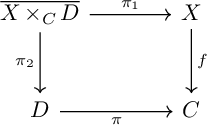
be as in Fenchel’s Conjecture. Then the following diagram (see Figure 2) commutes,
Figure 2

and the following assertions hold.
-
1. The normalized fiber product
$\overline {X \times _{C} D}$
is smooth. -
2.
$\pi _1 : \overline {X \times _{C} D} \to X$
is a finite Galois etale covering of X. -
3.
$\pi _2 : \overline {X \times _{C} D} \to D$
has no multiple fibers.


In [Reference Suzuki28], [Reference Gurjar12] the authors proved an important formula for the Euler–Poincaré characteristic of a smooth projective surface fibered over a smooth projective curve.
Theorem 3.4. Let
 $f:X\to C$
be a surjection morphism from a smooth projective surface X onto a smooth projective curve C such that a general fiber F of f is irreducible. Let
 $p_1,\ldots ,p_n$
be all the points in C such that f is not
 $\mathscr {C}^{\infty }$
-locally trivial in a neighbourhood of
 $p_i\;(1\leq i \leq n)$
. Then
 $$ \begin{align*}\chi(X)=\chi(C)\cdot \chi(F) + \sum\limits_{i=1}^{n}\left(\chi(F_i)-\chi(F)\right),\end{align*} $$
where
 $F_i:=f^{-1}(p_i)$
for
 $1\leq i \leq n$
.
Further, every difference in any bracket on the right-hand side of this equality is non-negative. If a difference
 $\chi (F_i)-\chi (F)=0$
, for some i, then F is isomorphic to an elliptic curve and
 $(F_i)_{red}$
is an irreducible (non-singular) elliptic curve.
Remark 3.5. If in the above lemma
 $\chi (F_i)-\chi (F)=0$
for every singular fiber
 $F_i$
, then the fibration f is elliptic and each
 $F_i$
is an irreducible curve which is multiple elliptic.
We also have the following result on the topology of elliptic surfaces from [Reference Friedman and Morgan9, II Theorem 2.3, II Lemma 2.3].
Theorem 3.6. Let
 $f: X\rightarrow C$
be a relatively minimal elliptic fibration. Let F be a general fiber of f. If f has at least one singular fiber with reduced structure or equivalently
 $\chi (X)>0$
, then the first map
 $\pi _1(F) \rightarrow \pi _1(X)$
is zero and if
 $\chi (X)=0$
and
 $g(C)>0$
then this map is injective.
Lemma 3.7. For a smooth projective surface X and a non-constant morphism
 $C \rightarrow X$
, where C is an irreducible projective curve, the map
 $H_2(C) \rightarrow H_2(X)$
is injective.
Theorem 3.8. Let M be a compact manifold of dimension n and let
 $K \subset M$
be a closed subset. Then
 $H^i(M,K) \simeq H^{n-i}(M-K)$
.
We also recall the well-known Nori Lemma relating fundamental groups of the base, total space and fiber in case of the fibration. (cf. [Reference Nori24]).
Theorem 3.9 (Nori’s Lemma; cf. [Reference Nori24, Lemma 1.5]).
Let X and Y be smooth connected complex algebraic varieties and
 $f: X \to Y$
a dominant morphism with a connected general fiber F. Assume that there is a codimension two subset S of Y outside which all the fibres of f have at least one smooth point (i.e.,
 $f^{-1}(p)$
is generically reduced on at least one irreducible component of
 $f^{-1}(p)$
for all
 $p \in Y\setminus S$
). Then the natural sequence,
 $$ \begin{align*}\pi_1(F) \to \pi_1(X) \to \pi_1(Y) \to (1)\end{align*} $$
is exact.
The proof of Nori’s Lemma shows that if the fibration f has the property that it has no multiple fibers, then too Nori’s lemma is valid. Also Nori’s Lemma is valid if X and Y are complex manifolds and f is a proper, holomorphic map.
4 Proof of the Theorems
4.1 Proof of Theorem 1.1
Proof. By assumption X is homotopic to a finite CW complex K of dimension atmost
 $2$
. From Corollary 2.17, we have K is homotopy equivalent to a CW complex of dimension
 $\leq 2$
with a single
 $0$
-cell, say
 $K'$
, which is also a presentation complex of
 $\pi _1(X)$
. Thus
 $\pi _1(X)=\pi _1(K)=\pi _1(K')$
. Since
 $H_2(K)=H_2(K')=0$
, it follows from Proposition 2.14, that Def
 $\pi _1(X)\geq 0$
.
4.2 Proof of Corollary 1.2
Proof. The first part follows immediately. If V is an affine surface, by the result in [Reference Hamm19], V is homotopic to a finite CW complex of dimension
 $\leq 2$
. The corollary then follows from Theorem 1.1.
We now come to the proof of Theorem 1.3 whose proof is a modification of the ideas in [Reference Gurjar13] and [Reference Gurjar and Pokale18].
4.3 Proof of Theorem 1.3
Proof. We begin by making an elementary but useful observation about how the universal cover of X is obtained. Firstly, by taking a suitable ramified covering of C we eliminate the multiple fibers (see Theorem 3.3). The pull-back fibration then continues to satisfy the same hypothesis as in the various parts of the theorem. Thus we assume without loss of generality that f has no multiple fibers. Let
 $C'$
be the universal cover of C. Since
 $g(C)>0$
,
 $C'$
is homeomorphic to
 $\mathbb C$
. Let
 $X' = C' \times _C X$
be the fibered product. Thus
 $X'$
is a (infinite-sheeted) covering of X and we have the projection
 $f': X' \rightarrow C'$
. The fibers of
 $f'$
map isomorphically onto the corresponding fibers of f. We continue to call F, the general fiber of the morphism
 $f'$
, by identifying it with its image in X. By applying Nori lemma to the fibration
 $f'$
, we see that the map
 $\pi _1(F) \rightarrow \pi _1(X')$
is surjective. Hence the inverse image
 $\widetilde {F}$
of F in
 $\widetilde {X} =\widetilde {X'}$
is connected. Let
 $\pi : \widetilde {X} \rightarrow X'$
be the universal covering map and let
 $\widetilde {f}:\widetilde {X} \rightarrow X' \rightarrow C'$
be the composite map. Thus
 $\widetilde {f}: \widetilde {X} \rightarrow C'$
is a fibration with connected general fiber. Now the map
 $\pi _1(F) \rightarrow \pi _1(X')$
factors through
 $\pi _1$
of any singular fiber of
 $f'$
. Hence for any singular fiber H of
 $f'$
, the map
 $\pi _1(H) \rightarrow \pi _1(X')$
is surjective, and hence the inverse image of H in
 $\widetilde {X}$
is also connected. Hence every fiber of the fibration
 $\widetilde {X} \rightarrow C'$
is connected, with the general fiber being a Riemann Surface; compact or non-compact depending on whether or not the induced map
 $\pi _1(F) \rightarrow \pi _1(X')$
is finite or infinite. Furthermore if D is a curve on
 $X'$
such the image of the the map
 $\pi _1(D) \rightarrow \pi _1(X')$
is finite (resp. infinite), then the inverse image of D in
 $\widetilde {X}$
splits into a disjoint union of compact (resp. non-compact) curves. The connected components of the inverse image of D in
 $\widetilde {X}$
are a principal set for the action of
 $\pi _1(X')$
and are in bijection with the cosets of the image subgroup of
 $\pi _1(D)$
inside
 $\pi _1(X')$
.
We now begin the proof of the theorem. Let
 $x_1,x_2\ldots $
be the countable set of points over which
 $f'$
and hence
 $\widetilde {f}$
has singular fibers. We can find a suitable covering
 $U_{1},U_{2},\ldots $
of
 $C'$
by closed squares (for example squares whose sides are parallel to axes in
 $\mathbb {R}^{2}$
) with the following properties,
-
1. The intersection of
$U_{i}, U_{j}$
for
$i \neq j$
is empty, one point or one of their common side. -
2. Any
$U_{i}$
contains at most one
$x_{j}$
in its interior. -
3. For any
$k= 1,2,\ldots $
the intersection
$(U_{1} \cup U_{2} \cup \ldots \cup U_{k}) \cap U_{k+1}$
is either a line segment or a union of two line segments meeting at one of their end points.


Let
 $V_{i}= \widetilde f^{-1}(U_{i})$
.
-
1. We wish to show that for all positive integers k,
$H_3(V_1 \cup \ldots \cup V_k)=0$
. If
$V_i$
doesn’t contain a singular fiber, then it has a deformation retract to a general fiber of
$\widetilde {f}$
, which is homeomorphic to
$\widetilde {F}$
, and hence two-dimensional and therefore
$H_3(V_i)=0$
. If
$V_i$
has a singular fiber (and hence a unique one),
$V_i$
deformation retracts to it and hence again for dimension reasons,
$H_3(V_i)=0$
. By induction, assume that
$H_3(V_1 \cup \ldots \cup V_k)=0$
. Now
$(V_1 \cup \cdots \cup V_k) \cap V_{k+1}$
is fiber bundle over a contractible base with fiber homeomorphic to
$\widetilde {F}$
. If
$\widetilde {F}$
is non-compact, then it follows that
$H_2((V_1 \cup \ldots \cup V_k) \cap V_{k+1})=0$
. Now a Mayer–Vietoris argument applied to the cover
$\{V_1 \cup \ldots \cup V_k;V_{k+1}\}$
shows that
$H_3(V_1 \cup \ldots \cup V_k \cup V_{k+1})=0$
. If
$\widetilde {F}$
is compact, then
$H_2(\widetilde {F}) \simeq \mathbb Z$
and by Lemma 3.7, the composite map
$H_2(\widetilde {F})\rightarrow H_2(V_{k+1}) \rightarrow H_2(X') \rightarrow H_2(X)$
is injective. In particular,
$H_2(\widetilde {F})\rightarrow H_2(V_{k+1})$
is injective. Hence the map
$H_2((V_1 \cup \ldots \cup V_k) \cap V_{k+1}) \rightarrow H_2(V_{k+1})$
is injective and so again the Mayer-Vietoris sequence applied to the cover
$\{V_1 \cup \ldots \cup V_k;V_{k+1}\}$
shows that
$H_3(V_1 \cup \ldots \cup V_k \cup V_{k+1})=0$
. -
2. Suppose
$\pi _1(F) \rightarrow \pi _1(X)$
is finite. If F has genus 0, then by the minimality of X, f and hence
$f'$
has no singular fibers and therefore
$f'$
and hence
$\widetilde {f}$
is a trivial fiber bundle and hence
$H_2(\widetilde {X}) \simeq \mathbb Z$
.


Now assume
 $g(F)>0$
. If f has no singular fibers, then it is a
 $\mathscr {C}^{\infty }$
-fiber bundle and hence by the long exact homotopy sequence
 $\pi _1(F) \rightarrow \pi _1(X)$
is injective, a contradiction. The map
 $\pi _1(F) \rightarrow \pi _1(X')$
has finite image and hence the fibration
 $\widetilde {f}$
has compact fibers. Fix k. Let
 $V=V_1\cup \ldots \cup {V_k}$
and let
 $W= V_{k+1}$
. Consider the Mayer–Vietoris sequence of homology associated to the pair
 $(V,W)$
,
 $$\begin{align*}\ldots \rightarrow H_{2}(V\cap W) \rightarrow H_{2}(V) \oplus H_{2}(W) \rightarrow H_{2}(V \cup W) \rightarrow H_{1}(V\cap W) \rightarrow \ldots \end{align*}$$
We wish to show that the map
 $H_2(V) \rightarrow H_2(V \cup W)$
is injective. Since
 $V\cap W$
is a fiber bundle over a contractible base (with a compact Riemann surface as fiber), it is actually a product and so
 $H_2(V\cap W) \cong \mathbb Z$
and generated by the class of
 $H_2(\widetilde {F})$
, where
 $\widetilde {F}$
is any fiber in
 $V \cap W$
(lying over the fiber F of
 $f'$
). It now suffices to show that the map
 $H_2(V \cap W) \rightarrow H_2(W)$
is non-zero. This will then force the map
 $H_2(V) \rightarrow H_2(V \cup W)$
to be injective, for then the kernel of the map
 $H_{2}(V) \oplus H_{2}(W) \rightarrow H_{2}(V \cup W)$
will only contain those pairs
 $(a,b) \in H_{2}(V) \oplus H_{2}(W)$
such that
 $b \neq 0$
whenever
 $a \neq 0$
.
If the map
 $H_2(V \cap W) \rightarrow H_2(W)$
is the zero map, then composing by the map
 $H_2(W) \rightarrow H_2(X)$
, we find that the composite
 $H_2(V \cap W) \rightarrow H_2(X)$
is the zero map. This implies
 $H_2(\widetilde {F}) \rightarrow H_2(X)$
is the zero map which is a contradiction, by Lemma 3.7. Thus we have shown that for any k, the map
 $H_2(V_1\cup \ldots \cup V_k) \rightarrow H_2(V_1\cup \ldots \cup V_{k+1})$
is injective.
Now
 $\chi (V \cup W) = \chi (V) +\chi (W) -\chi (V \cap W)$
. If W does not contain a singular fiber, then both W and
 $V \cap W$
deformation retract to
 $\widetilde {F}$
and hence their Euler characteristics are equal and hence
 $\chi (V \cup W) = \chi (V)$
. If W contains a singular fiber, then by Suzuki’s formula (see Theorem 3.4) and Remark 3.5 following it, it follows that the fibration f is not elliptic and that
 $\chi (W)> \chi (V \cap W)$
and hence
 $\chi (V \cup W)> \chi (V)$
. Continuing inductively and using the fact that
 $\widetilde {f}$
has infinitely many singular fibers, it follows that
 $\chi (V_1 \cup \ldots \cup V_n) \rightarrow \infty $
with n. It follows that
 $b_2(V_1 \cup V_2 \cup \ldots \cup V_n) \rightarrow \infty $
with n. Since the map
 $H_2(V) \rightarrow H_2(V \cup W)$
is injective for all k, it follows that
 $H_2(\bigcup V_n) = H_2(\widetilde {X})$
is infinitely generated. It was already proved in [Gur04] that
 $H_2(\widetilde {X})$
is free (see also Theorem 1.7). Thus
 $H_2(\widetilde {X})$
is free abelian group of infinite rank.
3a). In this case, the general fiber of
 $\tilde {f}$
will be a non-compact Riemann surface and hence the special fiber is also non-compact. Now with the notation as before, since
 $V\cap W$
has a deformation retract onto a non-compact Riemann surface,
 $H_2(V \cap W)=0$
. This implies that the map
 $H_2(V) \oplus H_2(W) \rightarrow H_2(V \cup W)$
is injective. By hypothesis, there are infinitely many singular fibers in the fibration
 $f'$
whose inverse image in
 $\widetilde {X}$
contain a compact component. Any W which contains such an inverse image of a singular fiber of
 $f'$
will have the property that
 $b_2(W)>0$
. The Mayer–Vietoris argument as in the proof of 2 above then shows that
 $b_2(\bigcup V_n) \rightarrow \infty $
with n. Hence
 $H_2(\widetilde {X})$
is free abelian of infinite rank.
3b). Under the given hypothesis, the irreducible components of the special fiber of
 $\widetilde {f}$
(if any) are all non-compact. The map
 $\pi _1(F) \rightarrow \pi _1(X)$
factors through
 $\pi _1$
of any singular fiber, say H of the fibration f. Hence the map
 $\pi _1(F) \rightarrow \pi _1(H)$
is injective. Since a tubular neighbourhood of H deformation retracts to H, it follows from the Nori sequence that
 $\pi _1(F) \rightarrow \pi _1(H)$
is surjective. Thus we conclude that
 $\pi _1(F)\rightarrow \pi _1(H)$
is an isomorphism. Suppose H is irreducible. Then
 $\chi (F)=\chi (H)$
and by Remark 3.5, it follows that f is an elliptic fibration, all the singular fibers of f are multiple elliptic and hence non-singular when taken with reduced structure. Suppose now f is a fibration with arbitrary genus general fiber and H is reducible. Then
 $\pi _1(H)$
is a free product of the fundamental groups of its irreducible components along with some copies of
 $\mathbb {Z}$
. Since
 $\pi _1(F) \simeq \pi _1(H)$
, it follows that
 $\pi _1(F)$
is also a free product of smaller subgroups along with some copies of
 $\mathbb {Z}$
. But since F is a compact Riemann surface, it is known that each of these subgroups is free, forcing
 $\pi _1(F)$
to be free, which is a contradiction. Combining the two cases, either f is an elliptic fibration with only (irreducible) multiple elliptic curves as singular fibers or a fibration having no singular fibers. If f is an elliptic fibration with only multiple elliptic curves as singular fibers, then by taking a suitable ramified covering of the base and taking fibered product, we get a finite covering of
 $X_1\rightarrow X$
, which admits an elliptic fibration without any singular fibers (taken scheme-theoretically). Hence by the long exact homotopy sequence, it follows that all the higher homotopy groups of
 $X_1$
, and hence of X, are zero. This implies that the universal cover
 $\widetilde {X}$
of X is contractible. If the fibration f has no singular fibers (scheme-theoretically) to begin with then again for the same reason
 $\widetilde {X}$
is contractible. This completes the proof.
Suppose now the map
 $\pi _1(F) \rightarrow \pi _1(X)$
is not injective:
We show that f has singular fibers when taken with reduced structure. We take two cases: Suppose the general fiber F of f is elliptic. Then as explained earlier, the singular fibers of f are either irreducible multiple elliptic curves or singular curves when taken with reduced structure. Suppose all the singular fibers are multiple elliptic curves. Then by Theorem 3.6,
 $\pi _1(F) \rightarrow \pi _1(X)$
is injective, contradicting the hypothesis. Thus there exists singular fibers which are not multiple elliptic and which are therefore singular even with reduced structure. Suppose now the general fiber of f is not elliptic, then by Remark 3.5, f not having singular fibers when taken with reduced structure implies that f is a
 $\mathscr {C}^{\infty }$
-fiber bundle and hence by the long-exact homotopy sequence,
 $\pi _1(F) \rightarrow \pi _1(X)$
is injective; a contradiction. Suppose now
 $\widetilde {X}$
is not contractible. Then since
 $H_1(\widetilde {X}), H_3(\widetilde {X})$
and
 $H_4(\widetilde {X})$
are all zero (see part 1), it follows that
 $H_2(\widetilde {X})$
is non-zero. Suppose now
 $H_2(\widetilde {X})$
is finitely-generated. We will arrive at a contradiction. For this we begin by making some observations.
Let G be the group of deck-transformations of
 $C'/C$
. G is thus isomorphic to the fundamental group of C. For any
 $\phi \in G$
, it follows easily that the pullback
 $\phi ^*(X')$
is again naturally biholomorphic to
 $X'$
. Thus any biholomorphism
 $\phi : C' \rightarrow C'$
over C lists to a biholomorphism
 $\phi ':X' \rightarrow X'$
over the map
 $\phi $
. Now by the lifting criterion for covering maps applied to the composite morphism
 $\phi ' \circ \pi :\widetilde {X} \rightarrow X' \rightarrow X'$
, it follows that
 $\phi '$
lifts to a biholomorphism
 $\tilde {\phi }:\widetilde {X} \rightarrow \widetilde {X}$
. Thus given any biholomorphism
 $\phi :C' \rightarrow C'$
over C and a lift
 $\phi ':X' \rightarrow X'$
of
 $\phi $
, there exists a biholomorphic lift
 $\widetilde {\phi }:\widetilde {X} \rightarrow \widetilde {X}$
of
 $\phi '$
.
Continuing with the proof, we cover the plane
 $C'$
by rectangles
 $U_i$
as defined at the start of the proof of the theorem. For any k, applying MayerVietoris sequence to the pair
 $(V_1\cup \ldots \cup V_k,V_{k+1})$
and observing that
 $((V_1\cup \ldots \cup V_k)\cap V_{k+1})$
is the total space of a fiber bundle with non-compact Riemann surfaces as fibers by assumption and therefore having vanishing second homology, it follows that
 $H_2((V_1\cup \ldots \cup V_k)\cap V_{k+1})=0$
. Thus
 $H_2(V_1\cup \ldots V_k)\oplus H_2(V_{k+1})$
injects inside
 $H_2(V_1\cup \ldots \cup V_k\cup V_{k+1})$
. Since all the irreducible components of the singular fibers of
 $ \widetilde {f}$
are non-compact by hypothesis, it follows that
 $H_2(V_{k+1})=0$
. Thus
 $H_2(V_1\cup \ldots V_k)$
injects inside
 $H_2(V_1\cup \ldots \cup V_k\cup V_{k+1})$
and the cokernel of this map injects inside
 $H_1((V_1\cup \ldots \cup V_k)\cap V_{k+1})$
and is thus, a free abelian group. Thus
 $\bigcup _k H_2(V_k)$
is an increasing union of free abelian groups with free cokernel at each stage and hence
 $H_2(\bigcup _k V_k)=H_2(\widetilde {X})$
is also free abelian.
Since
 $H_2(\widetilde {X})$
is finitely generated by assumption, for large enough k, the map
 $H_2(V_1\cup \ldots V_k) \rightarrow H_2(V_1\cup \ldots V_k\cup V_{k+1})$
is an isomorphism. Thus we can find a rectangle
 $R_1$
inside
 $C'$
with sides parallel to the axis, and which is a union of rectangles
 $U_1,U_2,\ldots ,U_k$
such that for any
 $l>k$
, the injective map
 $H_2(V_1\cup V_2\cup \ldots V_k)=H_2(\widetilde {f}^{-1}(R_1)) \rightarrow H_2(V_1\cup V_2\cup \ldots V_l)$
is an isomorphism. Further by assumption,
 $H_2(\widetilde {f}^{-1}(R))$
is a (free-abelian) group of finite, non-zero rank. Let
 $\widetilde {R_1}$
denote the inverse image of
 $R_1$
in
 $\widetilde {X}$
. It follows from the assumptions on
 $R_1$
that the natural (injective) map
 $H_2(\widetilde {R_1}) \rightarrow H_2(\widetilde {X})$
is an isomorphism. Since the action of G on
 $C'$
is properly discontinuous, there exists a translate
 $R_2 \subset C'$
of
 $R_1$
under an element
 $g\in G$
, which is disjoint from
 $R_1$
. Let
 $\widetilde {R_2}$
denote the inverse image of
 $R_2$
under
 $\widetilde {f}$
. Thus
 $R_2$
is a manifold with boundary, homeomorphic to
 $R_1$
. Let R be a rectangle which is a union of the rectangles
 $U_i$
described earlier such that both
 $R_1$
and
 $R_2$
are contained in the interior of R. Let
 $\widetilde {R}$
denote the inverse image of R under
 $\widetilde {f}$
. We will now argue that the injective homomorphism
 $H_2(\widetilde {R_1}) \rightarrow H_2(\widetilde {R})$
is not surjective, thereby contradicting the property of
 $R_1$
explained before.
The action of g lifts to the universal cover
 $\widetilde {X}$
and hence
 $g(\widetilde {R_1})=\widetilde {R_2}$
. Hence
 $H_2(\widetilde {R_1})\simeq H_2(\widetilde {R_2})\neq 0$
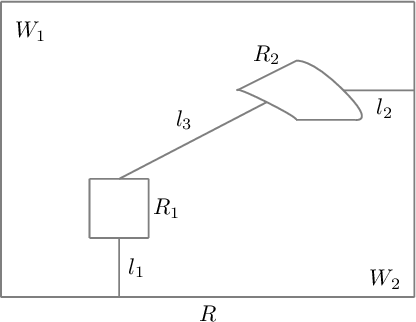
. We now choose Jordan arcs
 $l_1,l_2$
and
 $l_3$
(see Figure 1) in R with the properties that:
-
1.
$l_1$
is a Jordan arc joining a point on the boundary of
$R_1$
with a point on the boundary of R and such that no other point on
$l_1$
belongs to
$R_1$
or the boundary of R. -
2.
$l_2$
is a Jordan arc joining a point on the boundary of
$R_2$
with a point on the boundary of R and such that no other point on
$l_2$
belongs to
$R_2$
or the boundary of R. -
3.
$l_3$
is a Jordan arc joining a boundary point of
$R_1$
with a boundary point of
$R_2$
and such that no other in-between point on
$l_3$
belongs to
$R_1$
or
$R_2$
or boundary of R. We further assume that
$l_1$
,
$l_2$
and
$l_3$
are all disjoint. -
4. The fibers of
$f'$
over the points in
$l_1$
,
$l_2$
and
$l_3$
are all non-singular. This is possible since the singular fibers of
$f'$
are discrete. Thus the fibers of
$\widetilde {f}$
of points in
$l_1$
,
$l_2$
and
$l_3$
are non-compact Riemann surfaces. We can also assume that the fibers of
$f'$
over the points in the boundary of
$R_1$
and
$R_2$
are non-singular. -
5. Let B denote the subset
$R_1 \cup R_2 \cup l_1 \cup l_2 \cup l_3$
. The complement of B in R consists of exactly 2 connected components (each open in R). Let
$W_1$
and
$W_2$
denote their closures in R. Then
$W_i\cap B$
is homeomorphic to a closed and bounded interval in
$\mathbb {R}$
for
$i=1,2$
.


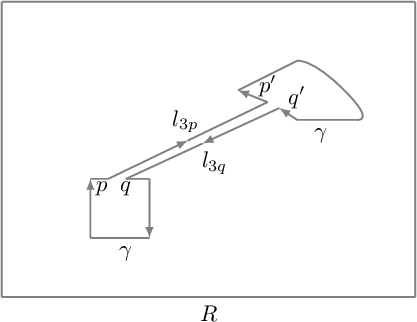
We briefly justify the existence of the figure (see Figure 3). These justifications are somewhat similar to geometrical arguments made in classical complex analysis (see Figure 4 below). We choose points
 $p,q$
on the boundary of
 $R_1$
which are sufficiently close to each other and points
 $p',q'$
on the boundary of
 $R_2$
which are close to each other such that there are Jordan arcs
 $l_{3p}$
and
 $l_{3q}$
joining p with
 $p'$
and joining q with
 $q'$
. The Jordan arcs
 $l_{3p}$
and
 $l_{3q}$
are close to each other and disjoint as shown. This gives us a simple closed curve
 $\gamma $
as shown. Then
 $\gamma $
is contained in the interior of R. Then
 $l_1$
and
 $l_2$
can be found satisfying conditions (1) and (2) as in classical complex analysis.
Figure 3

Let the image of B in the sphere obtained by identifying R with its boundary, be
 $\overline {B}$
. The long exact sequence for cohomology of pairs
 $(S^2,\overline {B})$
together with duality (Theorem 3.8) shows that the complement of
 $\overline {B}$
in
 $S^2$
has exactly two connected components, each of which is simply-connected. Now some easy topology shows that this implies that the complement of B in R also has exactly two connected components with their closures in R denoted
 $W_1$
and
 $W_2$
, and such that
 $W_1$
and
 $W_2$
are simply-connected. Since any subcomplex of
 $\mathbb R^2$
has zero second homology, the Mayer–Vietoris sequence for the pairs
 $(W_1,B)$
and
 $(W_2,B)$
shows that
 $H_1(W_1\cap B)=H_1(W_2\cap B)=0$
. Since
 $W_1\cap B$
and
 $W_2\cap B$
are 1-dimensional simplicial complexes, this implies that
 $W_1\cap B$
and
 $W_2\cap B$
are contractible. In particular this implies that any fiber bundle on
 $W_i \cap B$
is trivial. In fact a bit more work shows that
 $W_i \cap B$
are homeomorphic to a closed and bounded interval in
 $\mathbb R$
, but even the contractibility will do for us in the remainder of the proof (see Figure 4).
Figure 4

For any subset
 $S \subset R$
, we will denote its inverse image in
 $\widetilde {R}$
by
 $\widetilde {S}$
. Now
 $\widetilde {l_i} \rightarrow l_i$
is a fiber bundle with fibers having zero second homology and hence
 $$ \begin{align} H_2(\widetilde{l_i})=0. \end{align} $$
Also,
 $R_1$
(resp.
 $\widetilde {R_1}$
) is a deformation retract of
 $R_1 \cup l_1 \cup l_3$
(resp.
 $\widetilde {R_1} \cup \widetilde {l_1} \cup \widetilde {l_3}$
) and hence
 $H_i(\widetilde {R_1})\simeq H_i(\widetilde {R_1}\cup \widetilde {l_1}\cup \widetilde {l_3})$
and similarly,
 $$ \begin{align} H_i(\widetilde{R_2}) \simeq H_i(\widetilde{R_2}\cup \widetilde{l_2}\cup \widetilde{l_3}). \end{align} $$
Applying the Mayer–Vietoris sequence to the pair
 $(l_1\cup \widetilde {R_1}\cup \widetilde {l_3},~\widetilde {l_3}\cup \widetilde {R_2}\cup \widetilde {l_2})$
gives
 $$\begin{align*}H_2(\widetilde{l_3}) \rightarrow H_2(\widetilde{l_1}\cup \widetilde{R_1}\cup\widetilde{l_3}) \oplus H_2(\widetilde{l_3}\cup \widetilde{R_2}\cup\widetilde{l_2})\rightarrow H_2(\widetilde{B}). \end{align*}$$
By 4.1 and 4.2 above, it follows that
 $H_2(\widetilde {R_1}) \oplus H_2(\widetilde {R_2})$
injects inside
 $H_2(\widetilde {B})$
. Since
 $H_2(\widetilde {R_1}) \simeq H_2(\widetilde {R_2}) \neq 0 $
, this implies
 $H_2(\widetilde {B})$
is strictly bigger than
 $H_2(\widetilde {R_1})$
. To complete the proof, it will now suffice to prove that
 $H_2(\widetilde {B})$
injects inside
 $H_2(\widetilde {R})$
, thereby showing that
 $H_2(\widetilde {R})$
is strictly bigger than
 $H_2(\widetilde {R_1})$
, contradicting the assumption on
 $R_1$
.
By assumptions (4) and (5),
 $\widetilde {W_1} \cap \widetilde {B}$
is the total space of a fiber bundle over a base homeomorphic to an interval in
 $\mathbb R$
and with fibers having zero second homology and hence
 $H_2(\widetilde {W_1} \cap \widetilde {B})=0$
. Hence by the Mayer–Vietoris sequence applied to the pair
 $(\widetilde {W_1},\widetilde {B})$
, we find that
 $H_2(\widetilde {B})$
injects inside
 $H_2(\widetilde {W_1}\cup \widetilde {B})$
.
Now
 $(\widetilde {W_1}\cup \widetilde {B})\cap \widetilde {W_2}$
equals
 $\widetilde {B}\cap \widetilde {W_2}$
and is the total space of a fiber bundle over a base homeomorphic to a closed interval in
 $\mathbb R$
with fibers having vanishing second homology and hence
 $H_2((\widetilde {W_1}\cup \widetilde {B})\cap \widetilde {W_2})=0$
. Now a Mayer–Vietoris sequence for the pair
 $(\widetilde {W_1}\cup \widetilde {B},\widetilde {W_2})$
shows that
 $H_2(\widetilde {W_1} \cup \widetilde {B})$
injects inside
 $H_2(\widetilde {W_1}\cup \widetilde {B}\cup \widetilde {W_2})=H_2(\widetilde {R})$
. Combining everything, we find that
 $H_2(\widetilde {R_1})$
injects properly inside
 $H_2(\widetilde {R_1}\cup \widetilde {R_2})$
which in turn injects inside
 $H_2(\widetilde {R})$
proving therefore that
 $H_2(\widetilde {R})$
is strictly bigger than
 $H_2(\widetilde {R_1})$
. This contradicts the assumption on
 $R_1$
and hence completes the proof.
Corollary 4.1. As a consequence of part a) of the above theorem
 $\widetilde {X}$
is a Moore space
 $M(G,2)$
. Hence by the above, it is either contractible or of the homotopy type of an infinite wedge of 2-spheres. Hence we know the homotopy groups of
 $\widetilde {X}$
up to knowing them for
 $S^2$
.
Corollary 4.2. If X is a smooth projective variety with
 $b_2(\widetilde {X})$
non-zero of finite rank, then X cannot admit a positive genus fibration over a smooth projective curve of positive genus.
5 Remmert reduction
Let X be a smooth projective surface and
 $\widetilde {X}$
be its universal cover. Let us suppose, the universal cover
 $\widetilde {X}$
of X is holomorphically convex. Then
 $\widetilde {X}$
admits a canonical proper surjective, holomorphic map onto a normal Stein space with connected fibers, say
 $h: \widetilde {X} \rightarrow Y$
. This is called the Remmert reduction. Essentially h is obtained by contracting all the compact subvarieties in
 $\widetilde {X}$
to a point. If
 $\pi _1(X)$
is finite, then
 $\widetilde {X}$
is also projective and in this case Y is just a point. If
 $\pi _1(X)$
is infinite then
 $\widetilde {X}$
is non-compact and there are two possibilities: Either dim
 $Y=1$
in which case Y is a simply-connected Riemann surface, therefore homeomorphic to a disc, or dim
 $Y=2$
(Y may not be a manifold then) in which case f contracts a discrete set of curves to a point. Assume now that
 $\pi _1(X)$
is infinite. We wish to analyze how these compact curves occur in
 $\widetilde {X}$
. Let G be the deck transformation group. It acts freely and properly discontinuously on
 $\widetilde {X}$
. We consider two cases:
Case 1:
 $\dim Y=2$
. Let
 $C_1, C_2,\cdots $
be the disjoint, connected, compact curves that map to distinct points
 $p_1, p_2,\cdots $
in Y under h. Since
 $C_i$
is compact the subgroup
 $G_i$
of G keeping
 $C_i$
stable is finite. We know that the intersection form on the irreducible components of
 $C_i$
is negative definite. Then it follows that
 $C_i/G_i$
defines compact connected curves on X on which the intersection form is negative definite. Thus, if X has no curves with negative self-intersection then Case
 $1$
cannot occur. If Case
 $1$
occurs, we say the Remmert reduction on
 $\widetilde {X}$
is of the first kind.
Case 2: Y is a non-compact simply connected Riemann surface, hence biholomorphic to a disc or complex plane. Since h contracts precisely the compact irreducible curves in
 $\widetilde {X}$
to points and
 $\widetilde {X}$
has no compact horizontal curves with respect to h, the group of deck transformations, G, permutes the fibers of h. As in Case
 $1$
, for any fiber F of h the subgroup
 $G_F$
keeping F stable is finite. The group G of deck transformations descends to induce a group H of biholomorphisms of Y. Let K be the kernel of the surjection
 $G \to H$
. Then K keeps every fiber of h stable. Hence K is finite (since fibers of h are compact). If Case 2 occurs, we say the Remmert reduction on
 $\widetilde {X}$
is of the second kind.
One consequence of this is the following:
Suppose X is a
 $K(G,1)$
space. Then it follows from [Reference Gurjar and Pokale18, Lemma 6.2], that the Remmert reduction on X is of the second kind. By [Reference Gurjar, Gurjar and Hajra14, Lemma 3.4] or [Reference Milnor23] it follows that G has no finite subgroups. So
 $G \to H$
is an isomorphism. For a fixed fiber F of h, the subgroup
 $G_F \subset G$
keeping F stable is finite and hence trivial. Hence the action of G on
 $\widetilde {X}$
descends to induce an action of G on Y, which is moreover free and properly discontinuous. Let
 $C= Y/G$
. Then Y is the universal cover of the Riemann surface C. It follows that there is an induced fibration
 $f: X \to C$
such that
 $\pi : Y \to C$
is the universal cover and h is obtained by pulling back the fibration f to
 $\widetilde {X}$
via
 $\pi $
. In particular, C is compact. A general fiber of f is isomorphic to A general fiber of h, say F. Now an easy argument shows that
 $\pi _1(F) \to \pi _1(X)$
is trivial.
Now going back to the general case, suppose X is a smooth projective variety such that
 $\widetilde {X}$
admits a Remmert reduction
 $h:\widetilde {X} \rightarrow Y$
of the second kind. Let G be the deck transformations group. Then
 $\widetilde {X}$
is obtained as follows: As before, let K be the (finite) subgroup of the deck transformation group which stabilizes all fibers. Since
 $\widetilde {X}$
is simply-connected, all fibers of h have multiplicity 1. Let
 $H=G/K$
. H acts on the quotient
 $X'=\widetilde {X} /K$
and this action descends to an action on Y, which may not be free. The quotient
 $C=Y/H$
is a non-singular curve. The morphism
 $f': X' \rightarrow Y$
is H-equivariant and hence we get an induced quotient morphism
 $f: X \rightarrow C$
. The fibers of f can have multiplicity
 $>1$
. We analyze the relation between h and f a little more carefully: Let
 $X"$
denote the normalized fiber product
 $ Y \times _C X$
with projection
 $f" : X" \rightarrow Y$
.
 $X"$
is a non-singular, projective surface with the property that the covering map
 $\widetilde {X} \rightarrow X$
factors through
 $X"$
. Hence
 $X"$
is a covering of X and the fibration
 $X" \rightarrow Y$
has all fibers of multiplicity 1. The morphism
 $X' \rightarrow X"$
is a finite covering. Hence the fibers of
 $f'$
are finite unramified covers of the fibers of
 $f"$
and the fibers of h are finite unramified covers of the fibers of
 $f'$
.
Combining these argument we deduce that
 $h: \widetilde {X} \rightarrow Y$
is obtained as follows: Let
 $Y\rightarrow C$
be the holomorphic map obtained by composing the morphism in Fenchel’s conjecture (3.2) with the universal covering map of the base. We then take the normalized fiber product
 $X" =Y \times _C X$
. The projection
 $f": X" \rightarrow Y $
has the property that for a general fiber F of
 $f"$
, the image of the map
 $\pi _1(F) \rightarrow \pi _1(X")$
is finite. By taking a finite unramified cover of
 $X"$
(vertically), we get the univeral covering with its Remmert reduction
 $h: \widetilde {X} \rightarrow Y$
.
To summarize, we have the following theorem.
Theorem 5.1. Let X be a smooth projective surface with infinite fundamental group whose universal cover is holomorphically convex. Suppose the Remmert reduction on
 $\widetilde {X}$
is of the second kind. Then X admits a fibration
 $f: X \rightarrow C$
such that for a general fiber (and hence any fiber) F of
 $\pi $
, the induced map
 $\pi _1(F) \rightarrow \pi _1(X)$
is finite. If in addition, X is
 $K(G,1)$
surface, this induced map on
 $\pi _1$
is trivial.
Remark 5.2. In [Reference Eyssidieux, Katzarkov, Pantev and Ramachandran8] the authors have shown that if
 $\pi _1(X)$
admits a faithful complex linear representation, then (SC) is true.
Corollary 5.3. If X admits no fibration then Case
 $(2)$
cannot occur. This happens for instance if
 $Pic X$
is
 $\mathbb Z$
. But
 $Pic (X) = \mathbb Z$
implies X has no curves with negative self-intersection. Hence we deduce that if X is a smooth, projective surface with infinite fundamental group and
 $Pic (X)=\mathbb Z$
, then
 $\widetilde {X}$
is Stein.
We also make an observation when the Remmert reduction is of second kind and has low genus.
Theorem 5.4. Let X be a smooth, projective surface such that the universal cover
 $\widetilde {X}$
of X is holomorphically convex but not Stein and that the Remmert reduction
 $h: \widetilde {X} \rightarrow Y$
is of the second kind. Suppose the general fiber of h has genus
 $0$
, then there exists a fibration
 $f: X \rightarrow C$
and a universal covering map
 $\pi : Y \rightarrow C$
such that h is obtained by base change of f via
 $\pi $
. If the general fiber of h has genus 1, then there exists a fibration
 $f: X\rightarrow C$
and a holomorphic map
 $Y \rightarrow C$
such that the normalized fibered product
 $Y \times _C X$
is biholomorphic to
 $\widetilde {X}$
with the Remmert given by the first projection.
Proof. We continue to use notation as in the previous discussion. Suppose h is a
 $\mathbb {P}^1$
-fibration.
Since no non-trivial group can act freely on
 $\mathbb P^1$
, the subgroup K defined above is trivial. We get an induced
 $\mathbb P^1$
-fibration
 $f: X = \widetilde {X}/G \rightarrow C:= Y/G$
. Since
 $\mathbb P^1$
is simply-connected, f has no multiple fibers and
 $Y \rightarrow C$
is a covering. It follows that
 $\widetilde {X}= X\times _C Y$
and h is the base change of f via the covering
 $\pi : Y \rightarrow C$
. Thus unlike the general case discussed earlier, one does not have to normalize the fiber product and take further take a finite unramified cover.
Now suppose h is an elliptic fibration: Let
 $f:X \rightarrow C$
be the induced fibration discussed earlier. Let
 $Y \rightarrow C$
be the morphism as in Fenchels conjecture 3.2 followed by base change to the univeral cover of the base. The the normalized fiber product
 $X' = \widetilde {Y \times _C X}$
has the property that it is a complex manifold and the morphism
 $f': X' \rightarrow Y$
is a proper map with no multiple fibers. Since h has elliptic fibers, it follows that so does
 $f'$
. By [Reference Friedman and Morgan9, II Theorem 2.3, II Lemma 2.3], it follows that for a general fiber F of
 $f'$
, the homomorphism
 $\pi _1(F) \rightarrow \pi _1(X')$
has zero image and hence by Nori’s lemma 3.9, it follows that
 $X'$
is simply-connected and
 $f'$
is the Remmert reduction. Thus unlike the general case discussed earlier, one does not have to further take a finite cover of
 $X'$
to get the universal cover of X.
The preceeding discussions imply the following corollary.
Corollary 5.5. Let
 $f: X \rightarrow C$
be a morphism from a smooth projective surface to a smooth projective curve with
 $g(C)>0$
. Then the universal cover
 $\widetilde {X}$
of X is holomorphically convex but not Stein, if and only if the natural map
 $\pi _1(F) \rightarrow \pi _1(X)$
has finite image.
Proof of Theorem 1.6
Proof. If X has finite fundamental group then
 $\widetilde {X}$
is projective and hence by Poincare duality,
 $H_3(\widetilde {X})=0$
. If
 $\pi _1(X)$
is infinite and
 $\widetilde {X}$
is Stein, then X has a deformation retract onto a 2-dimensional CW complex and hence
 $H_3(\widetilde {X})=0$
. Suppose
 $\widetilde {X}$
is not Stein. Let
 $\pi : \widetilde {X} \rightarrow Y$
be the Remmert reduction. Y is a normal Stein space. Hence
 $H_3(\widetilde {Y})=0$
. We take two cases:
-
1. dim
$Y=2$
: There exists countably many curves
$C_i$
which get contracted to points
$\{p_i\}$
under
$\pi $
. Let
$U_i$
be small neighbourhoods of
$p_i$
in Y and let V be the complement of the union of
$p_i$
in Y. Then each
$U_i$
is contractible. Let
$U = \bigcup U_i$
. Then
$\{U,V\}$
form an open cover of Y. Let
$\widetilde {U}_i$
,
$\widetilde {U}$
and
$\widetilde {V} $
be the inverse images of
$U_i$
,
$U,$
and
$V,$
respectively, in
$\widetilde {X}$
. Then
$\{\widetilde {U},\widetilde {V} \}$
form an open cover of
$\widetilde {X}$
. Then the restricted map
$\widetilde {V} \rightarrow V$
is a biholomorphism and hence
$H_3(V)=H_3(\widetilde {V} )$
. Now
$H_3(U)=H_3(\coprod U_i) =0$
. Each
$\widetilde {U}_i$
has a deformation retract to a projective curve and hence for each i,
$H_3(\widetilde {U}_i)=H_3(\widetilde {U})=0$
. Likewise
$H_3(U \cap V) \simeq H_3(\pi ^{-1}(U\cap V))$
and
$H_2(U \cap V) \simeq H_2(\widetilde {U}\cap \widetilde {V} )$
. Now the Mayer-Vietoris sequences for Y (resp.
$\widetilde {X}$
) with open covers
$\{U,V\}$
(resp.
$\{\widetilde {U},\widetilde {V} \}$
) along with five-lemma show that the natural map
$H_3(\widetilde {X}) \rightarrow H_3(Y)$
is injective and so
$H_3(\widetilde {X})=0$
as well. -
2. dim
$Y=1$
: In this case Y is a 1-dimensional simply-connected Stein normal space and hence biholomorphic to
$\mathbb C$
. The proof of Theorem 1.3, part 1 then shows that
$H_3(\widetilde {X})=0$
.


Before proving Theorem 1.7 we prove a proposition which is helpful in proving Theorem 1.7.
Proposition 5.6. If M is a simply connected Stein manifold of complex dimension
 $2$
, then
 $\pi _i(M)$
is free for
 $i=2,3$
. In particular, the free rank of
 $\pi _i(M)$
is positive for
 $i\geq 2$
if M is not contractible.
Proof. As M is Stein so M is homotopic to a CW complex of dimension
 $\leq 2$
by [Reference Milnor23]. Also, by [Reference Colţoiu and Mihalache7, Theorem 3]
 $H_2(M;\mathbb Z)$
is free and
 $H_i(M;\mathbb Z)=0$
for
 $i \geq 3$
. As M is simply connected so
 $H_1(M;\mathbb Z)=0$
and
 $\pi _2(M) \cong H_2(M;\mathbb Z)= \mathbb Z^k$
where
 $k=b_2(M)\geq 0$
is the second Betti number, possibly (countably) infinite. So M is homotopic to the Moore space
 $M(\mathbb Z^k,2)$
. Using Proposition 2.2 we get
 $M \simeq \bigvee _{i=1}^k S^2$
.
-
1. If k is finite, by Proposition 2.21 we see that
$\pi _3 (M)$
is free. -
2. If k countably infinite:
For any infinite wedge
$X=\bigvee _{i\in I} X_i$
, the homotopy groups are just the colimit where F ranges over all finite subsets of I. For,
$$ \begin{align*}\pi_n(X)=\operatorname{colim}_F \pi_n\left(\bigvee_{i\in F} X_i\right),\end{align*} $$
$S^n$
is compact, so the image of any map
$S^n\to X$
must be contained in
$\bigvee _F X_i$
for some finite F; this means the natural map from the colimit to
$\pi _n(X)$
is surjective. Similarly, since
$S^n\times I$
is compact, any homotopy also lands in a finite wedge, so the natural map is injective.
The direct limit of an increasing union of free abelian groups having successive quotients also free is free and so applying 2.21, we find that
$\pi _3(M)$
is free even when k is countably infinite. For higher homotopy groups the statement holds by using Theorem 5.9.


Remark 5.7. As all connected, second countable manifolds have the homotopy type of a countable CW complex, their homotopy groups are countable.
Corollary 5.8. Let X be a smooth quasi-projective surface having a Stein universal cover. Then
 $\pi _3(X)$
is free.
For the proof of Theorem 1.8, we need to invoke the following theorem from homotopy theory whose proof follows from arguments in [Reference Hilton21], [Reference Sullivan27], [Reference Basu and Basu4].
Theorem 5.9. We have the following assertions:
-
1. The free rank of
$\pi _i(\bigvee _kS^2)$
is positive for
$i\geq 2$
, where
$\bigvee _kS^2$
denotes the wedge of k copies of
$2$
-spheres. -
2. The free rank of
$\pi _i(X)$
is infinite for
$i\geq 2$
, where
$X=\bigvee _{\infty } S^2$
denotes the countably infinite wedge of
$2$
-spheres.


Proof of Theorem 1.7
Proof. Suppose first that
 $\pi _1(X)$
is finite. Then
 $\widetilde {X}$
is simply connected closed real
 $4$
-manifold.
 $\pi _2(\widetilde {X})$
is free because
 $H_2(\widetilde {X};\mathbb Z)$
is finitely generated free. Then using [Reference Basu and Basu4, Corollary 4.10] one can see that
 $\pi _2(\widetilde {X})$
and
 $\pi _3(\widetilde {X})$
are free.
If
 $\pi _1(X)$
is infinite and
 $\widetilde {X}$
is Stein, then the freeness of
 $\pi _2$
and
 $\pi _3$
follows from Proposition 5.6. If
 $\widetilde {X}$
is not Stein but holomorphically convex and the Remmert reduction is of the second kind, then since
 $\widetilde {X}$
is non-compact, the base of the Remmert reduction is biholomorphic to the complex plane or the disc. Then the proof of Theorem 1.3 shows that
 $\pi _2(X) \simeq H_2(\widetilde {X})$
is free abelian. By Theorem 1.6,
 $H_3(\widetilde {X})=0$
and hence
 $\widetilde {X}$
is a Moore space
 $M(G,2)$
, where G is a free abelian group. Hence by the same argument as in 5.6, it follows that
 $\pi _2(X)$
and
 $\pi _3(X)$
are free abelian groups. Using Theorem 5.9 the rest follows. Suppose
 $\widetilde {X}$
is holomorphically convex and the Remmert reduction is of first kind. Let
 $h: \widetilde {X} \rightarrow Y$
be the Remmert reduction where Y is a 2-dimensional simply-connected Stein space. It was already shown in [Reference Colţoiu and Mihalache7, Theorem 3] that
 $\pi _2(Y) \simeq H_2(Y)$
is free. Let C be the union of the projective curves which have been contracted to a point under h. We consider the relative homology sequence associated to the pair
 $(\widetilde {X},C)$
.
 $$\begin{align*}0 \rightarrow H_3(\widetilde{X}) \rightarrow H_3(\widetilde{X},C) \rightarrow H_2(C) \rightarrow H_2(\widetilde{X}) \rightarrow H_2(\widetilde{X},C) \end{align*}$$
 $H_3(\widetilde {X},C) \simeq H_3(\widetilde {X}/C) \simeq H_3(Y)$
. Since Y has a deformation retract to a 2-dimensional CW complex,
 $H_3(Y)=0$
. Since C is a (possibly reducible) projective curve,
 $H_2(C)$
is free.
 $H_2(\widetilde {X},C) \simeq H_2(\widetilde {X}/C) \simeq H_2(Y)$
which is free. Since the subgroup of the free abelian group is free abelian, it follows that
 $H_2(\widetilde {X})$
is also free. Then as above, it follows that
 $\widetilde {X}$
is a Moore space
 $M(G,2)$
for a free abelian group G and hence again,
 $\pi _2(\widetilde {X})\cong \pi _2(X)$
and
 $\pi _3(\widetilde {X})\cong \pi _3(X)$
are free abelian groups. From Proposition 5.9 it follows that if
 $b_2(\widetilde {X})$
is finite (respectively infinite) the free rank of each higher homotopy group of X is positive and finite (respectively infinite).
Corollary 5.10. If X is a smooth projective surface not of general type then SC was proved in [Reference Gurjar and Shastri17]. Hence
 $\pi _3(X)$
can be calculated by identifying its universal cover with a suitable Moore space
 $M(G,2)$
.
Corollary 5.11. Let X be a smooth projective surface whose universal cover is biholomorphic to a bounded open set in
 $\mathbb C^2$
. Then
 $\pi _3(X)$
is a free abelian group.
Proof. This is because Siegel proved that in this case the universal cover of X is Stein and the proof follows from Proposition 5.6.
Corollary 5.12. Let
 $f: X \to C$
be a fibration from a smooth projective surface to a smooth projective curve such that either
-
1. The genus of the general fiber is 2 and
$b_1(X)> b_1(C)$
or -
2. The general fiber is hyperelliptic of genus at least 2 and all fibers are irreducible.

Then
 $\pi _3(X)$
is free.
Proof. Under the first hypothesis it was shown in [Reference Gurjar and Kolte15] that the universal cover of X is holomorphically convex. The same was shown in the case when X satisfies the second hypothesis in [Reference Gurjar, Paul and Purnaprajna16]. By Theorem 1.7, the result follows.
Proof of Theorem 1.8
Proof. Let
 $f: \widetilde {X} \rightarrow Y$
be the Remmert reduction onto a Stein normal space. If dim
 $Y=2$
, then there exists a discrete family of curves
 $C_i$
on
 $\widetilde {X}$
which are contracted to a point under
 $\pi $
. Since
 $\pi _1(X)$
is infinite, it follows that this collection of curves is countably infinite and are permuted by the deck transformation group. By Grauert’s theorem each of these curves has negative self intersection. We now show that the
 $C_i$
’s are independent in
 $H^{2}( \widetilde X,\mathbb {Z})$
.
Suppose not, after reordering the
 $C_i$
’s, let
 $\sum _{i=1}^{k} a_{i} C_{i} =0$
in
 $H^{2}(\widetilde X,\mathbb {Z})$
with
 $a_i \in \mathbb {Z}$
. Consider the exponential sequence on
 $ \widetilde X$
.
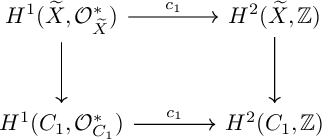
 $$\begin{align*}0 \rightarrow \mathbb{Z}_{\widetilde{X}} \rightarrow \mathcal{O}_{\widetilde X} \rightarrow \mathcal{O}_{\widetilde X}^{\ast} \rightarrow 0 \end{align*}$$
which induces a long exact cohomology sequence:
 $$\begin{align*}\ldots \to H^{1}(\widetilde X,\mathcal{O}_{\widetilde X}) \rightarrow H^{1}(\widetilde X,\mathcal{O}_{\widetilde X}^{\ast}) \rightarrow H^{2}( \widetilde X,\mathbb{Z}) \rightarrow \ldots. \end{align*}$$
Let L denote the analytic line bundle on
 $\widetilde {X}$
associated to the divisor
 $D = \sum _{i=1}^{k} a_iC_i$
. L defines an element in
 $H^{1}(\widetilde X,\mathcal {O}_{\widetilde X}^{\ast })$
whose image in
 $H^{2}(\widetilde X,\mathbb {Z})$
is
 $0$
.
 $L|_{C_1}$
defines an element in
 $H^1(C_1,{\mathcal O}_{C_1}^\ast )$
. Consider the commutative diagram (see Figure 5).
Figure 5

This shows that
 $c_1(L|_{C_1}) =0$
. But
 $c_1(L|_{C_1}) = C_1^2 <0$
. This contradiction shows that D defines a non-trivial element in
 $H^{2}(\widetilde X,\mathbb {Z})$
and hence
 $C_i$
’s define linearly independent elements in
 $H^{2}(\widetilde X,\mathbb {Z})$
. Hence
 $H^2(\widetilde {X},\mathbb Z)$
is infinitely generated. By the universal coefficient theorem,
 $H_2(\widetilde {X},\mathbb Z)$
is infinitely generated as well.
Suppose dim
 $Y=1$
. Then Y is a simply-connected normal one-dimensional Stein space and hence homeomorphic to
 $\mathbb C$
. The Remmert reduction
 $\pi : \widetilde {X} \rightarrow Y$
is a proper, holomorphic map with connected fibers. If
 $\pi $
has no singular fibers (scheme-theoretically), then
 $\pi $
is a
 $\mathscr {C}^{\infty }$
-fiber bundle and since the base Y is contractible, it is a product
 $Y \times F$
for some compact Riemann surface F. Since
 $\widetilde {X}$
is simply-connected, F is homeomorphic to
 ${\mathbb P}^1$
; a contradiction since X does not contain a
 ${\mathbb P}^1$
. If
 $\pi $
has singular fibers, but they are all homeomorphic, then by Theorem 3.4 stated earlier, it follows that
 $\pi $
is an elliptic fibration, with all fibers non-singular elliptic curves when taken with reduced structure. If
 $\pi $
has multiple fibers, then by base changing via a suitable non-trivial ramified covering of the base and normalizing, we get a finite unramified cover of
 $\widetilde {X}$
which contradicts simply-connectedness of
 $\widetilde {X}$
. Thus
 $\pi $
has no multiple fibers. Since
 $\pi $
has singular fibers as argued earlier, it follows by Theorem 3.4 that the Euler characteristic of the special fiber is greater than the Euler characteristic of the general fiber. The proof of Theorem 1.3, Case 2) then shows that
 $H_2(\widetilde {X})$
is infinitely generated.
Acknowledgements
R.V. Gurjar would like to thank IIT Bombay for a Visiting Professor position during this work. Sudarshan Gurjar would like to thank Max Plank Institute, Bonn for a visiting position where much of the work was done. Soumyadip Thandar would like to thank partially IIT Bombay Mathematics Department IRCC fellowship and TIFR postdoctoral fellowship during this work. We also thank the referee for critically reading the manuscript and pointing out a serious error in the earlier version.
Data availability statement
We do not analyze or generate any datasets, because our work proceeds within a theoretical and mathematical approach.