


Introduction
Post-traumatic stress disorder (PTSD) is precipitated by traumatic events in which an individual experiences horror, helplessness, or intense fear, and believes that serious injury or even death may occur. According to DSM-IV-TR criteria (APA, 2000), the condition is characterized by symptoms of re-experiencing, avoidance and hyper-arousal that last for more than 1 month. In comparison to other traumatic events, road traffic accidents (RTAs) occur frequently. For example, in the UK alone there were 189161 road accidents involving personal injury in 2006 (Department of Transport, 2008). The incidence of PTSD following RTA has been reported as varying between 7% and 40% (Mayou et al. Reference Mayou, Bryant and Duthie1993; Blanchard et al. Reference Blanchard, Hickling, Taylor, Loos, Forneris and Jaccard1996; Blanchard & Veazey, Reference Blanchard and Veazey2001), and relatively minor RTAs have been shown to have the potential to trigger PTSD (Koch & Taylor, Reference Koch and Taylor1995). The majority of people recover within a 3-year period. For example, Blanchard et al. (Reference Blanchard, Hickling, Taylor, Loos, Forneris and Jaccard1996) found a 48% remission rate at 6 months and only 33% of those initially diagnosed with PTSD still met criteria at 12 months. It is not uncommon for individuals with PTSD to have co-morbid depression and chronic pain (Blanchard & Veazey, Reference Blanchard and Veazey2001; Duckworth & Iezzi, Reference Duckworth and Iezzi2005). Consequently, affected individuals may not only suffer significant distress but also experience considerable disability and may be unable to drive or travel. Clearly, untreated RTA-related PTSD, can have a high economic cost (Chan et al. Reference Chan, Air and McFarlane2003), and there is an obvious need for effective interventions that can be delivered in a cost-efficient and timely manner.
Individual therapeutic approaches for PTSD have been widely studied and cognitive behavioural therapy (CBT) is an effective treatment (Bisson & Andrew, Reference Bisson and Andrew2005; NICE, 2005). Although there are relatively few studies that focus specifically on RTA-related PTSD, those available indicate that it responds well to CBT, although 24–50% of cases continue to meet diagnostic criteria at initial completion of treatment (Fecteau & Nicki, Reference Fecteau and Nicki1999; Blanchard et al. Reference Blanchard, Hickling, Devineni, Veazey, Galovski, Mundy, Malta and Buckley2003; Ehlers et al. Reference Ehlers, Clark, Hackmann, McManus, Fennell, Herbert and Mayou2003; Maercker et al. Reference Maercker, Zollner, Menning, Rabe and Karl2006). It is generally recommended that CBT for PTSD should involve exposure and cognitive restructuring and some studies have also incorporated relaxation training but with equivocal results (NICE, 2005). Exposure has been identified as being particularly effective, although there is some evidence that clinicians may have some resistance to actively implementing this aspect of successful treatment, possibly through fear of further distress to patients (Cahill et al. Reference Cahill, Foa, Hembree, Marshall and Nacash2006).
Since the inception of PTSD as a diagnostic entity, few studies have evaluated group therapy, and the majority of existing studies have been conducted with female survivors of sexual abuse or with Vietnam war veterans (Foy et al. Reference Foy, Glynn, Schnurr, Janowski, Wattenberg, Weiss, Marmar, Gusman, Foa, Keane and Friedman2000; Schnurr et al. Reference Schnurr, Friedman, Foy, Shea, Hsieh, Lavori, Glynn, Wattenberg and Bernardy2003). Although there is some evidence that trauma-focused group CBT may have advantages over non-trauma-focused group treatment (Schnurr et al. Reference Schnurr, Friedman, Foy, Shea, Hsieh, Lavori, Glynn, Wattenberg and Bernardy2003), the results from the existing literature are somewhat equivocal and suggest that further evaluation is required (NICE, 2005). Indeed, many elements of CBT lend themselves well to group presentation, and as such have been widely adapted in practice for the treatment of other psychological conditions (Free, Reference Free1999), although implementing exposure presents a specific problem insofar as there are risks of triggering the re-experiencing of symptoms, secondary retraumatization and patients becoming embarrassed or even ashamed. However, if these difficulties can be overcome group therapy offers not only a potentially efficient treatment solution, but also an opportunity for normalization and support, which in itself warrants further investigation.
Only two published case reports of group-based CBT for RTA-related PTSD are available in the extant literature (Taylor et al. Reference Taylor, Fedoroff, Koch, Thordarson, Fecteau and Nicki2001; Beck & Coffey, Reference Beck and Coffey2005). Taylor et al. (Reference Taylor, Fedoroff, Koch, Thordarson, Fecteau and Nicki2001) report on the outcome of several 12-session groups and found somewhat disappointing results with approximately just over one third of participants no longer meeting diagnostic criteria after treatment. There is sparse detail provided about the intervention other than that it covered the main aspects of CBT (psychoeducation, cognitive restructuring, applied relaxation, imaginal exposure, and in-vivo exposure), and it was not clear how these were adapted for group delivery. Beck & Coffey (Reference Beck and Coffey2005) report case-study data on one group with five female participants and found that the majority showed improvement, with three no longer meeting diagnostic criteria at completion of treatment. They provide information about the adaptation of their 10-session group, which was based on the guidelines of Blanchard & Hickling (Reference Blanchard and Hickling2004) and included exposure in the form of written disclosure.
Given the high number of RTA-PTSD referrals to health-care providers, we saw a need to develop and evaluate CBT group therapy for such survivors and have developed such interventions over the last few years (Thompson et al. Reference Thompson, Wilde and Doyle2002). The aims of the present pilot study were to conduct a preliminary investigation of the effectiveness of this approach and to report on some of the special considerations needed to adapt CBT for group delivery in this context.
Method
Participants
Participants were sought through advertisements sent to four community mental health teams covering the mental health needs of Barnsley, South Yorkshire, UK. Inclusion criteria were (i) PTSD associated with a RTA; (ii) willingness to participate in fortnightly group treatment; (iii) fluency in English. Exclusion criteria were (i) significant substance abuse likely to preclude active participation; (ii) serious head injury; (iii) personality disorder.
Twenty-four referrals were received for the group and of those 11 indicated an interest in the group treatment. Participants who opted in were invited for an assessment interview where the inclusion and exclusion criteria were confirmed by one of the authors during a clinical assessment interview, which involved administration of a number of measures. All participants were consequently diagnosed as having PTSD. Six people, four females and two males were assessed as suitable and started the group; the mean age was 40 years (range 26–56). Fifty per cent of the group was in full-time employment and the remainder was receiving government social security benefits. Five of the participants were married and one was divorced, all had some form of social support. All participants had received physical injuries as a result of the accident, and two of the participants’ passengers had also suffered injuries. All participants had comorbid symptoms of depression and had moderate-severe symptoms of PTSD of more than 1 year's duration. It was not known if the participants were engaged in ongoing litigation. All six participants completed the group treatment.
Treatment protocol
The group was facilitated by three chartered clinical psychologists (the authors), who have developed the treatment protocol into a manualized format over several years (Thompson et al. Reference Thompson, Wilde and Doyle2002). All three therapists facilitated the first and final session, and all other sessions were led by at least two of the authors. The involvement of three therapists was a result of the interest of those involved but also allowed the smooth running of the sessions as they could be divided between the authors. The material covered by the group was based on protocols used in previous PTSD studies (Foa et al. Reference Foa, Rothbaum, Riggs and Murdock1991; Hickling & Blanchard, Reference Hickling and Blanchard1997, Reference Hickling, Blanchard, Young and Blake1999; Resick & Schnicke, Reference Resick and Schnicke1999), self-help literature (Herbert & Wetmore, Reference Herbert and Wetmore1999), and the clinical experience of the authors, and this resulted in 20 fortnightly 2-h sessions. Each session participants were provided with written material summarizing the session. Specific homework assignments were used and individual, written feedback was provided to the participants, thus the group had within it an element of individually focused intervention.
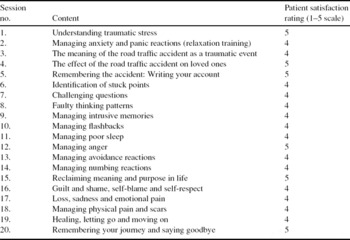
Each session had two parts: general discussion and feedback on the process of doing the out-of-session tasks (as opposed to the content), followed by focus on a specific topic (see Table 1). Tackling key areas of comorbidity were included within the later aspects of the group programme such as managing pain, overcoming guilt, shame, and low mood, as these have been identified as hindering recovery in complex cases of PTSD (Lee et al. Reference Lee, Scragg and Turner2001; Sharp & Harvey, Reference Sharp and Harvey2001). Shame is related to avoidance behaviour and is a common secondary affect in PTSD and may hinder intervention (Lee et al. Reference Lee, Scragg and Turner2001). Consequently, we believe that hearing from others that have experienced similar symptoms, can if handled sensitively, facilitate some challenging of shame-related cognitive thinking styles such as ‘over-personalization’. The main emphasis of the group was thus exposure, normalization or ‘de-shaming’ and cognitive restructuring. The contents of the sessions were as follows.
Overview of session content and accompanying satisfaction ratings

Managing shame and establishing the group as a safe working environment
Considerable early emphasis was placed on assisting the group members in forming a working supportive relationship with one another and our aim here was to create a supportive environment where individuals could work through exposure at their own pace whilst drawing on the support of their peers. There was open acknowledgement of the potential for group members to feel ashamed on disclosure of symptoms and a psychoeducational approach was taken to provide information on the nature and prevalence of PTSD in RTAs, with the aim of normalizing or ‘de-shaming’. Further, there was a specific session on identifying and challenging cognitions associated with both shame and guilt and group members were provided with techniques and support as to how to develop self-compassion (Gilbert, Reference Gilbert2005).
Exposure
The rationale for writing an account of the accident was provided early on and this aspect of the intervention often evolved at different paces for each participant. Participants were able to hand in their accounts and were provided with encouragement and written feedback on how to or what to continue to write about. Participants were encouraged to re-read their accounts outside of the session and to record their subjective distress on doing so. The experience of doing this was explored within the group.
Cognitive restructuring
The rationale for cognitive restructuring was also introduced early on and like exposure is the focus of ongoing intervention throughout the programme. Later on participants were also encouraged to view their accounts for ‘stuck thoughts’ and to develop alternative cognitions (Resick & Schnicke, Reference Resick and Schnicke1999).
Design
A pre- and post-questionnaire design was used. Group means were calculated for all of the measures used. The numbers were too small to allow statistical analysis at a group level. At an individual level Jacobson's Reliable Change Index (RCI; Jacobson & Revenstorf, Reference Jacobson and Revenstorf1988) was used to evaluate the significance of changes on the Post-traumatic Diagnostic Scale (PDS; Foa, Reference Foa1995). The RCI evaluates whether outcome change is greater than the change which would be expected on the basis of the error in the measure. Mean scores for the satisfaction questionnaire were calculated and thematic analysis conducted on the written responses.
Measures
Symptoms were assessed at the start of the group and at the end of the group with the Brief Symptom Inventory (BSI; Derogatis, Reference Derogatis1993), the Beck Depression Inventory – II (BDI-II; Beck et al. Reference Beck, Steer and Brown1995), the Inventory of Interpersonal Problems (IIP-32; Barkham et al. Reference Barkham, Hardy and Startup1996) and the PDS. Participants were considered to meet diagnostic criteria for PTSD on the PDS if they reported the minimum number of symptoms in each symptom cluster and reported at least two areas of their lives impaired as a result of the symptoms, and had a severity score of ≥15 (Foa, Reference Foa1995; Foa et al. Reference Foa, Ehlers, Clark, Tolin and Orsillo1999a).
Participants also anonymously completed a specifically developed satisfaction scale that asked about the helpfulness of each session using a 5-item scale. There were also questions asking the participants to write some details regarding the most and least helpful aspects of the group.
Results
Satisfaction
As shown in Table 1 the group reported finding all of the sessions ‘helpful’. All of the participants indicated that they intended to continue to use the techniques described in the sessions. During the group a metaphor of a ‘journey’ had been used and the satisfaction questionnaire asked participants to rate where they were on their journey on a 10-point scale (with 10 representing the end or recovery). The average rating was 7 and participants’ written responses to the question of ‘What were the most helpful part(s) of the group’, indicated:
‘Meeting other people that have been through the same things, writing an account’ and receiving information on PTSD.
All of the participants indicated that they found the balance between discussion and sharing information ‘very useful’. All participants indicated that they found writing their account very useful. The participants wrote ‘none’ or left blank the section in response to ‘What was the least helpful thing about the group’.
Outcomes
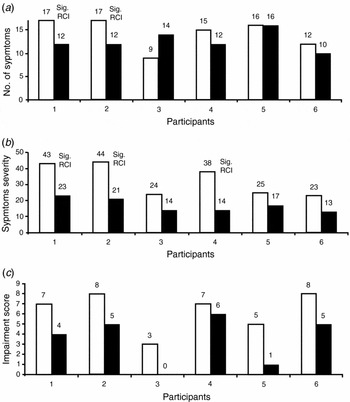
As a group, the number, severity and impairment of PTSD symptoms were reduced by the end of the treatment (see Table 2, Fig. 1). In addition, four of the group (67%) no longer met diagnostic criteria and the remaining two showed clinically significant change in both the number and severity of PTSD symptoms.
Pre- and post-group change on the Post-traumatic Stress Diagnostic Scale (PDS)

Individual Post-traumatic Stress Diagnostic Scale (PDS) scores for (a) number of symptoms, (b) symptom severity, and (c) impairment. □, Pre-group; ■, post-group. Reliable Change Index (RCI) indicated where significant.

Jacobson's RCI was used to evaluate the statistical significance of the individual participant's change on the PDS. Two participants showed a clinically significant change in both number and severity of symptoms and a further participant showed a significant change in symptom severity. It is not possible to calculate the RCI for impairment.
As a group, depression (BDI-II) reduced from the severe category (mean score 31.73) to the mild category (mean score 18.16) and the majority of symptom domains within the BSI were reduced, suggestive of a reduction in the presence of general psychiatric symptomatology. The mean group general severity index pre-group score (1.86) showed some decrease at post-group (1.60). However, the post-group scores remained indicative of ‘psychiatric caseness’. As a group the difference between the mean pre-group total IIP-32 score (1.49) and the mean post-group total score (1.45) suggested that there was only a minimal reduction in interpersonal problems.
Discussion
The preliminary analysis of this intervention suggests that group CBT therapy reduced the severity and associated impairment of chronic symptoms of PTSD and of comorbid symptoms of depression and two thirds of the group no longer met diagnostic criteria for PTSD. These results are comparable with the findings of individual trials. However, the majority of participants were still symptomatic at the completion of group treatment and two of them still met diagnostic criteria for PTSD. Consequently, taken with the findings of Taylor et al. (Reference Taylor, Fedoroff, Koch, Thordarson, Fecteau and Nicki2001), caution is still needed in considering the viability of group CBT for RTA-related PTSD in comparison to individual therapy. However, continuation of diagnostic status following treatment is also evident in individual trials of both RTA PTSD-specific CBT and CBT for other types of traumas, with intent-to-treat analyses showing between 35% and 47% of participants still meeting diagnostic criterion (Foa et al. Reference Foa, Dancu, Hembee, Jaycox, Meadows and Street1999b; Resick et al. Reference Resick, Nishith, Weaver, Astin and Feuer2002; Bryant et al. Reference Bryant, Moulds, Guthrie, Dang and Nixon2003).
The group was viewed as a ‘very helpful’ intervention by all the participants and all completed the treatment, whereas some trials of individual therapy have reported drop-out rates of around 25% (Blanchard et al. Reference Blanchard, Hickling, Devineni, Veazey, Galovski, Mundy, Malta and Buckley2003). Nonetheless, just over half of the people invited to consider attending the group chose not to opt-in to this form of intervention and clearly further exploration as to the reasons for its initial lack of appeal are needed. The use of exposure in the form of writing an account outside of sessions was viewed positively by participants, as was meeting other people with PTSD. This does lend some tentative support to the idea that it is possible to deliver exposure-based interventions within a group format in a supportive fashion that avoids re-traumatization.
The study was limited by small sample size and did not have a control condition, so caution is required in interpreting the findings. We cannot rule out that the changes were due to the intervention or to other factors such as maturation and history. Further, we did not assess for or address some of the known maintenance factors, such as ongoing litigation (Mayou et al. Reference Mayou, Ehlers and Bryant2002), which may have been hindering recovery. Last, whilst the RCI analysis was suggestive of clinically significant changes for three participants, caution is needed in interpreting RCI values because of the risk of regression to the mean (Morley, Reference Morley, Lindsay and Powell1994).
Despite the above limitations the preliminary evidence seems to justify further exploration of our group treatment approach, which could have benefits in terms of providing cost-effective treatment and which clearly has the potential to be acceptable to patients. Further research is required before group treatment can be advocated as an alternative to individual CBT.
Summary
-
• This study reports on the development of a CBT group intervention for chronic RTA-related PTSD and comorbid depression.
-
• The group had exposure and cognitive restructuring at its centre and was adapted to ensure this was safe for participants by facilitating the pacing of exposure and for individual support and guidance to be available.
-
• The participants valued the group support and reported high levels of satisfaction.
-
• Clinically significant change was evident in both symptoms of PTSD and depression and the majority of participants no longer met diagnostic criteria for PTSD at the end of the intervention.
-
• Given the limitations of this study, the number of sessions involved, and results of previous similar interventions, further research is clearly required to evaluate this form of group treatment before it can be can be advocated as an alternative to individual CBT.
Declaration of Interest
None.
Learning objectives
It is hoped that the reader will gain the following through reading this paper:
-
• Gain knowledge of the current research findings in relation to the treatment of RTA-related PTSD.
-
• Be able to consider the merits and inherent problems of developing group CBT interventions in this context.
-
• Understand the considerations needed to adapt individual elements of CBT (such as exposure) in order to avoid secondary traumatization and unhelpful triggering of re-experiencing of symptoms within the group.




Comments
No Comments have been published for this article.