Introduction
The increasing recognition of a need to prioritise healthy ageing as a global agenda is accompanying the trend of an ageing population (Salomon et al. Reference Salomon, Wang, Freeman, Vos, Flaxman, Lopez and Murray2012). This perpetual increase in life expectancy has resulted in a higher likelihood for older Australians to experience chronic and complex health conditions in later life (Department of Health and Ageing 2012: 15). While still in its infancy, the healthy ageing agenda has begun to tackle these issues, and drive health and social policy decisions in many nations (Peel, Bartlett and McClure Reference Peel, Bartlett and McClure2004; World Health Organization 2002). However, this agenda is yet to make a tangible impact on most existing models of care provision.
High levels of regulation in the aged care sector have resulted in limited competitive pressures, and a lack of incentive to innovate in response to emerging customer needs. This lack of responsiveness has left some customers feeling disempowered and with little choice in regards to care services in later life (Department of Health and Ageing Reference Christensen, Doblhammer, Rau and Vaupel2012). Amongst the more proactive governments facing these challenges, the Australian government has taken the initiative and launched the ‘Living Longer, Living Better’ aged care reform package; aiming to provide older Australians with more choice and control over care services in later life (KPMG International 2013: 40). In light of these changes driven by an ageing population, aged care providers are beginning to review the services they offer, and the ways in which these services are delivered.
Organisations in an aged care context are encouraged to employ operational models that depend on numerous stakeholders for the resources needed to deliver services to their customers (Weerawardena, McDonald and Mort Reference Weerawardena, McDonald and Mort2010), resulting in a tendency for providers to be reliant on government funding. Coupled with an increasingly savvy customer base discontented with the existing aged care offering, care providers often find themselves conflicted between responding to the needs of government and responding to the needs of their customers. Consequently, providers often have an unclear view of who the primary customer is, and how their needs can most effectively be addressed (Simons Reference Simons2010). Indeed, while providers struggle to adapt in this two-sided market, emerging customer needs remain unaddressed with customers seeking more choice and control over care services received in later life.
In exploring these challenges, the authors conducted a qualitative content analysis study of Australian aged care providers, with the Business Model Canvas (Osterwalder Reference Osterwalder2004; Osterwalder and Pigneur Reference Osterwalder and Pigneur2010) being used as the analysis framework. To the authors’ knowledge, this study is the first to use such a framework in an aged care context. This selection was made as the Business Model Canvas provides a framework for investigating how organisations create, deliver and capture value, and is established both academically and within industry. Through the study, the researchers sought to investigate: the common business model typologies utilised by aged care providers; the viability of existing aged care business model typologies; and the capacity of existing models of care in meeting the emerging needs of an ageing population. The study was conducted over a period of 24 months, and revealed that some providers of aged care are becoming increasingly concerned with emerging customer needs. Furthermore, it is likely that providers which remain complacent to impending changes in aged care and simply present an existing offering to market are unlikely to endure through this phase of industry reforms and shifting customer needs.
The paper proceeds as follows. First, relevant literature is reviewed, paying specific attention to the challenges and impacts of an ageing population on the provision of care in later life. Second, the primary research problem is explicated and the research design is outlined. Third, the organisations selected for analysis are presented and emergent typologies in the business models of aged care providers are identified. Fourth, the findings of the study are discussed, contributing a new model of care for an ageing demographic. Finally, the paper concludes with implications for practice and policy development, outlining directions for future research.
Current state of research
Literature concerning aged care often begins by addressing the global economic crises with the ageing population being at the forefront of each respective argument, and the emerging issue of fluctuating customer needs coming in at a close second (Mayhew Reference Mayhew, Stillwell and Clarke2011; Ratcliffe et al. Reference Ratcliffe, Laver, Couzner, Cameron, Gray and Crotty2010; Weerawardena and Mort Reference Weerawardena and Mort2001). Coupled with recent amplified commercialisation in aged care services, the increase of elderly consumers in the market has forced aged care providers to reconsider the way in which they operate (Walker Reference Walker2006). Providers are being challenged to pursue innovative ways of delivering aged care to their market in order to cope with an increase in market size along with new demands and expectations from consumers (Weerawardena and Mort Reference Weerawardena and Mort2001). Some organisations are responding by attempting to rely less on donations and grants and more on fees and contracts (Weerawardena and Mort Reference Weerawardena and Mort2001). However, this response does not truly address the issue at hand. Providers need to understand how customers make decisions in relation to choices about later living (Merlino and Raman Reference Merlino and Raman2013; Weerawardena and Mort Reference Weerawardena and Mort2001). In doing so, providers of care must understand family decision-making processes, dependency issues and preferences with regard to models of care in later life (Beatty and Talpade Reference Beatty and Talpade1994).
An increase in aged care customers has also attracted a number of private health insurers and private-sector aged care providers to the industry. Using existing models of staffing estimates (Hope et al. Reference Hope, Bamford, Beales, Brett, Kneale, Macdonnel and McKeon2012; King et al. Reference King, Mavromaras, Wei, He, Healy, Macaitis, Moskos and Smith2012), Australian for-profit, non-profit and government-owned aged care providers will need to increase their numbers threefold from roughly 250,000 staff presently to 800,000 staff mid-century to cope with the influx of consumers (Head Reference Head2013). However, an increase in workforce addresses only a single dimension of the emerging challenge (Richardson and Martin Reference Richardson and Martin2004). Current infrastructure and methods of delivering aged care are simply not capable of managing with rising demand and shifting customer preferences (Bury and Taylor Reference Bury and Taylor2008; Hope et al. Reference Hope, Bamford, Beales, Brett, Kneale, Macdonnel and McKeon2012).
Many current theoretical frameworks (Kaye, Butler and Webster Reference Kaye, Butler and Webster2003; Llewellyn et al. Reference Llewellyn, Balandin, Dew and McConnell2004; Rowe and Kahn Reference Rowe and Kahn1997; World Health Organization 2002) highlight the relevant dimensions for a positive ageing experience. These frameworks generally agree that amongst these dimensions are physical, mental, emotional, social and economic wellbeing. However, within each framework the emphasis rests on different dimensions of wellbeing, without consensus on which dimensions need to receive the greatest focus (Buys and Miller Reference Buys, Miller, Boulton-Lewis and Tam2012). Despite recent attention to care models that attempt to address more than an individual's health (King Reference King2007), their physical and mental wellbeing, the focus of care providers has continued to be the burden of old age (Bowling et al. Reference Bowling, Dieppe, Hanlon and Muirie2005), resulting in a model that is predominantly medical in nature (Bowling et al. Reference Bowling, Dieppe, Hanlon and Muirie2005: 1550).
Population ageing poses severe challenges and economic implications (Christensen et al. Reference Christensen, Doblhammer, Rau and Vaupel2009). Regardless of indications that successive generations are entering later life with greater health (Bury and Taylor Reference Bury and Taylor2008: 206), life expectancy is rising faster than healthy life expectancy, with working life expectancy remaining generally static (Mayhew Reference Mayhew, Stillwell and Clarke2011). In terms of the latter expectancy, so significant are the financial costs of an ageing society that terms such as demographic ‘time bomb’ have been used to express concern (Bury and Taylor Reference Bury and Taylor2008: 205). Keeping people independent and active as they age has enormous economic benefits (Mayhew Reference Mayhew, Stillwell and Clarke2011). Indeed, this justifies the focus of existing literature in the development of methods for increasing quality of living in later life (Kaye, Butler and Webster Reference Kaye, Butler and Webster2003; Llewellyn et al. Reference Llewellyn, Balandin, Dew and McConnell2004; Rowe and Kahn Reference Rowe and Kahn1997; World Health Organization 2002). However, little research explores the impact of these methods from an aged care business model perspective, and more significantly, the impact of these methods on the wellbeing of customers in later life.
An ageing population and reinventing government initiatives are widely discussed phenomena, yet their impact on models of aged care provision has remained relatively unexplored in an academic context. This paper explores these gaps by investigating the business models and value offerings of Australian aged care providers. Given the major changes implied by an ageing population and government reform initiatives, the research is exploratory and primarily focuses on aged care organisations’ value creation processes (Osterwalder and Pigneur Reference Osterwalder and Pigneur2010; Prahalad and Ramaswamy Reference Prahalad and Ramaswamy2004; Sok and O'Cass Reference Sok and O'Cass2011). As the research seeks to develop insights into the interrelated business model components of organisations, a qualitative research design based on content analysis was selected (Boillat and Legner Reference Boillat and Legner2013). The following section outlines the research objectives and approach.
Research objectives and approach
Under the scope of research, the authors sought to investigate Australian aged care providers’ value creation strategies, and to ascertain how a shifting customer demographic has impacted the business models of these providers. Through a longitudinal research approach, the authors explored aged care providers’ customer-facing elements, financial elements, resource base and value configuration. As the Business Model Canvas encompasses each of these elements it allowed the authors to approach this process systematically; providing a platform to compare the business models of providers and the ability to construct generalisable patterns from their business model configurations. Selection criteria were also developed rigorously to ensure the analysis holistically explored aged care in an Australian context.
Data selection criteria
Selection of aged care providers for analysis was determined through theoretical sampling (Van den Hoonaard Reference Van den Hoonaard and Given2008). Providers were chosen based on their offering to market, allowing for a diverse set of providers to be analysed. The criteria for the selection of providers were: (1) the provider's taxation status, (2) scope of the provider's offering, (3) size of the provider, and (4) geographical location of the provider.
To accommodate for variation across these criteria, the researchers selected:
-
1. A proportion of non-profit and for-profit providers representative of the aged care industry. Initially, this presented a ratio of 60 per cent non-profit to 40 per cent for-profit providers. However, as the study progressed additional for-profit providers were added to the sample. The for-profit providers were shown to be more innovative in their responses to change in the aged care industry, and therefore thought to be more informative in the context of this study.
-
2. Providers which represent the full spectrum of available aged care offerings. In achieving this, the study analysed providers that operate in only one of the common aged care work streams (retirement living, residential aged care and home care), as well as providers which offered each different combination of services amongst these aforementioned streams.
-
3. Providers with workforce and infrastructure sizes representative of the spectrum found in the Australian aged care industry, typically favouring medium to large-sized providers.
-
4. A selection of providers that operate in Australia. This included providers operating in one of the following states: New South Wales, Northern Territory, Queensland, South Australia, Tasmania, Victoria or Western Australia; as well as interstate providers that operate across several of these states, and international providers with Australian branches.
Data collection
A typical limitation of cross-sectional analysis is its implicit assumption that models are stable across both providers and time (Bowen and Wiersema Reference Bowen and Wiersema1999). Furthermore, analysis conducted at any one specific point in time is susceptible to either emphasise or marginalise fluctuating trends. In addressing these issues, the authors conducted a pooled cross-sectional analysis over a 24-month period, with each six-month period of the study presenting a pool of data. Comparing samples drawn at different times allowed the authors to capture changes in the offering of providers, identify emerging offerings by new entrants to market and more accurately assess temporary trends over the duration of the study.
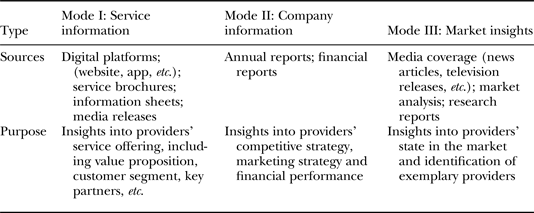
Three separate modes of data were collected from over 87 secondary sources (see Table 1 for types and Table 2 for breakdown). Data in Mode I focused on service information directly from the corresponding provider, Mode II consisted of organisational information found in annual and financial reports, and Mode III consisted of public media released by third parties. Having captured data across a diverse set of sources, the authors were able to increase the reliability and validity of the analysis by means of data triangulation (Thurmond Reference Thurmond2001).
Modes of data

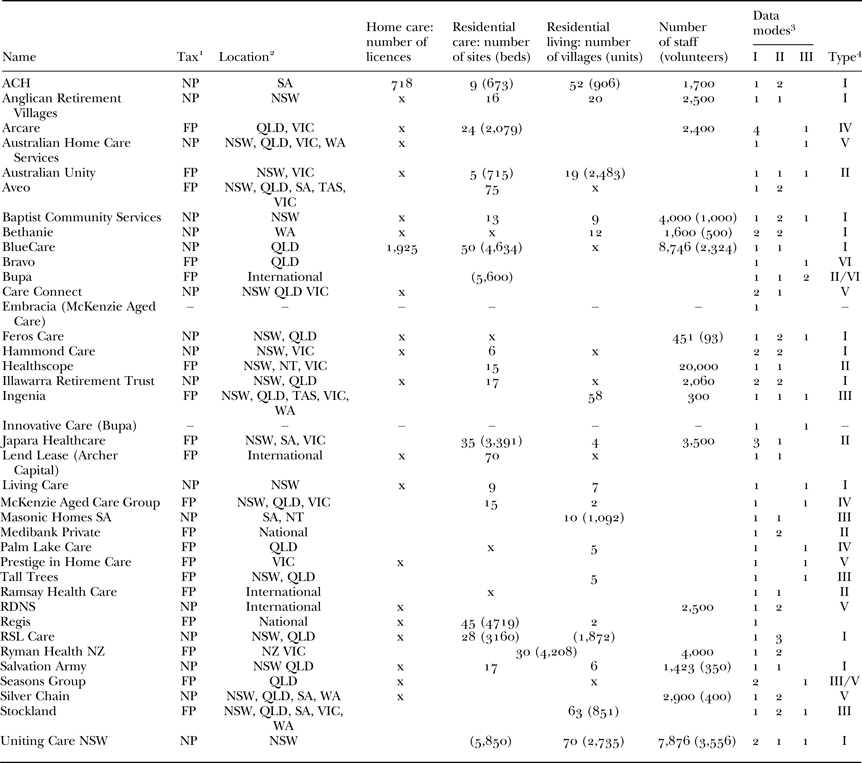
Organisations analysed

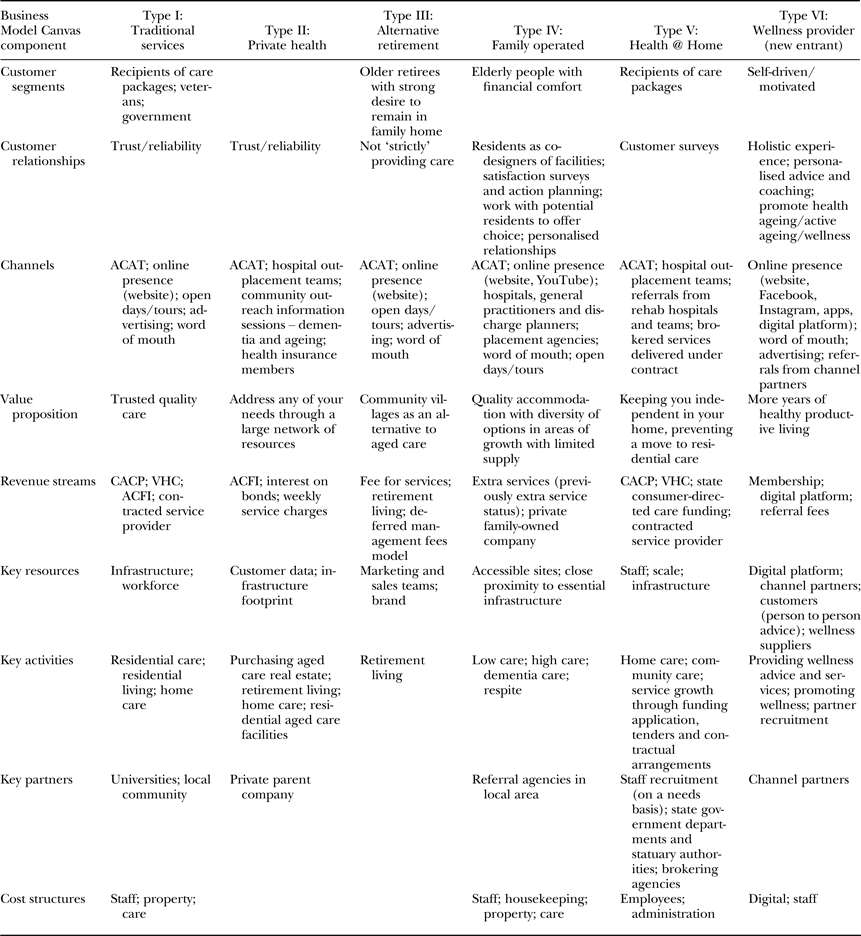
Aged care business model typologies

Notes: ACAT: Aged Care Assessment Team. CACP: community aged care packages. VHC: veterans’ home care. ACFI: aged care funding instrument.
Analysis framework
The research followed a deductive structured qualitative content analysis approach (Elo and Kyngäs Reference Elo and Kyngäs2008) utilising a predetermined categorisation matrix (Mayring Reference Mayring, Flick, Kardorff and Steinke2004). The matrix needed to be appropriate for systematically analysing how organisations create, deliver and capture value. For this purpose, the Business Model Canvas (Osterwalder and Pigneur Reference Osterwalder and Pigneur2010) was selected as the categorisation matrix. As with Bolliat and Lenger's (2013: 45) study, this selection was made on the basis of two factors. First, the nine business components featured in the canvas provide a holistic view of an organisation's architecture and strategy, comprising of elements found in most other business model frameworks. Second, the canvas is recognised in both industry and academia, and was established through a systematic ontological analysis of existing business model conceptualisations, and empirically validated by experts (Boillat and Legner Reference Boillat and Legner2013; Osterwalder Reference Osterwalder2004). Hence, in the context of this study, the nine business model components featured in the canvas are used to describe a business model. These nine components are described by Osterwalder and Pigneur (Reference Osterwalder and Pigneur2010: 20–40) as follows:
-
• The customer segments component comprises of the various groups of people or organisations an enterprise aims to reach and serve.
-
• The value proposition component outlines the bundle of products and services an organisation utilises to create value for its customer segments.
-
• The channels component describes the manner in which the organisation reaches and captures its customer segments in order to deliver its value proposition.
-
• The customer relationships component defines the types of relationships the organisation establishes with its customer segments.
-
• The revenue streams component represents how the organisation generates revenue from its customer segments.
-
• The key resources component identifies which assets are most significant in ensuring the business model is operational.
-
• The key activities component identifies which activities must be performed by the organisation for the business model to work.
-
• The key partnerships component outlines the network of partners and external suppliers needed by the organisation to make the business model work.
-
• The cost structure component describes the organisation expenditures in operating the business model.
Having selected a categorisation matrix, data were able to be coded in accordance with the predetermined categories featured in the matrix, and aspects of data which did not fall into the predetermined categories were able to be filtered out (Elo and Kyngäs Reference Elo and Kyngäs2008). A content-focused coding guide was developed so that data could be more precisely sorted into the categorisation matrix (Mayring Reference Mayring, Flick, Kardorff and Steinke2004).
Content analysis
Having developed a structured content analysis approach, the authors went about analysis of relevant secondary data. As the cross-sectional analyses were pooled, not all providers were analysed during the first phase of the study, with the original pool of data consisting of 19 aged care providers. The initial scope of work was structured to capture the state of the aged care industry during the onset of the study; specifically aiming to provide insights into common organisational methods for capturing value and identify similarities in the selected providers’ operational approaches.
Analysis was approached as follows. First, a general search of providers and offerings was conducted using the ‘My Aged Care’ online platform, a website established by the Australian Government in order to assist Australians in navigating the aged care system. The website offers a repository of information regarding the different types of aged care services available, eligibility in receiving these services, a search engine for finding local service providers, and estimated costs and fees associated with the aged care services. As this platform provided a comprehensive list of Australian aged care providers, its inbuilt search engine acted as the initial base from which providers were selected for analysis. Once a clearer picture of the state of market was established, providers were selected for analysis based on the selection criteria outlined in the previous section. For each provider, the authors sought to identify data under Modes I, II and III, with providers lacking a sufficient quantity of data for proper analysis being set aside and revisited during later stages of the study. The data were then sorted for coding in accordance with the categorisation matrix, and later compiled using the Business Model Canvas (Osterwalder and Pigneur Reference Osterwalder and Pigneur2010), with an individual canvas being utilised for each provider. Patterns were extracted from the canvases, allowing the authors to cluster providers into typologies. This process was repeated every six months across the duration of the study. Each subsequent cross-sectional analysis saw the authors incorporate additional providers into the study, and revisit providers analysed under previous sets.
Business model overview
The following section introduces the providers analysed under the scope of research, their organisational breakdown and the specific types of data analysed for each provider. Furthermore, the typologies derived from their operational approaches and value-creation strategies are presented and unpacked.
Provider selection
Over 37 providers were selected for analysis using the selection criteria. Providers were selected to be representative of two separate categories in terms of services rendered: providers which operate purely across either home care, residential care or residential living, and hybrid providers which operate across several of these streams. Additionally, providers were selected to be representative of size, to ensure a broad spectrum in quantity of staff employed and the number of sites in which services are delivered. The providers selected for analysis, along with their placement in terms of the selection criteria and typology allocation (see Table 3 for typologies), can be found in Table 2.
While analysis revealed a dynamic range of offerings amongst providers, many of the business model components remained consistent with very little differentiation. In some scenarios, little distinguished one provider from another apart from their geographical location. The most major shifts captured during the study were found in the language used by providers; particularly in their value proposition. For example, in their service offering terminology many aged care providers have begun to shift from a focus on care to a focus on wellness. This indicates that while providers are yet to address emerging customer needs fully, they are aware of shifting demands as a result of an ageing demographic.
Findings
Initial stages of research revealed that providers operating in the aged care industry can be categorised into one of five business model typologies, with a sixth typology segment emerging 18 months into the study. These typologies are outlined in Table 3, and further explained in the subsequent sections.
Traditional services
The traditional services typology represents a spectrum of aged care providers delivering traditional aged care services. These providers are often non-profit, charity based, have religious affiliations, and/or are funded and managed through a trust. They are often large, and use their size as a means of conveying their reliability and trustworthiness. However, from a logistical point of view their sheer size also acts as a barrier to innovation. As these organisations operate across most service streams, they are able to provide customers with a continuum of care through the various stages of life post-retirement. While they have the means to provide a continuum of care, they can often be restricted by process and regulations from doing so effectively. Furthermore, recipients of aged care often require care services at short notice, and have strong preferences in regards to location of services; resulting in limited competition between providers and little threat of displacement (Department of Health and Ageing 2012). Providers are then encouraged to compete on a geographical level based on catchment areas rather than an organisational scale.
Private health
This typology is formed of private health providers, notably larger than most aged care providers. Having diversified into the aged care industry, these organisations are considered as new entrants to market. As they do not operate purely in aged care, the majority of their activity can be seen to occur in private health care or insurance. These organisations possess large networks of resources which provide access to data on their customers’ health trends. As a result, they are able to make more informed decisions in regards to the services they offer to customers. Furthermore, having a larger footprint and considerable disposable assets allows them to grow at a much faster rate than aged care providers, usually through the acquisition of existing aged care real estate. For example, since entering the Australian aged care sector in 2007 (Australian Associated Press 2007), BUPA has become one of Australia's largest aged care providers (Allison Reference Allison2012; Urban Reference Urban2012) through the acquisition of various aged care providers such as Innovative Care. Five years after having entered the market, BUPA has grown beyond the size of one of Australia's larger aged care providers, RSL Care, which has spent over 75 years building its footprint. This aggressive entry into the market presents a huge risk to existing providers which cannot compete against BUPA's network of resources and extensive customer data.
Alternative retirement
What differentiates providers in this typology is their mission to be perceived as organisations which do not strictly deliver aged care. They provide a less clinical residential accommodation alternative for customers, primarily older retirees, who due to emerging circumstances cannot remain in their current accommodation. Due to stigma surrounding aged care, customers often find this option much more attractive than some of the more traditional alternatives. This typology veers away from a medically focused model, making it ill-suited for end-of-life care. However, this is often misinterpreted by customers who expect this accommodation to be a permanent, until end-of-life solution. This typology is reminiscent of a real-estate offering, with care services being delivered into sites through home-care providers as demand rises.
Family operated
Providers belonging to this typology are family owned, and often rely on key partners (such as construction agencies) to build facilities and deliver care services competitively. These providers are quite strategic with their placement of facilities, targeting areas of high growth with little existing supply. Through the provision of accommodation, food and services of a significantly higher standard, these providers are able to charge additional or higher fees for their services. Furthermore, due to their scope these providers are able to provide a more personalised customer relationship. While no longer the case under recent changes to regulation, Extra Service Status was previously integral to these providers’ strategies.
Health @ Home
Health @ Home providers strive to keep their customers healthy and independent in their own home. To accommodate this offering, these organisations specialise in home care, which can be quite difficult to operate competitively given Australia's geographical context. Interestingly, the home-care space is dominated by non-profit providers. The majority of this typology's customer base is derived from government packages, which are also delivered in various residential villages operated by other providers. In terms of preferences, home care is typically the service of choice as it allows many customers to prolong their time at home and maintain their lifestyle. While several of the typologies deliver home care, providers operating in this typology do not branch out into additional service streams.
Wellness provider
The wellness provider is an emerging segment which is becoming increasingly prevalent in several industries and had not been fully developed during initial stages of the study. The key difference between organisations sitting in this segment and organisations operating in both aged care and health care is their focus on all dimensions of wellbeing, rather than adopting a purely medical model. Additionally, a major part of many aged care providers’ customer base is derived from a captive audience which engages in aged care services due to a lack of alternate options. The wellness provision model focuses on motivated customers who have a desire and propensity to plan for the future, and have a higher level of financial comfort. Through an early engagement strategy, providers of wellness should be able to increase the healthy life expectancy of customers, delaying engagement with more traditional aged care services.
The wellness provider segment is not fully encompassed as an aged care typology, nor does it threaten an immediate impact to the market state. However, this segment presents significant long-term implications and a shift from a medically dominated model. While there exist very few providers operating in this space, some providers are taking the initiative to launch prototypes and digital applications that feature an offering that is reminiscent of that of the wellness supplier.
Business model configuration
Emerging typologies in the aged care sector indicate that traditional models for the provision of care have begun to align with emerging customer needs. Providers have begun to seek a better understanding of their customer, and question their value offered to market. The subsequent sections delve into the impact of emerging challenges in the aged care industry and illustrate the shifts exhibited by aged care providers’ business model configurations.
Typology evolution
The majority of typological shifts observed in the study were in relation to the value proposition expressed by providers, resulting in impacts to their target customer. Apart from the wellness provider emerging as an entirely new business model composition, most typologies remained fairly static throughout the study.
Customer segment
Across the six business model typologies outlined in the previous section, customers can be seen to exist within two separate groups. These groups are driven by the services customers receive, and then further defined by each customer's propensity to plan for the future, and their level of financial comfort. In terms of these criteria, customers who are motivated, prepared and financially equipped can be observed to incrementally engage in care services as they perceive future changes to their circumstances and needs; not as a result of a forced hand and a lack of alternatives. This represents the first group of customers, and the underlying reason that a ‘one-stop’ medical model will not see providers through shifting customer demands. Conversely, the second group of customers typically engages in care services as a result of a specific event, usually comprising of a rapid decline in health (such as a broken limb). As there is little to no notice under these scenarios, and customers are ill-prepared, they often find themselves restricted further beyond the traditional constraints in availability and proximity of care services. Given that providers of care are not funded to rehabilitate or improve the health of consumers, customers are then forced to continue engaging with the service provider, hence the ‘one-stop’ nature of the model.
However, increased consumer rights during respective generations have led to a customer base which is significantly more assertive in demanding that care services begin to prioritise wellbeing and quality of life (King Reference King2007: 202). Inevitably, this will result in major shifts to aged care providers’ service offering and customer base. Instead of delivering services which many see as negative or demoralising, providers will cater to an engaged market of customers seeking to lengthen their healthy life expectancy. With recent legislation aiming to provide customers with choice and control over where and how their funding is spent, it is easy to see why providers should cease being passive and begin to innovate and address these emerging needs.
Value proposition
The pooled cross-sectional analyses revealed that providers across each of the business model typologies have begun to shift their value proposition and offering in response to emerging customer demands. For some providers, initial stages of this change in offering have taken the form of extra fees for services; providing customers with more relevant services, and shifting from a reliance on government funding. However, the value proposition of providers is, to an extent, shaped by government funding as providers rely heavily on care (bed) licences to deliver services to market. Larger non-profit providers, such as those found in the traditional services typology, have been especially slow to adapt their value proposition to emerging customer demands when compared with their for-profit cousins. Moreover, family-operated providers and wellness providers were found to be more nimble in adapting their value proposition to address the prevalent challenges of aged care. This can be attributed predominantly to their smaller stature, and a higher degree of customer engagement and feedback practices.
Having acknowledged a shift in the customer demographic, providers of care have begun to take steps in pursuing a less medically oriented appearance in their business models. Instead of using supportive language which some customers find belittling, providers have opted to use more positive terms which are designed to stimulate or motivate their customers to be more engaged. This shift appears to be a façade, as there is yet to be a change in the services offered by providers. To address the emerging needs of customers, providers should look at wellbeing holistically rather than maintaining a focus on physical and mental wellbeing. Indeed, addressing their customers’ social and emotional wellbeing would result in increased independence and additional years of healthy and productive living for consumers of aged care. Shifting from a traditional model would also see providers aligning to a more significant portion of the market, where new models of care may emerge. While some wellness suppliers begin to explore this value proposition, their role in the aged care market is yet to be defined in full.
Channels
In terms of the Business Model Canvas, channels is the least diversified component in aged care provision. Online platforms, Aged Care Assessment Teams (ACATs), referrals and placement agencies account for the majority of channels utilised by aged care providers. Furthermore, consumers of aged care typically engage in services after having experienced a crisis or rapid decline in health and found their options to be lacking. This scenario presents both a captive audience and a negative interaction, leaving it primed for disruption.
Assuming a shift from a medical model of care, it would be also feasible for customers to engage with service providers in order to maintain their wellbeing and increase their healthy life expectancy at earlier stages of life. As this form of engagement is typically long term, it may inherently build a strong relationship between the customer and provider. At a time of crisis, or when the customer does eventually choose to engage in a more traditional aged care offering, they would likely consult their trusted advisor as opposed to a placement agency, allowing wellness providers to form a new channel for aged care provision. While this does not pose an immediate risk to providers, beginning to build strong relationships with their customers earlier in life would have significant long-term implications.
Discussion
In an Australian context, from 1990 to 2010 the average life expectancy and healthy life expectancy of the population increased by 4.6 and 2.7 years, respectively (Salomon et al. Reference Salomon, Wang, Freeman, Vos, Flaxman, Lopez and Murray2012: 2149). While this reflects additional years of life, it also reflects an increasing gap between life expectancy and healthy life expectancy. Prevailing literature discusses these two expectancies to great length, yet interestingly, does not provide a label for this ‘gap’: pernicious life expectancy. In narrowing the gap and decreasing the pernicious life expectancy of consumers, providers will be required to deliver services which increase healthy life expectancy, subsequently postponing initial engagement with traditional care services. This may have significant implications for providers of aged care, and provide an opportunity for providers to innovate the way they engage with their customers and other providers.
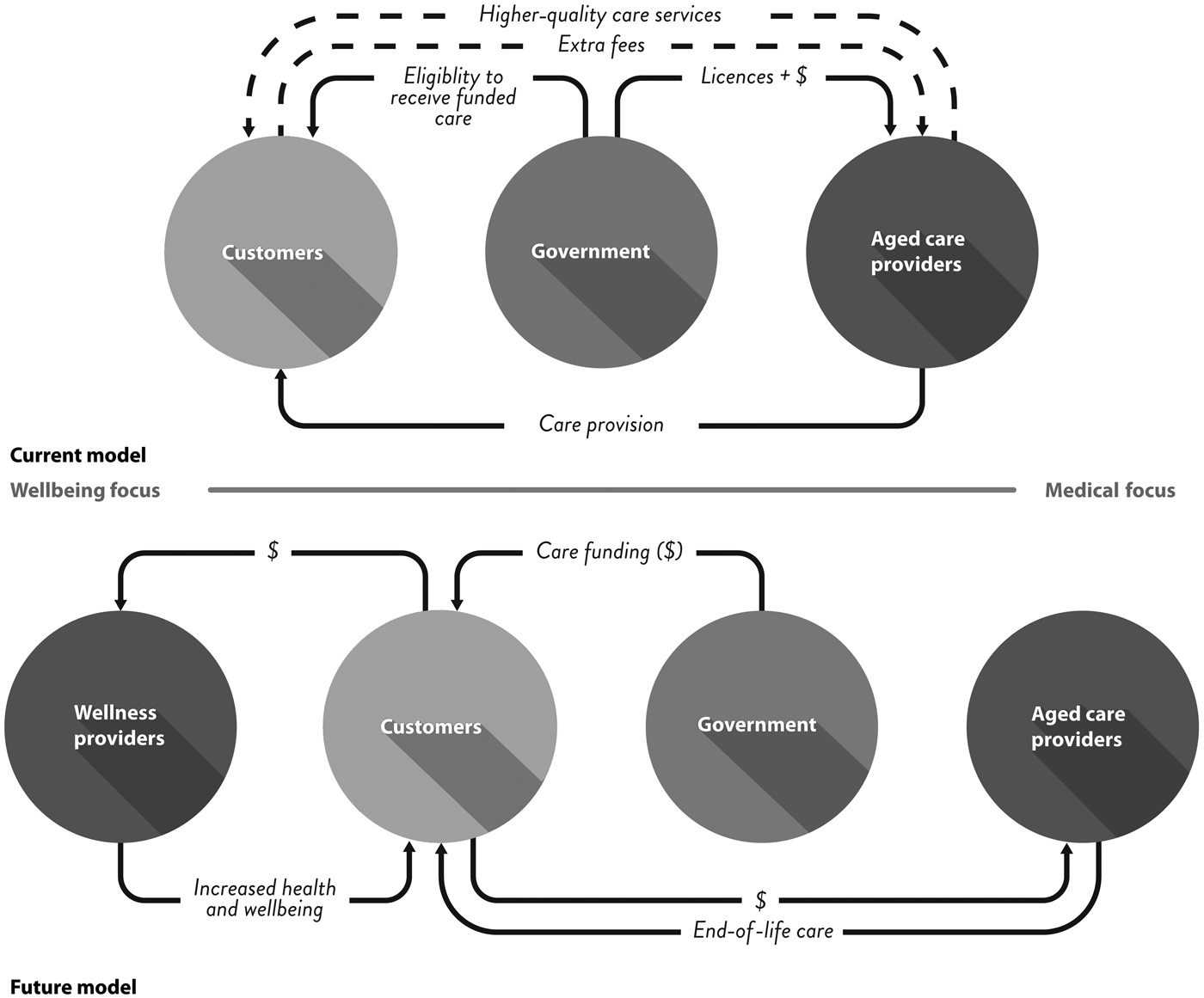
Under the existing highly regulated model of care (see Figure 1), the government acts as a middle man between customers and providers. Government determines who is eligible to receive funded care, customers are notified and prompted to select a provider, and providers deliver care funded by the government. As highlighted in prevailing literature, customers are often seen to be discontented with the generic offering, and choose to pay extra fees for a higher quality of care. While there exist numerous private providers, there are few instances in which the government does not play a role in the acquisition and funding of care. As a result, many providers see government as their primary stakeholder, and focus the majority of their time on responding to legislative demands, providing little incentive for providers to innovate and respond to the emerging needs of their customers. While providers in some typologies have been quick to respond to the emerging needs of their customers, most are yet to react.
Care models.

As highlighted in the literature review, many customers feel that they lack options or alternatives, and have little choice and control over the services they are provided. Recent legislative changes seek to address this issue, but do little to promote the healthy ageing agenda. A major impact of the reform package will be the manner in which customers are able to access funds. With increased control and transparency over how their funds are spent, providers will be more accountable for the quality of services delivered, driving competition within the sector and providing an opportunity for wellness providers.
The future model (see Figure 1) illustrates a notable impact to the existing aged care model in two ways. First, customers should have increased health and wellbeing as a result of engagement with wellness providers, and may engage in aged care services much later in life and for fewer years. Second, through an earlier engagement with customers these organisations should have the capacity to develop significant and enduring customer relationships, providing an opportunity for wellness providers to influence heavily which aged care organisations their customers engage with in later life. While the traditional model of care is likely to continue in the future, its predominant purpose will be providing end-of-life care. Failing to prepare for a shift in the customer relationship may also result in a diminished customer base for aged care providers who persist with only a traditional offering.
These changes also demonstrate an impending shift from a predominantly medical model to a model which explores its customers’ wellbeing holistically. Indeed, the pooled cross-sectional analyses revealed that providers have already begun to follow this trend in their public communications. While this shift is not yet evident in the value offering of providers, this is likely to change under the increasing popularity of healthy ageing. Such a model of care should also increase customers’ healthy life expectancy, allowing consumers to remain engaged and active in society well into their later years.
Limitations
One limitation of a study where secondary data are the major source is that the data may not contain full information on the organisations being studied. Some organisations may neglect to provide full information regarding their business models and other organisations may release information as a public relations exercise. To increase the reliability and validity of the findings further, empirical research on emerging business model typologies of aged care providers should be conducted in both a national and international context.
Conclusion and implications
Through a qualitative content analysis study, this paper investigated the impacts of an ageing population and regulatory changes to aged care providers’ business model typologies. Six overarching business model typologies were identified amongst aged care providers operating in Australia. While these six models cater to customers in the market, they do not align to the emerging customer needs stressed in literature. Furthermore, as observed in demographic trends (Mayhew Reference Mayhew, Stillwell and Clarke2011; Salomon et al. Reference Salomon, Wang, Freeman, Vos, Flaxman, Lopez and Murray2012), they do not address the increasing gap between consumers’ healthy life expectancy and life expectancy: their pernicious life expectancy.
In the face of an ageing customer demographic and increased demand to promote healthy ageing, providers of aged care are beginning to question their value creation processes and refine their offering to consumers. New entrants and forward-thinking organisations have begun to address this demand, driving providers to shift from a medically dominated model of care provision to one which explores all dimensions of wellbeing holistically. Building such a model of care will see providers addressing their customer as the primary stakeholder.
From a government perspective, this change would require a clear agenda in policy to promote healthy ageing. While recent changes to policy have seen the inclusion of criteria regarding the consumers’ economic status, the major focus of the existing model continues to be the consumers’ health and mental status, with little to no consideration for the consumers’ emotional and social wellbeing. To accommodate all relevant dimensions of their consumers’ wellbeing, policy criteria should be set to explore these additional dimensions. An appropriate place to begin would be inclusion of wellbeing criteria for ACATs prior to engagement with formal care services. While the ageing population and legislative changes are global phenomena, this paper focuses specifically on an Australian context. To broaden the scope of research, additional content analysis could be undertaken in an international context.
Markets are dynamic. Not only in aged care are organisations that remain static likely to falter and eventually fail. Innovation has been established to be an integral part of organisational success (McDonald Reference McDonald2007: 257–8). Yet in the context of care, innovation is frequently seen as a luxury or burden when it should be seen as a core activity (Mulgan and Albury Reference Mulgan and Albury2003: 5). However, in addressing emerging customer needs, providers of care have the opportunity to innovate their value propositions and underlying business models. Additionally, while it is clear that aged care services must begin to explore wellness holistically, to date, no research explores the balancing of each separate dimension of wellness in the provision of aged care. Inclusion of other dimensions of wellbeing into existing models of care will therefore need to be rigorously tested. In addressing this issue, providers of care will require tangible methods and guides for driving innovation within their respective organisations. This presents an opportunity for future research in providing structured frameworks for driving innovation in an aged care context.