INTRODUCTION
The crown-of-thorns (COT) sea star, Acanthaster planci (Linnaeus 1758), is distributed throughout the tropical Indo-Pacific and, although not an invasive species as such, is acknowledged as being, in outbreak mode, one of the most important biological disturbance factors on many Indo-Pacific reefs (Pratchett, Reference Pratchett2010). Outbreaks have been widely reported in the Indo-Pacific for more than four decades and anecdotally documented even earlier (Birkeland, Reference Birkeland1982).
Their continued destructive effects have however tended to be overshadowed in recent years by the attention given to other reef degradation causes. In the South China Sea several outbreak reports exist yet there are, as far as is known, no historical records in the literature or on the internet of A. planci occurring on the shelf reefs of BruneiFootnote 1, north-west Borneo. Intensive surveys conducted in the late 1980s (for the coastal profile of Brunei see Chua et al., Reference Chua, Chou and Sadorro1987) and subsequently Rajasuriaya et al. (Reference Rajasuriaya, De Silva and Zainan1992) did not report the occurrence of COT, and active diving clubs in the country had never reported the presence of this large, specialist coral predator until recently. Furthermore, searches by the author for these predatory sea stars since January 2001, during an intensive and ongoing echinoderm biodiversity research programme, had for many years failed to reveal them, or their feeding scars. Although A. planci at low population densities is generally cryptic in the daytime, the absence of feeding scars suggests that, until recently, this species has either been absent from Brunei reefs or occurred at very low abundances.
Coral reefs on the continental shelf of Brunei, north-west Borneo comprise, for the most part, bank reefs with the reef tops of depth ~7–15 m, or deeper platforms, that have not kept pace with increasing sea level during the Holocene Marine Transgression. In comparison with reefs of most other maritime South-east Asian nations they are limited in extent, covering a total area of 94.7 km2 (Environmental Resources Management, Hong Kong). The coral formations of these submerged reefs gain some protection from monsoon storm waves by the depth of overlying water and from human pressure due to a combination of depth, the exposed aspect of this coastline for small boats, and the fortuitous circumstances of a high per capita gross domestic product that results in minimal destructive fishing practices compared with some other countries in South-east Asia. Many of the reefs also occur within or close to exclusion zones associated with the offshore oil and gas industries and thus gain protection from rigorous monitoring and control, by the industries and marine authorities, of fishing and boating activities. Consequently, except for some areas of physical damage in the immediate vicinity of hydrocarbon drilling or production rigs, and a perceived lack of target fishery species (Chua et al., Reference Chua, Chou and Sadorro1987; DeVantier & Turak, 2009), the general visual impression is of relatively pristine reefs offshore (Rajasuriaya et al., Reference Rajasuriaya, De Silva and Zainan1992; Lane, Reference Lane, Heinzeller and Nebelsick2004; DeVantier & Turak, 2009) often with many large to very large table corals many metres in diameter. Line-intersect transect data (this paper and unpublished data of the author), indicating a high cover of live coral (42–58%) for offshore reefs, reinforces this impression.
The first known record of Acanthaster planci in Brunei waters occurred on 10 July 2008 at a depth of 10 m on Littledale Shoal, 18 km from the mainland (N05°06.167′ E114°45.855′), when a single 15-armed individual of diameter 18.6 cm was discovered and collected by the author. The location is the site of a series of permanent transects that have been quantitatively monitored for coral cover for several years as part of the Global Coral Reef Monitoring Network (GCRMN) programme. The presence of this sea star was revealed by a feeding scar on an Acropora table coral, beneath which the COT was hidden. Subsequently, during October 2008, several A. planci were observed at Silk Rock by a consultancy team undertaking a Rapid Environmental Assessment survey of reefs on behalf of the Brunei Department of Fisheries (DeVantier & Turak, 2009). These aggregations have been described as ‘moderate outbreaks’ (Mark Erdmann, personal communication) but were not quantified. A repeat visit by the author to the permanent transect sites at Littledale Shoal on 21 May 2009 revealed several COT of similar size to the individual found in 2008 but no evidence of extensive coral mortality. However, survey visits to the Littledale Shoal site in April 2010 revealed high numbers of adult COT, some of them non-cryptic and aggregated, and extensive mortality of coral colonies. In the same month significant numbers of COT, including non-cryptic aggregations, have been reported at Chearnley Shoal by the Panaga Diving Club (Tara Brothers, personal communication).
Although reports of COT outbreaks are no longer novel it is considered important from a global perspective to document this phenomenon from underreported localities, particularly where presence or outbreaks have never before been recorded, and to review increasing incidences of outbreaks within the Coral Triangle. The causes of this phenomenon are still vigorously debated, even after several decades of research. This paper concludes with a critique on current explanations for outbreaks.
MATERIALS AND METHODS
At Littledale Shoal a COT census was initiated in April 2010 using 30 m transect survey tapes and belt-transect widths of 10 m (7 transects). Counts included all individuals, cryptic or otherwise, that could be found by systematic searching. For population size–frequency data sets, individuals in the open were measured in situ or, where feasible, extracted from their hiding places and allowed to flatten and expand their arms and disc prior to measurement of dimensions. There was evidence of extensive coral mortality, both ongoing and recent, due to COT predation. Consequently, as in previous GCRMN database surveys, biennial at this Littledale Shoal site, the routine acquisition of coral cover data by the line intersect transect (LIT) method (English et al., Reference English, Wilkinson and Baker1997) was undertaken for five 30 m permanent transects. All LIT data records have been made in situ and by the same operator (the author), thus eliminating potential inter-operator variability in life-form interpretation. The COT belt transects were aligned to fully overlap the LIT transects.
RESULTS
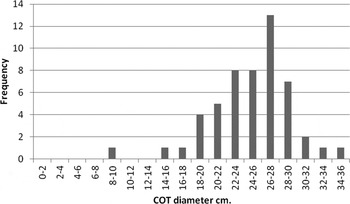
Crown-of-thorns densities ranged from 1 to 33 per 300 m2 belt transect at Littledale Shoal corresponding to densities of 33–1100 per ha. The wide variance in density is indicative of the patchiness in the distribution of this asteroid and this, plus the cryptic behaviour of many individuals, makes it difficult to extrapolate from belt surveys to overall reef densities. The size–frequency distribution peaks at the 26–28 cm size-class and is approximately normally distributed (Figure 1), with a single small individual in the 8–10 cm size-class perhaps suggesting the presence of more than one settlement cohort. Under-representation of small size-class cohorts might occur if they have a greater likelihood of being hidden within in the reef matrix. Although interpretation of age-classes from size–frequency distributions in A. planci is problematic (Moran, Reference Moran1986; Stump, Reference Stump1994) the size cohort at Littledale Shoal is consistent with a sexually mature age of at least 2 years (see review in Moran, Reference Moran1986), a conclusion supported by the observation of a midday spawning episode by one adult. In addition to Acropora species, a variety of other corals were undergoing predation including Porites, one of the reportedly least preferred prey genera (De'ath & Moran, Reference De'ath and Moran1998). Visits in May and June 2010 to the inshore reefs of Brunei Patches and, nearer to Brunei Bay, Abana Reef and Pelong Rocks did not reveal any COT. At Silk Rock, further from the mainland than Littledale Shoal and the site of previous COT sightings in 2008, none were seen in June 2010 but most standing table corals were dead. The surviving corals at Littledale were, in July 2010, further impacted by the occurrence of extensive, thermally-induced bleaching, notably of Porites and also including soft corals of the family Nephtheidae.
Crown-of-thorns (COT) size–frequency plot for Littledale Shoal 26 April–12 May 2010.

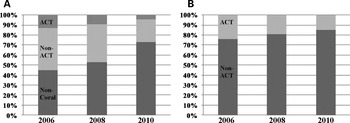
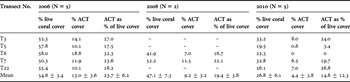
Percentage live coral cover data have been collected at the Littledale permanent-transect sites at two year intervals since 2006. Acropora species are prominent with tabular growth forms representing (in 2006) 100, 99.4, 98.3, 89.3 and 56.4% of the cover attributable to this genus at the five permanent transects. Mean total live coral cover for all transects declined slightly from 54.8% (N = 5) in 2006 to 47.1% (N = 2) in 2008 and then showed a dramatic reduction to 26.8% (N = 5) in 2010 during the COT outbreak (Figure 2). The reduction in coral cover from 2006 to 2010, as indicated by the t-test value (10.19, df = 8), is significant at the P 0.001 level. The t-test value for reduction of live tabular Acropora cover (3.65) is significant at the P 0.01 level whereas the reduction in live tabular Acropora as a proportion of live coral cover (t-test value = 1.84) is not significant. However, the wide variance in the tabular Acropora cover data tends to mask dramatic reductions of this growth form on some LIT transects with, for example, total or almost total losses occurring at transects T5 and T6 (Table 1). These findings concur with the general observation of a high mortality of standing tabular Acropora colonies, with dead colonies ranging from clean white skeletons, evidently recently predated, to non-eroded colony skeletons fouled to varying extents by green filamentous algae.
Changes in (A) mean percentage cover of live tabular Acropora (ACT), mean percentage cover of other live corals (non-ACT) and (B) the mean proportion of live coral cover attributable to table Acropora species from 2006 to 2010 during a crown-of-thorns outbreak. Bar chart values are means derived from data (Table 1) for five permanent transects.

Line intersect transect data for: percentage total live coral cover; percentage cover by tabular Acropora (ACT); and ACT as a percentage of live cover from 2006 to 2010 over a crown-of-thorns outbreak episode at permanent transect sites on Littledale Shoal, Brunei Darussalam. Means are given ± standard deviation. N, number of transects surveyed. Due to logistics difficulties only two of the five transects could be surveyed in 2008.

DISCUSSION
The shelf reefs of Brunei, in comparison with some of the reefs of neighbouring countries, have received limited anthropogenic impacts, are characterized by high live coral cover and, in common with some other outbreak locations (DeVantier & Turak, Reference DeVantier and Turak2004; Pratchett et al., Reference Pratchett, Schenk, Baine, Syms and Baird2009) have had no history, in recent decades at least, of depredations by COT outbreaks. Brunei reef communities comprise several different kinds (De Vantier & Turak, Reference De Vantier and Turak2009). At Littledale Shoal and some other bank reefs, tabular Acropora corals, a preferred genus and morphology in terms of COT prey (De'ath & Moran, Reference De'ath and Moran1998), are prominent and the fact that many are of large size is indicative not only of low levels of physical disturbance but also the former absence, for many years, of significant numbers of this asteroid predator. Aggregations of COT at the densities recorded on Brunei reefs in 2010 meet the varied definitions (Moran, Reference Moran1986; Moran & De'ath, Reference Moran and De'ath1992; Engelhardt et al., Reference Engelhardt, Miller, Lassig, Sweatman, Bass, Wachenfeld, Oliver and Davis1997) of an outbreak; one that has capitalized on a resource rich in preferred food at this site. Mean percentage live coral cover, quantified at permanent transects before and during the outbreak, declined by 50%. The LIT data (Table 1; Figure 2) confirm a predisposition for tabular Acropora as prey but with high mortality for other scleractinian taxa and growth forms too, a dietary pattern seen elsewhere at high predator densities where preferred prey become depleted (De'ath & Moran, Reference De'ath and Moran1998).
Reports of COT aggregations and outbreaks in the South China Sea are not infrequent (Morris, Reference Morris1977; Lane & Vandenspiegel, Reference Lane and Vandenspiegel2003; Tuan et al., Reference Tuan, Hoang, Nguyen, Phan, Suzuki, Nakamori, Hidaka, Kayanne, Casareto, Nadaoka, Yamano and Tsuchiya2006; World Wildlife Fund, 2007; Dumont & Alfian, Reference Dumont and Alfian2010) and recently (May 2010) a large number of COT have been sighted on the reefs of Pulau Sapi in the nearby waters of the Tunku Abdul Rahman National Park in West Sabah (Helen Brunt, Semporna Islands Darwin Project, personal communication). Current systems in the South China Sea are complex and are largely driven by the alternating monsoonal circulations. Residual surface currents in shelf waters trend along the Brunei coast to the south-west during the north-east monsoon and to the north-east during the south-west monsoon (Silvestre & Matdanan, Reference Silvestre, Matdanan, Silvestre, Matdanan, Sharifuddin, De Silva and Chua1992) but this is complicated by the South China Sea Southern Cyclonic and Anticyclonic Gyres and associated eddies (Hu et al., Reference Hu, Kawamura, Hong and Qi2000) and other coastal eddies near the shelf margins (Silvestre & Matdanan, Reference Silvestre, Matdanan, Silvestre, Matdanan, Sharifuddin, De Silva and Chua1992). Western Sabah and Brunei with their near simultaneous outbreaks may have been colonized by propagules from the same source but a linear progression of propagule-generated COT outbreaks in the South China Sea comparable to those observed in the Ryukyu archipelago (Yamaguchi, Reference Yamaguchi1986) and the Great Barrier Reef (Moran, Reference Moran1986), is not evident and there could be many potential source populations for the present outbreak on Brunei reefs. The fact that outbreaks or even low numbers of COT have been lacking in recent decades perhaps indicates a degree of stochasticity in current regimes and larval transport. Genetic studies such as those demonstrating connectivity for this sea star within regions of the wider tropical Indo-Pacific (Yasuda et al., Reference Yasuda, Nagai, Hamaguchi, Okaji, Gerard and Nadoaka2009; Timmers et al., Reference Timmers, Andrews, Bird, deMaintenton, Brainard and Toonen2011) have the potential to track source populations within the South China Sea.
There is growing evidence linking COT outbreaks to enhanced levels of phytoplankton food (Houk et al., Reference Houk, Bograd and van Woesik2007; Fabricus et al., Reference Fabricus, Okaji and De'ath2010) but there are some difficulties with the broad applicability of this hypothesis, as detailed below:
(a) enhanced food cell densities leading to enhanced COT larval success are likely to be restricted to anomalous, eutrophicated coastal or frontal/upwelling localities, as alternative evidence (Boyce et al., Reference Boyce, Lewis and Worm2010) points to global oceanic declines in phytoplankton density in the last century that are linked to warming, enhanced thermal stratification and nutrient depletion of surface waters. Wider Indo-Pacific applicability of the enhanced-food scenario would require analysis of pre-outbreak, in situ or satellite-derived, primary productivity data, which may or may not be available;
(b) there are geographical disparities in the reported occurrence and extent of outbreaks across the West Pacific that seem to challenge the enhanced-nutrient theory. With the exception of the Kepulauan Seribu reefs north of Jakarta Bay (Darsono & Soekarno, Reference Darsono, Soekarno, Sudara, Wilkinson and Chou1994), up until 5 to 10 years ago mass aggregations of this sea star had been reported only sporadically and infrequently within the realm of the high biodiversity zone known as the Coral Triangle (CT), which Brunei borders (e.g. Pyne, Reference Pyne1970; Soegiarto, Reference Soegiarto1973; Anon, 1982; Lane, Reference Lane1996; Hodgson & Liebeler, Reference Hodgson and Liebeler2002). Lack of reports does not prove outbreak absence but is at least indicative, particularly since the advent of widespread SCUBA activity. Given the reported association of COT outbreaks with nearby high islands and continental coasts characterized by periodic high precipitation and runoff (Birkeland, Reference Birkeland1982; Brodie et al., Reference Brodie, Fabricius, De'ath and Okaji2005; Fabricus et al., Reference Fabricus, Okaji and De'ath2010), it might be expected that the CT, a trans-equatorial region of high terrain, exceptionally high rainfall and high erosion rates (Gupta, Reference Gupta, Walling and Webb1996), would likewise be susceptible to nutrient-plume-enhanced ‘epidemic recruitments’ of juvenile COT;
(c) additionally, Indonesian seas, at the core of the CT region, periodically receive surface nutrient inputs as a result of monsoonal wind-driven upwelling that correlate with seasonal phytoplankton blooms (Kinkade et al., Reference Kinkade, Marra, Langdon, Knudson and Ilahudet1997; Moore et al., Reference Moore II, Marra and Alkatiri2003) and, in the Banda Sea for example, are more pronounced during El Ninõ Southern Oscillation events (Moore et al., Reference Moore II, Marra and Alkatiri2003). Levels of chlorophyll-a in these upwellings, largely attributable to microplankton (the food size-range for A. planci) approach (Moore et al., Reference Moore II, Marra and Alkatiri2003) or are at least double (>2.5 µg l−1; Kinkade et al., Reference Kinkade, Marra, Langdon, Knudson and Ilahudet1997) the value (~1.2 µg l−1) at which A. planci larvae attain maximal growth rates (Fabricus et al., Reference Fabricus, Okaji and De'ath2010). Natural larval food supply in upwelling zones is therefore seemingly more than adequate yet there is little historical evidence for either upwelling or plume-linked major COT population booms in the core CT region. The linkage of high ocean productivity to ‘outbreaks’ in Vanuatu (Houk & Raubani, Reference Houk and Raubani2010) refers only to the near simultaneous ‘emergence’ of adults, purportedly from deep water, a phenomenon for which little supporting evidence is provided; and
(d) a further difficulty with the enhanced-larval-food outbreak theory stems from the fact that a wide variety of marine invertebrates likewise broadcast-spawn large numbers of planktotrophic larvae that might be predicted to similarly (and concurrently) benefit from a nutrient-generated abundant food supply, with resultant outbreaks. It is not at all clear as to why enhanced larval food should be selective, if indeed it is, for COT. Boom–bust cycles are noted for other fecund echinoderms with planktotrophic development (Uthicke et al., Reference Uthicke, Schaffelke and Byrne2009; Valentine & Edgar, Reference Valentine and Edgar2010) and some at least have been linked to human-induced environmental changes (Uthicke et al., Reference Uthicke, Schaffelke and Byrne2009), but a wider investigation and appraisal of larval success for a spectrum of invertebrate planktotrophs, contemporaneously with ‘phytoplankton-linked’ COT outbreaks, is warranted.
Other contributory anthropogenic causes of COT outbreaks, in the form of overfishing and trophic cascades, may be operative on a broad scale throughout the tropical Indo-west Pacific. The evidence for significant predation of A. planci, adults or juveniles, by exploited fish is minimal or lacking (Ormond et al., Reference Ormond, Bradbury, Bainbridge, Fabricius, Keesing, De Vantier, Medlay, Steven and Bradbury1990; Sweatman, Reference Sweatman1995) but a clear increase in the frequency of outbreaks on fished reefs compared to no-take reefs (Sweatman, Reference Sweatman2008) and increased COT densities along an increasing gradient of fishing intensity (Dulvy et al., Reference Dulvy, Freckleton and Polunin2004) suggests that fish exploitation, which commonly depletes large predatory fish, leads to trophic cascades in food webs, as has been demonstrated, for example, in shark fisheries (Myers et al., Reference Myers, Baum, Shepherd, Powers and Peterson2007). It is postulated (Sweatman, Reference Sweatman2008) that removal of large piscivorous reef fish leads to increased numbers of their prey, typically benthic carnivores such as wrasse, that in turn reduce the populations of invertebrate predators in the reef rubble or matrix that would otherwise control the numbers of juvenile A. planci (Keesing & Halford, Reference Keesing and Halford1992).
Notwithstanding the above outbreak hypotheses, none of which are necessarily mutually exclusive, there seems to be little doubt that populations of synchronously spawning, highly fecund A. planci achieve, even at low densities, high fertilization success and are capable of generating high settlement rates and potential outbreaks independently of anthropogenic causes (Babcock & Mundy, Reference Babcock and Mundy1992; Johnson, Reference Johnson1992). It has been proposed also, that A. planci is capable of a resource-dependant variable reproductive strategy ranging between iteroparity and semelparity that may generate periodic outbreaks under natural conditions (Stump, Reference Stump1994). The extent, however, to which outbreaks, including local South China Sea episodes, are normal cyclical or stochastic phenomena, or are influenced by global anthropogenic factors, directly or indirectly, remains unresolved.
Historical reports of major COT episodes within the CT are few but in recent years, a succession of outbreaks in the Philippines (World Wildlife Fund, 2007), Halmahera (Wildlife Conservation Society, 2008), Bunaken Marine Park (DeVantier & Turak, Reference DeVantier and Turak2004; North Sulawesi Watersports Association, unpublished data, COTS collection 2003–2008), Central Sulawesi (Moore & Ndobe, Reference Moore and Ndobe2008), Tun Sakaran Marine Park, East Sabah in 2008–2010 (Nina Ho, World Wildlife Fund-Malaysia, personal communication) and in Papua New Guinea (Baine, Reference Baine2006; Pratchett et al., Reference Pratchett, Schenk, Baine, Syms and Baird2009) is increasing the concern (Wildlife Conservation Society, 2008) that coral communities and reefs within this biodiversity-rich zone are potentially becoming threatened by major COT outbreaks. This pattern is currently emulating that initiated in previous decades elsewhere in the Indo-Pacific. Coincidentally or not, coral cover has declined dramatically across Indo-Pacific reefs (including the CT) due to a variety of causes (Bruno & Selig, Reference Bruno and Selig2007) and in this regard it is notable that several ecoregions within the CT are already identified as being subjected to thermal stress (past and predicted) as well as a variety of direct anthropogenic stressors (Peñaflor et al., Reference Peñaflor, Skirving, Strong, Heron and David2009; McLeod et al., Reference McLeod, Moffitt, Timmermann, Salm, Menviel, Palmer, Selig, Casey and Bruno2010). It is possible that deteriorating environmental conditions, including anthropogenic factors other than, or additional to, eutrophication, may be implicated in recent A. planci population explosions in the CT region. The linkage of outbreaks off north-eastern Australia to continental floods and land-use change (Fabricus et al., Reference Fabricus, Okaji and De'ath2010) is convincing and indeed recent human coastal developments and associated enhanced nutrient plumes may be overtaking reefs and causing outbreaks in the CT region too. But the former lack of widespread CT outbreaks, despite naturally enhanced phytoplankton blooms, is suggestive of ecological and environmental complexities in COT population control that are as yet unravelled.
Adjacent to the CT, Brunei's reef systems, although small in areal extent, exhibit a remarkably high scleractinian richness which approaches that of the CT itself (De Vantier & Turak, Reference De Vantier and Turak2009). Given this fact, and the growing recognition of the importance of these reefs for the country's fisheries, research and ecotourism potential, the question of predator-control measures arises. Numerous intensive starfish eradication programmes have been undertaken in the Indo-Pacific in response to COT outbreaks, often at considerable cost and/or labour intensive effort, yet evidence indicates that such control measures have been largely unsuccessful either in eliminating the predators or preventing over-predation and reef degradation (Yamaguchi, Reference Yamaguchi1986; Dumont & Alfian, Reference Dumont and Alfian2010). The reefs in Brunei waters, even though small in area, are probably too extensive for comprehensive control measures to be effective and, at Littledale Shoal at least, such an approach is probably already too late. However, where additional stressors (such as thermal bleaching) result in significantly enhanced coral mortality, there may be valid arguments for reducing starfish numbers to mitigate the combined and possibly synergistic effects of the causes of coral destruction. Targeted removal of COT would be feasible and justifiable for Marine Protected Areas (soon to be designated) in Brunei that have a high coral diversity or ecotourism value, if done routinely. Such an approach for high-value localities currently remains the only control policy supported by the Great Barrier Reef Marine Park Authority for localized starfish removal on the Great Barrier Reef (Lassig, Reference Lassig1995).
ACKNOWLEDGEMENTS
The author thanks Saimon bin Ahmad and Abdul Bahri bin Roslan for managing the marine field trips, Simon Enderby of Scubazoo Images S/B for providing contacts and sources of information relating to crown-of-thorns outbreaks in Sabah, the North Sulawesi Watersports Association for providing data on crown-of-thorns removal at Bunaken Marine Park, and an anonymous referee for comments that resulted in improvements to the manuscript. The research for this article was partially supported by a Science & Technology Grant from the Brunei Government (grant number UBD/GSR/S&T/14).