INTRODUCTION
Shark reproduction does not involve a larval stage, so dispersal can occur only through swimming of neonate, juvenile, or adult individuals from one location to another (Heupel et al., Reference Heupel, Simpfendorfer and Fitzpatrick2010; Lopėz-Garro et al., Reference López-Garro, Zanella, Golfin-Duarte and Pėrez-Montero2012; Whitney et al., Reference Whitney, Robbins, Schultz, Bowen and Holland2012). Many species of reef shark are considered residential, which creates a paradox at islands or atolls, as some individuals must have performed long distance dispersal at some point. Telemetry and genetic methods are beginning to reveal occasional long-range dispersal events by reef-associated (and, often, seemingly sedentary) sharks across deep-ocean habitats (Schultz et al., Reference Schultz, Feldheim, Gruber, Ashley, McGovern and Bowen2008; Heupel et al., Reference Heupel, Simpfendorfer and Fitzpatrick2010; Whitney et al., Reference Whitney, Robbins, Schultz, Bowen and Holland2012; Mourier et al., Reference Mourier, Buray, Schultz, Clua and Planes2013).
The sicklefin lemon shark (Negaprion acutidens, Ruppell 1837) is a large reef-associated species (maximum size 310 cm) of the Indo-Pacific Ocean (Compagno et al., Reference Compagno, Dando and Fowler2005). Relatively little is known about this species' life history, although maturity is thought to occur at sizes >240 cm (Compagno et al., Reference Compagno, Dando and Fowler2005). Despite being relatively residential, genetic analysis suggests oceanic dispersal in areas where oceanic islands can act as ‘stepping stones’ (Schultz et al., Reference Schultz, Feldheim, Gruber, Ashley, McGovern and Bowen2008; Mourier et al., Reference Mourier, Buray, Schultz, Clua and Planes2013). In the central Pacific Ocean, N. acutidens has been reported as far north as Fanning Atoll in the Northern Line Islands (Compagno & Niem, Reference Compagno, Niem, Carpenter and Niem1998). Here, we report the presence of lemon sharks at Palmyra Atoll—an island lying 380 km north-west of Fanning Atoll in the same archipelago. Our observations suggest a range extension and a possible colonization event by N. acutidens.
MATERIALS AND METHODS
Study site
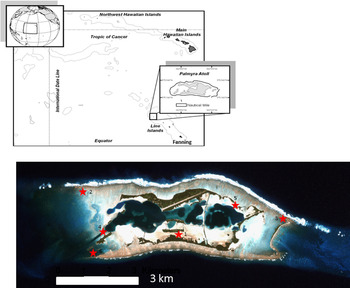
Observations were made at Palmyra Atoll (5°54′N 162°05′W), in the central Pacific Ocean from shallow sand-flat surveys, snorkelling and scientific fishing. Palmyra is part of the Northern Line Island chain, and was heavily modified by the US military during World War II. It was designated as a National Wildlife Refuge in 2001 and has since remained off-limits to fishing and is under the jurisdiction of the US Fish and Wildlife Service (see Maragos et al., Reference Maragos, Miller, Gove, DeMartini, Friedlander, Godwin, Musburger, Timmers, Tsuda, Vroom, Flint, Lundblad, Weiss, Ayotte, Sala, Sandin, McTee, Wass, Siciliano, Brainard, Obura, Ferguson, Mundy, Riegl and Dodge2008 for details). Palmyra is uninhabited except for a field station where 4–17 scientists and staff reside. The marine habitat consists of two large lagoons (maximum depth 55 m), connected by a small tidal channel. An 18 m wide deep water channel links the larger western lagoon directly to the forereefs. Lagoons contain low-visibility water and their sand flats become exposed to air during extreme low tides. Sand flats connect to backreef habitats by reef flats characterized by clear water, depths up to 3 m, and high vertical relief of coral. Backreefs then transition to forereef habitats, with a steep slope of high coral cover and high water visibility (Figure 1).
Map of Palmyra Atoll within the Line Island chain. Red stars display the location of lemon shark sightings or capture. Numbers by stars refer to details in Table 1.

RESULTS
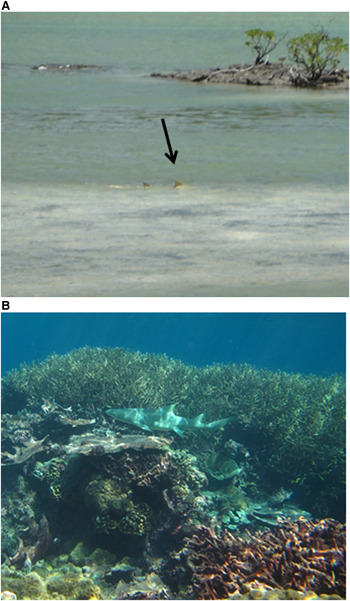
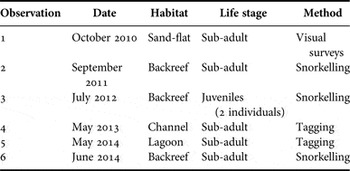
The first observation of a sub-adult Negaprion acutidens was made on the sand flats in July 2010 by C.L.W.; an individual of similar size was later photographed in the same location by C.L.W. (Figure 2A). Since that time, multiple individuals have been observed in both lagoon and backreef habitats (Figure 2B), but not on the forereefs despite multiple dive surveys taking place in that habitat. We document six of these observations, but this is only a minimum number (Table 1). While it is unclear how many of the observed individuals were re-sightings, both sub-adults and juveniles have been observed. In June 2013, a 208 cm (total length) male, with partially calcified claspers (suggesting immaturity), was caught in the channel leading to the west lagoon during the course of a shark tagging programme (Figure 1). All individuals observed by snorkellers were <2 m and likely immature.

Observations of lemon sharks (Negaprion acutidens) at Palmyra Atoll. Date of observation, habitat where shark was observed, life stage (sub-adult >150 cm) and method by which shark was observed. Numbers correspond to stars in Figure 1. Note these are the minimum number of observations, with many other sightings by other researchers that are not listed, but which occurred in the same habitats.

DISCUSSION
We extend the known geographical range of Negaprion acutidens to include Palmyra Atoll, which is approximately 380 km north-west of Fanning Atoll (the previous northerly limit of its range within the Line Islands). Despite the fact that N. acutidens is a relatively coastal species, genetic analysis and global phylogeography provide evidence to suggest that sicklefin lemon sharks may use islands as ‘stepping stones’ for long-distance oceanic dispersal (Schultz et al., Reference Schultz, Feldheim, Gruber, Ashley, McGovern and Bowen2008; Mourier et al., Reference Mourier, Buray, Schultz, Clua and Planes2013). Our observations suggest northward dispersal and subsequent colonization of the species up the Line Island chain. Pregnant females may swim from other islands to Palmyra Atoll to give birth, as seen in the Society Islands (Mourier et al., Reference Mourier, Buray, Schultz, Clua and Planes2013). Kingman Reef, the most northerly island in the Line Islands archipelago is 60 km north of Palmyra Atoll; 1600 km of open ocean separate Kingman Reef from the next island, Hawaii. Genetic analysis has also suggested limited oceanic dispersal, in the absence of islands to act as ‘stepping stones’ (Schultz et al., Reference Schultz, Feldheim, Gruber, Ashley, McGovern and Bowen2008). One other possibility is that heavy fishing pressure (before the 2001 National Wildlife Refuge designation) kept the lemon shark population below a detection threshold, and that the population is only now recovering. It is worth noting that lemon shark populations in the Society Islands are small, and are prone to inbreeding, which could make them particularly vulnerable to overfishing (Mourier et al., Reference Mourier, Buray, Schultz, Clua and Planes2013).
The elasmobranch fauna at Palmyra Atoll is similar to other central and south Pacific islands and atolls, primarily consisting of blacktip (Carcharhinus melanopterus) and grey reef sharks (Carcharhinus amblyrhinchos: DeMartini et al., Reference DeMartini, Friedlander, Sandin and Sala2008; Papastamatiou et al., Reference Papastamatiou, Caselle, Friedlander and Lowe2009). Our observations of lemon sharks in lagoon and backreef habitats are consistent with habitat use by this species at Aldabra Atoll (Stevens, Reference Stevens1984). This may present an interesting new interspecific competition dynamic at Palmyra Atoll, as blacktip reef and lemon sharks at other islands show overlap in diet, habitat use, and reproductive synchronicity (Stevens, Reference Stevens1984). The two species also show overlap in nursery habitat use, with parturition occurring in shallow sand flat habitats for both species (Papastamatiou et al., Reference Papastamatiou, Caselle, Friedlander and Lowe2009; Mourier et al., Reference Mourier, Buray, Schultz, Clua and Planes2013). Blacktip reef sharks at Palmyra Atoll are already thought to be food-limited based on their small sizes, and it is unclear how the presence of a new competitor may alter behaviour, habitat selection, or even population dynamics (Papastamatiou et al., Reference Papastamatiou, Caselle, Friedlander and Lowe2009). Although rare, it is important that we remain vigilant for potential island-scale colonization events by large predators, as they may have substantial repercussions for ecosystem dynamics.
ACKNOWLEDGEMENTS
We thank the colleagues and students who helped with diving, snorkelling, or fishing at Palmyra Atoll. We also thank all The Nature Conservancy and Fish and Wildlife Service staff who facilitated our stay at the Palmyra Research Station. This is PARC contribution No. 0110.