INTRODUCTION
The main goal of palliative care is to improve patients' quality of life at any stage of serious illness regardless of current treatment plans, and it is tailored to the needs of the patient and family (Strand et al., Reference Strand, Kamdar and Carey2013). Although palliative care is increasingly being integrated into contemporary cancer care, barriers remain to involving palliative care in the care of non-oncologic patients with a serious illness. Until recently, Serbia had no national guidelines, recommendations, standards, or policies concerning palliative care. In 2009, the Ministry of Health published a National Palliative Care Strategy that represented a good foundation for the development of palliative care in Serbia, though palliative care delivery has not yet been implemented in medical practice.
A significant part of a respiratory physician's professional time is dedicated to the end stage of chronic obstructive pulmonary disease (COPD) and lung-cancer treatment, and both diseases are among the top causes of death in Serbia and worldwide (Ministartsvo zdravlja Republike Srbije, 2007; Cancer Registry of Central Serbia, 2011).
The existing literature documenting the overall symptom burden in COPD has demonstrated that it is similar to and perhaps greater than that associated with cancer (Claessens et al., Reference Claessens, Lynn and Zhong2000; Walke et al., Reference Walke, Gallo and Tinetti2004; Habraken et al., Reference Habraken, ter Riet and Gore2009; Bausewein et al., Reference Bausewein, Booth and Gyseles2010a), and is also accompanied by profound psychological distress and social isolation (Gore et al., Reference Gore, Brophy and Greenstone2000; Ek & Ternestedt, Reference Ek and Ternestedt2008; White et al., Reference White, White and Edmonds2011). Despite patients with end-stage COPD and end-stage non-small-cell lung cancer (NSCLC) having a similar symptom burden, a few studies have directly compared their health-related quality of life (HRQoL). The available data suggest that end-stage COPD patients have poor HRQoL, comparable or even worse than that of advanced NSCLC patients (Gore et al., Reference Gore, Brophy and Greenstone2000; Habraken et al., Reference Habraken, ter Riet and Gore2009). In addition, a significant number of recent studies have confirmed that the palliative care needs of patients with severe COPD are considerable and as high as that for patients with advanced lung cancer, though patients with COPD have a more extended survival (Curtis, Reference Curtis2008; Gardiner et al., Reference Gardiner, Gott and Payne2010; Buxton et al., Reference Buxton, Stone and Buckingham2010).
Bearing in mind that economic disadvantages have a significant influence on HRQoL among patients with other chronic illnesses (McCabew & De Judicibus, Reference McCabew and De Judicibus2005), the presence of a clear association between poverty and COPD (Global Initiative for Chronic Obstructive Disease, 2010), and the lack of palliative care services for both diseases, we performed an investigation to compare HRQoL between end-stage COPD and advanced NSCLC patients in Belgrade, Serbia. An additional aim of our study was to examine the influence of demographic, socioeconomic, and main clinical factors on HRQoL among end-stage COPD and NSCLC patients.
PATIENTS AND METHODS
Patients
Between January of 2010 and June of 2013, we conducted a cross-sectional survey that included two groups of patients with severe COPD and advanced NSCLC at the Clinic of Pulmonology (the national referral center for lung diseases) at the Clinical Center of Serbia in Belgrade.
The study included 100 consecutive patients, aged 18 or older, with histologically confirmed advanced NSCLC (stage IIIB and IV at the time of diagnosis), according to the 7th edition of the AJCC Cancer Staging Manual (Edge & Compton, Reference Edge and Compton2010), and 100 consecutive patients with stage IV COPD (very severe disease: FEV1 < 30% predicted or FEV1 < 50% predicted plus the presence of chronic respiratory failure) (Global Initiative for Chronic Obstructive Disease, 2010), with two or more exacerbations in the preceding year. An exacerbation in COPD is defined as an acute event that is beyond normal day-to-day variations and leads to a change in medications (Rodriguez-Roisin, Reference Rodriguez-Roisin2000; Celli & Barnes, Reference Celli and Barnes2007). The exclusion criteria for both groups of patients were: the coexistence of lung cancer and COPD, previously diagnosed psychiatric disorders (patient too cognitively impaired to participate), existence of other malignant disease, or unwillingness to participate.
All patients were identified from medical records of the outpatient and inpatient clinics of our hospital. COPD patients were interviewed during their regular follow-up visits in an outpatient setting, and the NSCLC patients were examined during their visit to the outpatient oncology clinic.
The demographic and socioeconomic data were obtained directly from the patients during the interviews. Patients' clinical data were retrieved from their medical records, and their Karnofsky Performance Status (KPS) was measured during the assessment.
Instruments
The 36-item Medical Outcomes Short Form Health Survey (SF-36) (Serbian version) was used to measure HRQoL in both patient groups. The SF-36 is a well-validated generic health survey questionnaire and includes eight subscales and two summary scores: the Physical Component Summary (PCS) and the Mental Component Summary (MCS). Raw scores are linearly transformed into scores ranging from 0 to 100. Higher scores indicate a higher level of functioning or well-being (see http://www.qualitymetric.com.).
The EORTC QLQ–C30 is a 30-item disease-specific questionnaire composed of both multi-item scales and single-item measures, and was used in our study to measure the HRQoL of lung-cancer patients. These include five functional scales, three symptom scales, and one global score. Raw scores for each scale/item are linearly transformed into scores ranging from 0 to 100. A higher score for the functional scale and global HRQoL represents a higher level of functioning (see http://groups.eortc.be/qol/eortc-qlq-c30).
The St. George's Respiratory Questionnaire (SGRQ) (Serbian version) is a disease-specific questionnaire designed to measure health impairment in patients with asthma and COPD. It contains three domains: Symptoms, Activity and Impacts, and Total Score (which summarizes the impact of the disease on overall health status). Scores are expressed as a percentage of overall impairment, and 100 represents the worst possible and 0 the best possible health status (see http://www.healthstatus.sgul.ac.uk/sgrq).
The standard 21-item Beck Depression Inventory (BDI) was given to each study participant in order to explore feelings and attitudes related to general depressive status. Suggested cutoff values were: 0–10 = no depression; 11–17 = mild depression; 18–23 = moderate depression; and 24 + = severe depression (Beck & Beck, Reference Beck and Beck1972).
All instruments were given to both groups of patients by the investigator (DM), who was available for questions and explanations. Assistance was also provided if patients were not capable of filling out the questionnaires because of vision and motor problems or fatigue.
Informed consent was obtained from all participants. The study was previously approved by the Ethics Committee of the Faculty of Medicine (No. 440/V-16) at the University of Belgrade.
Statistical Analysis
The differences in SF-36 scores and other variables studied between COPD and NSCLC patients were assessed by ANOVA and a chi-squared test, depending on the type of variables. Discriminant analysis was performed as a method to optimize the discriminant power of QoL scales, for differentiation between COPD and NSCLC patients.
Linear regression was employed to determine the impact of patients' characteristics on HRQoL. Variables significant at p ≤ 0.05 in the simple regression analysis were included in the multiple regression models in order to identify factors that were independently associated with patients physical and mental QoL. The SPSS 17.0 statistical software package (SPSS Inc., Chicago) was utilized for the statistical analysis.
RESULTS
Patients' Characteristics
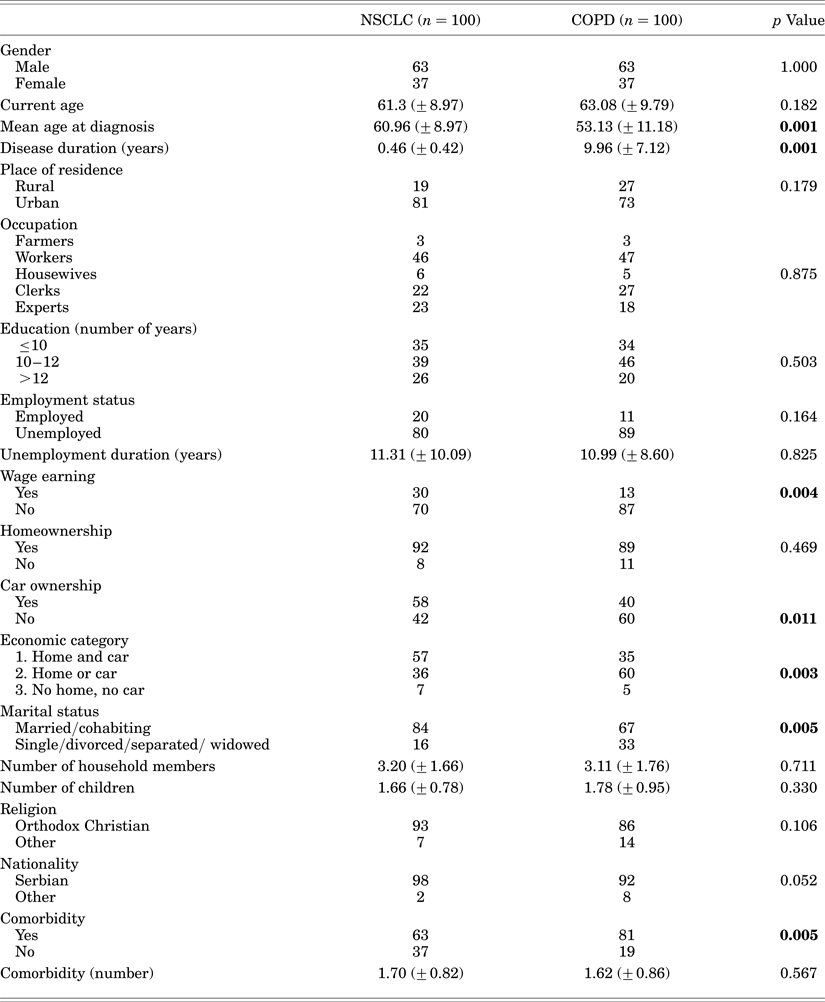
The demographic and socioeconomic characteristics of the two patient groups are presented in Table 1. The groups were similar in terms of age, gender, and socioeconomic background (measured by place of residence, occupation, education level, employment status, unemployment duration, and homeownership), but significantly fewer wage-earning and car-owning patients were in the COPD group (p = 0.004 and 0.001, respectively).
Sociodemographic characteristics of two patient groups

COPD patients were significantly younger at the onset of the disease, and the average disease duration at study onset was significantly longer in the COPD group. KPS scores were lower among COPD patients compared with NSCLC patients (61.9 ± 11.2 vs. 73.5 ± 19.0), and significantly more COPD patients reported the presence of comorbidities.
The most frequent pathohistological type of NSCLC was adenocarcinoma (57%), and 80 patients had metastatic disease (stage IV). Some 77 NSCLC patients were receiving active oncological treatment—palliative chemotherapy (cisplatin or carboplatin with gemcitabine, vinorelbine, taxanes) with or without radiotherapy. The average number of chemotherapy cycles was 4.05 ± 1.4.
All COPD patients had up-to-date FEV1 values obtained at the time of interview, and the average post-bronchodilator FEV1 value was 0.71 l (±0.37), that is, 24.16% (±6.23). Some 77 patients had chronic respiratory failure, and 33 patients were taking long-term oxygen therapy. The average number of exacerbations (treated in outpatient and hospital settings) during the preceding year was 6.17 (±6.01), and the average number of hospital admissions in the previous six months was 1.62 (±1.51). The average score obtained by the Medical Research Council (MRC) dyspnea scale was 3.98 ± 1.1.
Quality-of-Life Data
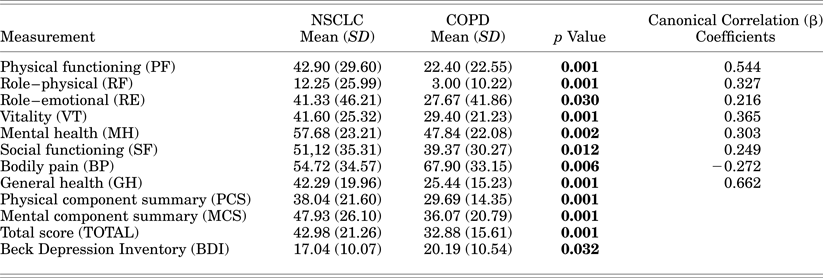
We observed the significant differences between the two patient groups in HRQoL measured by the SF-36 questionnaire (Table 2). COPD patients scored significantly lower compared to NSCLC patients in all SF-36 domains except for bodily pain, indicating poorer HRQoL among COPD patients. The largest unique contribution to the discrimination specified by the respective discriminant function was found for two scales: general health (GH) and physical functioning (PF), which showed the highest discriminant power (β = 0.662 and 0.544, respectively).
Quality-of-life measurements of two patient groups and canonical correlation coefficients
Additionally, significantly higher levels of depressive symptoms were reported among COPD patients compared to NSCLC patients (p = 0.032) (Table 2).
The mean SGRQ scores (SD) for the COPD group were: symptoms 69.6 (±16.6), activities 84.0 (±14.6), impacts 64.1 (±16.4), and total 71.1 (±13.5). The mean scores (SD) obtained by the EORTC QLQ–C30 for NSCLC patients were: global health = 45.33 (±29.07); physical functioning = 49.13 (±29.46); role functioning = 40.67 (±35.24); emotional functioning = 58.75 (±30.09); cognitive functioning = 80.50 (±24.96); and social functioning = 51.17 (±32.76).
Factors Associated with HRQoL of Two Patient Groups
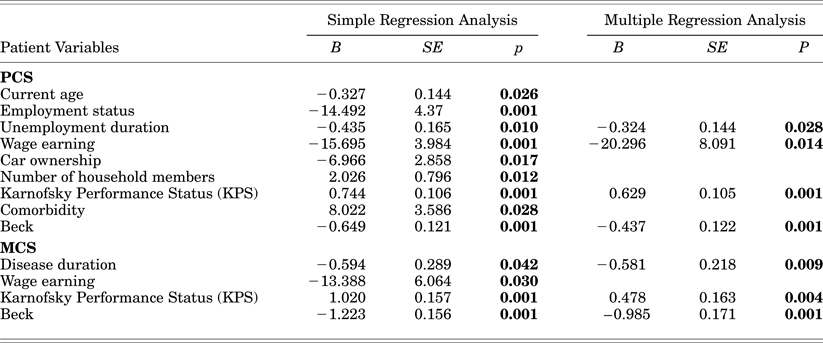
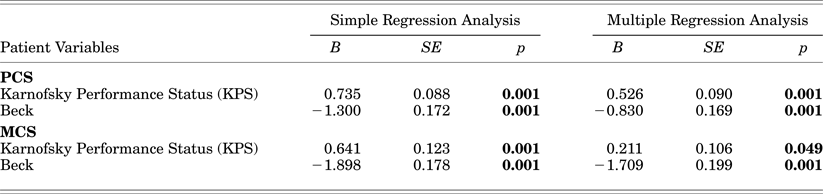
The results of the multiple regression analysis examining the demographic, socioeconomic, and main clinical factors related to patient HRQoL obtained by the SF-36 (dependent variables were PCS and MCS) are presented in Tables 3 and 4 for the COPD and NSCLC groups, respectively. The only variables that were significant on simple regression analysis at p ≤ 0.05 and were therefore included in the initial multiple regression models are shown in these tables.
COPD patient variables significantly associated with SF-36 PCS and MCS
NSCLC patient variables significantly associated with SF-36 PCS and MCS
The lower HRQoL in COPD patients was independently associated with longer unemployment duration, lack of wage earning, lower KPS score, and higher level of depression. Factors related to the worse mental HRQoL of COPD patients on multiple regression analyses were longer duration of disease, poorer KPS scores, and higher BDI scores. The independent variables significantly associated with the lower physical and mental HRQoL of NSCLC patients were lower KPS scores and higher BDI scores.
DISCUSSION
In our study, end-stage COPD patients experienced significantly lower HRQoL than patients with end-stage NSCLC across all HRQoL domains. The large differences found by the SF-36, indicating significantly poorer quality of life in the COPD patients, were similar to those presented in the landmark study conducted by Gore and coworkers (Reference Gore, Brophy and Greenstone2000) and that of Habraken and colleagues nine years later (Reference Habraken, ter Riet and Gore2009). In the Habraken study, COPD patients never scored favorably on HRQoL compared with the NSCLC patients on virtually all dimensions, and the most remarkable differences were recorded especially for the PF, social functioning (SF), and GH domains. Similarly, the highest discriminant power (β = 0.662 and 0.554) between the COPD and NSCLC patient groups in our investigation was observed in the GH and PF scale scores, respectively. In contrast, in one recent American study (Steinhauser et al., Reference Steinhauser, Arnold and Olsen2011), most HRQoL subscales (measured by Functional Assessment of Cancer Therapy–General)—social, physical, emotional, and spiritual well-being—did not differ for those with advanced cancer vs. COPD, whereas functional well-being and functional status did differ, with COPD faring worse on all measures. Furthermore, general health and physical functioning were reported as the domains of greatest vulnerability in studies that examined HRQoL in COPD patients (Skilbeck et al., Reference Skilbeck, Mott and Page1998; Edmonds et al., Reference Edmonds, Karlsen and Khan2001; Stahl et al., Reference Stahl, Lindberg and Jansson2005).
Additionally, COPD patients in our investigation scored significantly lower compared to NSCLC patients in the SF and mental health (MH) domains (p = 0.012 and 0.002, respectively) and demonstrated higher BDI depression scores compared to NSCLC patients (p = 0.032); the average BDI scores were in the range of mild depression for NSCLC patients and moderate depression for the COPD group. The low level of social functioning in COPD patients with effects on both social activities and family life has been reported by other investigators (Skilbeck et al., Reference Skilbeck, Mott and Page1998; Edmonds et al., Reference Edmonds, Karlsen and Khan2001), and there is a considerable body of qualitative research regarding patients' experience of loneliness and social isolation (Ek & Ternestedt, Reference Ek and Ternestedt2008; Elofsson & Ohlen, Reference Elofsson and Ohlen2004). Depression is common in patients with COPD as a result of their physical limitations and social isolation (Gore et al., Reference Gore, Brophy and Greenstone2000; Elkington et al., Reference Elkington, White and Addington-Hall2004; Ek & Ternestedt, Reference Ek and Ternestedt2008; Janssen et al., Reference Janssen, Franssen and Wouters2011). Gore et al. (2009) also found that COPD patients experienced significantly worse depression than NSCLC patients. In contrast, Habraken and colleagues (Reference Habraken, ter Riet and Gore2009) suggested little difference between the groups in terms of depression.
Given the findings we obtained in terms of significant differences in HRQoL between end-stage COPD and end-stage NSCLC patients, we attempted to elucidate the factors that predominantly affect the physical and mental aspects of HRQoL within these two groups. Regarding the predictive factors, we observed a different pattern between NSCLC and COPD patients. The physical health (SF-36 physical component summary (PCS)) and mental health (SF-36 mental component summary (MCS)) of NSCLC patients were strongly negatively associated only with lower KPS and higher BDI scores. The direct relationship between performance status, depression, and HRQoL in cancer patients (including lung cancer) is well known and supported by the results of numerous studies (Hopwood & Stephensen, Reference Hopwood and Stephensen2000; Lloyd-Williams, Reference Lloyd-Williams2002; Manser et al., Reference Manser, Wright and Byrnes2006; Brown et al., Reference Brown, Thorpe and Napp2007; Lloyd-Williams et al., Reference Lloyd-Williams, Sheils and Taylor2009).
Nevertheless, in our research, poorer performance status and higher BDI scores are shown to be independent predictors of worse physical and mental QoL for patients with advanced COPD, confirming the previously established importance of functional impairment and poor psychological well-being as independent predictors of reduced QoL among patients with end-stage COPD (Blinderman et al., Reference Blinderman, Homel and Billings2009; Steinhauser et al., Reference Steinhauser, Arnold and Olsen2011). However, in addition to these well-known factors, in multivariate analyses we found that the poor QoL in terms of the physical domain was strongly correlated with longer duration of unemployment and absence of wage earning. Similarly, in a recent Spanish study, lower socioeconomic status (assessed by educational level and occupational profile) represented an independent factor that substantially impaired the HRQoL of COPD patients, despite a healthcare system that is universally available and free of cost (Miravitlles et al., Reference Miravitlles, Naberan and Cantoni2011). Additionally, a significant impact of longer disease duration in COPD patients on the worse mental domain QoL is also found in the multivariate analyses. This is congruent with the known deterioration of psychological well-being found in many chronic and progressive diseases as they worsen (Williams, Reference Williams1993).
The important results of our study are significantly poorer HRQoL and higher depression levels among end-stage COPD patients compared to end-stage NSCLC patients, and the detrimental effect of socioeconomic status on the COPD population's health status. COPD patients were also characterized by a higher prevalence of comorbidities and a significant number of exacerbations and hospitalizations in their final stage. While acknowledging the important palliative care needs in the earlier stages of COPD, the prognostic uncertainty and unpredictability, and the protracted nature of the end-stage of COPD, the poorer HRQoL in this group may indicate similar or even greater needs in comparison with NSCLC patients, in part due to the unfavorable impact of socioeconomic factors and the longer duration of suffering. Although contemporary palliative care means the provision of care to all who are in need of it, services have predominantly focused on the management of patients with malignancy. However, even in developed countries, individuals with end-stage COPD have limited access to palliative care despite experiencing similar, yet more prolonged duration, of worse symptoms and higher functional limitations (Claessens et al., Reference Claessens, Lynn and Zhong2000; Goodridge, Reference Goodridge2006; Ambrosino & Simonds, Reference Ambrosino and Simonds2007; Bausewein et al., Reference Bausewein, Booth and Gysels2010b). The data related to palliative care provision in developing countries are very scarce, though they suffer a significant share of the global COPD burden (Global Initiative for Chronic Obstructive Disease, 2013). The optimal models of service delivery remain unknown, although several different models are being trialed in clinical practice in developed countries (Boland et al., Reference Boland, Martin and Wells2013).
Given the well-known association between the higher incidence of COPD and lower socioeconomic status (Prescott & Vestbo, Reference Prescott and Vestbo1999; Ellison-Loschman et al., Reference Ellison-Loschman, Sunyer and Plana2007), the results of our study shed light on the specific problems in this population: reduced physical functioning in the context of unfavorable socioeconomic status (e.g., among COPD patients, car ownership was significantly less prevalent) can limit the access of patients to health services, and can also compromise provision of palliative care. Therefore, future implementation of palliative care has to meet the needs of both groups of patients, but it is paramount to simultaneously provide increased social and community support for end-stage COPD patients. Emphasis on incorporating the palliative approach at the primary healthcare level together with organizational strengthening and capacity building of home treatment and care services may be appropriate. With increased community support, patients with COPD and their families may better cope with the condition, and the need for hospital admissions may be reduced.
Our study has several limitations. First, the small sample size impedes generalization of our results to the whole community. In remote areas, there may be a problem with accessibility of health services to terminally ill patients, carrying the potential to adversely affect their HRQoL. Second, ours is a cross-sectional study that determines HRQoL only at one timepoint, which prevents assessment of changes in HRQoL over the complete end-of-life period, particularly considering the different illness trajectories and duration for both diseases. Additionally, the COPD patients in our study were selected in line with the GOLD criteria (stage IV) relevant when our study began. While acknowledging the prognostic uncertainty, we attempted to reach a “real” end-of-life COPD population and therefore included the criterion of two or more exacerbations during the preceding year. New GOLD criteria have emerged in the meantime, and according to them (FEV1 < 30% and/or ≥ 2 exacerbations), our patients correspond to high-risk groups C and D, taking into account that the average MRC score was 3.98 ± 1.1 (Global Initiative for Chronic Obstructive Disease, 2013). These characteristics suggest a high probability that patients are nearing the end of life according to the Gold Standards Framework prognostic guidelines for COPD (Gold Standards Framework Centre, 2011). On the other hand, the majority of NSCLC patients (80%) had metastatic disease and the estimated prognosis for that stage is less than one year (Temel et al., Reference Temel, Greer and Muzikansky2010). However, most of them (77%) were undergoing active treatment, but survival data were not registered. Therefore, we cannot exclude the possibility that some of these patients lived longer, contributing to a more favorable health status in the NSCLC group.
In conclusion, our investigation confirms the results of previous studies that patients with end-stage COPD have an HRQoL similar or worse than patients with advanced NSCLC and indicates the importance of socioeconomic factors with respect to health status. Therefore, the forthcoming implementation of palliative care in Serbia should take into account the comparable needs, but also established differences, between disease groups, in order to develop comprehensive models of care for these patients.
ACKNOWLEDGMENTS
This investigation was supported by the Ministry of Education, Science, and Technological Development of the Republic of Serbia (grant No. 175087). The authors declare that they have no conflicts of interest to declare.