Introduction
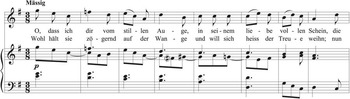
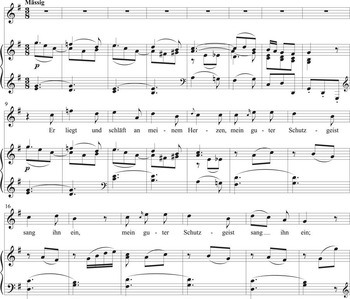
Franz Schubert’s ‘An die Geliebte’ and ‘An die Nachtigall’ invite speculation. As Examples 1 and 2 show, these lieder appear to begin similarly in C major, but soon move toward G. One might assume that Schubert decided the first song was inferior and salvaged its start in the second. Or, since neither is widely known, it may be supposed that they reveal little about the composer or his music.Footnote 1 And because both seem slight, each might be dismissed as inconsequential.Footnote 2 But such presumptions limit what the two can tell.
Schubert: ‘An die Geliebte’ (‘To the beloved’; 1815; D. 303), bars 1–8

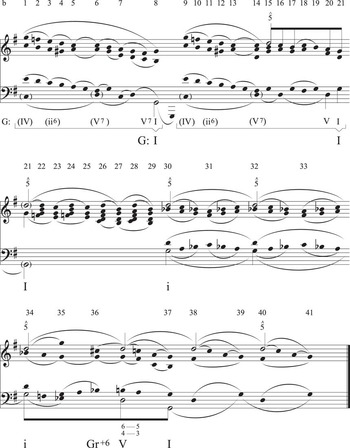
Schubert: ‘An die Nachtigall’ (‘To the nightingale’; 1816; D. 497), bars 1–21

‘An die Geliebte’ and ‘An die Nachtigall’ speak volumes if considered from the standpoint of conversation. For instance, each song conveys a single character’s interiority, as well as that character’s utterances to an unspeaking other, whose presence is crucial to the drama. However, when the lieder are placed in the context of Schubert’s life, each reveals inconspicuous implications within the character’s thoughts and statements. Indeed, within that context, each may be understood to articulate a personal expressive need of the composer at the particular time it was composed. Finally, their shared substance signals intertextuality, so each song surely informs the other. Thus, the metaphor of conversation affords an advantageous approach, as well as an analytical attitude. To begin, let us enter an ongoing discussion of these intriguing lieder.
‘Schubert Revising Schubert’ … or Perhaps Something Else?
Susan Youens has proposed that ‘An die Geliebte’ and ‘An die Nachtigall’ portray ‘Schubert revising Schubert’ and that they provide evidence of a critical attitude toward his compositions that compelled him to rework his music in myriad ways.Footnote 3 Among many types of revision that may be observed in the composer’s music, which include transposition, superficial alteration, major overhaul and reset texts, she suggests that these lieder show how Schubert ‘used music composed earlier to one poem as the basis for a setting of another poem by a different poet’.Footnote 4 Observing that they present male and female perspectives, respectively, Youens finds greater psychological depth in the later lied, ‘An die Nachtigall’, and submits that Schubert’s setting not only expands the signification of the poet’s text, but also exploits his music from ‘An die Geliebte’ more effectively.Footnote 5
While her interpretation of ‘An die Nachtigall’ is persuasive, it may be that ‘An die Geliebte’ represents more than a source of repurposed material.Footnote 6 Considered on its own merits, the earlier song actually seems successful as is, even innovative. And instead of revision, another creative impulse may offer a satisfactory account for the reappearance of its opening material in the later song. If so, our understanding of ‘An die Nachtigall’ might evolve significantly. Let us examine its predecessor.
The appeal of ‘An die Geliebte’
The text of ‘An die Geliebte’ is by Josef Ludwig Stoll (1778–1815), and it appears below with my translation.Footnote 7

A dramatic monologue, ‘An die Geliebte’ offers a captivating mix of emotions and implications in just eight lines. On the surface, its words speak of consolation and sympathy, eliciting curiosity regarding the source of the strong emotion to which the singer appears to respond. Is the unspeaking ‘other’ joyful or fearful? Why would her tears linger on her cheek? What brought them forth? We never learn for sure, but are moved to imagine possibilities, which surely must have been Schubert’s intention.
With so much ambiguity and possibility on the surface of ‘An die Geliebte’, it is easy to imagine that other levels of meaning may be perceived within. Susan Youens holds that it is ‘tenderly erotic, the lover drinking his beloved’s tears in a symbolic evocation of lovemaking’, and that it concludes ‘with the ecstatic-melancholy recognition that the lover assumes the beloved’s sorrows as well as the rapture of love’.Footnote 8 Indeed, ‘An die Geliebte’ most certainly represents an earnest entreaty to one whose ‘quiet eyes, in their loving look’ have shed tears of desire denied until that moment. This more intimate interpretation seems convincing, since it demands a listener’s imaginative contribution to the lied’s experience. And in the conservative Biedermeier era when it was composed, such personal sentiments could never have been expressed publically, so the song’s symbolism could have served to convey what could not be said aloud.
But there is something Youens did not mention in her discussion, a fact subsequently made widely known by John Reed in his own appraisal of these pieces: Schubert set ‘An die Geliebte’ on 15 October 1815 – Therese Grob’s name day.Footnote 9 Therese has come to be recognized as one of Schubert’s great loves, as well as a muse and an early interpreter, so this connection could be a coincidence, or it could represent something more.Footnote 10 Otto Erich Deutsch believed that Schubert’s affection for the young woman arose early in 1815, if not before, so it would seem at least possible that she may have inspired his remarkable creativity on that particular day.Footnote 11 We do not know if Therese ever heard ‘An die Geliebte’, but its poetic content and evocative setting certainly make me hope that she did.Footnote 12
Much about Schubert’s relationship with Therese (1798–1875) comes to us second-hand, interpreted through the lenses of others.Footnote 13 We know, for instance, that she sang at the première of Schubert’s Mass in F in 1814 at the Lichtental Church, that their families were close, and that a wedding may have been discussed, though the 18-year-old Schubert’s teaching job could not support them both.Footnote 14 And while an 1815 Viennese marriage law required that a prospective groom supply proof of sufficient income, the familial and spiritual values of the Grobs and Schuberts may have played roles in delaying their union as well.Footnote 15
In this context, ‘An die Geliebte’ may be more than the source of material for the later lied ‘An die Nachtigall’.Footnote 16 Surely the undercurrent of eroticism identified by Susan Youens in ‘An die Geliebte’ represents a second level of meaning borne by the poet’s verse, a stream of expressive intentions beyond that which may be gained from a superficial interpretation of Stoll’s words. Perhaps a third level of meaning exists within the song as well – a concealed message incorporated by Schubert, consciously or unconsciously, that communicated his passion and urged her patience.Footnote 17 Schubert’s setting is extremely engaging, so let us examine evidence for such a personal subtext.Footnote 18
‘An die Geliebte’ Unpacked
As Example 1 shows, ‘An die Geliebte’ begins without an introduction, enabling the singer to assert his presence at once. Its tonal structure immediately intrigues, implying uncertainty as well as pursuit. The tonality of C major seems suggested until the middle of bar 3, when the tonal focus shifts temporarily to A minor. However, both impressions are dispelled by the embellished dominant seventh sonority in bar 6.Footnote 19 The half cadence in bar 8 suggests G major but does not establish it, eliciting expectation of a more convincing assertion of the tonic. Preceded by a neumatic setting of the words ‘liebvollen Schein’ in the first verse, and ‘heiss der Treue weihn’ in the second, this half cadence adds fullness to the image of a tender glance and sincerity to the notion of constancy, yet looks ahead all the same.
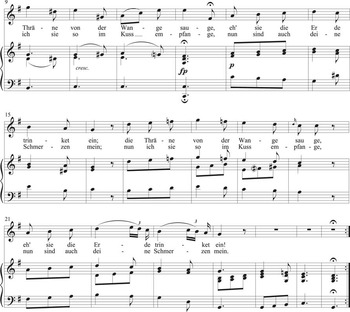
Example 3 reveals that the next three textual phrases of ‘An die Geliebte’ end on non-tonic harmonies – the dominant (b. 12), subdominant (b. 16), and supertonic (b. 20).
Schubert: ‘An die Geliebte’, bars 9–27

These pauses – which do not represent true harmonic cadences – permit the intensified repetition of the last two lines of each strophe, which, in turn, vivifies the notions of touch and reception, all while forestalling a convincing assertion of G major. As Example 3 shows, confirmation of tonic finally occurs in bar 24 of ‘An die Geliebte’, coinciding with the very last word of each verse, though the cadence is by no means emphatic. Indeed, tonal focus fades immediately, for the interlude features an F♮ in bar 25 that is contradictive of G and implicative of C. Providing a plagal effect evocative of prayer, this passage weakens the just-established tonal orientation and leads to the start of second verse, where C again initially holds sway.Footnote 20 Tonal vacillation, sustained through the second strophe and present at song’s close by the interlude-turned-postlude, brings impressions of yearning and anxiety.Footnote 21 Far from flawed, this sensitive setting conveys quiet desire and elicits warm sympathy in return. Underscoring and authenticating a tender plea, ‘An die Geliebte’ may be interpreted as a subtle message from Schubert to Therese asking her to hold hope. Given the tonal conventions for lieder in the second decade of the nineteenth century, ‘An die Geliebte’ must have been unsettling to its listeners, yet also quite riveting.Footnote 22
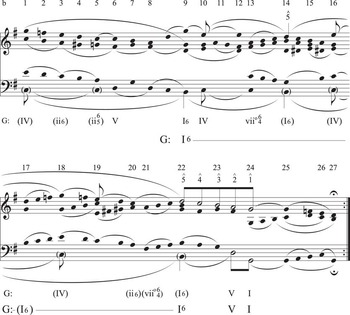
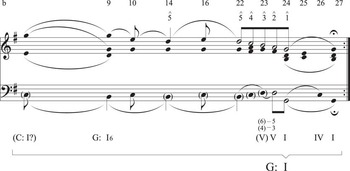
Example 4 offers a detailed view of ‘An die Geliebte’s voice-leading.
‘An die Geliebte’: detailed voice leading sketch

A bass line composed of often widely separated pitches sounding in the lowest register of the piano, plus implied tones suggested by the counterpoint above, forms the foundation of an intriguing aural fabric that engages its listeners, guides attention forward, and finally reaches the tonic only near the end. Represented by parenthesized notes and noteheads, its implied tones do not actually sound within the music, but help to account for the song’s ephemeral tonal tissue when the structural bass is absent and the piano’s higher tenor-level strand is the actual lowest sounding voice. The lied’s primary tone,
 $$\hat 5$$
, finally is asserted in bar 14 – halfway through its span – prior to the relatively quick descent of the fundamental line in bars 22–24; but its presence, too, is more sensed than heard. Closure is weakened in the final bars, especially by the lowered leading tone in bar 25, undermining what had been such a long-anticipated achievement. Through this allusively unfolding tonal structure, Schubert underscores the mixture of sincerity and doubt within his chosen text.
In the comprehensive view offered in Example 5, it may be more easily seen that the extended spans dominated by composed-out root-position C major harmonies effectively prolong and defer to an inverted G major triad – an inherently unstable harmony – which, in turn, leads to the dominant and ultimately to the root position tonic triad in bar 24.
‘An die Geliebte’: comprehensive voice leading sketch

‘An die Geliebte’ represents what I call a precursive prolongation – a greatly expanded harmonic prefix.Footnote 23 Here this anticipatory structure animates a story whose outcome holds some uncertainty, for, once its tonal objective is achieved, that long-sought success is undercut by the closing bars, where the tonic harmony is undermined ever so slightly by the brief swing toward the subdominant, achieved with the aid of the lowered leading tone, F♮.Footnote 24 Given how much attention C received at the start of the lied, its echo here weakens the work’s impression of closure.
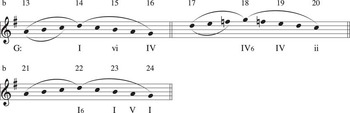
Aspiration and apprehension also may be perceived nearer the musical surface within the voice’s thrice-heard melodic gesture of bars 13–24. Example 6 illustrates.
‘An die Geliebte’: melodic gestures in bars 13–24

Composed of an ascending stepwise fourth-span followed by a descending fifth, each gesture embodies an advance and a retreat – ‘four steps up, five steps down’. In the first of these, the stepwise descent from dominant to tonic is harmonized by the submediant and subdominant, leading away from the expected tonic harmony. The second instance reaches higher than the first, harmonized by the subdominant of G and supertonic, yet it too concludes away from tonic. In both, the final non-tonic harmony colours the end of the phrase with uncertainty. Only with the final instance within bars 21–24, does a perfect authentic cadence impart a measure of satisfaction. Comparison with Schubert’s music in Example 3 reveals increasing surface embellishment, first the grace note of bar 20, then the neighbour tones within the triplets of bars 22–23, which seem nonchalantly improvised, but betray insecurity. Nevertheless, the lower-register ascending fourth-spans echoing in the piano interlude may suggest that hope remains.
Smaller elements in ‘An die Geliebte’ also elicit expectation. As Example 1 illustrates, the inner-voice suspensions of bars 2, 4, 5 and 6 feature embellished resolutions whose brief delays convey hesitancy, underscoring the subjunctive mood of the first line. The minor seventh spanned by the first vocal phrase, which declines from G5 to A4 in bars 1–8, conserves instability through the half cadence in bar 8. And as Example 3 shows, the end of the next phrase features a direct and dramatic descent of a minor seventh, its lower tone sustained by the fermata in bar 12. Supported by the thick, accented and dissonant dominant-seventh chord, this leap emphasizes the suggestive words sauge (‘suck’) and empfange (‘receive’) and may convey youthful impetuosity. Resolutions of these projected melodic sevenths are implied within the voice leading, but are not fully satisfying. The same is true of the inverted dominant seventh harmony in bar 12 of Example 3, whose dissonant, low C2 is transferred to C4, then C5, and only indirectly resolved in an inner voice in bar 14. With all of these elements, Schubert elicits anticipation, but leaves lingering expectation.
Descending and ascending minor second intervals also attract attention in ‘An die Geliebte’. For instance, the piano’s dotted quarter F♮5 in bar 2 of Example 1 implies its semitonal resolution downward to E5 on the following downbeat, thus establishing a motivic pattern.Footnote 25 In bars 4–5, the inner-voice pitches G♯4–A4, an upward-resolving suspension, inverts the motivic interval, producing an ascending semitone. Later, the ascending semitones in the piano part of bars 9–10 (D4–D♯4 and G4–G♯4) and 14–16 (D♯4–E4 and D♯4–E4) reinforce its memory, as Example 3 illustrates. Yet at the end of the song, the descent of F♮4 to E4 in the pianist’s right hand reverses the semitonal impulse. Tiny details, to be sure, but in the mostly diatonic context of ‘An die Geliebte’, these chromatic semitones stand out, adding ardent nuances.
While the images and ideas of Schubert’s ‘An die Geliebte’ are touching, its honesty and vulnerability seem convincing. In light of its context, ‘An die Geliebte’ may have communicated what its composer could not say.Footnote 26 Perhaps this is why it has survived, despite a later song that bears some of its substance. It is, in the words of Graham Johnson, ‘a perfect page’.Footnote 27 The same may be said of ‘An die Nachtigall’, composed a little over a year later. If ‘An die Geliebte’ bears multiple, co-existent and even ironic meanings, then perhaps its sequel does too.
The Resignation of ‘An die Nachtigall’
As Examples 1 and 2 show, music derived from the opening of ‘An die Geliebte’ initiates ‘An die Nachtigall’.Footnote 28 Concluding with a perfect authentic cadence in bars 7–8, the opening passage of ‘An die Nachtigall’ confirms G major by introduction’s end, thus departing from its predecessor. Sketching a quiet scene, at once spacious and intimate, the opening passage could be understood, all by itself, to portray the undulating descent of a nightingale. Repetition of its material in bars 9–14 surely reinforces that image as the text unfolds. Yet it also would appear to confirm that if Schubert considered ‘An die Geliebte’ a successful song, his decisive self-borrowing here signals intentional linkage. If so, perhaps even more ties bind these lieder.
‘An die Nachtigall’s text is by Matthias Claudius (1740–1815), and it appears below with my translation.Footnote 29

At first, Schubert’s setting may seem to suggest a mother’s lullaby. But its serenity soon gives way to exhilaration, fuelled by a flight of imagination. The final third of the song turns bleak, presenting a plea for silence. As with ‘An die Geliebte’, questions arise. Who is sleeping next to the singer’s heart? What is the source of her joy? Why would she implore the nightingale – whose song may be the most beautiful in nature – to let her love sleep? More lies below the surface of these six lines, though just what is not perfectly clear.Footnote 30 There is an arc of excitement within ‘An die Nachtigall’, yet it ends unexpectedly, even abruptly, on a note of resignation. Like ‘An die Geliebte’, this lied surely holds more for the imaginative listener.
Susan Youens proposes that ‘An die Nachtigall’ presents
a charming depiction of female experience, in which the woman takes delight in her return to herself, to a regained individuality, after love-making. Her love for the sleeping man by her side is not questioned – he is Amor or Love itself – but she has her own guardian spirit and her own capacity for delight apart from eroticism. ‘To the Nightingale’ is a plea for Nature’s foremost symbol of love to be silent.Footnote 31
‘An die Nachtigall’ appears richly endowed with significance, and this scenario seems entirely plausible. Associated with love, the nightingale also is a symbol of tragedy and of transformation, so perhaps its implications inspired Schubert.Footnote 32 What other intentions might be interpreted here?
‘An die Nachtigall’ Deconstructed
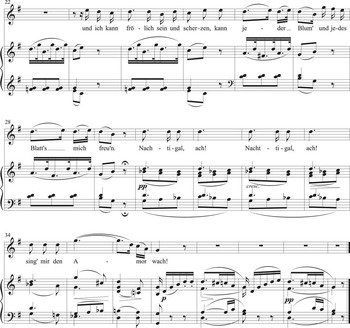
Earlier in this essay, Example 2 presented the first half of ‘An die Nachtigall’; Example 7 offers the rest of the song.
Schubert: ‘An die Nachtigall’, bars 22–41

Susan Youens observes that the chromaticism in bar 5 contributes to a ‘languid erotic aura’ and that the succeeding bars ‘emphasize the poetic persona’s gratitude to her guardian angel, who has sung the beloved to sleep’.Footnote 33 Noting that the ‘jauntiness of the dotted rhythmic patterns … and quickened prosodic pace [of bars 22–29] will make any listener smile’, she points out that the ‘vocal line stays poised on and around the dominant pitch (D) throughout mm. 24–34, not descending to the tonic pitch until the last syllable’, to portray ‘a poetic persona determined not to succumb to the erotic languor that has carried off her love’.Footnote 34 Schubert’s tonal fabric contributes to all of this in a variety of ways.
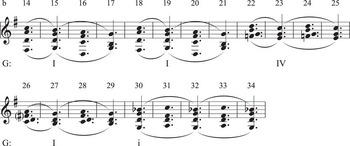
For instance, from bars 14 to 34, the piano’s harmonies change constantly, as the summarizing sketch in Example 8 suggests.
Schubert: ‘An die Nachtigall’, harmonic rhythm in bars 14–34

Focusing first on the tonic, then on the subdominant in bars 22–25, the accompaniment soon returns to tonic, which mutates to minor. While the text traverses several moods, and the rhythm of the vocal melody waxes and wanes, this extended embellishment of and emphasis on the tonic harmony within this span creates an underlying and welling tension all its own that culminates quickly in the closing bars that follow, drawing upon the power of aroused anticipation for change.
Example 9 offers a broader and more detailed view of Schubert’s lied.
Schubert: ‘An die Nachtigall’, detailed voice-leading sketch

The tonic harmony of G major is established by the piano introduction, brought about by the octave descent from G5 to G4 in the uppermost voice and confirmed by the perfect authentic cadence in bar 8. The primary tone, 5, finally appears in bar 15, and is locally reinforced by a preliminary melodic descent that concludes in bar 21. Once established, the primary tone,
$$\hat 5$$
, is retained and sustained via repetition and embellishment throughout the lied. No structural descent – no fundamental line – proceeds from
$$\hat 5$$
, as scale degree
 $$\hat 3$$
(B♮4) is distinctly avoided three times in bars 36–41. Despite the dramatic climax and structural cadence in bars 34–37, both the voice and the echoing piano postlude seem to project unrealised potential. Like its predecessor, ‘An die Nachtigall’ finishes wanting, albeit via different means. But the two songs have even more in common.
Within ‘An die Geliebte’, certain motivic features emerge early, and their repetitions elicit expectation and underscore uncertainty. These included prominent ascending and descending melodic semitones, plus the interval of the minor seventh. The same elements reappear in ‘An die Nachtigall’, but here they will assume an additional, culminative purpose. Let us begin by examining contextually significant instances of semitonal motion.
In Example 2, for instance, the descending inner voice semitones in bars 5 and 6, E4–E♭4–D4, which are repeated later in bars 13–14, recall the ascending semitones D4–D♯4–E4 in bars 9 and 10 of ‘An die Geliebte’ (see Ex. 3). The sequence D♯4–E4, heard within bars 14–16 of ‘An die Geliebte’ echoes that impulse. The descending chromaticism draws our attention toward the dominant, and in turn, toward tonic, while the ascending chromaticism draws attention toward the subdominant, and at least temporarily away from the tonic, underscoring the differing characters of the two songs. Yet the pitch-specific recurrences tie them together.
The authentic cadence at the end of ‘An die Nachtigall’s introduction in bars 7–8 also features both descending and ascending semitones, G4–F♯4–G4. In Example 7, the descending semitones F♮4–E4, and C4–B3, repeated in the lowest strand of the piano part of bars 23–29, also stress the descending semitone. Schubert’s use of modal interchange, which Susan Wollenberg describes as one of the composer’s ‘fingerprints’, surely embodies both ascending and descending chromaticism as well.Footnote 35 In bars 29–37 of ‘An die Nachtigall’, which feature the singer’s supplication to the nightingale (see Ex. 7), B♮s change to B♭s and back again, embodying ascending and descending chromaticism on a broader scale. It is significant that the voice avoids B4 and B♭4 in bar 36, as does the piano in bars 38 and 40. B♮3, however, is approached from above in bars 38–41, hidden within an inner voice. Within these two lieder, the semitone seems to symbolize fluctuant emotional intensity.
The interval of the minor seventh also attracts attention in ‘An die Nachtigall’. For instance, a minor seventh from F♮5 to G4 spans bars 10–21. And each of the even-numbered measures between bars 14 and 28 features a major-minor seventh chord, as do bars 31 and 33.Footnote 36 Indeed, the major-minor seventh becomes a characteristic sonority in ‘An die Nachtigall’, its distinctive interval thus readied for a decisive role.
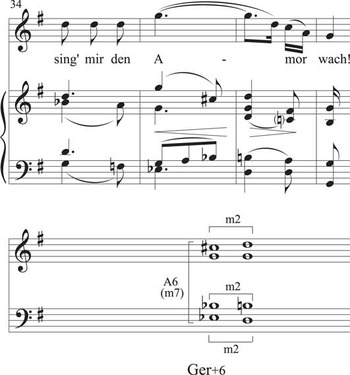
In bar 35, ascending and descending semitones, plus the enharmonic equivalent of a minor seventh, come together in the most distinctive harmonic event of ‘An die Nachtigall’: a striking German augmented sixth followed by a curiously uplifting cadential six-four sonority.Footnote 37 Together, they project and intensify the word ‘Amor’, as Example 10 suggests.
Schubert: ‘An die Nachtigall’, motivic coincidence in bars 35–36

Climactic and cathartic, this motivic coincidence occurs as the song’s persona beseeches the nightingale for silence. Most curiously, however, it brings back not the preceding minor but the tonic major! In contrast to the open-endedness of ‘An die Geliebte’, a forced finality reigns at the conclusion of ‘An die Nachtigall’. The surprising German augmented sixth, coordinated with the high G5 in the voice, would seem to signal the arrival of a dramatic half cadence in G minor, with an attendant emphasis on the dominant harmony, and perhaps considerably more music and text thereafter. Yet the subsequent cadential six-four sonority actually leads to a brief dominant seventh and a rather perfunctory perfect authentic cadence in G major, followed by two more authentic cadences in short order for good measure, before the lied concludes. Within the drama of this lied, Schubert’s expeditious ending communicates determined closure.
A musical process unfolds over these lieder, initiated within ‘An die Geliebte’ and concluded within ‘An die Nachtigall’. The shared opening material establishes an intended and intimate connection between the two songs, and the emphasis on the intervals of the semitone and the minor seventh links them as well. When these intervals coalesce into a remarkable German augmented sixth chord in the latter song, at a particularly decisive point in its narrative, the contextual process reaches its climax and conclusion. But what does all of this mean?Footnote 38 Some context may help.
Bookends
In April of 1816, at the age of 19, Schubert applied for a music master’s position at the Normal School in Laibach, supported by a testimonial from Antonio Salieri.Footnote 39 By early September, he learned that he did not get the job.Footnote 40 An entry from Schubert’s diary on 8 September reveals a young man stunned by the news, attempting to grasp its implications.Footnote 41 And perhaps by the end of the year, Schubert perceived a future with Therese was not possible.Footnote 42 Traces of that realization may remain within ‘An die Nachtigall’.
In November of 1816, when ‘An die Nachtigall’ was composed, one might assume that Schubert had conceived it as being sung by Therese, perhaps metaphorically as well as literally. If so, it would be easy to suppose that Schubert had, wishfully thinking, imagined himself the sleeping lover.Footnote 43 But if Schubert was a romantic realist, he may have interpreted his chosen text more philosophically, even stoically: the ‘he’ referred to by the lied’s speaking persona could well be an ‘it’ and correspond to an impossible love kept close to the woman’s heart, sung to sleep by her guardian angel, a love she begs the nightingale not to awaken. And under the circumstances at that point, which cannot be ignored, the climactic phrase ‘Sing mir den Amor nicht wach’ – ‘Do not sing my Love awake’ – might have multiple implications. For instance, it could voice a hope Schubert may have had – a wish that his affection for Therese be allowed to sleep. Or perhaps it expresses renunciationandmoving on – his recognition and acceptance of Therese as a muse and nothing more.Footnote 44 Indeed, perhaps more than one of these views may be true, for Schubert never averred that there was but one meaning within a song.Footnote 45 Whichever one prefers, it appears clear, both textually and musically, that ‘An die Nachtigall’ concludes what ‘An die Geliebte’ began.
‘An die Geliebte’ and ‘An die Nachtigall’ may be regarded as a complementary and conversational pair that frame an episode of Schubert’s life. The autograph and a copy of ‘An die Geliebte’ remained in Schubert’s possession until his death, perhaps kept as mementoes. ‘An die Nachtigall’ was submitted for publication a dozen years after its composition and published eight months after his death.Footnote 46 Like its companion, Schubert may have felt it brought back too many memories, or may have been too self-revelatory for release. Fortunately, by preserving these brief but uniquely bound lieder, Schubert has allowed us to infer what they have to say.
Besides inviting interpretation, these songs also prompt intriguing questions. Could ‘An die Geliebte’ and ‘An die Nachtigall’ ever be sung together? Certainly, I would think, if properly contextualized, and especially if programmed with others from the same era. Are there more pairs or groups of Schubert’s lieder that feature such links or parallels? Definitely!Footnote 47 For instance, Schubert’s ‘Horch, Horch, die lerche!’, based on lines from Shakespeare’s Cymbeline, and ‘Ständchen’, a setting of verse Ludwig Rellstab from Schwanengesang – serenades whose moods could scarcely be more different – nevertheless share as fundamental premises a common contextual process, as well as the persuasive impulse characteristic of their genre, with the latter bearing distinctive depth and maturity absent in the first.Footnote 48 Thus they would seem affiliated, like variations on a theme, though much less conspicuous. With some 700 companions within Schubert’s œuvre, surely more such associations may be found, and this conversation will continue.