Introduction
Internet gaming disorder (IGD) is a psychiatric disorder characterized by difficulties in controlling gaming cravings, leading to excessive and interfering patterns of gaming (APA, 2013). Studies have shown that IGD is associated with negative consequences, including to interpersonal relationships, mental states, and academic achievement (Liu et al., Reference Liu, Wang, Zhang, Xu, Shao, Chen and Yuan2021; Zhang, Zhou, Geng, Song, & Hu, Reference Zhang, Zhou, Geng, Song and Hu2021). Many studies have shown that people with IGD exhibit impaired executive control of gaming cravings (Dong & Potenza, Reference Dong and Potenza2014; Weinstein & Lejoyeux, Reference Weinstein and Lejoyeux2020). First, studies using different paradigms have shown impaired brain activation in executive control-related brain regions (Dong, Li, Wang, & Potenza, Reference Dong, Li, Wang and Potenza2017), including the dorsolateral prefrontal cortex (DLPFC) and the orbitofrontal cortex (Brand, Young, & Laier, Reference Brand, Young and Laier2014; Zheng et al., Reference Zheng, Hu, Wang, Wang, Du and Dong2019). Simultaneously, subjects with IGD experienced increased gaming cravings, assessed by increased brain activity in reward processing-related brain regions (Chun et al., Reference Chun, Park, Kim, Choi, Cho, Jung and Choi2020; Ma et al., Reference Ma, Worhunsky, Xu, Yip, Zhou, Zhang and Fang2019). Second, abnormal functional connectivity (FC) between brain regions involved in executive control and reward processing has been reported in subjects with IGD (Dong, Lin, Hu, Xie, & Du, Reference Dong, Lin, Hu, Xie and Du2015). People with IGD have lower FC between the orbitofrontal cortex and dorsal striatum (Wang et al., Reference Wang, Wu, Zhou, Lin, Zhang, Du and Dong2017), the left medial orbitofrontal cortex and putamen, and the DLPFC and putamen (Dong et al., Reference Dong, Wang, Zheng, Wang, Du and Potenza2021a; Han et al., Reference Han, Wu, Wang, Sun, Ding, Cao and Zhou2018). A study with a large sample size (337 subjects) observed that subjects with IGD had lower FC between the middle frontal gyrus and the putamen, inferior frontal gyrus and ventral striatum. Disorder severity and craving scores were negatively correlated with FC between striatal and frontal regions (Dong et al., Reference Dong, Wang, Zhang, Hu, Potenza and Dong2021b).
Resting-state FC facilitates the assessment of functional alterations in the absence of contextual modulation (Di Martino et al., Reference Di Martino, Scheres, Margulies, Kelly, Uddin, Shehzad and Milham2008, Reference Di Martino, Kelly, Grzadzinski, Zuo, Mennes, Mairena and Milham2011); these functional alterations are also related to individual differences in BOLD signals during task performance (Tavor et al., Reference Tavor, Jones, Mars, Smith, Behrens and Jbabdi2016). This approach has provided insight into neural circuits in psychiatric disorders, such as cannabis (Blanco-Hinojo et al., Reference Blanco-Hinojo, Pujol, Harrison, Macia, Batalla, Nogue and Martin-Santos2017; Zimmermann et al., Reference Zimmermann, Yao, Heinz, Zhou, Dau, Banger and Becker2018) and tobacco use disorders (Hu, Salmeron, Gu, Stein, & Yang, Reference Hu, Salmeron, Gu, Stein and Yang2015). An increasing number of studies have indicated that cognitive function is accomplished by the interactions of a brain network rather than by specific regions (Bassett & Sporns, Reference Bassett and Sporns2017). Recent studies have suggested that there are two distinct brain networks that jointly influence decision-making: the executive control network (ECN), which is associated with inhibiting impulses, and the reward network (or basal ganglia network, BGN), which mediates immediate reward (McClure, Ericson, Laibson, Loewenstein, & Cohen, Reference McClure, Ericson, Laibson, Loewenstein and Cohen2007). Abnormal interactions between these two networks have been observed in drug-addicted groups (Monterosso, Piray, & Luo, Reference Monterosso, Piray and Luo2012), heroin-dependent subjects (Xie et al., Reference Xie, Shao, Ma, Zhai, Ye, Fu and Li2014), and subjects with IGD (Dong et al., Reference Dong, Lin, Hu, Xie and Du2015), which suggests that impairments in executive control lead to ineffective inhibition of aggravated cravings for excessive online game playing. These findings elucidate the mechanisms of addictive behaviors at the large-scale system level. The combination of enhanced reward-seeking motivation and impaired inhibition of impulsive behaviors is thought to represent a failure of executive control (Volkow et al., Reference Volkow, Fowler, Wang, Telang, Logan, Jayne and Swanson2010).
However, previous studies have had some limitations. First, although studies have described the altered brain networks of patients with IGD and their association with impaired executive control of cravings, few could explain why these alterations result in impaired cognitive functions (Brand et al., Reference Brand, Wegmann, Stark, Muller, Wolfling, Robbins and Potenza2019; Petry, Zajac, & Ginley, Reference Petry, Zajac, Ginley, Widiger and Cannon2018). Second, researchers hypothesized that the connectivity among brain regions/networks was temporally static (Damoiseaux et al., Reference Damoiseaux, Rombouts, Barkhof, Scheltens, Stam, Smith and Beckmann2006; Friston, Reference Friston2011; Power et al., Reference Power, Cohen, Nelson, Wig, Barnes, Church and Petersen2011). However, the human brain is a complex system; brain activation and FC dynamically changes during learning, growth, and even rest states (Medaglia, Lynall, & Bassett, Reference Medaglia, Lynall and Bassett2015; Supekar, Musen, & Menon, Reference Supekar, Musen and Menon2009). The brain dynamically integrates and coordinates the interaction of different brain areas to enable complex cognitive functions. Third, the affiliation of the ECN and BGN during dynamic reconfiguration has not been elucidated. Although the static ECN of patients with IGD was considered unable to exert top-down control of the BGN, it remains unknown whether this result would hold true from the dynamic perspective.
Thus, to fully understand the neural foundations of impaired executive control of gaming cravings in subjects with IGD, it is necessary to explore the dynamic characteristics of time-dependent changes in the executive control and reward networks. In fMRI scans, blood oxygen level dependence signals indicate fluctuations in brain activity, thereby providing sufficient information to study the dynamic properties of brain networks (Handwerker, Roopchansingh, Gonzalez-Castillo, & Bandettini, Reference Handwerker, Roopchansingh, Gonzalez-Castillo and Bandettini2012). Several researchers have studied the variability of brain networks to detect dynamic functional changes, demonstrating that it is a useful method for detecting dynamic changes in brain networks (Chang & Glover, Reference Chang and Glover2010).
Community structure is a functionally relevant graph metric to study the organization and interaction of functional systems in the brain (Mucha, Richardson, Macon, Porter, & Onnela, Reference Mucha, Richardson, Macon, Porter and Onnela2010). The interactive couplings within community nodes (or brain regions) are strong and dense, whereas interactive couplings between communities are sparse (Newman & Girvan, Reference Newman and Girvan2004). Thus, the community structure (or modular organization) can delineate the functional segregation and integration of whole-brain networks. In most cases, two indices are used to measure the community features: recruitment, which refers to the probability that a brain region is in the same community as other nodes in its own network, and integration, which refers to the probability that a brain region is in the same community as nodes of other networks (He et al., Reference He, Bassett, Chaitanya, Sperling, Kozlowski and Tracy2018). Researchers have identified community structure in both structural and functional networks in the healthy human brain (Crossley et al., Reference Crossley, Mechelli, Vertes, Winton-Brown, Patel, Ginestet and Bullmore2013). Community structure has been used to identify potential functional modules among brain regions exhibiting similar trajectories and functions over time (Fortunato, Reference Fortunato2010). Temporal variations in networks can provide insights into neural mechanisms.
Recently, community structure methods have piqued the interest of clinical researchers, as studies have shown that disrupted community structures are found in a variety of brain disorders (Cary et al., Reference Cary, Ray, Grayson, Painter, Carpenter, Maron and Fair2017; Lerman-Sinkoff & Barch, Reference Lerman-Sinkoff and Barch2016). For example, a study found a less stable community structure at the resting-state network level in a group of patients with schizophrenia and provided novel methods for exploring dynamic community structure (Gifford et al., Reference Gifford, Crossley, Kempton, Morgan, Dazzan, Young and McGuire2020). Lord et al. examined the community structure of the functional network for individuals with unipolar depression (Lord, Horn, Breakspear, & Walter, Reference Lord, Horn, Breakspear and Walter2012). Zheng et al. (Reference Zheng, Li, Bo, Li, Yao, Yao and Wu2018) showed that in major depression disorder (MDD), the anterior cingulate cortex exhibited abnormal flexibility in community structures and that unmedicated MDD groups and medicated MDD groups exhibited similar reconfigurations of the community structure of the visual association and default mode networks but that the groups had different reconfiguration profiles in the frontoparietal control subsystems (He et al., Reference He, Lim, Fortunato, Sporns, Zhang, Qiu and Zuo2018). One study suggested that dynamic network measures may be an effective biomarker for detecting language dysfunction associated with neurological diseases such as temporal lobe epilepsy (He et al., Reference He, Bassett, Chaitanya, Sperling, Kozlowski and Tracy2018).
The primary aim of the current study was to address the limitations of previous studies on IGD and provide a better understanding of the neural mechanisms underlying impaired executive control of cravings. To achieve this goal, we examined the distribution of community assignment across the entire scanning time and compared changes in the community structure of the ECN and reward network in subjects with IGD. We hypothesized that patients with IGD would have a different community structure than recreational game users (RGUs) (the healthy controls in the current study). Second, to verify whether static findings from previous studies could be replicated in dynamic reconfiguration processes, we used a mediation model to explore how these community structure characteristics affect top-down executive control and whether these characteristics are found in subjects with IGD. We hypothesized that top-down executive control would be disrupted in subjects with IGD. This study has important therapeutic implications for developing effective interventions for IGD; for example, the use of noninvasive brain stimulation techniques to change their community characteristics.
Methods and procedures
Participants
This study was approved by the Ethics Committee of Hangzhou Normal University and conducted from December 2013 to December 2019. All participants provided written informed consent in accordance with the Declaration of Helsinki. We first instructed eligible participants who were interested in our study to complete the online IAT test, as the Chinese version of the IAT is a useful tool for diagnosing addicted subjects (Widyanto & McMurran, Reference Widyanto and McMurran2004). If they scored higher than 50 on the IAT, we arranged an interview with a psychiatrist capable of diagnosing IGD according to DSM-5 criteria and the MINI-listed psychiatric disorders (Sheehan et al., Reference Sheehan, Lecrubier, Sheehan, Amorim, Janavs, Weiller and Dunbar1998). Subjects with other addictive behaviors or additional MINI-listed psychiatric disorders were excluded from the current study.
A total of 430 online game players were recruited from universities in China. Twelve players with missing fMRI data and sixteen players with head motion >2.5° during the scan were excluded. The severity of IGD in the remaining subjects was evaluated via both Young's Internet Addiction Test (IAT) and DSM-5 diagnostic criteria.
In our study, individuals with IGD were defined as those with IAT scores greater than 50 and those who met at least five of the nine DSM-5 criteria. A total of 41 subjects recruited in December 2013 (before the release of the DSM-5) were diagnosed based solely on IAT scores. Of these 430 subjects, 162 were diagnosed with IGD, and the remaining 240 were classified as RGUs by trained researchers. For relevant demographic information, see Table 1.
Demographic information

All values are mean ± s.d. IGD, Internet gaming disorder; IAT, Internet addiction test; DSM-5, Diagnostic and Statistical Manual of Mental Disorders-5; All comparisons used the two-sample t test.
Individuals with IGD had to have IAT scores greater than 50, as well as at least five of the nine DSM-5 criteria. The IAT was self-reported questionnaire, and the DSM-5 scores were performed by the psychiatrist during the interview.
Image acquisition
Resting-state functional MRI data were acquired from a 3T Siemens Trio MRI system using an echo-planar imaging (EPI) pulse sequence (33 axial slices with 3-mm slice thickness, TR = 2000 ms, TE = 30 ms, matrix = 64 × 64, FOV = 220 × 220 mm, flip angle = 90°, and a total of 210 volumes). The structural images were from a high-resolution, T1-weighted magnetization-prepared rapid gradient echo sequence (TR = 1900 ms, TE = 2.52 ms, TI = 900 ms, flip angle = 9°, matrix = 256 × 256, slices = 176, voxel size = 1 × 1 × 1 mm3).
Image preprocessing
The DPABI version 5.2 toolbox was used to perform fMRI preprocessing. The first 10 volumes were removed for all data. Slice-time and motion parameters were then evaluated and corrected for the remaining volumes. Data in individual space were spatially normalized with the EPI templates and transformed to MNI coordinates with a 2 × 2 × 2 mm3 voxel resolution. Normalized data were smoothed with a 6 FWHM Gaussian kernel. Finally, the obtained images were detrended and regressed as covariates with noisy signals from white matter (WM), cerebrospinal fluid (CSF) and head motion parameters (Friston 24 model).
Network ROI selection
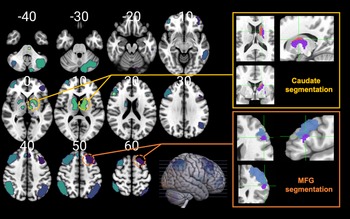
IGD is often accompanied by dysfunction of the frontostriatal circuits; this dysfunction can be interpreted as a lack of connectivity between the ECN and the BGN. We used the Shirer, Ryali, Rykhlevskaia, Menon, & Greicius (Reference Shirer, Ryali, Rykhlevskaia, Menon and Greicius2012) atlas, which includes 14 resting-state networks, to define these functional networks a priori. The left and right ECNs (including 6 brain regions per network) and the BGN (5 regions) were extracted for analysis. The right ECN and the BGN overlap in the right caudate nucleus and the middle frontal gyrus due to the functional diversity of these regions. The time correlation between each voxel within the overlapping area and the two networks was calculated using all subject data, and the right caudate and middle frontal gyrus were parcellated by using a ‘winner-takes-all’ approach with a bootstrapping strategy (Alcauter et al., Reference Alcauter, Lin, Smith, Short, Goldman, Reznick and Gao2014; Behrens et al., Reference Behrens, Johansen-Berg, Woolrich, Smith, Wheeler-Kingshott, Boulby and Matthews2003) (see Fig. 1).
Segmentation of the right caudate and middle frontal gyrus. These areas were divided into two networks based on the ‘winner-take-all’ strategy. For the caudate, the area marked in pink was assigned to the RECN, and the area marked in purple was assigned to the BGN. For the middle frontal gyrus, the area marked in blue was assigned to the RECN, and the area marked in purple was assigned to the BGN.

Network construction
We extracted the mean time series of 17 functionally defined regions of interest (ROIs). For network construction, we used wavelet decomposition rather than FC to extract information from these time series because it is more sensitive to subtle signal changes in nonstatic time series with noisy backgrounds (Brammer, Reference Brammer1998). We use a maximal overlap discrete wavelet transformation with the Daubechies least asymmetric approach to decompose the time series into multiple frequency intervals (Cazelles et al., Reference Cazelles, Chavez, Berteaux, Menard, Vik, Jenouvrier and Stenseth2008): scale 1, 0.125~0.25 Hz; scale 2, 0.062~0.125 Hz; scale 3, 0.031~0.062 Hz; and scale 4, 0.015~0.031 Hz. Scale 3 was chosen as the main analysis frequency band because it completely covers the frequency range commonly interpreted in resting fMRI (i.e. 0.01~0.1) and has higher sensitivity to disease classification (Wang et al., Reference Wang, Zuo, Dai, Xia, Zhao, Zhao and He2013).
The time-series data were then split into a consecutive series of 40-s time windows that overlapped with continuous windows by 50%. The magnitude-squared spectral coherence between each pair of ROIs was estimated according to (Bassett et al., Reference Bassett, Wymbs, Porter, Mucha, Carlson and Grafton2011), generating a 17 × 17 adjacency matrix for each time window. Finally, the adjacency matrices of all 19 time windows were linked together to form a multilayer network.
Multilayer community detection
A community describes a group of nodes that are more strongly connected to each other than to nodes outside of their community (Newman, Reference Newman2006), and a multilayer community further characterizes changes within a community over time. In the current study, we used a generalized Louvain community detection algorithm (Mucha et al., Reference Mucha, Richardson, Macon, Porter and Onnela2010), involving the following multilayer modularity quality function:

where μ is the total edge weight of the network, A ijl is the edge between nodes i and j at layer l of the multilayer network, and V ijl describes the corresponding element of a null model. The parameter γ l sets the structural resolution parameter of layer l (i.e. the weight of intralayer edges), the parameter ω jlr sets the temporal resolution parameter (i.e. the weight of interlayer edges, here γ l = 1, ω jlr = 0.4) (Chai, Mattar, Blank, Fedorenko, & Bassett, Reference Chai, Mattar, Blank, Fedorenko and Bassett2016), and the parameter g describes the community assignments of two nodes across the time domain, involving node i in layer l and node j in layer r. δ is a Kronecker delta function, where δ(g il, g jr) = 1 if il = jr; otherwise it is 0.
Although the current networks were considered orderly and to have interlayer links between sequential layers for nodes at the same position, the generalized Louvain algorithm has a stochastic nature, sometimes causing instability in community assignments (Good, de Montjoye, & Clauset, Reference Good, de Montjoye and Clauset2010). To ensure the stability of the results, we performed 100 iterations for each subject and calculated the mean, similar to an approach used in previous studies (He et al., Reference He, Lim, Fortunato, Sporns, Zhang, Qiu and Zuo2018).
Recruitment and integration
The 17 ROIs were categorized into three resting-state networks: the left and right ECNs and the BGN (reward network). We calculated two dynamic indicators, recruitment and integration, to quantify dynamic interactions within or between networks. The recruitment coefficient describes the average probability that node i is in the same community as other nodes in its network and is defined as:

where m N is the size of network N, calculated as the number of nodes in N, and P ij corresponds to the relative frequency at which nodes i and j were assigned to the same community across the time domain, where P ij = 1 if nodes i and j are always in the same community and 0 otherwise. Therefore, a node with high recruitment tends to be associated with nodes from its own network in the time domain. In contrast, the integration coefficient describes the average probability that node i is in the same community as nodes of other networks, given by:

where K is the total number of nodes. A node with high integration tends to be associated with nodes from other networks in the time domain.
Validation analysis with longitudinal data
To investigate further, we tracked 40 subjects (22 IGD subjects, 18 RGUs) for more than 6 months and obtained additional data, as the pretest data of these 40 subjects included 402 subjects from the main analysis. We collected resting-state data and addiction characteristics at two scanning times. We calculated the network integration and recruitment coefficients across the two scans for all subjects, and the analytic pipeline steps were the same as those in the cross-sectional analyses.
Statistical analysis
Statistical analyses were further conducted. To match the numbers of subjects in the two groups, we ordered subjects from high to low according to their IAT scores. The first third of the subjects (134 subjects per group) were included. This screening helped to rule out confounding effects from subjects close to the diagnostic threshold, as a recent study has indicated that the diagnostic threshold of IGD is debatable and suggested the use of stricter diagnostic criteria (Dong et al., Reference Dong, Wang, Dong, Wang, Zheng, Ye and Potenza2020). All statistical processes were performed at the network level, and the between-group differences were computed using independent-sample t tests. Each network (LECN, RECN and BGN) generated contrastive t values and corresponding p values based on recruitment and integration coefficients, and significance was determined using the Bonferroni correction (p < 0.016).
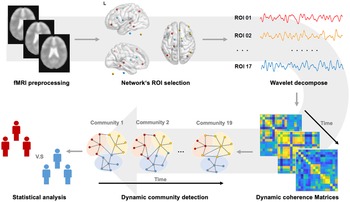
Given our hypothesis regarding the disrupted top-down executive control in IGD and the between-group differences in the RECN integration coefficients in our results below, we explored the integration coefficient of the RECN a possible mediating factor to determine the effect of RECN on recruitment within the BGN. We generated separate mediation models for the two groups, using the recruitment coefficient within the upstream RECN as the predictor and the recruitment coefficient of the downstream BGN as the outcome variable. For the exploratory mediation analysis, PROCESS bootstrapping and bias-corrected 95% confidence intervals were used to assess the significance of the mediation model (Hayes, Reference Hayes2012); a CI that did not contain 0 indicates a significant mediation effect. The analysis pipeline is depicted in Fig. 2.
Analytic pipeline of the current study. This flowchart shows the whole process, from preprocessing of data to statistical analysis.

For the validation analysis, a two-way repeated-measures ANOVA was performed to examine whether longitudinal changes in network coefficients in IGD subjects were consistent with the cross-sectional results. We separately calculated the variation of the integration and recruitment coefficients for the 3 networks, and the significance of the p value was adjusted for multiple comparisons using the Bonferroni correction (p < 0.016).
Results
Recruitment and integration
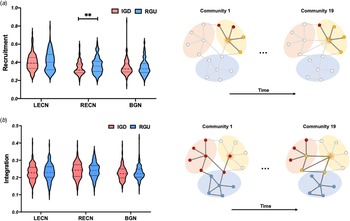
Compared to RGUs, subjects with IGD had a lower recruitment coefficient within the RECN (t = –2.689, p = 0.007, Bonferroni correction, see Fig. 3a). In general, a lower recruitment coefficient indicates that the nodes within the network are less likely to be categorized into the same community over time. Thus, the current results suggest that the functional network characterized by executive control in subjects with IGD changes over time. Although we hypothesized that we would find altered dynamic interactions between the ECN and BGN in subjects with IGD, no significant differences in the integration coefficient were observed between the groups (Fig. 3b).
Between-group differences in recruitment and integration coefficients. (a): (left) The between-group difference in the recruitment coefficient, and (right) a schematic diagram of the recruitment coefficient in a dynamic community. (b): (left) The between-group difference in the integration coefficient, and (right) a schematic diagram of the integration coefficient in a dynamic community. **p < 0.01.

To test whether the confounding effects of excluded subjects would have altered the current results, we included all subjects for between-group comparisons. The results showed that the differences in the RECN recruitment became nonsignificant (t = –1.746, p = 0.081). Additionally, we once more selected the top quartile of subjects (100 subjects per group) based on their IAT scores (ranked from high to low) for comparison. The obtained between-group differences were similar to the other results (t = –2.618, p = 0.009, Bonferroni correction). This evidence may justify the exclusion of a subset of control subjects, which allows the variability of IGD to be disentangled from that of the controls.
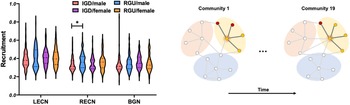
In addition, we examined sex differences in recruitment coefficients within the RECN. The results showed that there was a significant difference in the RECN recruitment coefficient only among males (t = –2.467, p = 0.015, Bonferroni correction, see Fig. 4).
Between-group differences in recruitment coefficients based on sex. (Left) The between-group difference in the recruitment coefficient for males and females, and (right) a schematic diagram of the recruitment coefficient in a dynamic community. *p < 0.05.

Mediation analysis
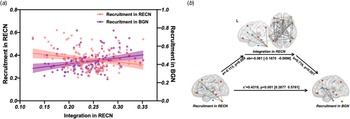
To further verify our hypothesis, we conducted an exploratory analysis of RECN differences between the groups with a mediation model. In the RGUs, we observed that the integration coefficient of the RECN was correlated with the recruitment coefficients of the RECN (r = –0.225, p = 0.009) and BGN (r = 0.276, p = 0.001); no similar correlations were found in subjects with IGD. We then performed a mediation analysis using the integration coefficient of the RECN as the mediating factor. We found that the integration coefficient of the RECN mediated the relationship between the recruitment coefficients of the RECN and BGN in RGUs (see Fig. 5b). The same model did not hold for subjects with IGD.
Mediation analysis. (Left) Correlations of the integration coefficient in the RECN with the recruitment coefficient in the BGN and RECN in RGUs. (Right) Integration in the RECN significantly mediates the relationships between recruitment in the BGN and RECN in RGUs.

Statistical null models
We adopted network null models to quantify the dynamic modular organization of the resting-state network in subjects with IGD and RGUs (Bassett et al., Reference Bassett, Wymbs, Porter, Mucha, Carlson and Grafton2011). Descriptions and the results of comparisons of these null models are provided in the online Supplementary Material. In short, the current results supported the dynamics of real network modules.
Validation analysis
The repeated-measures ANOVA found no significant interaction or main effects. We then used a paired-samples t test to compare pre- and post-measurement differences in only IGD subjects. We observed a decrease in recruitment in the community structure in the 22 IGD subjects (t = –1.435, p = 0.095), although this decrease did not reach statistical significance. This finding suggests that the progression of IGD over time further impaired recruitment in the ECN and provides additional support for our conclusions.
Discussion
Using the dynamic network analysis method, the current study evaluated the dynamic reconfiguration of the ECN and reward network in subjects with IGD. We found alterations in community structure (specifically, recruitment) in subjects with IGD, which may explain why these subjects exhibit impaired executive control. Further analyses showed that this decrease in the recruitment coefficient was only observed in male subjects, thus supporting previous findings regarding sex differences in IGD. We also explored mediation factors that influenced different networks.
Subjects with IGD show altered community structure in the executive control network
‘Recruitment’ refers to the probability that a brain region will be assigned to the same community as other nodes in its network; it quantifies the probability that a functionally defined region of interest will be assigned to the same community as functionally defined ROIs from the same subsystem (Bassett & Mattar, Reference Bassett and Mattar2017). In general, a lower recruitment coefficient indicates that the nodes of a given network are less likely to be categorized into the same network over time.
In the current study, we observed that executive control recruited consistent regions within the ECN and the reward network by observing RGUs throughout the scanning period. Regions within these two networks exhibited a higher likelihood of intra-subsystem communication and a lower likelihood of inter-subsystem communication. However, in subjects with IGD, recruitment in the ECN was unstable: regions within the ECN exhibited a lower likelihood of intra-subsystem communication and a higher likelihood of inter-subsystem communication. This suggests that the ECN of subjects with IGD is unstable and that the recruited brain regions may differ each time executive control is exerted. This variation reduces the efficacy of executive control and impairs impulse control in subjects with IGD. However, we did not observe differences in the reward network between the two groups.
Based on the patterns of recruitment we observed, we conclude that subjects with IGD have altered community structure in the ECN; regions in the ECN exhibited a lower likelihood of intra-subsystem communication and a higher likelihood of inter-subsystem communication. This decrease in recruitment impaired the efficacy of executive control in these subjects, which could explain why subjects with IGD exhibit impaired executive control and struggle to control gaming cravings.
Altered community structure in male but not female subjects with IGD
Further analysis showed that the differences in recruitment between groups were driven by male subjects with IGD; no such features were observed in female subjects with IGD. As discussed in the introduction, studies have reported impaired executive control of reward seeking and gaming cravings (Dong & Potenza, Reference Dong and Potenza2014; Wang, Dong, Zheng, Du, & Dong, Reference Wang, Dong, Zheng, Du and Dong2020; Weinstein & Lejoyeux, Reference Weinstein and Lejoyeux2020) as well as sex differences in IGD. First, the prevalence of IGD is higher in males than in females, which suggests that males are more likely than females to develop IGD (Pan, Chiu, & Lin, Reference Pan, Chiu and Lin2020). Additionally, male subjects with IGD show greater impairments in executive control than female subjects with IGD and find it more challenging to control gaming cravings. For example, the inhibitory control of game-elicited cravings in male subjects with IGD was more severely disrupted by gaming cues than that of females (Zhou et al., Reference Zhou, Zhang, Yang, Zheng, Du and Dong2021); short-term gaming elicited more craving-related activation in response to gaming cues in males than in females (Dong, Wang, Du, & Potenza, Reference Dong, Wang, Du and Potenza2018a). Brain regions implicated in executive control also showed differential FC in males during gaming (Dong, Wang, Wang, Du, & Potenza, Reference Dong, Wang, Wang, Du and Potenza2019). Even among recreational gamers, female players exhibit better executive control than male players in response to gaming cues, which may protect against developing IGD (Dong et al., Reference Dong, Zheng, Liu, Wang, Du and Potenza2018b).
In the current study, decreased recruitment was observed in only male subjects with IGD, not females. These findings further support studies that have reported sex differences in IGD. Studies have shown that males with higher levels of impulsivity are at greater risk for developing IGD (Yen et al., Reference Yen, Liu, Wang, Chen, Yen and Ko2017). When gaming, all players exhibited less engagement of the left DLPFC, but this reduction was predominantly observed in males (Dong et al., Reference Dong, Wang, Du and Potenza2018a). Loneliness may be a risk factor particularly relevant to females, representing an obstacle to recovering from IGD (Sioni, Burleson, & Bekerian, Reference Sioni, Burleson and Bekerian2017). In females with higher self-reported loneliness (Kim, Reference Kim2001), depression is associated with other negative emotions, such as anxiety or distress (Kim et al., Reference Kim, Kim, Lee, Hong, Cho, Fava and Jeon2017), and females experience depression and other negative mood states more frequently than males (Laconi, Pires, & Chabrol, Reference Laconi, Pires and Chabrol2017). This finding suggests that the neurocognitive mechanisms of IGD substantially differ between males and females. Future studies should consider sex differences in the study and treatment of IGD.
Mediation effects suggest that subjects with IGD lack top-down executive control
In RGUs, we also observed that the integration coefficient of the RECN mediates the relationship between the recruitment of both the RECN and BGN, a result not found in subjects with IGD. The integration coefficient of the RECN reflects the dynamic interaction between nodes in the RECN and other networks. According to the addiction framework, addiction is the result of an imbalance between the ECN and BGN, which are generally considered to be structurally independent but functionally coordinated (Noel, Brevers, & Bechara, Reference Noel, Brevers and Bechara2013). After an individual learns social rules, the ECN, which is primarily located in the frontal lobe, controls the subcortical BGN through several mechanisms, including decision-making and inhibitory control, which is considered to provide top-down regulation of the ECN in addiction (Bechara, Reference Bechara2005; Bechara et al., Reference Bechara, Berridge, Bickel, Moron, Williams and Stein2019). In our study, we speculate that a stable top-down regulatory mechanism was present based on the mediation model in RGUs. However, this top-down regulation appears to be absent in subjects with IGD, which might be a potential explanation as to why IGD tends to be associated with impaired executive control.
Limitations
Several limitations of this study should be addressed. First, no subjects in the current study had comorbid disorders to exclude potential confounding effects from other disorders. However, IGD is usually comorbid with other disorders, such as ADHD, nicotine addiction, or other psychiatric disorders. Second, all data were cross-sectional; we lacked longitudinal data to verify the causal relationship between IGD and impaired executive control. Future studies should investigate this issue.
Conclusions
First, subjects with IGD showed a lower recruitment coefficient than RGUs. This could explain why subjects with IGD exhibit impaired executive control of gaming cravings. Second, decreased recruitment was observed in only male subjects with IGD, consistent with previous findings of sex differences in IGD. Third, top-down regulation was observed in only RGUs, not subjects with IGD, which suggests that subjects with IGD lack stable top-down executive control.
Statistics and reproducibility
All statistical analyses were performed using open-source or commercial software; we did not modify the programs. The parameters are provided for each of the statistical steps. Preprocessing was performed using the DPABI toolbox based on MATLAB (http://rfmri.org/dpabi); community detection analysis was performed using the GenLouvain toolbox based on MATLAB (https://github.com/GenLouvain/GenLouvain); and statistical analysis was performed using MATLAB and SPSS 20.0 (https://www.ibm.com/products/spss-statistics).
Supplementary material
The supplementary material for this article can be found at https://doi.org/10.1017/S0033291722002665.
Data
The data stored at our lab-based network attachment system: http://QuickConnect.cn/others. ID:guests; PIN dong@123.COM.
Acknowledgements
The current research was supported by The Cultivation Project of Province-levelled Preponderant Characteristic Discipline of Hangzhou Normal University (20JYXK008) and the Zhejiang Provincial Natural Science Foundation (LY20C090005). This article has been posted on the preprint server MedRxiv (BIORXIV/2021/462308).
Author contributions
Min Wang designed this research and wrote the first draft of the manuscript. Min Wang and Hui Zheng analyzed the data and prepared the figures and tables and the longitudinal data analyses; Weiran Zhou, Lingxiao Wang, Shuaiyu Chen contributed to fMRI data collection, and manuscript revision. Guang-Heng Dong designed this research and edited the manuscript. All authors contributed to and approved the final manuscript.
Conflict of interest
The authors declare that they have no competing interests.