Implications
In production systems with castrated young animals slaughtered at around 12 months old, the age of castration is not an important factor in terms of meat quality or production parameters. However, the protein composition of the diet plays an important role in increasing the muscle content in animals with lower meat development from dairy purpose breeds. Reducing methionine in the diet to increase the ratio of lysine/methionine (lys/met) is recommended, since there is no improvement in growth, carcass quality or muscle composition by adding protected methionine in order to reach the current recommendations of a 3.0 lys/met ratio.
Introduction
Carcass data from Friesian bulls processed in Spain show that 62.7% of carcasses are classified as ‘O’ for conformation (SEUROP scale) and 32.5% as ‘2’ for fatness (1–5 scale) according to the EU Beef Carcass Classification Scheme (Mach et al., Reference Mach, Bach, Velarde and Devant2008). These low classifications are representative of the dairy purpose of the breed and the production techniques, which could be improved.
Castration is an important production tool for enhancing meat quality as it reduces aggressiveness, sexual behaviour and carcass bruising and improves ease of handling (Mach et al., Reference Mach, Bach, Realini, Font i Furnols, Velarde and Devant2009). Furthermore, castration increases carcass fatness, intramuscular fat content and tenderness (Aricetti et al., Reference Aricetti, Rotta, Prado, Perotto, Moletta, Matsushita and Prado2008) which could benefit eating quality. On the other hand, castration reduces average daily gain and feed efficiency (Rotta et al., Reference Rotta, Prado, Prado, Valero, Visentainer and Silva2009) as well as the incidence of a high ultimate pH, changing its chemical composition and fatty acid profile (Aricetti et al., Reference Aricetti, Rotta, Prado, Perotto, Moletta, Matsushita and Prado2008). The differences in performance between bulls and steers are mainly expressed after puberty as a consequence of a greater production of anabolic hormones by the testes (Adams et al., Reference Adams, Daley, Adams and Sakurai1996) which happens at an age of 6–9 months in Friesian bulls (Lunstra et al., Reference Lunstra, Ford and Echternkamp1978). Knight et al. (Reference Knight, Cosgrove, Death and Anderson1999) have proposed post-pubertal castration of bulls at 13 months of age as a way to maintain the performance advantage and benefits of castration on meat quality. However, the majority of cattle in Spain are slaughtered before reaching 14 months old, which implies that castration should be performed earlier than the age proposed by Knight et al. (Reference Knight, Cosgrove, Death and Anderson1999).
A variety of methods to increase meat production through dietary changes have been extensively studied. It is generally accepted that meat production increases with increased dietary CP level (NRC, 2001). However, a number of factors affecting performance, carcass characteristics and meat quality are not included within the NRC (2001) requirements. Differences in genetic strain and feeding management affect requirements, body composition and subsequent growth (Rotta et al., Reference Rotta, Prado, Prado, Valero, Visentainer and Silva2009). Furthermore, trends to produce larger cattle breeds, the selection objectives within traditional breeds and the introduction of dairy breeds have altered the cattle population and have introduced changes to the quality of the meat sold in markets (Campo et al., Reference Campo, Santolaria, Sañudo, Lepetit, Olleta, Panea and Alberti2000; Monsón et al., Reference Monsón, Sañudo and Sierra2004).
Large-framed cattle reared directly after weaning have rapid and efficient gains, depositing a large percentage of protein as lean tissue (Byers and Rompala, Reference Byers and Rompala1980). These animals have high metabolizable protein requirements that may exceed their supply of microbial and dietary protein (Klemesrud et al., Reference Klemesrud, Klopfenstein, Stock, Lewis and Herold2000a and Reference Klemesrud, Klopfenstein and Lewis2000b). Supplementing the aforementioned cattle with escape protein has improved feed efficiency especially in the early feeding period without affecting ruminal activity or animal productivity (Sindt et al., Reference Sindt, Stock, Klopfenstein and Shain1993). There is, however, no single source of a rumen undegradable CP which provides an ideal balance of essential amino acids to match the profile of cattle (Robinson, Reference Robinson2010). Thus, it is difficult to formulate rations to provide all required amino acid concentrations using currently available feed sources and metabolic models. Lysine and methionine appear to be the first two rate-limiting amino acids for growth (Sinclair et al., Reference Sinclair, Garnsworthy, Mann and Sinclair2014). Therefore, an escape protein should be supplied in adequate amounts for each of these two amino acids.
There is not currently enough information concerning the effect of pre-pubertal castration, protein levels and lysine/methionine (lys/met) ratio in the diet on carcass and meat quality of Friesian bulls, especially those slaughtered at young ages. The aim of this study was to determine the effects of pre-pubertal castration (early, 15 days, or late, 5 months), dietary protein level (14.6% v. 16.8% of DM) and the lys/met ratio (3.0 v. 3.4) on animal performance, carcass characteristics, water losses, texture and chemical composition of Friesian steers finished with diets containing high levels of concentrate.
Material and methods
Animals and treatments
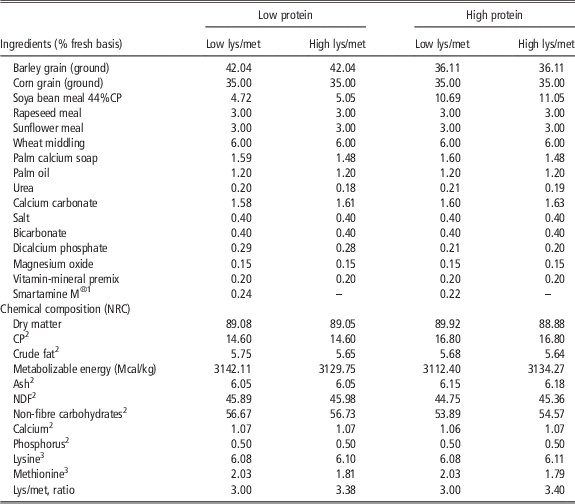
Sixty-four Friesian calves sourced from one herd were used in a complete factorial design. Half of the calves were selected at random and castrated at 15 days of age by the short scrotum method using a rubber ring. The rest of the animals were castrated at 5 months of age with a standard Burdizzo instrument (La Burdizzo, Corso Sebastopoli 187, Turin, Italy). All castrations were performed under local anaesthesia and analgesia (2% lidocaine (Xilocaina Ovejero, Laboratorios Ovejero, Spain) followed by a non-steroidal anti-inflammatory (Flunixin Meglumine, Laboratorios Karizoo S.A., Spain)). At 90 days of age calves were weighed and distributed into one of eight pens of equal dimensions and design, meeting European welfare requirements (EC, 2009). Each pen was randomly assigned to one of eight treatments with the following levels: Castration (early castration (15 days) or late castration (5 months)), dietary protein level (14.6% or 16.8% CP; DM basis) and lys/met ratio (low (3.0) or high (3.4)) following NRC (2001) and INRA (2007) requirements. The estimation of the amino acid ratio was performed from the ingredients of the diet in terms of protein digested in the small intestine considering energy. Rumen protected methionine (Smartamine M®; Adisseo USA Inc., Alpharetta, GA, USA) was supplemented in order to approach the recommended balanced intestinal digestible lysine and methionine ratio of 3.0 (NRC, 2001; INRA, 2007). When protected methionine was not added, the ratio lys/met remained at 3.4. The average initial live weight was 92.9±0.65 kg which was balanced within treatments at the beginning of the experimental feeding period. Calves were fed concentrate (Table 1) and barley straw ad libitum in separate feeders.
Diet composition

1 Protected methionine; contains >70% met (Adisseo USA Inc, Alpharetta, GA).
2 % on dry matter basis.
3 %/PDIE (protein digested in the small intestine when rumen fermentable energy is limiting, INRA, 2007).
Steers were slaughtered when they reached 443.5±26.2 kg live weight at an average age of 355.3±26.6 days old. All steers were deprived of feed before slaughter for less than 24 h but with free access to water. Transportation did not exceed 2 h.
Carcass measurements and sampling
Animals were transported to an EU-commercial slaughterhouse (Friusa, Gerona, Spain). Steers were stunned using a captive-bolt pistol and dressed according to commercial practices. No electrical stimulation of carcasses was performed.
After chilling the carcasses at 2°C for 24 h, cold carcass weight was obtained. Carcass dressing was calculated as the cold carcass weight divided by the live weight at 24 h before slaughter. Carcass classification was performed by a certified grader using the SEUROP classification scale for conformation, scoring from 18 (for S+) to 1 (for P−) and for fatness score (FS) ranking from 15 (for 5+) to 1 (for 1−). Carcass length was recorded according to De Boer et al. (Reference De Boer, Dumont, Pomeroy and Weniger1974).
At 24 h postmortem the 6th rib joint and Longissimus thoracis (LT) were obtained from the left side of the carcass. The LT muscle at the 6th rib was used to measure pH and conduct the fatty acid profile and proximate composition. The rest of the 6th rib was frozen and kept at −18°C until a tissue composition analysis by dissection was performed. Similarly, the rest of the LT was sliced into 3.5 cm thick steaks, vacuum packed and kept at 4°C until reaching 7 days of ageing. Packages were then frozen to measure water-holding capacity by cooking losses and texture analysis to be undertaken at a later time.
pH, cooking losses and texture
The pH was measured 48 h postmortem with a portable CRISSON 503 pH-meter equipped with a penetrating electrode probe on the LT at the 6th rib. To determine cooking losses, samples were thawed overnight at 4±1°C and cooked in a water bath at 75±2°C until they reached an internal temperature of 70°C. Cooking losses were calculated as the difference between thawed and cooked weights (% CL=[(thawed weight – cooked weight)/thawed weight]×100). The same sample was then used for assessing the shear force with a Warner–Bratzler probe in an INSTRON 4301, with a minimum of 5 cores parallel to the muscle fibre orientation per animal.
Tissue composition
After thawing overnight at 4±1°C the muscle, fat, bone and waste were physically separated from the 6th rib and individually weighed to calculate the overall percentage of each tissue.
Chemical analysis
The samples of LT were thawed at 4±1°C, minced, homogenized and analysed in duplicates. Meat moisture and ash content were determined according to ISO R-1442 (1997) and ISO R-936 (1998). CP content was obtained through ISO R-937 (1978). Total fat was determined following ISO 1443 (1973).
For fatty acid determination, the samples were fast-thawed in tap water (1 h) without losing vacuum. The meat was then minced and the fat was extracted in chloroform–methanol with butylated hydroxytoulene as an antioxidant (Bligh and Dyer, Reference Bligh and Dyer1959). All of the samples were analysed in duplicates. The methyl esters from fatty acids (FAMES) were formed using a KOH solution in methanol. The FAMES were analysed in a gas chromatograph HP-6890 II with a SP-2380 capillary column (100 m×0.25 mm×0.20 μm) using nitrogen as the carrier gas (Carrilho et al., Reference Carrilho, Lopez and Campo2009).
Statistical analysis
To conduct the analysis of animal performance, carcass characteristics, pH, cooking losses, texture, tissue percentages and fatty acid composition, the effects of castration age, protein level and lys/met ratio were assessed using SPSS (19.0.0) with the following model:
 $$\eqalignno{Y_{{ijk}} =\ &\mu {\plus}C_{i} {\plus}P_{j} {\plus}R_{k} {\plus}C_{i} {\times}P_{j} {\plus}C_{i} {\times}R_{k} {\plus}P_{j} {\times}R_{k} \cr &{\plus}C_{i} {\times}R_{j} {\times}L_{k} {\plus}e_{{ijk}} ,$$
where Y ijk is the dependent variable; µ the population average; C i the fixed effect of castration age; P j the fixed effect of protein level; R k the fixed effect of lys/met ratio; C i ×P j the interaction between castration age and protein level; C i ×R k the interaction between castration age and lys/met; P j ×R k the interaction between protein level and lys/met; C i ×P j ×R k is the interaction among castration age, protein level and lys/met and e ijk the error. When the effect was significant, differences between means were determined using the Duncan test.
Results and discussion
Animal performance and carcass characteristics
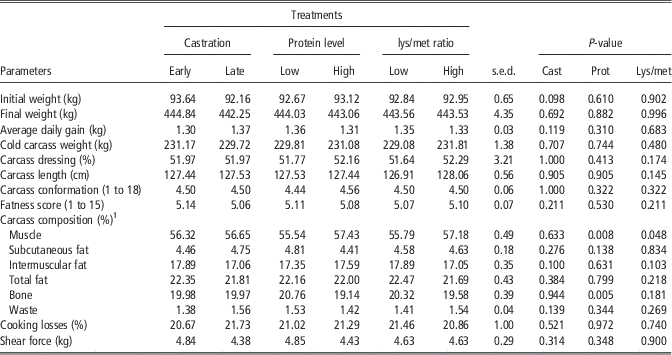
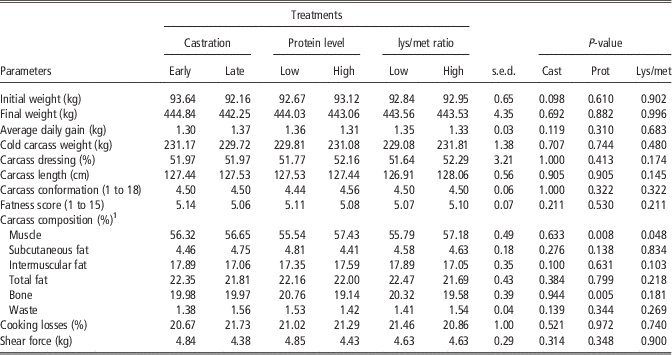
No significant interactions (P>0.05) for animal performance and carcass characteristics were found, thus the effects of treatments are discussed as main effects (Table 2).
Effects of castration age (cast) (early v. late), protein level (prot) (14.6% v. 16.8%) and lys/met ratio (3.0-low v. 3.4-high) on animal performance, carcass characteristics, cooking losses and shear force at 7 days of ageing of Friesian steers intensively reared
Interactions between main effects were not significant (P>0.05).
n=32 animals per group.
1 Carcass composition from the dissection of the 6th rib.
Average daily gain (ADG), final live weight, carcass weight, carcass conformation and fatness scores were not affected by castration age (P>0.05). Castration is a tool in beef cattle production to enhance meat quality and reduce aggressive behaviour (Mach et al., Reference Mach, Bach, Realini, Font i Furnols, Velarde and Devant2009). However, it may also reduce ADG (Rotta et al., Reference Rotta, Prado, Prado, Valero, Visentainer and Silva2009). Results from the current study agree with previous studies conducted with Holstein steers castrated at 5.5 months of age (Fisher et al., Reference Fisher, Crowe, Varga and Enright1996) that have reported no negative effects on ADG and feed intake in the first 35 days after castration. Bagley et al. (Reference Bagley, Morrison, Feazel and Saxton1989) indicated that the practise of castrating calves at birth did not reduce suckling calf weight at weaning compared with delaying castration until 4 months of age. Similarly, no advantages were found in carcass conformation or fatness scores, meat yield or commercial cuts after adopting late castration on Piemontese calves instead of the traditional practice to castrate before puberty (Lazzaroni and Biagini, Reference Lazzaroni and Biagini2008). The difference between the two groups of castrated animals in the current study is small. This may be explained by differences in performance between bulls and steers that are mainly manifested after puberty as a consequence of a greater production of anabolic hormones by the testes (Adams et al., Reference Adams, Daley, Adams and Sakurai1996) which occurs at 9 months in Holstein bulls (Lunstra et al., Reference Lunstra, Ford and Echternkamp1978). Therefore, Knight et al. (Reference Knight, Cosgrove, Death and Anderson1999) have proposed post-pubertal castration of bulls at 13 months of age as a way to maintain the performance advantages and the benefits of castration on meat quality characteristics afterwards. Nevertheless, in Spain Friesian bulls are slaughtered at an average age of 12 months (Mach et al., Reference Mach, Bach, Velarde and Devant2008), as were the animals in this study.
Animal performance and carcass classification (Table 2) were not significantly different between low or high dietary protein (14.6% v. 16.8% CP). These results suggest that a high protein diet can be replaced with a cheaper diet without compromising feedlot performance and carcass classification, which is currently used as the reference for the price to be paid in most European countries. Similarly, no significant difference was found in performance or carcass classification between the two lys/met ratios (3.0 v. 3.4). Lysine and methionine have frequently been identified as the first and second limiting amino acids for growing cattle (Klemesrud et al., Reference Klemesrud, Klopfenstein, Stock, Lewis and Herold2000a and Reference Klemesrud, Klopfenstein and Lewis2000b). The requirements for these limiting amino acids have been estimated from studies in which the amino acids were infused postruminally in a protected form to allow escape from the ruminal microbial deamination but available for digestion and absorption in the small intestine (Schroeder and Titgemeyer, Reference Schroeder and Titgemeyer2008) being the recommended ratio between them around 3.0 (INRA, 2007). However, growth response to supplementation of diets with escape proteins has been inconsistent (Klemesrud et al., Reference Klemesrud, Klopfenstein, Stock, Lewis and Herold2000a and Reference Klemesrud, Klopfenstein and Lewis2000b; Schroeder and Titgemeyer, Reference Schroeder and Titgemeyer2008).
Tissue composition (total muscle, total fat and bone percentages) did not significantly differ between castration ages (Table 2). Previous studies indicate the castration of calves increases carcass fatness and intramuscular fat content (Knight et al., Reference Knight, Cosgrove, Death and Anderson1999), whereas in this study both treatments were castrated and the analysed effect was the age at which castration occurred. In any case, the percentage of dissected fat was higher than that found in entire animals with a similar diet (Partida et al., Reference Partida, Olleta, Campo, Sañudo and Maria2007a) directly due to the effect of castration in tissue composition. After a literature review no studies have been found that evaluate the change in tissue composition of calves castrated at 15 days old compared with other pre-pubertal castration ages. Therefore, 9 months between castration and slaughtering are long enough for tissue differences to disappear in the case that early castrated animals would have started to increase their fat deposition at a higher rate than late castrated animals, while this latter group had not yet been castrated. Similarly, protein level and lys/met ratio did not significantly modify fat percentage. On the other hand, muscle percentage was significantly higher for the high dietary protein (P=0.008) and high lys/met treatments (P=0.048). Bone percentage was lower (P=0.005) in the high dietary protein treatments. Thus, feeding high protein and high lys/met increased muscle deposition without affecting carcass fatness.
pH, cooking losses and texture
The ultimate pH (at 48 h) did not differ among treatments. Values were below 5.6 (data not shown) indicating that animals were not stressed at the time of slaughter. Thus the ultimate pH can be considered as normal, assuming that a value >5.8 is regarded as undesirable (Abril et al., Reference Abril, Campo, Önenç, Sañudo, Albertí and Negueruela2001; Mach et al., Reference Mach, Bach, Velarde and Devant2008).
Cooking losses were not affected by castration age, protein level or lys/met ratio (Table 2) where the values in the current study are similar to those reported in the literature (Oliván et al., Reference Oliván, Martínez, Osoro, Sañudo, Panea, Olleta, Campo, Oliver, Serra, Gil and Piedrafita2004). Shear force was not significantly affected although the values at 7 days of ageing were lower compared with those of entire Friesian males slaughtered at a similar age (Monsón et al., Reference Monsón, Sañudo and Sierra2004) or similar compared with longer ageing times (Partida et al., Reference Partida, Olleta, Campo, Sañudo and Maria2007a). This might be due to the effect of castration reducing the insoluble collagen content (Zilio et al., Reference Zilio, Vincenti, Ballico, Ficco and Juarez2009).
Proximate composition
There were some significant interactions in the proximate values among castration age, protein level and lys/met ratio thus differences between batches were analysed as eight treatments (Table 3). The moisture percentage was higher (P=0.024) in meat from late castrated steers (73.3%) than early castrated steers (72.8%). However, high lys/met in late castrated animals showed higher moisture content than in early castrated animals (P=0.017). Nevertheless, moisture percentages in all treatments were lower (from 72.2% to 73.7%) than those found by Brugiapaglia et al. (Reference Brugiapaglia, Lussiana and Destefanis2014) in entire Friesian males. This was probably due to the higher fatness in the animals under study, since fluctuations in moisture percentage are often attributed to variations in lipid percentage (Rotta et al., Reference Rotta, Prado, Prado, Valero, Visentainer and Silva2009).
Effects. of castration age (cast) (early v. late), protein level (prot) (14.6% v. 16.8%) and lys/met ratio (3.0-low v. 3.4-high) on proximate composition (%) of Longissimus thoracis from Friesian steers intensively reared

Absent interactions between main effects were not significant (P>0.05).
n=8 animals per group.
a–cValues in rows with different letters are significantly different (P⩽0.05).
Protein percentage was similar between castration ages, although it tended to be higher (P=0.053) in early (21.32%) than late castrated animals (20.81%). The percentage was higher in treatments with high lys/met (P=0.028) where there was a significant interaction (P=0.030) since late castrated animals fed high lys/met showed higher protein percentage in the muscle (21.64%) than those fed low lys/met (20.47%). The protein percentage in meat from steers ranged between 20.08% and 22.00%. Similarly, some authors (Aricetti et al., Reference Aricetti, Rotta, Prado, Perotto, Moletta, Matsushita and Prado2008; Rotta et al., Reference Rotta, Prado, Prado, Valero, Visentainer and Silva2009) reported that protein percentage in the Longissimus muscle varied between 21% and 24% with different ages of castration and nutritional status.
Lipid percentage significantly differed (P=0.004; 0.019) in late castrated steers fed with high protein and low lys/met with respect to other treatments. This group showed the highest lipid content (6.26%) which corresponded to the lowest protein content and possessed one of the lowest moisture levels in the muscle. Percentages varied from 4.34 to 6.26% which are comparatively higher in relation to the results of Mach et al. (Reference Mach, Bach, Realini, Font i Furnols, Velarde and Devant2009). These authors discussed the failure of the castration procedure in some of their animals which reduced their fat content. This failure did not occur in our experiment and hence, our higher results for intramuscular lipids. Nevertheless, castration positively increased lipid composition in comparison with similar entire animals fed similar diets (Partida et al., Reference Partida, Olleta, Sañudo, Albertí and Campo2007b) and even the leanest animals showed higher intramuscular fat compared with other entire Friesian slaughtered at a heavier weight (Brugiapaglia et al., Reference Brugiapaglia, Lussiana and Destefanis2014). In general, ash percentage was higher (P=0.014) for the high dietary protein and high lys/met treatments although ash percentage is not influenced by age of castration or feeding management (Padre et al., Reference Padre, Aricetti, Gomes, Goes, Moreira, Prado, Visentainer, Souza and Matsushita2007).
Fatty acid profile
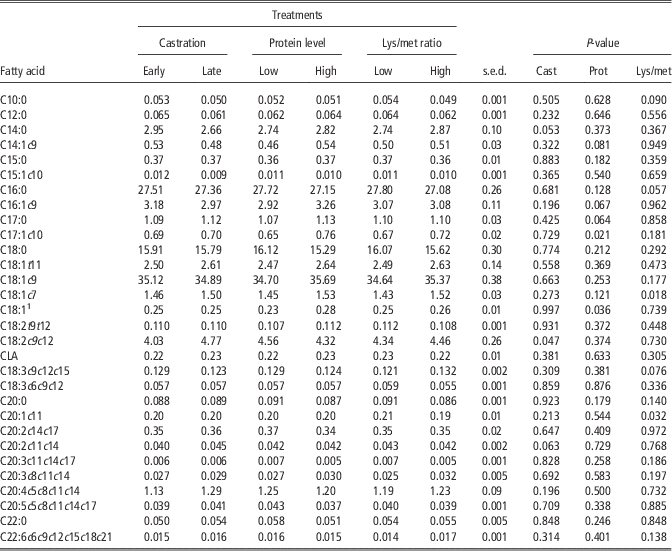
Castration age, protein level and lys/met ratio had a limited effect on intramuscular fatty acid (IMF) composition (Table 4). Late castrated steers had a significantly higher percentage of linoleic acid (C18:2,n-6) but no other IMFs differed. There were significantly higher percentages of C17:1, C18:1 t6+t7+t8 due to dietary protein and only C18:1c11 and C20:1c11 differed due to lys/met.
Effects of castration age (cast) (early v. late), protein level (prot) (14.6% v. 16.8%) and lys/met ratio (3.0-low v. 3.4-high) on Longissimus thoracis fatty acid composition (% of total fatty acids) of Friesian steers intensively reared

CLA=sum of isomers of conjugated linoleic acid.
Interactions between main effects were not significant (P>0.05).
n=32 animals per group.
1 Σ t6, t7, t8.
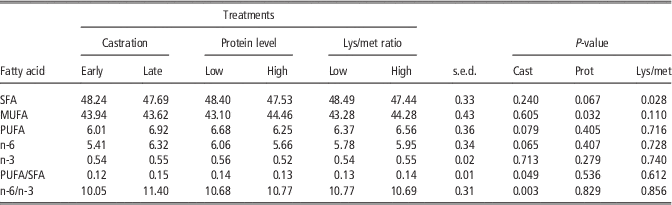
Castration age and protein level did not significantly affect (P>0.05) the SFA percentage (Table 5). However, SFA percentage was higher (P=0.028) in meat from steers fed a low lys/met ratio, possibly related to their lower muscle content. Monounsaturated fatty acid (MUFA) percentage was higher (P=0.032) in meat from steers fed a high protein level but was not affected by castration age or lys/met ratio. No differences were found for total PUFA percentage or in the n-6 or n-3 proportions. On the other hand, PUFA/SFA and n-6/n-3 were higher in late castrated steers (Table 5) whereas protein level and lys/met ratio did not influence these ratios (P>0.05). The PUFA/SFA ratio was low (0.13) although this value is within the normal range for cattle (Padre et al., Reference Padre, Aricetti, Gomes, Goes, Moreira, Prado, Visentainer, Souza and Matsushita2007), especially for animals that are intensively fed cereal-based diets (Scollan et al., Reference Scollan, Hocquette, Nuernberg, Dannenberg, Richardson and Moloney2006). As for n-6/n-3, it is recommended to be over 4. The current study found an average of 10.7 which is in accordance to diets containing high proportions of barley, corn and soybean meal, all of which are very rich in linoleic acid. Overall, these results suggest that the influence of the castration age and, especially, the protein quantity and its quality on IMF is relatively small.
Effects of castration age (cast) (early v. late), protein level (prot) (14.6% v. 16.8%) and lys/met ratio (3.0-low v. 3.4-high) on Longissimus thoracis composition of groups of fatty acids (% of total fatty acids) from Friesian steers intensively reared

SFA=saturated fatty acids; MUFA=monounsaturated fatty acids; PUFA=polyunsaturated fatty acids.
Interactions between main effects were not significant (P>0.05).
n=32 animals per group.
Conclusions
Animal performance, carcass conformation and proximate composition of the LT muscle were not affected by castration age on animals slaughtered at 12 months old approximately. On the other hand, a high protein level (16.8% CP, DM basis) increased the percentage of muscle and intramuscular monounsaturated fatty acids without modifying feedlot performance or other studied characteristics of the meat. Supplementation with protected methionine to produce a lys/met ratio of 3.0 did not enhance feedlot performance or carcass characteristics of the steers. Thus a ratio of 3.4, reached without methionine supplementation, could be recommended for rearing conditions in animals slaughtered at this young age.
Acknowledgements
This work has been made possible by financial help from a CDTI project. For the use of facilities the authors thank S.A.T. Sant Mer (Agricola Mas Jonquer) and especially Javier Heras. They would also like to thank the Animal Production personnel in the Faculty of Veterinary of Zaragoza for their technical assistance.