Kawasaki disease is an acute, febrile systemic vasculitis of unknown cause that has a striking predilection for the coronary arteries and leads to acquired heart disease in infants and young children, mainly under the age of 5 years.Reference Kawasaki, Kosaki and Okawa 1 The diagnostic criteria for Kawasaki disease are prolonged fever for at least 5 days, bilateral conjunctival injection, changes in the mucous membranes of the upper respiratory tract, polymorphous rash, peripheral oedema, peripheral erythema, periungual desquamation, and cervical adenopathy.Reference Fimbres and Shulman 2
Kawasaki disease is more prevalent in Asia and Pacific islands compared with Caucasian populations.Reference Fimbres and Shulman 2 In the United States of America and other Western countries, Kawasaki disease occurs in ~1 per 10,000 children under the age of 5 years. The increased prevalence of Kawasaki disease in Asian groupsReference Burns and Glode 3 , Reference Nakamura, Yashiro and Uehara 4 allowed family-based studies of the disease that revealed that a high percentage of Kawasaki-diseased patients has a family history and that the siblings of a Kawasaki-diseased patient are at higher risk of developing the disorder.Reference Fujita, Nakamura and Sakata 5 – Reference Uehara, Yashiro and Nakamura 7 In addition, the risk of occurrence in twins was estimated to be ~13%.Reference Fimbres and Shulman 2 Therefore, the above data support the contribution of genetic factors in disease manifestation.
Specifically, genes related to innate and acquired immune functions or to vascular remodelling have been studied in Kawasaki disease predisposition in subjects with Japanese, Korean, Taiwanese, Indian, Pacific Northwestern, and Caucasian descent. Genetic association studies and genome-wide association studies revealed more than 70 gene loci to be related to Kawasaki disease susceptibility.Reference Lv, Wang and Sun 8 Owing to the fact that the aetiological agent of Kawasaki disease remains unknown, genome-wide association studies carry the advantage that the identification of candidate genes does not require previous knowledge of disease’s pathophysiology.
In the largest genome-wide association study conducted on European and Asian populations, a variant of FCGR2A [Fc fragment of immunoglobulin G, low-affinity IIa, receptor] gene was related to Kawasaki disease, exceeding the threshold for genome-wide significance.Reference Khor, Davila and Breunis 9 The associated polymorphism rs1801274 is a missense variant leading to an amino-acid substitution of histidine by arginine at position 131 (H131R). The studied variant H131R was reported to interact differently with immunoglobulin G subclasses, and as a result, it may be associated with the susceptibility to autoimmune diseases such as Kawasaki disease.Reference Warmerdam, van de Winkel and Vlug 10 In the present study, the association of this variant was examined for the first time in a group of Kawasaki-diseased patients of Greek origin.
Materials and methods
A total of 47 Kawasaki-diseased children (27 female, 20 male, mean age 5.4±0.5 years old) were included in the study. Disease diagnosis was based on the American Heart Association criteria. The control group consisted of 50 Greek healthy adults with no cardiovascular disease and no history of Kawasaki disease. Genomic DNA was extracted from peripheral blood lymphocytes according to the standard salt extraction procedure. FCGR2A [Fc fragment of immunoglobulin G, low-affinity IIa, receptor] gene polymorphism rs1801274 was amplified using the following primer pair rs1801274F: 5′- GGA AAA TCC CAG AAA TTC TCG C-3′ and rs1801274R: 5′- CAA CAG CCT GAC TAC CTA TTA CGC GGG-3′. Polymerase chain reaction–restriction fragment length polymorphism assay was performed using the restriction endonuclease Bst UI. Double digestion of each polymerase chain reaction product was performed so as to confirm the results of the restriction fragment length polymorphism assay, and no discrepancies between the two digestions were revealed. The FCGR2A-131-Histidine and FCGR3A-131-Arginine alleles produced DNA fragments of 343 base pair and 322 plus 21 base pairs, respectively.
The SPSS statistical package was used to test the differences in polymorphisms’ distribution between Kawasaki-diseased patients and controls (Pearson’s χ2). Furthermore, the odds ratio with a confidence interval of 95% was calculated. A difference with a p-value lower than 0.05 was considered as statistically significant.
Results
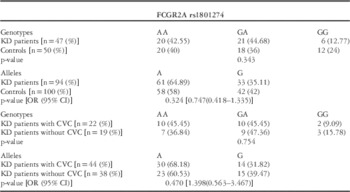
Genotypes’ and alleles’ distributions of rs1801274 polymorphism in cases and controls are shown in the table. The studied polymorphism rs1801274 was in Hardy–Weinberg equilibrium in both cases and controls (p=0.894, 0.065, respectively). No statistical difference was observed between the Kawasaki-diseased patients and controls neither in genotypes’ nor in alleles’ distribution. Furthermore, genotypes’ and alleles’ distributions of rs1801274 were not related to cardiovascular complications in the Kawasaki-diseased patients (Table 1).
Genotypes’ and alleles’ distribution of FCGR2A gene polymorphism rs1801274 in patients with Kawasaki disease and control subjects, and in patients with and without cardiovascular complications.

95% CI=confidence interval of 95%; CVC=cardiovascular complications; FCGR2A=Fc fragment of immunoglobulin G, low-affinity IIa, receptor; KD=Kawasaki disease; OR=odds ratio
Discussion
Fc γ receptors are glycoproteins that bind the Fc region of immunoglobulin G. FCGR2A [Fc fragment of immunoglobulin G, low-affinity IIa, receptor] gene encodes a member of a family of receptors for immunoglobulin G, which is a membrane-bound protein of many immune cells and is involved in the cellular activation and uptake of immune complexes.Reference Falcini, Trapani and Turchini 11 The fact that Kawasaki disease is suggested to be triggered by an infectious agent in genetically predisposed children and that disease therapy involves intravenous immunoglobulins rationalises worldwide researchers’ interest over the role of FCGRA2 [Fc fragment of immunoglobulin G, low-affinity IIa, receptor] gene in Kawasaki disease predisposition, disease severity, and patients’ intravenous immunoglobulin response.
In the present study, no association was found between the polymorphism rs1801274 of FCGRA2 [Fc fragment of immunoglobulin G, low-affinity IIa, receptor] gene and Kawasaki disease in the patients of Greek origin. In addition, no association was revealed between this polymorphism and the development of cardiovascular complications in the studied patients. The negative association of rs1801274 with Kawasaki disease reported here is in accordance with this reported in a group of Dutch Kawasaki-diseased children,Reference Biezeveld, Geissler and Merkus 12 whereas positive association was described in other Caucasian groups.Reference Khor, Davila and Breunis 9 , Reference Shrestha, Wiener and Shendre 13 Owing to the fact that Kawasaki disease is characterised by low prevalence in the Caucasian populations,Reference Fimbres and Shulman 2 the independent genetic association studies in more Caucasian groups of patients add to the pool of genetic data for their future meta-analysis, which will define with more accuracy the genetic factors related to Kawasaki disease susceptibility worldwide.
Acknowledgements
None.
Financial Support
This research received no specific grant from any funding agency, commercial, or not-for-profit sectors.
Conflicts of Interest
None.
Ethical Standards
The authors assert that all procedures contributing to this work comply with the ethical standards of the relevant national and institutional committees on human experimentation and with the Helsinki Declaration of 1975, as revised in 2008.