In recent years, numerous researches have been devoted to bioactive peptides encrypted in dairy proteins in order to take advantage of such peptides in functional food ingredients for the maintenance of health. In a previous study (Plaisancie et al. Reference Plaisancie, Claustre, Estienne, Henry, Boutrou, Paquet and Leonil2013), we demonstrated that the peptide β-CN(94-123), that we identified in fermented milks in concentrations ranging between 0·3 and 1·7 μm, has the characteristics of such a bioactive compound. Indeed, this peptide which corresponds to the sequence (94-123) of bovine β-casein, increased expression of the intestinal secreted mucin MUC2 and of the transmembrane-associated mucin MUC4 by human intestinal mucus-producing cells. More significantly, it also induced the expression of Muc2 and Muc4, as well as the expansion of mucus cells in rat intestinal mucosa after oral administration.
The intestinal mucus gel covering the mucosal surface is a major component of physiological defence mechanisms. Mucus provides protection from noxious substances (e.g., acidity, proteolytic enzyme activities, or toxins), and constitutes a local physical barrier against microbiota and pathogens (Corfield et al. Reference Corfield, Carroll, Myerscough and Probert2001; Corazziari, Reference Corazziari2009). Mucus also regulates epithelial hydration, allows lubrication of the cell surface, and participates indirectly in the immune response due to interactions with secretory immunoglobulins (Pelaseyed et al. Reference Pelaseyed, Bergstrom, Gustafsson, Ermund, Birchenough, Schutte, van der Post, Svensson, Rodriguez-Pineiro, Nystrom, Wising, Johansson and Hansson2014). The intestinal mucus gel owes its properties to secreted mucins, which are high-molecular-weight glycoproteins produced by goblet cells of the epithelium. To date, up to 20 different mucins (MUC) have been identified in humans and divided into two main classes: secreted and cell surface-associated (membrane-associated) mucins (Corfield, Reference Corfield2014). Secreted gel-forming mucins include MUC2, MUC5AC, MUC5B, MUC6 and MUC19. Each of these mucins has a characteristic organ and cell type-specific distribution. Normal stomach mucosa is characterised by the production of MUC5AC, primarily by surface epithelial mucus cells, and by the production of MUC6 by the gastric glands. The epithelium of the small and large intestine contains characteristic goblet cells that produce MUC2. The protective role of MUC2 is definitively proven by the development of spontaneous colitis and intestinal tumours in Muc2 knockout mice (Velcich et al. Reference Velcich, Yang, Heyer, Fragale, Nicholas, Viani, Kucherlapati, Lipkin, Yang and Augenlicht2002; Van der Sluis et al. Reference Van der Sluis, De Koning, De Bruijn, Velcich, Meijerink, Van Goudoever, Buller, Dekker, Van Seuningen, Renes and Einerhand2006). In human, many studies support the hypothesis that alterations in MUC2 synthesis, secretion, and/or degradation are involved in the initiation or maintenance of intestinal disorders such as duodenal ulcer, ulcerative colitis, necrotising enterocolitis and colon carcinomas (Pugh et al. Reference Pugh, Jayaraj and Bardhan1996; Mizoshita et al. Reference Mizoshita, Tsukamoto, Inada, Hirano, Tajika, Nakamura, Ban and Tatematsu2007; Strugala et al. Reference Strugala, Dettmar and Pearson2008; Mudter, Reference Mudter2011). The membrane-associated mucins have also received increasing attention for their role in the protection of epithelia. In the gut, prominent membrane-associated mucins are MUC1, MUC3, MUC4, MUC12, MUC13 and MUC17 which are detectable both in goblet cells and in enterocytes, providing a static external barrier that can limit direct access of pathogens (Corfield et al. Reference Corfield, Myerscough, Longman, Sylvester, Arul and Pignatelli2000; Corfield, Reference Corfield2014).
The secreted mucin MUC2 in association with the membrane-associated mucin MUC4 acting as a physicochemical barrier for the protection of the epithelial cell surface, it can be speculated that fermented milks containing peptide β-CN(94-123) could offer specific health benefits to consumers for preventing or treating many intestinal diseases. However, some issues still need to be clarified before the use of this peptide. In particular, the question arises about the minimal active sequence. β-CN(94-123), a 30 amino acid residues peptide, could be considered as a multifunctional molecule. It contains encrypted in its sequence, an opioid peptide named neocasomorphin-6 (β-CN f114-119), a peptide with antioxidant activity (β-CN f98-105) and a peptide inhibitor of angiotensin converting enzyme (ACE-I) (β-CN f108-113), which could affect production of mucins (Philanto-Leppälä et al. Reference Philanto-Leppälä, Rokka and Korhonen1998; Jinsmaa & Yoshikawa, Reference Jinsmaa and Yoshikawa1999; Gupta et al. Reference Gupta, Mann, Kumar and Ram Bhagat2010). The enzymatic hydrolysis of β-CN(94-123) during intestinal digestion may also generate other small sequences carrying biological activities. All these points require experiments. The identification of bioactive sequences smaller than β-CN(94-123) will help to clarify the mechanisms of action involved in the activation of goblet cells, will allow designing synthetic peptide more resistant to enzymatic digestion and will make easier the development of novel regulators of intestinal host defence. To achieve this objective, we tested in vitro, on intestinal HT29-MTX cells, the activity of peptides chosen using several strategies based on (Fig. 1) (i) the known bioactive peptides which are encrypted in the sequence of β-CN(94-123) (ii) in silico prediction of opioid peptide reactivity and (iii) an approach based on the digestion of β-CN(94-123) by enzymes of the brush border membrane of intestinal epithelial cells, knowing that the active sequences must escape the action of brush border enzymes to reach the goblet cells and exert their physiological effects.
Strategies used to search the minimal sequence responsible for the biological activity of peptide β-CN(94-123).

Materials and methods
In vitro studies
Cell culture
HT29-MTX, a human colon carcinoma derived mucin-secreting goblet cell line, was grown in 25-cm2 plastic culture flasks in DMEM supplemented with 10% feotal bovine serum (FBS) and 100 mg penicillin-streptomycin/ml at 37 °C in a 5% CO2 atmosphere in a humidified incubator as previously described (Zoghbi et al. Reference Zoghbi, Trompette, Claustre, El Homsi, Garzon, Jourdan, Scoazec and Plaisancie2006). HT29-MTX cell line is a well-established model which produces mucin in response to various stimulants (Zoghbi et al. Reference Zoghbi, Trompette, Claustre, El Homsi, Garzon, Jourdan, Scoazec and Plaisancie2006; El Homsi et al. Reference El Homsi, Ducroc, Claustre, Jourdan, Gertler, Estienne, Bado, Scoazec and Plaisancie2007). These cells also exhibit immunopositivity for μ-opioid receptors on their cell membranes (Zoghbi et al. Reference Zoghbi, Trompette, Claustre, El Homsi, Garzon, Jourdan, Scoazec and Plaisancie2006). The NCI-H292 epithelial cells (American Type Culture Collection, Manassas, VA, USA), a human airway epithelial cell line that produces mucins, were cultured in RPMI 1640 medium (Invitrogen, Carlsbad, CA, USA) supplemented with 2 mml-glutamine, 100 U penicillin/ml, 100 μg streptomycin/ml and 10% FBS. The cells were grown at 37 °C in 5% CO2 fully humidified air and were subcultured twice weekly (Borchers et al. Reference Borchers, Carty and Leikauf1999).
To study the effect of peptides, cells were seeded in 12-well culture plates. Experiments were performed when cells reached confluency (NCI-H292) or 21 d after cells reached confluency (HT29-MTX), as previously described (Plaisancie et al. Reference Plaisancie, Claustre, Estienne, Henry, Boutrou, Paquet and Leonil2013). All experiments were performed at least three times in triplicate. Peptides were synthesised from GENOSPHERE Biotechnologies (Paris, France).
Enzyme-linked lectin assay for mucins from cell culture media
An enzyme-linked lectin assay (ELLA) was used to measure mucin-like glycoprotein secretion as previously described (Zoghbi et al. Reference Zoghbi, Trompette, Claustre, El Homsi, Garzon, Jourdan, Scoazec and Plaisancie2006). The amount of glycoprotein secreted in the incubation medium was expressed as nanograms of mucin-like glycoprotein per 106 cells, and results are given as per cent of controls.
Quantitative real time PCR analysis
Measures were performed with the real-time fluorescence detection method using the Mastercycler® ep realplex (Eppendorf, Hambourg, Germany) with Maxima™ SYBR Green qPCR Master Mix (Fermentas, St. Leon-Rot, Germany) in PCR plates, as previously described (Plaisancie et al. Reference Plaisancie, Claustre, Estienne, Henry, Boutrou, Paquet and Leonil2013). Calculations were performed according to the 2−ΔΔCt method with correction for efficiency and the final value was adjusted so that controls had a mean relative mRNA level of 1 (Livak & Schmittgen, Reference Livak and Schmittgen2001; Pfaffl et al. Reference Pfaffl, Horgan and Dempfle2002).
Western blot analysis
Proteins (30 μg) were separated using Tris acetate 3–8% and then used for western blot analysis as described previously (Plaisancie et al. Reference Plaisancie, Claustre, Estienne, Henry, Boutrou, Paquet and Leonil2013).
Dot blot of MUC2 in apical media
Sixty microlitres vigorously mixed apical medium of each well were spotted onto nitrocellulose membrane (45 μm) using a Bio-Dot apparatus (Bio-Rad Laboratories, Hercules, CA). After rinse with distilled water, the membrane was dried and blocked during 2 h and then incubated 3 h at room temperature with a monoclonal anti-MUC2 antibody (Abcam, Paris, France; 1/2000). Blots were developed with a commercial kit (WesternBreeze Chemiluminescent, Invitrogen, France). The optical density of spots was visualised and pixelised with the ‘Image System’ (ImageMAster VDS-CL, Amersham Bio-sciences) and densitometrically analysed with Quantity one image analysis software (Biorad Laboratory, Hercules, CA, USA).
In silico prediction of bioactive sequences
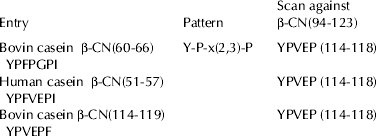
PattinProt software (http://npsa-pbil.ibcp.fr/) was used to identify putative consensus sequences for opioid peptides. The obtained pattern Y-P-x(2,3)-P was searched against the sequence of the β-CN(94-123) peptide using the ScanProsite search engine located on http://prosite.expasy.org/scanprosite/.
Digestion of β-CN(94-123) by enzymes of intestinal brush border membrane vesicles (BBMV)
Preparation of intestinal BBMV
BBMV from the ileum of a freshly killed pig were prepared as described (Boutrou et al. Reference Boutrou, Jardin, Blais, Tome and Leonil2008). Purification and enrichment of the BBMV were checked by determination of the marker enzymes alkaline phosphatase (EC 3.1.3.1) and dipeptidyl peptidase IV (DPP IV; EC 3.4.14.5). Samples were diluted 1 : 100 in 0·1 m sodium carbonate buffer pH 9·4 and mixed to an equal volume of paranitrophenyl phosphate. The absorbance at 405 nm was measured each min during 10 min to determine the activity. To measure the activity of DPP IV, samples were diluted 1 : 80 in 0·02 m Tris-HCl buffer pH 7·5. Fifty microlitres were incubated with 50 μl 0·66 mm Phe-Pro β-naphtylamide at 37 °C. The reaction was stopped by adding 50 μl of a mixture containing 1 mg Fast Garnet/ml, 10% (v:v) Triton X-100 and 1 m sodium acetate pH 4·0 after 0, 5, 10, 15 and 20 min and the absorbance at 550 nm was measured. Protein concentration was determined by using the Bradford reagent (Sigma, St.-Quentin Fallavier, France) with bovine serum albumin as standard. The specific alkaline phosphatase and DPP IV activities were 19·6 and 17·0 fold enriched, respectively in the final BBMV fraction.
Digestion of β-CN(94-123) by BBMV enzymes
Digestion of the peptide β-CN(94-123) by BBMV enzymes was performed at 37 °C in 35 mm Hepes-Tris buffer, 0·15 m KCl pH 7·0. Digestion was started by mixing equal volume of substrate solution (5 g/l) and BBMV preparation diluted 1 : 10 (v:v) in Hepes-Tris buffer. At selected times 0·3 ml samples were withdrawn and the reaction was stopped by removing the BBMV (centrifugation at 2000 g for 1 min). The supernatants were stored at −20 °C until analysis. A blank sample was obtained by replacing the substrate with buffer. A control was obtained by replacing BBMV preparation with buffer.
Identification of peptides by nano LC-ESI/MS-MS
All mass spectra were performed using a hybrid quadrupole time of flight (Q/TOF) mass spectrometer (MS) QStar XL (MDS Sciex, Toronto, Canada). The instrument was calibrated with a multi-point calibration using fragment ions that resulted from the collision-induced decomposition of a peptide from β-casein, β-CN(193-209) (NeoMPS S.A., Strasbourg, France). After 1 : 1000 dilution in 0·1% trifluoroacetic acid (TFA; Pierce, Touzart et Matignon, Vitry-sur-Seine, France), the peptide fraction (10 μl) was trapped onto a micro-pre-column cartridge C18 PepMap 100 (300 μm i.d.×5 mm, Dionex) before separation of peptides onto a column C18 PepMap 100 (75 μm i.d.×150 mm, Dionex). The separation started with 10% solvent B for 10 min and a linear gradient from 10 to 50% of solvent B for 40 min was performed at a flow rate of 300 nl/min. Solvent A contained 2% acetonitrile, 0·08% formic acid and 0·01% TFA in LC grade water; and solvent B contained 95% acetonitrile, 0·08% formic acid and 0·01% TFA in LC grade water. The online separated peptides were analysed by ESI Q-TOF in positive ion mode. An optimised voltage of 2·8 kV was applied to the nanoelectrospray ion source (Proxeon Biosystems A/S, Odense, Denmark). MS and MS/MS data were acquired in continuum mode. Data-direct analysis was employed to perform MS/MS analysis on 1+ to 4+ charged precursor ions. Precursor selection was based upon ion intensity, charge state and if the precursors had been previously selected for fragmentation they were excluded for the rest of the analysis. Spectra were collected in the selected mass range 400–1500 m/z for MS spectra and 60–2000 m/z for MS/MS. The mass spectrometer was operated in data-dependant mode automatically switching between MS and MS/MS acquisition using Analyst QS 1.1 software (Applied Biosystems, Framingham, MA) when the intensity of the ions was above ten cps. To identify peptides, all data (MS and MS/MS) were submitted to MASCOT software (v. 2.2). The search was performed against a homemade database dealing with major milk proteins which represents a portion of the Swissprot database (http://www.uniprot.org); consequently the endogenous proteins were not identified in the present study. No specific enzyme cleavage was used and the peptide mass tolerance was set to 0·2 Da for MS and 0·15 Da for MS/MS. For each peptide identified, a minimum MASCOT score corresponding to a P-value <0·05 was considered as a prerequisite for peptide validation.
Statistical analysis
In vitro data were compared using repeated-measures ANOVA, followed by the Mann–Whitney U-test when appropriate or Mann–Whitney test alone for single comparisons. All the data are expressed as mean±sem. Differences with P<0·05 were considered significant. Statistical analyses were performed with XLSTAT, Version 2009.4.06 (Addinsoft, Paris, France).
Results
In vitro effects of bioactive peptides encrypted in β-CN(94-123)
Bioactive peptides previously identified in the literature and encrypted within the amino-acids sequence of β-CN(94-123) are: VKEAMAPK (β-CN f98-105, an antioxidant peptide), EMPFPK (β-CN f108-113, an ACE-inhibitory peptide) and YPVEPF (β-CN f114-119, an opioid peptide named neocasomorphin-6). We studied their impact on the secreted mucin MUC2 and on the transmembrane-associated mucin MUC4 which are known to be stimulated by β-CN(94-123). Expression of the major mucin produced by HT29-MTX cells, the mucin MUC5AC, was also considered.
Addition of VKEAMAPK to the incubation medium (0·01–100 μmol/l, 4 h) did not modulate the mRNA level of MUC2, MUC4 and MUC5AC ( Fig. 2a). As shown in Fig. 2, EMPFPK and YPVEPF dose-dependently increased the expression of the transmembrane-associated mucin MUC4 with a maximal response achieved with 100 μmol/l EMPFPK (142±8% of control, P<0·05) or YPVEPF (152±22% of control, P<0·05). In contrast, they did not alter the expression of MUC2 and MUC5AC. They were also without effect on mucus secretion (data not shown). The effect of EMPFPK on MUC4 was not reproduced by Captopril (D-3-mercapto-2-methyl-propionyl-L-proline) (0·01–100 μmol/l), a strong and specific ACE-Inhibitor (data not shown).
Effect of known bioactive peptides encrypted in β-CN(94-123) on MUC2, MUC5AC and MUC4 expression in HT29-MTX cells (4 h exposure). After overnight serum starvation, the cells were incubated without (control, CT) or with known bioactive peptides à 37 °C for 4 h. Total RNA was isolated and mucin mRNA levels were analysed by quantitative RT-PCR. Cyclophilin A mRNA, used as internal control, were unaffected by treatment. A/ Effect of VKEAMAPK (an antioxidant peptide); B/ Effect of EMPFPK (an ACE-inhibitor peptide) and C/ Effect of YPVEPF (neocasomorphin-6, an opioid peptide). Each bar represents the mean per cent increase vs. controls ±sem of 4 experiments performed in triplicate. *P<0·05 vs. controls.
In vitro effects of in silico predicted peptides
As several milk peptides with effects on intestinal goblet cells act as opioid agonists (Zoghbi et al. Reference Zoghbi, Trompette, Claustre, El Homsi, Garzon, Jourdan, Scoazec and Plaisancie2006), we have compared the sequence of β-CN(94-123) with that of endogenous opioid. A consensus sequence was determined, and its search in the peptide β-CN(94-123) revealed the sequence YPVEP (Table 1). The peptide was chemically synthesised and tested on HT29-MTX cells (0·01, 1 and 100 μmol/l) for 4 h. YPVEP did not induce an increase in MUC2, MUC4 and MUC5AC mRNA levels (data not shown).
A pattern was determined from sequences of endogenous opioid peptides and searched against the sequence of the β-CN(94-123) peptide
In vitro effects of β-CN(94-108) and β-CN(117-123) identified throughout β-CN(94-123) digestion by enzymes of intestinal BBMV
Digestion by enzymes of intestinal BBMV
The peptide β-CN(94-123) was digested through the action of enzymes from the brush border membrane. The digestion products were identified using HPLC techniques coupled to mass spectrometry. Peptides were not detected in the digested sample after 3 h. The peptide β-CN(94-108) was identified from 0·25 to 3 h digestion. The peptide β-CN(117-123) was later released; it also appeared stable because identified from 1·5 to 3 h digestion. To investigate a direct effect of these peptides on the induction of MUC2 or MUC4 expression, we exposed HT29-MTX cells to each of them.
In vitro effects of β-CN(94-108) and β-CN(117-123) peptides – Effects on intestinal HT29-MTX cells
Surprisingly, the peptide β-CN(117-123) induced a strong decrease in MUC2 expression after 4 h of stimulation. The first significant decrease in transcripts was observed with a concentration of 0·01 μmol/l (41±6% of CT, P<0·05) (Fig. 3a). Following this result, an intermediate concentration (0·1 μmol) was tested. Similar inhibition of MUC2 expression was observed again. Analyses of western blot and of dot blot revealed that this decreased MUC2 mRNA level was reflected either by a reduced intracellular MUC2 protein level in HT29-MTX cells (Fig. 4a) or by a lower secretion of MUC2 in cell culture medium (P<0·05) (Fig. 4b). For example, upon stimulation with the lowest dose of peptide β-CN(117-123), HT29-MTX cells have maintained an intracellular content of MUC2 identical to that of control cells but to the detriment of MUC2 secretion. The peptide β-CN(117-123) also induced a significant increase in the expression of MUC5AC (156±20% of CT at 0·1 μm, P<0·05) and of MUC4 (194±38% of CT, P<0·05 and 152±13% of CT, P<0·05 at 0·01 and 0·1 μm, respectively) (Fig. 3a). This effect of peptide β-CN(117-123) on the expression of MUC5AC and MUC4 was not observed when tested at higher concentrations (1 and 100 μm). One possible explanation for these results may be that the interaction of β-CN(117-123) with a putative receptor would reach saturation.
Effect of the peptides β-CN(94-108) and β-CN(117-123) on MUC2, MUC5AC and MUC4 expression in HT29-MTX cells (4 h exposure). After overnight serum starvation, the cells were incubated without (control, CT) or with the peptides β-CN(94-108) and β-CN(117-123) à 37 °C for 4 h. Total RNA was isolated and mucin mRNA levels were analysed by quantitative RT-PCR. Cyclophilin A mRNA, used as internal control, were unaffected by treatment. Each bar represents the mean per cent increase vs. controls ±sem of 4 experiments performed in triplicate. A/ Effect of peptide β-CN(117-123) B/ Effect of peptide β-CN(94-108).
Effect of the peptide β-CN(117-123) on the secreted mucin MUC2 in HT29-MTX cells (4 h exposure). After overnight serum starvation, the cells were incubated without (control, CT) or with the peptide β-CN(117-123) à 37 °C for 4 h. (A) Western blot analysis of MUC2 in lysates of HT29-MTX cells treated with β-CN(117-123). The expression of MUC2 was normalised to the reference protein level (β-actin) in each sample. Each bar represents the mean per cent increase vs. controls±sem of 4 experiments performed in triplicate. Picture: Representative western blot picture of MUC2 and β-actin in control and treated cells (peptide β-CN(117-123), 0·01–100 μmol/l). Images are representative of 4 separated experiments performed in triplicate. (B) Dot blot analysis of MUC2 in the cell culture medium (P<0·05). Each bar represents the mean per cent increase vs. controls±sem of 4 experiments performed in triplicate. *P<0·05 vs. controls. Picture: Representative dot blot picture of MUC2 in control and treated cells (peptide β-CN(117-123), 0·01–100 μmol/l). Images are representative of 4 separated experiments performed in triplicate.
Incubation of HT29-MTX cells in presence of the peptide β-CN(94-108) increased MUC5AC expression (190·0±3·0% of CT; P<0·05 when tested at the concentration of 0·1 μm) but did not modify the expression of MUC2 and MUC4 (Fig. 3b). Western blot and dot blot analysis also showed that β-CN(94-108) did not modulate MUC2 secretion or intracellular MUC2 production (data not shown).
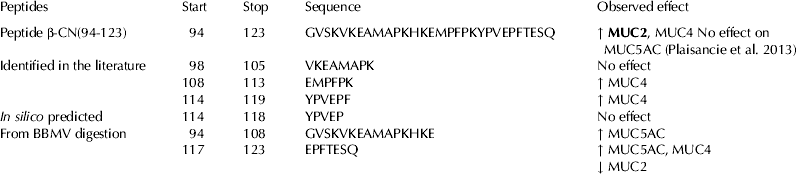
The effects of all the tested peptides on HT29-MTX cells are summarised on Table 2.
Effects of the tested peptides on HT29-MTX cells
Effects on an airway epithelial cell line
Although the mucus is an important factor of airway protection, an excessive production contributes to obstruction in several lung diseases (asthma, chronic obstructive pulmonary diseases, cystic fibrosis …). In this context, a peptide inhibiting the production of secreted mucins could be a help in aerosol therapies. To examine this hypothesis, we used confluent NCI-H292 cells, a human pulmonary mucoepidermoid cell line, which is frequently used for studying production of airway mucins (Kai et al. Reference Kai, Yoshitake, Hisatsune, Kido, Isohama, Takahama and Miyata1996; Rose et al. Reference Rose, Piazza, Chen, Alimam, Bautista, Letwin and Rajput2000). We observed that peptide β-CN(117-123) significantly decreased MUC2 gene expression and MUC2 protein production after 4 h incubation (Fig. 5). In this airway epithelial cell line, β-CN(117-123) also induced a diminution in MUC5AC mRNA level at 0·01 and 0·1 μm (P<0·05). Western blotting could not be achieved with MUC5AC because the amount of protein produced was too low. The decreased expression of MUC2 and MUC5AC was maintained after 24 h exposure with peptide β-CN(117-123) (Fig. 6). In this experimental condition, the maximal effect was observed when β-CN(117-123) was tested at 1 μm.
Effect of peptide β-CN(117–123) on the secreted mucin MUC2 and MUC5AC in NCI-H292 cells (4 h exposure) (A) MUC2 and MUC5AC expression: Total RNA was isolated and mucin mRNA levels were analysed by quantitative RT-PCR. Each bar represents the mean per cent increase vs. controls±sem of 4 experiments performed in triplicate. (B) Western blot analysis of MUC2 in lysates of NCI-H292 cells treated with β-CN(117-123). The expression of MUC2 was normalised to the reference protein level (β-actin) in each sample. Each bar represents the mean per cent increase vs. controls ±sem of 4 experiments performed in triplicate. *P<0·05 vs. controls. Picture: Representative Western blot picture of MUC2 and β-actin in control and treated cells (peptide β-CN(117-123), 0·01–1 μmol/l). Images are representative of 4 separated experiments performed in triplicate.
Effect of peptide β-CN(117-123) on the secreted mucin MUC2 and MUC5AC in NCI-H292 cells (24 h exposure) (A) MUC2 and MUC5AC expression: Total RNA was isolated and mucin mRNA levels were analysed by quantitative RT-PCR. Each bar represents the mean per cent increase vs. controls ±SEM of 4 experiments performed in triplicate. (B) Western blot analysis of MUC2 in lysates of NCI-H292: The expression of MUC2 was normalised to the reference protein level (β-actin) in each sample. Each bar represents the mean per cent increase vs. controls±sem of 4 experiments performed in triplicate. *P<0·05 vs. controls. Picture: Representative Western blot picture of MUC2 and β-actin in control and treated cells (peptide β-CN(117-123), 0·01–1 μmol/l). Images are representative of 4 separated experiments performed in triplicate.
Discussion
Recently, we demonstrated that a novel bioactive peptide derived from bovine β-casein, the peptide β-CN(94-123), was active on mucus cells, a population of the intestinal epithelium implicated in gut defence. The present study was dedicated to the search of minimal sequences responsible for its biological activity. We focused our attention on bioactive peptides described in the literature and encrypted in β-CN(94-123), in silico predicted and the ones which resist in vitro intestinal digestion. The results are discussed according to their activity on expression and production of mucins.
Our study revealed that peptide β-CN(117-123) inhibited the expression as well as the production of MUC2 in intestinal cells. After 4 h stimulation, this decreased MUC2 expression generates either a reduction of the intracellular MUC2 protein level or a lesser secretion of MUC2 in culture medium. It is likely that a longer stimulation with this peptide could lead to total depletion of MUC2 and could therefore have a deleterious effect on intestinal defences. This peptide has been chosen because it is resistant to proteases throughout the intestinal tract, a prerequisite for milk-derived peptides to exert biological activities in the intestine. However, it is important to note that the probability of release of β-CN(117-123) in vivo seems low. Indeed, although intestinal BBMV procedure is a very interesting model to study enzymatic hydrolyses of amino-acid sequences, the in vivo digestion is a much more complex process including degradation by acid and by pepsin in the stomach, an endopeptidase with broad specificity, and then by pancreatic proteases before the action of the brush border membrane enzymes. So that both peptides β-CN(117-123) and β-CN(94-108) may not be produced, or not be produced in sufficient quantities, in the intestinal lumen. In agreement with this hypothesis, we recently investigated peptides released in the jejunum of human volunteers fed with casein (Boutrou et al. Reference Boutrou, Gaudichon, Dupont, Jardin, Airinei, Marsset-Baglieri, Benamouzig, Tome and Leonil2013) and we demonstrated that the β-CN(94-108) and β-CN(117-123) peptides were not detected. It is also to be noted that we did not observe such an inhibitory effect on intestinal Muc2 after oral administration of β-CN(94-123) in rats (Plaisancie et al. Reference Plaisancie, Claustre, Estienne, Henry, Boutrou, Paquet and Leonil2013).
We established that β-CN(94-108) and β-CN(117-123) induced expression of the secreted mucin MUC5AC, whereas β-CN(94-123) was without effect on this one (Plaisancie et al. Reference Plaisancie, Claustre, Estienne, Henry, Boutrou, Paquet and Leonil2013). As in physiological conditions, MUC5AC is mainly produced in the airways and in the stomach, this effect cannot strengthen or restore intestinal homoeostasis. As discussed above, the peptide β-CN(117-123) decreased expression and production of MUC2, but it also induced expression of MUC5AC. While many studies have focused on the mechanisms controlling the expression of MUC2 alone or of MUC5 alone, experiments on factors that regulate the expression of these mucins in opposite direction are rare. Some studies have only observed a temporal correlation between de novo expression of MUC5AC and a decreased expression of MUC2 in colonic preneoplastic lesions (Sylvester et al. Reference Sylvester, Myerscough, Warren, Carlstedt, Corfield, Durdey and Thomas2001; Zoghbi et al. Reference Zoghbi, Drouin, Claustre, Bara, Scoazec and Plaisancie2007). If MUC2 and MUC5AC may have a simultaneous expression in various cell lines, thus indicating common regulatory mechanisms (Han et al. Reference Han, Lee, Kim, Baek, Ahn, Chae, Erickson, Sleisenger and Kim2000; Gaudier et al. Reference Gaudier, Jarry, Blottiere, de Coppet, Buisine, Aubert, Laboisse, Cherbut and Hoebler2004; Gosalia et al. Reference Gosalia, Leir and Harris2013), their cell- and tissue-specific distribution also implies the involvement of other pathways. For example, Gum et al. (Reference Gum, Hicks, Gillespie, Carlson, Komuves, Karnik, Hong, Epstein and Kim1999) revealed the existence of cell-specific elements responsible for MUC2 expression in intestinal goblet cells. Therefore, we could hypothesise that peptides may act on such cell-specific factors of regulation, at least for a mucin.
It is interesting to note that β-CN(117-123) decreased the expression of MUC2 and MUC5AC in NCI-H292 cells, a human airway epithelial cell line. Such a peptide could therefore be interesting to mitigate symptoms of some lung diseases. Indeed, overexpression of the gel-forming mucin MUC5AC is a characteristic of inflammatory pulmonary diseases including asthma, chronic bronchitis, and cystic fibrosis. Mucus overproduction can then block the conducting airways, impair the gas exchange and therefore, contribute to the pathogenesis of respiratory diseases. Furthermore, although the production of MUC2 has not been demonstrated yet in normal airway mucus, there is evidence that expression of this secreted mucin is up regulated in cystic fibrosis but also following exposition with Pseudomonas aeruginosa (Li et al. Reference Li, Dohrman, Gallup, Miyata, Gum, Kim, Nadel, Prince and Basbaum1997; Voynow et al. Reference Voynow, Gendler and Rose2006). Thus, adding synthetic peptide β-CN(117-123) in aerosol therapy could present advantages in the treatment of several lung diseases. Several experiments will be required to verify this hypothesis.
We demonstrated that among the seven peptides tested, 3 of them (EMPFPK, YPVEPF and EPFTESQ) induce expression of the transmembrane-associated mucin MUC4. One of these peptides, and in particular the peptide EPFTESQ, could be at the origin of the effect of peptide β-CN(94-123) on intestinal expression of MUC4. Indeed, we previously showed that the effect of β-CN(94-123) on the expression of MUC4 by HT29-MTX cells was the most prominent at a concentration of 0·01 μmol/l and that this effect was reversed when β-CN(94-123) was tested at 100 μmol/l. Our results showed that the peptide EPFTESQ has a similar effect on MUC4, which is not the case of peptides EMPFPK and YPVEPF. Note that the sequence β-CN f108-113, i.e., the casokinin EMPFPK, is known to act by blocking the Angiotensin Converting Enzyme (ACE), a dipeptidyl peptidase also known as kininase II (EC 3.4.15.1). In the present study, we observed that EMPFPK significantly increased expression of the transmembrane-associated mucin MUC4 when tested at 100 μm. This effect was not reproduced by captopril (D-3-mercapto-2-methyl-propionyl-L-proline), a strong and specific ACE inhibitor often used in the treatment of hypertension, thus suggesting that EMPFPK acts on goblet-like cells through mechanisms independent of ACE inhibition pathway. Like EMPFPK, the sequence YPVEPF, also named neocasomorphin-6 (Teschemacher, Reference Teschemacher2003), induced a significant rise in MUC4 expression in HT29-MTX cells and was without effect on the expression of MUC2 and MUC5AC. In keeping with these results, Martínez-Maqueda et al. (Reference Martinez-Maqueda, Miralles, De Pascual-Teresa, Reveron, Munoz and Recio2012) demonstrated that neocasomorphin-6 did not provoke mucin secretion by HT29-MTX cells. It is worth noting that YPVEP was without effect on HT29-MTX cells, thus suggesting that the C-terminal phenylalanine in the sequence YPVEPF plays a critical role in the action of neocasomorphin-6 on MUC4 expression.
The high reactivity of MUC4 is surprising and could be related to a specific protective function in newborns. Indeed, MUC4 is present in breast milk, suggesting again a major role in neonate defences. Actually, several studies demonstrated that the membrane-associated mucins MUC1 and MUC4 present in milk strongly block the attachment of pathogens to host cell membranes (Ruvoen-Clouet et al. Reference Ruvoen-Clouet, Mas, Marionneau, Guillon, Lombardo and Le Pendu2006; Habte et al. Reference Habte, Kotwal, Lotz, Tyler, Abrahams, Rodriques, Kahn and Mall2007, Reference Habte, de Beer, Lotz, Tyler, Kahn and Mall2008; Liu et al. Reference Liu, Yu, Chen, Kling and Newburg2012).
In conclusion, we demonstrated that different peptides encrypted in the sequence of β-CN(94-123) interact with intestinal goblet cells (Fig. 7). Three of them, β-CN(108-113), β-CN(114-119) and β-CN(117-123) induced MUC4 expression and could be partly responsible for the activity of β-CN(94-123) on this transmembrane-associated mucin. Two others, β-CN(94-108) and β-CN(117-123), modulated the expression of the secreted mucin MUC5AC while β-CN(117-123) also decreased that of MUC2. However, none of them reproduced the stimulatory effect of β-CN(94-123) on the prominent intestinal mucin MUC2, thus suggesting that the 30 amino-acids of β-CN(94-123) are necessary for reinforcing intestinal protection. In contrast, the peptide β-CN(117-123) inhibited the expression as well as the production of MUC2 in intestinal cells. This peptide could therefore have a deleterious effect on intestinal defences.
Summary diagram. Only the sequence (94-123) of bovine β-casein stimulates the production of MUC2, a crucial factor of intestinal protection. The peptide β-CN(94-123), derived from bovine β-casein and identified in yoghurt, represents a novel molecule with potential health applications. It enhances the expression of the secreted mucin MUC2 and of the transmembrane-associated mucin MUC4. The mucin MUC2 is secreted by goblet cells and forms a viscous gel (mucus layer) on the intestinal epithelial surface. Mucus lubricates the intestinal surface, limits passage of luminal molecules into the mucosa, functions as a defensive barrier against enzymes, acid and enteric pathogens. The membrane-associated mucin MUC4 is believed to play a role in the protection of cell surfaces. Tested on human intestinal HT29-MTX cells, the peptides EMPFPK and YPVEPF increased the expression of MUC4 and could thus enhance static protection. None of them modulated production of the secreted mucin MUC2, a major player in the intestinal protection. The peptide EPFTESQ also induced expression of MUC4, but it greatly reduced MUC2 expression. This surprising effect was observed on intestinal cells (HT29-MTX) and also on cells of the airways (NCI-H292). In the latter case, the peptide EPFTESQ also decreased the expression of MUC5AC that is highly expressed in the lungs. This peptide could thus be of interest in the treatment of lung diseases characterised by an overproduction of mucus. Note that the peptide GVSKVKEAMAPKHKE has increased expression of the secreted mucin MUC5AC but this is produced in the stomach and will therefore not strengthen or restore intestinal homoeostasis.
This project has been funded in part by grants from INRA Prevalorisation project ‘Pept94-MUC’.