School achievement is, without doubt, the most important factor in promoting socioeconomic welfare, as well as the physical and mental health, of both citizens and nations (OECD, 2007; Poropat, Reference Poropat2011). Since the creation of psychological tests a century ago, psychological science has demonstrated that intelligence is the best single predictor of school achievement (Ackerman, Chamorro-Premuzic, & Furnham, Reference Ackerman, Chamorro-Premuzic and Furnham2011; Jensen, Reference Jensen1998; Loehlin, Reference Loehlin and Sternberg2000; Neisser et al., Reference Neisser, Boodoo, Bouchard, Boykin, Brody, Ceci and Urbina1996). The robust association between intelligence and school achievement is ubiquitous, both geographically and over time. Measures employed to assess intelligence can take various forms (e.g., verbal or non-verbal tasks), and different types of intelligence can be measured (e.g., Gf - fluid intelligence, which is a capacity to think logically and solve problems in novel situations, independent of acquired knowledge; or Gc - crystallized intelligence, which is the ability to use skills, knowledge, and experience). Regardless of the type of test or dimension of intelligence employed, a positive correlation between school achievement and intelligence in both developed (Strenze, Reference Strenze2007) and developing (Colom & Flores-Mendoza, Reference Colom and Flores-Mendoza2007) countries is always found.
Additionally, personality dimensions also can predict school achievement. For instance, persistence/distractibility (Oliver, Guerin, & Gottfried, Reference Oliver, Guerin and Gottfried2007), conscientiousness (Caprara, Vecchione, Alessandri, Gerbino, & Barbaranelli, Reference Caprara, Vecchione, Alessandri, Gerbino and Barbaranelli2011; Chamorro-Premuzic & Furnham, Reference Chamorro-Premuzic and Furnham2003; Spinath, Freudenthaler, & Neubauer, Reference Spinath, Freudenthaler and Neubauer2010), aggressive behavior (Aluja & Blanch, Reference Aluja and Blanch2002), socialization and study habits (Aluja-Fabregat & Blanch, Reference Aluja-Fabregat and Blanch2004; Poropat, Reference Poropat2009), psychoticism (Poropat, Reference Poropat2011; Saklofske, Reference Saklofske1977), temperament difficulties (Colom, Escorial, Shih, & Privado, Reference Colom, Escorial, Shih and Privado2007), self-control (Bertrams & Dickhäuser, Reference Bertrams and Dickhäuser2009; Duckworth & Seligman, Reference Duckworth and Seligman2005; Wolfe & Johnson, Reference Wolfe and Johnson1995), and/or psychoticism, sensation seeking, and impulsiveness (Aluja-Fabregat & Torrubia-Beltri, 1998) are among these personality predictors. The correlations of these personality dimensions with school achievement varies from −.08 to −.57 indicating great variability of results across studies and across predictors (Colom et al., Reference Colom, Escorial, Shih and Privado2007; Ackerman et al., Reference Ackerman, Chamorro-Premuzic and Furnham2011; De Fruyt, Van Leeuwen, De Bolle, & De Clercq, Reference De Fruyt, Van Leeuwen, De Bolle and De Clercq2008; Freudenthaler, Spinath, & Neubauer, Reference Freudenthaler, Spinath and Neubauer2008; Furnham & Chamorro-Premuzic, Reference Furnham and Chamorro-Premuzic2006).
What happens when intelligence and personality are measured simultaneously? The absolute majority of studies indicates that intelligence is a stronger predictor of school achievement than personality. For instance, Petrides, Chamorro-Premuzic, Frederickson, and Furnham (Reference Petrides, Chamorro-Premuzic, Frederickson and Furnham2005) measured verbal cognitive ability, personality, and school achievement in a sample of 901 secondary school students (aged from 14 to 16 years.), and they found a robust association between academic problems (AP) and verbal ability or Gc (r = .84), and less robust associations with personality dimensions such as Psychoticism (r = −.14) and Extraversion (r = −.25). Laidra, Pullmann, and Allik (Reference Laidra, Pullmann and Allik2007), who assessed 3618 Estonian schoolchildren, reported 21% of variance explained by intelligence whereas Agreeableness explained 2.2% of the total variance (grades 2 to 4). For grades 6 to 12, intelligence explained 18% of the variance whereas Conscientiousness accounted for 4.4% of school achievement variance. Furnham and Monsen (Reference Furnham and Monsen2009) studied 334 England secondary school students, both selected and non-selected in their admissions to the schools. Results showed 21% of school achievement variance explained by intelligence, whereas personality dimensions added 8% of the variance. Rosander, Bäckström, and Stenberg (Reference Rosander, Bäckström and Stenberg2011) investigated different school subjects in a sample of 315 secondary Swedish students. When predicting school achievement, they found general intelligence was a more robust predictor (standardised coefficient = .60) than Conscientiousness (standardised coefficient = .31). Moreover, Freudenthaler et al. (Reference Freudenthaler, Spinath and Neubauer2008) considered 1353 Austrian students and their results indicated that intelligence account for 23.9% (22.6% for girls) unique variance and self-esteem for 1.2% (3.6% for girls). Surprisingly, none of the Big Five personality dimensions predicted school achievement in the Freudenthaler et al. study.
To summarize the real contribution of personality dimensions on school achievement, Poropat (Reference Poropat2009) conducted a meta-analysis involving 80 research reports (with sample sizes ranging from 31,995 to 70,926 participants). According to analysis by Poropat, Conscientiousness was the only personality trait, among the Big Five factors of personality, with consistent associations to school achievement, and it had, unexpectedly, levels of validity that were similar to those for intelligence measures.
Why should Conscientiousness be important for school performance? Conscientiousness is related to ordering, planning, perseverance, will to achievement, and dutifulness (Costa & McCrae, Reference Costa and McCrae2008), and its relevant contribution to work performance is well documented in meta-analyses conducted by Barrick and Mount (Reference Barrick and Mount1991) and Barrick, Mount, and Judge (Reference Barrick, Mount and Judge2001). In this sense, if school achievement and work performance share practical characteristics such as obedience to rules and controlling impulses to achieve goals, it is unsurprising that Conscientiousness is an important personality trait for social accomplishments. Conversely, low Conscientiousness would indicate lack of planning, negative attitudes to schoolwork, lack of commitment, and difficulties for controlling impulsivity, all of which are considered to be the core of other non-cognitive constructs such as disruptive behavior. In fact, disruptive behavior is an umbrella term that refers to diverse behavioral problems such as attention-deficit/hyperactivity disorder (ADHD), oppositional defiant disorder (ODD), and conduct disorder (CD) that strongly and negatively affect school achievement (DeShazo Barry, Lyman, & Klinger, Reference Barry, Lyman and Klinger2002; DuPaul et al., Reference DuPaul, Volpe, Jitendra, Lutz, Lorah and Gruber2004; Fergusson & Horwood, Reference Fergusson and Horwood1995; Frick et al., Reference Frick, Kamphaus, Lahey, Loeber, Christ, Hart and Tannenbaum1991; Johnson, McGue, & Iacono, Reference Johnson, McGue and Iacono2009; Petrides et al., Reference Petrides, Chamorro-Premuzic, Frederickson and Furnham2005; Woods & Wolke, Reference Woods and Wolke2004). The association between disruptive behavior and school achievement ranges from −.21 (Trzesniewski, Moffit, Caspi, Taylor, & Maughan, Reference Trzesniewski, Moffitt, Caspi, Taylor and Maughan2006) to −.40 (Rabiner & Coie, Reference Rabiner and Coie2000).
More recently, Frazier, Youngstrom, Glutting, and Watkins (Reference Frazier, Youngstrom, Glutting and Watkins2007) conducted a meta-analysis of literature published since 1990 to investigate the association of achievement problems with externalizing behavior, represented in this case by attention-deficit/hyperactivity disorder. Frazier et al. reported negative associations between ADHD and achievement for different moderators, such as age, gender, achievement domain (reading, math, spelling), measurement method (standardized tests vs. grades, parent/teacher ratings, etc.), sample type (clinical vs. nonclinical), and system used to identify ADHD (DSM-III-R or DSM-IV). Additionally, evidence from longitudinal studies suggests that childhood behavioral disturbances are associated with lower scores on academic tests and poor educational attainment later in life (Breslau et al., Reference Breslau, Breslau, Peterson, Miller, Lucia, Bohnert and Nigg2010; Bub, McCartney, & Willett, Reference Bub, McCartney and Willett2007).
However, behavioral disorders are not independent from personality traits. As a matter of fact, behavioral disorders may reflect individual differences in temperament or personality. For example, behavioral disorders may reflect temperament difficulties defined as individual differences in reactivity and self-regulation (Colom et al., Reference Colom, Escorial, Shih and Privado2007; Rothbart, Ahadi, & Evans, Reference Rothbart, Ahadi and Evans2000; White, Reference White1999). On the other hand, behavioral disorders may reflect known personality traits related to difficulties in sociability and responsibility such as Psychoticism from the Eysenck’s PEN model (Schmidt & Fox, Reference Schmidt and Fox1995), which is defined as a dimension of antisocial behavior, lack of conformity, aggressiveness, and impulsivity (Eysenck & Eysenck, Reference Eysenck and Eysenck1991), or Agreeableness (interpersonal tendencies) and Conscientiousness (self-control, planning, organizing, and carrying out tasks), both traits described in the Five Factor Model of personality (Costa & McCrae, Reference Costa and McCrae1992; Poropat, Reference Poropat2011).
Therefore, non-cognitive psychological constructs that share characteristics related to discipline (or self-control) and sociability, such as disruptive behavior, temperament difficulties, and personality traits (psychoticism, agreeableness and conscientiousness), could display relevant associations with school achievement beyond that of psychometric intelligence.
Additionally, some evidence indicates that sex differences in school achievement, cognitive abilities, and personality exist (Costa, Terracciano, & McCrae, Reference Costa, Terracciano and McCrae2001; Halpern et al., Reference Halpern, Benbow, Geary, Gur, Hyde and Gernsbacher2007; Lynn & Martin, Reference Lynn and Martin1997; Wittmann, Reference Wittmann, Wilhelm and Engle2005). For instance, individual differences in school achievement, especially in Science and Mathematics, are considered a controversial topic due to the fact that the extent, magnitude, and nature of these differences is unclear (Halpern et al., Reference Halpern, Benbow, Geary, Gur, Hyde and Gernsbacher2007), although these differences appear to be stronger in adulthood. The same phenomenon occurs with intelligence (Lynn & Irwing, Reference Lynn and Irwing2004). In turn, sex differences on personality dimensions seem more stable. For example, independently of age, males are higher than females on psychoticism (Eysenck, H. & Eysenck, S., 1969), impulsivity (Biver et al., Reference Biver, Lotstra, Monclus, Wikler, Damhaut, Mendlewicz and Goldman1996; Gershon, Reference Gershon2002), and disruptive behavior (Bettencourt & Miller, Reference Bettencourt and Miller1996; Campbell, Reference Campbell2006; Carlson, Leanne Tamm, & Gaub, Reference Carlson, Tamm and Gaub1997), whereas female, independently of age, have higher scores than males on Neuroticism (Fanous, Gardner, Prescott, Cancro, & Kendler, Reference Fanous, Gardner, Prescott, Cancro and Kendler2002; Feingold, Reference Feingold1994; Hettema, Prescott, & Kendler, Reference Hettema, Prescott and Kendler2004; Kendler, Kuhn, & Prescott, Reference Kendler, Kuhn and Prescott2004; Williamns & Wiebe, Reference Williams and Wiebe2000). Thus, sex differences in personality traits could have different consequences for school achievement.
Last but not least, differences in social economic status (SES), especially in developing countries, undoubtedly are associated with variations in school achievement. This social phenomenon is well documented in studies at the individual level (Colom & Florez-Mendoza, Reference Colom and Flores-Mendoza2007; Fergusson, Horwood, & Boden, Reference Fergusson, Horwood and Boden2008; Perry & McConney, Reference Perry and McConney2010; Sirin, Reference Sirin2005) as well as at national level (Akiba, LeTrende, & Scribner, Reference Akiba, LeTrende and Scribner2007; Lynn & Meisenberg, Reference Lynn and Meisenberg2010; Lynn & Mikk, Reference Lynn and Mikk2009; Sackett, Kuncel, Arneson, Cooper, & Waters, Reference Sackett, Kuncel, Arneson, Cooper and Waters2009). However, the exact magnitude of this association is unknown, particularly when effects of cognitive factors are controlled (Colom & Flores-Mendoza, Reference Colom and Flores-Mendoza2007).
The Present Study
The present study assumes that the wide variety of measures administered across studies to assess personality such as observer ratings (De Fruyt et al., Reference De Fruyt, Van Leeuwen, De Bolle and De Clercq2008) or self-report (Laidra et al., Reference Laidra, Pullmann and Allik2007; Petrides et al., Reference Petrides, Chamorro-Premuzic, Frederickson and Furnham2005) as well as the diversity of criteria to assess school achievement such as marks/GPA (Di Fabio & Busoni, Reference Di Fabio and Busoni2007; Laidra et al., Reference Laidra, Pullmann and Allik2007), teachers’ and/or parents’ opinions (De Fruyt et al., Reference De Fruyt, Van Leeuwen, De Bolle and De Clercq2008) or grades (Petrides et al., Reference Petrides, Chamorro-Premuzic, Frederickson and Furnham2005) can produce confusing results in the research related to personality and school achievement (Di Fabio & Busoni, Reference Di Fabio and Busoni2007; O’Connor & Paunonen, Reference O’Connor and Paunonen2007; Freudenthaler et al., Reference Freudenthaler, Spinath and Neubauer2008). Greater consistency of results might be found if standardized measures were used for all constructs.
In addition, studies should simultaneously consider personality dimensions and constructs related to behavior problems, such as disruptive behavior (White, Reference White1999), to verify which of these retain validity in predicting school achievement.
For the present study, the personality model considered is the Eysenckian model, a theory represented by three broad factors (Psychoticism, Neuroticism and Extraversion). The well-known EPQ-J [Eysenck Personality Questionnaire-Junior] scale is the most commonly used instrument to assess these dimensions. The reasons for choosing this model are: (a) there is evidence that the psychoticism dimension is probably a consistent factor related to school achievement (Heaven, Ciarrochi, & Vialle, Reference Heaven, Ciarrochi and Vialle2007), and (b) no personality measure for standard dimensions, such as those in the Big Five taxonomy, currently is available for assessing Brazilian children at the age covered in this study.
Regarding sex differences in school achievement, some Brazilian studies indicate nil or decreasing sex differences related to mathematics (Gonçalves, Reference Gonçalves2000), although sex differences might depend on the social-economical level of the school (Andrade, Franco, & Carvalho, Reference Andrade, Franco and Carvalho2003). Sex differences were investigated in all of our analyses. In the present study, two samples of participants were used. The first sample consisted of children who were assessed on basic disciplines (reading, writing, and arithmetic) using an instrument called TDE; the second sample was composed of adolescents who were assessed with the PISA test, version 2003, which emphasises mathematics. The TDE measure is appropriate for assessing children up through sixth grade, but not adolescents; the PISA test is proper for assessing adolescents, but not children. The assessment batteries differed somewhat across studies, so statistical comparisons using two-group modeling could not be performed. However, we were able to replicate certain key patterns of effects across the two samples, particularly the predictive effect of psychoticism on school achievement.
Finally, the influence of SES over the relationship between intelligence, personality, and school achievement should also be considered in these studies (Freudenthaler et al., Reference Freudenthaler, Spinath and Neubauer2008). Colom and Flores-Mendoza (Reference Colom and Flores-Mendoza2007) found that the influence of SES factors on school achievement diminishes when intelligence is considered, but additional work on this topic is warranted because the effects of personality and behavior disorders were not evaluated by Colom and Flores-Mendoza (Reference Colom and Flores-Mendoza2007).
In summary, both cognitive and non-cognitive factors predict individual differences in school achievement, and studies concurrently analyzing intelligence (Gf, Gc), personality/temperament dimensions, SES factors, and school achievement (this latter being measured by standardised measures) are very rare. Thus, the present study is unique because (a) all these factors were analysed concurrently using standardised and reliable measures of personality, behavior problems, intelligence and SES factors, (b) data were collected within a developing country from Latin-America, and (c) school achievement data was obtained from a national objective measure (School Achievement Test-TDE) and from a well-known international objective measure (PISA).
Our general hypothesis was that, beyond intelligence and SES variables, personality dimensions such as psychoticism and/or behavior problem measured by disruptive behavior scale will be reasonable predictors of school achievement. Further, SES will be correlated with intelligence. Finally, we predicted that no sex differences in school achievement will be found for the age levels covered in the present study.
Method
Participants
The present study was approved by the ethical committee at the Universidade Federal de Minas Gerais (UFMG). All parents of the selected children agreed to let their children to participate in this study. Informed written consent from one caregiver was obtained for all participating children.
Two samples of participants, comprising a total of 534 students, were tested in the present study. These two samples took part in different phases of a large longitudinal study regarding cognitive and personality development of school children conducted by the Laboratorio de Avaliação das Diferenças Individuais of UFMG. This project began in 2002 and the assessments are done each two years (see more information at www.fafich.ufmg.br/∼ladi).
The first sample, assessed in 2006, consisted of 374 students (196 girls and 178 boys) with a mean age of 10.5 years (SD = 1.13 years, ranging from 8 to 12 years), attending 3rd to 6th grade. The second sample, assessed in 2008, included 160 students (79 girls and 81 boys), with a mean age of 13.7 years old (SD = 0.67; ranging from 13 to 15 years, with 88% between 13 and 14 years) attending 7th and 8th grade. The two samples were recruited from a single school that belongs to the Universidade Federal de Minas Gerais (UFMG). However, the first sample also included students from schools located in a small city within the state of Minas Gerais. Note that these schools were characterised by broad SES range of their students.
Measures
Intelligence and personality for both samples were measured by the Standard Progressive Matrices - (SPM) (CEPA, Reference Campos2001) and by the Eysenck Personality Questionnaire - Junior Version - (EPQ-J) (Eysenck & Eysenck, Reference Eysenck and Eysenck1975). SPM is considered a measure of Gf (Jensen, Reference Jensen1998); its reliability (coefficient alpha), estimated for this study, was 0.94. The EPQ-J sub-scales show reliability values (alpha) of .74, .70, and .77 for Psychoticism, Extroversion, and Neuroticism, respectively; its factorial validity was demonstrated by comprehensive exploratory factor analysis with procrustean rotation (in this case, the fit parameters were: Chi-square = 3195.49; df = 2.012; Chi/Dif = 1.588; RMSEA = 0.038) (Mansur-Alves, Reference Mansur-Alves2007).
Furthermore, the second sample was also assessed by the WISC-III Verbal Scale (Wechsler, Reference Wechsler2002), considered a measure of Gc (Jensen, Reference Jensen1998). The reliability of the WISC-III Verbal Scale is ranges between 0.78 and 0.90 across samples.
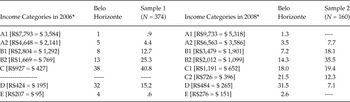
SES was estimated for both samples using Criterio Brasil, which is based on two sources: available resources (and quantity) within their home (e.g. TV, washing machine, refrigerator, etc.), and parents’ level of education. The points accumulated by each item are calculated and converted into a classification scale (e.g., 1 TV = 1 point whereas 3 TVs = 3 points; 1 bathroom = 4 points whereas 2 bathroom = 5 points). In 2006 seven categories were valid, and in 2008, another category was added. Footnote 1 Levels of SES ranged from A1 (highest SES level) to E (lowest SES level). Table 1 shows the income distributions for 2006 and 2008 for the various SES levels as calculated by the government, and how they compare to both the city of Belo Horizonte and the samples of this study.
Percent of People at SES Levels A1 through E, For Population of Belo Horizonte City and for Samples 1 and 2 of the Present Study

Note:
*Income categories ranged from A1 (the highest SES level) through E (the lowest SES level), respectively. For each income category, the mean income is shown in brackets in both Brazilian currency (R) and converted to American dollars [1 American dollar = R$ 2.17 (for 2006) and R$ 1.83 (for 2008)]. Tabled values are percentages for Belo Horizonte city and for the given sample. Sample 1 was collected in 2006, so comparisons used 2006 income data; Sample 2 was collected in 2008, so comparisons employed 2008 data.
School achievement was measured by the Teste de Desempenho Escolar – (School Achievement Test or TDE in Portuguese language) (Stein, Reference Stein1994) – for the first sample (ranging from 8 to 12 years). TDE is usually administered to children from 1st to 6th grade, and it comprises three subtests: written language, arithmetic, and reading. The TDE was designed to ‘tap’ school contents from first to sixth grade in both public and private schools, and it is the only standardised scholastic Brazilian test for the measurement of school achievement of pupils who attend primary school. The 143 items comprising the TDE are ordered in increasing complexity. The reliability (α) of the TDE is .98.
For the second sample (ranging from 13 to 15 years), a short version of the PISA (2003) Footnote 2 was administered. This version emphasises mathematics and consists of 16 items, selected from a total of 45 items. For the present study, the alpha coefficient of this measure was .72.
Finally, for the second sample, the Escala de Transtorno do Déficit de Atenção/Hiperatividade scale (Benczik, Reference Benczik2000), a Brazilian attention deficit/hyperactivity disorder rating scale, was employed to assess disruptive behavior (DB). The instrument is designed to measure defiant, aggressive, and antisocial behavior of students aged 6 to 17 years by their teachers. It comprises 49 items, distributed among four scales: (1) Attention Deficit (AD), (2) Hyperactivity/Impulsivity (HI), (3) Academic Problems (AP), and (4) Anti-social Behavior (AS). The coefficient alpha values were 0.97, 0.95, 0.94 and 0.90 for AD, HI, AP, and AS, respectively. For the present study, a general score composed of AD, HI, AP, and AS was utilised to represent DB. We prefer to use the term Disruptive Behavior (DB) instead of ADHD, considering that: (1) the majority of the items refers to disruptive behaviors (e.g. “Perturbs the teacher with several noise”, “Stands up frequently”, “Provokes uproar in the classroom”) which are simply observed by teachers, therefore the results do not constitute psychiatric or neurological clinical diagnosis of ADHD; and (2) the exploratory factorial analysis indicated a factor accounts for 65% of variance of the scale. This robust factor we called DB.
Procedure
The SPM, EPQ-J, and the PISA test were administered collectively in the classrooms, whereas the TDE and the verbal scale of the WISC-III were administered individually. For the first sample, the measures took two sessions (SPM + EPQ-J, in the first session; and the TDE, in the second session). For the second sample, the measures took three sessions (SPM + EPQ-J in the first session; PISA in the second; and the verbal scale of WISC-III in the third session). SES information was obtained using a questionnaire which was made available to the parents by each pupil. Finally, teachers were requested to assess their students with the disruptive behavior scale. The measures for the first sample were applied between April and October 2006. The testing for the second sample occurred between March and October 2008.
Statistical Analysis
First, in each sample, we used independent-samples t-tests to investigate possible sex differences on school achievement. Then, we used path analysis to predict individual differences in school achievement using the sets of predictors described above with the Mplus program (Muthén & Muthén, 2008-2010). For model evaluation, we used three criteria: the likelihood ratio χ2 test of model fit; the Root Mean Square Error of Approximation (or RMSEA); and the Comparative Fit Index (or CFI). The RMSEA and CFI indices are commonly used measures that are relatively independent of sample size and contain corrections for model complexity. Commonly accepted cut points for good fit are: RMSEA ≤ 0.08; and CFI ≥ 0.95 (Byrne, Reference Byrne2010).
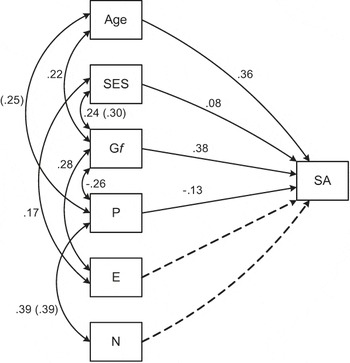
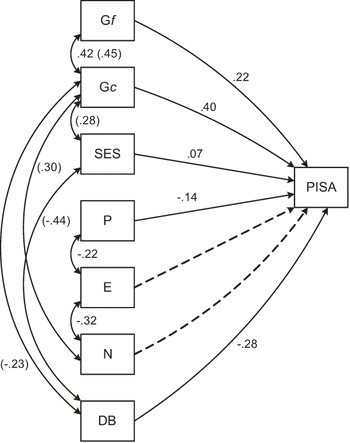
We used a two-group approach in our current analyses to test for sex differences in the relations among predictors and the outcome of school achievement. The two groups were males and females in a given sample. In sample 1, our primary predictors of school achievement were Gf (SPM), psychoticism (P), extraversion (E), and neuroticism (N), and age and SES were used as control variables (cf. Colom & Flores-Mendoza, Reference Colom and Flores-Mendoza2007). The specification of our model was as follows: Each of the six predictors and the school achievement criterion was a single-indicator variable. Thus, SPM was the single indicator of the Gf latent variable; EPI psychoticism scale score was the single indicator for the Psychoticism latent variable, etc. Because all variables were single-indicator variables, we showed them in rectangles in Figure 1. Also, to simplify the presentation in Figure 1, we did not include curved, double-headed arrows on each rectangle; these figural terms would represent the variance of each predictor and the residual variance of the criterion variable, but were removed because they cluttered the figure too much. Our specification of the model for sample 2 followed the same general approach as for sample 1.
Path model of the effects of Gf (Raven SPM), psychoticism (P), extraversion (E), and neuroticism (N) on school achievement (SA), controlling for age and SES. Note: Correlations among predictors are listed for females, with correlations for males in parentheses.

Within each sample, we used a two-group approach to test for sex differences, where the two groups were male and female participants. Using this approach, we first fit a model in which the regression weights for predictors of school achievement were freely estimated for males and females. In a restricted model, we constrained the regression weights and intercept to be invariant across the male and female groups. If this had led to a significant worsening of model fit, we could conclude that predictors had significantly different effects on school achievement for males and females.
Results
Sex Differences in School Achievement
Independent-samples t-tests were conducted to compare the school achievement of males and females. No significant differences in the mean scores of males and females were found for the TDE [t(372) = −.615; p = .165] in the first sample, or the PISA test [t(146) = −.84; p = .10] in the second sample. Thus, no main effect of sex was found in school achievement. However, sex differences still could emerge in the models predicting school achievement, so we proceeded next to our structural modeling analyses.
Sample 1: Relations between fluid intelligence, personality, and school achievement
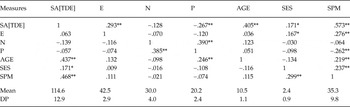
Table 2 shows descriptive statistics for each measure (intelligence, personality and school achievement) from sample 1. As discussed in the Method section, we used a two-group approach in our current analyses to test for sex differences in the relations among predictors and the outcome of school achievement. In our baseline model, all six predictor variables were allowed to co vary freely, and each of the six predictors had estimated effects on school achievement. Because the baseline model was saturated, fit of this model was perfect, χ Footnote 2 (0) = 0.0.
Correlation matrix and descriptive statistics for the first sample (N = 374)

Note:
**Correlation is significant at the .01 level and * Correlation is significant at the .05 level. Correlations on the upper right side of the matrix pertain to females and correlations on the lower left side of the matrix pertain to males. Measures: SA [TDE] = School Achievement [Teste de Desempenho Escolar]; E = Extroversion; N = Neuroticism; P = Psychoticism; SES = Socioeconomic status; SPM = Standard Progressive Matrices of Raven.
In our second model, we constrained the intercept and all six regression weights to be invariant across the two groups to test whether sex differences in predictive effects were significant. The fit of this constrained model was very good statistically, χ2 (7) = 11.45, p = .12, and practically, with CFI = 0.987 and RMSEA = 0 .058, with 90% CI [0.00, 0.12]. In our third model, we deleted the path coefficients from extraversion and neuroticism to school achievement, which resulted in a non-significant worsening of fit, Δχ2 (2) = 3.85, p = .15. This model had very good overall levels of fit statistically, χ2 (9) = 15.30, p = .08, and practically, with CFI = 0.982 and RMSEA = 0.061, with 90% CI [0.00, 0.12].
As shown in Figure 1, Gf (SPM) had a strong positive regression weight (β = .38, SE = 0.04, p < .001) when predicting academic achievement, controlling for the significant effects of age (β = .36, SE = .04, p < .001) and SES (β = .08, SE = .04, p < .05). Of the personality dimensions, only psychoticism had a significant predictive effect (β = −.13, SE = .04, p < .001).
Also shown in Figure 1 are the significant correlations among predictor variables, which differed as a function of sex. Specifically, for females, Gf (SPM) correlated significantly with age (r = .22, p < .001), SES (r = .24, p < .001), psychoticism (r = −.26, p < .001), and extraversion (r = .28, p < .001), extraversion correlated with SES (r = .17, p < .05), and neuroticism correlated with psychoticism (r = .39, p < .001). For males, Gf correlated only with SES (r = .30, p < .001), psychoticism correlated with age (r = .25, p < .001) and with neuroticism (r = .39, p < .001). Non-significant correlations among predictors were deleted from Figure 1 to simplify the interpretation.
Second sample: Relationships between fluid and crystallised intelligence, psychoticism, disruptive behavior and the PISA test
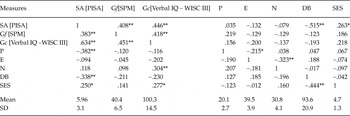
Table 3 shows the descriptive statistics for each measure [intelligence (Gf and Gc), personality, disruptive behavior, school achievement] assessed in sample 2. Once again, we used a two-group approach in our analyses to test for sex differences in the relations among predictors and the outcome of school achievement. Our primary predictors of school achievement were Gf (SPM), Gc (the Verbal IQ from the WISC-III), psychoticism (P), extraversion (E), neuroticism (N), and disruptive behavior, and SES was used as a control variable (cf. Colom & Flores-Mendoza, Reference Colom and Flores-Mendoza2007). In our baseline model, all seven predictor variables were allowed to co vary freely, and each of the seven predictors had freely estimated effects for males and females on school achievement. Because the baseline model was saturated, fit of this model was perfect, χ2(0) = 0.0.
Correlation matrix and descriptive statistics for the second sample (N = 160)

Note:
**Correlation is significant at the .01 level and * Correlation is significant at the .05 level. Correlations on the upper right side of the matrix pertain to females and correlations on the lower left side of the matrix pertain to males. Measures: SA [PISA] = School Achievement [PISA test]; Gf = Fluid Intelligence; Gc = Crystallized intelligence; P = Psychoticism; E = Extroversion; N = Neuroticism; DB = Disruptive Behavior; SES = Socioeconomic status.
In our second model, we constrained the intercept and all seven regression weights to be invariant across the two groups to test whether sex differences in predictive effects were significant. The fit of this constrained model was good statistically, χ2 (8) = 15.08, p = .06, and practically, with CFI = 0.954. The point value of the RMSEA was large, RMSEA = .105 with 90% CI [0.00, 0.19], but close fit could not be rejected, p = .13. In our third model, we deleted the path coefficients from extraversion and neuroticism to school achievement, which resulted in a non-significant worsening of fit, Δχ2 (2) = .13, p = .99. This model had better overall levels of fit statistically, χ2 (10) = 15.21, p = .12, and practically, with CFI = .966 and RMSEA = 0.081 with 90% CI [0.00, 0.16].
As shown in Figure 2, the strongest predictor of school achievement was Gc (β = .40, SE = .08, p < .001), and Gf (SPM) had a weaker, but significant positive regression weight (β = .22, SE = .08, p < .01), controlling for SES (β = .07, SE = .07, p = .34). Of the personality dimensions, only psychoticism had a significant predictive effect (β = −.14, SE = .07, p < .05). Importantly, disruptive behavior had the second strongest effect (β = −.28, SE = .08, p < .001), with higher levels of disruptive behavior related with lower levels of school achievement.
Path model of the effects of Gf (Raven SPM), Gc (WISC III Verbal IQ), psychoticism (P), extraversion (E), neuroticism (N), and disruptive behavior (DB) on school achievement (PISA), controlling for SES. Note: Correlations among predictors are listed for females, with correlations for males in parentheses.

Also shown in Figure 2 are the significant correlations among predictor variables, although the significant correlations differed some by sex. Specifically, for females, Gf (SPM) correlated significantly with Gc (r = .42, p < .001), extraversion was correlated with psychoticism (r = −.22, p < .05) and with neuroticism (r = −.32, p < .01). For males, Gc correlated significantly with Gf (r = .45, p < .001), SES (r = .28, p < .01), neuroticism (r = .30, p < .01), and DB (r = −.23, p < .05), and DB correlated with SES (r = −.44, p < .001). Non-significant correlations among predictors were deleted from Figure 2 to simplify the interpretation.
Discussion and Conclusions
This study was designed to test if intelligence and personality factors, namely fluid and crystallised intelligence, psychoticism, extraversion, and neuroticism, as well as disruptive behavior, predict individual differences in school achievement, controlling for SES. To this end, we analysed the results of two samples of students, which are part of a broad project lead by our Laboratory regarding psychological factors and school achievement.
Several objective measures were used in this design to overcome the limitations observed in previous studies (e.g. teacher’s or parent’s opinion about intelligence, school achievement, and/or personality of their students/sons). Disruptive behavior was the only construct assessed by a subjective measure, which, due to its nature, can be obtained only by observer rating (in our case teacher’s opinion). Moreover, Leeson, Ciarrochi, and Heaven (Reference Leeson, Ciarrochi and Heaven2008) pointed out that most studies use convenience samples, such as university students (i.e., highly able students), which might increase the predictive power of personality dimensions when predicting academic performance. This problem did not occur in the current study. In the present study, the samples were composed of non-selected students, which guaranteed heterogeneity in intelligence as well as in SES. In this sense, the results of our study support several important points.
First, no significant sex difference in school achievement was detected. Girls did not score higher than boys (or vice-versa). This result was found for both the TDE (children) and the PISA tests (teenagers) in samples 1 and 2, respectively. These results are consistent with evidence from prior studies in the Brazilian context. For example, Dias, Enumo, and Turini (Reference Dias, Enumo and Turini2006) administered the TDE to 172 children attending 2nd to 5th grade in Espírito Santo, a state close to Minas Gerais. They found no significant sex difference in the first administration of TDE, but after a 12 month retest they found differences favouring males. The PISA test was used in other investigations with high school students and no sex differences were found (Moravia, Rozenberg, Schlottfeldt, & Flores-Mendoza, Reference Moravia, Rozenberg, Schlottfeldt and Flores-Mendoza2008). Moreover, at national levels, the PISA results indicated that differences between countries mostly favoured men, but the effect sizes were small (Wittmann, Reference Wittmann, Wilhelm and Engle2005).
Second, both Gf (measured by the SPM) and P (assessed by the EPQ-J) predicted individual differences in school achievement, despite the latter being measured by two different tests (TDE and PISA). After controlling for age and SES differences, the general findings remained the same. Because the PISA test can be considered as a literacy test (Wittmann, Reference Wittmann, Wilhelm and Engle2005), it was not surprising to find a higher relationship with Gc rather than Gf in the second sample.
Third, disruptive behavior predicts school achievement. This is consistent with the findings reported by Colom et al. (Reference Colom, Escorial, Shih and Privado2007), who showed that both cognitive ability and temperament difficulties predict school achievement. However, Colom et al. noted that the contribution of these temperament difficulties (impulsiveness, fearlessness, and sensation seeking) could result from the fact that school achievement was measured by grades obtained by the students, and these grades could be “contaminated” by teachers’ subjective ratings of the students’ behavior in the school setting. However, the findings from the current study are not affected by this potential confound, because school achievement was measured by standardised tests. The general findings from the current study are that children scoring higher in gc (or gf) and lower in psychoticism (or disruptive behavior) tend to show better school achievement.
Fourth, SES was associated with individual differences in both Gf and Gc as well as with school achievement. This means that higher SES levels are significantly related to higher intelligence scores. However, SES was only weakly related to school achievement when measures of intelligence were included as predictors, a result which contrasts with findings by Colom and Flores-Mendoza (Reference Colom and Flores-Mendoza2007) who found non-significant relations for SES. But, the current findings are consistent with a recent meta-analysis involving 101,157 students from 6,871 different schools. In the meta-analysis, Sirin (Reference Sirin2005) showed significant associations between six components of SES (education, occupation, income, free or reduced-price lunch, neighbourhood, and home) and academic performance.
However, Sirin (Reference Sirin2005) could not control an important student characteristic moderator in his analysis: intelligence. When individual differences in intelligence are considered, the association between SES and school achievement in the current study was diminished considerably, even though the association between intelligence and school achievement was little affected, or remained the same, when controlling SES statistically.
Finally, and unsurprisingly, age co varied with Gf and was a predictor of school achievement in the first sample, but the same tendency was not found in the second sample. The most likely explanation for these results is the greater age variability in the first sample (ages ranged from 8 to 12 years) than in the second (age varied primarily from 13 to14 years). This interpretation is supported by the Pearson correlation between age and Gc (a facet of intelligence known for its growth, even after 18 yrs old), which was only 0.008 for the second sample. On the other hand, age differences related to personality dimensions were found only for P in the first sample. Thus, the age range considered in the first sample (8–12 yrs) appears to be somewhat sensitive to changes in P. The same pattern of results was found by Poropat (Reference Poropat2009) in his meta-analytic review of studies regarding personality dimensions and academic achievement. In addition, many researchers (e.g., Costa & McCrae, Reference Costa and McCrae1992) have found that personality slightly changes across life span. For example, the recent Brazilian standardisation of the NEO PI-R (Costa & McCrae, Reference Costa and McCrae2008) indicated low, but statistically significant, correlations between age and Conscientiousness (−0.11) and Agreeableness (0.218), exactly the two factors with greatest similarity to P (Eysenck, Reference Eysenck1992). Therefore, to identify real changes in P according to age, a more comprehensive investigation regarding the distribution of P across the life span in the Brazilian population would be necessary.
In general terms, the present study provided clear evidence of a consistent, replicable relationship between P and school achievement. In several prior studies, Conscientiousness has been the best personality predictor of school achievement (Caprara et al., Reference Caprara, Vecchione, Alessandri, Gerbino and Barbaranelli2011; De Fruyt & Mervielde, Reference De Fruyt and Mervielde1996; Poropat, Reference Poropat2011; Rosander et al., Reference Rosander, Bäckström and Stenberg2011). But, because Eysenck (Reference Eysenck1992) reasoned that Conscientiousness (C) and Agreeableness (A) are first-order P factors, it is not surprising that C also appears as a strong predictor of school achievement. Saggino (Reference Saggino2000) found partial support for this argument in an Italian sample: P combines A, C, and Openness. In another study, Heaven et al. (Reference Heaven, Ciarrochi and Vialle2007) found a negative correlation (r = −.53) between P and C, although C was the strongest predictor of school achievement.
P is useful for distinguishing antisocial personalities both in the general population (Lykken, Reference Lykken1995), and among young adolescents who also show higher scores in other personality dimensions such as impulsiveness, fearlessness, and sensation seeking (Herrero, Ordoñez, Salas, & Colom, Reference Herrero, Ordoñez, Salas and Colom2002). In addition, disruptive behavior provokes problems in several contexts, especially in academic performance (DeShazo Barry et al., Reference Barry, Lyman and Klinger2002; DuPaul et al., Reference DuPaul, Volpe, Jitendra, Lutz, Lorah and Gruber2004). Therefore, P and disruptive behavior can be considered as representative features of temperament difficulties. If this is indeed the case, then we arrive at the same conclusion as Colom et al. (Reference Colom, Escorial, Shih and Privado2007). However, we acknowledge that future studies with Brazilian students should incorporate measures related to the Five Factor Model, and should also verify whether the predictive power of P is still significant when C and disruptive behavior are used as simultaneous predictors.
In general, our findings are consistent with the conclusions that individual differences in scholastic achievement are predicted by key measures of cognitive ability (Gf and Gc), as well as by differences in personality dimension capturing children’s temperament difficulties (P) or high scores in disruptive behavior measures. Furthermore, no noteworthy sex differences in school achievement were found; and SES was not a strong factor for predicting school achievement.
One limitation of this study is related to the instrument used to assess disruptive behavior. We used a screening scale rather than a structured diagnostic interview that would provide psychiatric diagnoses according to the DSM criteria. In this sense, our sample cannot be considered a clinical one. Second, we relied only on teacher reports of children’s behavior problems for this investigation. It is well-known that the assessment of behavioral problems should be based on more than one source because agreement among raters tends to be quite low (Laidra, Allik, Harro, Merenäkk, & Harro, Reference Laidra, Allik, Harro, Merenäkk and Harro2006; Manuzza, Klein, & Moulton, Reference Manuzza, Klein and Moulton2002).
Despite these limitations, this study adds important information to the literature on the relation between school achievement and behavioral problems. First, similar results were found for two samples of students at different age levels. Second, few studies on this topic have been conducted in developing countries, in which disruptive behavior of children and adolescents can be considered a high-priority public health problem. Third, in this study, unlike the majority literature of this field, cognitive and non-cognitive variables were administered simultaneously, which permits a more complete adequate model of the factors that predict school achievement.
Finally, to sum up, our results support the recommendation that educational psychologists as well as school administrators, teachers, policy makers, and parents focus greater attention on the first manifestations of temperament differences in the early years of childhood. A link between temperament disposition and other personality traits has been documented in prior research (Rothbart et al., Reference Rothbart, Ahadi and Evans2000), and we found that the personality variable of P was a consistent predictor of school achievement. In the present study, disruptive behavior was related to P, but not to N or E, as White (Reference White1999) asserted in his review of the literature. Other studies could try not only to replicate this association, but should test whether this association continues to be found during the course of life and replicate our findings that both disruptive behavior and personality dimensions such as P or C add significantly to explained variance beyond measures of psychometric intelligence.