INTRODUCTION
According to the European Water Directive (WFD), benthic invertebrates have a major role in the functioning of aquatic systems and are used for evaluating the ecological quality status (EcoQ) of surface and transitional (lagoons) water bodies (Blanchet et al., Reference Blanchet, Lavesque, Ruellet, Dauvin, Sauriau, Desroy, Desclaux, Leconte, Bachelet, Janson, Bessineton, Duhamel, Jourde, Mayot, Simon and de Montaudouin2008; Lavesque et al., Reference Lavesque, Blanchet and de Moutaudouin2009). They are considered as potentially powerful indicators of marine ecosystem health (Warwick, Reference Warwick1986; Dauvin, Reference Dauvin1993; Blanchet et al., Reference Blanchet, Lavesque, Ruellet, Dauvin, Sauriau, Desroy, Desclaux, Leconte, Bachelet, Janson, Bessineton, Duhamel, Jourde, Mayot, Simon and de Montaudouin2008) because they are situated at the sediment-water interface, making them excellent integrators of the change of both systems (Dauvin, Reference Dauvin1993). Benthic organisms are almost sedentary and have relatively long lifespans, meaning they are unable to escape disadvantageous conditions and allowing their use in evaluation of accidental and chronic variations (Dauvin, Reference Dauvin1993; Reiss & Kroncke, Reference Reiss and Kroncke2005). Furthermore, benthic invertebrates consist of numerous species exhibiting different tolerances to stress and are an important component in feeding activities in aquatic systems (Glémarec & Grall, Reference Glémarec and Grall2000). Finally, due to the limitations of physico-chemical approaches available to measure the impact of disturbances on marine systems (Dauer, Reference Dauer1993; Carvalho et al., Reference Carvalho, Gaspar, Moura, Vale, Antunes, Gil, Cancela da Fonseca and Falcao2006), ecologists note the importance of benthic macroinvertebrates to establish the ecological status of communities (Puente et al., Reference Puente, Juanes, García, Álvarez, Revilla and Carranza2008; Afli et al., Reference Afli, Ayari and Zaabi2008b) and assess biological integrity of marine systems (Dauvin, Reference Dauvin2007), especially lagoonal ecosystems.
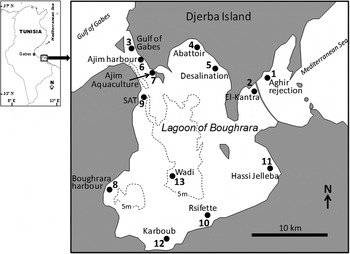
Tunisian lagoons, as with Mediterranean lagoons in general, are characterized by large daily and seasonal fluctuations in physico-chemical parameters, including extreme temperature/salinity and water-level fluctuations (Afli et al., Reference Afli, Boufahja, Sadraoui, Ben Mustpha, Aissa and Mrabet2009a). The study site, the Boughrara lagoon (Figure 1), is a Mediterranean ecosystem distinguished by the natural and anthropogenic constraints it has undergone over many years (Romdhane et al., Reference Romdhane, Kefi Daly Yahia, Benrjeb Jenhani and Daly Yahia1998).
Map of the study site showing the location of the sampling stations.

The first study in the lagoon of Boughrara was undertaken by Seurat (Reference Seurat1929). Further studies were devoted to the biological aspects of some species (Zaouali, Reference Zaouali1971, Reference Zaouali1974; Daly-Yahia, Reference Daly-Yahia1993; Romdhane, Reference Romdhane2001; Benrejeb-Jenhani & Romdhane, Reference Benrejeb-Jenhani and Romdhane2002; Derbali et al., Reference Derbali, Jarboui, Ghorbel and Zamouri-Langer2008), and some others to ecological (Zaouali, Reference Zaouali1980; Mahmoudi et al., Reference Mahmoudi, Beyrem, Baccar and Aissa2002, Reference Mahmoudi, Beyrem and Aissa2003) and hydrological aspects (Jedoui, Reference Jedoui1980; Ben Aoun et al., Reference Ben Aoun, Farhat, Chouba and Hadj-Ali2007; Guetat et al., Reference Guetat, Sellem, Akrout, Brahim, Atoui, Ben Romdhane and Daly, Yahia2012). However, studies were limited to only particular aspects, without investigating the general status of the ecosystem. Since there was a lack of general research before the development of the channel of El Kantra, this work proposes to evaluate the ecological status of the lagoon of Boughrara during all four seasons, in order to create a useful reference for future similar studies.
The aim of this work is (1) to study the function and the organization of the benthic macrofauna community, relying on trophic structure and biotic indices, after the extension of the channel of El Kantra and (2) to analyse the main physico-chemical parameters which control the functioning of the lagoon ecosystem.
MATERIALS AND METHODS
Study site
The lagoon of Boughrara is located in the south-east of Tunisia (Figure 1). It shares a land border to the north with Djerba Island and to the south with the mainland. With about 500 km2 surface area, it is the largest lagoon in Tunisia. It is linked with the Gulf of Gabes by only two passages, the channel of Ajim in the north-west of the lagoon of about 2.2 km width, and the channel of El Kantra, which is a narrow path in the east of around 12.5 m wide at the mid of the Roman road connecting the Djerba Island to the mainland. In 2004 the channel of El Kantra underwent an extension of 160 m length and 5 m height, that allowed an exchange of about 6.9 million m3 of water a day instead of 0.8 million m3 previously (DGPA, 2001).
Air temperature has a very important role in the lagoon of Boughrara because it rapidly influences the water temperature, due to the shallow depth and the low renewal of the water in summer (Zaouali, Reference Zaouali1971). Thus, the seasonal variation of the water surface temperature is remarkable in the lagoon of Boughrara; it is on average around 24.7 °C in summer and 11.2 °C in winter, with an increasing north-south gradient (Ben Aoun et al., Reference Ben Aoun, Farhat, Chouba and Hadj-Ali2007). The salinity of the lagoon of Boughrara is higher than that of the surrounding sea. It oscillates on average between 42.19 (Ben Aoun et al., Reference Ben Aoun, Farhat, Chouba and Hadj-Ali2007) and 48.8 psu (Benrejeb-Jenhani & Romdhane, Reference Benrejeb-Jenhani and Romdhane2002). The lagoon of Boughrara is considered to be a fragile and vulnerable ecosystem due to increasing natural and anthropogenic stressors. Besides the variable hydrodynamic/climatic conditions, the lagoon is being affected by increasing and harmful anthropogenic disturbances, due to the demographic/industrial surrounding development (Benrejeb-Jenhani & Romdhane, Reference Benrejeb-Jenhani and Romdhane2002). The main sources of disturbance in the lagoon of Boughrara are waste water (loaded in nutrients and organic matter) discharged by aquaculture farms on both banks of the lagoon (Turki & Hamza, Reference Turki and Hamza2001), the traffic/fishing activities in the harbours of Jorf, Ajim, Boughrara and Hassi Jalleba, the entry of marine waters loaded with phosphorus coming from the Gulf of Gabes (Bejaoui et al., Reference Bejaoui, Rais and Koutitonsky2004) and the low water exchange between the lagoon and the open sea.
Sampling and laboratory procedures
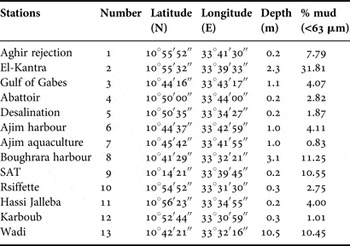
Marine surveys were carried out seasonally in April 2009, August 2009, November 2009 and February 2010 at 13 stations (Figure 1, Table 1). Water temperature was measured on-site by an electronic probe type WTW 197i, salinity by a salinometer type WTW Multi-340i, pH by a pH-meter type WTW 340 and dissolved oxygen by an oximeter type WTW. Water samples were also taken at the surface, and were preserved at −4 °C in an icebox for later determination of the concentration of main nutrients (NO2 −, NO3 −, NH4+ and PO4 3−) (Strickland & Parsons, Reference Strickland and Parsons1965). To measure chlorophyll a concentration, part of the collected water was immediately filtered with a Whatman filtration device, and the filtering membrane was then placed in a spin-dried tube and preserved in cool and dark conditions (Rodier et al., Reference Rodier, Bazin, Broutin, Chambon, Champsaur and Rodi1996). It should be noted that some physico-chemical parameters were not measured during certain seasonal surveys, because of the weather conditions and the availability of the logistical material. Sediment samples for benthic macrofauna studies were collected by scuba divers with a quadrat (10 cm depth), sieved through a 1 mm mesh and preserved in a 7% formaldehyde/seawater solution. Three replicates were carried out at each station making a total sampling surface of 0.5 m2. In the laboratory, the concentrations of NO2 −, NO3 −, NH4 + and PO4 3− were determined with a Bran-Luebbe Autoanalyseur 3 (Tréguer & Le Corre, Reference Tréguer and Le Corre1975). The concentration of chlorophyll a was determined according to Lorenzen & Jeffrey (Reference Lorenzen and Jeffrey1980). The macrofauna samples were washed with fresh water on a 1 mm mesh, and the animals collected were preserved with diluted alcohol (70%) before being identified, for most of them, up to species level.
Characteristics of sampled stations.

Data analysis
The main structure parameters of the benthic macrofauna measured at each station are the specific richness (S, number of species), the abundance (A, number of individuals/m2), the Shannon–Wiener index (H′) (Shannon & Weaver, Reference Shannon and Weaver1963) and Pielou's measure of evenness (J′) (Pielou, Reference Pielou1966). Analyses were performed using PRIMER v6 package. Identified species were classified into trophic groups according to Fauchald & Jumars (Reference Fauchald and Jumars1979) and notably modified by Grall & Glémarec (Reference Grall and Glémarec1997), Hily & Bouteille (Reference Hily and Bouteille1999), Afli & Glémarec (Reference Afli and Glémarec2000), Pranovi et al. (Reference Pranovi, Curiel, Rismondo, Marzocchi and Scattolin2000) and Afli et al. (Reference Afli, Ayari and Brahim2008a):
-
– Carnivores (C): predatory animals (e.g. mobile polychaetes, sea anemones).
-
– Detritus feeders (DF): feed on particulate organic matter, essentially vegetable detritus (mainly amphipods and tanaids).
-
– Suspension feeders (SF): feeding on suspended food in the water column (e.g. most bivalves).
-
– Micrograzers (μG): feeding on benthic microalgae, bacteria and microbial detritus (essentially polyplacophores and gastropods).
-
– Selective deposit feeders (SDF): feeding on organic particles settled on the sediment (e.g. most sedentary polychaetes and some bivalves and crustaceans).
The most common biotic indices, namely AMBI (Borja et al., Reference Borja, Franco and Pérez2000), BENTIX (Simboura & Zenetos, Reference Simboura and Zenetos2002) and M-AMBI (Muxika et al., Reference Muxika, Borja and Bald2007) were used. AMBI and BENTIX qualify the ecological status within a five-class scale of pollution, by using simple indices calculated on the basis of the relative proportions of the five ecological groups established initially by Glémarec & Hily (Reference Glémarec and Hily1981). M-AMBI was calculated using AMBI, specific richness and the Shannon–Wiener index, combined with the use, in a further development, of factor analysis together with discriminant analysis (see Borja et al., Reference Borja, Franco and Muxika2004; Bald et al., Reference Bald, Borja, Muxika, Franco and Valencia2005; Muxika et al., Reference Muxika, Borja and Bald2007). This method compares monitoring results with reference conditions (Borja & Tunberg, Reference Borja and Tunberg2011), and was computed using AMBI software (http://www.azti.es). At ‘high’ status, the reference condition may be regarded as an optimum where M-AMBI approaches 1. Under ‘bad’ status, the M-AMBI value approaches zero.
Statistically significant differences in the numerical values of abiotic variables (temperature, salinity, pH, NO2 −, NO3 −, NH4+ and PO4 3 −) and biotic indices (S, A, J′ and H′) were tested through analyses of variance (ANOVA) using STATISTICA 8 software. The normality of data was assumed; ANOVA test was used when homogeneity of variance (Bartlett's test) was achieved. If significant heterogeneity was identified, data were log10(x + 1) transformed.
To assemble the similar samples (station/season) on the taxonomic level and characterize them by the principal taxonomic groups, a correspondence factor analysis (CFA) was carried out using the software XLSTAT 2013 on data organized in rectangular matrices where the seasonal samples occupy the columns and the taxonomic groups (classes) occupy the lines.
RESULTS
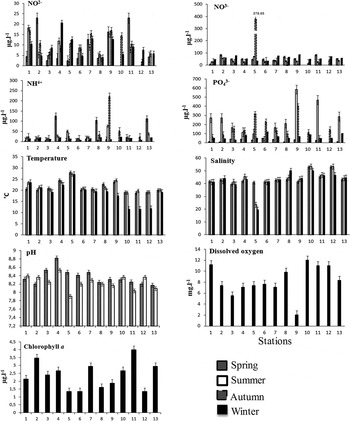
Certain physico-chemical parameters register relatively high spatial-temporal fluctuations, these being nitrites, nitrates, ammonium, phosphates, dissolved oxygen and chlorophyll a (Figure 2). However the other parameters (temperature, salinity and pH) are more stable. Nitrites show the highest value in spring (23 µg l−1 at stations 2 and 11), while certain other contents (station 4 in summer and station 12 in autumn) are lower than the threshold of detection of around 2 µg l−1 (Anonymous, 2007). The highest value of nitrates (378.65 µg l−1 at station 5 in autumn) is far higher than the other registered values, and the lowest value (4.63 µg l−1) was measured at station 1 in spring. Ammonium levels vary with some values relatively higher (222.01 µg l−1 at station 9 in autumn), other values between 5 and 77 µg l−1 and some others lower than 5 µg l−1 (stations 1, 5 and 6 in spring and station 8 in summer). Phosphate contents (PO4 3−) fluctuate, with a maximum (585.01 µg l−1) at station 9 in summer and a minimum (7.125 µg l−1) at station 8 in spring.
Spatial-temporal variations of main physico-chemical parameters and chlorophyll a in the Boughrara lagoon.

The temperature varies between 11.4 °C in winter (station 11) and 27.9 °C in spring facing a desalination station (station 5) where no notable seasonal variations are recorded. In contrast, salinity shows important seasonal fluctuations in front of this station, 19.5 in winter and 23.4 in summer against 40.9 in spring. Except at this station, measures vary between 39.3 in winter (station 3) and 53.3 in summer (stations 10 and 12). The level of dissolved oxygen is relatively very low (2 mg l−1) in winter at station 9 (aquaculture farm). For the other stations, registered values are between 5.5 mg l−1 at station 3 and 12 mg l−1 at station 10. The pH varies between 7.91 in summer (station 5) and 8.82 in spring (station 4, a slaughterhouse). The other values range between 8.04 (station 11 in summer) and 8.53 (station 3 in spring and station 4 in summer). Chlorophyll a concentrations vary in winter between 1.33 µg l−1 (stations 5, 6 and 12) and 4 µg l−1 (station 11).
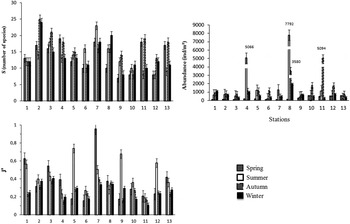
The specific richness (S) and the abundance (A) show clear spatial-temporal fluctuations (Figure 3), with S varying between seven species in spring (station 9) and 25 species in autumn (station 2), and A varying between several tens of individuals in 1 m2 in spring (66 ind m−2 at station 1, 82 ind m−2 at station 3 and 84 ind m−2 at station 6) to few thousands of individuals in 1 m2 (7792 ind m−2 at station 8 in summer and 5094 ind m−2 at station 11 in autumn). The evenness (J′) also fluctuates and is generally low; it varies between 0.11 at station 11 in winter and 0.96 at station 7 in spring. The other values do not exceed 0.74.
Spatial-temporal variations of macrofauna parameters in the Boughrara lagoon.

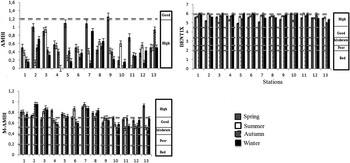
Biotic indices AMBI and BENTIX (Figure 4) show similar results, and classify all the stations to be in a high ecological status (unpolluted), except station 9 which is classified by AMBI as being in a good ecological status (slight pollution). The M-AMBI appears to be more severe, it classifies stations 10 and 13 in autumn and stations 11, 12 and 13 in spring to be in a moderate ecological status (moderately polluted).
Spatial-temporal variations of the biotic indices used and corresponding ecological statuses.

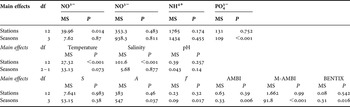
An ANOVA shows that generally nutrients do not differ significantly between seasons and stations (Table 2), except perhaps nitrites and phosphates which show significant differences between stations and seasons, respectively. For the temperature and the salinity, tested separately, the difference is significant only between stations. For macrofauna parameters, the difference is significant only between seasons and for A, J′, AMBI, M-AMBI and BENTIX.
ANOVA, mean squares (MS) and their significance levels (P) for main biotic and abiotic parameters.

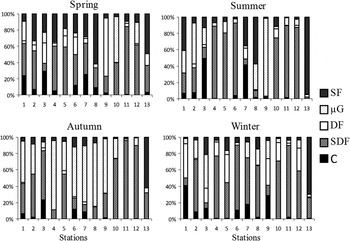
Trophic groups show important spatial-temporal fluctuations (Figure 5). All year round, the selective deposit feeders (SDF) dominate the majority of stations. However, suspension feeders (SF) dominate at station 13. At the other stations, two or few trophic groups follow one another at the leader positions. Selective deposit feeders (SDF) dominate in winter (51%) and in spring (49%), and the other trophic groups are more balanced in winter (DF 16%, μG 13%, C 11% and SF 10%) than in spring (SF 22% and μG 17%). In summer, SDF dominate clearly (60%) followed by SF (17%) and μG (16%), while in autumn, μG dominate widely (63%) followed distantly by SDF (28%).
Spatial-temporal variations of trophic groups of the benthic macrofauna in the Boughrara lagoon. C, carnivores; SDF, selective deposit-feeders; DF, detritus feeders; μG, micrograzers; SF, suspension feeders.

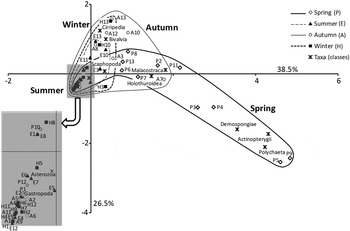
The CFA shows, on the plan formed by the first two factors (65% of eigenvalues), a dispersion clearly wider for spring/autumn samples compared with winter/summer ones (Figure 6). Spring samples are characterized mainly by polychaetes (77% of contribution on the factorial plan 1–2) and Demospongiae (<1%). The most characteristic stations of spring are station 3 (3% of contribution on the factorial plan 1–2), station 5 (23%) and station 9 (41%). Holothuroideans (1%) and malacostracans (24%) together characterize spring and autumn, the Cirripedia (6%) and bivalves (63%) together characterize autumn and winter, while scaphopods (1%), asterozoans (1%) and gastropods (29%) characterize all the four seasons together. It should be noted that in summer there are no characteristic taxa, there are only common taxa.
Results of the correspondence factor analysis (CFA) carried out on the classes abundances in the seasonal samples.

DISCUSSION
Physico-chemical parameters
The role of the sedimentary texture, which is a paramount factor structuring benthic communities is minimized in this study, due to the homogeneity of the sediment at sampled stations which are constituted exclusively of fine sediments, mainly mud and sand (Daly-Yahia, Reference Daly-Yahia1993). Generally, concentrations of nutrients (nitrites, nitrates, ammonium and phosphates) in the lagoon of Boughrara seem to be comparable to Mediterranean lagoons (Specchiulli et al., Reference Specchiulli, Focardi, Renzi, Scirocco, Cilenti, Breber and Bastianoni2008). The main nutrient sources seem to be linked to the presence of fish farms (SAT and Ajim Aquaculture), the low water flow/restriction of water exchange, the discharges of the slaughterhouse (station 4) and the desalination station (station 5), and to the waters coming from the Gulf of Gabes that are loaded in phosphates (Aloui-Béjaoui & Afli, Reference Aloui-Béjaoui and Afli2012). This confirms the results observed by Guetat et al. (Reference Guetat, Sellem, Akrout, Brahim, Atoui, Ben Romdhane and Daly, Yahia2012) in the same site, but with a small temporal/spatial shift, except nitrite and nitrate concentrations which were clearly higher than present results.
However, higher concentrations were registered in the lagoon of Bizerte, 400 km to the north (218 µg l−1 for nitrites and 399 µg l−1 for nitrates) (Afli et al., Reference Afli, Boufahja, Sadraoui, Ben Mustpha, Aissa and Mrabet2009a), and lower concentrations in the lagoon of Thau in France (Ifremer, 2004) and the lagoon of Orbetello in Italy (Specchiulli et al., Reference Specchiulli, Focardi, Renzi, Scirocco, Cilenti, Breber and Bastianoni2008).
Temperature, salinity and pH do not show notable differences between sampled stations. Nevertheless, dissolved oxygen is low (2 mg l−1) at station 9, and relatively high at the other stations (11 and 12 mg l−1) compared with the values recorded by Ben Aoun et al. (Reference Ben Aoun, Farhat, Chouba and Hadj-Ali2007) in the same site where it did not exceed 6 mg l−1 during winter. It is difficult to attribute, on the basis of currently available data, this increase of dissolved oxygen to a natural fluctuation from one year to another, or to a general improvement in water quality. Chlorophyll a concentrations are relatively low compared with those recorded in other Tunisian lagoons, such as that of Ichkeul where concentrations were sometimes about five times higher (Chaouachi et al., Reference Chaouachi, Ben Hassine and Lemoalle2001), and that of Bizerte (Bejaoui et al., Reference Bejaoui, Ferjani, Zaaboub, Chapelle and Moussa2010). They are comparable with some other Mediterranean lagoons, such as the lagoon of Varano in Italy (Specchiulli et al., Reference Specchiulli, Focardi, Renzi, Scirocco, Cilenti, Breber and Bastianoni2008). Analysis of climate parameters suggests that these high chlorophyll a concentrations tend rather to the hypothesis of an exceptional year. In fact, the sampling year corresponds to particular climatic factors characterized by relatively low temperatures and high precipitation, which could limit photosynthesis. Bejaoui et al. (Reference Bejaoui, Ferjani, Zaaboub, Chapelle and Moussa2010) showed that nitrogenous elements limit the development of the phytoplankton in the lagoon of Bizerte. This might also explain the high concentrations of nitrogenous elements and high dissolved oxygen levels at some stations.
That ANOVA analysis did not show significant differences between the values recorded for most of the physico-chemical parameters must be due to the small size of the study area and also to the permanence/constancy of the nutrient sources. Most studies on Mediterranean lagoons show that strong fluctuations of environmental parameters linked to temperature, precipitation and sea currents govern the functioning of these ecosystems generally, and anthropogenic activities subsequently aggravate the situation (Rossi et al., Reference Rossi, Castelli and Lardicci2006; Afli et al., Reference Afli, Chakroun, Ayari and Aissa2009b). Borja et al. (Reference Borja, Dauer, Díaz, Llanso, Muxika, Rodríguez and Schaffner2008) noted that high concentrations of nutrients and organic matter, high temperature and salinity and the low levels of dissolved oxygen are associated with disturbed areas. Afli et al. (Reference Afli, Chakroun, Ayari and Aissa2008c, Reference Afli, Chakroun, Ayari and Aissa2009b) affirmed that environmental conditions, particularly temperature and salinity, play a major role in the structure and the organization of the communities and the exclusion of certain species or groups of species in the Tunisian and Mediterranean lagoons in general.
Macro-benthic community
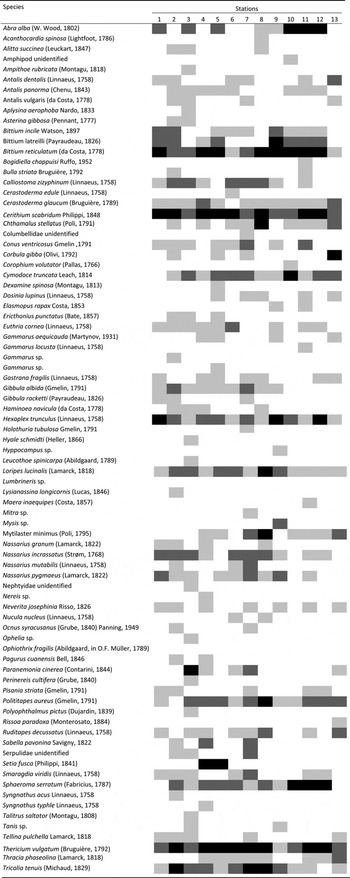
The benthic community in the lagoon of Boughrara seems to be characterized by a structure and an organization identical to the Mediterranean lagoons with mainly molluscs, crustaceans, polychaetes, cnidarians and echinoderms. This was also observed in other Mediterranean lagoons, such as those of Bizerte (Afli et al., Reference Afli, Boufahja, Sadraoui, Ben Mustpha, Aissa and Mrabet2009a) and El Bibans (Zaouali & Baeten, Reference Zaouali and Baeten1985) in Tunisia, that of Biguglia in Corsica (Clanzig, Reference Clanzig1991) and also in Atlantic lagoons such as those of Sidi Moussa and Oualidia in Morocco (Kersten et al, Reference Kersten, Piersma, Smit and Zegers1983; Chbicheb, Reference Chbicheb1996). The macro-benthic community of the lagoon of Boughrara is, in terms of specific richness and abundance, similar to that of the lagoon of Smir, with an average 10–24 species and 4460–34,400 ind m−2 (Chaouti & Bayed, Reference Chaouti and Bayed2011). The specific richness registered in summer and spring is relatively low. This seasonal variability cannot be attributed to only some environmental parameters, because the seasonal variability of the community is also due to the biological cycles of the species which are themselves linked to the cyclic fluctuations of the climatic factors (Afli et al., Reference Afli, Boufahja, Sadraoui, Ben Mustpha, Aissa and Mrabet2009a). Nevertheless, the lagoonal-marine stations (2, 3 and 7) present a relatively high specific richness compared with the other stations. This difference seems to be related to the hydrodynamics, to the physico-chemical factors and to the sediment texture, which confirms the results obtained by Chaouti & Bayed (Reference Chaouti and Bayed2005) in the lagoon of Smir (Morocco). Contrary to the specific richness, the abundance is lower at these lagoonal-marine stations. In fact, these areas correspond to a transitional environment where the influences of both marine environment and lagoon environment coexist, and where the fluctuations in the physico-chemical parameters are stronger. This promotes the exclusion of sensitive species such as the gastropod Cerithium scarbidum and the bivalve Abra alba in favour of species tolerant to these parameters, such as gastropods of the genus Nassarius and the bivalves Corbula gibba and Cerastoderma glaucum that can live in this environment favoured by the exclusion of rival sensitive species (Table 3). Therefore, the lagoonal-marine stations present a relatively high specific richness and a low abundance. In terms of trophic diversity, the macro-benthic community of the lagoon of Boughrara is dominated by selective deposit feeders, essentially gastropods of the genus Cerithium. This is linked generally to the deposit of organic matter which is more important in coastal areas and lagoons because of the continental sedimentary inputs, and also following the deceleration of marine currents which allows organic matter to deposit on the bottom (McLusky & McIntyre, Reference McLusky, McIntyre, Postma and Zijlstra1988). These results confirm those obtained by Bazairi et al. (Reference Bazairi, Bayed and Hily2005) in the lagoon of Smir (Morocco), Afli et al. (Reference Afli, Chakroun, Ayari and Aissa2008c, Reference Afli, Chakroun, Ayari and Aissa2009b) in the lagoon of Ghar El-Melah (Tunisia) and Lavesque et al. (Reference Lavesque, Blanchet and de Moutaudouin2009) in the Atlantic bay of Arcachon (France). However, the domination of the selective deposit feeders is not completely systematic in the Tunisian and Mediterranean lagoons, since other trophic groups dominate clearly in other Mediterranean lagoons. But research to date shows that most of the Tunisian and Mediterranean lagoons are dominated by a single trophic group, even two trophic groups in certain cases. For example, carnivores dominate widely in the lagoon of Bizerte, micrograzers in the southern lagoon of Tunis, selective deposit feeders in the lagoon of Ghar El-Melh (Afli et al., Reference Afli, Ayari and Brahim2008a, Reference Afli, Chakroun, Ayari and Aissa2009b) and detritus feeders in the lagoon of Smir (Chaouti & Bayed, Reference Chaouti and Bayed2011).
List of principal species collected in the lagoon of Boughrara during the four seasons of 2009–2010.  Absent,
 1–30 ind m−2,
 30–200 ind m−2,
 ≥200 ind m−2.

With regard to seasonal variability, suspension feeders appear in spring, while all other trophic groups are present all year round, and their respective dominances seem to be linked to the availability of trophic resources. Thus, micrograzers, for example, dominate in summer at certain stations and in autumn at the majority of stations when the primary production is naturally more intensive because of the extension of the daylight and the nutrient supply of continental origin forwarded by water courses and runoffs (Grall & Glémarc, Reference Grall and Glémarec1997). This seems to be a sign of satisfactory status of the ecosystem, according to Afli et al. (Reference Afli, Ayari and Zaabi2008b), who noted that in uncontaminated areas, the trophic organization of the communities can correctly reflect this status because it depends primarily on the resources (food and space) available. However, in a polluted area, this relationship is not always possible because other intrinsic characteristics of the species (resistance, tolerance and opportunism) can play increasing roles.
Unlike our observations on the ground (absence of vegetation and strong sedimentary dynamic), the biotic indices used are consistent to classify most of sampled stations as having good or high ecological status. This was also noted in the lagoon of Venice (Italy) that suffers from multiple anthropogenic stressors (Micheletti et al., Reference Micheletti, Gottardo, Critto and Marcomini2011). In fact, these biotic indices based on ecological groups are dependent on the Pearson–Rosenberg model (Pearson & Rosenberg, Reference Pearson and Rosenberg1978) and are, thus, related with the gradient of organic matter content (Simboura et al., Reference Simboura, Panayotidis and Papathanassiou2005; Labrune et al., Reference Labrune, Amouroux, Sarda, Dutrieux, Thorin, Rosenberg and Grémare2006; Afli et al., Reference Afli, Ayari and Zaabi2008b), and not with the other stressors such as physical disturbance (Carvalho et al., Reference Carvalho, Gaspar, Moura, Vale, Antunes, Gil, Cancela da Fonseca and Falcao2006).
Despite the small size of the study area and the permanence/constancy of the nutrient sources that tend to homogenize biotic/abiotic conditions in the lagoon, ANOVA and CFA were able to dissociate seasonal data. The ANOVA shows that A, J′, AMBI, BENTIX and M-AMBI differ significantly between seasons, and the CFA shows that, during spring and autumn, the distribution of the systematic classes on plan 1–2 is more scattered. This means that these moderated seasons in terms of temperature and salinity essentially offer more favourable conditions to a broader range of species. Thus, these two seasons are characterized by several groups, i.e. polychaetes, Demospongiae, Holothuroidea, Malacostraca, Cirripedia and Bivalvia. This distribution is more restricted during summer and winter when extreme temperatures and salinity can occur. Consequently, only some euryhalin/eurythermal species belonging to groups of Scaphopoda, Asterozoa and Gastropoda are present. Indeed, Rossi et al. (Reference Rossi, Castelli and Lardicci2006) noted that in summer, anoxic conditions can easily arise in Mediterranean lagoons.
Compared with Adriatic lagoons, such as the Sacca di Goro lagoon (Po River Delta) considered as a case study of a highly impacted coastal environment (Giordani et al., Reference Giordani, Azzoni, Bartoli and Viaroli1997; Marchini et al., Reference Marchini, Gauzer and Occhipinti-Ambrogi2004) and the Venice lagoon (Micheletti et al., Reference Micheletti, Gottardo, Critto and Marcomini2011), the lagoon of Boughrara seems to be less impacted and macrofauna community more diversified. Indeed, until now, no serious risk of eutrophication seems to threaten the lagoon of Boughrara, but certain signs, such as the presence of some opportunistic species, for example bivalves Corbula gibba and Cerastoderma spp., suggest that the area may in the future be at risk of eutrophication if conditions do not improve.
In conclusion, lagoons which are ecologically important have been subject, these last decades, to a marked loss of their biodiversity. It seems that Mediterranean lagoons, generally, present remarkable specificities compared with other lagoons. The species richness is generally low and the communities are dominated, most of the time, by only certain species. The trophic chain is based on only one or two trophic groups, depending essentially on the availability of the trophic resources and the other environmental and anthropogenic factors, such as extreme temperature, salinity, hydrodynamics and pollution (Morrisey et al., Reference Morrisey, Turner, Mills, Williamson and Wise2003). If a single or few parameters such as salinity or temperature fluctuate to extremes, which can often occur in Mediterranean lagoons, this is enough to destabilize the community and the ecosystem will be unbalanced (Afli et al., Reference Afli, Ayari and Brahim2008a). Thus, only certain populations can adapt to these fluctuating conditions.
ACKNOWLEDGEMENTS
Many thanks to those who contributed to the field and laboratory components of this project.
FINANCIAL SUPPORT
This work was undertaken within the framework of the project ‘EBHaR’ financed by the Tunisian Ministry of Higher Education, Scientific Research, Information and Communication Technologies.