When the Supreme Court declares unconstitutional a legislative act or the action of an elected executive, it thwarts the will of representatives of the actual people of the here and now; it exercises control, not in behalf of the prevailing majority, but against it.
—Alexander Bickel (Reference Bickel1962, 16–17)Judicial Review does not serve to thwart or legitimate popular majorities; rather that practice alters the balance of power between the numerous political movements that struggle for power in a pluralist democracy.
—Mark Graber (Reference Graber2005, 428)I. Introduction
These two quotations nicely encapsulate what one might respectively call the traditional and revisionist views of judicial review. Alexander Bickel’s (Reference Bickel1962) formulation of the “countermajoritarian difficulty” launched what is “perhaps the central debate in the legal literature on judicial review” (Berry, Bueno de Mesquita, and Gersen Reference Berry2013, 1). In the traditional view set forth by Bickel, the exercise of judicial review—even if normatively necessary and desirable at times—is inherently problematic because judges are seen as “overruling” the representative branches of government (Waldron Reference Waldron2006).
In recent years, a variety of scholars have pushed back against the traditional view with a revisionist account that sees judicial review as a “normal” institution in a democratic society marked by competing interests and power. As such, there are instances when judicial review can be either “nonmajoritarian” (Graber Reference Graber1993) or even “pro-majoritarian” (Lain Reference Lain2012; Berry et al. Reference Berry2013). Scholars have presented a wealth of evidence showing that judicial review can actually help legislators advance their political agendas rather than hindering the exercise of legislative power (Keck Reference Keck2007; Whittington Reference Whittington2007; Lemieux and Watkins Reference Lemieux2009).
While this literature—which falls under the umbrella of the “regime politics” approach to judicial review (Graber Reference Graber2005)—focuses on the interests of political coalitions (i.e., political elites), a corollary of the approach is that judicial review can actually be pro-majoritarian with respect to public opinion—given the linkage between the public and legislators in a representative democracy. Determining whether this is the case, however, requires a careful analysis of policy, public opinion, and judicial decisions on particular issues in which courts exercise judicial review. Specifically, it also requires comparing status quo policies against contemporaneous public opinion to evaluate judicial review in the context of whether opinion does or does not match current policy. This is important because even when either legislative or opinion majorities may prefer policy change, the status quo biases inherent in a separation of powers system may produce a disconnect between public opinion and policy. Yet, despite the wealth of case studies cited above, there have been few quantitative studies that attempt to examine the extent to which judicial review is pro-majoritarian by directly comparing the results of judicial evaluations to public opinion on current policy.Footnote 1
In this article, I examine the relationship between public opinion, policy, and judicial review with the goal of adjudicating between the traditional and revisionist views of the countermajoritarian difficulty. To do so, I focus on the role of courts in the debate surrounding abortion policy in the American states prior to the Supreme Court’s 1973 decision in Roe v. Wade to legalize abortion. That decision is often placed at the center of the debate over the countermajoritarian difficulty, given the Court’s decision to craft a national rule for state abortion statutes. As Solum (Reference Solum2014) argues, “the counter-majoritarian difficulty seems particularly acute when it comes to so-called ‘implied fundamental rights,’ like the right to privacy at issue in cases like … Roe v. Wade.” While the degree to which the Court’s decision in Roe matched national public opinion has been well studied, less well known is that both state and federal courts were quite active in evaluating the constitutionality of state abortion statutes in the decade leading up to Roe. Rather than emerging out of the blue, the justices’ decision in 1973 followed a number of state and lower federal court decisions that both upheld and struck down existing state statutes as unconstitutional.
I use these decisions to broaden the lens of the countermajoritarian difficulty on the role of courts in this important period of social reform. In doing so, this article makes a number of empirical contributions. First, I use multilevel regression and poststratification (MRP) to develop the first ever state-level estimates of opinion on abortion policy in the pre-Roe period. These estimates allow for a direct comparison of the opinion of state majorities to existing state policies on abortion regulation. Second, I collect an original data set of every state and federal case that evaluated the constitutionality of a state statute before Roe (from 1969 to 1972). Such challenges were brought in 29 states, with courts striking down statutes in 13 states.
Connecting policy with public opinion, I find that there was a substantial correlation between state-level public opinion and whether a state liberalized its abortion statutes away from the status quo policy, which effectively allowed abortions only to save the life of the woman. At the same time, the data reveal considerable heterogeneity in the relationship between opinion and policy: in many states where sizable majorities favored reform, the status quo remained in place, creating a mismatch between state policy and majority opinion. Next, I analyze the correlation between public opinion and the likelihood of judicial invalidation of state abortion statutes in the pre-Roe period. I find a strong connection between the two: the probability of the exercise of judicial review was increasing in state-level support for policy change. Importantly, judicial decisions striking down state statutes tended to occur in states where support for policy reform was high, and courts did not strike down statutes in states where majority opinion was firmly in favor of the status quo.
Finally, I return to the evaluation of the countermajoritarian difficulty with respect to Roe v. Wade itself. National-level opinion shows that Americans were closely divided over effectively allowing all abortions in the early months of pregnancy—which was the rule announced by the Court in Roe. Moreover, a majority of state majorities did not favor such a policy. Thus, the policy announced in Roe was countermajoritarian to some degree. However, the state-level analysis shows that in the absence of some exercise of judicial review, the mismatch between policy and opinion was likely to remain in some states for some time. Finally, while the approach in the article is descriptive, I conclude with some thoughts on the theoretical implications of these findings for placing state and lower federal courts in the debate over the countermajoritarian difficulty and for judicial federalism more broadly.
II. Representation and Judicial Review
While the countermajoritarian difficulty is fundamentally about representation, the concept can be viewed on multiple dimensions. Friedman (Reference Friedman1993) usefully draws a distinction between process and substance majoritarianism. The former is concerned with the “extent to which the judiciary is accountable to majority will” (588). Judicial review gives judges the power to invalidate laws passed by popularly elected legislative majorities, which naturally creates a normative tension in a representative democracy. This tension is particularly acute with respect to federal judges, given that they are unelected and life tenured.Footnote 2 When judges invalidate a law, they potentially disrupt the relationship between elected officials and their constituents.
However, just because a court invalidates a statute does not necessarily mean that the court is acting in a countermajoritarian manner. This requires the application of substance majoritarianism, which asks whether “judicial decisions interfere with or actually comport with majority rule” (Friedman Reference Friedman1993, 589). Substance majoritarianism has two components: source majoritarianism asks whether courts have “relied upon evidence of popular will in deciding cases,” while result majoritarianism examines whether “actual results of judicial decisions … correspond with majority preferences” (589).Footnote 3 Moreover, while this distinction is not always made explicit, there is an asymmetry to result majoritarianism. The judicial invalidation of statutes inherently implicates the countermajoritarian difficulty (broadly conceived), even if the outcome of a decision matches current public sentiment. On the other hand, upholding a statute does not implicate the countermajoritarian difficulty, since this means that courts are deferring to legislatures (even if a law is out of step with current public opinion).
These distinctions allow for the placement of the traditional view of the countermajoritarian difficulty in a more concrete analytical framework—particularly with respect to the relationship between public opinion and lawmaking. According to the (implicit) notion of the traditional view, public opinion and policy tend to track each other closely. If this were the case, then judicial invalidations of legislation would mean that judges were superseding the preferences of both elected representatives and the public. Along these lines, Waldron (Reference Waldron2006, 1346) argues that “allowing decisions by courts to override legislative decisions … fails to satisfy important criteria of political legitimacy.” In addition, recall Bickel’s contention: “when the Supreme Court declares unconstitutional a legislative act or the action of an elected executive, it thwarts the will of representatives of the actual people of the here and now; it exercises control, not in behalf of the prevailing majority, but against it” (Reference Bickel1962, 16–17).
However, two strands of the revisionist account—both of which are based implicitly on the notion of result majoritarianism—challenge how broadly actual instances of judicial review meet the conditions of the traditional view. First, as proponents of the regime politics approach have argued, under many circumstances legislative majorities will want courts to exercise judicial review, for a variety of political reasons. This includes settings in which legislators would actually prefer to defer to courts rather than face the political costs of changing policy directly (Graber Reference Graber1993; Lovell Reference Lovell2003; Lemieux and Lovell Reference Lemieux2010). Whittington (Reference Whittington2005), for example, shows how the Supreme Court’s apportionment decisions in the 1960s helped the Democratic regime overcome entrenched interests that sought to maintain the status quo of malapportioned and gerrymandered legislative districts. It also includes settings in which national electoral majorities rely on courts to “rein in” outlying local electoral minorities (Whittington Reference Whittington2005).
Second, and more relevant for this article, even when either legislative or opinion majorities may prefer policy change, the status quo biases built into a separation of powers system may actually lead to slippages in the matching between public opinion and policy, when the former moves and the latter does not (Lax and Phillips Reference Lax2012). As a result, the status quo set forth by statutes can lag behind changes in public opinion, perhaps because of blocking by entrenched interests (Klarman Reference Klarman1997; Whittington Reference Whittington2005; Lain Reference Lain2012). Because courts can set constitutional policy without having to navigate the various veto points in an American legislature (state or federal), judicial review may actually help restore a more one-to-one matching between opinion and policy. To be sure, judges may act strategically and decide not to engage in judicial review for fear of reprisal (Clark Reference Clark2011). But if the median member of a multimember court wants to implement a new legal policy, it is much easier for her to do so than the median member of a legislative body.
Thus, when evaluating judicial review with respect to the countermajoritarian difficulty, it is crucial to compare not just the correspondence between public opinion and judicial decisions but also how those decisions relate to the location of the legislative status quo. For a judicial decision to be countermajoritarian, it must replace the status quo with a new policy even farther away from the public’s ideal point (however defined). For a judicial decision to be pro-majoritarian, it must replace the status quo with a policy closer to what the public prefers. For example, while the formal model presented in Berry et al. (Reference Berry2013) does not directly model public opinion, the location of the status quo relative to the ideal point of the median member of a legislature determines whether an act of judicial review will be pro- or countermajoritarian.
To be sure, there exists a voluminous literature on whether the decisions of the US Supreme Court align with majority opinion (e.g., Dahl Reference Dahl1957; Mishler and Sheehan Reference Mishler1993; Epstein and Martin Reference Epstein2010). However, these studies tend to examine whether shifts in public opinion, on average, tend to produce concomitant shifts in Supreme Court decision making. Importantly, most of these studies use highly aggregated measures of public opinion (such as measures of overall public mood) to predict the Court’s aggregate voting behavior, meaning that a one-to-one comparison of policy and opinion is not impossible (see, e.g., McGuire and Stimson Reference McGuire2004; Giles, Blackstone, and Vining Reference Giles2008; Casillas, Enns, and Wohlfarth Reference Casillas2011). Thus, these studies do not squarely analyze whether the Court’s exercise of judicial review is pro-majoritarian with respect to the status quo policy. One important exception is the study by Marshall (Reference Marshall1989), who systematically compares issue-level public opinion with Supreme Court decisions. His analysis, however, only briefly considers whether judicial review tends to be counter- or pro-majoritarian (see pp. 95–97).Footnote 4 Finally, none of these studies examine any decision making by state or lower federal courts.
Whose opinion? Assessing the countermajoritarian difficulty also requires assessing whose opinion is relevant. Given the dominant focus in the literature on the US Supreme Court, the assumed relevant measure of opinion is usually national-level opinion on a given issue. This makes sense when evaluating the justices’ review of federal legislation. When the Supreme Court invalidates state legislation, the metric is less clear, as it involves balancing of national opinion versus state majorities (see, e.g., Casper Reference Casper1976; Friedman Reference Friedman1993, 634n279). In addition, and less recognized, as new legal issues emerge, state and lower federal courts make decisions in the absence of a national policy by the Supreme Court. When this occurs, judicial policy is localized in the sense that state and lower federal courts’ opinions have force only in a particular state (or circuit). Under these circumstances, state opinion is the proper metric for evaluating the countermajoritarian difficulty, as there is no national policy to weigh against national opinion.
Consider, for example, the legal debate surrounding gay marriage that unfolded between 2013 and 2015. In the period following the Supreme Court’s invalidation of the Defense of Marriage Act in U.S. v. Windsor (133 S. Ct. 2675) in June 2013, the Court essentially “delegated” the question of the constitutionality of same-sex marriage bans to lower federal courts. As a result, between that time and January 2015, when the Court granted cert on the question (before ultimately ruling bans on same-sex marriage unconstitutional in June 2015), a succession of lower courts invalidated state bans on gay marriage in the absence of a clear statement of doctrine from the justices (Liptak Reference Liptak2014). In such contexts, state and lower federal courts are the proper venue to evaluate the countermajoritarian difficulty.
State courts. Discussion of the countermajoritarian difficulty has traditionally focused on federal courts, where the normative tension is greatest because federal judges are unelected and have life tenure. Less attention has been paid to state courts, where most judges are elected and face more direct accountability from voters. Indeed, many argue that there exists a majoritarian difficulty with elected state court judges, since their incentives for reelection may make them too responsive to particular opinion (Croley Reference Croley1995; Pozen Reference Pozen2008). The differences between state and federal judges are certainly important, but we still might usefully apply the countermajoritarian difficulty to state courts. First, many state judges are appointed, meaning they do not face direct elections. Second, even among elected judges, judicial elections have historically been of low salience, creating higher hurdles for the prospect of electoral accountability, though certainly the salience of these elections has increased in recent years (Langer, Leonard, and Polk Reference Langer2010). In addition, different electoral selection systems create different incentives for responding to public opinion (Canes-Wrone, Clark, and Kelly Reference Canes-Wrone2014). Developing theoretical predictions based on such issues is beyond the scope of this article; moreover, any such predictions would be impossible to test, given the small number of judicial decisions in the sample analyzed below. However, it is still useful to ask whether state courts were invalidating abortion statutes before Roe v. Wade in a pro- or countermajoritarian fashion. To foreshadow the results (discussed in Sec. IV.D below), federal judges were in fact responsible for the majority of judicial invalidations of state abortion statutes in the pre-Roe period. At the same time, state court judges did not “reach out” and invalidate statutes in states where opinion was squarely on the side of maintaining the policy status quo.
III. The Abortion Context
Given the prominence of Roe v. Wade in debates surrounding the countermajoritarian difficulty, the issue of abortion has received significant attention in both traditional and revisionist accounts. Before turning to these accounts, it is useful to provide a brief history of abortion policy in the United States in order to place judicial review of pre-Roe abortion statutes in its proper context.Footnote 5 Under English common law, abortion was not considered a crime if performed before “quickening,” that is, before the woman could feel the fetus move, which usually occurred at about 16–18 weeks. No statute concerning abortion was enacted by a state until the 1820s. Through the middle of the 19th century, most legislatures that enacted laws did so to clarify that abortion after quickening was illegal. The broader aim, however, was to regulate abortion as a medical procedure, and early statutes usually contained therapeutic exceptions in cases in which abortion was necessary to save the life of the woman.
Beginning in the middle of the 19th century, two forces combined to make abortion policy more restrictive. First, for medical, professional, and moralistic reasons, physicians (under the umbrella of the American Medical Association) advocated for statutory reforms stipulating that only doctors could decide when an abortion was necessary. Second, an antiabortion social movement arose during this time (joining such movements as the anti-obscenity campaign). These efforts were extremely successful. “Between 1860 and 1880, 40 antiabortion statutes were passed. Thirteen states or territories outlawed abortion for the first time, and twenty-one strengthened and broadened their older statutes” (Rubin Reference Rubin1987, 15). By 1880, abortion was illegal in every state.Footnote 6
This status quo would persist until the middle of the 20th century, when a reform movement arose, driven by several factors. Despite their illegality following the passage of the 19th-century statutes, thousands of abortions were performed each year—many by poorly trained practitioners or in unsafe conditions, leading to a high risk of severe injury or death. The medical profession gradually shifted toward the view that the abortion decision should be in the hands of a doctor, and not the state. This view was echoed by parts of the legal profession, which were disturbed by the fact that criminal prosecutions were rare relative to the incidence of the procedure and that the primary effect of the existing laws was to prevent abortions by competent doctors. Finally, a combination of social forces (such as the introduction of new contraceptive devices) and high-profile events such as the Sherri Finkbine case and an outbreak of German measles helped to place the issue on the public agenda.Footnote 7
In 1959, the American Law Institute (ALI) drafted a model law that called for reforming abortion statutes. Under the proposal, which the ALI adopted 3 years later, abortion would be permitted if necessary to sustain the physical or mental health of the woman, if the child would be born with severe physical or mental defects, or in cases of rape or incest (Greenhouse and Siegel Reference Greenhouse2011, 2037–38). Compared to the legal status quo, in which most states banned abortions except in the case in which the woman’s life was in danger, the implementation of the proposal would mark a substantial liberalization of abortion policy (Epstein and Kobylka Reference Epstein1992, 142–43).
While the proposal drew little immediate attention, beginning in 1966 a number of states implemented ALI-style reforms. In addition, four states (Alaska, Hawaii, New York, and Washington) essentially repealed their laws, making abortion legal if performed early in a pregnancy by a licensed physician. A majority of states, however, did not reform their laws. Proreform advocates, such as Planned Parenthood and the American Civil Liberties Union, brought a number of legal challenges (in state and federal courts) in both the states that had passed the ALI-style reforms and those that had made no changes. A number of these suits were successful. Most notably, in the 1969 case of People v. Belous (71 Cal. 2d 954), the California Supreme Court struck down the state’s 1850 abortion statute, ruling that women had a fundamental right to an abortion. In other states, however, these challenges were unsuccessful, and the 19th-century restrictions remained the law. This was the state of affairs when the Supreme Court decided Roe v. Wade in January 1973.
Legislative change in the pre-Roe period. Given this historical development, central to evaluating the subsequent actions by courts is the likelihood of legislative action in the absence of judicial intervention. Indeed, a central criticism of Roe v. Wade—which falls squarely in the traditional view of the countermajoritarian difficulty—is that it cut off an active debate at the state level, thereby preventing many states from liberalizing their laws on their own account. Even some supporters of abortion rights have endorsed a version of this critique—most prominently, Justice Ruth Bader Ginsburg (Reference Ginsburg1984).
Revisionist accounts have challenged this critique in two ways. First, in a regime politics account, Graber (Reference Graber1993) argues that judicial intervention on the question of the constitutionality of abortion statutes was actually desired by many legislators (particularly Democrats) who faced cross pressures among their socially liberal and conservative constituents (see also Lemieux and Lovell Reference Lemieux2010). Second, and more relevantly for this article, several scholars argue that the reform movement had run its course by 1972 (Nossiff Reference Nossiff1994, Reference Nossiff2001; Burns Reference Burns2005; Lemieux Reference Lemieux2009; Lain Reference Lain2012). They argue, more specifically, that reform was blocked by a well-organized minority, led by the Catholic Church, and the stalling of reform did not reflect majority opinion. Lemieux (Reference Lemieux2009, 34), for example, writes, “Far from reflecting the legislative enactment of a newly formed consensus of the public, abortion law in the states before Roe was instead rather strikingly illustrative of one of the definitive features of Madisonian institutions: a determined, well-organized minority prevailing over a more diffuse majority.” Similarly, Lain (Reference Lain2012, 25) argues, “In short, the state legislative stance on abortion in the early 1970s was more a testament to the power of an intensely committed right-to-life lobby than a reflection of majority will.” Thus, under these accounts, the state of abortion policy at the time of Roe exhibited a significant status quo bias. However, while the influence of interest groups was undeniable, claims of “majority will” cannot be evaluated without accurate measures of state-level opinion in this period, to which policy can be compared. I turn now to this task.
IV. Data and Methods
A. State Policy
I begin my analysis by describing state policy in the pre-Roe period. As noted above, states varied in both the extent to which they reformed their 19th-century statutes and, among those states that did enact reforms, the extent to which policy was liberalized. Following Craig and O’Brien (Reference Craig1993) and Mooney and Lee (Reference Mooney1995), I use an index to measure state policy. For now, I focus solely on legislative changes to state policy—that is, policy change that was made by legislatures (or through referendum), not through judicial invalidations of existing state law. Moving from low to high in terms of liberalization, state policy is coded according to when abortions were permitted:
-
• 0: all abortions prohibited;
-
• 1: only to preserve the life of the woman;
-
• 2: in cases of rape or incest;
-
• 3: if the woman’s physical health was at risk or there was a fetal defect;
-
• 4: if the woman’s mental health was at risk;
-
• 5: for any reason.
As Mooney and Lee (Reference Mooney1995) note, the policy index was monotonic in practice: no state allowed abortions under a condition at a certain threshold while banning them under a lower threshold.Footnote 8
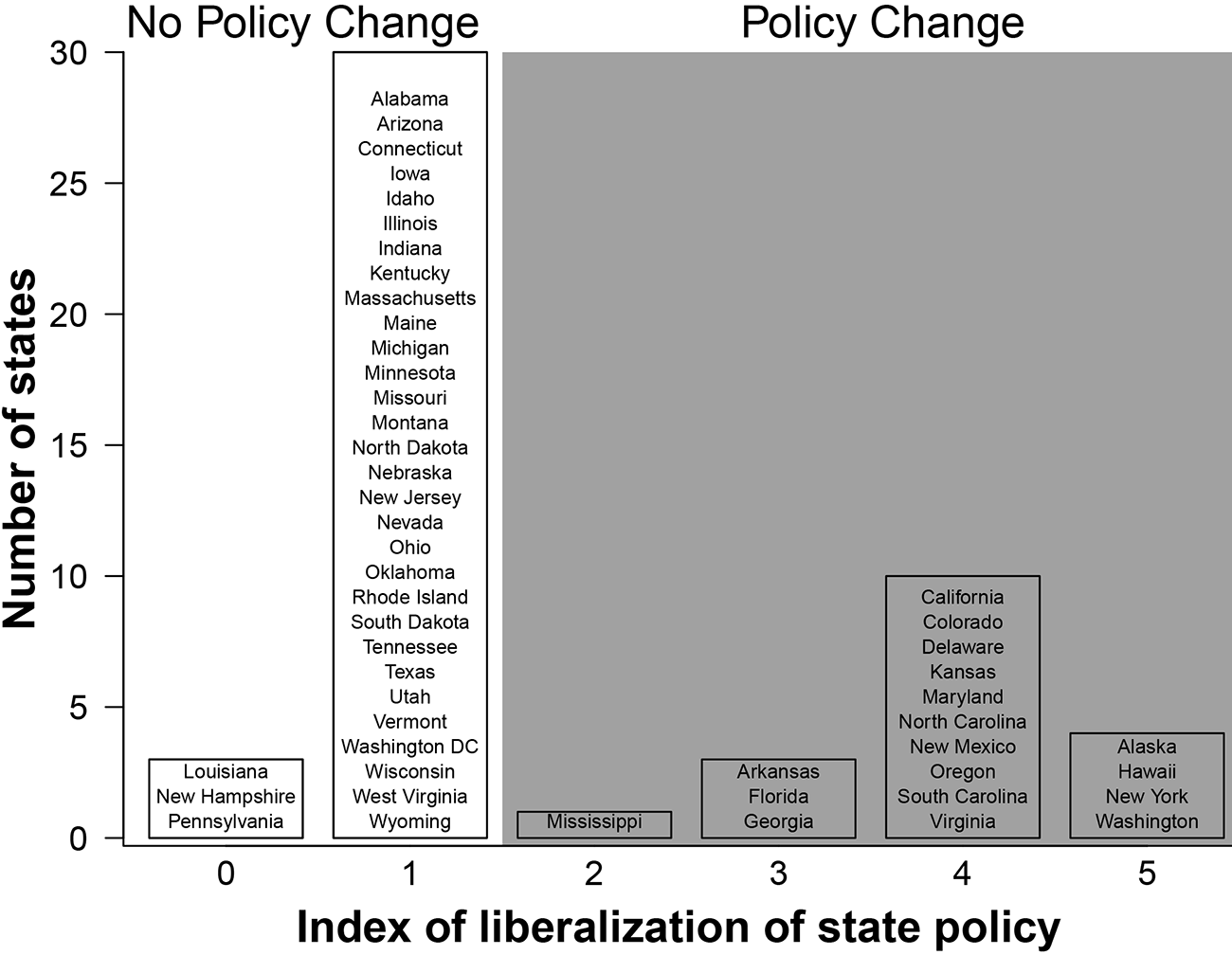
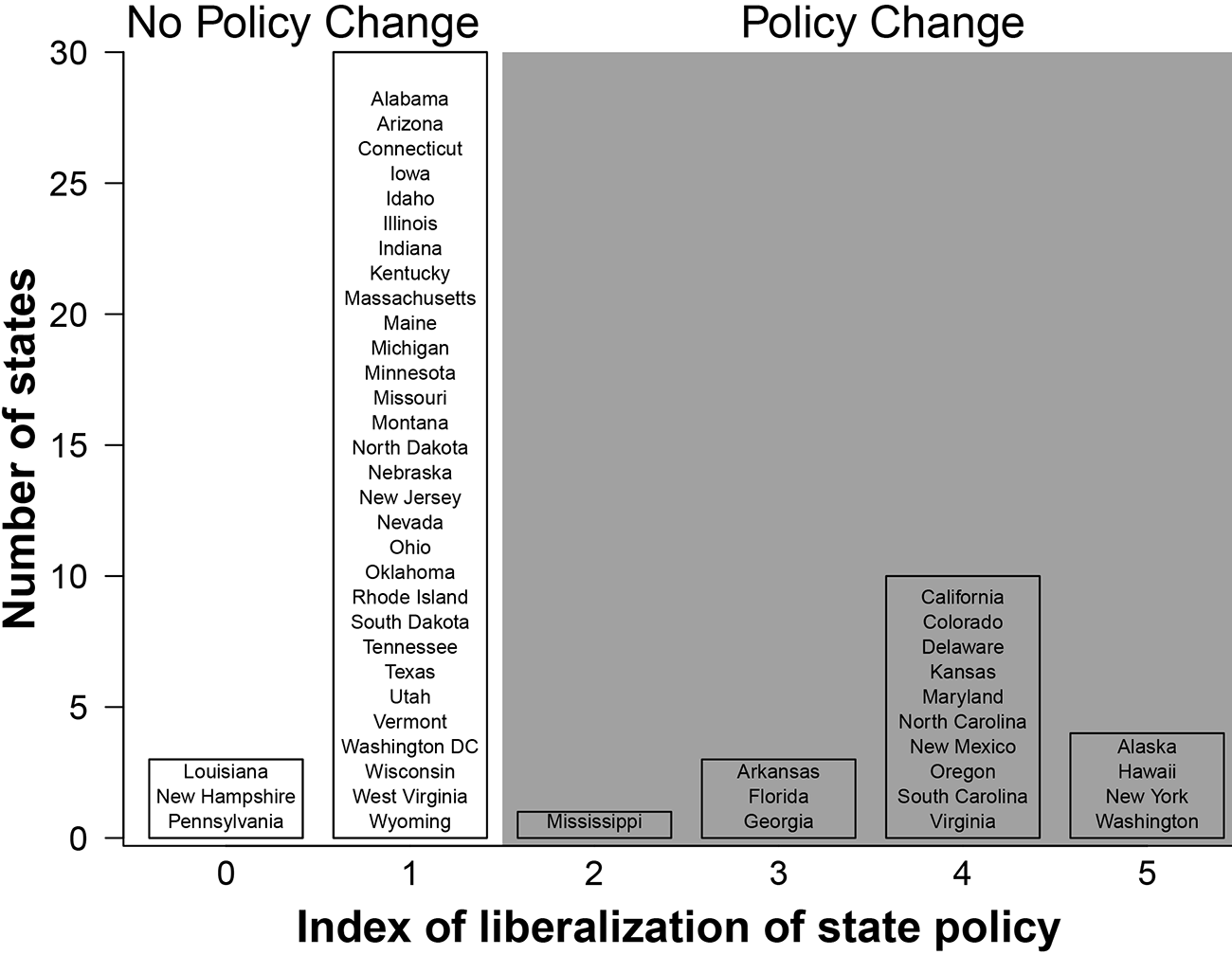
Figure 1 depicts the distribution of state policy in state law, at the time of the Supreme Court’s decision in Roe v. Wade. The graph shows that a majority of states (33) maintained the 19th-century status quo, with 30 of those states allowing abortions only to preserve the life of the woman. Among the minority of states that did enact policy change, there was significant variation in the extent of reform. Mississippi changed its law to allow for abortion in cases of rape or incest, while, as noted above, Alaska, Hawaii, New York, and Washington State passed what amounted to full repeals. Thus, there was significant heterogeneity in state policy during this period.
Abortion policy in the states: state abortion policy as established by legislatures and referenda, as of January 1973. The bar plot depicts the number of states at each level of the abortion policy index, which is increasing in terms of the liberalization of policy. The shaded region depicts states in which legislatures changed policy, that is, in the absence of court intervention. A majority of states maintained the 19th-century status quo prior to Roe v. Wade.
B. Public Opinion
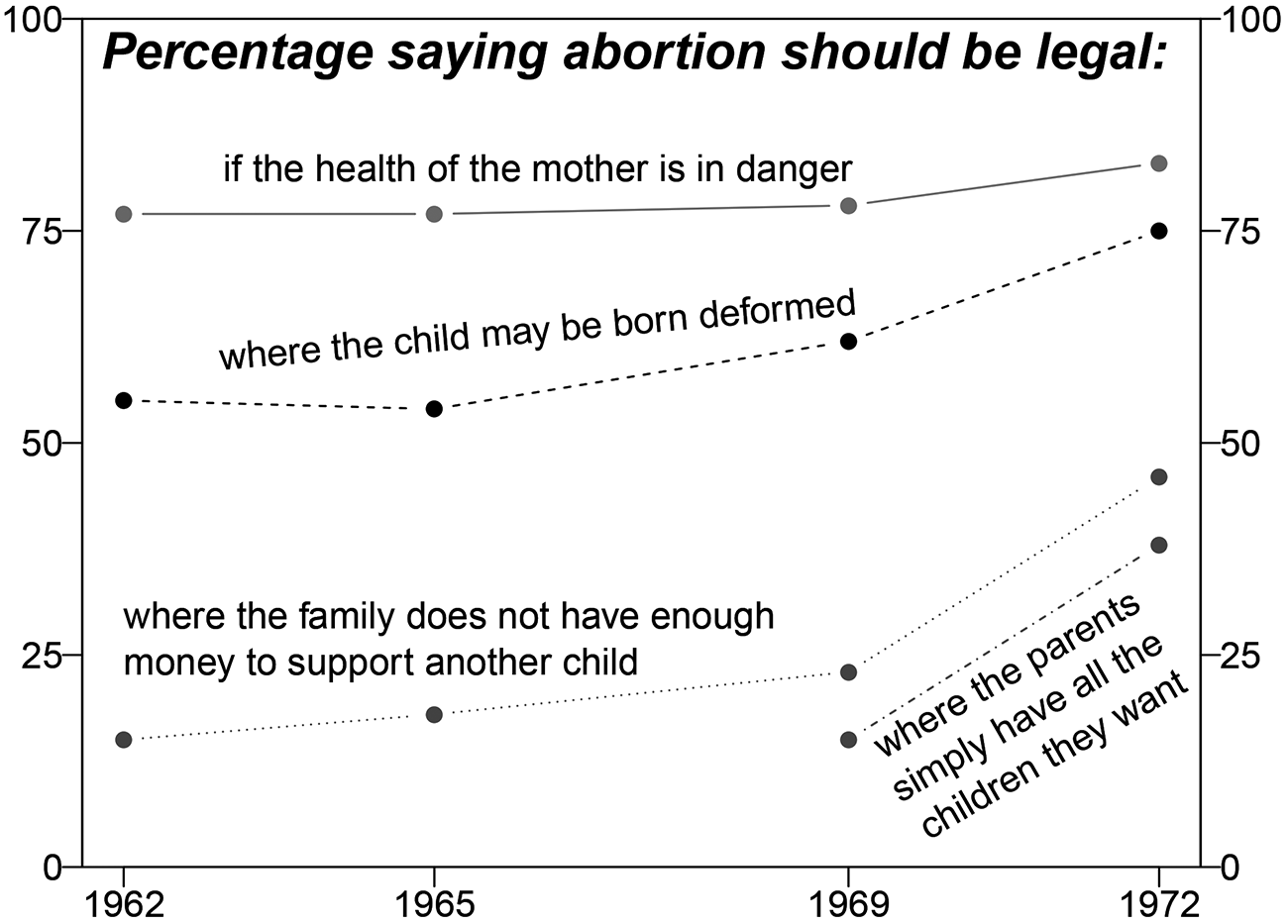
National opinion. Before moving to state-level public opinion, I first examine national opinion in the decade leading up to Roe v. Wade. According to the iPoll archives, the first public opinion question related to abortion was asked in 1962 (this poll was spurred by the Finkbine episode). I begin by looking at national opinion in the decade preceding Roe. In 1962, 1965, and 1969, Gallup asked respondents whether or not “abortion operations should or should not be legal in the following cases: where the health of the mother is in danger; where the child may be deformed; and where the family does not have enough money to support another child.” In 1969, the following condition was added: “where the parents simply have all the children they want although there are no major health or financial problems involved in having another child.” Finally, in 1972, the General Social Survey (GSS) asked similar questions, thus creating a comparable time series spanning 1962–72.Footnote 9
Figure 2 depicts the percentage of Americans saying abortion should be legal under each of the four conditions, over time.Footnote 10 The graph makes clear that, as early as 1962, a sizable majority (77%) favored the legalization of abortion in cases in which the health of the mother would be in danger. This proportion remained fairly constant through 1972. In 1962, a small majority (55%) said that abortion should be legal in the case of possible deformities. This proportion rose steadily to 75% in 1972. Thus, a sizable majority favored moving away from the 19th-century status quo of either prohibiting abortion outright or allowing abortion only when the life of the woman was in danger.
National public opinion on abortion policy, 1962–72: percentage saying abortion should be legal.
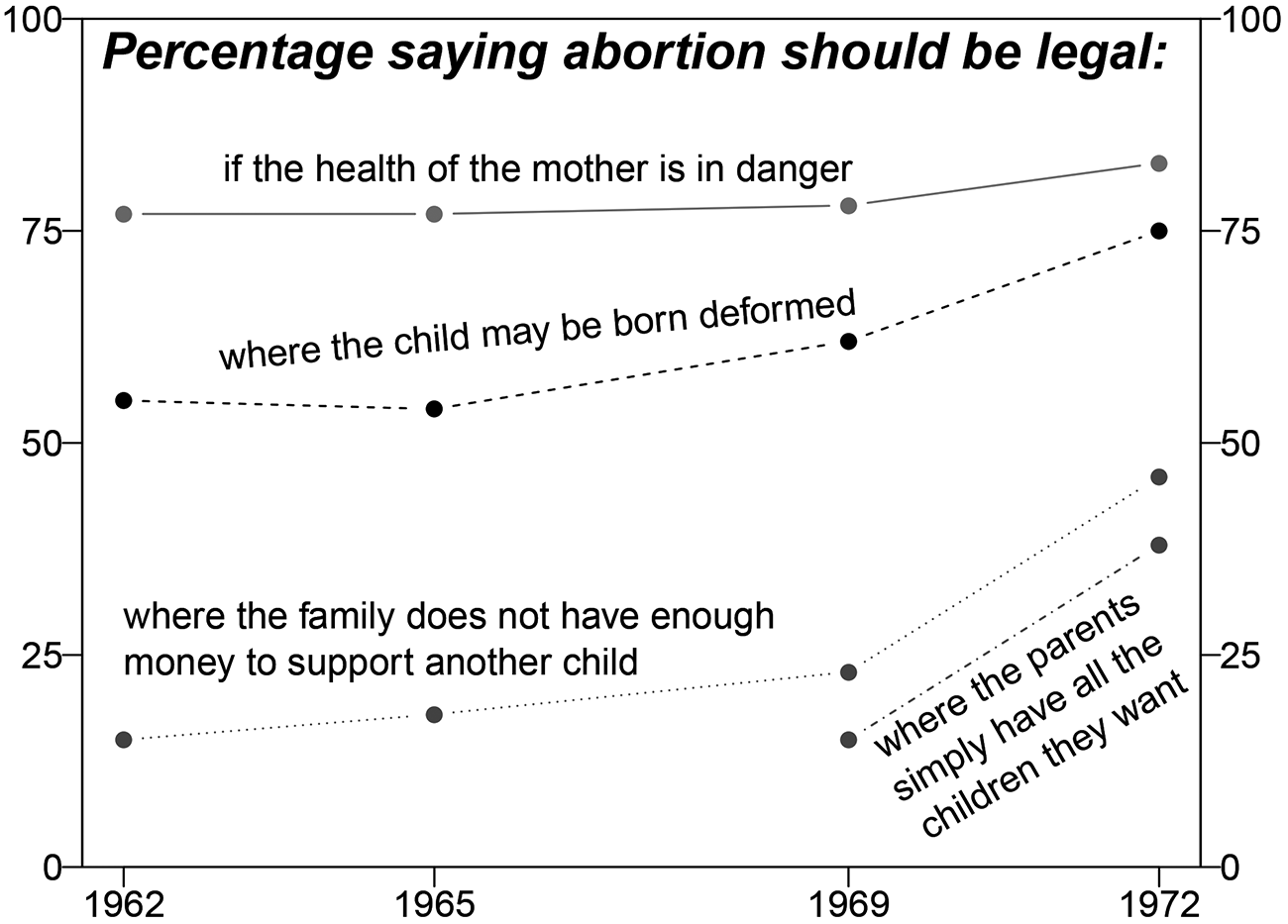
On the other hand, in 1962 a large majority was against abortion being legal “on demand,” that is, in cases in which the family lacked funds to support another child. However, the percentage of respondents indicating support for legalization in this condition rose steadily—to nearly 50% in 1972. In addition, by 1972, 38% of Americans favored legalization “where the parents simply have all the children they want.”Footnote 11 Thus, in the decade leading up to Roe, a majority of Americans did not favor strict bans on abortion but also did not favor allowing abortions for simply financial reasons or if the parents had enough children.
As a handful of states implemented full repeal in the late 1960s and early 1970s, public opinion about such proposals became relevant. In 1970, Harris asked respondents, “Hawaii, Maryland, and New York now have or are about to have new state abortion laws that permit a woman to have her pregnancy aborted, for any reason, up to a certain month of pregnancy. In general, do you favor such laws permitting abortion for almost any reason or do you oppose them?”Footnote 12 Forty percent responded they favored such laws, with 50% opposed. In 1969 and 1972, Gallup asked, “Would you favor or oppose a law which would permit a woman to go to a doctor to end pregnancy at any time during the first three months?” Forty percent and 46%, respectively, favored such laws, while 50% and 45% opposed them. Thus, national opinion was split on whether to legalize abortion fully in the early months of a pregnancy.
On the basis of the dynamics of legislative and judicial politics in this period, my goal is to estimate two measures of opinion. The first is opinion on changing the policy status quo, in particular, the general distribution of support for liberalizing existing abortion laws, in the relevant period of 1965 to early 1973. Recall that in 1962, 1965, and 1969, Gallup asked respondents whether they favored legalization of abortion under a variety of conditions. I use responses from the 1965 and 1969 polls in order to use polls as close as possible to the relevant period under which legislatures and courts were active.Footnote 13 Responding no to all conditions, or yes only to if “the health of the mother is in danger,” effectively evinces support for the status quo that emerged in the 19th century. Accordingly, I code any respondents as being “pro-liberalization” if they answer yes to any of the other conditions: deformity, not enough money, or simply all the children they want.Footnote 14
To these polls, I add the 1972 American National Election Study (ANES), which asked respondents the following question: “Which one of the opinions on this page best agrees with your view? 1. Abortion should never be permitted. 2. Abortion should be permitted only if the life and health of the woman is in danger. 3. Abortion should be permitted if, due to personal reasons, the woman would have difficulty in caring for the child. 4. Abortion should never be forbidden, since one should not require a woman to have a child she doesn’t want.” I code any respondent who answered 3 or 4 as “pro-liberalization.”Footnote 15 Combining these polls results in a status quo “megapoll” of 7,522 responses (after dropping observations with missing data).Footnote 16
The second measure of interest is opinion on full repeal, which would effectively legalize abortion in the first few months of pregnancy. To generate these estimates, I use the 1969 and 1972 Gallup polls referenced above, in which respondents were asked whether they would “favor or oppose a law which would permit a woman to go to a doctor to end pregnancy at any time during the first three months.” Combining these polls results in a full-repeal megapoll of 2,734 observations (the 1970 Harris poll referenced above does not contain state codes).
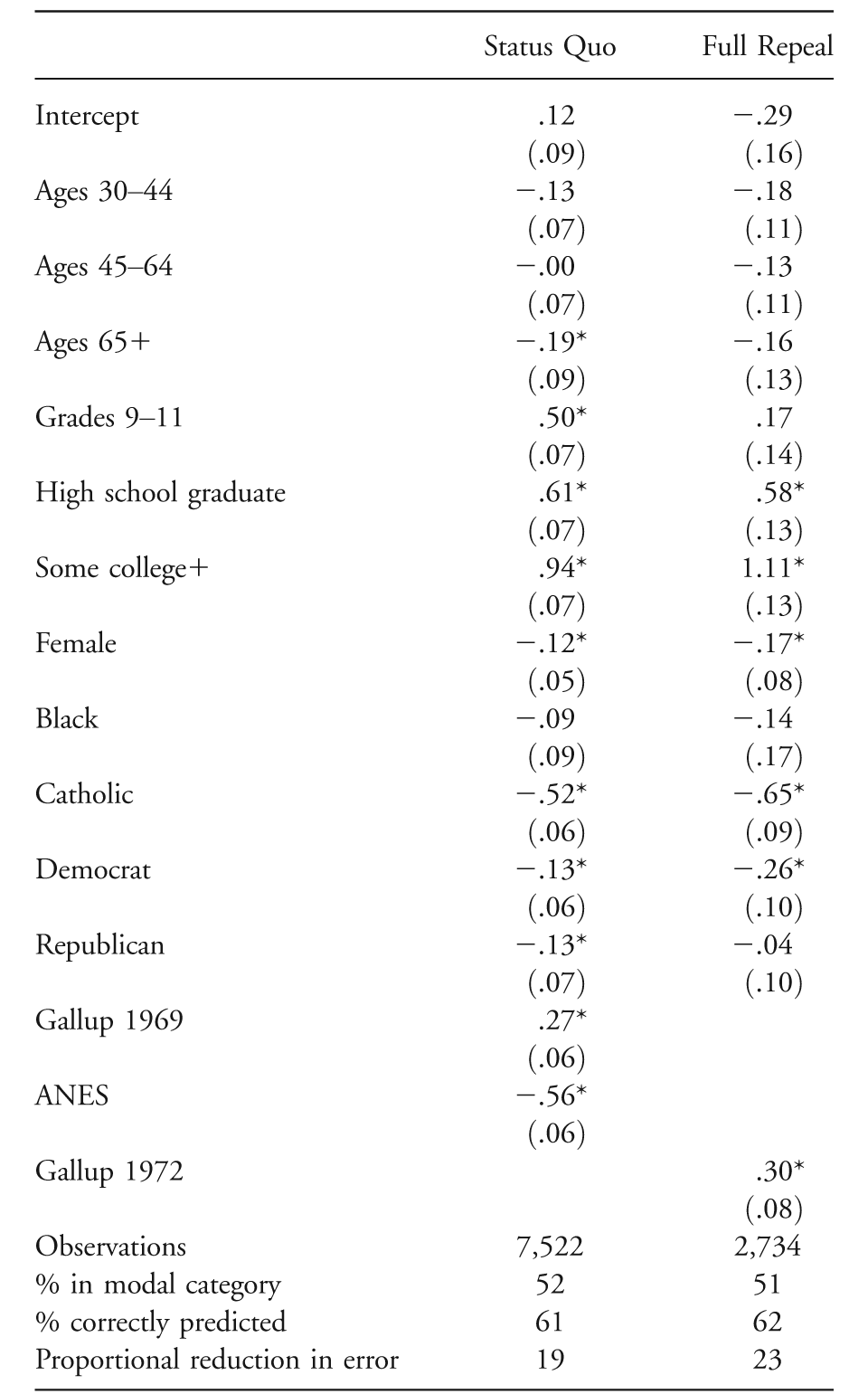
Individual-level opinion. Before turning to the creation of state-level opinion estimates, it is useful to examine the correlates of individual-level opinion. Appendix table A1 presents separate logistic regressions (for opinion on changing the status quo and full repeal) examining the predictive effect of the following demographic and political variables: age, education, race, Catholicism, and party identification. For both types of opinion, respondents with more education were more likely to favor liberalization, as were men, ceteris paribus. Older Americans were less likely to favor liberalization, though this relationship was significant only in the status quo models. Black and white respondents did not significantly differ, while Catholic respondents were much less likely to favor liberalization. In terms of partisan identification, there were no significant differences between Republican and Democratic respondents in opinion on changing the status quo, while Republicans were actually slightly more likely to favor full repeal than Democrats; the size of this difference, however, was much smaller than the differences based on religion and education. These results are consistent with research showing that attitudes on abortion did not polarize along party lines until after Roe was decided (Carmines, Gerrity, and Wagner Reference Carmines2010; Noel Reference Noel2013, 158).
Measuring state-level opinion. For both opinion on changing the status quo and full repeal, my goal is to estimate the distribution of support among state majorities. Accordingly, I use each megapoll to generate a set of “static” estimates for states that pools responses across the different dates at which opinion was measured.Footnote 17
How best to use these megapolls to estimate state-level opinion? One option would be to use simple disaggregation to generate estimates of state-level support—that is, take the mean level of opinion in each state. There are two issues with this approach. First, the respective megapolls do not include observations from every state, including Alaska and Hawaii. Including these two states is particularly important in this analysis, as they were two of the four states to fully repeal their existing laws. Second, even among the states with representation in the megapolls, the number of respondents in the smaller states is too small to generate estimates of any reasonable precision (this is particularly true in the full-repeal megapoll, in which there were fewer than 10 respondents in 11 states).Footnote 18
Accordingly, I use multilevel regression and poststratification (MRP), which has been shown to generate accurate estimates of opinion on a range of policies, including gay rights (Lax and Phillips Reference Lax2009b) and abortion (Warshaw and Rodden Reference Warshaw2012). The full details of the estimation procedure can be found in appendix A, but I give a brief overview here. MRP proceeds in two steps. First, individual-level responses are modeled as a function of both demographic predictors and the respondent’s state of residence. This information on states, which is combined with state-level predictors, is used to estimate state-level effects, controlling for demographics. Second, the estimates for each “demographic-state” type (e.g., college-educated white male Californians aged 18–29) are weighted, or poststratified, according to the distribution of each type in the actual population.
One complication arises in this application of MRP. As noted above, Catholics were significantly less likely to support abortion legalization than non-Catholics. However, the 1970 census—which I use to measure the actual distribution of types in the population—does not contain information on religion. Fortunately, Leemann and Wasserfallen (Reference Leemann2014) have devised a solution to this particular problem. Applying their advance (see app. A for details), I use estimates of the proportion of Catholics in each state to calculate the proportion of Catholics in each demographic-state type (e.g., the proportion of college-educated white male Californians aged 18–29 who are Catholics). This allows me to proceed as if the census included information on the proportion of Catholics.
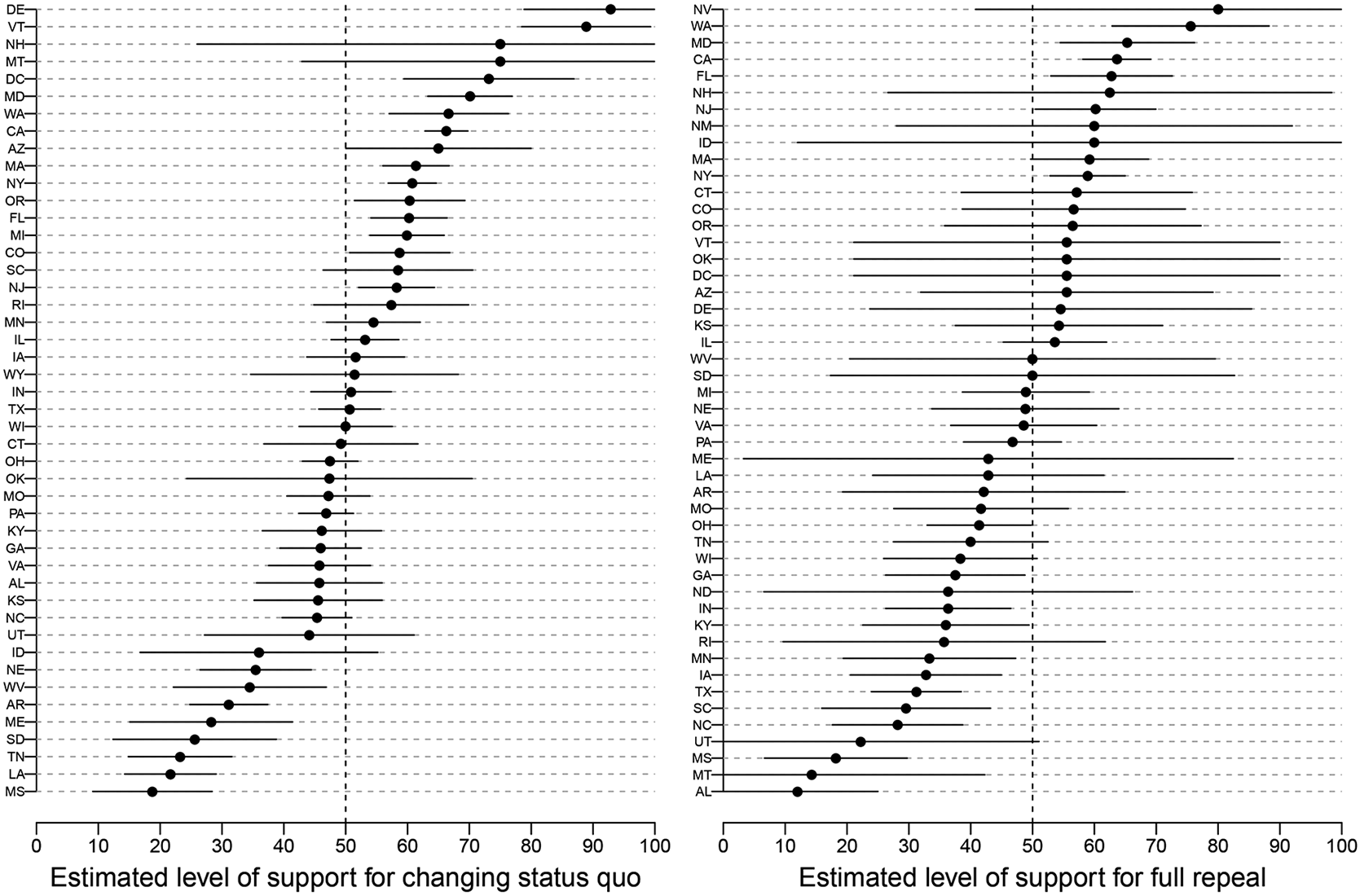
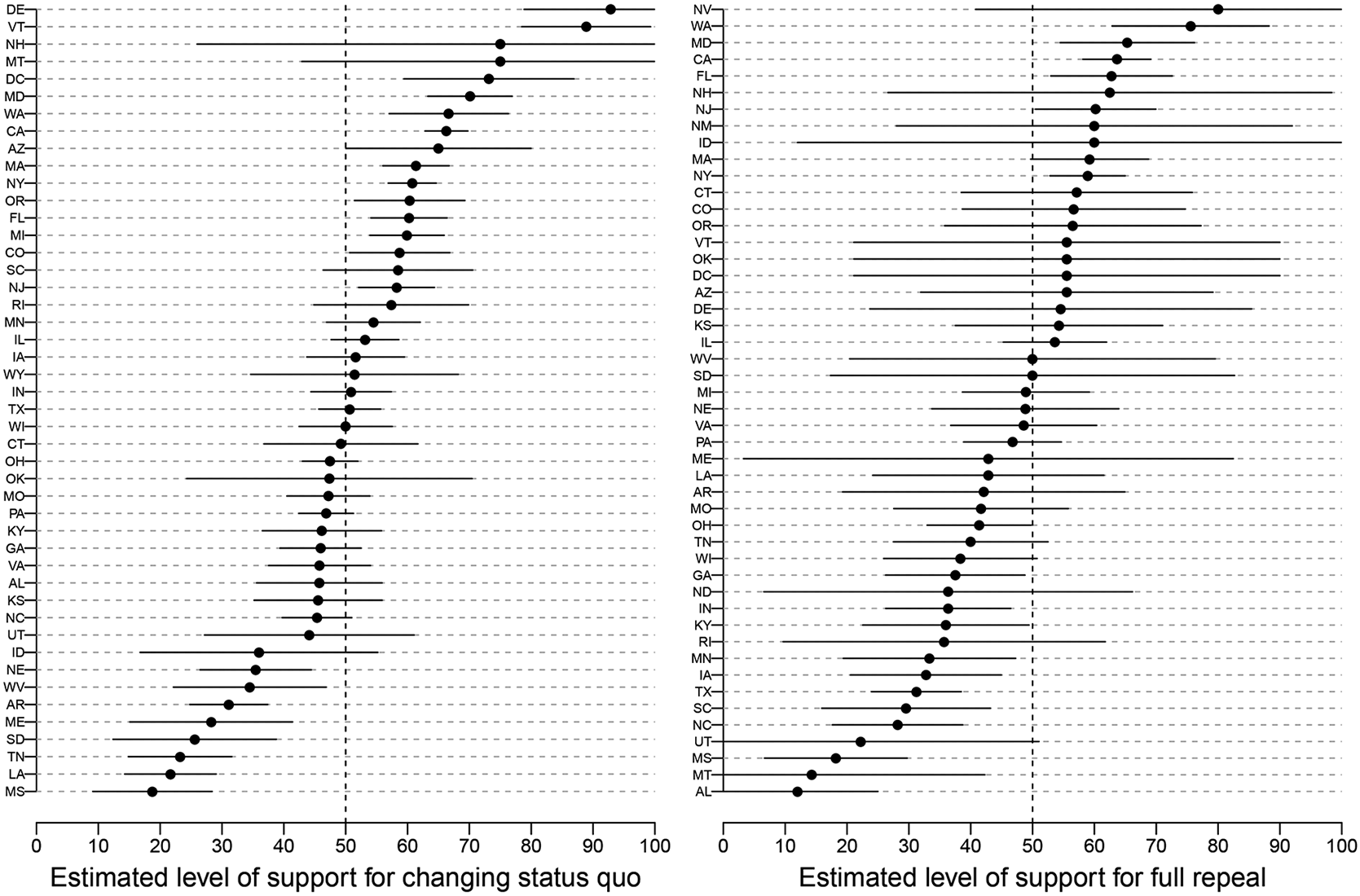
Estimates of state-level opinion. The left panel of figure 3 depicts an ordered dot plot of support at the state level for changing the status quo to make abortions easier to obtain under the law, along with 95% confidence intervals. These intervals are calculated using simulations, which are based on uncertainty in the first stage of the MRP procedure. There exists wide variation in the point estimates across states. An estimated 73% of people in Maryland supported liberalization, compared to about 25% of people in Mississippi. Half the states fall between 48% and 62% support; in most states, majorities supported liberalization. Next, the right panel of figure 3 presents estimates of state-level opinion on full repeal, along with 95% confidence intervals. In line with national opinion, support for full legalization is much lower than support for changing the status quo. In fewer than 20 states is a majority of the state population estimated to support full legalization in the first few months of pregnancy, and in only three of these states does the confidence interval exclude 50% support.Footnote 19
Estimated state-level opinion on (left) changing the legal status quo to make abortions more accessible and (right) legalizing abortions in the first 3 months. Horizontal lines depict 95% confidence intervals. Note that the states are ordered separately in each plot.
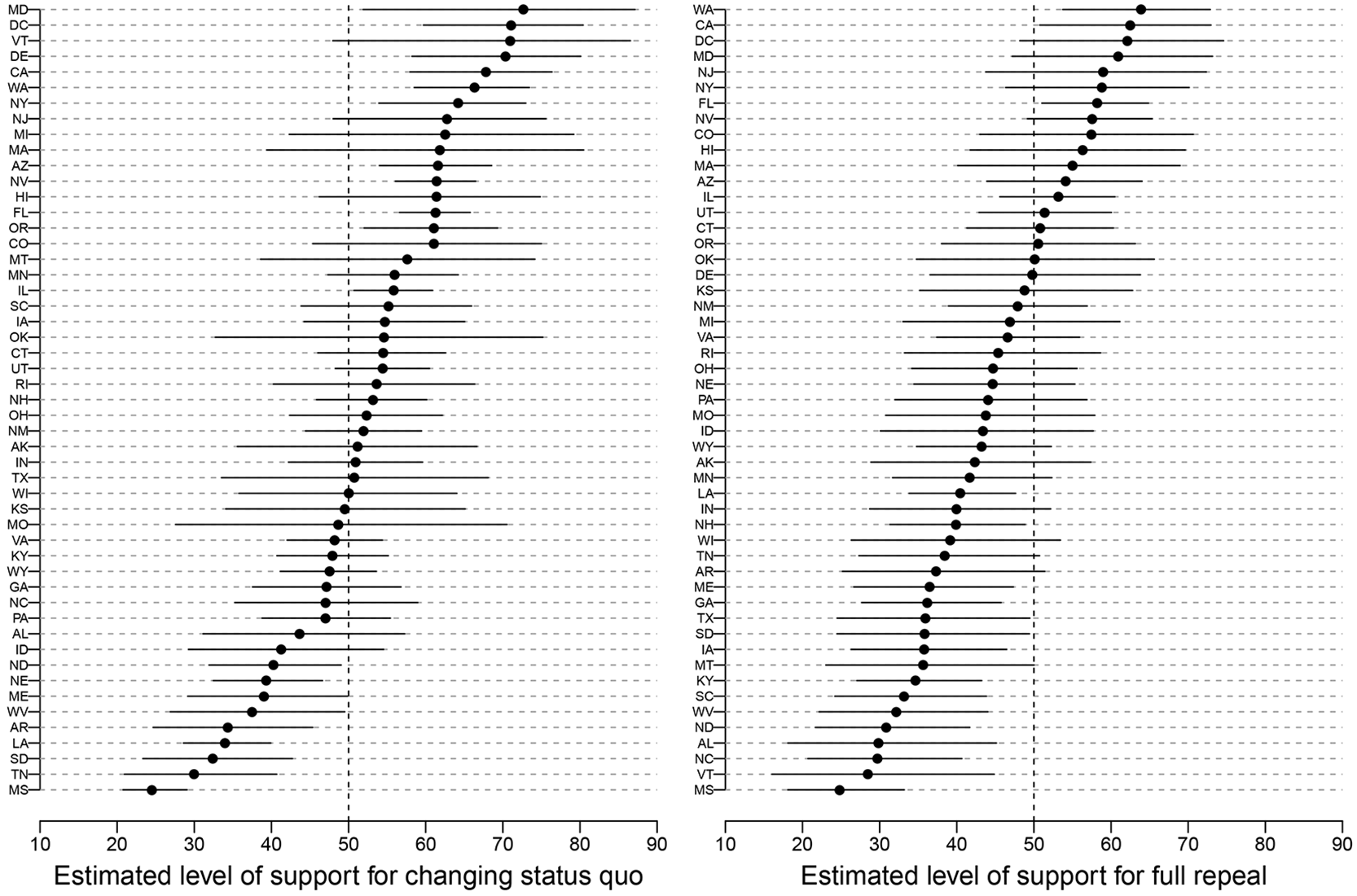
Importantly, figure 3 reveals that there is significant uncertainty in many of the state estimates. Accordingly, in all the analyses that follow I propagate this uncertainty into all the resulting estimates. I do this in two ways. First, for the congruence analyses that follow, I calculate congruence across every simulation (i.e., there are 51 states with 1,000 estimates each), which allows me to make probabilistic statements about legislative and judicial congruence with public opinion. Second, to generate uncertainty in the regression lines presented below in figures 4 and 6, I follow the procedure outlined in Treier and Jackman (Reference Treier2008, 215–16) and implemented in Kastellec et al. (Reference Kastellec2015). For each set of simulations, I regress either legislative policy or judicial decisions on opinion. Each of these regressions, of course, has its own uncertainty; I incorporate this by simulating the intercept and slope coefficient one time in each draw, so as to build in the standard errors and covariances from the regression models into the estimates. The result is a distribution of 1,000 intercept and slope coefficients that fully incorporates the uncertainty from the opinion estimates.
C. Connecting Opinion with State Policy
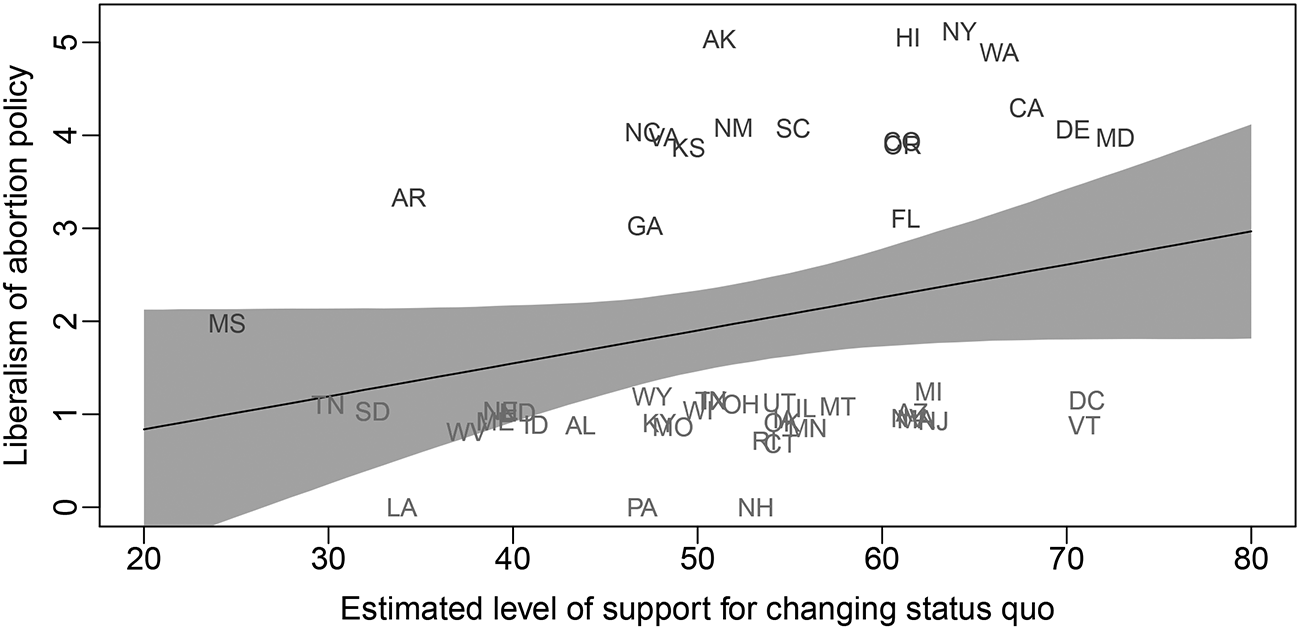
With these estimates in hand, I next examine how well state policy correlated with public opinion in the pre-Roe period. Figure 4 depicts a scatter plot of state-level opinion on changing the status quo against the 6-point policy liberalism scale discussed above. Each point shows a given state (using their postal codes); the points are slightly jittered to make it easier to distinguish among states. The solid line depicts the fit of regressing policy on opinion (accounting for uncertainty in the opinion estimates), while the shaded area depicts 95% confidence intervals. All the states that fall below the regression line did not change their policy at all. The plot reveals a positive relationship between public opinion and policy; states with greater public support for liberalization were more likely to have more liberal laws, as of the decision in Roe v. Wade. The correlation between opinion and policy is positive and statistically significant; the probability that the slope on opinion is greater than zero is about .97. Substantively, moving from 30% approval in opinion to 70% predicts about a 1.5-unit shift in policy.
State legislative policy versus public opinion on changing status quo in the pre-Roe period. See the text for details.
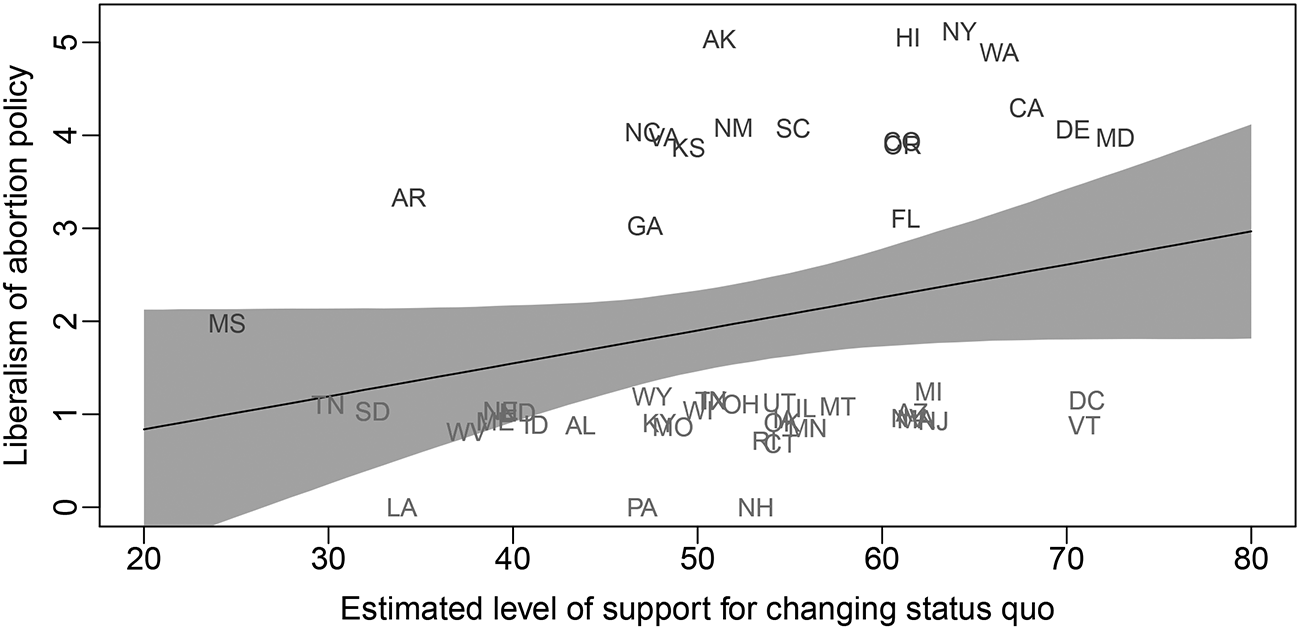
At the same time, the plot reveals considerable heterogeneity in the mapping between opinion and policy. Most notably, the bottom-right quadrant of the plot contains many states with sizable majorities that supported moving away from a strong ban on abortion, yet where policy remained unchanged. For example, while more than 70% of Vermont residents favored liberalization, as of 1972 the state legislature had not changed the 19th-century statute.
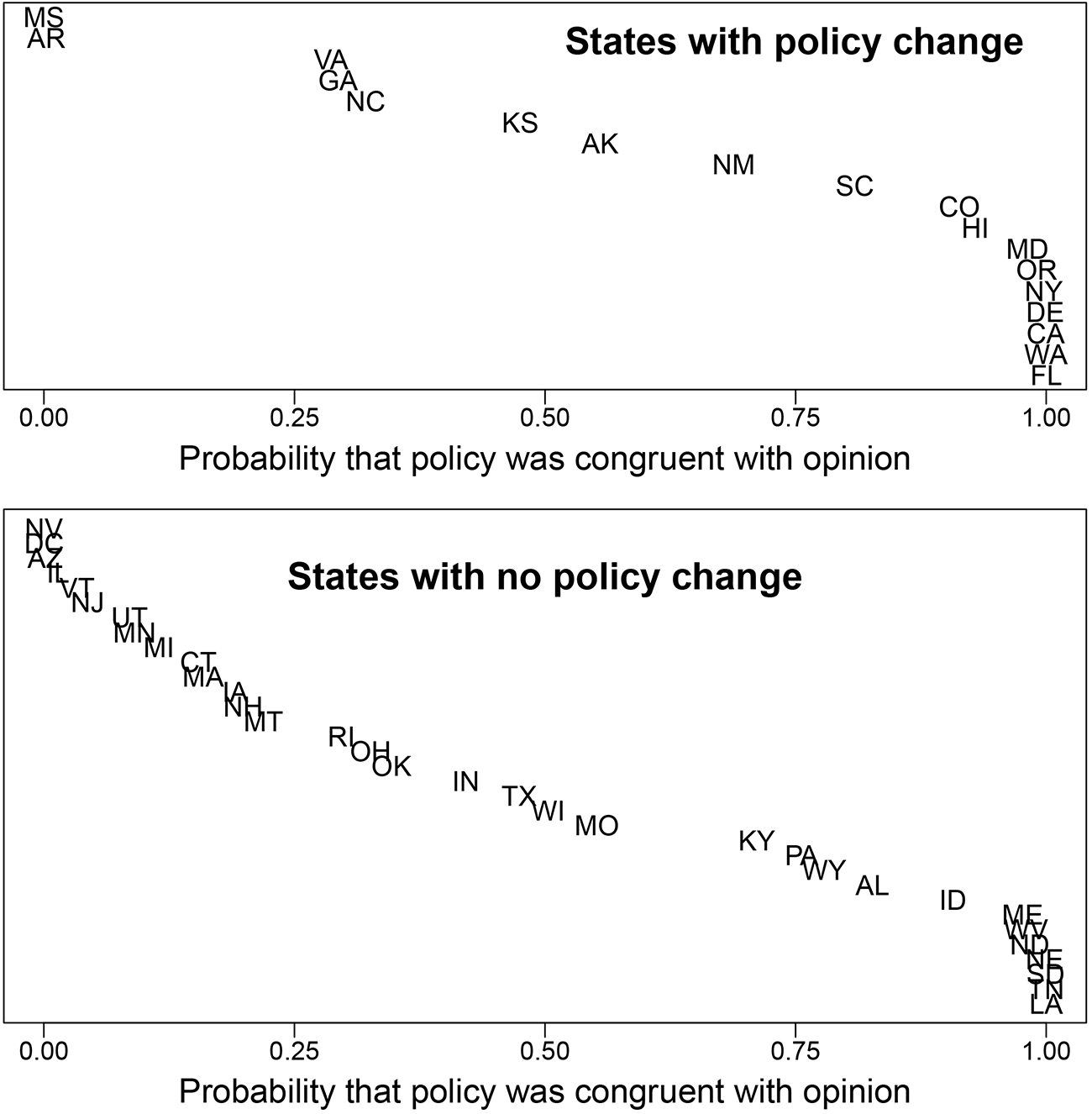
More directly, figure 5 depicts the probability that policy was congruent with state opinion. Here I collapse policy into either change or no change (recall that the latter includes states that are coded as either 0 or 1 on the policy index). The top plot depicts congruence in states that liberalized their laws, while the bottom plot looks at states where the status quo remained in place. The probabilities of congruence are based on calculating congruence across all simulations of opinion and dividing the number of simulations in which policy change matched majority opinion by the overall number of simulations. The graph reveals that in most states with policy change, the probability of congruence exceeded .5; in half the states the probability exceeded .9. Conversely, in a majority of states where the status quo remained in effect, there was at least a 50% chance that policy was incongruent with opinion. And in 14 states without policy change, the probability of congruence was less than 25%.
Congruence between state opinion and state policy. The plot shows the probability that policy is congruent with opinion, for states with (top) and without (bottom) policy change. Panel A of table 1 presents a cross-tab of when opinion matches policy.
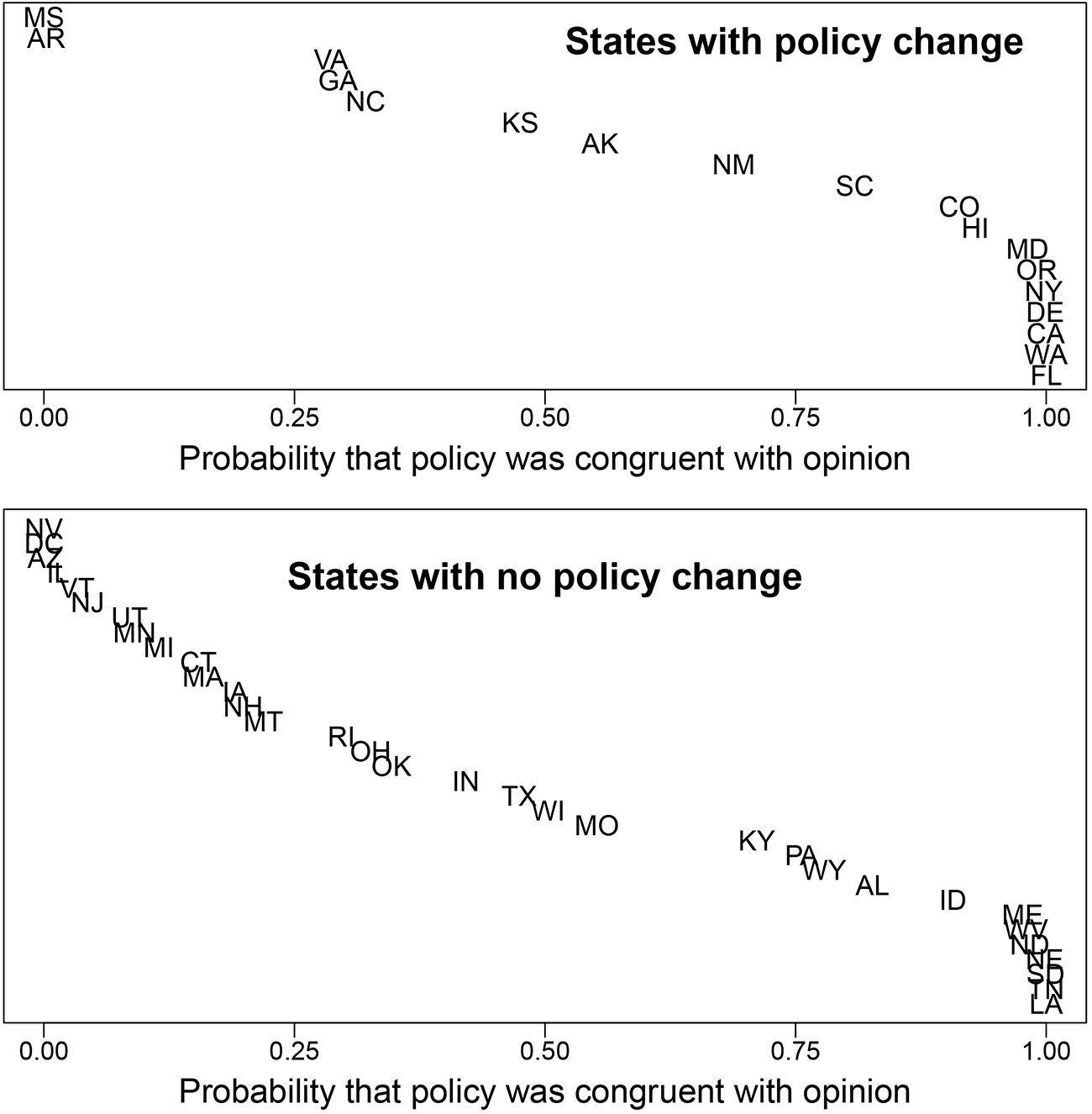
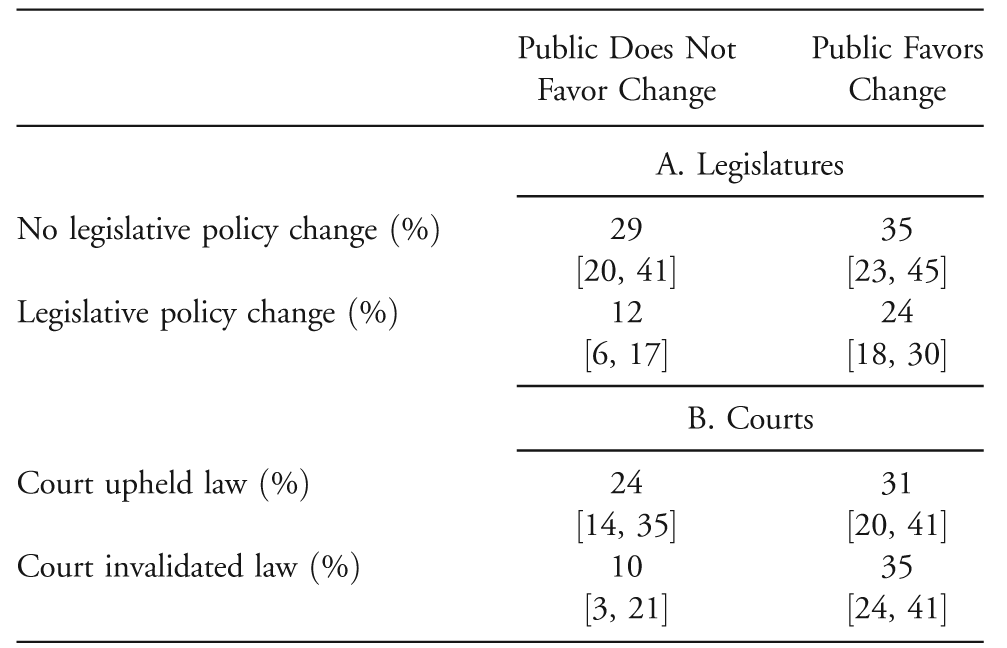
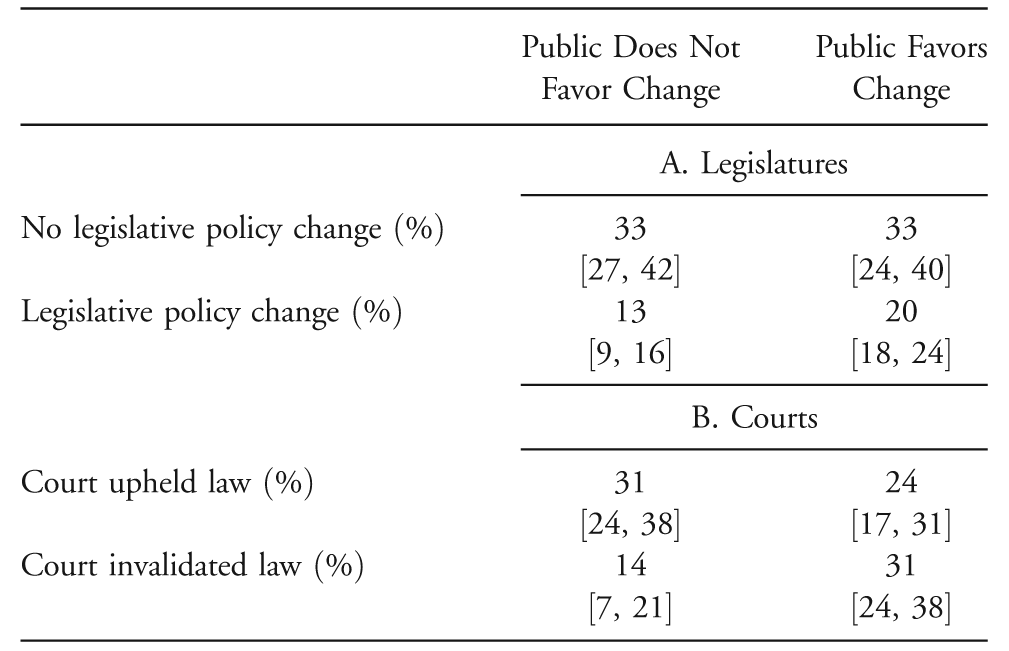
Table 1 (panel A) examines the congruence between opinion and policy in a different way. It depicts the proportion of states in which policy matches opinion, with 95% confidence intervals in brackets. The table gives cell percentages; for instance, in an estimated 29% of states, the status quo remained in place and the state majority favored the lack of policy change. This table makes clear that when the public favored change, more often than not the status quo remained in place. Thus, it is clear that in many states policy lagged behind majority opinion. In such states judicial invalidation of statutes would be pro-majoritarian and not countermajoritarian.
Cross-Tabs of When Opinion Matches Policy for Legislatures and Courts
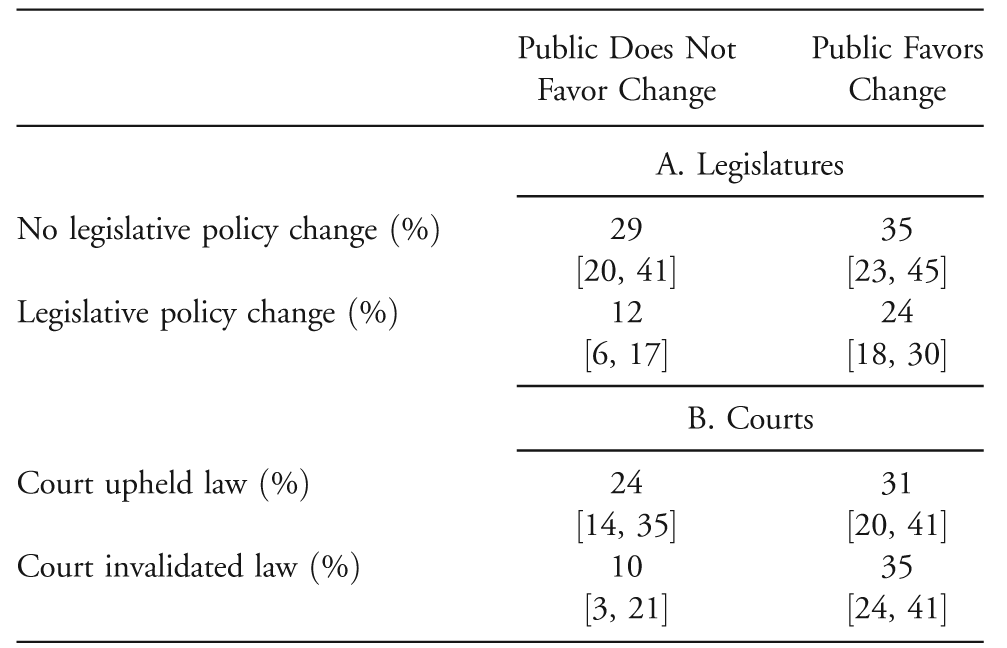
Note.—The table presents two cross-tabs of when opinion matches policy, for decisions made by legislatures (panel A) and courts (panel B). The cross-tab for courts is based on states in which the legislature did not change abortion policy. The percentages are cell percentages for the number of states in which each condition is met. The brackets contain 95% confidence intervals, which are based on the simulated estimates of opinion.
D. Judicial Review of State Statutes
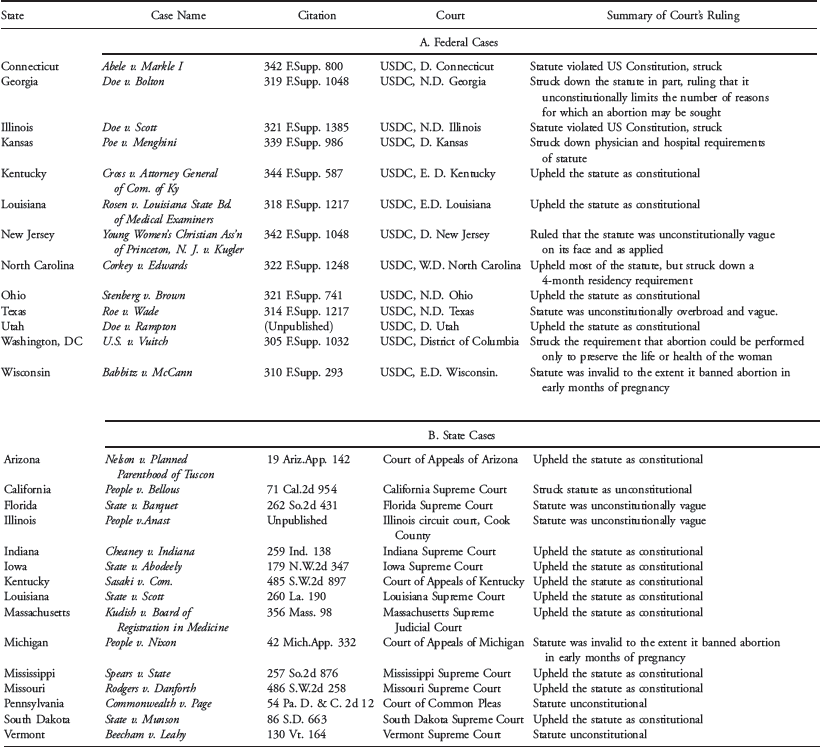
To examine the relationship between public opinion and judicial review of abortion statutes, I collected an original data set of court decisions in the pre-Roe period. Using both Westlaw and secondary sources, I sought to identify every case in state and federal courts in which litigants brought a constitutional challenge to a state abortion statute and where a court made a final determination regarding the constitutionality of the statute.Footnote 20 Details on the case collection procedures can be found in appendix A.
This search revealed that challenges were brought in 29 states. Appendix table A2 summarizes the cases used in the analysis. Federal courts issued decisions in 13 states, while state courts issued decisions in 16 states (in a few states both state and federal courts made decisions). The courts hearing these cases were presented with many arguments on both sides and thus had many options in disposing of these challenges. In most cases, however, the court either upheld the statute in total or struck it down as constitutionally infirm. Accordingly, I code each decision as invalidating a statute if it strikes down any part of the statute and upholding otherwise. Out of the 29 states with final decisions, the courts upheld the statute in 16 states and invalidated them in 13 states. Using these decisions, I can compare how courts ruled with public opinion in each state; essentially this is a direct test of result majoritarianism.Footnote 21
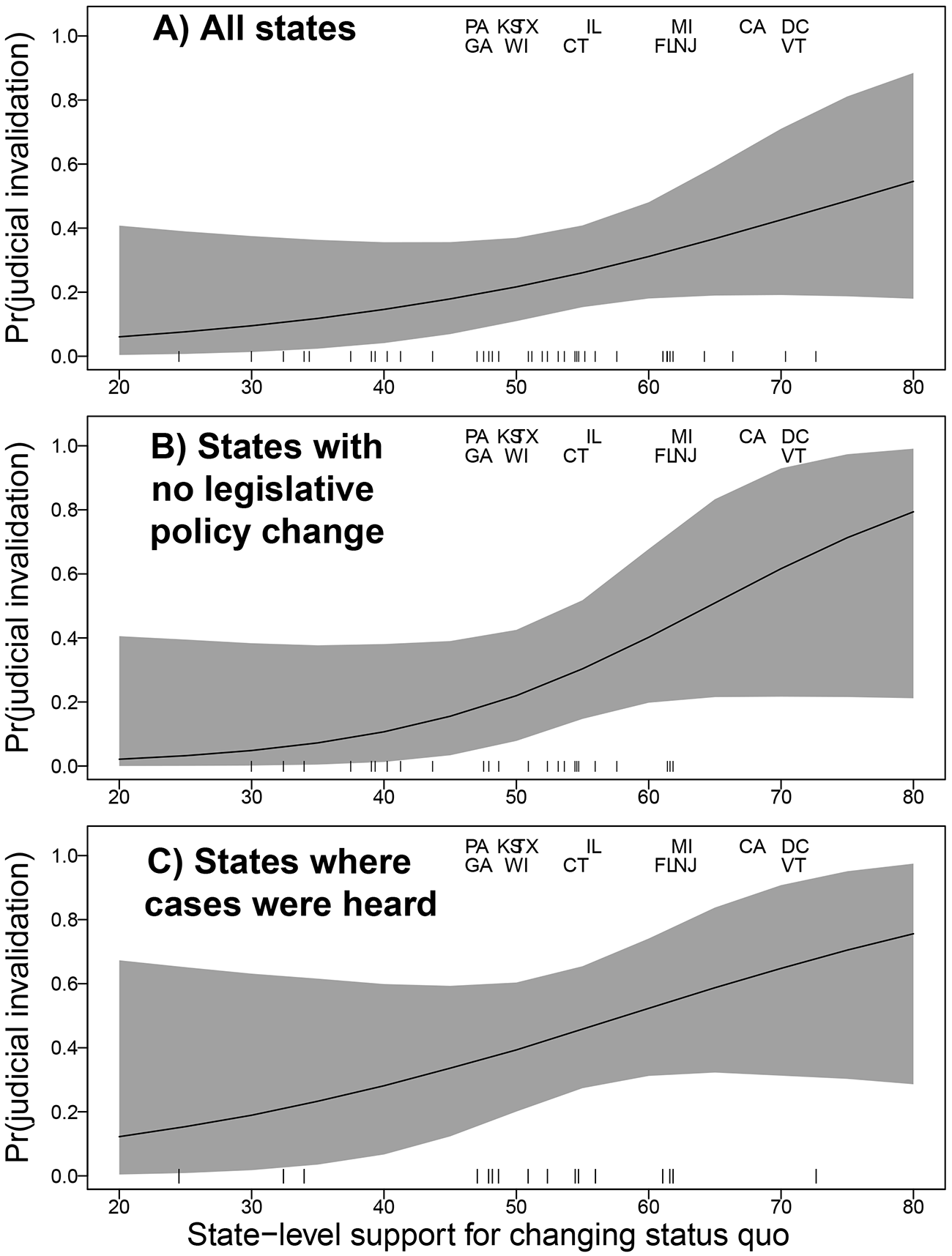
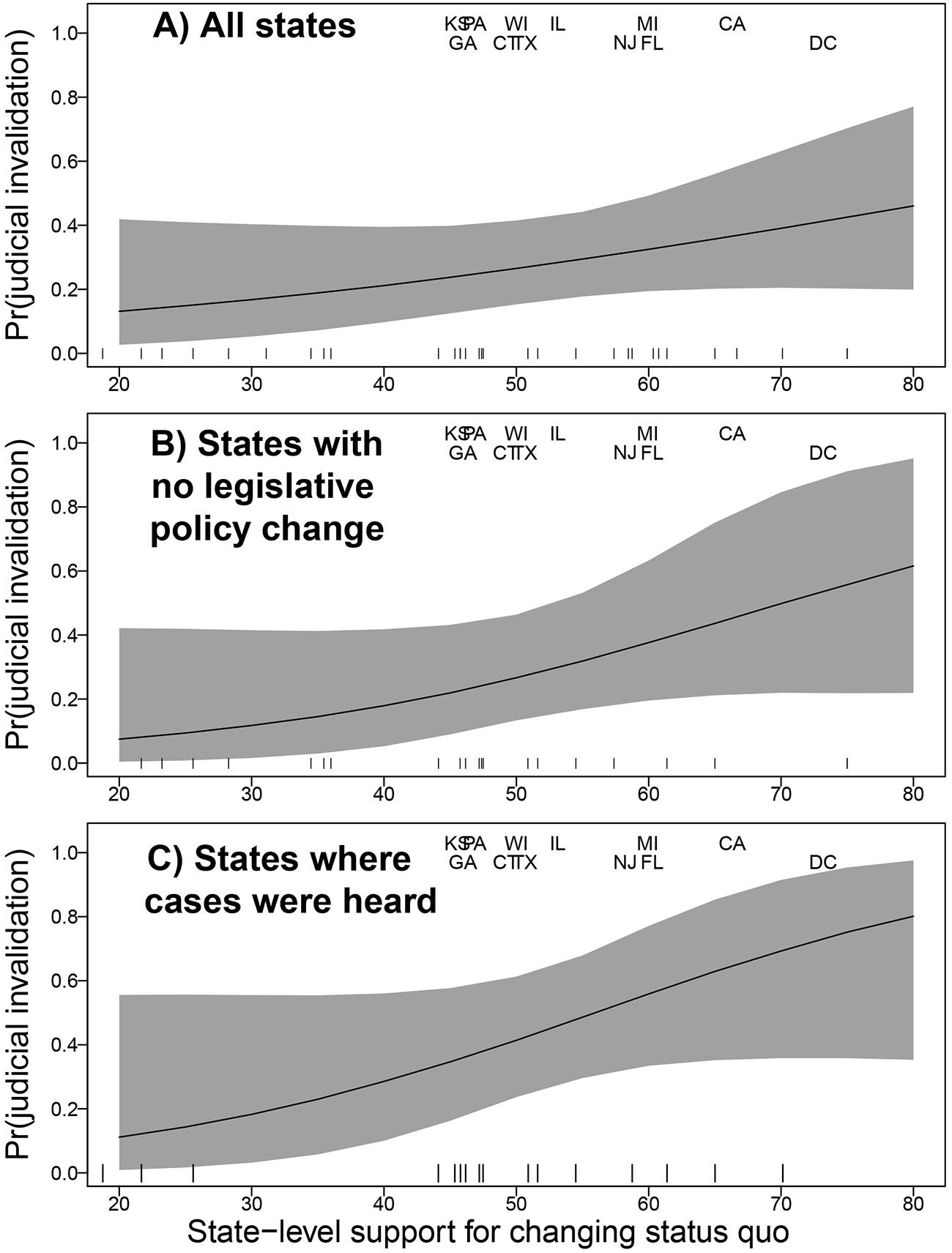
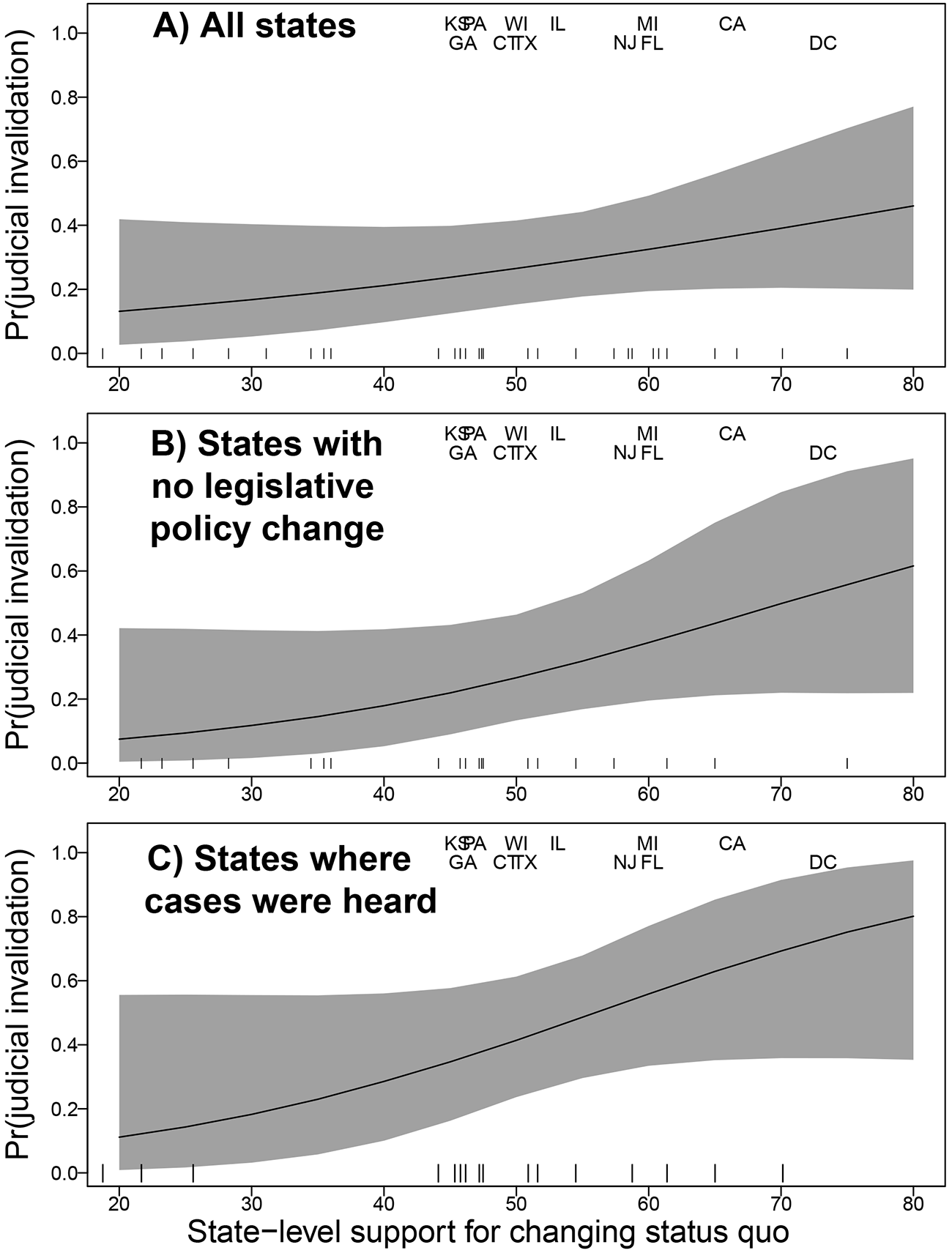
Each panel in figure 6 plots the probability of a judicial invalidation of a state statute against state-level support for changing the status quo. In each plot, the solid line represents the estimated logistic curve from regressing judicial invalidations on state opinion (accounting for uncertainty). The shaded areas depict 95% confidence intervals. Figure 6A includes all states. Figure 6B focuses the analysis only on states where no policy change occurred, that is, those states where judicial review was most likely to occur. Finally, figure 6C includes only states where cases were actually heard to ensure that the correlation is not an artifact of proreform litigants bringing challenges in states where courts were more likely to be more receptive to their claims. In each plot, I present the initials of only those states in which laws were struck down.
State-level public opinion and the probability of a judicial invalidation of a state abortion statute. Panel A includes all states. Panel B includes only states that did not change their laws at all. Panel C includes only states in which cases were brought. In all three, the probability of a judicial invalidation is increasing in state-level support for changing policy away from the status quo.
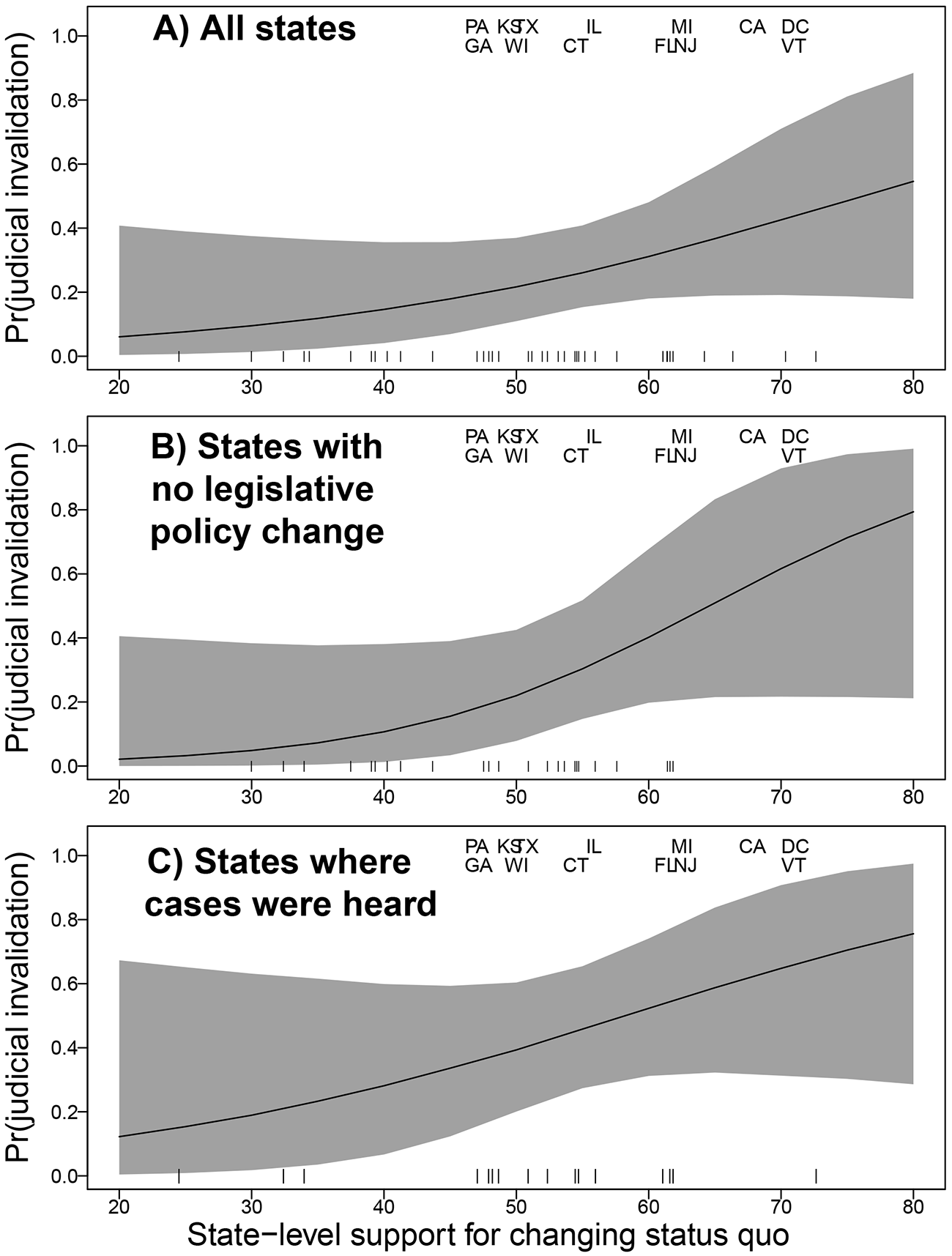
Regardless of how the data are broken down, the plot reveals a clear pattern: as public support for policy change increases, so does the likelihood of a court striking down the state statute. And while the plots reveal considerable uncertainty, the probability that the slope coefficient in each plot is greater than zero is .93, .96, and .92, respectively. Finally, the substantive magnitude of the relationship is significant. On the basis of the estimates in figure 6B , moving from 40% state-level approval for changing the status quo to 60% saw the likelihood of a judicial invalidation increase from 10% to 40%.
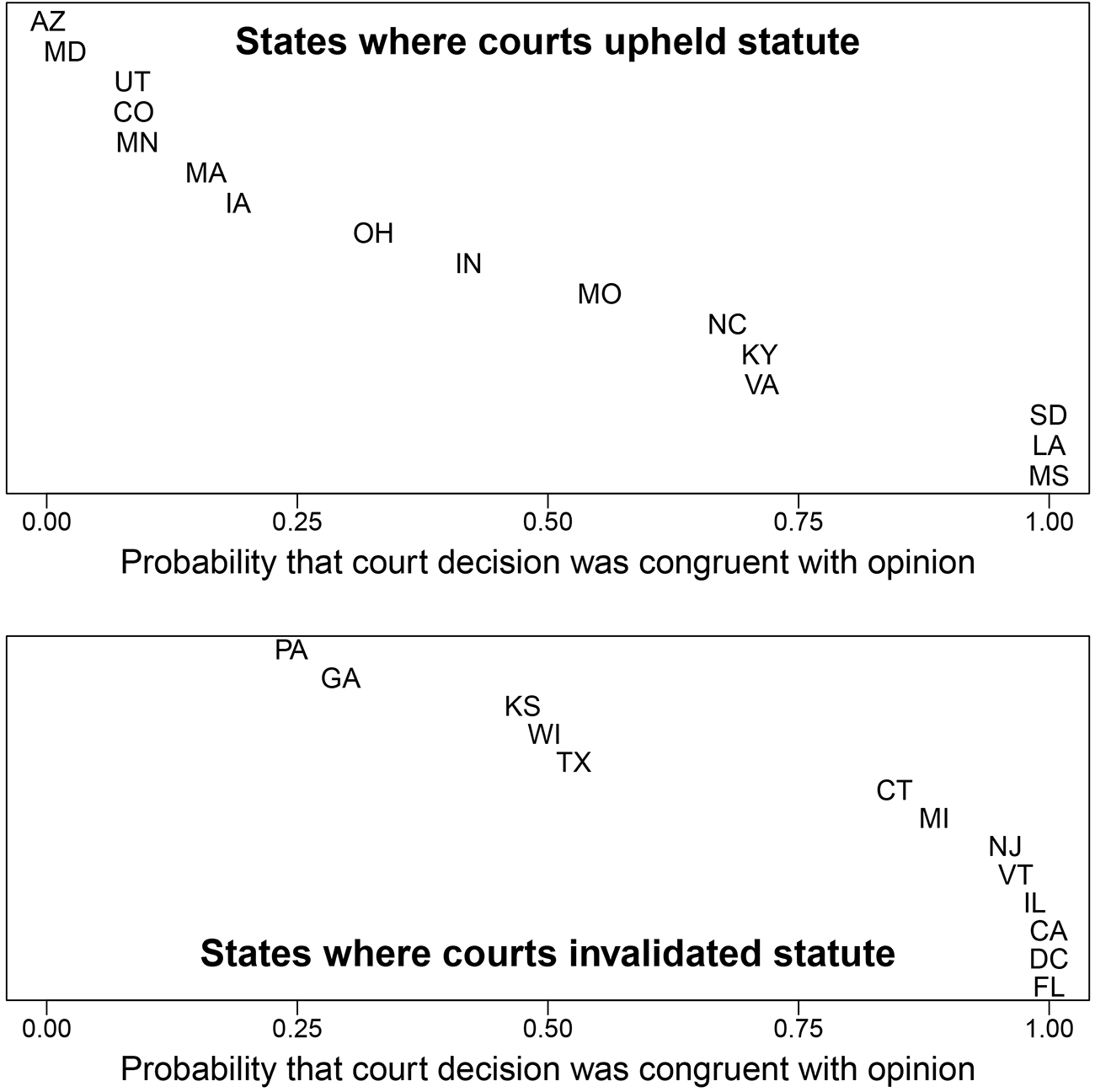
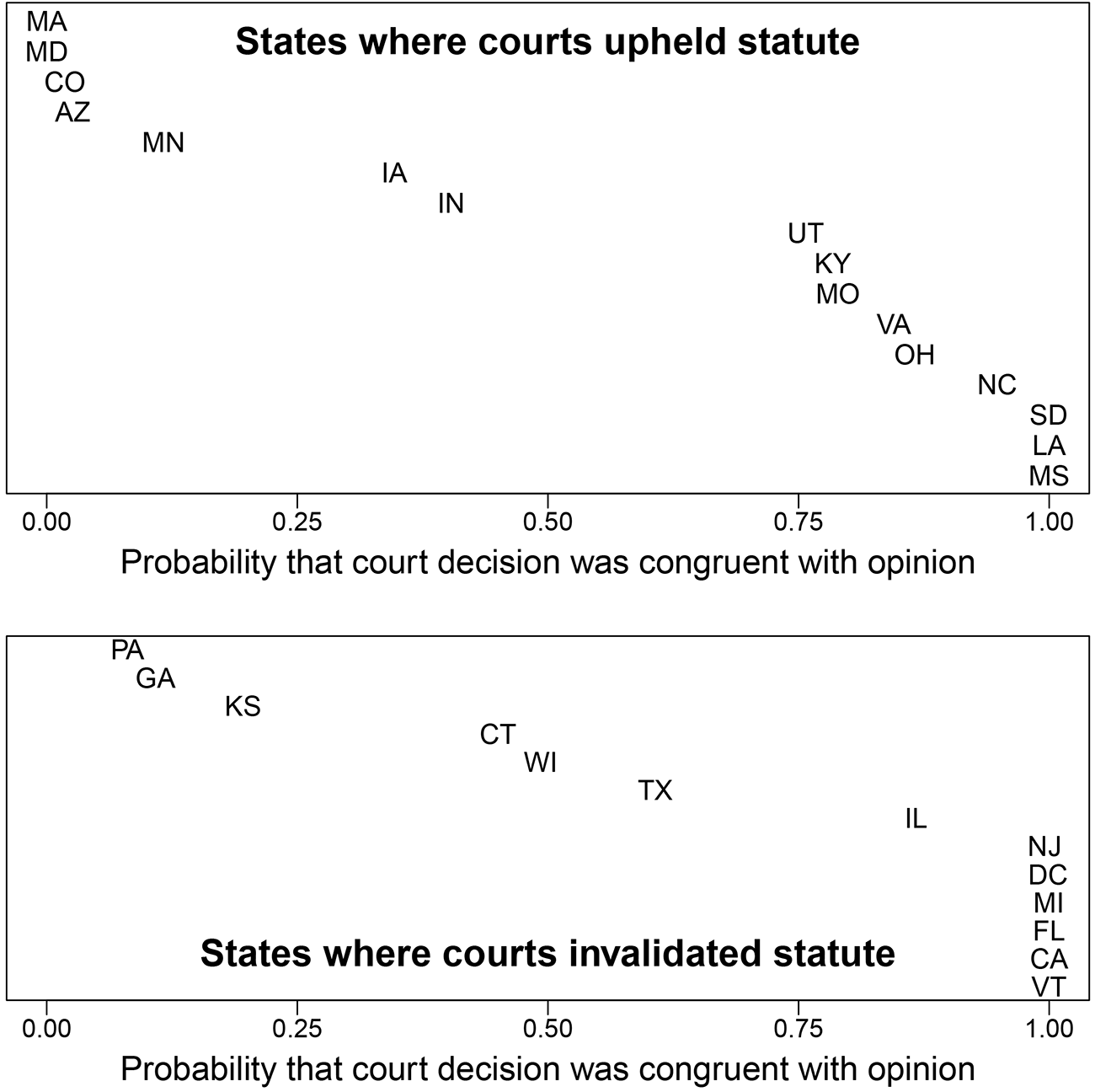
Next, I present a congruence analysis on the exercise of judicial review, just as I did in comparing policy change by legislatures to status quo. Here I focus solely on states where courts heard cases. Figure 7 depicts the probability that the outcome of a judicial decision was congruent with state opinion (with the probability based on calculating congruence across all simulations of opinion). The top plot depicts congruence in states where courts upheld the statute, while the bottom plot looks at states where courts invalidated the statute. It is clear that where courts upheld the statute, there is wide variation in congruence; in many states courts upheld statutes where clear majorities favored change. However, as noted in Section II, this pattern is not a problem in terms of the countermajoritarian difficulty, given that courts were deferential in these instances by upholding the relevant statute.
Congruence between state opinion and judicial review, in states in which court challenges to existing statutes were heard. The plot shows the probability that policy is congruent with opinion, for states with (top) and without (bottom) policy change. Panel B of table 1 presents a cross-tab of when opinion matches policy, based on states in which the legislature did not change abortion policy.
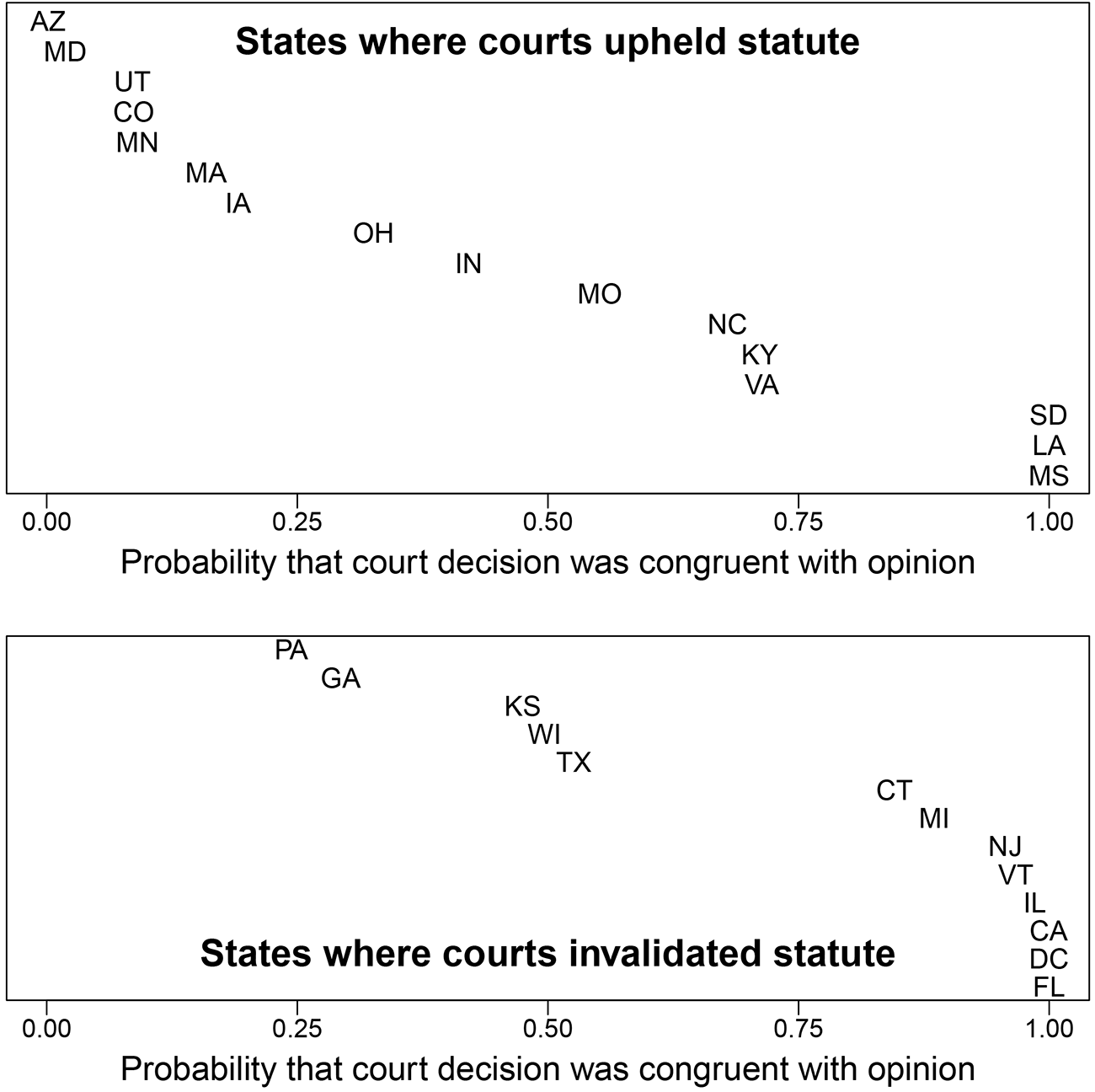
Conversely, for nearly every state where courts invalidated the statute, the probability that the decision was congruent with majority state-level opinion was near or above 50%, meaning they were likely pro-majoritarian. And, in the two states where the decision to invalidate the statute was incongruent (Pennsylvania and Georgia), the estimated level of approval for changing the status quo exceeded 47%.Footnote 22 Thus, in no state did a court “reach out” and invalidate a statute where opinion was overwhelmingly on the side of the status quo.
Returning to table 1, panel B presents a cross-tab of judicial invalidation versus state majority opinion, keeping only states where courts heard cases. Here the most relevant comparison is the proportion of states that fall in each column when the court invalidated the statute. The bottom row of the table shows that among states where the court struck down the statute, a majority of the public was three times as likely to favor change from the status quo policy. Moreover, comparing panel B in table 1 to panel A, judicial decisions actually appear to be slightly more responsive to public opinion than to legislatures. The comparison is not perfectly apt, since courts did not rule on policies in many states. But, with this caveat in mind, looking on the diagonal of the cross-tab in panel B in table 1 shows that the exercise of judicial review was congruent with state opinion 59% of the time. In contrast, as seen in the cross-tab in panel A, legislative policy was consistent with state opinion only 53% of the time.
Finally, while the number of decisions is too small to make much of any differences between state and federal courts, it is worth noting that the probability of invalidation was higher in federal courts than in state courts. Each federal case was decided by a three-judge panel of the district courts: of the 11 federal cases, eight resulted in either partial or full invalidation of the statute. Conversely, only five of 18 state cases resulted in invalidations. What this means is that it was not simply elected state judges striking down unpopular statutes, a result that, if true, would have significant implications for assessing the countermajoritarian difficulty. Rather, life-tenured federal judges were responsible for the majority of invalidations of state abortion statutes before Roe v. Wade and, hence, were more likely than state judges to bring policy in line with public opinion.
E. Evaluating Roe v. Wade
Having shown that state and lower federal courts were, in many instances, exercising judicial review in a majoritarian fashion in the pre-Roe period, it is useful to circle back to the Supreme Court’s decision itself in Roe. While many of the lower court decisions invalidating statutes noted the higher burden on the state to justify regulations on abortion early in the pregnancy, no decision attempted to overtly outline a trimester system, as fashioned by the majority opinion in Roe. As noted earlier, as of 1972, about half of Americans favored laws “which would permit a woman to go to a doctor to end pregnancy at any time during the first three months.”
Two conclusions emerge from that distribution. First, given the roughly equal split, the Court’s decision in Roe did not impose a policy contrary to the wishes of a large majority of the American public (Friedman Reference Friedman2009, 297). At the same time, the split means that the decision did not reflect any sort of national consensus. In addition, returning to the right panel of figure 3, very few state majorities favored such a policy, meaning that the Court was mandating a federal floor of protection for abortion rights higher than the average state majority would prefer. In this sense, the decision was certainly countermajoritarian to a degree. At the same time, the evidence on state-level policy and judicial review demonstrates that, in the absence of some exercise of judicial review, the mismatch between policy and opinion was likely to remain in some states for some time. For the Supreme Court to have not weighed in at all on the constitutionality of abortion restrictions would have had the effect of keeping many unpopular policies in place.
V. Discussion and Conclusion
The results presented here contribute to a growing body of evidence that suggests that the traditional view of the countermajoritarian difficulty does not adequately capture the political realities in which courts operate. In particular, given the prevalence of status quo biases in a government with multiple veto players and multiple interests, there will be many occasions in which policy lags behind changes in public opinion. In ruling state statutes invalid, many judges were acting in concert, and not discord, with the preference of state majorities. Thus, this study illustrates how in many circumstances courts may serve as pro-majoritarian policy-making institutions that can move policy toward a majority’s preferences when other political actors either cannot or do not want to shift policy (Frymer Reference Frymer2003; Silverstein Reference Silverstein2009).
The findings also suggest the importance of creating a role for state and lower federal courts in evaluating the countermajoritarian difficulty. The focus on the Supreme Court is natural, given its prominence and its place at the summit of the judicial hierarchy. But in many instances the Court will take years to weigh in on an issue, leaving lower courts to adjudicate emerging constitutional issues. The empirical approach I have taken in this article suggests a means for more systematic evaluation of the extent to which courts are countermajoritarian. Advance in methodologies in estimating subnational opinion now make it feasible to measure opinion in smaller units than that of the national government, where courts often exercise political power in the absence of direct action from superior courts. For example, returning to the issue of the constitutionality of gay marriage bans, whether the judicial invalidations of such bans by state and lower federal courts (before the Supreme Court weighed in) were pro-majoritarian is an empirical question that could easily be answered, given state-level estimates of support for gay marriage (Lax and Phillips Reference Lax2009a). A similar pattern of correspondence between state-level public opinion and judicial review would not be surprising, given the significant shift toward support for gay marriage in the past two decades (Klarman Reference Klarman2012).
In addition, the judicial invalidations of abortion statutes before Roe demonstrate that focusing solely on the Supreme Court may lead to an underestimation of the extent of judicial power. For instance, in support of his argument that Roe had only a limited effect on abortion rates, Rosenberg (Reference Rosenberg1991, 178) notes that the increase in legal abortions began in 1970, 3 years before Roe was decided. But some of this increase could have been due to state and lower court decisions striking down state abortion laws, thereby increasing the availability of legal abortions.Footnote 23
The activity of state and lower federal courts in abortion politics is also relevant to the burgeoning literature on whether prominent judicial decisions on contested issues induce a “backlash” from the public and elites (Klarman Reference Klarman1994; Keck Reference Keck2009; Fontana and Braman Reference Fontana2012). The conventional account in this literature is that Roe v. Wade emerged suddenly and inspired a broad countermobilization among antiabortion forces that persists to this day (see, e.g., Rosenberg Reference Rosenberg1991; Sunstein Reference Sunstein1991; Eskridge Reference Eskridge2005). A number of recent studies challenge this claim, arguing that the fault lines in the abortion debate began to emerge in the decade before Roe was decided, with antiabortion forces mobilizing well before 1973 (Nossiff Reference Nossiff2001; Post and Siegel Reference Post2007; Lemieux Reference Lemieux2009; Greenhouse and Siegel Reference Greenhouse2011). While my data cannot speak to interest group activity or the intensity of preferences, the fact that abortion litigation reached the doors of courts in more than half the states by the time Roe v. Wade was decided does illustrate the depth of abortion politics in the years before the decision. Moreover, as noted above, without action by the Supreme Court, policy was likely to lag behind opinion in many states, and so the claim that the decision in Roe cut off a secular trend toward liberalization in the states is not supported by the data.
More generally, the linkages between courts, public opinion, and policy evaluated in this article also illustrate the unique way in which courts can affect representation. Recall from figure 4 the heterogeneity in the relationship between policy and public support for changing the status quo. While I focused on the states where policy was “too low,” the figure also reveals many states where policy was “too high.” In these states, the ability of courts to serve as a check on mismatched policy is constrained by the fact that courts cannot say that states provide “too much” protection for abortion rights.Footnote 24 Thus, in many areas of the law, courts serve as a “one-way” ratchet: they can force states to increase their level of constitutional protections but cannot compel them to lower it.
After Roe, this asymmetry would interact with judicial federalism in an important way that would affect the implementation of abortion policy. The Supreme Court’s decision in Roe set a federal “floor” of policy below which no states would legally go (Mooney Reference Mooney2000). In the years to follow, many states would attempt to push back against this policy by setting new abortion restrictions; meanwhile, the Supreme Court became increasingly conservative, upholding more restrictions on abortions (while declining to overrule Roe). At the same time, state courts are free to interpret their state constitutions as requiring “higher” levels of protection beyond the federal floor established by the US Supreme Court. This led abortion rights supporters to bring their claims to state courts in the hopes of greater victory there. In this way, the opportunity for a greater match between opinion and policy would play out in the states—with courts serving as intermediaries via the use of judicial review.
Appendix A
This appendix provides information on the data and measures used in the paper.
A. State Policy
The index of state policy comes from similar indices employed in Craig and O’Brien (Reference Craig1993) and Mooney and Lee (Reference Mooney1995). The indices in those sources are nearly identical; the index in Mooney and Lee (Reference Mooney1995) does not distinguish between the states in my 0 and 1 categories but is slightly more fine grained in distinguishing among the states that implemented reform. Note that Washington, DC, is coded as a repeal “state” in Craig and O’Brien (Reference Craig1993). This policy change was actually accomplished via judicial decision; the district’s relevant statute was passed in 1901 and allowed for abortion only for the health or life of the mother. Thus, for the purposes of legislative policy, I coded DC as 1.
B. Public Opinion
National and individual-level opinion. All the national polling results presented in Section IV.B and in figure 2 come directly from iPoll’s summary of the relevant poll questions.
Table A1 presents individual-level logistic regressions of opinion on changing the status quo and full repeal. See the subsection on state-level opinion below for a fuller description of the covariates used in the regressions. The models also include fixed effects for the separate polls used in each analysis.
Logit Models of Individual-Level Opinion
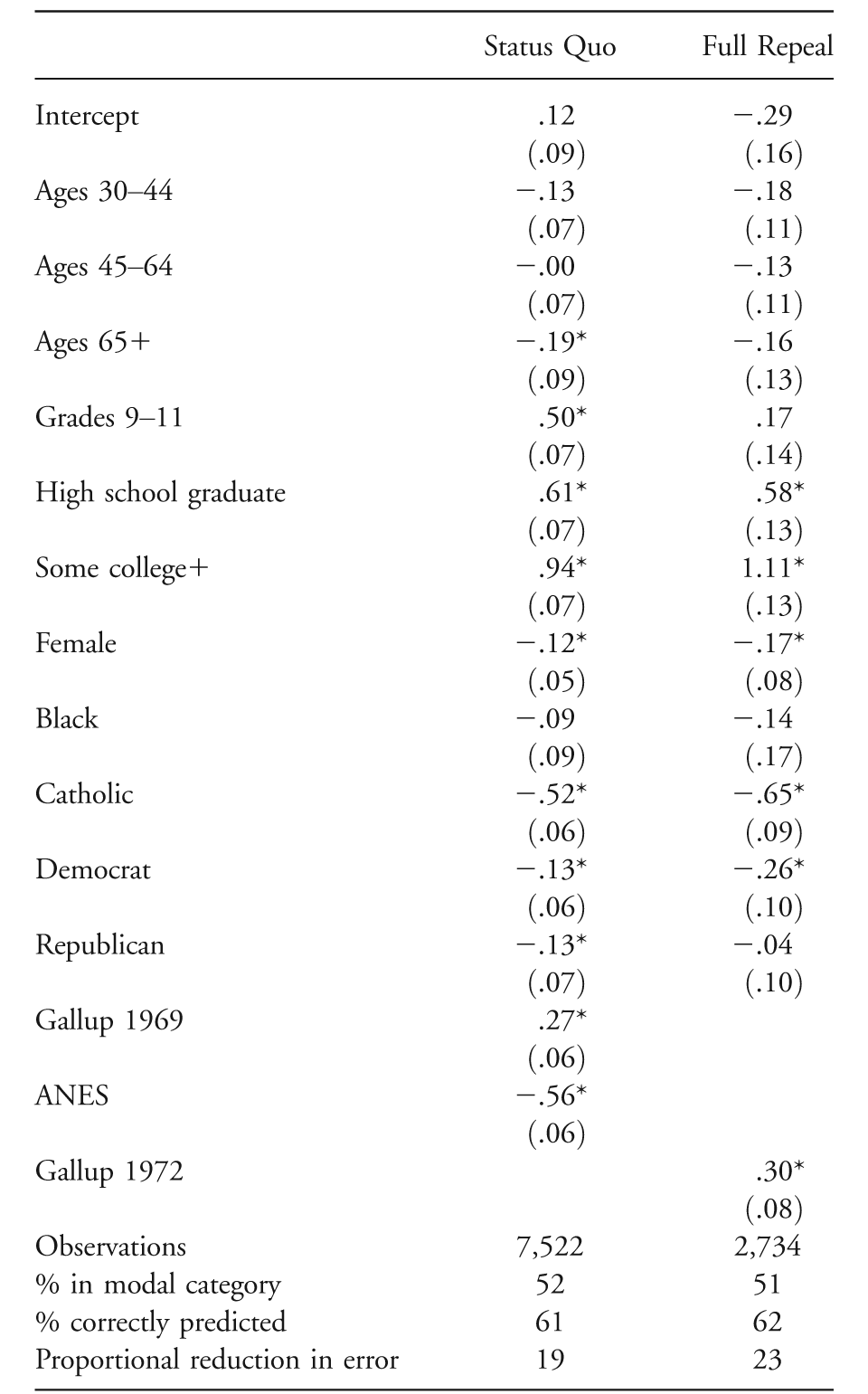
Note.—The first model looks at opinion on changing the status quo; the second model looks at opinion on full repeal. Standard errors are in parentheses.
* Significant at p < .05.
State-level opinion. To estimate state-level opinion, I employ multilevel regression and poststratification. There are two stages to MRP. In the first stage, opinion is modeled as a function of demographic characteristics of respondents and geography (i.e., the state they live in), using random effects. In the second stage, the estimates are poststratified according to the true proportion of each “demographic-geographic” type in each state. In the first stage, I model response as a function of gender; one of four age groups (18–29, 30–44, 45–64, and 65+); race (white and black); and one of four education groups. To reflect the fact that Americans generally had less education in the 1960s and early 1970s, I use the following education breakdowns: less than grade 9, grades 9–11, high school graduate, and some college or more. In the second stage, the first-stage estimates are poststratified according to the distribution of each type in the actual state population. For this stage, I use the 5 Percent Public Use Microdata Sample in the 1970 census.
As noted in the text, one complication of using MRP in this context is that the census does not ask about religion; as table A1 shows, Catholics were much less likely to favor abortion law liberalization than non-Catholics. Fortunately, Leemann and Wasserfallen (Reference Leemann2014) have devised a solution to the generic problem of not having data at the census level that are correlated with individual responses. Specifically, they show that if one knows the distribution of the “missing” variable in the census at the state level, one can weight the joint distributions from the census types by the marginal distribution of that variable and recover estimates that are very close to what one would recover in the presence of complete census data. Accordingly, I first obtained the proportion of Catholics in each state from Johnson, Picard, and Quinn (Reference Johnson1974). I then updated the 1970 “poststratification file”—the distribution of demographic types in each state—by weighting each type by the marginal distribution of Catholics in each state. With this updated poststratification file, I can thus weight the first-stage estimates by the population distribution of demographic-geographic types.Footnote 25
Formally, let yi = 1 denote a response in favor of liberalization, in terms of either the status quo or full repeal. For each set of estimates, I estimate the following model:

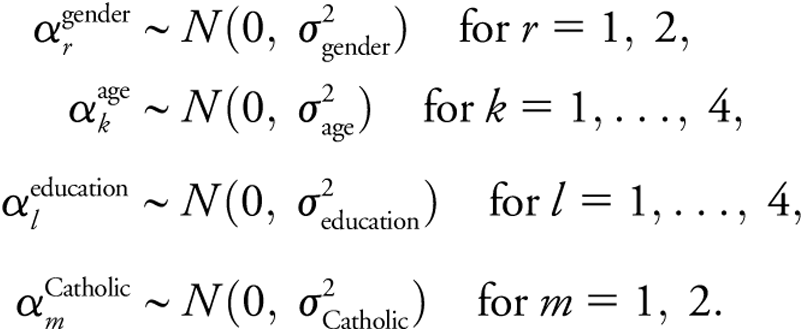
The terms after the intercept are modeled effects for the various groups of respondents (modeled as drawn from a normal distribution with mean zero and endogenous variance):
The state effects are modeled as a function of the proportion of people in each state that live in an urban area, which is positively correlated with support for abortion liberalization:

In the second stage, I use the coefficients that result from this estimation to calculate predicted probabilities of opinion for each demographic-geographic type. There are 6,528 combinations of demographic and state values (128 within each state). Let j denote a cell from the set of demographic-geographic types. For any j, the results above allow us to make a prediction of support for liberalization
 , which is simply the predicted probability given by the results from equation (A1). I next poststratify these results according to population frequencies derived from the 1970 census. For each state, we then can calculate the percentage who support liberalization, aggregating over each cell j in state s. Let
 denote an estimate of support for liberalization in a given state s. Then
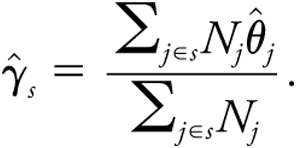
All the estimates were calculated using the MRP package in R (Malecki et al. Reference Malecki2014). The package also allows for the estimation of uncertainty for each estimate.
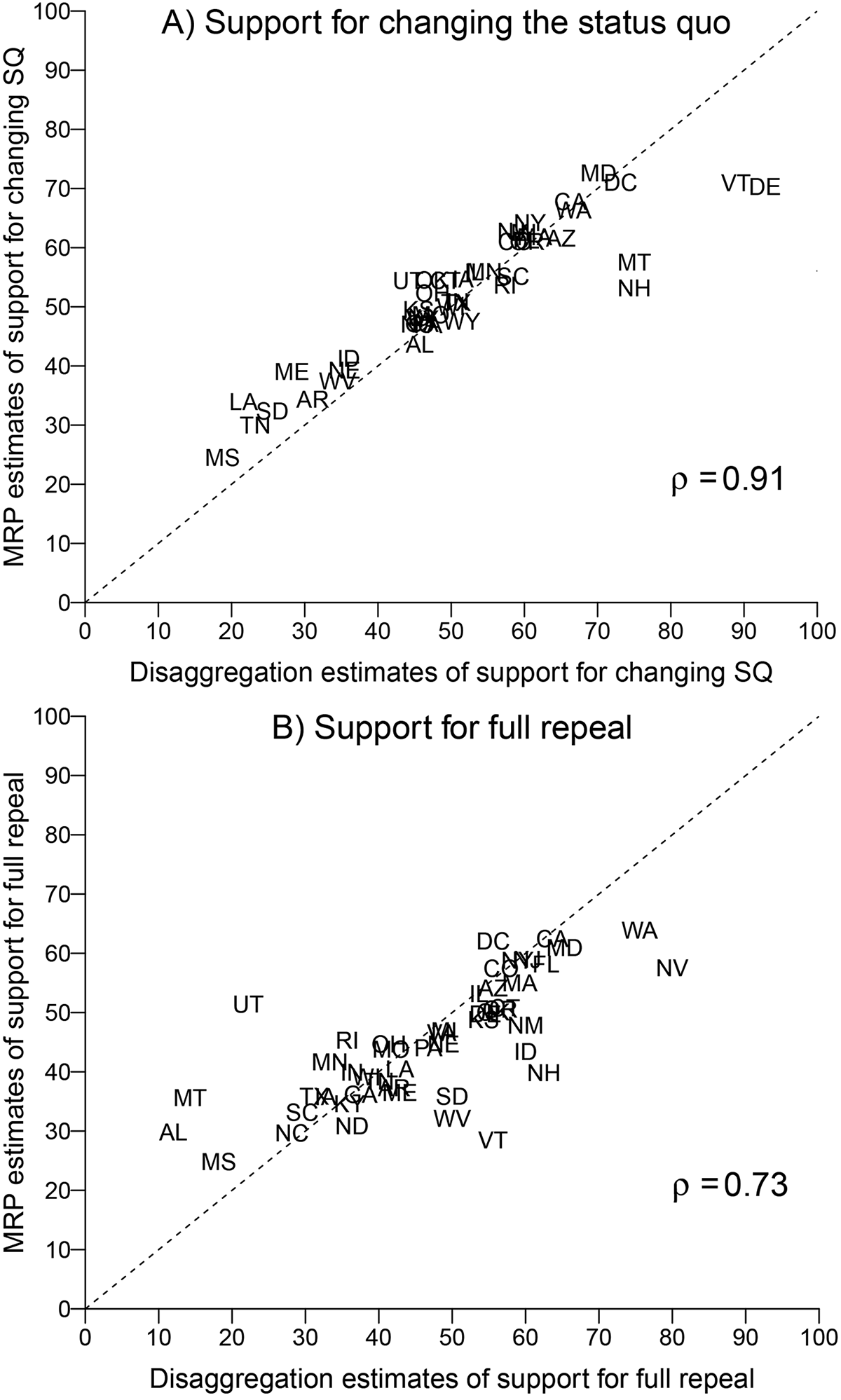
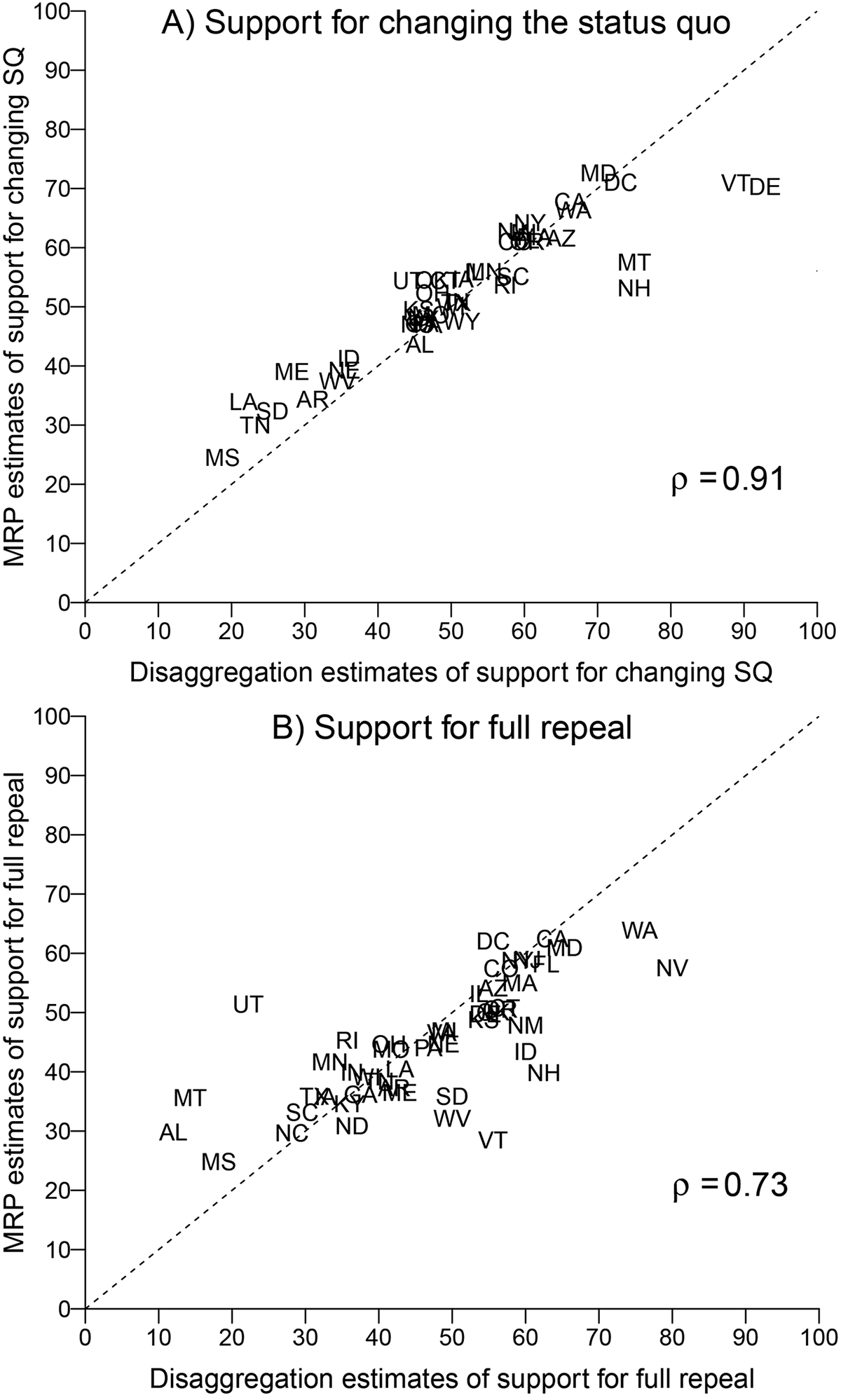
Validation of MRP estimates. It is useful to compare the MRP estimates to that produced by disaggregation—that is, simply taking the mean level of opinion in each state. Figure A1 depicts scatter plots of the respective MRP and disaggregation estimates for changing the status quo (panel A) and for full repeal (panel B). The estimates are highly correlated, especially for changing the status quo (ρ = .91). The correlation among the full-repeal measures is slightly weaker (.73) but still strong.
Disaggregation versus MRP estimates for (panel A) changing the status quo and (panel B) support for full repeal. The dotted lines are 45-degree lines.
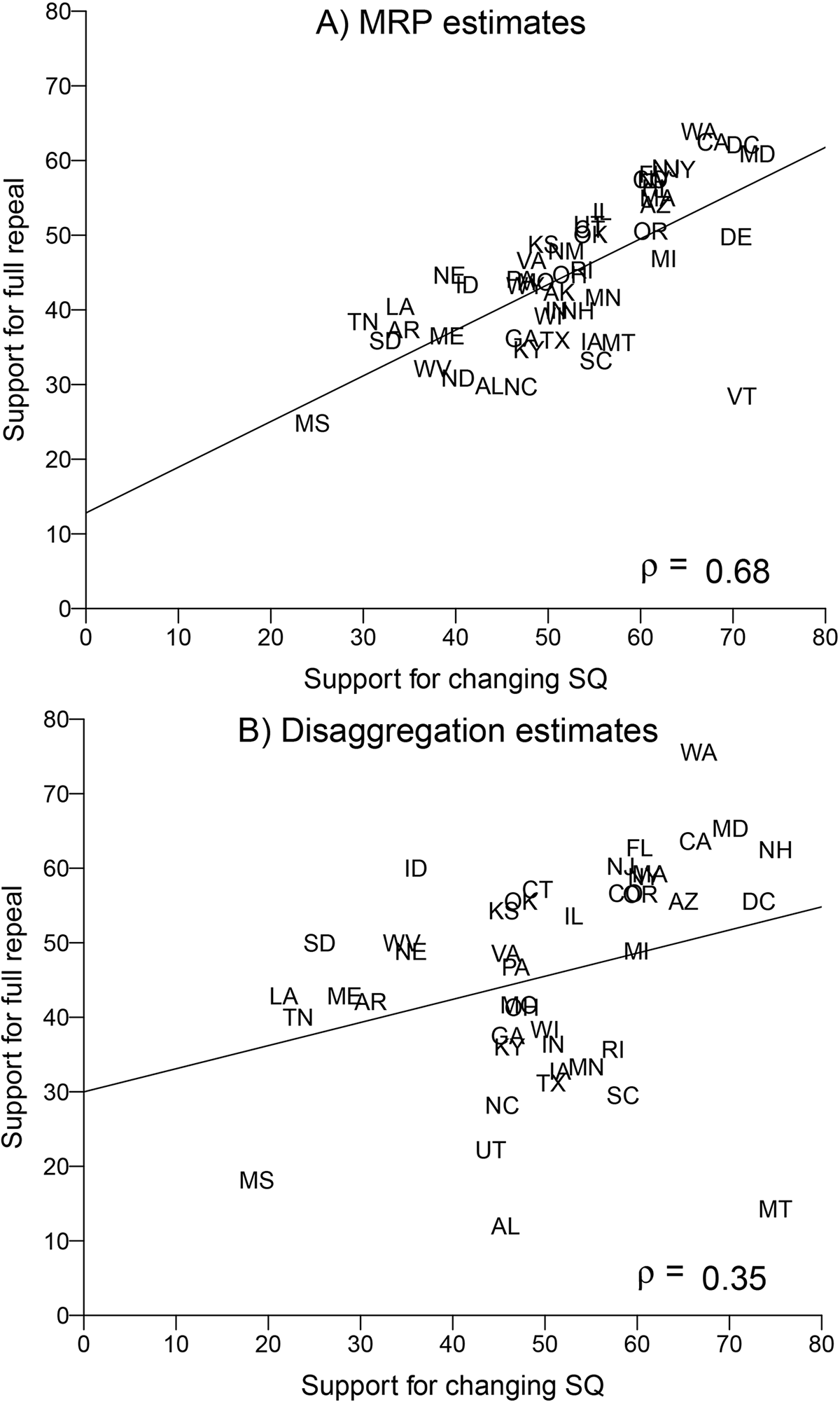
As an additional validity check, we can compare the correlation between the status quo and full-repeal measures, which should be at least moderately high, given that people who support full repeal must support liberalization (though the converse is not true). Figure A2A depicts a scatter plot of the MRP estimates for the two measures; the solid line is a regression line. The two estimates correlate at .68. The only dramatic outlier is Vermont, which is estimated to be firmly in favor of supporting the status quo but also firmly against changing the status quo. (If Vermont is excluded the correlation increases to .78.)
State-level estimates of support for changing the status quo versus state-level estimates of support for full repeal, based on (A) MRP estimates and (B) disaggregation estimates. The solid lines are regression lines.
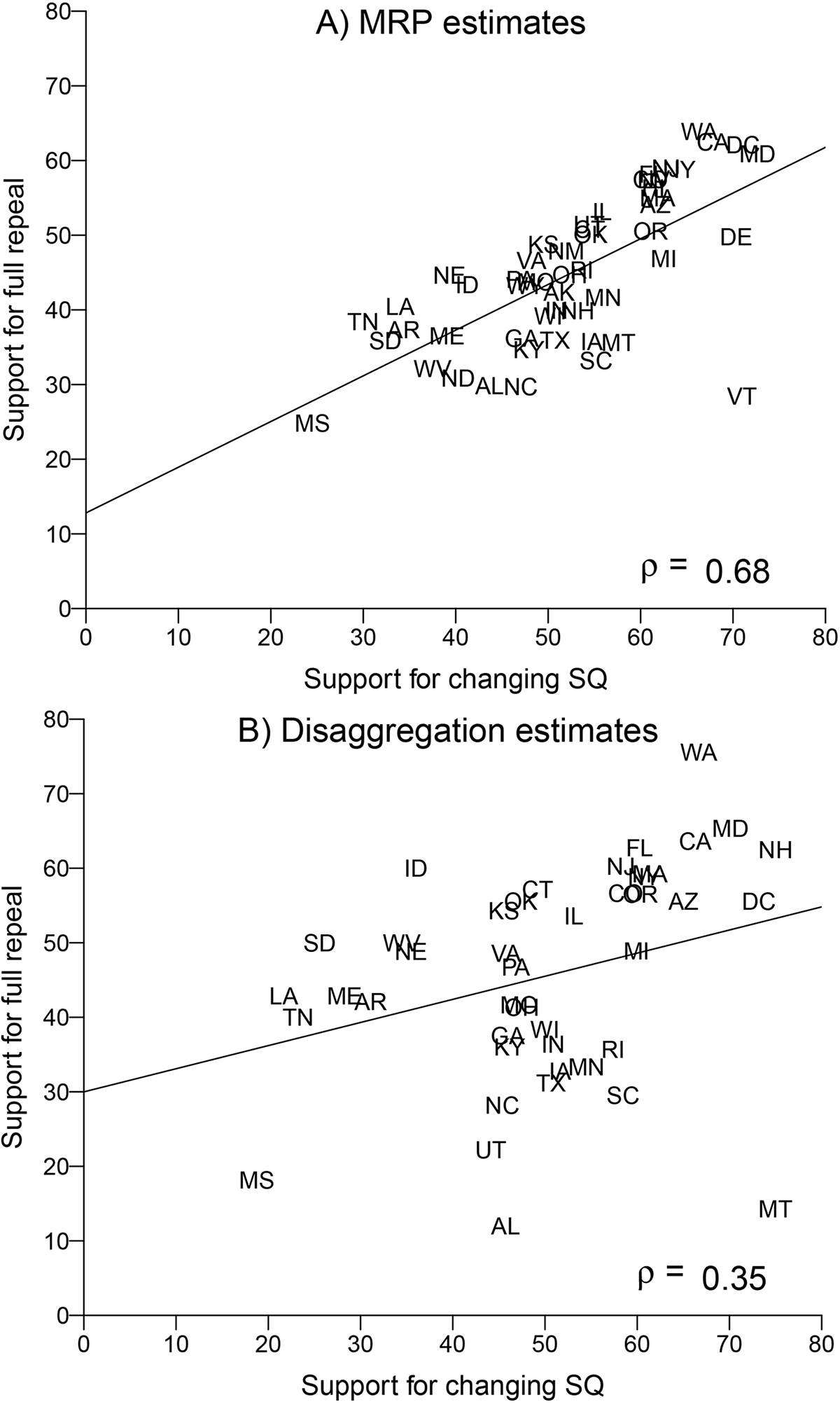
Figure A2B depicts a similar scatter plot, but this time using the disaggregation measures of state-level opinion. The correlation is a much weaker .35, because of (in part) significant measurement error in the estimates for the states with fewer respondents. This suggests a significant improvement from using the MRP estimates over disaggregation.
C. Judicial Decisions
To find all constitutional challenges to state abortion statutes, I first used Westlaw. I used the following search term: DA(aft 01-01-1965 & bef 01-22-1973) & “4 abortion” and constitution! unconstitution!. I then read each case to determine whether it was a direct challenge to the statute. “Standard” cases involving abortion—such as appeals from convictions under the statute that did not raise a challenge—were discarded. For each challenge, I then coded whether the court invalidated any or all of the state statute.
I cross-checked my Westlaw results with the lists of cases in Roemer (Reference Roemer1971), Vergata et al. (Reference Vergata1972), and Epstein and Kobylka (Reference Epstein1992, 164). If a case was listed in one of those sources and did not appear in Westlaw, I relied on the source’s description of the decision to code the outcome.
Finally, note that in some states there were multiple cases involving challenges to abortion statutes. For comparative purposes, I treat states as the unit of analysis and thus pool all court decisions within a single state if there are multiple cases. If an earlier case upheld the statute and a later case struck it down, the latter case is used to code the state’s judicial outcomes (this occurred, e.g., in Vermont). In other instances, a higher court in the state struck down a lower court decision. The highest court decision in the state is used to code the state’s judicial outcomes. (For example, a lower state court decision striking down the state’s statute was later reversed by the state supreme court.)
Table A2 lists each case used in the analysis, along with a summary of the court’s decision.
Summary of Cases
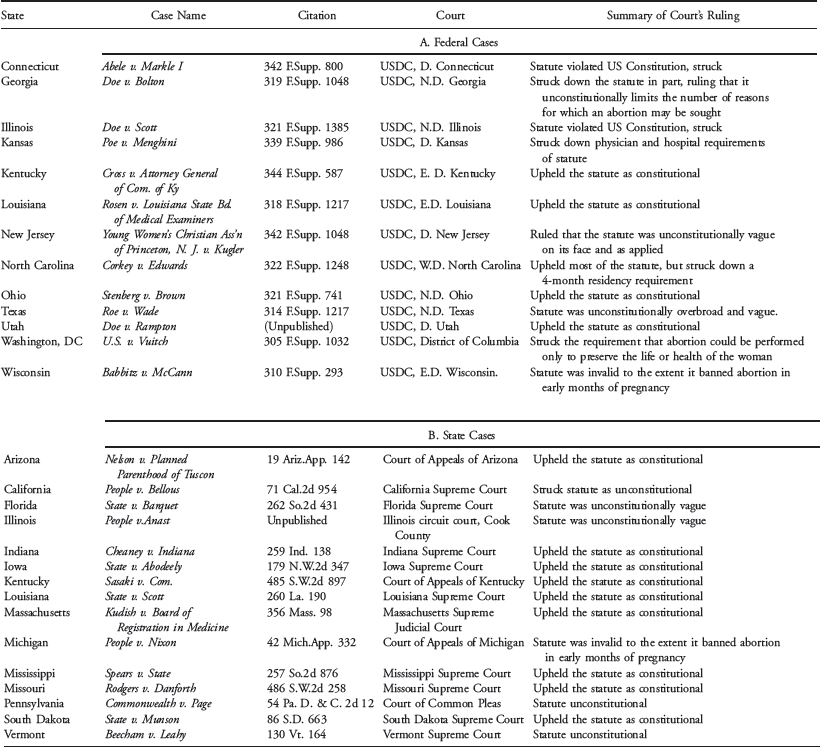
Note.—USDC = United States District Court.
Appendix B
As discussed in Section IV.B in the text, an advantage of using MRP-based estimates of state-level opinion is that such estimates exist even for states without polling data. However, it is useful to check whether the substantive results are the same if I use the disaggregated estimates of state-level opinion, that is, simply taking the mean of opinion by state, for support both for changing the status quo and for full repeal. In this appendix I show that indeed the results are robust.
First, figure B1 replicates figure 3 in the text, using the disaggregation estimates. To generate the uncertainty in the estimates, I simply use the sample mean and standard deviation and simulate distributions of estimates for each state.Footnote 26 The left panel reveals that the distributions of opinion across states using the disaggregation measures are roughly similar to the MRP estimates. However, for many states, the uncertainty is much larger in the disaggregation estimates compared to the MRP estimates—especially in the estimates of support for full repeal, which are based on smaller sample sizes.
Estimated state-level opinion using disaggregation on (left) changing the legal status quo to make abortions more accessible and (right) legalizing abortions in the first 3 months. Horizontal lines depict 95% confidence intervals. Note that the states are ordered separately in each plot.
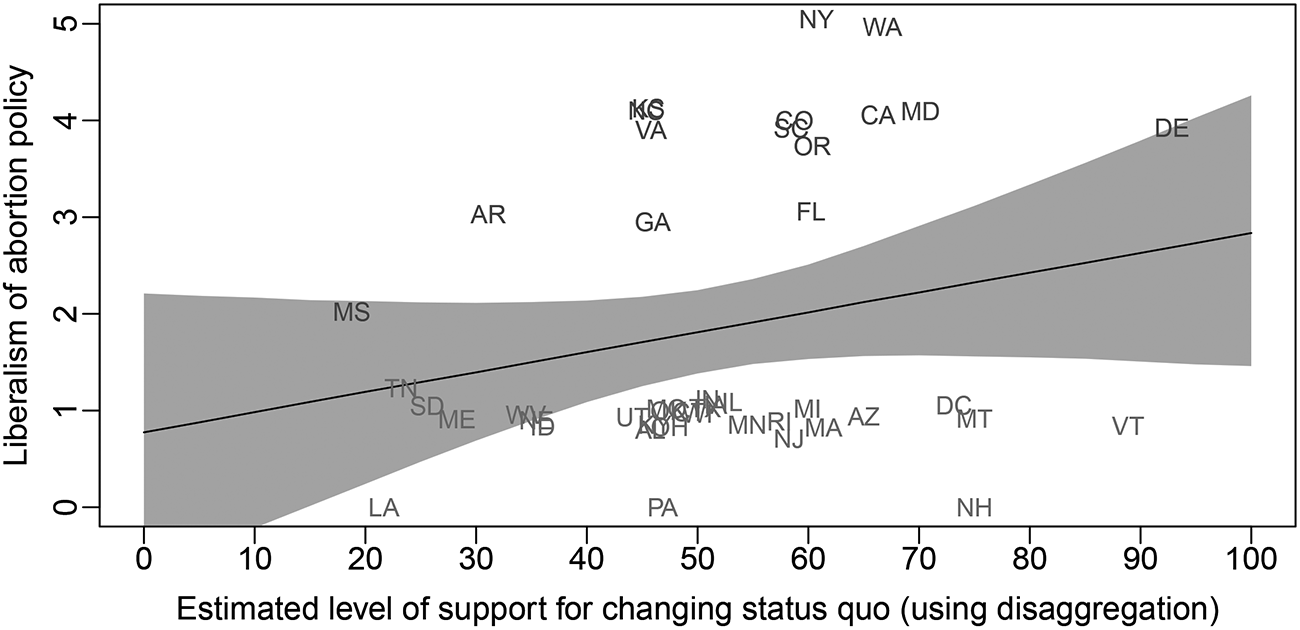
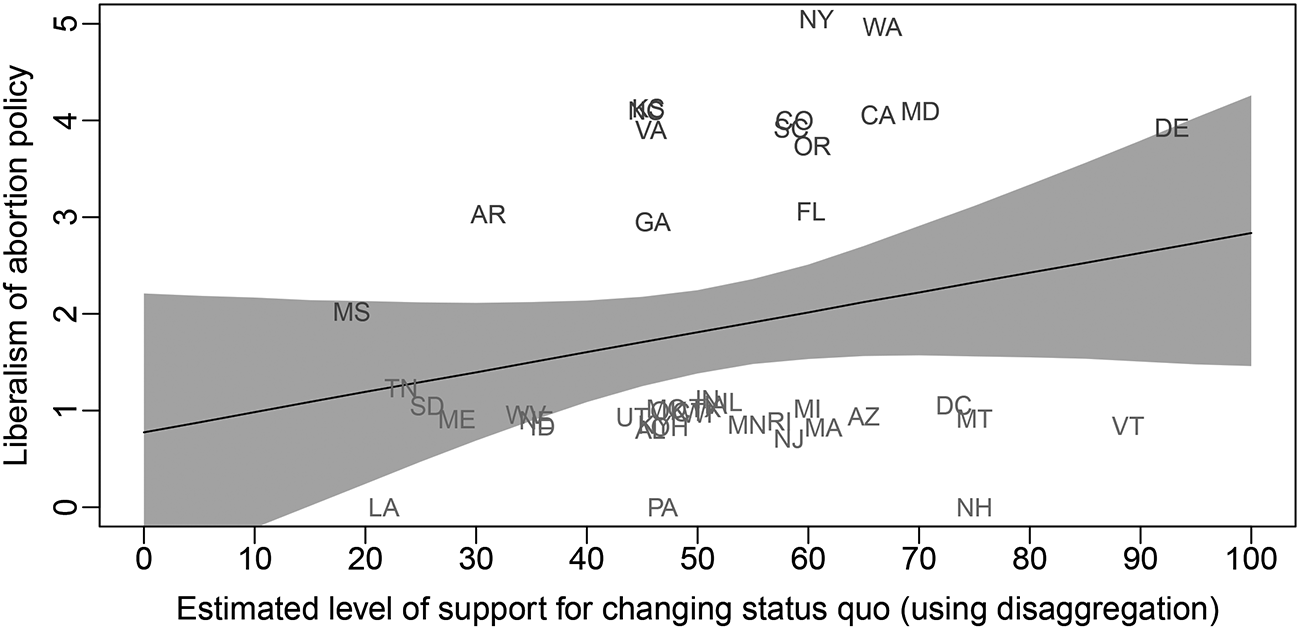
Next, figure B2 replicates figure 4 in the text and shows a positive relationship between public opinion and policy; states with greater public support for liberalization were more likely to have more liberal laws, as of the decision in Roe v. Wade. But, using the disaggregation estimates of opinion, we see in the bottom-right quadrant that many states with majorities supported moving away from a strong ban on abortion where policy remained unchanged.
State legislative policy versus public opinion on changing status quo, in the pre-Roe period, based on the disaggregation measure of public opinion.
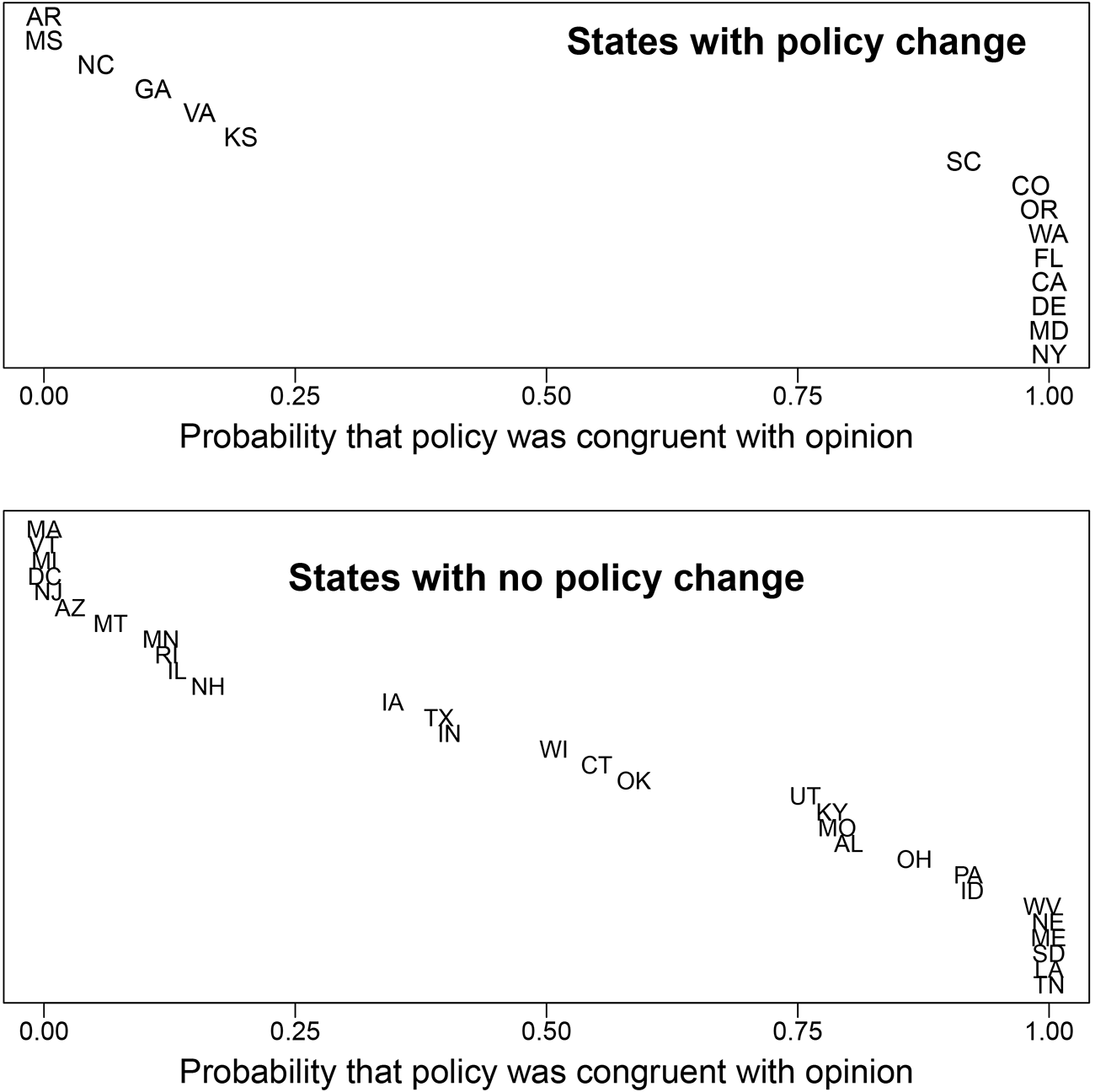
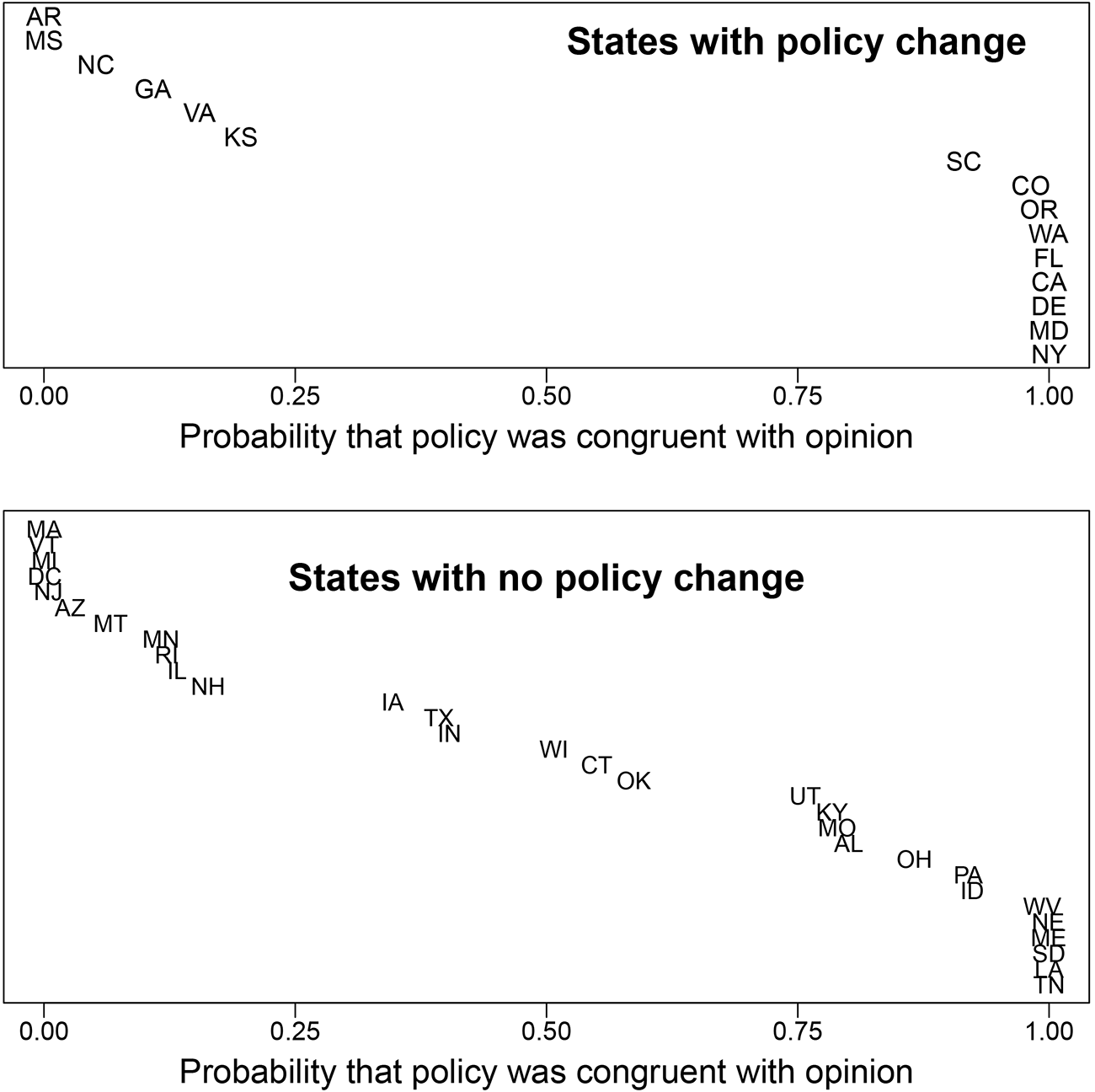
Next, figure B3 replicates figure 5 in the text and depicts the probability that policy was congruent with state opinion, using the disaggregation estimates of opinion. This plot again shows high probabilities of incongruence in many states in which there was no policy change. Table B1 (panel A) confirms that when the public favored change, more often than not the status quo remained in place.
Congruence between state opinion and state policy, based on disaggregation estimates. The plot shows the probability that policy is congruent with opinion, for states with (top) and without (bottom) policy change. Panel A of table B1 presents a cross-tab of when opinion matches policy.
Cross-Tabs of When Opinion Matches Policy for Legislatures and Courts
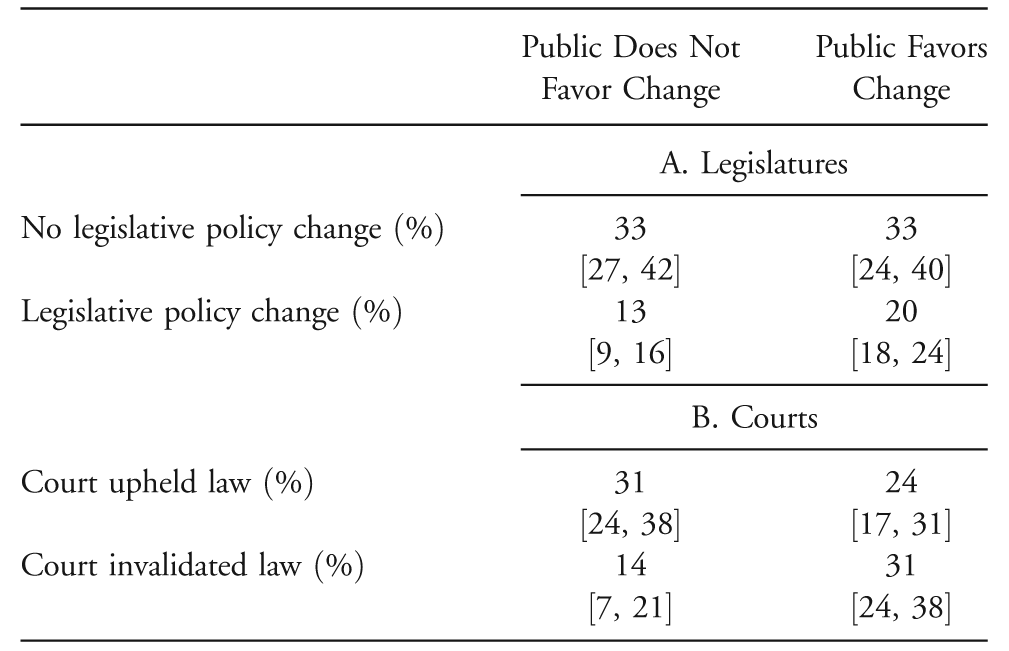
Note.—The table presents two cross-tabs of when opinion matches policy, for decisions made by legislatures (panel A) and courts (panel B). The cross-tab for courts is based on states in which the legislature did not change abortion policy. Both cross-tabs use the disaggregation measure of public opinion. The percentages are cell percentages for the number of states in which each condition is met. The brackets contain 95% confidence intervals, which are based on the simulated estimates of opinion.
Figure B4 replicates figure 6 in the text and shows a positive relationship between disaggregation estimates of state-level public opinion and the probability of judicial invalidation. As public support for policy change increases, so does the likelihood of a court striking down the state statute.
State-level public opinion and the probability of a judicial invalidation of a state abortion statute, based on disaggregation estimates. Panel A includes all states. Panel B includes only states that did not change their laws at all. Panel C includes only states in which cases were brought. In all three, the probability of a judicial invalidation is increasing in state-level support for changing policy away from the status quo.
Finally, figure B5 and panel B in table B1 show patterns and results similar to those in figure 7 and panel B in table 1, respectively, in the text: courts were more congruent with public opinion than legislatures were in the pre-Roe period.
Congruence between state opinion and judicial review, in states in which court challenges to existing statutes were heard, based on disaggregation estimates. The plot shows the probability that policy is congruent with opinion, for states with (top) and without (bottom) policy change. Panel B of table B1 presents a cross-tab of when opinion matches policy, based on states in which the legislature did not change abortion policy.