Many philosophers and others who disbelieve in god describe themselves as ‘naturalists’. They do so because they believe theism is incompatible with science. But most of these philosophers also hold that science is compatible with many other beliefs that theists also embrace, beliefs about morality, free will, the mind, and the meaning of life. The minority of naturalists who reject these other beliefs need a different label for their view. For some time I have advocated that we take the word ‘scientism’ away from those who employ it as a term of abuse.
Scientism is defined by those who reject it as a brace of theses:
1. The unwarranted confidence in the methods of science as the only way to secure knowledge.
2. The unwarranted acceptance of the implications of contemporary natural science for questions that have hitherto be addressed by other methods.
Those who, like me, accept scientism adopt this definition with two elisions that are easy to spot:
1. Confidence in the methods of science as the only way to secure knowledge.
2. Acceptance of the implications of contemporary natural science for questions that have hitherto been addressed by other methods.
So defined, scientism has obvious and important implications for many questions philosophers address. Here is a brief list, with its answers.
Is there a God? No.
What is the nature of reality? What physics says it is.
What is the purpose of the universe? There is none.
What is the meaning of life? Ditto.
Is there a soul? Is it immortal? Are you kidding?
Is there free will? Not a chance!
What is the difference between right and wrong, good and bad? There is no moral difference between them.
Why should I be moral? Because it makes you feel better than being immoral.
Does history have any meaning or purpose? It's full of sound and fury, but signifies nothing.
Does the human past have any lessons for our future? Fewer and fewer, if it ever had any to begin with.
The answers scientism requires be given to these questions are deeply disturbing and widely rejected by many naturalistic philosophers whose views are also driven by science. The aim of this article is to sketch out why the answers given are the ones science dictates and, more important, what it is about humans, including the most sophisticated exponents of a scientific world view, that makes these answers hard for us to accept.
Why scientism? The grounds for scientism are of course the success of natural science, especially physical science, in particular its success in explanation, as certified by the only way explanatory success can be assured: predictive success. Predictive success is not the aim of science, its aim is explanation. But the only test of whether a science has got its explanations right is some track record of improvement in predictive success. Properly understood this is a pretty weak predictive test for explanatory success. But only science can meet it. All it requires is that when a new and improved explanation for any phenomenon is offered there is some new, novel, direct or indirect predictive (or retrodictive) test implied by the explanation that is confirmed.
Scientism: Some Details
Scientism's metaphysics is simple and unqualified: The physical facts fix all the facts. The universe is fermions and bosons, and everything that can be made up of them, and nothing that can't be made up of them. All the facts about fermions and bosons determine or ‘fix’ all the other facts about reality and what exists in this universe or any other if, as physics may end up showing, there are other ones. Another way of expressing this fact fixing by physics is to say that all the other facts – the chemical, biological, psychological, social, economic, political, cultural facts – supervene on the physical facts and are ultimately explained by them.
If physics can't in principle fix a putative fact, it is no fact after all. In effect, scientism's metaphysics is, at more than a first approximation, given by what physics tell us about the universe.
The universe is completely devoid of purpose, everywhere and at every level of organization, including us. If the physical facts fix all the facts, this rules out purposes altogether, in biology, in human affairs, and in human thought-processes too. Physics of course fakes design, though only with great difficulty and very rarely.
Until Darwin (Reference Darwin1859) came along things looked pretty good for Kant's (Reference Kant2007, p. xvii) pithy observation that there never would be a Newton for the blade of grass – that physics could not explain living things, human or otherwise, because it couldn't invoke purpose.
But the process that Darwin discovered – random, or rather blind variation, and natural selection, or rather passive environmental filtration – does all the work of delivering the means/ends economy of biological nature that shouts out ‘purpose’ or ‘design’ at us.
Reality is the foresightless play of fermions and bosons producing the illusion of purpose.
In a universe governed by our laws of physics good design is rare, expensive and accidental. If the physical facts fix all the facts, natural selection is the only way adaptations can emerge anywhere in the universe. Physics imposes three conditions on any mechanism that produces adaptations. And the only way to satisfy them is via the process Darwin discovered – natural selection.
(1) The process producing adaptations must begin with zero adaptation.
(2) That first merest sliver must appear by random chance alone and very infrequently. Further adaptations will have to be built from prior adaptations in the same way they were.
(3) The process that produces adaptations has to harness the second law of thermodynamics. It is the sole source of temporally asymmetrical processes in the universe and the process of building adaptations is an asymmetrical energetically expensive, indeed wasteful, process.
Thoroughgoing scientism leaves no room for normative values, for ethical truths, or for that matter moral responsibility. But it is also rather reassuring about most humans’ proclivity to act cooperatively, altruistically, nicely. To see why scientism has to be nihilistic about values requires two premises it is hard to reject:
1. All cultures, and almost everyone in them, endorse a single core morality binding on everyone, and therefore moral disagreements are disguised factual disagreements.
2. The core morality we share has significant consequences for humans' biological fitness – for our (ancestor's) survival and reproduction.
Most normal humans came to share a core morality through selection on alternative moral codes or systems, a process that resulted in just one winning the evolutionary struggle and becoming ‘fixed’ in the population.
Now, notice, if our universally shared moral core were both the one selected for and also the right moral core, then the correlation of being right and being selected for couldn't be a coincidence. But science doesn't tolerate cosmic coincidences. Either our core morality is an adaptation because it is the right core morality or it's the right core morality because it's an adaptation, or it's not right, but only feels right to us. The first two of these alternatives are ruled out by science: natural selection doesn't track the truth; it tracks what works. The truth, warrant, rightness, if any, of the moral core can't have a causal role in its evolutionary emergence. And of course natural selection can't make core morality right just because it selects for it. That's patently false Social Darwinism (better, Social Spencerism). The only alternative science can contemplate is that our moral core is neither right nor wrong, justified or unjustified, true or false, it's simply an adaptation, one that works in part by making itself believed by us to be right, correct, true, justified.
How the moral core emerged and how strong its grip on us came to be becomes clear as we uncover the strongest obstacle to scientism: our genetically hard-wired theory of mind.
Humanity's Great Bulwark Against Scientism
Hardly anyone accepts scientism. Why not? Distaste? Implausibility? Too hard to understand?
All of the above, but all three of these factors are rooted in the same cause. The rejection of scientism is bred in the bone, as close to hard wired as it can be. It's caused by our unswerving devotion to the theory of mind, a theory we carry with us and use everywhere and always.
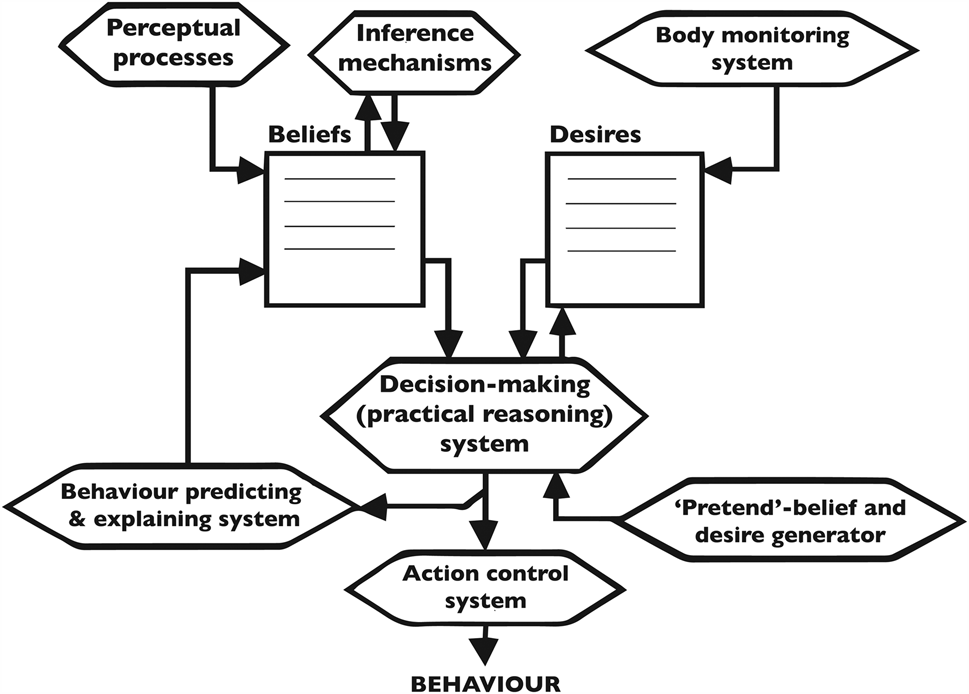
The theory of mind (hereafter TOM) has other names – folk psychology, common-sense psychology, the belief/desire model of human action. It has been formalized as the starting point of empirical cognitive social psychology. As such it is often expounded in the flow chart, or ‘boxology’, in Figure 1.
From Nichols (Reference Nichols, Carruthers and Smith1995), with permission.

TOM's essential claims about the mind/brain include two: there are beliefs that represent the way the world is – they have content, ‘aboutness’, intentionality; there are desires that represent the way the world would, could or might be – they are intentional too. Beliefs and Desires ‘pair up’ roughly as means/ends packages to drive decision, choice, action. Which one of the indefinitely many beliefs gets paired up with one of an equally huge number of desires, to drive a choice or decision and bring about an action, is determined by their (intentional) content. It is their contents that bring about the actions and also make them intelligible to us.
The TOM looks innocent enough. Why does the TOM block acceptance of scientism? To begin with it does so, because it blocks the understanding and acceptance of science. The TOM makes us story-tellers and story-consumers. It's what makes us love narratives with plots – human motivations fulfilled or thwarted – what facilitates our remembering them; we even use them as devices to remember non-narrative information (cf. techniques for memorizing random lists). The TOM turned humans into hyperactive motivation detectors. Because we can't escape relying on the TOM, we anthropomorphize everything. But, of course, science doesn't come packaged in stories about good guys, bad guys and their motives, narratives with plots. Science is delivered in laws, equations, models, data-assemblies, things we can't keep in our heads because we can't assemble them into stories. Our devotion to the TOM obstructs our uptake of science.
But we cannot dispose of, dispense with, turn off our use of the TOM because it is hard wired in our genetic inheritance. This is because the TOM was an indispensable part of quick and dirty Darwinian solutions to immediate evolutionary design problems of the Hominid line. In fact it was the imperfect but indispensable solution to a design problem from hell that faced us on the African savannah.
By the time we found ourselves forced out of the rain forest and at the bottom of the food chain in the veldt, we were already producing too many offspring. We were having them too close together, unlike other primates, and these offspring required a decade-long childhood owing to the need for post-natal brain development. This was the design problem from hell: too many kids too close together and dependent for much too long.
Unless Mother Nature found a way to turn large populations of young children, with long periods of dependence, into an adaptation, these three traits were bound to carry us to extinction. What we needed was a way to foster coordination and cooperation in hunting megafauna, a way to effect economies of scale in child rearing and to use the long childhood to enhance technology transfer. The TOM did all three of these things; it solved the design problem from hell. This is because the TOM enables one to predict reliably enough the behaviour of small numbers of people (and animals) in your immediate vicinity over the very near future.
Its accuracy and precision fall off rapidly for larger numbers beyond direct observation and longer time horizons. But it works well enough in coordinating hunters’ tactics, teaching young children to imitate complex tasks, and getting women to trust others with their offspring while they go out gathering. The TOM is an adaptation of our lineage that no other species shares. What's more, it had to be in place already for language to evolve. How did it get hard wired? There was time enough in the Holocene and mechanisms available (the Baldwin effect) to hardwire this quick and dirty solution to the design problem from hell.
Is there evidence for this ‘Just so story’? A great deal. Infants detect and track teleological behaviour at six months, toddlers have shared intentionality at eighteen months – they cooperate in games that grown chimps can't play. They understand false belief before they've mastered language. The way they laugh at the right time at Punch and Judy shows toddlers already have a concept of false belief. To have that they first need a concept of belief. It's a concept they also need to learn language, following a speaker's eyes and actions. More tellingly, children with autism, a genetic disorder, have defective TOMs. This deficit is the main diagnostic symptom. Finally, fMRI has localized the regions that deliver TOM reasoning, and identified some lesions in the regions associated with autism. Some high-functioning autistic persons are better than average at mathematical, causal reasoning, the sort that science demands. There is an attractive neurological explanation of this fact, one relevant to our resistance to science. The TOM is part of the brain's Default Mode Network (DMN). Causal/mathematical reasoning is subserved by Task Positive Network (TPN). These two networks are antagonistic and competitive. When one is turned up the other is turned down. Some autism sufferers show DMN deficits – they can't handle narratives and stories – but they do better than most people on tasks requiring TPN – science. Normal people have the opposite strengths and weaknesses.
Our reliance on the TOM makes understanding science difficult just because science doesn't come in stories with plots and motives and it is stories that that we are hard wired to crave, to be satisfied with, to remember. Insofar as science banishes purpose, teleology, design and thus their well-understood causes – desire and belief – from nature, it makes itself hard to accept. More important, the TOM is among the presuppositions of most of our philosophically deep questions and one of most indispensable building blocks of most of the alternative answers to these questions. Pull the TOM out from under the questions and the answers and they can't even really be stated or answered in terms we can or will accept. But, as we will see, pulling the rug out from under the Tom is what science does. And that is what makes scientism so hard for people even to understand or contemplate.
The next two sections explain first how neuroscience reveals that the TOM is a completely mistaken theory of human action, as wrong as or more wrong in its way than Ptolemaic astronomy, and then exactly how it makes scientism difficult even to contemplate, let alone endorse.
The Trouble with TOM
Despite its venerability and longevity, the TOM has not improved in its predictive power or explanatory detail since its first articulation in recorded history (and probably not before then either). It's the very same explanatory theory employed from Herodotus and Thucydides to contemporary history and biography. Indeed, the TOM is the same theory humanity has employed to understand and enjoy narratives since Gilgamesh and the Iliad. But the theory has not been improved in its predictive precision in all that time. It still only works with any reliability to predict the behaviour of a small number of individuals in our immediate vicinity over the very near future, the circumstances it was selected for.
It was recent Nobel Prize-winning discoveries in neuroscience that revealed the TOM is worse than Ptolemaic astronomy, roughly on a par with phlogiston theory in its predictive powers. This is ironical insofar as the TOM served to guide the research programmes of cognitive science and cognitive neuroscience over the last half century or so. Every research programme is driven by an initial theory that identifies the programme's research questions. Cognitive science and cognitive neuroscience's initial theory has been the TOM. Its initial marching orders to neuroscience were obvious. First, locate regions that implement belief box and desire boxes. These may turn out not to be discrete regions or modules, of course. Second, explain how these regions have the representational content, ‘aboutness’, intentionality, that pairs them together to drive choice and decision. The research programme thus driven begins with animal models, both because human brains are too complex and because we can't do the needed experiments on them.
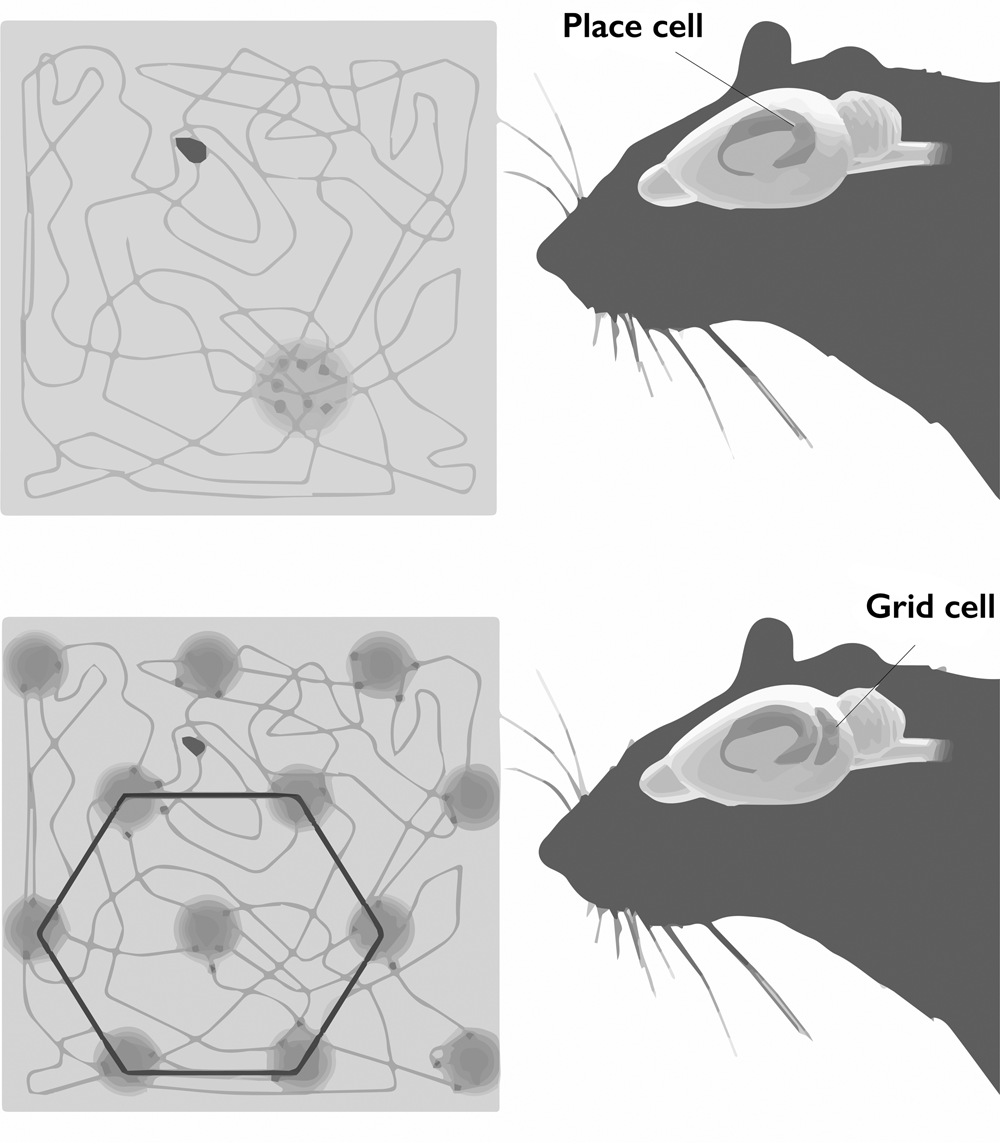
Over time rats became the model system of choice for this work, owing to the extensive homology with human brains at many different levels of organization. If we seek to understand how belief is implemented in us, we must start by understanding how it is implemented in the rat. Because rats don't speak (our) language, it's a non-trivial problem to figure out what they are thinking and then look for its neural implementation. But it has been done, and the work has secured Nobel Prizes. Consider our beliefs about locations, for example, my belief that Paris is the capital of France. We can get a first approximation to how my brain stores this information by figuring out how a rat stores information about the location of a raft in the Miller water maze (see Figure 2). Human medicine and experiments with rats have revealed that this information is initially formed in the midbrain, the medial entorhinal cortex and the hippocampus, then ‘consolidated’ to the neo-cortex. John O'Keefe and May-Brit and Edvard Moser discovered exactly how this is done and won the 2014 Nobel Prizes in medicine for doing so.Footnote 1 The take-home message for cognitive and cognitive neuroscience, and so for scientism, is that the brain doesn't work anything like the way the TOM says it does. And that's what makes the TOM such a poor theory.
Used with permission of the Nobel Foundation.

Here's a brief sketch of what these neuroscientists discovered. In the hippocampus there are ‘Place’ cells that fire together to give the rat's location in the box. In the medial entorhinal cortex there are other cells – ‘Grid cells’ – that give the geography of the box – its shape and size. These grid cells feed into ‘project’ to the Place cells where location is ‘computed’.
O'Keefe and the Mosers located the distinct neural circuits that fire when the rat is at locations indicated by the coloured dots in the squares. The experimenter can predict location and behaviour from data about neural circuit firing.
Besides grid cells in the entorhinal cortex, there are also head-direction cells, boundary wall cells, and many other neural circuits that feed information about the environment of the rat into the hippocampus. All these regions and cell types of the rat's brain are shared by the human brain.
Subsequent work by the Mosers and others has ‘decoded’ the electrochemical firings that link these cells. What it has shown is that there is no ‘code’ to decode. It's just different cells firing in exactly the same way, the same pattern, sometimes compressed a hundredfold, but always sets of electrochemical pulses – theta waves – of exactly the same shape and structure. It turns out there is no language of thought, no symbolic representation, no content, to what is going on in the acquisition, storage and implementation of information about the rat's environment. There isn't even a map that the rat's brain consults to determine location, direction to reward, or appropriate behaviour. Experimenters can construct a map from the neural circuitry firings of the electrodes in the rat's brain record. Using it they can predict the rat's behaviour very accurately, much more accurately than by using the TOM, what Daniel Dennett (Reference Dennett1969) long ago identified as ‘the intentional stance’. But neither the rat nor its brain constructs a map. That's not how it works.
The pattern of oscillations in a particular neural circuit in the hippocampus gets preserved while compressed a hundredfold into sharp wave ripples that move to the neocortex where they organize the same patterns for long-term information storage. The same pattern in reverse will recreate the neural firing pattern in the place cells at a later time. When the rat is at a choice point, say two arms of a T-maze, sharp wave ripples from the neo-cortex will activate similar circuitry elsewhere in the neocortex to drive behaviour in one way or the other. By watching which neural circuits fire the experimenter can reliably predict choice behaviour. But it's all a matter of repeated pattern and its timing. No representations, no content, no intentionality, no cognitive maps! The neuroscientist can draw a real map from the neuronal circuitry. The neuroscientist can predict actual behaviour with high precision just by detecting which cells fire. The rat doesn't use a map.
Why assume that we are anything like rats when it comes to cognition? It's not an assumption. It's an inference from the vast body of data: human medical syndromes, comparative anatomy – gross, cellular, macromolecular homology of the hippocampus, its CA1, CA3 place cells, the entorhinal cortex and its grid cells; genetics – the same patterns of somatic gene regulation in us and in the rat; electrochemistry – the neural firing is identical right down to the sharp wave ripples. Finally, there is the pharmacology – the rat is a well-established successful surrogate for drug development, mechanism and efficacy testing. You can deny that our brains are like rat brains, but you'd be flouting the evidence.
There are good reasons to think all information is registered, stored, deployed in rat and human brains the same way, without representational content, ‘aboutness’ or intentionality. But the TOM's non-negotiable commitments are to representational content in beliefs and desires. Ergo, the TOM is as wrong about the brain as Ptolemaic astronomy was wrong about the solar system.
But aren't we conscious in our first-person introspection of the meaning and content of our own thoughts, our beliefs and desires that give the purposes of our actions? This is a hard presumption to shake. But notice first that consciousness can't be necessary for content, aboutness, intentionality. Otherwise all the informational content we think our brains carry non-consciously, when we aren't thinking about that content, couldn't exist. And if consciousness is just the play of (iterated and often recursive) shapes and sounds across our experience, it's sheer bluff to insist that this process constitutes content without some further argument. And none has ever been given. The topic is, however, vast and until we have a good theory of consciousness, we have no idea whether it can provide any support for the TOM, still less evidence that will undermine experimental science.
Science Undermines TOM, but TOM Obstructs Scientism
It hardly needs saying that TOM underlies much that scientism rejects because science makes scientism reject the TOM. Without the TOM, there is no space of reasons in our heads, no place were meanings can lodge and have a role in thought or action. That means there's no will, and so no free will, no agency or responsibility, no enduring self that can entertain or respond to reasons, not to mention the interpretations that we overlay on events to give them meaning. Neuroscience banished purpose from our heads as completely as Darwin banished it from the rest of the biological domain. Without reasons in our heads, or anywhere else, there are no resources to scientifically construct what Sellars called ‘the manifest image’ required by our culture, civilization, its legal, political, moral, creative, artistic subsystems. The costs of surrendering the TOM are huge, so huge we can't do it for the practical purposes of everyday life, indeed for civilization as a whole. This destines us to the use of a highly imperfect (predictively unreliable, explanatorily baseless) instrument in the construction and operation of the institutions of our culture and it explains many of their failures, defects and deficiencies.
But all this is too much for science to overthrow. And if creatures like us have a hard time understanding science in the first place, because the TOM bred in our bones obstructs science, then we'll have an even tougher time even understanding, let alone accepting, scientism.
It's the TOM that creates the only real problem for scientism as a philosophy. This is the problem of how we can provide a consistent account of the meaning and truth of scientism in light of science's support of the denial that there are states of the brain with representational content, i.e. beliefs and desires. The TOM grounds a ‘pragmatic contradiction’ in our attempt to convince others of scientism: we scientistic philosophers believe there are no beliefs and we're trying to get you to believe it too. In fact, we also want you to believe that there are no wants either.