


Introduction
Implicit followership theories (IFTs), which refer to individuals’ expectations regarding followers’ traits and behaviors (Sy, Reference Sy2010), have received increasing research attention in recent years (Coyle & Foti, Reference Coyle and Foti2022a; Goswami, Park, & Beehr, Reference Goswami, Park and Beehr2020; Lord, Epitropaki, Foti, & Hansbrough, Reference Lord, Epitropaki, Foti and Hansbrough2020). IFTs include both positive and negative dimensions (Epitropaki, Sy, Martin, Tram-Quon, & Topakas, Reference Epitropaki, Sy, Martin, Tram-Quon and Topakas2013). Positive IFTs refer to expectations regarding followers’ positive characteristics, including industriousness, enthusiasm, and being a good organizational citizen. Negative IFTs pertain to expectations regarding followers’ negative characteristics (Epitropaki et al., Reference Epitropaki, Sy, Martin, Tram-Quon and Topakas2013; Junker & van Dick, Reference Junker and van Dick2014). Previous research has devoted substantial attention to leaders’ positive IFTs, claiming that leaders’ setting of high expectations for their followers (i.e., positive IFTs) is an effective way to enhance follower performance (also known as the Pygmalion effect; Goswami, Park, & Beehr, Reference Goswami, Park and Beehr2020; Goswami, Carsten, & Coyle, Reference Goswami, Carsten and Coyle2022; Whiteley, Sy, & Johnson, Reference Whiteley, Sy and Johnson2012). However, our knowledge of the performance implications of positive IFTs remains incomplete because followers’ positive IFTs have not been considered in light of the connection between IFTs and performance.
Although leaders contribute 10–20% of an organization’s success, followers play a critical role in achieving the remaining 80–90% of success (Kelley, Reference Kelley1992). Namely, followers’ job performance reflects their actual behaviors, which are guided by their prototypical IFTs (Knoll, Schyns, & Petersen, Reference Knoll, Schyns and Petersen2017). Therefore, this study challenges the claims of previous research (Goswami, Carsten, & Coyle, Reference Goswami, Carsten and Coyle2022; Whiteley, Sy, & Johnson, Reference Whiteley, Sy and Johnson2012) by arguing that leaders’ high positive IFTs do not necessarily lead to followers’igh job performanc high job performance. If followers have lower positive IFTs, they might behave in accordance with their own IFTs rather than leaders’ high positive IFTs, because followers have a natural inclination to behave in line with their self-perceptions, and failing to do so can cause stres (Uhl-Bien et al., Reference Uhl-Bien, Riggio, Lowe and Carsten2014). Furthermore, followers play an active role in the leader–follower dynamic and can cocreate interactions. Some followers may even reject unethical requests from leaders due to their positive IFTs (Knoll, Schyns, & Petersen, Reference Knoll, Schyns and Petersen2017) or engage in constructive resistance to unethical requests when they view themselves as coproducers of the leadership process (Carsten & Uhl-Bien, Reference Carsten and Uhl-Bien2013), leaders’ higher positive IFTs may be insufficient to improve followers’ job performance and could even cause dyadic conflict (Coyle & Foti, Reference Coyle and Foti2015). Therefore, it is important to consider leader–follower congruence (vs. incongruence) in positive IFTs (rather than merely leaders’ positive IFTs), which could offer a more nuanced picture of the performance implications of IFTs. By introducing a leader–follower congruence perspective, this study aims to offer novel insights for contemporary organizations that use IFT-based expectation plans to manage their employees’ performance (Whiteley, Sy, & Johnson Reference Whiteley, Sy and Johnson2012).
Drawing on the social identity approach, which views the need to reduce self-concept uncertainty as an essential motive for identity construction (Haslam, Reference Haslam2001; Reid & Hogg, Reference Reid and Hogg2005), this study proposes that relational identification, which refers to how individuals define themselves in terms of their relationship with the leader (Sluss & Ashforth, Reference Sluss and Ashforth2007), mediates the transition from positive IFT congruence (vs. incongruence) to high job performance. This relationship is particularly relevant when followers have higher levels of uncertainty avoidance, that is, a fundamental value that motivates individuals to avoid ambiguous work stimulants (Chen & Kao, Reference Chen and Kao2009). To determine how and when leader–follower congruence (vs. incongruence) in positive IFTs impacts followers’ relational identification and subsequent performance, we conducted two studies (a vignette-based experiment and field survey) in China. Specifically, the experiment was conducted to examine whether congruent (vs. incongruent) positive IFTs causally impact followers’ outcomes and whether these effects vary between groups of participants assigned to high versus low uncertainty avoidance conditions. To address the limitations of the experimental study, we also conducted a field survey and used polynomial regression and response surface analysis to test our hypotheses.
This study makes two contributions. First, we advance IFTs research by investigating why and when leaders’ positive IFTs facilitate followers’ job performance. Our proposition that relational identification serves as an explanatory mechanism for this relationship allows us to identify a key path by which positive IFTs boost performance. Furthermore, previous research on IFTs congruence has proposed heterogeneous arguments: some studies have viewed IFTs congruence as beneficial for work outcomes (e.g., Peng & Wang, Reference Peng and Wang2016), while others have not (e.g., Coyle & Foti, Reference Coyle and Foti2015). By proposing the moderating role of uncertainty avoidance, this study helps reconcile these previous paradoxical findings, suggesting that the congruence effect seems to be strongly contingent. Second, our use of the social identity approach offers a novel perspective beyond previous studies that have drawn on the social exchange approach (i.e., leader–member exchange) to illustrate the implications of leader–follower congruence in IFTs (Coyle & Foti, Reference Coyle and Foti2015). The process of social exchange between two parties is guided by rational choices (a form of conscious processing) (Blau, Reference Blau1964), which may not fully explain the effect of IFTs congruence since cognitive prototypes can operate without conscious processing (i.e., without thorough rational calculation) (Epitropaki et al., Reference Epitropaki, Sy, Martin, Tram-Quon and Topakas2013). To address this issue, this study focuses on the suggestion of Epitropaki, Kark, Mainemelis, & Lord (Reference Epitropaki, Kark, Mainemelis and Lord2017) that positive IFTs play a fundamental role in followers’ identity processes and thus adopts a social identity approach.
Theory and hypotheses
Implicit followership theories
Consistent with the positive organizational behavior scholarship (Cameron & Dutton, Reference Cameron and Dutton2003), we focused on positive IFTs because they allow us to examine how leaders’ beliefs regarding positive followership drive their positive attitudes toward followers, e.g., liking and trust (Sy, Reference Sy2010). Ultimately, these leaders’ positive attitudes improve followers’ job performance (Whiteley, Sy, & Johnson, Reference Whiteley, Sy and Johnson2012). Although IFTs originally focused on the leader’s perspective, recent studies have shown that followers can also be characterized by their IFTs (Junker, Stegmann, Braun, & Van Dick, Reference Junker, Stegmann, Braun and Van Dick2016; Mohammadzadeh, Mortazavi, Lagzian, & Rahimnia, Reference Mohammadzadeh, Mortazavi, Lagzian and Rahimnia2015). Followers’ IFTs are their lay beliefs regarding their roles, including the types and scope of the tasks, goals, and problems they perceive to be their responsibilities and their approaches to these tasks, goals, and problems (Knoll, Schyns, & Petersen, Reference Knoll, Schyns and Petersen2017). Therefore, followers’ positive IFTs represent their self-schemas, which guide them by indicating ‘who I am in this situation’ and ‘what I should do’ (Epitropaki et al., Reference Epitropaki, Kark, Mainemelis and Lord2017). These answers shape their identities in terms of their role as followers within organizations and provide a clear standard for followers’ actions (Epitropaki et al., Reference Epitropaki, Kark, Mainemelis and Lord2017).
Leader–follower congruence (vs. incongruence) in positive IFTs and relational identification
From an integrative perspective (DeRue & Ashford, Reference DeRue and Ashford2010), both leaders’ and followers’ IFTs impact followers’ identity construction, which can influence relational identification and subsequent outcomes. We draw on the social identity approach (Reid & Hogg, Reference Reid and Hogg2005) to clarify these relationships. Follower identity refers to the set of behavioral expectations associated with the follower position in the leader–follower relationship structure (Epitropaki et al., Reference Epitropaki, Kark, Mainemelis and Lord2017; Sluss & Ashforth, Reference Sluss and Ashforth2007). To construct their identities (i.e., who they are and what they should do), followers access their positive IFTs and generate their own interpretations and expectations of their follower roles (Epitropaki et al., Reference Epitropaki, Kark, Mainemelis and Lord2017). Thus, followers’ positive IFTs guide them to attain a positive identity. Additionally, followers need their leaders to grant them an expected identity through the guidance of leaders’ positive IFTs, which are related to the behaviors exhibited by leaders in social interactions, through which they express their own opinions of followers’ identities (DeRue & Ashford, Reference DeRue and Ashford2010). Overall, we claim that the social identity approach helps reveal how both leaders’ and followers’ positive IFTs, particularly the congruence between the two (which determines the alignment between claiming and granting), shape followers’ reactions and subsequent performance.
The social identity approach posits that a core motive underlying social identification is the desire to reduce uncertainty about one’s self-concept (i.e., Haslam, Reference Haslam2001; Reid & Hogg, Reference Reid and Hogg2005). Based on this motive, followers are more likely to identify with an entity that reduces their feelings of self-uncertainty (Peng, Chen, Nie, & Wang, Reference Peng, Chen, Nie and Wang2020). In a relational process in which a leader and a follower share congruent positive IFTs, the actions that a follower take to imbue himself or herself with a positive identity (claiming a positive identity) are more likely to be validated or approved by a leader (granting a positive identity) (DeRue & Ashford, Reference DeRue and Ashford2010). Discussion and communication are helpful for individuals to achieve social awareness of others’ implicit theories and awareness of how self- and other implicit theories may or may not match. In this case, the follower’s self-uncertainty is resolved, and his or her identity becomes clear and more legitimate. The follower thus internalizes the positive characteristics associated with this relational process (reflecting the nature of the leader–follower relationship) as a part of his or her self because (a) this relationship, which entails a satisfying claiming–granting process, is valuable to the follower’s sense of self and (b) such internalization enhances and routinizes the follower’s clear and legitimate identity, which offers more psychological benefits for his or her future work (Peng et al., Reference Peng, Chen, Nie and Wang2020). In contrast, when a leader and a follower have incongruent positive IFTs, they may have inconsistent views regarding the appropriate behaviors for a follower during social interactions (Coyle & Foti, Reference Coyle and Foti2015). In these conditions, the follower’s self-view is not approved by his or her leader, which results in the follower experiencing uncertainty regarding who to be and how to behave. To mitigate or prevent such aversive feelings, the follower is less likely to define himself or herself in terms of his or her relationship with the leader. Accordingly, the follower’s development of relational identification with the leader is limited.
Hypothesis 1: Congruence (vs. incongruence) in positive IFTs is positively related to followers’ relational identification. Specifically, congruence has a stronger positive relationship with followers’ relational identification than incongruence does.
According to social identity theory, followers reduce their self-uncertainty and increase their relational identification with the leader as long as identity-claiming and identity-granting are aligned. The specific manner in which leaders and followers are congruent in positive IFTs (i.e., high–high congruence or low–low congruence) is not critical for triggering the uncertainty reduction mechanism that increases relational identification. That is, relational identification in the low–low congruence condition is not significantly different from such identification in the high–high congruence condition. As suggested by van Vianen (Reference van Vianen2018), optimal outcomes are achieved in cases of person–supervisor congruence, regardless of whether this congruence is based on high or low levels of personal attributes.
Furthermore, incongruence in positive IFTs might always be detrimental to relational identification, regardless of which member of the dyad has high positive IFTs. Specifically, when leaders hold low positive IFTs but followers are characterized by high positive IFTs, followers might feel demotivated and doubt the legitimacy of their high positive IFTs, thereby hindering their development of relational identification. When leaders hold high positive IFTs but followers are characterized by low positive IFTs, followers are less likely to react to leaders’ high expectations positively because they may perceive leaders’ high expectations as demanding stressors that are not actually desirable (Dai, Dietvorst, Tuckfield, Milkman, & Schweitzer, Reference Dai, Dietvorst, Tuckfield, Milkman and Schweitzer2018). In such cases, followers may choke under pressure and decrease their relational identification with the leader. This prediction is consistent with Van Vianen’s (Reference van Vianen2018) suggestion that deficiency and excess are similarly harmful to outcomes at extreme levels.
The moderating role of uncertainty avoidance
Uncertainty avoidance has been widely recognized as an individual’s fundamental cultural orientation that indicates the extent to which an individual prefers to avoid uncertainty, ambiguity, and unstructured situations (e.g., Hofstede, Reference Hofstede1980; Mueller, Melwani, & Goncalo, Reference Mueller, Melwani and Goncalo2012; Zhang & Zhou, Reference Zhang and Zhou2014). Individuals (e.g., employees) within a given society may vary in terms of their need for uncertainty reduction (Chen & Kao, Reference Chen and Kao2009; Zhang & Zhou, Reference Zhang and Zhou2014). We infer that the ‘uncertainty reduction’ argument (Reid & Hogg, Reference Reid and Hogg2005) is particularly relevant to followers characterized by high levels of uncertainty avoidance, as they are more likely to experience threatening feelings when confronted with ambiguous stimuli (Chen & Kao, Reference Chen and Kao2009; Hofstede, Reference Hofstede1980; Zhang & Zhou, Reference Zhang and Zhou2014). Although leader–follower congruence in positive IFTs can reduce followers’ uncertainty regarding the legitimacy of their claimed identity, not all followers value such uncertainty reduction. Due to their stronger need for self-uncertainty reduction, followers characterized by high (vs. low) uncertainty avoidance are more (vs. less) inclined to internalize the relational process associated with leader–follower congruence in positive IFTs as a part of the self.
When followers exhibit high uncertainty avoidance, they have a strong need to ensure the legitimacy of their claimed identity, which is guided by their positive IFTs. Leaders’ granting (which is determined by their positive IFTs; DeRue & Ashford, Reference DeRue and Ashford2010) sends a clear signal to such followers regarding the legitimacy of their claimed identity (DeRue & Ashford, Reference DeRue and Ashford2010). Leader–follower congruence in positive IFTs reduces followers’ uncertainty regarding the legitimacy of their claimed self-identities by matching follower claiming with leader granting, which is more likely to be appreciated by followers characterized by high (rather than low) levels of uncertainty avoidance (Coyle & Foti, Reference Coyle and Foti2022b). However, incongruence in positive IFTs may lead to a situation in which followers’ claimed identity is not granted by their leader, causing followers to feel uncertainty regarding their claimed identity (DeRue & Ashford, Reference DeRue and Ashford2010). Such social interactions are devalued by followers characterized by high levels of uncertainty avoidance (Hogg, Reference Hogg2000), thus making relational identification less likely. Thus, for followers characterized by high levels of uncertainty avoidance, congruence (vs. incongruence) in positive IFTs is more (vs. less) likely to be related to relational identification. In contrast, followers characterized by low levels of uncertainty avoidance are less averse to feelings of uncertainty (Dorfman & Howell, Reference Dorfman and Howell1988); for such followers, congruence (vs. incongruence) in positive IFTs is less highly valued (or more redundant). Consequently, followers characterized by low levels of uncertainty avoidance are less motivated by the uncertainty reduction facilitated by congruence in positive IFTs. Thus, the beneficial impact of leader–follower congruence (vs. incongruence) in positive IFTs on relational identification is less pronounced for followers characterized by low uncertainty avoidance.
Hypothesis 2: Followers’uncertainty avoidance positively moderates the relationship between congruence (vs. incongruence) in positive IFTs and followers’ relational identification.
Hypothesis 2a: The positive relationship between leader–follower congruence (vs. incongruence) in positive IFTs and relational identification is stronger (vs. weaker) when followers have high (vs. low) levels of uncertainty avoidance.
Relational identification as a mediator of the relationship between the congruence/incongruence of positive IFTs and performance
The social identity approach emphasizes not only the reasons underlying the emergence of social identity but also the crucial role of social identity in enhancing psychological and behavioral functions (Haslam & Ellemers, Reference Haslam, Ellemers, Hodgkinson and Ford2005). The ways in which we define ourselves have profound effects on our thinking, actions, and goals (DeRue, Ashford, & Cotton, Reference DeRue, Ashford, Cotton, Roberts and Dutton2009). Specifically, social identification motivates individuals to adopt the perspective of the target of identification and to strive to ensure the welfare of the target (e.g., leaders; Haslam & Ellemers, Reference Haslam, Ellemers, Hodgkinson and Ford2005; Peng et al., Reference Peng, Chen, Nie and Wang2020). Accordingly, we expect relational identification to be positively related to job performance. First, followers’ relational identification with their leader drives them to adopt the leader’s perspective (Yoshida, Sendjaya, Hirst, & Cooper, Reference Yoshida, Sendjaya, Hirst and Cooper2014). Such perspective-taking enlarges followers’ scope of attention, leading to greater variation in problem-solving during task implementation and thereby improved job performance. Second, relational identification with the leader reflects a sense of oneness with the leader, such that the follower subsumes the leader’s success as his or her own (Qu, Janssen, & Shi, Reference Qu, Janssen and Shi2015). In other words, when followers develop a high level of relational identification with their leaders, they are motivated to improve their own performance to contribute to their leaders’ success (Carmeli, Atwater, & Levi, Reference Carmeli, Atwater and Levi2011; Zhu, He, Trevino, Chao, & Wang, Reference Zhu, He, Trevino, Chao and Wang2015). Several studies have validated the positive relationship between relational identification and job performance (e.g., Walumbwa & Hartnell, Reference Walumbwa and Hartnell2011; Zhu et al., Reference Zhu, He, Trevino, Chao and Wang2015). Integrating these arguments with Hypotheses 1 and 2, we further propose a mediation hypothesis and a moderated mediation hypothesis as follows:
Hypothesis 3: Relational identification mediates the relationship between congruence in positive IFTs and job performance.
Hypothesis 4: Follower uncertainty avoidance positively moderates the indirect effect of congruence (vs. incongruence) in positive IFTs on job performance via relational identification.
Hypothesis 4a: Congruence (vs. incongruence) in positive IFTs has stronger (vs. weaker) positive effects on job performance via relational identification when follower uncertainty avoidance is high (vs. low).
The theoretical model is presented in Figure 1.
Theoretical model.

Overview of studies
We conducted two studies (an experiment and a field survey) because of their complementarity. The experimental study aimed to explore the initial evidence regarding the causal relationships depicted in our model and to establish their internal validity. The field survey study aimed to replicate our findings in a real workplace context, verify their external validity, and conduct supplementary analyses to address the limitations of Study 1.
Study 1: A vignette‐based experiment
Method
Participants and procedure
A total of 200 Chinese undergraduates with internship experience (Meanage = 20.44, female = 75.50%) participated in a vignette‐based experiment (Aguinis & Bradley, Reference Aguinis and Bradley2014). We used a 2 (congruence vs. incongruence in positive IFTs) × 2 (uncertainty avoidance: low vs. high) between-subjects factor design. After providing their consent to participate, each participant was randomly assigned to one of these four conditions, following which they completed the priming procedure for high/low uncertainty avoidance, read a description of (in)congruence in positive IFTs, and finally completed surveys measuring the study variables.
Experimental scenario
Participants were told to imagine that they were employees of a human resource department in a large organization. Pat is a human resource manager who supervises the work unit and reports directly to the top management team of the organization. To complete their assigned tasks successfully, participants and their colleagues in this unit needed to communicate and cooperate with Pat.
Manipulation of uncertainty avoidance
We used the priming paradigm proposed by Mueller, Melwani, & Goncalo, (Reference Mueller, Melwani and Goncalo2012) to activate high or low levels of uncertainty avoidance. Participants in the high (low) uncertainty avoidance condition were told to write three propositions in support of the following statement: ‘It is important for me to avoid (tolerate) ambiguous rules, policies, expectations and requirements at work.’
Manipulation of leader–follower (in)congruence in positive IFTs
The participants were told that after working in the department for some time, they needed to discuss the traits and behaviors that characterized followers like themselves with their supervisors. The description of the manipulation of congruence versus incongruence conditions was as follows:
During the discussion, you found that Pat’s assumptions regarding the positive traits and behaviors that characterize followers like you are congruent (incongruent) with your own assumptions.
Measures
A 5-point scale ranging from 1 (strongly disagree/not at all) to 5 (strongly agree/extremely) was used unless indicated otherwise.
Manipulation check measures
A 5-item scale (Blodgett, Lu, Rose, & Vitell, Reference Blodgett, Lu, Rose and Vitell2001) was used for the manipulation check of participants’ uncertainty avoidance (e.g., ‘I like to work in a well-defined job where the requirements are clear,’ Cronbach’s α = 0.84).
A Venn diagram was used to visualize and operationalize leader–follower congruence in positive IFTs (Van Quaquebeke, Graf, & Eckloff, Reference Van Quaquebeke, Graf and Eckloff2014). This diagram includes two circles to represent the positive IFTs of a leader and a follower. These circles are initially separate from each other and converge over the course of seven steps until they overlap completely in the final step (Step 1 = low congruence; Step 7 = high congruence). We asked participants to use these overlapping Venn diagrams to indicate the degree to which their current leader’s positive IFTs were congruent with their own IFTs.
Relational identification with the leader
We measured relational identification using a four-item scale developed by Sluss, Ployhart, Cobb, & Ashforth (Reference Sluss, Ployhart, Cobb and Ashforth2012) (e.g., ‘If someone criticized my work relationship with my supervisor, it would be a personal insult,’ Cronbach’s α = 0.78).
Job performance
Following Wang et al. (Reference Wang, Tsai, Dionne, Yammarino, Spain, Ling and Cheng2018), we measured participants’ likelihood of exhibiting high job performance using Ingold, Kleinmann, Konig, & Melcher’s (Reference Ingold, Kleinmann, König and Melchers2015) 5-item scale (e.g., ‘I would fulfill all the requirements of the job,’ Cronbach’s α = 0.89).
Control variables
Our choice of control variables was guided by Bernerth and Aguinis’ (Reference Bernerth and Aguinis2016) best-practice recommendations. Previous studies have identified leader–member exchange (LMX, rated by the follower in this case) as the predominant mediator of the relationship between leader–follower cognition congruence and work outcomes (Riggs & Porter, Reference Riggs and Porter2017; Tsai, Dionne, Wang, Spain, Yammarino, & Cheng, Reference Tsai, Dionne, Wang, Spain, Yammarino and Cheng2017). To rule out the potential effect of LMX on our findings, we controlled for the LMX mechanism, which was measured using Graen and Uhl-Bien’s (Reference Graen and Uhl–Bien1995) 7-item scale (e.g., ‘My supervisor understands my job problems and needs’) (Cronbach’s α = 0.91).
Analytical approach
We used t tests, analyses of variance, and bootstrapping-based regression analyses (bootstrap sample = 1,000). We estimated 95% confidence intervals (CIs) for the mediation and moderated mediation effects.
Results
Manipulation checking results
The results of the t test analyses show that the participants in the high uncertainty avoidance (or congruence) condition reported higher scores on the uncertainty avoidance (or congruence) scale (M = 4.32, SD = 0.52; or M = 5.53, SD = 1.84) than those in the low uncertainty avoidance (or congruence) condition (M = 3.12, SD = 0.63; or M = 2.66, SD = 1.21), t(198) = 14.65, p < .001, or t(198) = –13.04, p < .001.
Hypothesis testing
Table 1a presents the descriptive statistics and correlations.
Results of study 1

Note. N = 200.
* p < .05, **p < .01, ***p < .001. Unstandardized coefficients are presented.
As shown in Table 1(b), the results of the analyses of variance indicate that participants in the congruence condition report higher relational identification (M = 3.66, SD = 0.63); F(1, 200) = 16.08, p < .001, ηp 2 = 0.08) than participants in the incongruence condition (M = 3.33, SD = 0.69). As shown in Table 1(c), the results of the regression analysis indicate that leader–follower congruence in positive IFTs is positively related to relational identification (b = 0.34, p < .001), thus supporting Hypothesis 1.
The two-way analyses of variance results reveal a significant interaction effect (F(1, 200) = 10.45, p < .001, ηp 2 = 0.05) (see Figure 2(a)). The results of the regression analysis also indicate this interactive effect (b = 0.54, p < .01). Thus, Hypothesis 2 is supported. The relationship between leader–follower congruence (vs. incongruence) in positive IFTs and relational identification is stronger when uncertainty avoidance is high (b = 0.61, p < .001) but nonsignificant when uncertainty avoidance is low (b = 0.07, n.s.). Thus, Hypothesis 2a is supported.
(a) The moderating role of uncertainty avoidance (Study 1). (b) Congruence in positive IFTs and relational identification (Study 2). (c) High levels of uncertainty avoidance. (d) Low levels of uncertainty avoidance.

Relational identification mediates the relationship between congruence (vs. incongruence) in positive IFTs and job performance (indirect effect = 0.11, 95% CI = [0.05, 0.19]). Thus, Hypothesis 3 is supported. Leader–follower congruence (vs. incongruence) in positive IFTs has a strong relationship with followers’ job performance via relational identification when uncertainty avoidance is high (conditional indirect effect = 0.21, 95% CI = [0.10, 0.34]), but this indirect effect is nonsignificant when uncertainty avoidance is low (conditional indirect effect = 0.02, 95% CI = [–0.05, 0.10]). The difference between these two sets of indirect effects is significant (difference = 0.19, 95% CI = [0.06, 0.35]). Thus, Hypothesis 4 is supported.
Discussion
The results suggest that the congruence (vs. incongruence) condition allows followers to receive social validation from their leaders and to experience more self-certainty, which boosts their relational identification. Two limitations of Study 1 are worth noting. First, Study 1 focuses only on comparing congruence with incongruence, and it does not investigate whether relational identification differs between the high–high condition and the low–low condition or whether relational identification differs between the ‘leader high–follower low’ condition and the ‘leader low–follower high’ condition. Second, all participants in Study 1 were undergraduates. Compared to actual employees, these students may lack the ability to imagine the scenarios in the provided materials, which involve actual experiences with leader–follower interactions. To address these limitations, we conducted Study 2, in which we (a) adopted an indirect measurement approach in which leaders and followers reported their positive IFTs separately, in which context some indirect indexes (e.g., polynomial regression combined with response surface analyses) were used, (b) investigated the existence of an asymmetrical congruence effect and an asymmetrical incongruence effect, and (c) aimed to replicate our findings among actual employees who were embedded in real leader–follower relationships within organizations.
Study 2: A field survey study
Method
Sample and procedure
To collect multisource, multiwave data, we published a recruitment flyer on a social media platform (WeChat), which invited working adults to serve as the focal participants in our study. The participants who signed up for this study were required to provide valid job information (e.g., company, department, and position) as well as evidence of their employment (e.g., a copy of their identity card or labor contract). Only individuals whose information (authenticity) passed our careful check were allowed to serve as the focal participants. The focal participants were then asked to provide information regarding their immediate supervisors, which we used to invite their supervisors to participate as an additional data source. To verify that the participants’ leaders completed the questionnaires, we contacted the leaders directly to verify their willingness to participate in this study and review their basic information. This sampling method has been used successfully in several previous studies (e.g., Matta, Scott, Koopman, & Conlon, Reference Matta, Scott, Koopman and Conlon2015; Riggs & Porter, Reference Riggs and Porter2017). To match data from leaders and followers, we assigned a unique identification number to each leader and his or her follower, which was located at the beginning of the online survey. At Time 1, we sent surveys to 290 leader–follower dyads that asked them to report their demographic information, positive IFTs, uncertainty avoidance, and control variables (responses = 271). Two months later, at Time 2, we sent surveys to followers who had completed the survey at Time 1 that asked them to report their relational identification (responses = 260). After another 2 months, at Time 3, we sent surveys to leaders whose followers had completed the Time 2 survey that asked them to rate their followers’ job performance (responses = 223). The response rate was 76.89% (The response rate was high for three reasons. First, we provided a clear explanation of the survey’s purpose (e.g., that the data collected would be used for academic research rather than evaluative purposes) and assured participants of the confidentiality of their responses. Second, we emphasized the survey’s brevity and offered compensation for each wave of participation. Specifically, each participant was offered 40, 50, and 60 Chinese RMB (approximately 6, 7, and 9 US dollars) to complete the Time 1, Time 2, and Time 3 surveys, respectively. These incentives motivated employees and leaders to participate. Finally, following the suggestion of Walzenbach (Reference Walzenbach2019), we ensured that the survey questions were worded in a neutral manner to decrease social desirability bias.).
The participants worked in various industries, including government (6.8%), education (6.6%), finance (6.3%), manufacturing (5.5%), internet technology (5.8%), retail (5.6%), services (5.2%), advertising (4.2%), and construction (10%). Among followers, 42.60% were male and 72.20% had a bachelor’s degree. Their average age and tenure with their leaders were 25.52 years (SD = 5.50) and 12.15 months (SD = 16.57), respectively. Among leaders, the majority were male (51.10%); 69.50% had a bachelor’s degree, while their mean age was 32.91 years (SD = 7.84).
Measures
A 5-point Likert scale was used unless otherwise indicated.
Positive IFTs
We used Sy’s (Reference Sy2010) 9-item scale (i.e., hardworking, outgoing, happy, and reliable) to measure both leaders’ and followers’ positive IFTs. Leaders were invited to indicate the extent to which they believed that each trait is a proposed characteristic of the [target] follower (Cronbach’s α = 0.91), while followers were invited to indicate the extent to which they believed each trait is a proposed characteristic of themselves, acting in the role of a follower (Cronbach’s α = 0.92).
We measured relational identification with the leader (rated by the follower, Cronbach’s α = 0.85), uncertainty avoidance (rated by the follower, Cronbach’s α = 0.91), and job performance (rated by the leader, Cronbach’s α = 0.93) using the same scale as used in Study 1.
Control variables
We controlled for LMX (Cronbach’s α = 0.91) in the same manner as in Study 1. Moreover, gender differences (0 = ‘same gender,’ 1 = ‘different gender’), age differences (absolute difference score), education differences (absolute difference score), and dyadic tenure (the number of months reported by followers) were included as controls (Previous studies have found that dyadic differences in demographic characteristics influence identification with the leader and LMX (Bauer & Green, Reference Bauer and Green1996; Pelled & Xin, Reference Pelled and Xin1997). Zhang, Wang and Shi (Reference Zhang, Wang and Shi2012) and Matta, Scott, Koopman, and Conlon (Reference Matta, Scott, Koopman and Conlon2015) also included demographic differences as control variables in polynomial regression analyses. Based on these findings, we controlled for leader–follower demographic differences. Notably, the supplementary analyses reveal that including leaders’ and followers’ demographics in the regression did not affect our findings, thus indicating that the demographic information of leaders and followers did not bias our findings.).
Measurement model
The results of confirmatory factor analyses showed that the hypothesized factor model (χ2 = 483.40, df = 309, CFI = 0.96, TLI = 0.95, RMSEA = 0.05, SRMR = 0.05) fit the data better than competing models (Δχ2’s ≥ 310.01, Δdf’s ≥ 5, Δp’s < .001).
Analytical approach
We tested our hypotheses using polynomial regression combined with response surface methodology (Edwards & Parry, Reference Edwards and Parry1993) in Mplus 7.0 software (Muthén & Muthén, 1998–Reference Muthén and Muthén2012). Polynomial regression provides a nuanced view of the relationships between combinations of two predictor variables and an outcome variable by analyzing and graphing the results in a three-dimensional space (Edwards & Parry, Reference Edwards and Parry1993). These techniques ‘have more explanatory potential than do difference scores or traditional moderated regression analyses’ (Shanock, Baran, Gentry, Pattison, & Heggestad, Reference Shanock, Baran, Gentry, Pattison and Heggestad2010, p. 543). The equations used in these polynomial regressions were as follows (with all control variables omitted in the presentation):
 \begin{equation}M = {a_0} + {a_1}L + {a_2}F + {a_3}{L^2} + {a_4}LF + {a_5}{F^2} + e\end{equation}
where M represents relational identification and L and F represent leader positive IFTs and follower positive IFTs, respectively. Based on the estimated coefficients of Equation (1), we created a three-dimensional response surface, where L and F are plotted on the perpendicular horizontal axes, while M is plotted on the vertical axis (see Shanock et al., Reference Shanock, Baran, Gentry, Pattison and Heggestad2010 for detailed information).
Test of Hypothesis 1
To support the congruence (vs. incongruence) effect, the curvature along the incongruence line (the line where L = –F, calculated as a 3 – a 4 + a 5) should be significant and negative; that is, the surface along the incongruence line should exhibit an inverted U shape.
Test of Hypotheses 2 and 2a (moderation test)
To evaluate the interaction effects, we added the moderator and interaction terms to the equations:
 \begin{align} M & = {a_0} + {\ }{a_1}L{\ } + {\ }{a_2}F{\ } + {\ }{a_3}{L^2} + {\ }{a_4}LF{\ } + {\ }{a_5}{F^2} + {\ }{a_6}W{\ } + {\ }{a_7}L \times W{\ } + {\ }{a_8}F \times W{\ } + {\ }{a_9}{L^2} \nonumber\\ & \quad \times W
+ {a_{10}}LF \times W{\ } + {\ }{a_{11}}{F^2} \times W{\ } + {\ }e \end{align}
where W represents the moderator, that is, uncertainty avoidance, and the L × W, F × W, L 2 × W, LF × W, and F 2 × W terms collectively represent the interaction terms. We tested Hypothesis 1 based on the results of Equation (1). Specifically, the incremental explained variance of Equation (2) compared to Equation (1), as indicated by the ΔR 2 statistic, could support the effects of the moderators. In the equation, the curvature along the incongruence line is represented by  $\left( {{a_3} - {a_4} + {a_5}} \right) + \left( {{a_9} - {a_{10}} + {a_{11}}} \right)W$. When conducting simple curvature analysis, we evaluated the curvature of the surface at high and low levels of the moderator by substituting values 1 SD above and below the mean of the moderator, W (Vogel, Rodell, & Lynch, Reference Vogel, Rodell and Lynch2016).
Test of Hypothesis 3
We followed the suggestions of Vogel, Rodell, and Lynch (Reference Vogel, Rodell and Lynch2016) and calculated the indirect effect by multiplying the curvature along the incongruence line in Equation (1) by the coefficient of the identification–performance relationship in Equation (3). We thus generated an indirect effect: (a 3 – a 4 + a 5)b 6 (Vogel, Rodell, & Lynch, Reference Vogel, Rodell and Lynch2016). In addition, we estimated the 95% CI for the indirect effect using bias-corrected bootstrapping.
Test of Hypotheses 4 and 4a
We added the mediator and polynomial terms to the equations:
 \begin{align} Y & = {b_1} + {\ }{b_2}L{\ } + {\ }{b_3}F{\ } + {\ }{b_4}{L^2} + {\ }{b_5}LF{\ } + {\ }{b_6}{F^2} + {\ }{b_7}W{\ } + {\ }{b_8}L \times W{\ } \nonumber\\ & \quad + {\ }{b_9}F \times W{\ } + {\ }{b_{10}}{L^2} \times W + {b_{11}}LF \times W{\ } + {\ }{b_{12}}{F^2} \times W{\ } + {\ }{b_{13}}M{\ } + {\ }e \end{align}
We tested for moderated mediation according to the results of both Equations (2) and (3). Specifically, we applied the logic of the moderated mediation analysis approach (Edwards & Lambert, Reference Edwards and Lambert2007) to the polynomial regression and estimated two sets of indirect effects, [(a 3 – a 4 + a 5) + (a 9 – a 10 + a 11)W]b 13, at high and low levels of the moderator. We estimated the 95% CIs for these two indirect effects (bootstrap sample = 1,000). A significant difference in these two sets of indirect effects could provide support for Hypothesis 4 (Vogel, Rodell, & Lynch, Reference Vogel, Rodell and Lynch2016).
Results
Descriptive statistics and correlations
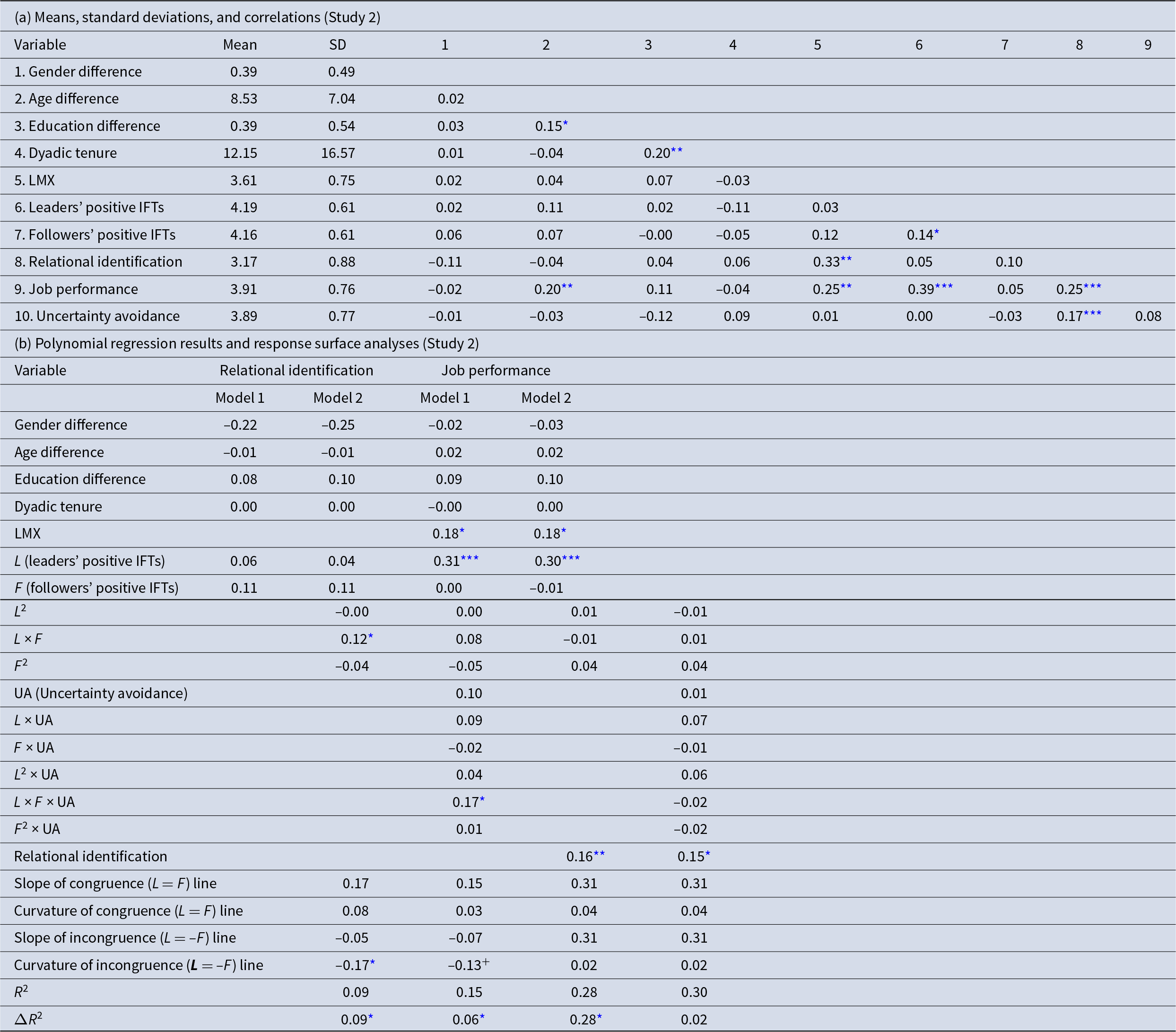
Table 2(a) presents the descriptive statistics and correlations. Leaders’ (r = 0.05, n.s.) and followers’ positive IFTs (r = 0.10, n.s.) are not separately related to relational identification. Relational identification is positively related to job performance (r = 0.25, p < .001).
Results of study 2
Note. N = 223.
* p < .05, **p < .01, ***p < .001. Unstandardized coefficients are presented.
Preliminary analyses
Based on the suggestions of Shanock et al. (Reference Shanock, Baran, Gentry, Pattison and Heggestad2010), we identified the percentages of congruent values and the percentages of incongruent values. ‘Any participant with a standardized score on one predictor variable that is half a standard deviation above or below the standardized score on the other predictor variable is considered to have discrepant value’ (Shanock et al., Reference Shanock, Baran, Gentry, Pattison and Heggestad2010, p. 547). We report the frequencies of leader positive IFTs that are over (27.35%), under (26.46%), and congruent with (46.19%) follower positive IFTs based on our example. Nearly half of the dyads in our sample exhibit values of leader positive IFTs and follower positive IFTs that differ in one direction or the other. We conclude that exploring how congruence (vs. incongruence) between leader positive IFTs and follower positive IFTs is related to relational identification and job performance makes practical sense.
Hypothesis testing
Table 2(b) presents the results of polynomial regression, including the mediation results and the moderated mediation results. As shown in Model 1 of Table 2(b) (which includes relational identification as a dependent variable), the curvature along the incongruence line is significant and negative (curvature = –0.17, p < .05) (see Fig. 2(b)). These findings indicate that relational identification with the leader is higher when the positive IFTs of the leader and the follower are congruent and that any deviation from the congruence line decreases relational identification. Thus, Hypothesis 1 is supported. However, Model 1 (which includes job performance as a dependent variable) shows that the curvature along the incongruence line is nonsignificant (curvature = 0.02, n.s.), thus suggesting the lack of a direct relationship between congruence in positive IFTs and followers’ job performance.
The significant ΔR 2 (0.06) of Model 2 shown in Table 2(b) (compared with Model 1) indicates that uncertainty avoidance interacts significantly with congruence in positive IFTs to predict relational identification. Thus, Hypothesis 2 is supported. The curvature of the surface along the line of incongruence is negative and significant (curvature = –0.23, p < .05, 95% CI = [–0.42, –0.03]; see Fig. 2(c)) under conditions of high uncertainty avoidance and is nonsignificant (curvature = –0.03, n.s., 95% CI = [–0.23, 0.20]; see Fig. 2(d)) under conditions of low uncertainty avoidance. Hence, congruence is positively related to relational identification when follower uncertainty avoidance is high but unrelated to relational identification when follower uncertainty avoidance is low. Thus, Hypothesis 2a is supported.
The indirect effect of the curvature along the positive IFT incongruence line on job performance via relational identification is –0.03, 95% CI = [–0.06, –0.003]; thus, supporting Hypothesis 3. The curvature of the indirect effect along the line of incongruence is significant and negative (curvature = –0.03, 95% CI = [–0.09, –0.004]) when uncertainty avoidance is high and does not exist when uncertainty avoidance is low (curvature = –0.00, 95% CI = [–0.04, 0.03]). The difference in these two sets of indirect effects is 0.03 (95% CI = [–0.002, 0.10], 90% CI = [0.003, 0.08]). Thus, Hypothesis 4 is supported.
Supplementary analyses
We investigated whether relational identification differs between the high–high condition and the low–low condition (the asymmetrical congruence effect) and whether relational identification differs between the ‘leader high–follower low’ situation and the ‘leader low–follower high’ situation (the asymmetrical congruence effect). To test the asymmetrical congruence effect, we examined the slope along the congruence line (the line where L = F, calculated as b 1 + b 2). As shown in Table 2(b), the slope along the congruence line (Model 1) is positive but not robustly significant (slope = 0.17, p = .07), thus suggesting that the benefits of low–low congruence for relational identification are not significantly lower than those of high–high congruence. To test the asymmetrical incongruence effect, we examined the slope along the incongruence line (the line where L = –F, calculated as b 2 – b 1). The slope along the incongruence line (Model 1) is nonsignificant (slope = 0.05, p = .59), thus suggesting that incongruence in positive IFTs is always detrimental to relational identification, regardless of which member of the dyad has a high level of positive IFTs.
Discussion
In response to recent calls for research that takes both leaders’ and followers’ IFTs into account when investigating followers’ identity construction process (Coyle & Foti, Reference Coyle and Foti2022a; Epitropaki et al., Reference Epitropaki, Kark, Mainemelis and Lord2017), we conducted two studies to determine how leader–follower congruence (incongruence) in positive IFTs impacts followers’ relational identification and subsequent performance with followers’ uncertainty avoidance serving as a boundary condition. The results suggest that leader–follower congruence (vs. incongruence) in positive IFTs boosts followers’ relational identification with the leader, ultimately improving followers’ job performance. This effect is more pronounced for followers characterized by high levels of uncertainty avoidance. Supplementary analyses show that congruence (vs. incongruence) in positive IFTs is beneficial for followers’ relational identification, regardless of whether leaders and followers are congruent in terms of their high or low levels of positive IFTs as well as whether leaders’ positive IFTs are higher or lower than those of their followers.
Theoretical implications
This study advances previous IFT research by highlighting the role of leader–follower positive IFT congruence in facilitating work outcomes. The extant IFT literature has focused primarily on the leader effect, arguing that leaders’ positive IFTs lead to positive work outcomes, a phenomenon known as the Pygmalion effect (Goswami, Carsten, & Coyle, Reference Goswami, Carsten and Coyle2022; Whiteley, Sy, & Johnson, Reference Whiteley, Sy and Johnson2012). However, some counterintuitive evidence has raised challenges regarding the Pygmalion effect by showing that leaders’ high expectations cause followers to ‘choke under pressure’ (Veestraeten, Johnson, Leroy, Sy, & Sels, Reference Veestraeten, Johnson, Leroy, Sy and Sels2021; Welsh & Ordóñez, Reference Welsh and Ordóñez2014). Inspired by this evidence, we found that high levels of leaders’ positive IFTs do not always enhance followers’ work outcomes, especially when followers hold low levels of (incongruent) positive IFTs. Moreover, low levels of leaders’ positive IFTs may not decrease followers’ work outcomes, particularly when followers are characterized by low levels of (congruent) positive IFTs. This study offers a relatively novel understanding of the performance implications of positive IFTs, suggesting that the determinant of work outcomes is leader–follower congruence in positive IFTs rather than solely leaders’ positive IFTs.
Second, based on the identity construction perspective, this study offers a new explanation of how leader–follower congruence in positive IFTs improves follower performance. Our finding differs from those of previous studies that have focused primarily on cooperation and LMX (Coyle & Foti, Reference Coyle and Foti2015; Riggs & Porter, Reference Riggs and Porter2017) as mechanisms underlying the beneficial effects of leader–follower congruence in implicit theories. We extend this stream of research by exploring the mediating role of relational identification in the link between leader–follower IFTs congruence and job performance. Therefore, we highlight the importance of followers’ identity development (Almeida, Ramalho, & Esteves, Reference Almeida, Ramalho and Esteves2021) for the beneficial effects of dyadic congruence. This finding may be meaningful because previous studies have overlooked followers’ identity construction (Coyle & Foti, Reference Coyle and Foti2022b).
Third, by identifying uncertainty avoidance as a moderator, this study reveals the boundary conditions associated with the beneficial implications of leader–follower congruence in positive IFTs. Followers characterized by high levels of uncertainty avoidance place more value on feelings of certainty, thereby strengthening the importance of leader–follower congruence in positive IFTs for followers’ relational identification and subsequent job performance. This finding is consistent with Hogg, Van Knippenberg, & Rask’s (Reference Hogg, Van Knippenberg and Rast2012) suggestion that individuals who are averse to uncertainty are more likely to identify with a social entity that provides them with structure. This finding also provides a relatively new perspective on the uncertainty avoidance literature. Previous studies have viewed uncertainty avoidance mainly as a boundary condition of the relationship between leadership styles and proactive behaviors (e.g., voice behavior, Holley, Wu, & Avey, Reference Holley, Wu and Avey2019, and creative behavior; Zhang & Zhou, Reference Zhang and Zhou2014). This study responds to Hogg’s (Reference Hogg2000) call by investigating how uncertainty avoidance moderates followers’ identity construction according to the congruence (vs. incongruence) of leaders’ and followers’ positive IFTs. This finding corroborates Milesi’s (Reference Milesi2022) study, suggesting that when employees suffer from uncertainty, they are motivated to seek entities that are predictable rather than unpredictable to reduce uncertainty.
Finally, this study may offer new insights into the relational identification literature by identifying a previously unexplored antecedent. Unlike previous studies, which have addressed the characteristics of leaders (e.g., leadership style, Qu, Janssen, & Shi, Reference Qu, Janssen and Shi2015; Yoshida et al., Reference Yoshida, Sendjaya, Hirst and Cooper2014) or followers (e.g., gender, Zhang, Deng, & Wang, Reference Zhang, Deng and Wang2014) separately as antecedents of relational identification, this study sheds light on the role of leader–follower congruence in positive IFTs in shaping relational identity. Furthermore, while Pelled and Xin (Reference Pelled and Xin1997) discovered that leader–follower congruence in demographics (surface-level characteristics) predicts relational identification, we extend this notion by exploring how leader–follower congruence in deep-level characteristics (i.e., positive IFTs) fosters relational identification.
Practical implications
Previous research has highlighted the significance of leaders’ positive IFTs for work outcomes and suggested Pygmalion interventions in organizations (Whiteley, Sy, & Johnson, Reference Whiteley, Sy and Johnson2012). Concerning the benefits of congruence in positive IFTs, this study adds the following: (a) followers characterized by low IFTs may be less receptive to leaders’ positive expectations and (b) dyadic congruence in positive IFTs, rather than merely leaders’ high positive IFTs, improves work outcomes. Accordingly, we offer the following practical suggestions. First, when leaders find themselves paired with followers characterized by incongruent IFTs, they can communicate positive views by clarifying followers’ duties, discussing expected follower characteristics, and sending appreciative letters to align followers’ positive IFTs with their own (Whiteley et al., Reference Whiteley, Sy and Johnson2012). Second, organizations can also offer training programs, for example, in the selective IFTs activation approach (Schyns, Kiefer, Kerschreiter, & Tymon, Reference Schyns, Kiefer, Kerschreiter and Tymon2011), in which positive follower attributes are repeatedly cued and thus become more accessible, to align leaders’ and followers’ IFTs. Finally, followers characterized by high uncertainty avoidance appear to be more sensitive to congruent (vs. incongruent) IFTs. Thus, we suggest that leaders should strive to align their positive IFTs with those of followers characterized by high levels of uncertainty avoidance.
Limitations and future studies
This study has several limitations. First, the young age of our participants may restrict our findings’ generalizability to older individuals. Younger workers may exhibit more contemporary IFTs (e.g., proactivity) because they usually embrace the values of individualism, freedom, and equality (Anderson, Baur, Griffith, & Buckley, Reference Anderson, Baur, Griffith and Buckley2017). Therefore, examining the implications of IFTs across generations would be interesting. Second, this study did not include other assumptions related to the social identity approach, for example, self-enhancement and belongingness. Future research could focus on alternative mechanisms (e.g., sense of belongingness and organization-based self-esteem) that link leader–follower congruence in positive IFTs to job performance. Third, the sample was drawn from China, which may limit our findings to cultures with high levels of uncertainty avoidance and collectivism. Nevertheless, we believe that our findings have important implications across different cultures since the uncertainty reduction motive is universal (Hogg, Reference Hogg and Zanna2007). Future research could examine whether our findings can be replicated in other countries. Finally, future research may incorporate a unique indigenous perspective in the Chinese context (Li, Leung, Chen, & Luo, Reference Li, Leung, Chen and Luo2012) to investigate how positive IFT congruence facilitates relational identification. For instance, Chinese employees value guanxi, a unique type of social relationship that reflects the importance of social interdependence in China’s collectivist culture (Ko, Ma, Kang, English, & Haney, Reference Ko, Ma, Kang, English and Haney2017), and are motivated to internalize leader–follower relationships into their self-concepts. Thus, Chinese employees’ motivation to establish good guanxi with their leaders (Zhang, Chen, Chen, Liu, & Johnson, Reference Zhang, Deng and Wang2014) may moderate the relationship between leader–follower congruence and relational identification.
Conclusions
This study highlights the important influence of leader–follower congruence in positive IFTs on followers’ work outcomes. We found that it is not just the positivity of IFTs that influences outcomes, but rather the alignment between leaders’ and followers’ IFTs plays a crucial role. Additionally, the findings demonstrate that followers with high levels of uncertainty avoidance benefit more from the congruence of their positive IFTs with those of their leaders, resulting in stronger relational identification with leaders and improved performance outcomes. These insights underscore the importance of understanding and fostering congruence in leadership practices to enhance employee productivity.
Data Availability Statement
The data sets were used in the first time and are available from the corresponding author on reasonable request.
Financial Support
This research was supported by the National Natural Science Foundation of China (grant no.71902048).
Conflicts of Interest
Jian Peng, Qi Nie, Xiao Chen, and Zhijie Zhang declare that they have no conflicts of interest. Authors obtained informed consent from all participants involved in the study.
Jian Peng is an associate professor in the School of Management at Guangzhou University, Guangzhou, China. His primary research interests include leadership, followership, creativity, innovation, and team/group dynamics. His research has been published in the Academy of Management Journal, Journal of Organizational Behavior, Human Relations, Journal of Business Ethics, and Journal of Managerial Psychology.
Qi Nie is a lecture in the School of Business at Nanjing Normal University, Nangjing, China. Her primary research interests include workplace break. Her research has been published in the Journal of Organizational Behavior, Human Relations, and Journal of Managerial Psychology.
Xiao Chen is an associate professor in the School of Business and Digital Leadership Research Center at Guangdong University of Foreign Studies, Guangzhou, China. Her primary research interests include leadership. Her research has been published in the Human Relations, Journal of Business Ethics, Asian Business & Management, and Journal of Managerial Psychology.
Zhijie Zhang is an employee of Jiangmen Dachangjiang Group in Human Resource Department. His primary research interests include leadership and human resources management practices.



