


Project Context
This article submission derives from a multiyear collaborative book research project, “Ted Stamm: Participatory-Based Works,” examining Stamm’s participatory sketchbook-based works from 1974–81. The project is in collaboration with Professor Graham Bader of Rice University and incorporates research conducted with University of Chicago fellows, exploring how Stamm’s Tag series invited contributions from 650 artists, friends, and passersby to create collaborative artworks.
Introduction
Artist-educators like Ted Stamm actively constructed alternative art historical narratives through strategic photographic choices in the 1970s and intentionally produced important archives for feminist art history during a period of change in the culture of the United States. Between 1968 and 1984, Stamm, an artist and educator, systematically documented New York’s evolving art scene through approximately 6,450 35mm slides representing 500 artists, 1 simultaneously preserving visual evidence of the burgeoning feminist art movement, alternative space culture, and marginalized artistic practices that later proved crucial to art historical scholarship (shown digitalized in Figure 1).
Digital interface of the Ted Stamm slides collection, Archives of American Art, Smithsonian Institution, Washington, DC. This screenshot shows the online accessibility of Stamm’s comprehensive photographic documentation of New York’s art scene in 1968–84, representing a substantial digitized archives for feminist art historical research. 7

When work by women artists comprised less than 5% of major museum collections in the 1970s, Reference Chadwick2 Stamm’s inclusion of approximately 20% women artists in his slide collection represented a pedagogical approach that was extremely progressive for the period. 3 Stamm’s strategic inclusion of 127 women artists among his 500 documented practitioners contrasted sharply with the collection of the Museum of Modern Art (MoMA), which featured only 3% women artists in 1975. Stamm’s documentation advanced beyond white-box gallery exhibitions to include street art, performance experiences, and alternative venues where women artists and LGBTQ+ practitioners were creating revolutionary work outside the territory of institutional gatekeeping. This approach captured what the curator Harmony Hammond later identified as the “non-canonical” abundance that defines marginalized cultural production, work that is not recognized because it exists outside of the spaces of the official art world. Reference Hammond4
The feminist art movement of the 1970s emerged alongside such photographic documentation, challenging what Linda Nochlin provocatively questioned in the ARTnews article “Why Have There Been No Great Women Artists?” Reference Nochlin5 Her critique states, “The fault lies not in our stars, our hormones, our menstrual cycles, or our empty internal spaces, but in our institutions and our education.” As they formed collectives such as New York City’s A.I.R. Gallery, the first all-female artists’ cooperative in the United States, in 1972 (Figure 2) and SOHO20 Gallery, established by twenty women artists in 1973, women artists were simultaneously documented through photographic practices often used within pedagogical context that preserved their institutional innovations for future art historical scholarship and led to their inclusion in the art world.
A.I.R. Gallery exterior, SoHo, New York, the first all-female artists co-op in the United States, founded in 1972. Source: Ted Stamm Estate Archive, Archives of American Art, Smithsonian Institution, Washington, DC.

Artists including Rosemarie Castoro, whose Minimalist installations questioned sculptural boundaries, exemplified the feminist artists who found support within these alternative institutional networks. Reference Castoro6 Castoro’s work from the early 1970s, including her ceiling-based geometric sculptures documented in Stamm’s slide collection (Figure 3), shows how women artists were developing innovative approaches to spatial relationships and material processes that diverged from male-dominated Minimalist traditions. Her participation in feminist collectives and mainstream gallery exhibitions reveals the nuanced strategies women artists employed to navigate institutional recognition while preserving their ties to feminist communities.
Rosemarie Castoro, untitled ceiling installation, 1970. Gesso and cardboard construction documented in Ted Stamm’s pedagogical slide collection. Source: Ted Stamm Estate Archive, Archives of American Art, Smithsonian Institution, Washington, DC.

Pedagogical Archives as Feminist Repositories
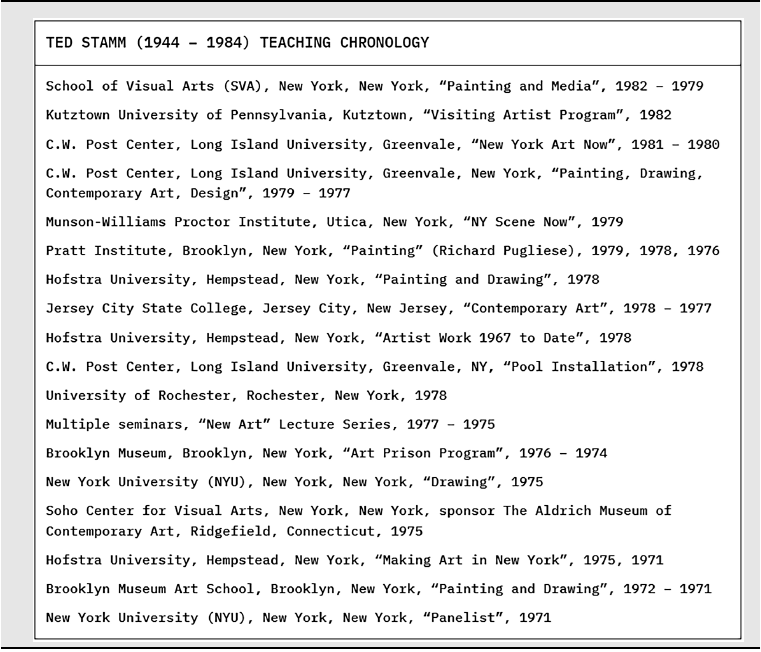
Progressive pedagogical frameworks that inherently supported feminist principles of inclusion and accessibility constructed artist-educator photographic documentation. Stamm’s teaching positions at the School of Visual Arts (SVA), Hofstra University, and C.W. Post College, among others, provided the institutional framework for a documentation practice that challenged canonical hierarchies (see Table 1 for his full list of seminars and teaching experience) Reference Fox and Jensen8 . While elite institutions maintained collections dominated by male artists, Stamm’s more egalitarian approach to visual education democratized access to diverse artistic practices for students outside traditional centres of art historical training. This inclusive pedagogical approach is evident in his teaching materials documented in his archives and the scope of artists represented in his slide collection. In 1977, The New York “Contemporary Art” course at Jersey City State College, New Jersey, notes Stamm wrote, “The most important art is that of the period we live in as it is a byproduct of our time as is our pop culture, music, politics, etc.” 9
Ted Stamm’s teaching chronology showing how course slides documented institutional inclusion practices. His syllabi featured reading lists and exercises that progressively guided students to explore artists outside the mainstream art scene and institutional frameworks.11

Table 1 Long description
A table titled 'Ted Stamm (1944 - 1984) Teaching Chronology' with one column and multiple rows. The table lists Ted Stamm's teaching positions and courses from 1971 to 1982. Row 1: School of Visual Arts (SVA), New York, New York, Painting and Media, 1982 - 1979. Row 2: Kutztown University of Pennsylvania, Kutztown, Visiting Artist Program, 1982. Row 3: C.W. Post Center, Long Island University, Greenvale, New York Art Now, 1981 - 1980. Row 4: C.W. Post Center, Long Island University, Greenvale, New York, Painting, Drawing, Contemporary Art, Design, 1979 - 1977. Row 5: Munson-Williams Proctor Institute, Utica, New York, NY Scene Now, 1979. Row 6: Pratt Institute, Brooklyn, New York, Painting (Richard Pugliese), 1979, 1978, 1976. Row 7: Hofstra University, Hempstead, New York, Painting and Drawing, 1978. Row 8: Jersey City State College, Jersey City, New Jersey, Contemporary Art, 1978 - 1977. Row 9: Hofstra University, Hempstead, New York, Artist Work 1967 to Date, 1978. Row 10: C.W. Post Center, Long Island University, Greenvale, NY, Pool Installation, 1978. Row 11: University of Rochester, Rochester, New York, 1978. Row 12: Multiple seminars, New Art Lecture Series, 1977 - 1975. Row 13: Brooklyn Museum, Brooklyn, New York, Art Prison Program, 1976 - 1974. Row 14: New York University (NYU), New York, New York, Drawing, 1975. Row 15: Soho Center for Visual Arts, New York, New York, sponsor The Aldrich Museum of Contemporary Art, Ridgefield, Connecticut, 1975. Row 16: Hofstra University, Hempstead, New York, Making Art in New York, 1975, 1971. Row 17: Brooklyn Museum Art School, Brooklyn, New York, Painting and Drawing, 1972 - 1971. Row 18: New York University (NYU), New York, New York, Panelist, 1971.
The feminist critique of art history’s institutional structure, as developed by scholars such as Griselda Pollock in her foundational work Vision and Difference, Reference Pollock10 provided theoretical frameworks for understanding how pedagogical practices could either reinforce or challenge patriarchal hierarchies. She analysed the “masculine subject position” within art historical discourse, showing how documentation and archives offered counternarratives to dominant cultural formations. Stamm’s intentionally inclusive approach, documented in his teaching archives and materialized through his slide collection, exemplifies this counterhegemonic practice and the participatory-based practices also seen within his artwork.
Stamm’s slide archives are organized into the following series:
-
1) Series I (Chronological Survey): 2,134 slides
-
2) Series II (Artists A–Z): 1,876 slides
-
3) Series III (Venues): 1,204 slides
-
4) Series IV (Movements): 1,236 slides
These documents include chronological surveys, movement-based categories, alphabetical artist listings, and venue-specific documentation, thus creating space for women artists within each category rather than segregating them into separate feminist sections. 12 This integrated approach reflected what the feminist scholars Rozsika Parker and Pollock in Old Mistresses: Women, Art, and Ideology identified as key to avoiding the ghettoization of women’s artistic production in art historical discourse. Reference Parker and Pollock13 Using archival inks Stamm hand-stencilled what would be seen today as metadata onto 35mm cardboard mounts, transforming standard teaching materials into systematic documentation systems and elevating feminist artists to fine art contexts. 14 By simply including the female artists in the context of their male counterparts, the former’s status was elevated. Stamm discussed this concept of inclusion and exclusion through his teaching.
Alternative Spaces and Feminist Institution-Building
Stamm’s documentation of alternative spaces such as non-commercial venues, cooperative galleries, and artist-run spaces coincided with the growth of feminist art institutions in SoHo and the broader New York area. Between 1972 and 1975, more than thirty women-run galleries opened in Downtown Manhattan, coinciding with Stamm’s most intensive period of documentation during which he photographed an average of twelve exhibitions monthly. Systematically photographing venues including Artists Space, P.S.1, and other non-commercial galleries captured the infrastructure that supported women artists who were excluded from traditional gallery representation. 15 A.I.R. Gallery, founded in 1972 at 97 Wooster Street in SoHo, exemplified this parallel development of feminist institutional alternatives. Stamm’s physical proximity to this feminist cultural hub in his studio and residence at 101 Wooster Street from 1970 onward positioned him as a witness and documenter of the emerging alternative art ecosystem, enabling documentation of feminist institutional innovations as they developed.
The timing of such documentation practices aligned with the emergence of feminist artist collectives that challenged established art world hierarchies. Declaring that it “does not sell art; it changes attitudes about art by women,” 16 the A.I.R. Gallery articulated the broader feminist project of transforming cultural values rather than merely seeking inclusion within existing structures. As Whitney Chadwick argues in Women, Art, and Society, these alternative institutions represented systematic defiance of the assumption that “great women artists are exceptions to the rule, who ‘transcended’ their sex to produce major works of art.” 17
In 1973 twenty women artists founded SOHO20 Gallery in another moment of feminist art history that coincided with active documentation of the period. 18 The gallery’s mission to “end gender-based discrimination in the arts by demonstrating how important art by women, queer, trans, and otherwise marginalized artists is to our cultural well-being” reflects the intersectional awareness that was developing within feminist art communities during this time.
The collaborative networks documented in such archives prefigured contemporary approaches to collective practice and institutional alternatives. These feminist institution-building strategies weakened the gatekeeping barriers of the traditional art world while creating supportive communities for underrepresented practitioners. The methodological innovations developed by the feminist art historians Norma Broude and Mary Garrard in their influential anthology Feminism and Art History: Questioning the Litany provided scholarly frameworks to understand how such archival documentation functioned as forms of institutional critique. Reference Broude and Garrard19
Performance Art and the Female Body
Documentation of performance art and body-based practices proved central to preserving feminist artistic strategies during the 1970s. Slides captured performative experiences and public installations that challenged traditional distinctions between art objects and lived experience. This documentation proves invaluable given the ephemeral nature of performance work and the limited institutional support for its preservation during this period.
Martha Rosler’s groundbreaking video performance Semiotics of the Kitchen exemplified the feminist appropriation of domestic spaces and tools for artistic critique. Reference Rosler20 Her systematic demonstration of kitchen utensils from apron to tenderizer transformed domestic labor into conceptual art practice, challenging patriarchal assumptions about women’s roles while exposing the violence inherent in traditional feminine spaces. Laura Mulvey’s contemporaneous theorization in Visual Pleasure and Narrative Cinema provided critical frameworks to understand the challenge such performances posed to what she termed the “male gaze” within visual culture. Reference Mulvey21 In this case, Stamm documented such feminist practices through his exhibition materials rather than slide photography.
Through a confrontational feminist practice, Lynda Benglis defied art world masculinity through sculptural work such as Corner Piece from 1970 (Figure 4) and via provocative self-representation. Benglis took out an Artforum advertisement that featured the artist nude with a double-headed dildo, directly confronting what feminist theorists identified as “male ethos” in the art world and asserting positive feminine sexual power. Reference Benglis22 Stamm documented her work from 1970 through 1983 and used her oeuvre within his teaching practice, directly referencing the Artforum piece in his course reading for students.
Lynda Benglis, Corner Piece, 1970, Ted Stamm slide collection. Source: Ted Stamm Estate Archive, Archives of American Art, Smithsonian Institution, Washington, DC.

Earthworks and Environmental Feminism
Women artists making land art during the 1970s developed distinctly feminist approaches to environmental practice that confronted masculine paradigms of landscape conquest. Nancy Holt’s Sun Tunnels, constructed between 1973 and 1976 in Utah’s Great Basin Desert, exemplified this alternative vision: these monumental structures emphasized human-scale relationships with natural environments rather than domination narratives typical of male land art. Reference Holt23 A version of the Sun Tunnels that was likely documented by Stamm in one of the Holt’s exhibitions of environmental work from the mid-1970s at John Weber Gallery or Franklin Furnace (Figure 5).
Nancy Holt, Sun Tunnels, 1976. Photograph from Ted Stamm’s slide collection documenting Holt’s pioneering feminist approach to land art. The image likely documents one of the exhibitions of Holt’s environmental work from the mid-1970s at John Weber Gallery or Franklin Furnace, both within Stamm’s SoHo neighborhood. 27 Source: Ted Stamm Estate Archive, Archives of American Art, Smithsonian Institution, Washington, DC.

Holt’s four massive concrete cylinders, aligned with the sunrise and sunset during summer and winter solstices, functioned as viewing devices that framed the desert landscape while creating an intimate experience of astronomical phenomena. Her approach differed from contemporaneous works by male land artists such as Robert Smithson or Michael Heizer whose works often emphasized industrial intervention and geological manipulation. Reference Beardsley24 Instead, Holt developed what she described as “bringing the vast space of the desert back to human scale,” reflecting feminist commitments to accessibility and embodied experience. Reference Foundation25
Alice Aycock’s early works of land art incorporated phenomenological experiences that engaged viewers’ bodies to systematically explore architectural and psychological spaces. Her Maze (1972) and Low Building with Dirt Roof (for Mary) (1973) created “exploratory situations for the perceiver” that questioned traditional distinctions between interior and exterior spaces. 26 Aycock’s work shows how women artists were developing alternative approaches to environmental art that emphasized process, embodied experience, and psychological inquiry. Her work also appears frequently in Stamm’s teaching materials and archives.
The feminist dimensions of earthworks extended beyond individual artistic practices to include a broader environmental consciousness and critique of capitalist land use. Women artists in the land art movement often emphasized sustainability, site-specific relationships, and collaborative rather than extractive approaches to natural environments. This environmental feminism proved prescient as ecological concerns became increasingly central to contemporary art practice.
Stamm’s documentation of land art through exhibition materials and gallery installations preserved evidence of these feminist environmental practices within the broader context of alternative space culture. His archive shows that feminist approaches to landscape and environment were integral to the broader alternative art ecosystem of 1970s New York.
LGBTQ+ Artistic Networks and Intersectional Feminism
Documentation from this period shows the emergence of post-Stonewall LGBTQ+ artistic communities that significantly overlapped with feminist art networks. The 1969 Stonewall Uprising catalysed broader civil rights activism that influenced artistic practice throughout the 1970s. Artists including David Hammons, who moved to New York in 1974 and whose work Stamm documented through the 1980s, were developing practices that addressed the intersecting experiences of racial, sexual, and cultural marginalization.
The downtown bohemian scene that flourished from the late 1960s through the 1980s provided crucial cultural infrastructure for both feminist and LGBTQ+ artistic development. The Christopher Street Pier, Westside Parking Lots, and other locations became sites of artistic documentation and community formation. Using photography, Stamm systematically captured these spaces and the artists who frequented them, including Peter Hujar, Reference Hujar28 whose powerful black-and-white portraits crystallized the queer counterculture scene that Stamm simultaneously documented in his slide collection. 29
The development of alternative art spaces coincided with the growth of LGBTQ+ cultural institutions and activist organizations. Stamm’s recording of venues such as Franklin Furnace, which featured feminist and queer artists, and Artists Space, which provided platforms for marginalized practitioners, preserved crucial evidence of the intersectional networks that sustained these communities. His archive includes documentation of artists including Keith Haring, illustrated in Figure 6, whose work became crucial in AIDS activism, and Andy Warhol, whose Factory scene represented an intersection of LGBTQ+ and artistic communities. Reference Gruen30
Keith Haring, 1982, Bowery and Houston, New York City. Source: Ted Stamm Estate Archive, Archives of American Art, Smithsonian Institution, Washington, DC.

Stamm’s slides also documented the work of Robert Mapplethorpe, whose controversial photographs of gay male BDSM culture challenged mainstream concepts of decency while asserting positive queer visibility. Stamm’s inclusion of such artists within his pedagogical archive shows how his obsessive-compulsive tendencies toward archival documentation preserved evidence of intersectional artistic and cultural communities that mainstream institutions often marginalized or ignored entirely.
Stamm’s archive evinces an intersectional approach and shows how feminist art communities were developing more inclusive conceptions of identity and oppression during this period. This evolution from single-issue feminism toward intersectional awareness proved crucial for subsequent developments in feminist theory and practice, as later theorized in the enlarged anthology The Expanding Discourse: Feminism and Art History. 31
Digital Transformation and Feminist Digital Humanities
The digitization of archival materials, such as that of the Archives of American Art Terra Foundation Center for Digital Collections, has become an engine of transformation in feminist art history. The 2023 digital release of Ted Stamm’s expansive slide collection, comprising over 6,450 images documenting New York’s art scene from 1968 to 1984, signals how technological innovation can radically democratize research access while advancing the recovery of overlooked feminist and other marginalized histories. This effort responds directly to decades-long barriers to equity identified by feminist scholars. Physical archives centralized in elite institutions historically excluded researchers with disabilities, from underrepresented backgrounds, and from outside academia. By digitizing and making materials available online, archives now support text-to-speech compatibility, virtual research, alternative browsing, and global inclusivity, each aligning with feminist commitments to democratizing cultural knowledge.
Yet the full potential of digital humanities is contingent on nuanced critical engagement. While digitization radically expands geographic and practical accessibility, challenges persist around discoverability and equitable algorithmic representation. Major collections, including Ted Stamm’s, often remain organized only at the series or collection level, limiting item-level discovery and individual artist visibility. This discoverability falls short especially for women and non-Western artists who have been historically marginalized by conventional cataloguing methods and archival hierarchies. Recent advances in artificial intelligence (AI) tools, machine learning, and metadata promise eventual improvements in item-level search, helping ensure that digital archives genuinely serve feminist research agendas and surface new voices.
Computational analysis now gives feminist scholars new ways of working in digital humanities. Columbia University’s Reverse Engineering the Image Library and other similar projects show how large-scale image analytics can reveal patterns in gender representation, artist networks, and exhibition histories previously inaccessible through manual research. Reference Zorich32 For instance, analysis of the Stamm collection has informed studies that map intersections of feminist artists, alternative exhibition spaces, and urban transformation, which are pivotal to understand the layered social contexts undergirding New York’s cultural renaissance. Such methodologies are increasingly collective: Computational data sets and collaborative annotation enable universities, museums, and grassroots researchers to verify historical claims and develop multidimensional interpretations of vast image archives, breaking down the boundaries that once siloed scholarly expertise.
Preservation strategies are at the core of understanding and planning this digital transition. Even as accessibility increases, digital collections face new risks: metadata decay, unsustainable funding, and the “digital black hole,” in which technological obsolescence threatens long-term cultural memory. Feminist digital humanities have responded by advocating community-controlled archival models and distributed preservation networks, strategies that mitigate the vulnerabilities of institutionally centralized collections and open space for more equitable stewardship. Such approaches, however, require ongoing technical investment, strategic institutional partnerships, and active re-evaluation of ethical frameworks as digital norms evolve. The economic sustainability of digitization projects is a real challenge, demanding creative coupling of technical best practices with secure financial models to guarantee enduring access.
The shifting priorities of prominent museums and collecting institutions reflect the impact of digital recovery. For example, the contemporary relevance of Stamm’s documentation is evidenced by the inclusion of twelve artists in the 2024 Whitney Biennial 33 who were first recorded in his slides, many of whom have now achieved market recognition and have garnered scholarly attention. 34 This outcome illustrates the critical institutional nudge toward diversification, transparency, and redefinition of the canon. Landmark works such as May Stevens’s SoHo Women Artists and collaborative feminist publications including Heresies—whose visual and textual histories were preserved and made accessible through archival digitization—continue to inspire academic research and institutional transformation in the twenty-first century. 35
Finally, theoretical frameworks developed by feminist scholars such as Mulvey 36 and Parker Reference Parker37 remain similarly relevant in the digital age. Mulvey’s critique of the “male gaze” finds new resonance in algorithmic search environments, in which software systems advertently reproduce patriarchal structures unless actively resisted through careful tagging, representation, and community annotation. Parker explores the hierarchies mirrored in digital humanities: Unless attention is paid to the labour of metadata creation and descriptive equity, the digital record may perpetuate exclusion.
In sum, the digital transformation of feminist art archives such as those found in Ted Stamm’s slides constitutes a methodological framework and an ethical opportunity. To realize the full promise of digital humanities, accessibility, computational innovation, and sustainable preservation have to work together. It is only through a holistic approach found in the feminist values of collaboration, participation, accessibility, and critical care for cultural memory that such archives can help to reconstruct marginalized histories, resist exclusionary logics, and create new inclusive research infrastructures for future generations.
Conclusion
Historical archives and documentation demonstrate how individual efforts can preserve cultural abundance that may exceed original intention. Systematic photography of art scenes captured feminist resistance, alternative institution-building, and marginalized artistic practices that mainstream cultural institutions often overlooked or undervalued. The digital accessibility of this documentation now enables feminist scholars to reconstruct historical narratives that defy canonical exclusions and hierarchies.
Archival significance extends beyond documentation of individual artists or artworks to encompass the cultural networks, alternative institutions, and collaborative practices that sustained alternative art communities during transitional periods. Progressive pedagogical approaches inadvertently modelled the accessibility and democratization for which feminist educators and activists were simultaneously advocating within cultural institutions.
Contemporary digital humanities methodology offers opportunities to analyse preserved abundance through computational approaches that can surface patterns, trace networks, and document relationships across large datasets. Realizing these opportunities, however, requires sustained institutional commitment to preservation, accessibility, and collaborative research infrastructure that aligns with feminist values of inclusion and equity.
The transformation of pedagogical slides into publicly accessible research resources illustrates how digitization can democratize access to cultural documentation while simultaneously raising new questions about preservation, sustainability, and institutional responsibility. For feminist art history, this digital accessibility represents both opportunity and obligation—the chance to reconstruct marginalized histories combined with the responsibility to ensure these resources remain available for future generations of scholars and communities.
Historical archives exemplify what scholars describe as an ‘abundance of marginalized cultural production’ Reference Hammond38 , materials that remain underutilized or undiscovered within digital collections until systematic analysis and accessibility initiatives make them visible to researchers. Feminist art histories preserved within systematic documentation show how marginalized cultural production often exceeds the institutional frameworks designed to contain and categorize it. Digital accessibility enables recovery of this abundance while challenging scholars to develop new methodologies adequate to its complexity and significance.
Such archives stand as a testament to the capacity of feminist art communities and are evidence of the ongoing necessity for alternative documentation practices that preserve cultural production beyond institutional recognition. As contemporary scholars work to decolonize museums, diversify collections, and develop more inclusive cultural narratives, these resources provide historical precedent and model methods for the collaborative, participatory, accessible, and systematically inclusive approaches that feminist scholars continue to advocate. The foundational work of scholars such as Broude, Chadwick, Garrard, Mulvey, Nochlin, Pollock, and Parker explores theoretical frameworks that appreciate how archives function within broader projects of feminist cultural transformation.
Acknowledgements
The author acknowledges the Archives of American Art, Smithsonian Institution, Washington, DC, for digitizing and providing access to historical slide collections. Special thanks to editors Amelia Kutschbach and Kraig Binowski, the Ted Stamm Estate and the Terra Foundation Center for Digital Collections for their technical support in making archives publicly accessible.




 Open access

