





Thinking with the planetary
The planetary is a concept still being defined by the Earthly conditions of its emergence. Its current prominence marks a radical encounter with rapidly shifting ground conditions which defy dominant politics and practices. Climate change alters seasons and ecosystems, with animals – human and non-human alike – shifting their migration patterns in response. Pollution disperses and accumulates. Global economies and multi-national corporations influence local and international policy. AI models built and trained across national boundaries pose new influence on thinking and imagining. Satellites transmit continuous data streams unevenly around the world. Across continents, Indigenous communities work to sustain, repair and care for living cultures and homelands as their lands are cleared and extracted to fuel global technologies. This custodianship is undertaken within socio-political environments which have been responsible for and benefited from Indigenous people’s displacement. Established national boundaries struggle to contain these events from spilling over while maintaining colonial programmes in which the claim of territory organises the extraction and possession of land, air, water, food, energy and life.
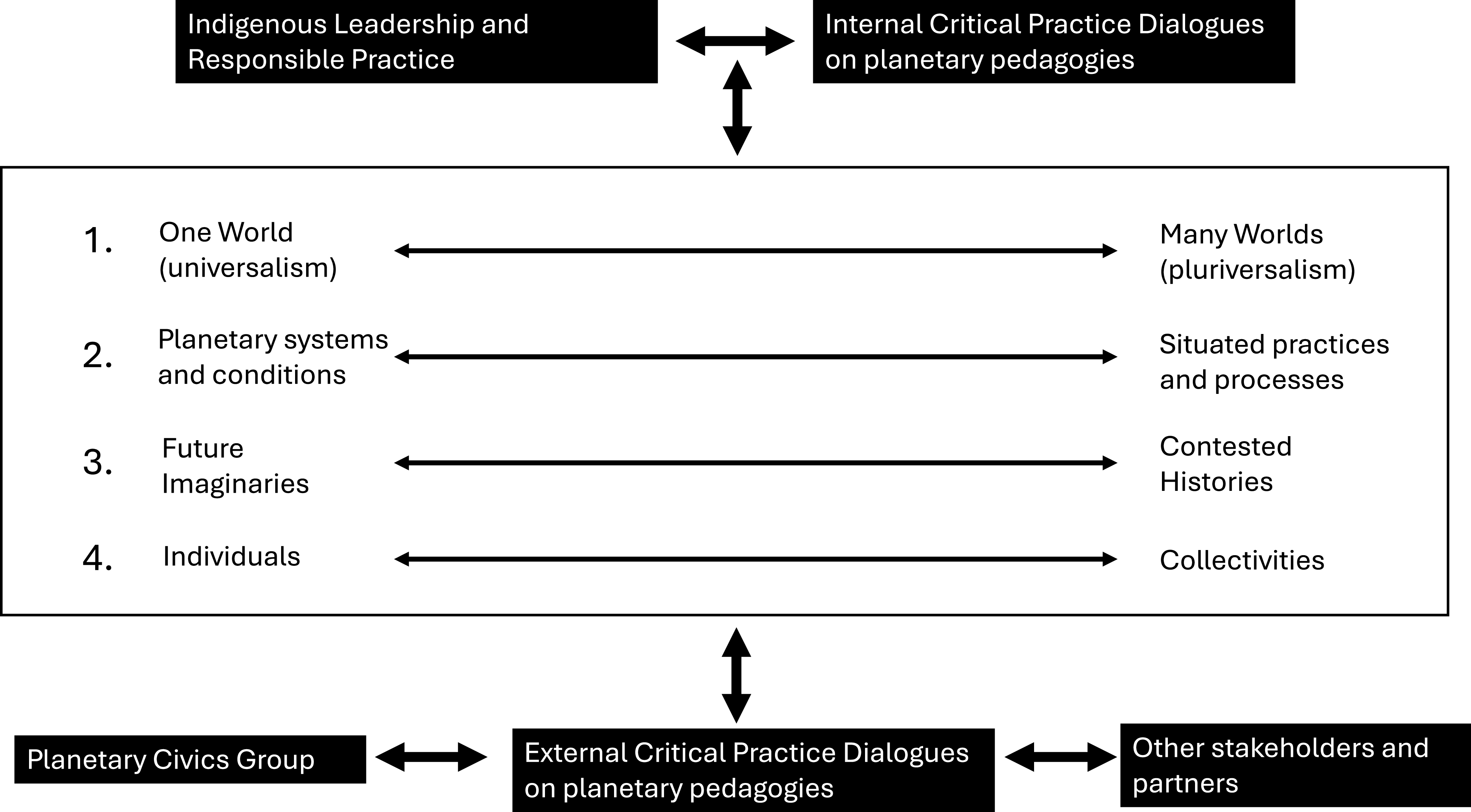
In 2024 we began meeting weekly to discuss and write about what these planetary conditions mean for our teaching in the university. Our collective came together as part of a transnational initiative called the Planetary Civics Inquiry (2026) to pursue this distinctive focus on pedagogical practice under rapidly changing planetary conditions. Bringing together scholars from diversely situated fields and career stages, our collective aimed to establish a guiding philosophical framework as the university we work for entered an extended period of pedagogical renewal and re-orientation towards regenerative futures. Our weekly gatherings focused on exploring what we termed “critical practice dialogues” which tackled key philosophical issues associated with conceptualising and teaching with the planetary across discipline areas. We worked closely with our university’s Indigenous leadership in developing these dialogues while also meeting regularly with collaborating organisations in the Planetary Civics Inquiry (see Figure 1).
Diagram of how critical practice dialogues fed into this discussion paper in conversation with internal and external stakeholders.

In early 2025 we self-published an initial position paper on the Planetary Civics website which served as an early version of this paper (Daley et al., Reference Daley, Greenfield, Lee, Hussey-Smith, Magner, Lester and Thomas2025). The position paper was constructed by breaking into groups and writing collaboratively on sections which had already been discussed extensively during our weekly critical practice dialogues. We then went through a careful and deliberative process of editing these co-authored writings together into short sections, adding another layer of collective thinking and interweaving to our method. We have chosen to list our authorship order alphabetically as a reflection of the genuinely collective nature of our research and writing process. The discussions that follow speak in a plural voice which bears witness to the multiplicity of situated perspectives and knowledges which came into conversation over the course of our research process.
One or many worlds
The concept of the planet as a single, all-encompassing World has radiated largely out of Europe since the Enlightenment era. This idea forms the foundation for the colonial and capitalistic extraction of the Earth and its inhabitants as fungible resources (Mbembe, Reference Mbembe2021; Wynter, Reference Wynter2003) and continues to be an assumed first principle for most Western models of science and governance despite disruptions from within the sciences themselves, most notably in quantum physics (Barad, Reference Barad2007) and epigenetics (West-Eberhard, Reference West-Eberhard2003; Reference West-Eberhard2007). Alternatively, the concept of the planet as a multiplicity of worlds has a far longer genealogy which goes back tens of thousands of years through the living histories of Indigenous peoples (Escobar, Reference Escobar2018; Nakata, Reference Nakata2007).
If life’s capacity to differ from itself is the main catalyst for the planetary, then it is not subsumable under the place-less notion of an all-encompassing World (Law, Reference Law2015). Gayatri Spivak (Reference Spivak2003) reminds us that the planet is not reducible to the globe, even though globalisation remains a dominant conception and image of planetary existence. Lobo, Mayes, and Bedford (Reference Lobo, Mayes, Bedford, Lobo, Mayes and Bedford2024) extend Spivak’s argument to suggest that many “planetarities” are possible and indeed necessary in navigating the vast complexity of concepts and movements towards planetary justice. The globalised world is clearly one of the primary ways in which planetarity has been given representation, but it’s not the only way. While globalisation has brought unimaginable wealth to the few, it has also brought incomprehensible suffering to the many whose lives are deemed extractable under racial capitalism (Mbembe, Reference Mbembe2023). If a globalised planet has been asserted largely for hegemonic purposes of control and domination, the turn to “planetarities” realises such a programme is futile – not to mention, unjust – and searches relentlessly for more partial and pluralistic concepts of worldmaking (Wynter, Reference Wynter2003).
Pluralistic concepts of the planetary recognise that different cosmological accounts of the universe generate different living practices and that these living practices make very real, material differences in how planetary life unfolds (Stengers, Reference Stengers2018). Over the past decade, many divergent concepts of the planetary have been gathered and discussed through the concept of the “pluriverse” (Escobar, Reference Escobar2018). As an onto-political call for “a world where many worlds fit” (Blaser & de la Cadena, Reference De La Cadena and Blaser2018), the pluriverse was coined by First Nations peoples in Latin America and has since gained currency as a concept which refuses the universalising ambitions of Euro-western modernity and its claim to a single, all-encompassing reality or ‘nature’ (Escobar, Reference Escobar2020). Numerous educators, artists, designers, scientists and activists have adopted the language of the pluriverse in recent years, giving rise to a new lexicon of practices which recognise diversely situated cosmologies and knowledges of the Earth and cosmos (Castillo, Reference Castillo2016; Leitao, Reference Leitão2022; Lobo & Rodríguez, Reference Lobo and Rodríguez2022; Perry, Reference Perry2021; Rousell et al., Reference Rousell, Ryan, Bauer-Nilsen and Lai2022, Reference Rousell, Boadu, Hussey-Smith, Kelly, Mayes, Moss and McCandless2025; Vasudevan & Novoa, Reference Vasudevan and Novoa2022).
The implications of the pluriverse and its associated commitments to “multi-naturalism” are only just starting to be explored in the field of environmental education (Garcia-Arias et al., Reference Garcia-Arias, Corbetta and Baronnet2023; Korsant, Reference Korsant2024; Rousell, Reference Rousell2026). A recently published special issue on Critical Forest Studies goes some way towards setting an agenda for pluriversal thinking in environmental education (Rousell et al., Reference Rousell, Hill, Ryan, Harvey, Barns, Aleksic and Boadu2026), with contributions focusing on new animisms (Antang et al., Reference Antang, Rousell, van Eeden and Grover2026), multinatural perspectivism (Holmes, Reference Holmes2026), and Indigenous onto-political governance (Jeffries & Esperon-Rodriguez, Reference Jeffries and Esperon-Rodriguez2026). These recent contributions reinforce the pluriverse as first and foremost a site of onto-political struggle, bearing the promise of an Earth where different worlds co-exist without being assimilated by the universalising grasp of Euro-western constructs of “science,” “politics,” “nature,” “environment,” and “nation.” While calls for the pluriverse have arisen from onto-political resistance movements from across the Global South in particular (Escobar, Reference Escobar2020), pluriversal thought now speaks to planetary struggles in all places where ethical negotiations and exchanges between worlds have become the very means of survival.
One or many natures
The pluriverse bears a special meaning and responsibility for us writing here in Naarm (Melbourne), Australia on unceded sovereign lands of Wurundjeri Woiwurrung and Boonwurrung Country. Naarm is a place where the incommensurability between settler colonial and First Nations relations with lands, skies and waters is starkly present and unavoidable. Country is an Aboriginal English term used by Aboriginal and Torres Strait Islander people to describe lands, skies, and waterways along with cultural knowledges and living practices present in these locations across thousands of generations. The Australian Institute for Aboriginal and Torres Strait Islander Studies Map of Indigenous Australia shows more than 250 Indigenous Countries across the continent (AITSIS, 2025), each which have their own distinct cosmologies and associated systems of language, governance, science, education and law. These understandings and articulations of Country do not claim universality. They differ depending on who you are, where you are and where you come from.
Country has awareness, it is not just a backdrop. It knows and is part of us. Country is our homeland. It is home and land, but it is also more than that. It is the seas and waters, the rocks and soils, the animals and winds and people too. It is the connections between those beings, and their dreams and emotions, their languages and their Law. (Gay-Wu Group of Women, 2019, p. 15)
Country does not end at the terrestrial. As Wurundjeri cultural custodian and scholar Mandy Nicholson (Reference Nicholson2018) explains, Country has many layers that extend into the internal depths of language and subjectivity and out into the cosmic depths of Sky Country and outer space. In a recent defense of Indigenous sky rights from colonial exploitation, First Nations astronomers Karlie Noon and Krystal De Napoli write that “it is incorrect to think of Sky Country as lifeless, nor can it be regarded as sphaera nullius” (Reference Noon and De Napoli2022, p. 15).
The concept of Sky Country offers a perspective of the cosmos which pluralises nature rather than reducing it to a monolithic signifier. It provides a multiplicitous view of the cosmos which places Australia in and between the Southeast Asian and Pacific archipelagos, and thus many worlds away from imperial Europe and Commonwealth law which legitimates the ongoing colonial dispossession and occupation of sovereign Indigenous Country (Moreton-Robinson, Reference Moreton-Robinson2015).
These insights from First Nations cultural custodians and scholars are especially important for us living and working in settler colonial contexts. They help us responsibly engage with perspectives that (re-)imagine the planet as emplaced and embodied by peoples, practices and histories that are near to us, and importantly, also precede the systems of coloniality of which we are part. A curriculum and pedagogy focused on critically attuned readings of Indigenous and Global South literatures, whether as teachers or students, can restore a much-needed sense of planetary nearness and inseparability for us all (Poelina et al., Reference Poelina, Paradies, Wooltorton, Guimond, Jackson-Barrett and Blaise2023).
While there is no doubt that practices and ideas travel the Earth, it is always our nearest and closest neighbours with whom it would seem we are most directly and tangibly entangled. These most proximate links to planetary conditions connect us with every other part of the Earth: they are the roots and routes of our planetary relations (DeLoughrey, Reference DeLoughrey2007). For those of us writing from unceded Indigenous lands, a planetary pedagogy must firstly identify the extractive and possessive structures underlying contemporary higher education and principles of knowledge production (Lobo & Rodríguez, Reference Lobo and Rodríguez2022). A key task of a planetary pedagogy is to confront institutional structures of supremacy and complicity both personally and collectively. This requires becoming alert to the slippage between thinking in solidarity with decolonial and Indigenous scholarship and co-opting these ontologies, discourses and practices as “new” innovations in thinking and practice (Todd, Reference Todd2016).
In our own institutional context, this work is framed and guided by the concept of Responsible Practice. Responsible Practice is a call to embody actions that support responsible ways of working with Aboriginal and Torres Strait Islander perspectives, knowledges, places and communities (Nakata, Reference Nakata2007). This involves a continuous interrogation and reconceptualisation of education and research practices through critical dialogues guided by Indigenous leadership (Bishop, Reference Bishop2022). Responsible practice is not just something we do through our roles at the university. It extends from our working lives into our everyday relations of care with local places, our multispecies communities, each other and ourselves.
One or many complexities
By working to engage responsibly at the cultural interface of the university where many worlds converge in an unequally shared place, there is an opportunity to develop deeper understandings of living within more-than-human ecologies and diverse ways of knowing and caring for Country. The pluriverse proposes that worlds are continuously being regenerated and degenerated through Earthly practices of life-living. New worlds do not emerge out of nowhere. Rather, they are born of ethical and political struggles between differently situated cosmologies and knowledges as they come into encounter, conflict, negotiation and (mis)recognition (Escobar, Reference Escobar2020). By conceptualising the planetary as a site of ongoing struggle for articulation and intelligibility, its claims are concretely grounded in how human and nonhuman creatures live and make sensible an ontology of relatedness in differentially shared places of encounter and semiosis across worlds (Holmes, Reference Holmes2026). Regenerative worldmaking is born of the differences generated and learned through the immediacy of worldly encounters. This is why a planetary environmental education can’t rely on abstract systems or models to explain “nature,” “science,” “complexity,” or “reality” in universal terms.
Since the mid-20th century many different branches of Western science have sought to define the planetary as constituted by complex systems across scales – from the sub-atomic to the astronomical. Complexity thinking is often evoked as a capacity to identify, describe and represent patterns that resonate in systems across scales (Byrne & Callaghan, Reference Byrne and Callaghan2022). Many proponents of complexity theory and systems thinking also see a complexity-informed worldview as urging against hubris and over-confidence and working towards inclusivity and an acknowledgement of plurality (Boulton et al., Reference Boulton, Allen and Bowman2015). However, complexity and systems theories have now become key rubrics through which many global industries and governments design their systems and modes of operation, finding high levels of compatibility with automated decision-making and AI (Spoor & de Werd, Reference Spoor and de Werd2023). This is not surprising given the historical links that have been made between general systems theory, statistics and racial capitalism emerging from corporate technology and military industries from the mid-20th century (Cogdell, Reference Cogdell2019; Eckstein & Reinfandt, Reference Eckstein and Reinfandt2016; McIlwain, Reference McIlwain2020), a convergence that sought to model the complexity of nature (including the human mind) as an all-encompassing system with an explicable and exploitable order. Systems and complexity theories have been seen by some as following a line of European and Anglo-American thought which seeks to universalise the planetary as a system that can be secured, managed, governed and controlled (Chun, Reference Chun2021; Costanza-Chock, Reference Costanza-Chock2020; McElroy, Reference McElroy2024), despite many proponents of complexity theory overtly emphasising the incompleteness and indeterminacy in any knowledge system.
Studies of pluriversality provide significant counterexamples to universal models of complexity by demonstrating how ontological politics often determines which worlds survive and which worlds are lost (Gills & Hosseini, Reference Gills and Hosseini2022; Paulson, Reference Paulson2018). Recent work exploring the impacts of climate change on animist rituals practiced in Brazil, Trinidad and Bali provide a telling series of examples (Rousell et al., Reference Rousell, Ryan, Bauer-Nilsen and Lai2022). Working through a pluriversal framing of climate impacts across multiple worlds, the authors conceptualise rituals as pedagogies through which “memories, epistemology, ontology, sound and affect, multiple physical materials with earlier lives (in trees, in the earth) and lives yet to come … all become joined, metabolised, knotted together in entanglements of sinuous threads” (p. 277). One particular story from Brazil stands out. As a collaborator and guest of the Kuikuro people in the Central Amazon basin, choreographer Birgitte Bauer-Nilsen describes how she learned directly the onto-political struggle to retain ritual dance practices as plants and animals go extinct in the Amazon due to climate change. This loss of ritual marks world-ending events in which complex threads of ecological balance and regeneration developed over millennia are now breaking down at the contested interface between Indigenous lifeways and capitalist logics of extraction. Pluriversal thinking helps witness the loss of ritual in the Central Amazon as a conflict between vastly different political cosmologies and ontologies which are irreconcilable under any universal model of complexity or systematisation (de la Cadena & Blaser, Reference De La Cadena and Blaser2018; Robinson, Reference Robinson2020).
Federal court cases and laws in Bolivia, Peru and Aotearoa (New Zealand) that recognise the entangled rights of nature and Indigenous sovereignties have also become contact zones where the logic of the pluriverse is being tested (de la Cadena, Reference De La Cadena2010; Querejazu, Reference Querejazu2024). However, these cases remain contained within the politico-legal systems of individual states making it difficult to influence timely action on climate justice at a planetary scale. In working towards a concept and practice of planetary justice, we are learning how to critically evaluate the historical locatedness of various theories and models of planetary complexity and build “contingent collaborations” between them as an important pedagogical task (Lobo et al., Reference Lobo, Mayes, Bedford, Lobo, Mayes and Bedford2024). We need to remain wary of claims to any universal solution while attending to planetary perspectives which accommodate diverse cosmologies and living relationships with the Earth, even when they are mutually incommensurable with one another (Tuck & Yang, Reference Tuck and Yang2012). The pluriverse and its commitment to planetary justice is a paradoxical proposition which seeks to inhabit and move with (rather than dissolve) the incommensurabilities that arise from onto-political struggles between worlds.
Thinking beyond disaster
Many of the global discourses around climate change and biodiversity loss have called for unification in response to imminent disasters and planetary crises. However, a planetary pedagogy that seeks to cultivate places of learning where multiple worlds are shared cannot be driven by fear of disasters and crises to come. As teachers, we have struggled with the knowledge that our students often wear the burden of knowing that their future will be dramatically affected by the climate crisis and biodiversity loss. While climate change is unfolding before our eyes, worse is projected to come, and these students will need to be prepared to adapt to radically destablised planetary conditions (Verlie et al., Reference Verlie, Rousell, de Kleyn, Hartup, Rickards, St Clair and Ofosu-Asare2025). We recognise that climate distress amongst our students is real, especially when together we read texts that deal with climatological trauma and loss, prompting their own reflections on what it means to grow up in the so-called Anthropocene. Loss of hope, paralysis and nihilism are all understandable responses. How do we engage sensitively with these feelings? Could it be that this loss of hope is also a loss of faith in reductive and totalising concepts of humanity, science and nature which have been inherited through Euro-western knowledge systems?
As First Nations writers, scholars and activists have long pointed out, dystopian and apocalyptic conditions are not new but rather something their communities have endured, resisted and survived for centuries (Walton & Coleman, Reference Walton, Coleman, McQuilten and Palmer2023; Whyte, Reference Whyte2017). To teach with and through the planetary is to teach against the universal narratives of disaster and saviourism, which in our context, are largely inherited through Euro-western structures of thought. We recognise the violence in this disaster thinking, where an event only becomes a crisis when it impacts the fragility of dominant cultures and frameworks of life-living. Evoking the planetary through fear risks a one-dimensional conceptualisation and potentially reinforces the anthropocentric and individualising roots of coloniality that perpetuate modernity’s insistence on a universal account of nature and the real.
Becoming worlds: one or many temporalities
How do we teach with a sense of the planetary as always more than a single nature or world? Given the centrality of time to cosmological accounts of worldmaking and complexity, the question of temporality is key to how planetary pedagogies might be cultivated and navigated. Although designed for the purposes of knowledge production and preservation (however problematic), the contract of learning within the Western university was founded on the “mean time” of European modernity as the guarantee for certain prescriptions of value (Bastian & Facer, Reference Bastian and Facer2023). Recent work in the environmental humanities has brought to bear the challenges that temporal models have upon distinctions between natural and human-made systems (Bastian, Reference Bastian2012), while critical education researchers have emphasised the radical impact of temporal frames on how environmental problems are comprehended and addressed across scales (Cole, Reference Cole2024; Facer, Reference Facer2019; Rousell, Reference Rousell2020). This includes framings of deep cosmological and biological time, such as long-term geological and evolutionary processes, as well as anthropogenic time, which involves historical, cultural and societal perspectives that shape time according to particular onto-political investments (Clayton, Reference Clayton2021).
Teaching within a pluriversal frame has a way of multiplying and diffracting time. It incites us to explore the mutual enfolding of process and place by learning from Indigenous timescapes that rupture linear models of temporality (Bawaka Country, Reference Wright, Suchet-Pearson, Lloyd, Burarrwanga, Ganambarr, Ganambarr-Stubbs, Ganambarr and Maymuru2015; Noon & da Napoli, Reference Noon and De Napoli2022). Imagining the timescapes of other species also offers an important pedagogical opening. Michelle Bastian (Reference Bastian2012) argues that the Euro-Western separation of human concepts and measurements of time from the temporalities of nonhuman creatures has produced a fatal sense of confusion around action on climate change. She describes the endangered Leatherback turtle as an ecological clock with 100 million years of evolutionary history which is now registering the sudden and drastic temporal effects of a hyper-carbon-based economy. For Bastian, “turtles not only tell us about the unstable time of an active Earth, they also tell the frustratingly slow time of human efforts to respond to recognised environmental threats” (p. 44).
To recognise and learn from multispecies timescapes can encourage us to become “active and unfinished learners and makers of worlds” (Amsler & Facer, Reference Amsler and Facer2017, p. 10). This holds the potential for radically diversified and hybridised forms of planetary citizenship and environmental custodianship which recognise responsibilities between past, present and future generations. As an exploration of interconnectedness across different temporal scales, a planetary pedagogy and curricula could support ecological reparation within colonised landscapes through a critical appreciation for the slow, transformative forces that restore and regenerate the poly-temporal diversities of life.
Conclusion: towards the pluriversity
At the heart of this political project lays an ethics that respects vulnerability, but re-works it affirmatively, while actively constructing social infrastructures of generosity and hope. (Braidotti, Reference Braidotti, Braidotti, Hanafin and Blaagaard2013, p. 8)
The remit of higher – and other tiers of – education needs urgently to be retrained on the formation of more-than-human planetary solidarities. This shift is political in the sense of rerouting populations and the individuals who comprise them as the necessary fulcrum to interrupt current arrangements of power and knowledge and set them on a vastly different course.
To develop new approaches for a planetary education, universities must reconsider the occupations they teach and how these fields perpetuate extractive practices and often shirk the consequences of extinction, disaster and environmental degradation, or pass them on for others to cleanup. The pedagogical task that we face calls for a relational ethic of care and responsibility that is not yet achieved through a traditional university model. What we propose is something more akin to a pluriversity which understands itself as a porous gathering and crossroads between worlds in continuous formation. Rather than asserting a systematised model of the World and how it works as the default, the pluriversity asks us to work from the opaque and unknowable differences that arise when incommensurable worlds meet. This includes nonhuman worlds which have their own ways of producing, communicating, regenerating and exchanging knowledges.
Let’s listen. Do you hear the wind in the trees? The water on the beach? The splash of the fish? That is the wind, the trees, the water, the sand, the fish communicating. They have their own language, their own Law. Sometimes they are sending a message to humans. Sometimes they are sending a message to each other. Humans are not the centre of the universe, you see. Humans are only one part of it. Humans are part of Country along with the mullet, the tides, the moon, the songs and stories, along with the spirits, the plants and animals, the feelings and dreams. (Bawaka Country, Reference Wright, Suchet-Pearson, Lloyd, Burarrwanga, Ganambarr, Ganambarr-Stubbs, Ganambarr and Maymuru2015, p. 270)
The voice of Bawaka Country comes from a close-knit collective of Yolngu and non-Indigenous women and their nonhuman kin in Northeast Arnhem Land. They invite us to come and listen to Country with care, where everything teaches and learns, and there is no human authority to be separated from all the rest to judge its veracity from a distance. Such listening practices are crucial for a planetary pedagogy that cares for multiple cosmologies and knowledges that do or may exist, “but do not meet the requirements of modern knowledge and therefore cannot be proven in its terms” (de la Cadena, Reference De La Cadena and Blaser2018, p. 14, cited in Rousell et al., Reference Rousell, Ryan, Bauer-Nilsen and Lai2022).
Like a string of islands cast across the abyss of the sea, planetary pedagogies are structured more like an archipelago than a monolithic continent or nation state (Rousell & Hussey-Smith, Reference Rousell and Hussey-Smith2024). Following the work of Martinician philosopher Édouard Glissant (Reference Glissant1997), we respect the opaque and unfathomable depths between worlds and actively acknowledge that these depths need not be rendered transparent to practice our lives in responsible and regenerative ways.
Just as Foucault (Reference Foucault2019) gave a historical sense to “the individual” as a new political identity formed through modern practices of individualisation, the task of a planetary pedagogy is to engender future histories of political solidarity predicated on planetary practices of collectivisation. Harney and Moten (Reference Harney and Moten2013) refer to this as the ongoing formation of an “undercommons” which is not so much a collection of individuals as a general antagonism and unsettlement of the very idea of the individual. The undercommons entails the improvisation of shared structures of feeling and sociality that are inclusive of radically diverse human and nonhuman worlds, an onto-ethical orientation that begins from what Denise Ferreira da Silva (Reference da Silva2014) terms “difference without separability.” As a pedagogy predicated on planetary proximity and responsibility rather than distancing and individualisation, “difference without separability” asks both teachers and students to relinquish learned understanding of humans as self-contained subjects consuming education as chosen knowledge to acquire their necessary capital.
Such ambitions and the possibility of remaking an education predicated on collective attributes and capacities is neither unprecedented nor only a very long-term project, a consideration given the urgency of our times. Nonetheless, the techniques and knowledges to be assembled and invented are considerable, and educators need to be given – or take – the organisational time and space to study and practice this work carefully and responsibly.
A logic of extraction - with its linear, transactional, means-end relationships - is the logic by which the Earth’s material and subjective reserves have been so effectively plundered. What if we could practice a pedagogical means without any specific end in mind? The ongoing invention of a means without end is key to the production of a planetary pedagogy as a collective endeavour that is openly creative and improvisational at heart. This is powerfully realised through educational environments which take up the continuous struggle to collectively seed and nourish worlds growing in the ruins of the modern university.
Acknowledgements
RMIT University acknowledges the people of the Woi wurrung and Boon wurrung language groups of the eastern Kulin Nation on whose unceded lands we conduct the business of the University. RMIT respectfully acknowledges their Ancestors and Elders, past and present. RMIT also acknowledges the Traditional Custodians and their Ancestors of the lands and waterways across Australia where we conduct our business.
Ethical statements
Ethical approval was not required for this study as it is a conceptual paper that did not involve human participants.
Financial support
The author(s) received no financial support for the research, authorship, and/or publication of this article.
Author Biographies
Linda Daley is an Associate Professor of Literary Studies at RMIT University whose teaching and research focuses on the interrelations of ethics, politics and aesthetics and particularly from feminist, anti-colonial and planetary perspectives.
Cathy Greenfield is Associate Professor of Communication, in the School of Media & Communication, RMIT University. Her research deals with the role of media in the government of populations, across a range of topics such as populism, financialization, ecological sustainability, and political economic literacy.
Kelly Hussey-Smith is a Senior Lecturer in the School of Art at RMIT University, where she teaches and researches in the areas of photography as a social and relational practice and socially engaged art education.
Julian Lee is the Associate Dean, Global and Language Studies, in RMIT’s School of Global, Urban and Social Studies.
Bonnie Amelia Lester is a Melbourne-based researcher, designer, educator and writer. She is undertaking a PhD and teaches Landscape Architecture at RMIT where she has led design research studios focusing on the intersection of technological and ecological systems at planetary scales.
Brigid Louise Magner is Associate Professor of Literary Studies at RMIT University and co-director of the non/fictionLab research group.
David Rousell is Associate Professor of Education for Regenerative Futures at RMIT University. He teaches and researches in the areas of climate justice, art and design, ecological philosophy, and education futures.
Chris Speed is Professor of Design for Regenerative Futures at RMIT, Melbourne, Australia, where he collaborates with a wide variety of communities and partners to explore how design provides methods to adapt towards becoming a regenerative society.
Naomi Stead is an architectural writer, critic, educator and researcher, and Associate Deputy Vice Chancellor Engagement in the College of Design and Social Context at RMIT.
Wendy Steele is a Professor of Environmental Sustainability and Critical Governance in the Centre for Urban Research and leads the Planetary Civics Inquiry at RMIT.
Gary William Thomas is a Yui and Australian South Sea Islander man from North Queensland. He is the Pro Vice-Chancellor, Indigenous Education, Research and Engagement at RMIT University.

 Open access

