INTRODUCTION
The focus of West European immigration and diversity debates is on Islam, which is claimed to form a “bright boundary” separating immigrants from the host societies (Alba 2005; Zolberg and Long Reference Zolberg and Long1999). Muslims are singled out as prototypical outsiders and Islam is presented as threatening Western democratic norms and values (see Kundnani 2007; Scholten and Holzhacker 2009; Vasta 2007). From a democratic consensus perspective mass support for civil liberties is considered indispensable for democratic stability. Whether Islam is compatible with Western democratic principles is therefore much debated. Some scholars have argued that the duty based nature of Islam and the emphasis on conformity to religious rules and practices are problematic for the development of tolerance and democratic attitudes (Bruce Reference Bruce2011; Harris Reference Harris2004). This is illustrated for instance by the heated debates in Western countries on the Danish cartoons of the Prophet Mohammed, the Salman Rushdie affair, and other controversial issues that may be offensive to Islam. Furthermore, it has been argued that social and political experiences of exclusion and discrimination amplify the perceived cultural differences between Muslim immigrants and liberal and democratic Western values (Phalet et al. Reference Phalet, Fleischmann and Stojčić2012; Verkuyten and Yildiz Reference Verkuyten and Yildiz2007). Muslims may turn to stricter religious observance and rejection of host society principles as a way to consolidate their threatened religious identity. This is especially likely among those who identify strongly with their community of believers (Turner and Reynolds Reference Turner and Reynolds2001). In contrast, given the prevalence of democratic norms in Western societies, those who identify with the host society can be expected to adopt key democratic values of political tolerance.
Tolerance for dissenting beliefs and practices is a key condition for democracy (Sullivan and Transue Reference Sullivan and Transue1999). There are only a few studies that have empirically examined political tolerance among Muslim minorities in Western countries, yielding mixed results. Research has found that Dutch Muslims (Verkuyten and Slooter Reference Verkuyten and Slooter2008) and American Muslims (Djupe and Calfano Reference Djupe and Calfano2012) tend to be intolerant of acts against religion. Yet, two other studies among Dutch Muslims found no evidence that strong Islamic belief hampers the development of political tolerance (Phalet and Güngör 2004; Verkuyten Reference Verkuyten2010).
We build on these studies in a number of ways. First, we investigate political tolerance among Sunni and Alevi Muslims originating from Turkey and living in Germany and the Netherlands. Second, we examine whether political tolerance is associated with religious group identification and host nation identification. For this we use a social identity perspective (Tajfel and Turner Reference Tajfel and Turner1979; Turner and Reynolds Reference Turner and Reynolds2001), which is increasingly used in research on religious groups (e.g., Herriot Reference Herriot2007; Hunsberger and Jackson Reference Hunsberger and Jackson2005; Penning Reference Penning2009), and that argues for the importance of identity content and of religious and host national identification for people's attitudes and beliefs. Third, we examine political tolerance using the least-liked group approach (Sullivan et al. Reference Sullivan, Piereson and Marcus1979). Although this content-controlled approach has its limitations (Petersen et al. Reference Petersen, Slothuus, Stubager and Togeby2010) it allows us to examine political tolerance of groups that the Muslim participants themselves actually dislike (Hurwitz and Mondak Reference Hurwitz and Mondak2002).
POLITICAL TOLERANCE AND RELIGION
Political tolerance has been defined as “a willingness to ‘put up with’ those things that one rejects,” and “implies a willingness to permit the expression of those ideas or interests that one opposes” (Sullivan et al. Reference Sullivan, Piereson and Marcus1979, 785). For a well-functioning democracy people should accept that members of disliked groups, for example, deliver a public speech, hold public rallies or teach in public schools.
Since Stouffer's (Reference Stouffer1955) seminal work on political tolerance it has been common to argue that religious belonging, belief, and behavior are related to less tolerance toward disliked groups (Nunnet et al. Reference Nunn, Crockett and Williams1978). However, these early studies used broad religious categories such as Protestant, Catholic, and Jew and were therefore unable to detect possible differences within religious traditions. More recent research has shown differences in tolerance between religious denominations (e.g., Froese et al. Reference Froese, Bader and Smith2008; Gay and Ellison Reference Gay and Ellison1993; but see Eisenstein Reference Eisenstein2006). For example, some studies suggest that Evangelical or Conservative Protestants are more intolerant than other religious traditions (e.g., Reimer and Park Reference Reimer and Park2001; Wilcox and Jelen Reference Wilcox and Jelen1990), and that there are substantial differences in levels of tolerance among various Protestant denominations (Murphy-Beatty and Walter Reference Murphy Beatty and Walter1984). These differences between denominations have been explained in terms of minority positions in society (Gay and Ellison Reference Gay and Ellison1993) and the content of religious beliefs and practices. The more emphasis a denomination places on dogmatic beliefs and strict religious rules, the less tolerant the followers tend to be toward groups that challenge or violate these beliefs and rules (Burge Reference Burge2013; Froese et al. Reference Froese, Bader and Smith2008; Murphy-Beatty and Walter Reference Murphy Beatty and Walter1984; Tutiya Reference Tutiya2005).
These studies were conducted in the context of the United States and predominantly involve Christian groups. Research on political tolerance of Muslim minorities living in the West is rare and to our knowledge there is no research on differences between Muslim minorities of different denominations. It is estimated that the great majority of West European Muslims are Sunnis (Buijs and Rath Reference Buijs and Rath2002), but there also is a sizeable Alevi community in Germany and the Netherlands (an estimated 20% of the Turkish minority members). Despite their shared Islamic faith,Footnote 1 similar migration background as so-called guest workersFootnote 2 and comparable relatively low socio-economic position in Germany and the Netherlands (Kaya Reference Kaya2006), there are large differences in religious beliefs and practices between these groups. Sunni Muslims ideally adhere to the pillars of Islam: the declaration of faith, prayer (five times a day), fasting during the month of Ramadan, the Hajj (visiting Mecca), and Zakat (giving alms). Orthopraxis is central in the Sunni faith, which is not to say that all Sunni Muslims adhere to it. Bruce (Reference Bruce2011) has argued that this emphasis on orthopraxy restricts a personal interpretation of Islam, creating higher levels of social conformity to religious dogmas than in other religions.
In contrast, almost none of the Alevis who self-identify as Muslims practice the ritual prayer five times a day, go to a mosque, fast during the Ramadan, or go on the Hajj. These are not Alevi religious customs and Alevi Muslims tend to interpret Islam and the Qur'an in a spiritual and mystical way rather than in terms of strict rules and regulations. For most of them, the love of God and of other human beings, whether religious or not, is central. How a person treats other humans and whether he or she acts as a responsible and caring human being is considered a key issue. Some argue that “Alevis share with Germans and Europeans a democratic, laicist and egalitarian outlook” (Kosnick Reference Kosnick2004, 985). Given this humanistic and democratic outlook, it can be expected that Alevi Muslims will be politically more tolerant than Sunni Muslims. However, there are also reasons to expect Alevis to be equally intolerant than Sunni Muslims toward particular groups.
In German and Dutch public discourse and governmental policies no distinction between Sunnis and Alevis is made, and most people will not know the difference.Footnote 3 This means that both groups face similarly high levels of religious identity threat. Public opinion surveys since the late 1990s have shown widespread resistance against the presence of Muslims in Germany and the Netherlands, with higher levels of resistance in the former than the latter country (Phalet et al. Reference Phalet, Fleischmann and Stojčić2012; Pollack Reference Pollack2010). Muslims are singled out by critics of multiculturalism as prototypical outsiders and Islam is presented as incompatible with host national norms and values, particularly by extreme right political parties and their adherents (see Sniderman and Hagendoorn Reference Sniderman and Hagendoorn2007; Verkuyten Reference Verkuyten2013). This situation of religious identity threat can be expected to make Sunni and Alevi Muslims equally intolerant toward the extreme right. The notion of threat is a key factor in political tolerance and those who are more threatened by their “enemies” are less likely to tolerate them (Gibson Reference Gibson2006a; Sullivan et al. Reference Sullivan, Piereson and Marcus1982). Furthermore, the paradox of intolerance indicates that it is difficult to be tolerant toward a group (extreme right) that itself is considered intolerant, in this case, towards immigrants and Muslims.
The notions of group threat and the intolerance paradox are also relevant for the relationship between Sunni and Alevi Turkish Muslims. In Western Europe and in Turkey, Alevis tend to define their identity in contrast to Sunni Muslims (Sökefeld Reference Sökefeld2008), in particular by narratives about collective traumas like the massacre of Alevi intellectuals by Sunni fundamentalists in the Turkish city of Sivas (Van Bruinissen 2007; Yildiz and Verkuyten Reference Yildiz and Verkuyten2012). Alevis tend to contrast the supposed humanist, virtuous and peace-loving nature of Alevism with the dogmatic, violent and intolerant character of Sunni Islam. Alevi identity is partly shaped by oppression by the Sunni majority and the continuous historical struggle against the suffering from Islamic fundamentalism. It is likely that the social and political experiences of Alevi Muslims have promoted intolerance toward religious fundamentalist groups that are seen as oppressive to Alevi belief and practices. Thus, compared to Sunnis, Alevis might more likely select Muslim fundamentalists as least-liked group, and be less likely to tolerate them.
RELIGIOUS GROUP IDENTIFICATION
Cross-national research on religion and support for democracy has shown that different dimensions of religiosity relate differently to democratic attitudes and beliefs. For example, in a number of studies Bloom and Arikan (Reference Bloom and Arikan2012; Reference Bloom and Arikan2013a; Reference Bloom and Arikan2013b) examined the belief and behavior aspects of religiosity (Wald and Smith Reference Wald and Smidt1993) and found for different religions that the private aspect of religious belief is related to lower support for democracy and the communal aspect of religious social behavior to higher support. They found these associations also among Turkish Muslims in an experimental priming study (Bloom and Arikan Reference Bloom and Arikan2013a). Yet in their comparison of 45 democratic countries they showed that stronger Muslim belief and more social behavior were associated with less support for democracy (Bloom and Arikan Reference Bloom and Arikan2012).
In these and other studies (e.g., Karpov Reference Karpov2002), the group belonging aspect of religiosity (Ward and Smith 1993) is examined in terms of religious denomination. Yet, there are individual differences in religious group identification within the same religious denomination. Some individuals feel a stronger sense of belonging to their religious group than others. The relationship between group identification and (in)tolerance is a contested one with some studies finding a positive association, others a negative relation, and still others no association (e.g., Gibson Reference Gibson2006b). This suggests that we should not look for a generic relation between religious group identification and (in)tolerance, because this ignores the content of the group identity. According to the social identity perspective (Turner and Reynolds Reference Turner and Reynolds2001), people who feel a high sense of belonging to their group are inclined to act in terms of their group membership. Group identification implies that collective beliefs and values that characterize the group become normative and part of the psychological self. People start to think, feel, and act in terms of the way that their group is understood. In line with this perspective, research has shown that group identification can have exclusionary but also pro-social implications for outsiders, depending on the specific normative group beliefs and values (e.g., Citrin et al. Reference Citrin, Johnston and Wright2012; Smeekes et al. Reference Smeekes, Verkuyten and Poppe2012). For example, among Italian Catholics it was found that those who identified highly with their religious group more strongly endorsed religious principles of pro-sociality which, in turn, were related to higher tolerance of Muslim immigrants (Brambilla et al. Reference Brambilla, Manzi, Regalia and Verkuyten2013).
Given the fact that Alevi belief is strongly focused on humanistic values we expected for Alevis a positive relationship between Muslim group identification and political tolerance. The expectation for the Sunni group is less straightforward. On the one hand, it can be argued that higher Sunni identifiers are less tolerant because they more strongly adopt Islamic orthodox beliefs and practices and more strongly value conformity and the maintenance of religious rules and conventions. This reasoning leads to the prediction of a negative association between religious group identification and political tolerance. On the other hand, Sunni Islam, like most religions, teaches pro-social principles including love for and acceptance of others (Armstrong Reference Armstrong1994). This would mean that Sunni individuals who identify more strongly with their religious group are more tolerant. In a study among Sunni Muslims in the Netherlands it was indeed found that stronger religious group identification was associated with higher tolerance of dissenting beliefs and a stronger ability to reflect on democratic matters (Grundel and Maliepaard Reference Grundel and Maliepaard2012; see also Maxwell Reference Maxwell2010). This reasoning suggests that, like for the Alevis, a positive association between Sunni religious group identification and political tolerance can also be expected.
HOST NATIONAL IDENTIFICATION
Although negative beliefs and attitudes toward Muslim immigrants are widespread in Western Europe (Helbling Reference Helbling2012), research has shown that Germans are less accepting of Muslims than people in other Western European countries, including the Netherlands. For example, Germans have objected more strongly to the headscarf and new mosques and minarets than the Dutch, and they have been less willing to concede equal rights to minority religions (Pollack Reference Pollack2010; Van der Noll 2012). Furthermore, Turkish Muslims report more experiences of discrimination in Germany than in the Netherlands and the position of Islamic organizations is much less established in the former than the latter country (Fetzer and Soper Reference Fetzer and Soper2005; Fleischmann and Phalet Reference Fleischmann and Phalet2012).
Religious tolerance is often presented as a traditional aspect of Dutch society (Lechner Reference Lechner2008). Historically, the Netherlands was built on separate religious and ideological “pillars” which determined almost all of political and social life and implied the need for political tolerance (Lijphart Reference Lijphart1975). The “pillars” maintained their own institutions but enjoyed equal rights and representation in national affairs. Nowadays, there is a widespread belief that tolerance is a self-defining aspect of Dutch national identity (Sniderman and Hagendoorn Reference Sniderman and Hagendoorn2007).
The integration literature shows that migrants tend to take over cultural norms, values, and practices of the host society (e.g., Alba and Nee Reference Alba and Nee2003; Esser Reference Esser2004). Exposure to the host country and the dominant ways of life means that migrants gradually adapt to the mainstream. This process of adaptation together with the country differences mentioned leads us to expect that the level of political tolerance of the Turkish Muslims is higher in the Netherlands compared to Germany. Moreover, host nation identification implies a sense of belonging and a tendency to think, feel and act in terms of the beliefs and values that characterize the society. Therefore, identification with the host country is expected to be positively related to tolerance in the Netherlands, because tolerance is a norm in this country, while this association is less likely in Germany.
METHOD
Data and Participants
The study “Living in Germany/the Netherlands” was conducted in 2008 among 661 Turkish Sunnis (70%) and Alevis (30%) from Germany (45%) and the Netherlands (55%). Conducting a study among a representative sample of Sunni and Alevi Muslims proved impossible, since Muslim denomination is not registered. Therefore, participants were recruited by means of snowball sampling, with four chains initiated in each country. The procedure in both countries was exactly the same. Four Turkish research assistants initiated the data collection by using their personal networks, and by visiting mosques, Cem houses, and Turkish centers. In Germany, participants were mainly recruited in the western region around the city of Cologne and in the Netherlands in the middle (city of Utrecht) and east (city of Arnhem) of the country. As the questionnaire was offered in Dutch or German, only Turkish Muslims who read the language of the host country participated in the survey. Because the great majority of Turkish Muslims speaks and read the host language (around 80%; Dagevos et al. Reference Dagevos, Euwals, Gijsberts and Roodenburg2006; Huijnk and Dagevos Reference Huijnk and Dagevos2012) this means that mainly older first generation immigrants could not participate. There were more male (55%) than female (45%) participants and this gender difference corresponds with the similar higher proportion of males in the Turkish immigrant population in both countries (Dagevos et al. Reference Dagevos, Euwals, Gijsberts and Roodenburg2006). More than half of the respondents (55%) were nationals of the host country, including those with a double nationality (Turkish-German or Turkish-Dutch). This is somewhat lower than for the general Turkish immigrant population (around 70%; Gijsberts et al. Reference Gijsberts, Huijnk and Dagevos2011). Furthermore, in the German sample more people (61%) had host country nationality than in the Netherlands (49%), χ 2(1) = 10.25, p < 0.01. The age of the participants ranged from 15 to 84 years (M = 35.87, SD = 12.86) and the participants were either born in the Netherlands/Germany (30%) or had moved to one of these countries (70%) on average 21.5 years ago (SD = 10.39). For the Turkish immigrant population, the percentage of born in the host society is around 45% (Gijsberts et al. Reference Gijsberts, Huijnk and Dagevos2011). As to the level of education, 25% had completed no education or only primary school, while 23% had a tertiary degree. Comparing the German and Dutch samples showed that age (M GER = 34, M NL = 37) and length of stay in the host country for members of the first generation (M GER = 21, M NL = 22) were similar, but the German sample was somewhat higher educated, t(658) = 4.65, p < 0.001.
Measures
Political tolerance was measured using the least-liked group approach (Sullivan et al. Reference Sullivan, Piereson and Marcus1979). First, respondents were asked to indicate on a list of five groups which of these groups disturbed and annoyed them the most: religious fundamentalists, political right-wing extremists, gays, apostates, or feminists. The choice of these five groups was based on their controversial and often negative status within Muslim communities and the fact that Muslims' alleged intolerance of these groups is central in public debates about the incorporation of Islam within liberal democracy (Modood and Ahmad Reference Modood and Ahmad2007; Sniderman and Hagendoorn Reference Sniderman and Hagendoorn2007). In a next step, respondents were asked whether people of the group chosen should be allowed to (1) hold public office, (2) teach in schools, (3) give public speeches, and (4) hold public rallies. A seven-point scale was used with answer categories ranging from “no, definitely not” (-3) to “yes, definitely” (3) with “neutral” (0) as the midpoint of the scale. Cronbach's alpha of the four items was 0.84.
Religious identification was measured using five items taken from previous research among Turkish Muslim immigrants (Verkuyten and Yildiz Reference Verkuyten and Yildiz2007). The items are common in social psychological research and ask about the importance of and identification with Muslim identity; e.g., “My Muslim identity is an important part of me,” “I identify strongly with Muslims,” and “I am proud of my Islamic background.” Cronbach's alpha was 0.93.Footnote 4
National identification was also measured with five items that have been used in previous research among Turkish Muslim immigrants (Verkuyten and Yildiz Reference Verkuyten and Yildiz2007); e.g., “I identify with the Dutch/Germans,” “I feel Dutch/German,” and “I feel connected to the Dutch/Germans.” Cronbach's alpha was 0.88.
Confirmatory factor analysis in Mplus (version 5) was used to examine the fit of the proposed identification measures. This analysis revealed that religious identification and national identification are two separate constructs. Compared to a two-factor model, a model in which the items loaded on one factor resulted in a significantly worse model fit (Δχ2 = 1508 with 2 df, p < 0.001). Because our sample contains Turkish Muslims from Germany and the Netherlands, we further examined whether the items measure the same two constructs in both countries. Multi-group models in Mplus indicated that the fit of the metric equivalence measurement model is acceptable across both countries (χ 2 (159, 640) = 675; χ 2/df = 4.25, p > 0.05; CFI = 0.92, RMSEA = 0.10), and both religious groups (χ 2 (159, 640) = 706; χ 2/df = 4.44; p > 0.05; CFI = 0.91; RMSEA = 0.10). In addition, all factor loadings are positive, significant and above 0.65 across groups and countries. Therefore, we can use both constructs to make reliable comparisons across the two Muslim groups and the two countries.Footnote 5
The mean level of religious group identification was higher in Germany (M = 4.63, SD = 2.01) than in the Netherlands (M = 4.15, SD = 1.54), F(1, 659) = 12.06, p = 0.001. It was also higher for Sunni Muslims compared to Alevis (M = 4.70, SD = 1.70, and M = 3.60, SD = 1.74, respectively), F(1,659) = 57.19, p < 0.001. Furthermore, national identification was stronger in the Netherlands (M = 4.12, SD = 1.28) than in Germany (M = 3.69, SD = 1.57), F(1, 656) = 14.80, p < 0.001. Alevis showed higher national identification than Sunnis (M = 4.55, SD = 1.25, and M = 3.65, SD = 1.42, respectively), F(1,656) = 58.86, p < 0.001.
Missing values are always <2%, except for the least-liked group. Nine percent of respondents did answer the questions on tolerance, but did not indicate a least-liked group.
RESULTS
Religious Differences in Tolerance
In general, Turkish Muslims in the Netherlands and Germany score significantly below the neutral midpoint of the tolerance scale (M = −0.90, SD = 1.63; t(660) = 14.28, p < 0.001), indicating that on average they tend to be intolerant. In total, 64% of respondents are located on the intolerant side of the scale (<0) and 25% on the tolerant side (>0) with 11% being neutral (=0). Unexpectedly, Alevis (M = −1.28, SD = 1.64) are significantly less tolerant than the Sunni participants (M = −.074, SD = 1.60; t(658) = 3.98, p < 0.001). Furthermore and as expected, Muslims living in the Netherlands (M = −0.60, SD = 1.39) are more tolerant than those living in Germany (M = −1.27, SD = 1.81; t(658) = 5.33, p < 0.001).
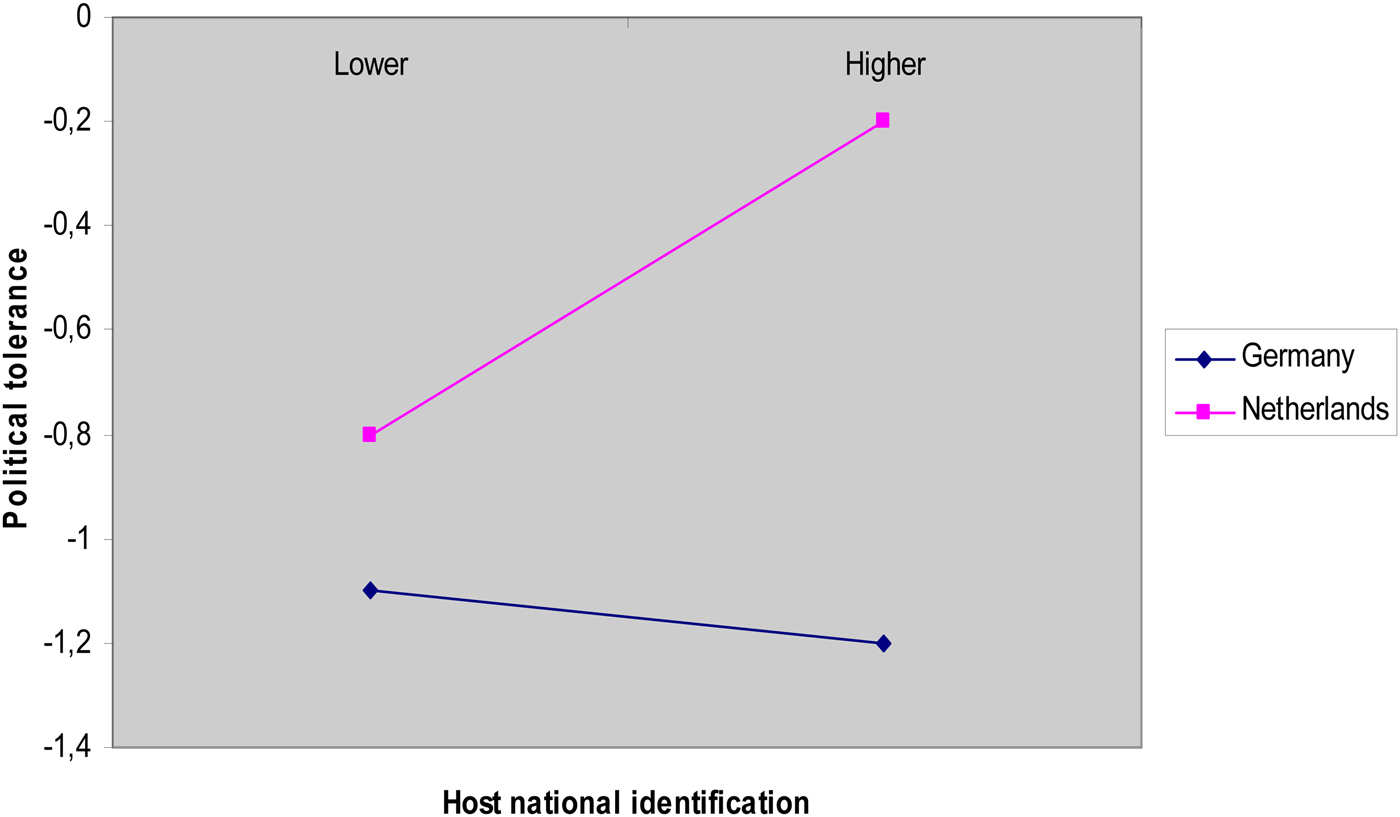
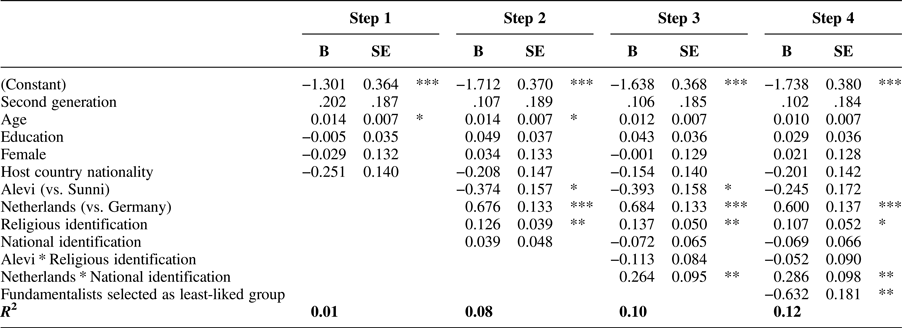
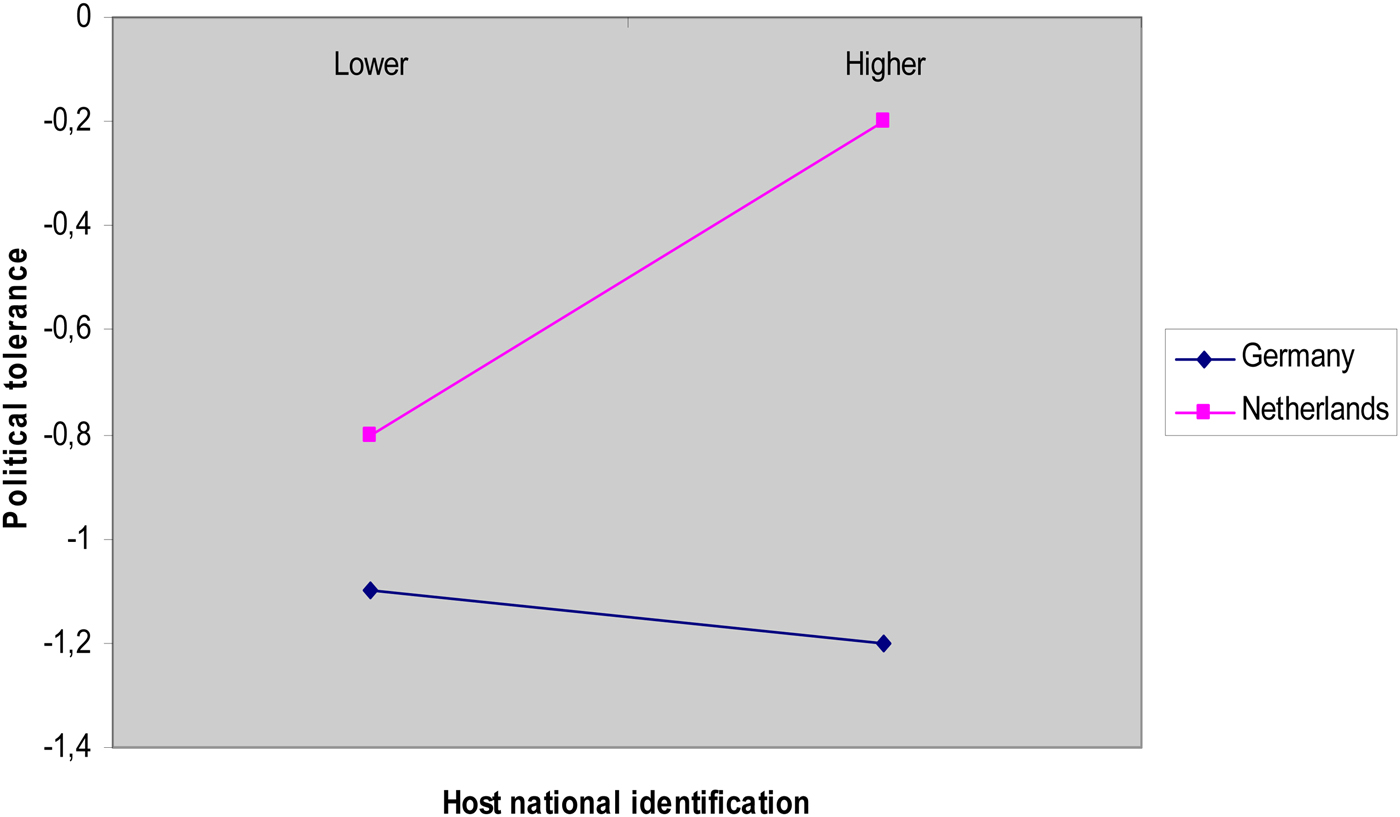
In the first step in a regression analysis, we included standard demographic characteristics for political tolerance: age in years, migration generation (0 = first, 1 = second), host country nationality (yes/no), gender and education (ranging from (1) no education to (8) tertiary education). As shown in Table 1, only age is related to tolerance, with older people exhibiting higher levels of political tolerance. In the second step we included Muslim subgroup, country of residence, religious group identification, and host national identification as predictors. In addition to the significant effects of religious subgroup and country of residence discussed, stronger religious identification was associated with higher tolerance. National identification was not associated with the level of tolerance. In a third step, the interactions between Muslim group and religious group identification and between country and host national identification were added to the regression equation, in order to test our expectations on subgroup and country differences. Only the latter interaction is significant. As can be seen in Figure 1, stronger host national identification is associated with higher tolerance in the Netherlands (ß = 0.19, p = 0.001), but not in Germany (ß = −0.01, p = 0.88). Religious identification has similar beneficial effects for Sunni and Alevi Muslims when it comes to political tolerance, given the positive main effect and insignificant interaction term.
(Color online) Simple slope analysis of the interaction of national identification with country of residence on political tolerance of Muslim immigrants from Turkey.
Regression analyses predicting political tolerance of Muslim immigrants from Turkey.

*** p < 0.001; ** p < 0.01, * p < 0.05.
Differences in the Least-Liked Group
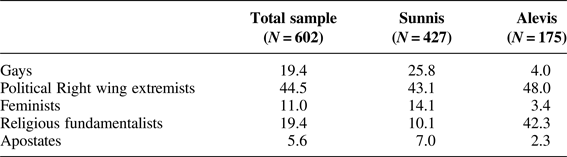
To further understand the unexpected lower tolerance of Alevi compared to Sunni Muslims we considered the specific least-liked group selected.Footnote 6 As shown in Table 2, Alevi and Sunni Muslims equally (χ2(1, N = 602) = 1.21, p = 0.27) and most frequently (44.5%) selected right-wing extremists as the least-liked group. However, many Alevis selected religious fundamentalists as their least-liked group, whereas this choice was rare among Sunnis (42.3% versus 10.1%; χ2(1, N = 602) = 82.27, p < 0.001). Sunnis on the other hand were more likely than Alevis to choose gays (χ2(1, N = 602) = 44.94, p < 0.001), feminists (χ2(1, N = 602) = 14.35, p < 0.001), and apostates (χ2(1, N = 602) = 5.23, p < 0.05) as their least-liked group.
Least-liked group selection among Sunnis and Alevis (in percentages)

We examined whether Alevis are always less tolerant toward disliked groups or whether this depends on the target group. Because Alevis rarely selected gays, feminists, or apostates as least-liked groups (total n = 19), the tolerance toward these groups cannot be reliably compared to that of Sunnis. The difference in tolerance can be tested more reliably toward right-wing extremists and religious fundamentalists. A one-way ANOVA indicates that there is no significant difference in level of tolerance toward right-wing extremists between Sunnis (M = −1.05, SD = 1.77) and Alevis (M = −1.09, SD = 1.63), F(1, 266) = 0.04, p = 0.85. Yet, there is a strong group difference for tolerance of religious fundamentalists, F(1, 114) = 11.86, p < 0.001. Alevis score far below the midpoint when it comes to tolerance of fundamentalists (M = −1.94, SD = 1.45; t = −11.43, p < 0.001), whereas Sunnis score closer to, but still significantly below, the midpoint (M = −0.99, SD = 1.41; t = −4.61, p < 0.001).
Different Least-Liked Group, Different Tolerance Level?
Does the fact that Alevis choose a different least-liked group explain the difference in tolerance between Sunnis and Alevis? We tested this in a regression analysis in which we included a dummy variable indicating the choice for fundamentalists as the least-liked group as compared to all other groups (Step 4, Table 1). Including this variable resulted in the disappearance of the subgroup difference. Thus, Alevis are more likely to choose fundamentalists as least-liked group, and this explains their overall lower tolerance. This suggests that the strong anti-fundamentalist attitude among many Alevis explains their lower levels of tolerance.
Additional analyses: Religious identification and least-liked group
We additionally examined whether the positive relationship between religious identification and tolerance depends on the least-liked group selected. This turned out not to be the case because all interactions between religious identification and selected group were not significant (p s > 0.05). Furthermore, this was true both for Sunnis and Alevis because no significant three-way interactions were found (p s > 0.05). Finally, the effect of religious identification holds across educational levels, generations, and for men and women (p s > 0.05). These results indicate the robustness of the positive effect of religious group identification on political tolerance.
DISCUSSION
Using the least-liked group approach, we examined political tolerance among Sunni and Alevi Muslims from Turkey living in Germany and the Netherlands. In general we found a relatively low level of tolerance, going in the direction of not accepting the least-liked group to hold public office, teach in schools, make public speeches, and hold public rallies (64% intolerant). Although no fully comparable data are available, the level of political tolerance seems somewhat lower compared to native populations in Europe. For example, around 50% of the Dutch population agreed that members of their least-liked group should be banned for public office and should not be allowed to teach in public schools, and 45% agreed that they should not be allowed to hold public rallies.Footnote 7 Furthermore, in a cross-national European study around 40% of the population was not willing to grant political liberties to ethnic minorities (Weldon Reference Weldon2006).
Despite their more humanistic and liberal interpretation of Islam, Alevi compared to Sunni participants turned out to be less tolerant. This denominational difference was due to the choice of the least-liked group. Alevis were much more negative toward religious fundamentalists than Sunnis. They more often selected this group as their least-liked one and their level of intolerance toward this group was high. Perceived threat is one of the most important reasons for political intolerance (Gibson Reference Gibson2006a). Alevis in Western Europe and Turkey tend to define their identity in terms of a continuous historical struggle against the suffering and violence from Islamic fundamentalism (Sökefeld Reference Sökefeld2008; Van Bruinissen 2007; Yildiz and Verkuyten Reference Yildiz and Verkuyten2012). Alevi identity would be denied and oppressed by the dogmatic and intolerant character of Islamic fundamentalism leading to intolerance of the perceived intolerant fundamentalists.
Threat and perceived intolerance might also be the reason why most of the Alevis and the Sunnis selected right wing extremist groups as their least-liked group and that their level of intolerance toward these groups was similar. These groups tend to stigmatize and demonize Islam and threaten the rights and identity of Muslim immigrants (Alexander 2013; Verkuyten Reference Verkuyten2013). Thus it can be argued that the participants were intolerant toward this threatening political “enemy.” Future studies should examine this more closely by including a measure of perceived threat.
We did not only examine the difference between the two Muslim subgroups but also the role of religious group identification. Previous research has examined the support for democracy and political tolerance in relation to religious belief and religious social behavior and considered religious belonging in terms of denominational affiliation only (Bloom and Arikan Reference Bloom and Arikan2012; Reference Bloom and Arikan2013b; Karpo Reference Karpov2002). Furthermore, while some studies indicate that religious belonging is associated with higher intolerance (e.g., Wilcox and Jelen Reference Wilcox and Jelen1990) others have suggested that this is not the case (e.g., Eisenstein Reference Eisenstein2006). Drawing on the social identity perspective (Turner and Reynolds Reference Turner and Reynolds2001), we moved beyond religious group membership and focused on religious group identification. Group identification implies that beliefs and values that characterize one's religious group become normative so that people start to think, feel, and act in terms of the way that their group is understood. Alevi belief is characterized by humanistic and liberal values, and for Alevi participants' higher religious group identification was found to be associated with higher political tolerance. Interestingly, the same positive association was found for the Sunni participants. Thus, there was no evidence for the reasoning that higher Sunni identifiers were less tolerant because they more strongly adopt Islamic orthodox beliefs and practices. The meaning and interpretation of Sunni Islam is complex and, like all religions, also teaches love for and acceptance of others (Armstrong Reference Armstrong1994). This might explain why Sunni individuals who identify more strongly with their religious group are more tolerant. In a study among Sunni Muslims in the Netherlands it also was found that stronger religious group identification was associated with higher tolerance of dissenting beliefs (Grundel and Maliepaard Reference Grundel and Maliepaard2012), and a study among British Muslims found that higher religious identification was associated with stronger trust in parliament and local councils (Maxwell Reference Maxwell2010). These findings suggest that Muslim identity does not have to be contradictory to democratic values and principles (Esposito and Mogahed Reference Esposito and Mogahed2007). This does not mean, however, that more orthodox Sunni Muslim beliefs and stronger involvement in orthopraxis cannot be associated with higher political intolerance (i.e., salafism). Across countries Bloom and Arikan (Reference Bloom and Arikan2012) found for Muslims that religious belief as well as participation in collective religious activities was negatively associated with support for democracy. Islam can be interpreted and used to justify intolerance of dissenting beliefs and practices and there can be internal pressures to conform to these interpretations (Ryan et al. Reference Ryan, Rigby and King1993; Martinovic and Verkuyten Reference Martinovic and Verkuyten2012). Thus, future studies should examine religious beliefs and practices in addition to religious group identification.
Participants living in the Netherlands were more tolerant than those living in Germany. Turkish Muslims in these two countries have a similar history of labor migration and occupy similar socioeconomic positions (see e.g., Kogan Reference Kogan2006; Vermeulen and Penninx Reference Vermeulen and Penninx2000). However, the public recognition and acceptance of Islam and Islamic organizations is lower in Germany than in the Netherlands. In contrast to Germany, where Islamic organizations remain marginalized relative to established churches (Fetzer and Soper Reference Fetzer and Soper2005), the Dutch history of a multi-faith society and its tradition of pillarization have offered Islamic organizations the same rights as other religious organizations. Gradual adaptation to the mainstream might explain why the level of political tolerance of the Turkish Muslims was higher in the Netherlands than in Germany. Furthermore, we found that stronger host national identification was related to higher tolerance in the Netherlands but not in Germany. In line with the social identity perspective (Turner and Reynolds Reference Turner and Reynolds2001), this indicates that a stronger sense of host national belonging is only associated with higher tolerance when tolerance is perceived to be characteristic of and therefore normative for the host society.
Whereas we found clear differences in political tolerance between the two Muslim subgroups and between the two countries, there were no systematic differences for gender, migration generation, and education. This might be related to the use of the least-liked-group approach in which participants select the group that they dislike most. Sullivan et al. (Reference Sullivan, Piereson and Marcus1982) also found no clear or strong gender, age, education, or generation differences in tolerance (but see Golebiowska 1990; Soleto Reference Soleto1999). Such differences might manifest themselves in the selection of the least-liked group but not necessarily in the degree of tolerance towards this group. Future studies should examine possible demographic differences among Muslims further by using other measures of political tolerance.
There are some limitations that should be considered and that give additional suggestions for further study. For example, the non-representative sample and the cross-sectional design do not allow us to draw general and causal conclusions. It is not possible to draw a representative sample of Sunni and Alevi Dutch or German Muslims, and although it is rather difficult to collect data among this group we succeeded in involving a relatively large and demographically diverse group of participants. Yet, some form of selectivity is likely, also because the questions were asked in the host language. Although the great majority of Turkish immigrants is able to speak and read German/Dutch (Dagevos et al. Reference Dagevos, Euwals, Gijsberts and Roodenburg2006) some subgroups (older members of the first generation) are not. This selectivity probably implies that we did not reach the most segregated Turkish Muslims. This can have implications for the mean levels of tolerance and of religious and national identification but not necessarily for the associations between the measures. Future studies should improve the sample to investigate this. These studies could also try to include comparison groups of religious and non-religious natives and collect longitudinal data in order to examine the impact of religious and host national identification on political tolerance. In doing so it would be useful to consider other dimensions of religiosity like religious belief, religious practices and involvement in the religious community because this would give a more detailed and comprehensive understanding of the relationship between aspects of Muslim identity and political tolerance (Bloom and Arikan Reference Bloom and Arikan2012; Djupe and Calfano Reference Djupe and Calfano2012).
Furthermore, future research could consider methods other than the least like group approach for measuring political tolerance among Muslim migrants. The advantage of this measure is that it is “content controlled” or conceptually equivalent: each respondent is asked about his or her most disliked group which means that there is antipathy towards the target group which is a requirement for tolerance. However, the least-liked group measure depends on the target groups listed. In the current study we were interested in target groups that are central in public debates about Muslim immigrants' alleged intolerance (Modood and Ahmad Reference Modood and Ahmad2007; Sniderman and Hagendoorn Reference Sniderman and Hagendoorn2007) and therefore we presented the participants with five target groups that have a controversial status within Muslim communities. Yet, the findings might differ if another set of target groups was presented to the participants. Furthermore, there is not always a strong association between the least-liked group measure and measures that ask explicitly about specific groups and specific activities (Gibson Reference Gibson1992). A comparison between these measures has not been made for Muslim immigrants and it is therefore possible that a different measure would yield somewhat different results.
Despite these qualification and limitations, the present research makes a novel and timely contribution to our understanding of political tolerance among Muslim migrants living in Western Europe. Immigration and diversity debates in Europe revolve primarily around Islam (Zolberg and Long Reference Zolberg and Long1999) and the question of the incorporation of Islam within liberal democracy is at the heart of what is perceived as a “crisis of multiculturalism” (Modood and Ahmad Reference Modood and Ahmad2007). Political tolerance is a key condition for civic engagement and democracy. From a democratic consensus perspective it does not only involve the acceptance of Islamic practices and rights by the native majority population but also the acceptance of disliked groups by Muslim migrants. This is more difficult when these disliked groups themselves are seen as intolerant and threatening, like right wing extremists (for Sunnis and Alevis) and religious fundamentalists (for Alevis). The low level of tolerance that we found and the higher intolerance of the Alevis compared to the Sunnis is most likely due to this tolerance paradox. Importantly, we also found that stronger religious group identification is associated with higher tolerance. Thus, stronger attachment to Islam does not have to go together with less tolerance, as commonly assumed in public and political debates, but rather can stimulate the acceptance of the rights of others. Political tolerance was also found to be lower in Germany than the Netherlands and in the latter country tolerance was positively associated with host national identification. This shows that it is not only Islamic belief and Muslim group identification that are important for political tolerance but also the host national context in which Muslim immigrants find themselves.