Perfectionistic Automatic Thoughts (PAT) are known as ruminations based on the belief that perfection can and should be achieved (Flett et al., Reference Flett, Hewitt, Blankstein and Gray1998), as well as on mistakes made or one’s own defects (Flett et al., Reference Flett, Hewitt, Blankstein and Gray1998). Different studies have observed three dimensions that encompass PAT. These factors are Perfectionistic Strivings (reflections based on an excessive sacrifice towards the achievement of perfection), Perfectionistic Demands (self-improvement judgments) and Perfectionistic Concerns (cognitions based on the execution of a task and the concerns regarding making a mistake in its performance) (Esteve-Faubel et al., Reference Esteve-Faubel, Aparicio-Flores, Vicent, Gonzálvez, Sanmartín and García-Fernández2020; Stoeber et al., Reference Stoeber, Kobori and Brown2014). The importance of PAT research resides in the fact that it is a perfectionism component that is highly detrimental to the psychological well-being of individuals. In fact, research has revealed the positive relationship that exists between PATs and emotional sensitivity (Kirtley et al., Reference Kirtley, O’Connor and O’Carroll2015), pessimism (Žitniaková-Gurgová, Reference Žitniaková-Gurgová2011), neuroticism (Flett et al., Reference Flett, Molnar, Nepon and Hewitt2012), anxiety (Flett et al., Reference Flett, Hewitt, Blankstein and Gray1998), depression (Flett et al., Reference Flett, Nepon, Hewitt and Fitzgerald2016), psychological distress, negative automatic thoughts (Flett et al., Reference Flett, Hewitt, Blankstein and Gray1998) and stress (Flett et al., Reference Flett, Hewitt, Blankstein and Gray1998, Reference Flett, Molnar, Nepon and Hewitt2012, Reference Flett, Nepon, Hewitt and Fitzgerald2016). Downey et al. (Reference Downey, Reinking, Gibson, Cloud and Chang2014) observed a greater presence of PAT in females than in males. According to the authors, these results may be due to social pressure to be perfect and maintain a perfect body.
The PAT construct has been extensively investigated from the clinical point of view, considering the relationship between this variable and other maladaptive variables such as those indicated above. However, it would be of interest to know what the link is between PAT and other adaptive variables, such as Emotional Intelligence and Dispositional Empathy.
For Mayer et al. (Reference Mayer, Caruso and Salovey2016), Emotional Intelligence is defined as the ability to adapt emotions to different ordinary situations, being able to perceive, estimate, regulate and express one's own emotional state and that of others, which entails an adequate ability to channel information and to solve problems. Therefore, Emotional Intelligence refers to inter- and intrapersonal skills (Mayer et al., Reference Mayer, Caruso and Salovey2016), that is, it is linked to social and personal experiences (Gómez-Núñez et al., Reference Gómez-Núñez, Torregrosa, Inglés, Lagos-San Martín, Sanmartín, Vicent and García-Fernández2020). Emotional Intelligence is a variable of great interest as it is positively linked to happiness, well-being and social development (Fernández-Berrocal & Extremera, Reference Fernández-Berrocal and Extremera2009). Likewise, it has a fundamental role in the self-regulation of emotions and in the socialization of individuals (Mayer et al., Reference Mayer, Roberts and Barsade2008). Similarly, there is a positive relationship between Emotional Intelligence and Empathy (Mayer et al., Reference Mayer, Roberts and Barsade2008).
Emotional Intelligence comprises three components: Perception (the ability to feel and adequately express the feelings of an individual), Comprehension (the ability to understand the emotional state in which a person is) and Repair (the ability to regulate emotions towards an adaptive state) (Fernández-Berrocal et al.,Reference Fernández-Berrocal, Extremera and Ramos2004). Regarding the differences based on gender, according to Fitness and Curtis (Reference Fitness and Curtis2005), women tend to present higher levels of Emotional Repair, while men tend to score higher in Perception.
On the other hand, Empathy, according to MacDonald and Price (Reference MacDonald and Price2019), is understood as the cognitive and emotional ability to put oneself in the place of the other. In the existing literature, there is a lack of consensus regarding the nature of empathy. Some authors consider it as a trait, while others as a state in a given situation (Preston & De Waal, Reference Preston and De Waal2002). In this sense, Situational Empathy refers to those specific situations or contexts that generate a greater or lesser burden of empathy. While Dispositional Empathy consists of the degree of empathy that individuals have regardless of the specific situation that occurs at a certain moment (Auné et al., Reference Auné, Abad and Attorresi2015). Dispositional Empathy is composed of four dimensions: Perspective Taking (ability to put oneself in someone’s place), Empathic Concern (tendency to present a feeling of compassion and concern for those things that affect other people), Fantasy (empathic propensity towards identifying imaginary characters or contexts) and Personal Discomfort (irritation and helplessness of the person when contemplating a negative situation) (Pérez-Albéniz et al., Reference Pérez-Albéniz, de Paul, Etxeberría, Montes and Torres2003). Regarding the differences based on gender, several studies showed higher scores in the four factors of Dispositional Empathy for females than for males (Fitness & Curtis, Reference Fitness and Curtis2005; Pérez-Albéniz et al., Reference Pérez-Albéniz, de Paul, Etxeberría, Montes and Torres2003), with the exception of Perspective Taking in studies such as that of Davis (Reference Davis1980).
PAT, Emotional Intelligence and Dispositional Empathy
Previous literature has found a negative link between Perfectionistic Concerns and Emotional Intelligence (Gong et al., Reference Gong, Fletcher and Paulson2017; Smith et al., Reference Smith, Saklofske and Yan2015). However, some authors, such as Chan (Reference Chan2009), found that individuals characterized by a healthy perfectionism (with high scores in Personal Standards, Parental Expectations and Organization, as well as with low levels in Parental Criticism, Doubts about Actions and Concerns over Mistakes) obtained higher Emotional Intelligence scores compared to the individuals considered non-perfectionists and the group with maladaptive perfectionism (characterized by high levels in all perfectionist dimensions).
On the other hand, although, to our knowledge, there are no previous studies that have analyzed the relationship between perfectionism and empathy, it seems that interpersonal relationships are not among the strengths of a perfectionist individual. It should be noted that individuals with high PAT present high levels of social anxiety (Esteve-Faubel et al., Reference Esteve-Faubel, Aparicio-Flores, Vicent, Gonzálvez, Sanmartín and García-Fernández2020). Likewise, other-oriented perfectionism and socially prescribed perfectionism are associated with social disconnection and hostility (Stoeber et al., Reference Stoeber, Noland, Mawenu, Henderson and Kent2017). However, Stoeber and Yang (Reference Stoeber and Yang2016) observed how high personal standards, as well as concern over mistakes, were positively correlated with perfectionism based on moral attitudes.
It is noteworthy that the studies observed so far on Perfectionism and Emotional Intelligence have been analyzed from a multidimensional perfectionism perspective and not from a PAT perspective. Moreover, the relationship between Dispositional Empathy and perfectionism has not been investigated, nor from a multidimensional perfectionism perspective nor from the PAT perspective. Therefore, it is of interest to find what the link is between PAT and both variables.
The main objective of the present study is to analyze the relationship between PAT and Emotional Intelligence and Dispositional Empathy. This general objective is specified in: (a) examining the relationships based on gender in the way in which PATs are linked to Emotional Intelligence and Dispositional Empathy; (b) analyze the possible existence of clusters with different PAT intensity; and (c) observe whether there are statistically significant differences between the clusters of different PAT intensity in Emotional Intelligence and Dispositional Empathy.
Method
Participants
The initial sample, selected based on accessibility criteria, was composed of 705 participants, of which 14 (1.99%) declined taking part in the study. Thus, the final sample was composed of 691 university students enrolled in the Early Childhood Education Teaching (N = 328) and Primary Education Teaching (N = 363) degrees of two universities in the southeast of Spain. The participants were between 20 and 41 years old (Mage = 23.1; SD = 5.26), and 70.7% were women. Likewise, the educational level of the parents was recorded, which yielded that 20.40% of the parents had studies in Primary Education, 57.77% had studies in Secondary Education, 15.41% had university studies, and 7.42% of the participants did not report the educational level of their parents. Similarly, regarding the ethnicity of the participants, the sample was composed of Spanish (94.65%), South American (3.04%), European (1.74%), Arab (0.43%) and Asian (0.14%) students.
Instruments
Perfectionism Cognitions Inventory (PCI; Flett et al., Reference Flett, Hewitt, Blankstein and Gray1998). The version translated into Spanish of the PCI (Esteve-Faubel et al., Reference Esteve-Faubel, Aparicio-Flores, Vicent, Gonzálvez, Sanmartín and García-Fernández2020) is a Likert-type scale with 5 response options (1 = Not at all; 5 = All the time) that comprise 17 items which measure the assiduity of PAT across 3 dimensions: I. Perfectionistic Strivings, composed of 7 items that evaluate judgments based on excessive sacrifice to achieve perfection (e.g.: I can always do better, even if things are almost perfect); II. Perfectionistic Demands, composed of 4 items that measure self-improvement thoughts (I should be doing more); and III. Perfectionistic Concerns, with 6 items that evaluate reflections based on the divergence between executing a task and the anxiety of the negative evaluation that it can entail considering the excessively high performance goals set by the individual (e.g.: Why can I not be perfect?). The scale shows, in the present work, adequate reliability indices both for the total and for all its dimensions, respectively (α = .89, .84, .70, and .83).
Trait Meta-Mood Scale (TMMS-24; Fernández-Berrocal et al., Reference Fernández-Berrocal, Extremera and Ramos2004). The TMMS–24 is the Spanish version that measures Emotional Intelligence through a scale of 24 items with a Likert-type response (1 = Strongly disagree; 5 = Strongly agree). The TMMS–24 is composed of three dimensions: I. Perception (e.g.: I pay close attention to feelings), composed, in turn, of 8 items that assess the ability to feel and adequately express the person's feelings; II. Comprehension (e.g.: I almost always know how I feel), which is composed of 8 items that assess the ability to understand emotional states; and III. Repair (e.g.: Although I sometimes feel sad, I usually have an optimistic perspective), with 8 items related to the ability to adaptively regulate emotional states. The reliability levels for this scale, in the present study, were adequate for all dimensions respectively (α = .89, .90, .85).
Interpersonal Reactivity Index (IRI; Pérez-Albéniz et al., Reference Pérez-Albéniz, de Paul, Etxeberría, Montes and Torres2003). The IRI, in the Spanish version adapted by Pérez-Albéniz et al. (Reference Pérez-Albéniz, de Paul, Etxeberría, Montes and Torres2003), is a Likert-type scale with 5 response options (0 = It does not describe me well; 4 = It describes me very well) and composed of 28 items that measure Dispositional Empathy across four dimensions: I. Perspective taking, with 7 items that measure the ability to put oneself in the place of the other (e.g.: Sometimes, I try to understand my friends better by imagining how they see things from their perspective); II. Fantasy, with 7 items that evaluate the empathic tendency to identify with imaginary characters or situations (e.g.: When I am reading an interesting novel or story, I imagine how I would feel if what happens in the story were to happen to me); III. Empathic concern, with 8 items that measure the propensity to feel compassion and concern for the situations of others (e.g.: When I see someone being taken advantage of, I feel the need to protect them); and IV. Personal discomfort, composed of 6 items based on the discomfort and helplessness of the individual when viewing a negative scene (e.g.: I sometimes feel helpless when I am in the middle of a very emotional situation). The IRI reliability levels, in the present study, were acceptable for all its factors respectively (α = .72, .74, .69, .75).
Procedure
After holding a meeting with the teaching staff to present the study and its purpose, and request their collaboration and permission, the next step was to inform all the participants and request their consent.
Subsequently, the questionnaires were administered by the research team and the help of the teaching staff, collectively in the classroom, respecting anonymity and voluntary participation in the study. The tests were administered in a 30-minute session.
Data Analyses
Firstly, descriptive analyses were carried out, calculating the mean (M) and the standard deviation (SD) for all the variables considered in the study, as well as the Pearson's correlation coefficients between PAT and Emotional Intelligence and Dispositional Empathy according to gender.
To identify clusters with different PAT intensity, a cluster analysis was carried out with a non-hierarchical method (quick cluster analysis) (Hair et al., Reference Hair, Anderson, Tatham and Black1998). Next, to observe the differences in Emotional Intelligence and Dispositional Empathy between the different PAT clusters, an analysis of variance (ANOVA) was performed and the Bonferroni test was used for the post-hoc comparisons.
To check the magnitude of the differences between pairs of variables, the d index (standardized mean difference) was used. Its interpretation was carried out under the recommendations of Cohen (Reference Cohen1988), who estimated scores between .20 and .49 for a small effect size, scores between .50 and .79 for a moderate effect size, and scores greater than .80 for a large effect size.
The analyses were carried out with the SPSS 20 statistical program.
Results
Descriptive Statistics and Correlations between Factors according to Gender
Table 1 shows the means and standard deviations for the total scores and the dimensions of PAT, Emotional Intelligence and Dispositional Empathy.
Total Descriptive Statistics for PAT, EI and DE

Note: M = Mean; SD = Standard deviation; PAT = Perfectionistic Automatic Thoughts; EI = Emotional; Intelligence; DE = Dispositional Empathy.
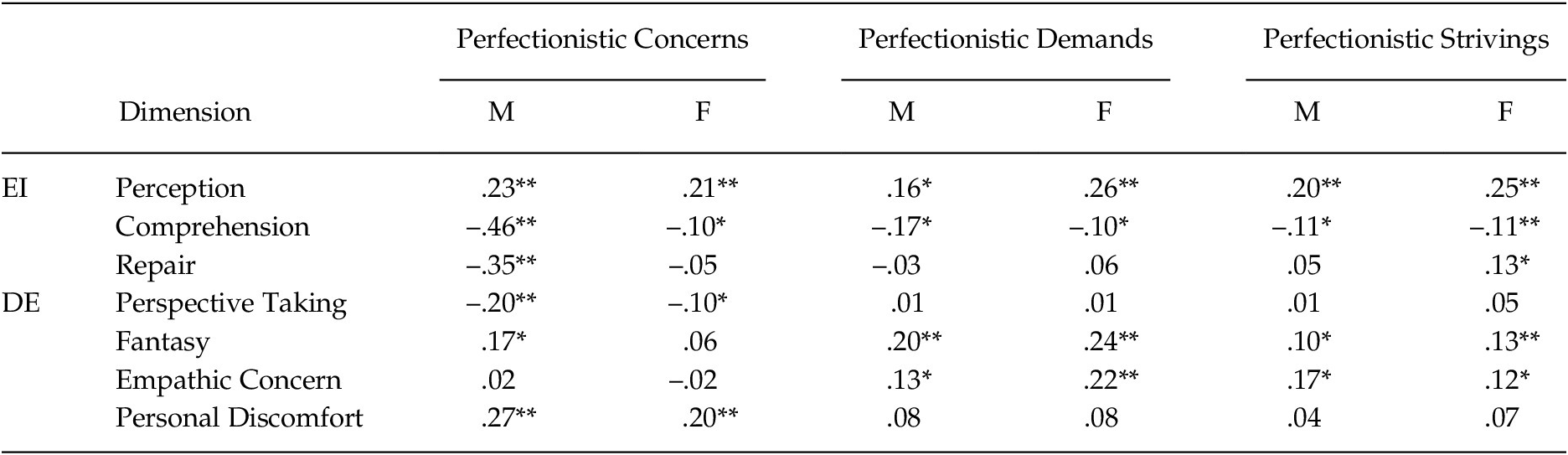
As can be seen in Table 2, the correlations between the Perfectionistic Demands factor and the dimensions of Emotional Intelligence and Dispositional Empathy were of the same magnitude and in the same direction for both genders. Similarly, in Perfectionistic Strivings, the correlations were also in the same direction and with similar effect sizes for both genders, except for the correlations for the Repair dimension, with a small magnitude for the sample of women while, in men, it was insignificant. Regarding the Perfectionistic Concerns factor, again correlations in the same direction and magnitude were obtained for both genders, with the exception of the dimensions of Comprehension, Repair and Fantasy. Specifically, in the case of Comprehension, negative and significant correlations were obtained for both genders, although the magnitude of these correlations was moderate in the case of men and small in the case of women. Regarding the dimensions of Repair and Fantasy, significant correlations were obtained in the sample of men, and non-significant correlations in the case of women.
Correlations between the PAT Factors and the Dispositional Empathy and Emotional Intelligence factors according to gender

Note: EI = Emotional intelligence; DE = Dispositional Empathy; M = Male; F = Female
*p < .05. **p < .01
Perfectionistic Automatic Thoughts Clusters
The cluster analysis differentiated three clusters with different degrees of PAT with respect to each of its dimensions (see Figure 1).
Cluster with PAT
Note. LPAT = Low Perfectionistic Automatic Thoughts; MPAT = Moderate Perfectionistic Automatic Thoughts; HPAT = High Perfectionistic Automatic Thoughts; PS = Perfectionistic Strivings; PD = Perfectionistic Demands; PC = Perfectionistic Concerns.

Group 1, with 122 future teachers (17.65%), was characterized by low scores in Perfectionistic Thoughts, Demands and Strivings, which is why it was named as a group with Low Perfectionistic Automatic Thoughts (Low PAT). Group 2, with 273 university students (39.51%), was composed of moderate scores in the three dimensions of PAT, which is why the group was labeled as the Moderate Automatic Perfectionistic Thoughts (Moderate PAT) group. Group 3, with 296 students (42.84%), was characterized by high scores in the three dimensions that encompass PAT. Thus, it was labeled as a group with High Automatic Perfectionistic Thoughts (High PAT).
Inter-group Differences
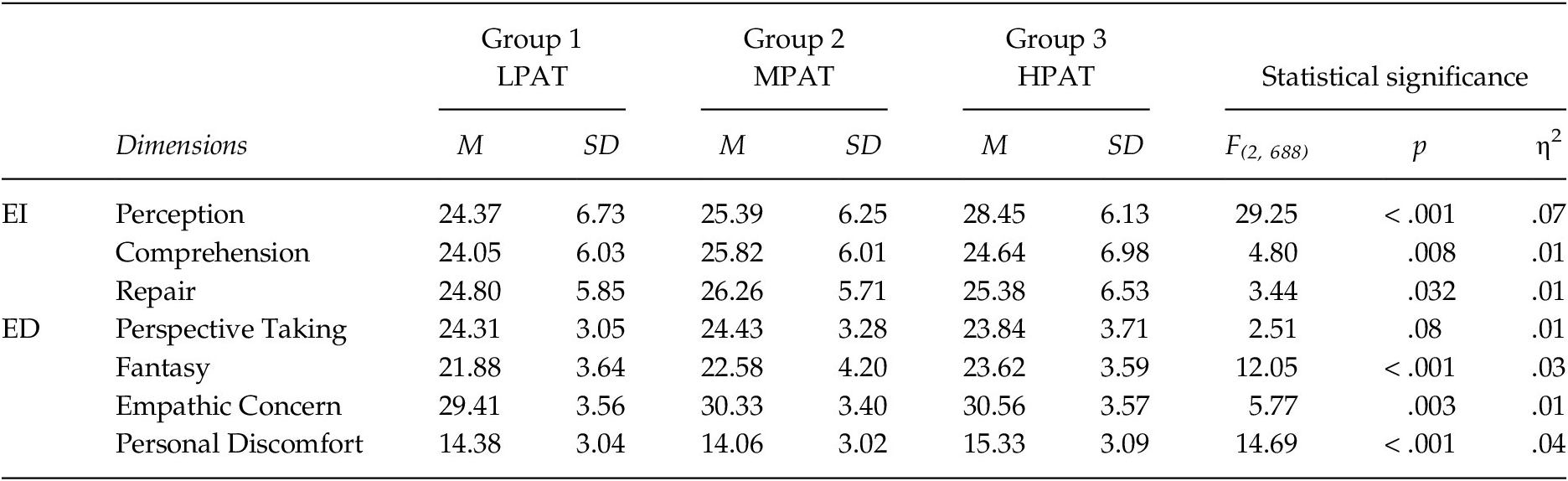
The results of the ANOVA analyses of variance showed statistically significant differences between the PAT groups as a function of all the Emotional Intelligence dimensions, as well as in Dispositional Empathy, except for the Perspective Taking dimension (see Table 3).
Differences between the PAT profiles in the dimensions of Dispositional Empathy and Emotional Intelligence

Note: LPAT: Low Perfectionistic Automatic Thoughts; MPAT: Moderate Perfectionistic Automatic Thoughts; HPAT: High Perfectionistic Automatic Thoughts; EI = Emotional Intelligence; DE = Dispositional Empathy.
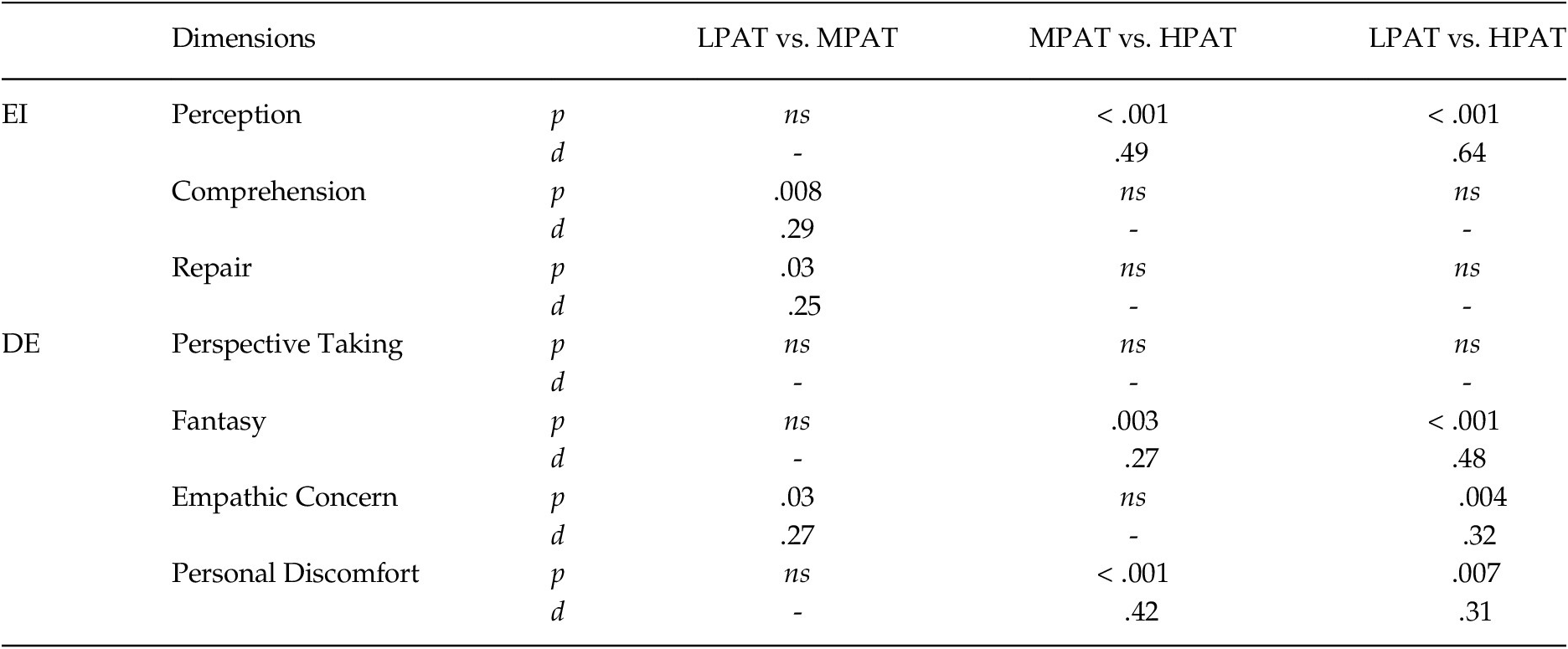
Table 4 shows the post-hoc comparisons (Bonferroni test) between the clusters that present low, moderate and high levels of PAT, based on the scores obtained by each profile in the dimensions of both Dispositional Empathy and Emotional Intelligence.
Cohen’s index for post hoc contrasts between PAT profiles and the dimensions of Empathy and Emotional Intelligence

Note. LPAT = Low Perfectionistic Automatic Thoughts; MPAT = Moderate Perfectionistic Automatic Thoughts; HPAT = High Perfectionistic Automatic Thoughts; EI = Emotional Intelligence; DE = Dispositional Empathy.
As can be observed, the High PAT group scored significantly higher than the Low PAT group in all dimensions of Dispositional Empathy, except for Perspective Taking, as well as in the Perception of Emotional Intelligence dimension. Similarly, the High PAT group also scored significantly higher in the dimensions of Fantasy, Personal Discomfort and Perception, compared to the Moderate PAT group. On the other hand, the Low PAT group reported significantly lower levels than the Moderate PAT group in Empathic Concern, Comprehension and Repair. The magnitude of these differences was in all cases of small size (d = .27, .49) with the exception of the contrasts between the Low PAT and High PAT groups, whose effect sizes were moderate (d = .64).
Discussion
The main objective of the present study was to determine different PAT profiles across university students, as well as to observe whether there are significant differences between the different clusters according to Emotional Intelligence and Dispositional Empathy.
Similarly, this study also set out to analyze the correlations between PATs and Dispositional Empathy and Emotional Intelligence as a function of gender. The results suggest that there are no differences between men and women in the way in which PATs are linked to most of the dimensions of Emotional Intelligence and Dispositional Empathy. However, gender differences were found for the association between Perfectionistic Strivings and Emotional Repair. Specifically, the results suggest that this link is greater in women than in men, in line with Fitness and Curtis’ study (Reference Fitness and Curtis2005) who found that women scored significantly higher than men in Repair. On the contrary, with regard to Perfectionistic Concerns, the results of the correlational analysis suggest that the nexus, in a negative sense, between this dimension of PAT and Emotional Comprehension and Repair is stronger in the case of males than in the sample of females. These results are also in line with Fitness and Curtis’ study (Reference Fitness and Curtis2005), which attributes higher levels of Emotional Perception to men than to women. Similarly, Perfectionistic Concerns correlated significantly with Fantasy in the male sample, as well as non-significantly in the female sample. In other words, these findings suggest that these ruminations based on concerns to achieve perfection obtain higher levels of Fantasy in men.
On the other hand, three PAT clusters labeled as Low PAT, Moderate PAT and High PAT were identified as being characterized by low, moderate and high levels of PAT, respectively. The cluster with the highest prevalence was the High PAT, followed by the Moderate PAT. It is noteworthy that Esteve-Faubel et al.’s (Reference Esteve-Faubel, Aparicio-Flores, Vicent, Gonzálvez, Sanmartín and García-Fernández2020) study found, in the same way, three profiles of individuals with different intensity of PAT, based on low, moderate and high rumination of perfection. In this way, the present study replicates the results found in the previous literature. Taking into account the close relationship between PAT and various variables of a maladaptive nature (Flett et al., Reference Flett, Hewitt, Blankstein and Gray1998, Reference Flett, Nepon, Hewitt and Fitzgerald2016), and considering that the profile with high levels of perfectionistic ruminations accounted for more than 40% of the sample of this study, it is of interest to continue research in this regard in order to prevent possible at risk profiles.
On the other hand, the results observed in this study show statistically significant differences between the PAT profiles for all the dimensions of Emotional Intelligence and Dispositional Empathy, except for Perspective Taking. Specifically, the High PAT group obtained the highest mean scores, except for the factors of Comprehension and Repair in the Emotional Intelligence dimension, in which the scores were higher for the Moderate PAT group. On the contrary, the Low PAT group obtained the lowest mean scores in Emotional Intelligence and Dispositional Empathy, except for the Personal Discomfort factor.
Regarding the post-hoc comparisons between the clusters with Low PAT, Moderate PAT and High PAT and Emotional Intelligence, it is observed that the profile with High PAT scored higher in Emotional Perception compared to the Moderate PAT and Low PAT groups. In this sense, it is observed that Emotional Perception increases as PAT increases. It should be noted that this factor of Emotional Intelligence evaluates the ability to observe, feel, reflect and express those experiences of emotions and feelings of the person (Fernández-Berrocal et al., Reference Fernández-Berrocal, Extremera and Ramos2004), which would be beneficial if those emotions were positive, but it would be harmful if those feelings and reflections were negative, as would be the case in the high PAT profile (Flett et al., Reference Flett, Hewitt, Blankstein and Gray1998). Although this is, to our knowledge, the first study that has examined the relationship between PATs and Emotional Intelligence, these results are in line with those obtained by previous research that has analyzed the link between Emotional Intelligence and rumination. On the one hand, Fernández-Berrocal et al. (Reference Fernández-Berrocal, Extremera and Ramos2004) observed how Emotional Perception positively correlated with depression and ruminative responses, but not the dimensions of Emotional Comprehension and Repair. These results suggest that paying excessive attention to our own emotions has maladaptive consequences and can lead to perfectionistic ruminations. In fact, Chan (Reference Chan2009), confirming these findings, although from a study on profiles based on multidimensional perfectionism, observed how the group with a healthy perfectionism obtained higher scores in Emotional Intelligence, followed by the maladaptive group, with the non-perfectionist group being the group that obtained the lowest levels in Emotional Intelligence. However, this conclusion is contrary to other studies that measure Emotional Intelligence and Perfectionistic Concerns, which suggest that the effect between both constructs is negative (Gong et al., Reference Gong, Fletcher and Paulson2017; Smith et al., Reference Smith, Saklofske and Yan2015).
On the contrary, the Moderate PAT profile is the group with the highest Emotional Comprehension and Repair, although it did not differ significantly from the High PAT group. Individuals with PAT present great psychological distress when contemplating the divergence between their real self and their ideal self (Flett et al., Reference Flett, Hewitt, Blankstein and Gray1998). However, constantly ruminating between how they perform each action and its result is not only carried out in terms of physical tasks, but also for academic, social and emotional performance, and, as can be seen in this study from the variables of Dispositional Empathy, also moral performance. These excessive thoughts towards the attainment of perfection require constant perception, which in many cases differs from reality (Flett et al., Reference Flett, Hewitt, Blankstein and Gray1998). It should be noted that Emotional Perception is that first step to establish adequate cognitive-emotional processing. That is, if emotions are not perceived properly, it will be difficult to accurately comprehend and repair them (Palomera et al., Reference Palomera, Salguero and Ruiz-Aranda2012).
The degree of specificity with which emotions are perceived is revealed as an indicator of well-being and a factor that explains the level of psychosocial adjustment (Palomera et al., Reference Palomera, Salguero and Ruiz-Aranda2012), and although high evaluative concerns are harmful to the Emotional Intelligence of an individual (Gong et al., Reference Gong, Fletcher and Paulson2017; Smith et al., Reference Smith, Saklofske and Yan2015), it has been shown that individuals with high personal standards master how to use emotions to increase problem-solving abilities (Gong et al., Reference Gong, Fletcher and Paulson2017). However, it is necessary to take into account that the approach that individuals with PAT have, often lacking in reality, even obscures the perception they have about themselves. The fact of observing a greater comprehension of their emotions shows, in this specific case, the constant habit of working towards their emotional self-knowledge. However, this reiterated self-judgment clouds the appreciation they have themselves regarding their own ability for real comprehension and repair, being a double-edged sword when they confront reality again. In fact, if attention is paid to the correlations between PAT and Comprehension as a function of gender, it is possible to observe that they are in all cases significant correlations in the negative sense. Likewise, if attention is placed on Repair, negative significance is only shown for the Perfectionistic Concerns in men and Perfectionistic Strivings in women, which have low magnitude correlations.
On the other hand, among the clusters with Low PAT, Moderate PAT and High PAT and the Dispositional Empathy factors, the results show significant differences in Fantasy between the Moderate PAT and High PAT groups, as well as between the Low PAT and High PAT clusters. In this regard, no previous studies have been found showing the relationship between Fantasy and PATs. However, according to Cerdá (Reference Cerdá2014), we can understand Fantasy as the ability of the human being that enables him/her to detach from the present, prelude the future, test various conclusions to various problems and create. Studies such as that of Scott et al. (Reference Scott, Yap, Francis and Schuster2014) show how this anticipatory behavior mediates the link between maladaptive perfectionism and social anxiety, being also beneficial for interventions in cognitive-behavioral therapies that reduce these psychopathological variables. Thus, Scott et al. (Reference Scott, Yap, Francis and Schuster2014) already showed association between fantasy thoughts and perfectionism, which would coincide with the results obtained in the present study for the relationship between Fantasy and PAT.
Likewise, differences are observed in Empathic Concern with regard to the contrasts between the Low PAT and Moderate PAT groups, as well as between the Low PAT and High PAT groups, showing greater concern for others with higher PATs. In the same way, the findings show significant differences in Personal Discomfort between the Moderate PAT and High PAT groups, and between Low PAT and High PAT, in both cases the group with High PAT being the one with the greatest Personal Discomfort. To our knowledge, there is a lack of previous studies that show the relationship between PAT and both factors of Dispositional Empathy. However, it should be noted that these dimensions of Empathy carry with them a concern for others when an unfavorable situation is observed. This suggests that people who are more empathetic and also have more Emotional Perception may be more sensitive to socially stressful problems or situations. That is, the fact of being more empathetic makes these individuals take responsibility for the problems of others. In this sense, the observed findings show that people who ruminate so much at a perfectionist level, not only worry about their problems, but also about the problems of others, which leads to greater rumination. In fact, it should be highlighted that Stoeber and Yang (Reference Stoeber and Yang2016) observed that personal standards and concern over mistakes correlate with moral perfectionism, known as the personality characteristic based on attitudes, virtues and moral judgments beyond general perfectionism. That is, this type of perfectionism assesses the moral standards that an individual sets for him/herself and the concern over committing a moral mistake, which on numerous occasions involves other people. Likewise, it is important to note that the scientific literature has shown that high levels of PAT positively correlate with emotional sensitivity (Kirtley et al., Reference Kirtley, O’Connor and O’Carroll2015), as well as with pessimism (Žitniaková-Gurgová, Reference Žitniaková-Gurgová2011), neuroticism and negative stress (Flett et al., Reference Flett, Molnar, Nepon and Hewitt2012).
This study has several limitations that should be addressed in future research. Firstly, its transversal nature prevents us from establishing causal relationships between the different constructs evaluated, so this aspect should be addressed in the future using longitudinal data. Secondly, the generalization of the results should be carried out with caution, as the sample used consisted of university students from the Teaching Degrees. Consequently, future studies need to replicate the work with samples of university students from other Degrees, as well as with adolescents, clinical populations and even across other cultures.
In conclusion, the present study's findings have important practical implications. On the one hand, they show three PAT profiles with different intensities, highlighting the fact that the group with High PAT was the most prevalent. It should be noted that PAT are ruminative reflections of an internal nature, and the fact of obtaining the highest prevalence in the group that presents High PAT reveals the importance of expanding the analysis on the construct, taking into account that its identification, on occasions, can be confusing as the High PAT group is the one that scores highest in Emotional Intelligence and Dispositional Empathy, as can be observed from the results of the present study. This fact can be a double-edged sword when observing findings related to adaptive variables with higher levels of PAT, if one is not aware of the maladaptive personality that defines these individuals. Thus, this study implies an increase in knowledge to be able to detect symptoms of PAT in university students.
The present study shows how people with High PAT have higher values of Fantasy and Personal Discomfort, as well as Emotional Perception, which means that, with the appropriate cognitive restructuring treatments, individuals with higher PAT could use their high empathetic and perceptive abilities to counteract these high perfectionistic ruminations. That is, despite obtaining a high degree of PAT, they are easily aware of it, thus, with tools that reduce the anguish of making mistakes and obtaining a greater perception of reality, these individuals could use their skills to counteract persistent perfectionistic ruminations. To do so, and taking into account the results of the present study, it should be noted that Fantasy benefits the reduction of variables of a psychopathological nature within cognitive-behavioral therapies (Scott et al., Reference Scott, Yap, Francis and Schuster2014). The degree to which our own emotions are perceived positively affects the level of psychological and social adjustment (Palomera et al., Reference Palomera, Salguero and Ruiz-Aranda2012), and although concerns do not, high personal standards do help in solving problems (Gong et al., Reference Gong, Fletcher and Paulson2017). In addition, Emotional Intelligence acts as a moderator of perfectionism and happiness (Abdollahi et al., Reference Abdollahi, Hosseinian, Panahipour, Najafi and Soheili2019) of perfectionism and loneliness (Kaya & Birol, Reference Kaya and Birol2018), of maladaptive perfectionism and anxiety (Abdollahi & Abu-Talib, Reference Abdollahi and Abu-Talib2015) as well as between Perfectionistic Strivings and Concerns and depression and anxiety (Smith et al., Reference Smith, Saklofske and Yan2015).
However, we must not forget several aspects observed in the current findings. On the one hand, that the link established between PAT and Dispositional Empathy occurs in the factors that are associated with thoughts of a more negative nature when thinking about a complicated situation in which a person can find him/herself. On the other hand, although this first Emotional Perception has been observed in individuals with a greater presence of PAT, a real Comprehension of the situation is needed, as well as some Repair to positively regulate emotional states. Therefore, it is important that, at the same time, these interventions work on the development of Perspective Taking and Empathic Concern, factors of Dispositional Empathy, which mainly favor the ability to put oneself in the place of the other, as well as Comprehension and Repair, dimensions of Emotional Intelligence, which follow the Perception of emotions.
In conclusion, it is important to take into account the maladaptive nature of PATs (Flett et al., Reference Flett, Hewitt, Blankstein and Gray1998, Reference Flett, Molnar, Nepon and Hewitt2012, Reference Flett, Nepon, Hewitt and Fitzgerald2016; Kirtley et al., Reference Kirtley, O’Connor and O’Carroll2015; Žitniaková-Gurgová, Reference Žitniaková-Gurgová2011) and the negative influence that they may have in the future if they are not diminished.