


Introduction
Wells articulated the self-reflective executive functioning model (S-REF model) (Wells, Reference Wells2000), proposing that regulation of cognitive activity is conducted as a result of the individual's cognitive goals and the application of different mental strategies implemented to reach those goals. In that proposal, elevated levels of positive and negative metacognitive beliefs result in the activation of a thinking style that interferes with the down-regulation of unwanted cognitive and emotional experiences. Metacognitive beliefs are ‘aspects of cognition that control the way a person thinks and behaves in response to a thought, belief or feeling’ (Wells, Reference Wells2009, p. 4). The interfering thinking style is named the Cognitive Attentional Syndrome (CAS). The CAS consists of maladaptive strategies marked by self-focused attention, threat monitoring, and repetitive cognitions, preventing the individual from applying appropriate metacognitive awareness and flexible metacognitive control in response to unwanted cognitive and emotional experiences. Due to positive metacognitive beliefs, the individual perceives mental strategies, such as rumination or worry, as solutions, failing to see them as part of the problem.
Anger has an adaptive potential in securing personal safety and assisting in reaching important life goals, when it is processed with sufficient control. However, anger presents as a clinical problem when it is triggered too frequent, too intensely, is prolonged in duration, or triggers excessive aggression (Novaco, Reference Novaco, Cavell and Malcolm2007). In other words, the anger experience in itself is not problematic, but it becomes a problem when it is dysregulated.
While the behavioural models of anger explain anger by referring to its contingencies, the cognitive models emphasize the appraisals of perceived unpleasantness and causes of frustrations (DiGiuseppe and Tafrate, Reference DiGiuseppe and Tafrate2007). The metacognitive approach understands emotional dysregulation (e.g. problematic anger) as the application of maladaptive metacognitive strategies for regulating cognition that backfires and maintains emotional dysregulation. As such, it adds to the standard cognitive and behavioural approach by introducing that the response to own cognitive activity (manifested in the application of certain metacognitive strategies for controlling cognitive activity) constitute cognitive processing relevant in regard to emotional distress and dysregulation. In regard to anger, the metacognitive approach proposes that elevated positive beliefs about anger increase the tendency to activate and maintain anger in response to unpleasant thoughts and emotions, because anger is viewed by the person as a viable coping strategy. However, due to elevated negative beliefs about anger as being dangerous and uncontrollable, the emotional arousal (anger) can be perceived to be threatening and beyond personal control. The significance of positive and negative metacognitive beliefs in regard to anger is reflected in the duality that anger has in its associations. To illustrate this, Novaco (Reference Novaco, Cavell and Malcolm2007) used the Roman Janus metaphor – two faces pointing in opposite directions suggesting a duality of psychosocial images. On the one hand, anger is associated with eruptive and destructive feelings linked to madness, while on the other hand, anger is associated with energizing and empowering experiences linked to survival systems. Positive beliefs about anger/aggression as a strategy to achieve a desired goal have been empirically associated with aggression (Archer and Haigh, Reference Archer and Haigh1997a,Reference Archer and Haighb; Bailey and Ostrov, Reference Bailey and Ostrov2008; Bellmore et al., Reference Bellmore, Witkow, Graham and Juvonen2005; Huesmann and Guerra, Reference Huesmann and Guerra1997). Negative beliefs about anger/aggression reflect the historical view of anger as a mental disturbance, a madness or an insanity, conceiving anger as an uncontrollable, diseased state of mind (Potegal and Novaco, Reference Potegal, Novaco, Potegal, Stemmler and Spielberger2010). Reviews on cognitive processes involved in problematic forms of anger have emphasized the importance of ruminationFootnote 1 (e.g. Denson, Reference Denson2013; Owen, Reference Owen2011), due to its association with increased anger and aggression (Denson et al., Reference Denson, Pedersen and Miller2006; Sukhodolsky et al., Reference Sukhodolsky, Golub and Cromwell2001; Wilkowski and Robinson, Reference Wilkowski and Robinson2010). In a small case series study among individuals referred for anger problems using a semi-structured interview, Simpson and Papageorgiou (Reference Simpson and Papageorgiou2003) reported that all patients confirmed that they ruminated after an anger episode, all patients held negative metacognitive beliefs about angry rumination, and eight out of 10 held positive metacognitive beliefs about angry rumination.
Cartwright-Hatton and Wells developed the MetaCognitive Questionnaire (MCQ; Cartwright-Hatton and Wells, Reference Cartwright-Hatton and Wells1997) to assess the components of their proposed metacognitive framework (Wells, Reference Wells2000). A growing body of literature indicates that the five metacognitive components of the MCQ are associated with a broad range of symptoms and a range of measures focusing on metacognitive beliefs and thought control strategies have been successfully adapted for specific problems, including psychosis (The Beliefs about Paranoia Scale; Morrison et al., Reference Morrison, Gumley, Schwannauer, Campbell, Gleeson, Griffin and Gillan2005), insomnia (Metacognitions Questionnaire – Insomnia; Waine et al., Reference Waine, Broomfield, Banham and Espie2009)Waine, alcohol (Positive Alcohol Metacognitions Scale and the Negative Alcohol Metacognitions Scale; Spada and Wells, Reference Spada and Wells2008), depression (positive beliefs about depressive rumination; Papageorgiou and Wells, Reference Papageorgiou and Wells2001), and anger (Metacognitive Anger Processing scale; Moeller, Reference Moeller2016). In the preliminary validation of the MAP among 192 police students and 167 male prisoners (Moeller, Reference Moeller2016), three components of a metacognitive framework on anger were identified (positive beliefs, negative beliefs, and rumination) and positively correlated with anger.
Current study objectives
The target population for the MAP is persons exhibiting clinical problems involving anger, which has been demonstrated to be present in a wide range of disorders (Novaco, Reference Novaco, Potegal, Stemmler and Spielberger2010). Therefore, the main goal of the present study was to test the validity of the MAP in a sample of mixed clinical patients and a sample of male forensic patients. Analyses for the scalability of the MAP with regard to its Positive beliefs, Negative beliefs, and Rumination subscales were conducted for the combined samples and divided by sample type (mixed clinical, male forensic in-patient). To evaluate convergent validity, the theoretically expected relationship between the general metacognitive measure and the MAP was explored in the clinical sample, while concurrent validity with established anger measures (NAS, STAXI-2 and ARS) was evaluated in both samples.Footnote 2
Method
Participants
In view of the relevance of anger among psychiatric and forensic patients (cf. Moeller et al., Reference Moeller, Novaco, Heinola-Nielsen and Hougaard2015; Novaco, Reference Novaco2011; Posternak and Zimmerman, Reference Posternak and Zimmerman2002; Swogger et al., Reference Swogger, Walsh, Homaifar, Caine and Conner2012; Ullrich et al., Reference Ullrich, Keers and Coid2014), participants included a sample of mixed clinical patients and a sample of male forensic in-patients. Diagnoses were extracted from the patient's files.
Mixed clinical sample
The clinical patients were recruited from the psychiatric facilities located in two rural towns in Denmark. All available patients were invited to participate. Information on refusal to participate was not collected. Two closed wards, one open ward and three outreach teamsFootnote 3 recruited patients. The settings represented the natural variability of Denmark's psychiatric facilities. The mean age of participants was 38.1 years (SD 14.2, range 16.0–74.0).
Male forensic in-patient sample
The male in-patients were recruited by S.B.M. from the forensic unit of the Mental Health Centre Sct. Hans in Denmark. The unit has 80 beds and low-, medium-, and high-security levels. Patients are admitted under psychiatric orders imposed by courts for having committed a serious offence and being unfit to endure punishment because of severe psychopathology.
Of 88 available male forensic in-patients, 54 (61%) volunteered to participate. Females were excluded, because they were limited in number (n = 8). The mean age of the patients was 36.4 years (SD 11.9, range 19–67).
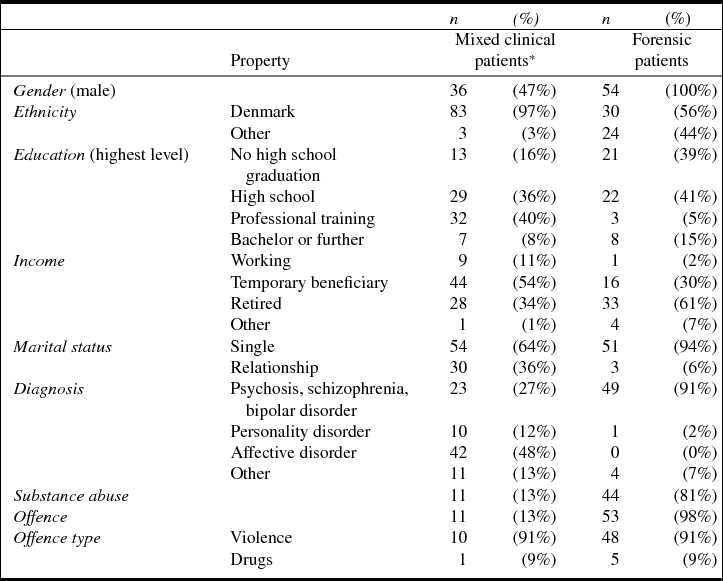
Additional sample characteristics for both samples are given in Table 1.
Socio-demographic and psychiatric characteristics of the mixed clinical patients (n = 88) and male forensic in-patients (n = 54)

*Missing: 4 gender, 7 education, 2 ethnicity, 6 income, 4 marital status, 2 diagnosis.
Measures
Metacognitive Anger Processing scale
(MAP; Moeller, Reference Moeller2016): this is a 26-item scale assessing metacognition in relation to anger in three domains: (1) general positive beliefs about the functions of anger (e.g. ‘anger helps me solve problems’); (2) uncontrollable rumination (e.g. ‘I cannot let go of angry thoughts’); and (3) negative conceptions related to anger, particularly those focused on danger, harm and madness in association with anger (e.g. ‘anger could make me go mad’). MAP items are worded solely to assess anger, avoiding overlap with aggression. The items are rated on a 4-point scale (1 = never true, 2 = sometime true, 3 = often true, 4 = always true). Alpha coefficients and test–retest reliability have been shown to be satisfactory, and concurrent validity with measures of metacognition and anger has been established with students and prisoners in separate studies (Moeller, Reference Moeller2016). Prior to the studies presented in this paper, the MAP was revised based on those earlier studies. Five items were omitted due to overlapping content, and three items were slightly reworded. One item was retained because of its theoretical relevance, even though it loaded on two factors in the preliminary testing.
Novaco Anger Scale
(NAS; Novaco, Reference Novaco2003): this is a 60-item scale constructed to measure anger disposition. Its items were generated from a theoretical framework. The Cognitive, Arousal and Behavioral subscales each consist of 16 items. The sum of these 48 items forms the NAS Total score. There is also a separate 12-item Anger Regulation subscale. All items are rated on a 3-point scale of 1 = ‘never true’; 2 = ‘sometimes true’; and 3 = ‘always true’. Alpha scores and test–retest reliability across various settings have shown excellent reliability (Novaco, Reference Novaco2003; Novaco and Taylor, Reference Novaco and Taylor2004). The validity of the NAS has been established by independent investigators (e.g. Hornsveld et al., Reference Hornsveld, Muris and Kraaimaat2011; Jones et al., Reference Jones, Thomas-Peter and Trout1999), including the prediction of violent behaviour by psychiatric patients (Monahan et al., Reference Monahan, Steadman, Silver, Appelbaum, Robbins and Mulvey2001). The Danish translation of the NAS was conducted in collaboration with its original author. The reliability and validity of the NAS Danish have been demonstrated by Moeller et al. (Reference Moeller, Novaco, Heinola-Nielsen and Hougaard2015) in a multi-study project.
Stait Trait Anger eXpression Inventory
(STAXI-2; Spielberger, Reference Spielberger1999): this is a 57-item scale constructed to measure a broad range of anger experiences and control. It has been revised and adjusted over the last 10 years. Anger is assessed as a joint combination of individual differences in dispositional anger (trait anger) and the momentary experience of anger (state anger). The scale consists of six subscales measuring anger Trait Anger (T-Ang), State Anger (S-Ang), and Anger Expression. The Anger Expression subscale measures outward expression of anger (AX-O) to inward expression of anger (AX-I); it also has two anger-control subscales: Anger Control-In (AC-I), which measures the tendency to invest energy in calming down and securing inner control, and Anger Control-Out (AC-O), which measures the tendency to invest energy in monitoring and preventing the outward expression of anger. The STAXI-2 is generally considered a strong anger assessment instrument with a clear conceptualization and solid psychometric properties in varied settings. In a STAXI-2 (Spielberger, Reference Spielberger1999) study that included data from 1600 normal adults and 274 hospitalized psychiatric patients, the reliability scores were as follows: T-Ang ranged from .84 to .87; S-Ang ranged from .92 to .94; AX-O ranged from .74 to .80; AX-I ranged from .74 to .82; AC-O ranged from .84 to .87; and AC-I ranged from .91 to .93. Regarding validity, the STAXI discriminated between healthy and clinical participants. The STAXI-2 was translated into Danish with written permission from its original author. The questionnaire was translated by this manuscript's first author and then back-translated by a bilingual translator. The rewording of a few items occurred during this process.
MetaCognitive Questionnaire
(MCQ; Cartwright-Hatton and Wells, Reference Cartwright-Hatton and Wells1997): this is a measure used to assess general aspects of metacognition. The MCQ is presently the most consistently used tool for operationalizing the S-REF model. Wells and Cartwright-Hatton initially developed the MCQ, which was later revised into a shortened version, the MetaCognitive Questionnaire, short form (MCQ-30; Wells and Cartwright-Hatton, Reference Wells and Cartwright-Hatton2004). The questionnaire was developed for anxiety, but has been used as a measure of general components of metacognition. The focus of the questionnaire is metacognition in relation to worry. It uses a scale from 1 to 4 in which 1 = do not agree, 2 = agree slightly, 3 = agree moderately, and 4 = agree very much to measure metacognition on five subscales: (1) experiences/evaluations of one's own cognitive function, (2) positive beliefs about worry, (3) experiences/evaluations of one's own awareness of cognition, (4) beliefs and experiences about danger and uncontrollability, and (5) beliefs about the need to control one's own cognition. The psychometric properties of the MCQ-30 were addressed satisfactorily, including validation with other measures of worry and anxiety (Wells and Cartwright-Hatton, Reference Wells and Cartwright-Hatton2004). The MCQ-30 was translated into Danish by other researchers (Austin et al., Reference Austin, Mors, Nordentoft, Hjorthøj, Secher and Hesse2015).
Anger Rumination Scale
(ARS; Sukhodolsky et al., Reference Sukhodolsky, Golub and Cromwell2001): this measures the tendency to ruminate about anger. It contains 19 items on four factors: Angry After-thoughts (6 items); Thoughts of Revenge (4 items); Angry Memories (5 items); and Understanding the Causes (4 items). In a student sample (Sukhodolsky et al., Reference Sukhodolsky, Golub and Cromwell2001), internal reliability coefficients satisfactorily ranged from .72 to .83 for the subscales and .93 for the ARS Total. In addition, the 1-month test–retest reliability was adequate. Convergent validity tests were conducted with the STAXI-2 Trait, reporting positive correlations ranging from .41 to .57 for the subscales (Ibid). The questionnaire was translated by the first author and back-translated by a bilingual translator, with permission from the author of the original questionnaire.
Hospital Anxiety and Depression Scale
(HADS; Zigmond and Snaith, Reference Zigmond and Snaith1983): this is a 14-item self-report questionnaire measuring anxiety and depression. The respondent provides ratings for his or her most recent week. Seven items measure anxiety, and seven items measure depressive symptoms. Higher scores indicate higher levels of anxiety and depression. Its reliability and validity have been established in clinical settings and in the general population (Bjelland et al., Reference Bjelland, Dahl, Haug and Neckelmann2002). However, several studies have also revealed problems in the construction and psychometric properties of the HADS (e.g. Cosco et al., Reference Cosco, Doyle, Ward and McGee2012). Using HADS to screen for depression and anxiety disorders or differentiate between depression and anxiety does not seem to be justified, but it is viable as a measure of general distress (Norton et al., Reference Norton, Cosco, Doyle, Done and Sacker2013). In the present study the HADS is used as a measure for symptom severity. The questionnaire is available in the public domain and was translated and back-translated by a bilingual translator.
The assessment package for the clinical sample consisted of the MAP, NAS, STAXI-2, MCQ-30, ARS and HADS. The assessment package in the forensic sample consisted of the MAP, NAS and HADS.
Statistical analysis
Across participants and measures, less than 5% of responses were missing, and no respondent was missing more than a total of three items. The values for the missing items were replaced with the series mean for the item. For the study measures, ANOVA tests of mean differences between the mixed clinical patients and male forensic in-patients were computed. To test the psychometric validity of the MAP, we used the non-parametric Mokken analysis. It entails the testing of each item of a scale to detect to what extent it stands alone on the dimension of severity tested by the scale and allow for testing the scalability of the MAP with regard to its subscales: Positive beliefs, Negative beliefs, and Rumination. Analyses were run for the combined samples and partitioned by sample type (mixed clinical, forensic). The Mokken model (Mokken, Reference Mokken1971) is based on the Guttman cumulative rating scale principle (Bech, Reference Bech2012) that scorings on lower prevalence manifest items must be preceded by scorings on high prevalence items. The scalability is evaluated by use of Loevinger's coefficient of homogeneity (Bech, Reference Bech2012). According to Mokken (Reference Mokken1971) or Van Schuur (Reference Van Schuur2011), coefficients of homogeneity from 0.20 to 0.29 belong in a questionable zone as to constitute a cumulative scale, coefficients of 0.30 to 0.39 are acceptable, while a coefficient of 0.40 or higher clearly indicates scalability. The Mokken analysis was performed using the MSP program (Molenaar et al., Reference Molenaar, Debels and Sijtsna1994). Regression analyses were used to test convergent and concurrent validity.
Results
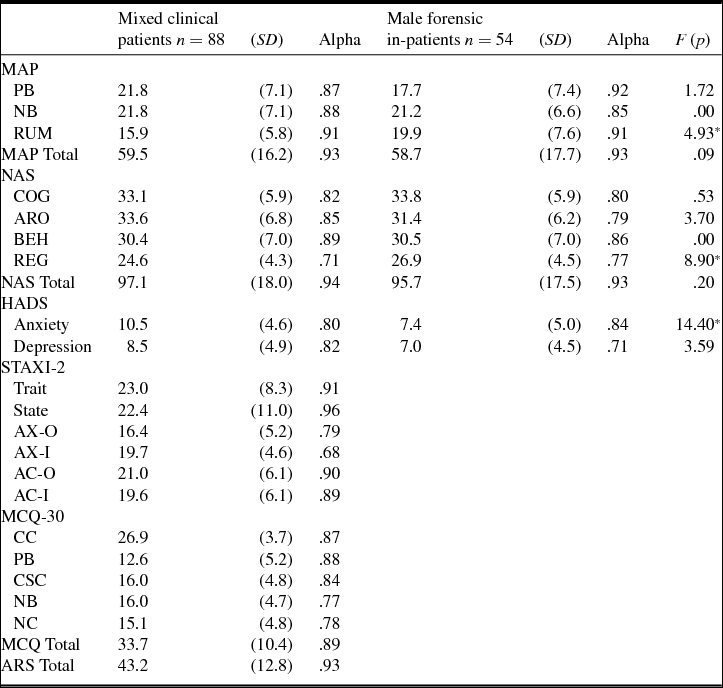
No differences between the two samples appeared on the NAS, apart from the NAS Regulation subscale, for which the male forensic in-patients unexpectedly reported significantly higher regulation of anger than the mixed clinical sample. On the MAP, the male forensic in-patients had significantly higher mean on the MAP Rumination subscale than the mixed clinical patients. Regarding HADS scores, the mixed clinical patients had higher HADS Anxiety scores than the male forensic in-patients. Table 2 presents the descriptive statistics and sample comparisons for the anger and the metacognitive measures for mixed clinical patients and male forensic in-patients. Internal reliability was excellent for the MAP.
Descriptive statistics, internal reliability coefficients and ANOVA test of mean differences of anger scores for mixed clinical patients and male forensic in-patients

*p < .01. MAP, Metacognitive Anger Processing scale; MAP PB, positive beliefs subscale; MAP NB, negative beliefs subscale; MAP RUM, rumination subscale; NAS, Novaco Anger Scale; COG, cognitive subscale; ARO, arousal subscale; BEH, behavioral subscale; HADS, Hospital Anxiety and Depression Scale; HADS Anxiety, HADS anxiety subscale; HADS Depression, Depression subscale; STAXI-2, Stait Trait Anger eXpression Inventory; Trait, trait anger subscale; State, state anger subscale; AX-O, anger expression out; AX-I, anger expression in; AC-O, anger control out; AC-I, anger control in; MCQ-30, MetaCognitive Questionnaire; CC, cognitive confidence subscale; PB, positive beliefs subscale; CSC, cognitive self-consciousness subscale; NB, negative beliefs subscale; NC, negative beliefs about need to control thoughts; ARS, Anger Rumination Scale.
The MAP's scalability was investigated for the combined sample, and then separately for the mixed clinical sample and the forensic sample. The coefficient of homogeneity for the total score of the 26 MAP items was 0.36 for the combined sample (acceptable scalability), 0.37 for the forensic sample and 0.36 for the mixed clinical sample. The subscales all had good scalability in the combined sample: Rumination 0.57, Positive Beliefs 0.57, and Negative Beliefs 0.44. Subscales also had good scalability in the mixed clinical and in the forensic sample, ranging from 0.36 to 0.66.
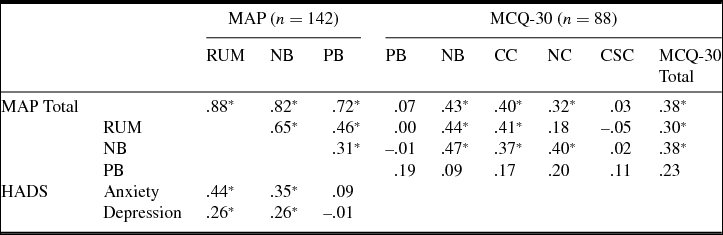
For the combined sample, Pearson inter-correlations between the subscales of the MAP were highly correlated with the MAP Total. MAP Total and its subscales are positively correlated with MCQ-30 Total. Results are given in Table 3.
Correlations (Pearson) between the MAP subscales and measures of metacognition and anger level (NAS Total) for male forensic in-patients (n = 54) and mixed clinical patients (n = 88)

*p < .01; n = 142 includes forensic sample and mixed clinical sample; n = 88 includes only the mixed clinical sample. MAP, Metacognitive Anger Processing scale; MAP PB, positive beliefs subscale; MAP NB, negative beliefs subscale; MAP RUM, rumination subscale; HADS, Hospital Anxiety and Depression Scale; HADS Anxiety, HADS anxiety subscale; HADS Depression, Depression subscale; MCQ-30, MetaCognitive Questionnaire; PB, positive beliefs subscale; NB, negative beliefs subscale; CC, cognitive confidence subscale; NC, negative beliefs about need to control thoughts; CSC, cognitive self-consciousness subscale.
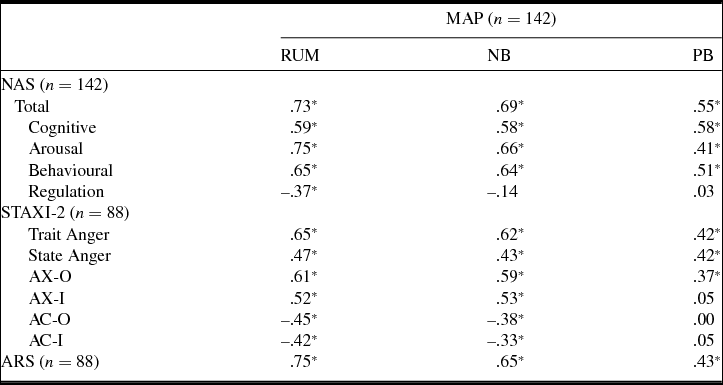
To examine concurrent validity for anger, correlations for the MAP with the anger criteria (NAS, STAXI-2 and ARS) were computed. Results are given in Table 4. Each of the MAP subscales is substantially correlated with the NAS Total, STAXI Trait Anger, and ARS score criteria.
Correlations (Pearson) between the MAP subscales and the NAS for mixed clinical patients and forensic in-patients (n =142), and the MAP and STAXI-2and ARS subscales for mixed clinical patients (n = 88)

*p < .01. MAP, Metacognitive Anger Processing scale; MAP PB, positive beliefs subscale; MAP NB, negative beliefs subscale; MAP RUM, rumination subscale; NAS, Novaco Anger Scale; STAXI-2, Stait Trait Anger eXpression Inventory; AX-O, anger expression out; AX-I, anger expression in; AC-O, anger control out; AC-I, anger control in; ARS, Anger Rumination Scale. The STAXI-2 and the ARS were only administered in the clinical sample.
To further test the concurrent validity of the MAP, a hierarchical regression with forced entry was conducted on the mixed clinical sample data, with NAS Total as the criterion variable and the HADS subscales, Trait Anger (T-Ang), and MAP Total as the predictors. On the first step, HADS subscales were entered as covariates. T-Ang was entered on the second step, and then MAP Total entered on the third step to test for its incremental contribution. The HADS subscales entered alone were significantly associated with anger level (NAS Total), adjusted R² = .254 (p < .001). When T-Ang was added to this equation on the second step, an additional 44% of the variance in the criterion variable was explained (ΔR² = .436; p < .001). Entering the MAP Total on the third step explained an additional 11% of the variance in the criterion variable (ΔR² of .111, p < .001). The final model was significant, adjusted R² = .818, F (4.83) = 93.44, p < .001. In the final model T-Ang (p < .001) and MAP Total (p < .001) were significantly associated with anger level measured by the NAS Total, whereas HADS subscales were no longer significant.
Analyses performed on the coefficients in Table 4 found discriminant validity for the MAP Rumination subscale as its correlation with the ARS (r = .75) is significantly higher than that for MAP Negative Beliefs (r = .43; z = 4.28, p < .01) and for MAP Positive Beliefs (r = .65; z = 1.65, p = .05) with the ARS in the mixed clinical sample. Also, the correlation of the MAP Rumination with the set of four rumination items of the NAS Cognitive subscale were higher for MAP Rumination, compared with the MAP Positive Beliefs and Negative Beliefs subscales (r = .65 versus r = .53; z = 1.54, p = .06; and r = .35; z = 3.42, p < .01, respectively) in the combined sample. In addition, MAP Rumination showed a negative correlation with the NAS Regulation (r = –.37) and STAXI anger control (AC-O, r = –.45; AC-I, r = – .42), indicating that this subscale measures a maladaptive anger processing strategy.
Discussion
The validity of the MAP as a metacognitive measure across samples is supported by the magnitude of the correlations for the MAP with the MCQ-30, which were in the same range as in the preliminary testing (Moeller, Reference Moeller2016). The validity of the MAP as an anger measure was substantiated by its robust correlations with the STAXI and NAS criteria. Due to the thematic overlap including the word ‘anger’ appearing in most items in the MAP, NAS and STAXI, at least some level of inter-correlations will be expected. Interestingly, the MAP Positive Beliefs had non-significant correlations with several STAXI Anger Expression subscales, Anger In and both Anger Control scales (AC-O and AC-I), which calls for further investigation.
The convergent validity of the MAP Rumination subscale was substantiated by its strong correlation with the Anger Rumination Scale (ARS), with the rumination items of the NAS Cognitive subscale, and with STAXI Anger In. The high correlation between MAP Negative beliefs and STAXI Anger In suggests that the perception of anger as uncontrollable and dangerous may foster a tendency to try to withhold the expression of anger. That speculation is supported by findings from Gilbert et al. (Reference Gilbert, Gilbert and Irons2004) showing that people restrain their anger due to negative beliefs about the consequences of expressing anger (e.g. fear of rejection by others, fear of losing control, fear of harming others). Experimental research has shown that individuals instructed to withhold their emotional expression have an increased physiological response compared with individuals with no such instruction (Gross and Levenson, Reference Gross and Levenson1997). Indeed reviewing clinical evidence on low levels of anger expression among violent offenders, Davey et al. (Reference Davey, Day and Howells2005) identify over-control of anger as a maladaptive emotion regulation strategy increasing the risk of violence. The MAP may prove helpful in conceptualizing variables involved in withholding anger expression.
The male forensic sample had significantly higher mean on the MAP Rumination subscale than the mixed clinical patients, which calls for further investigation. This finding could indicate rumination as a particularly relevant treatment target for forensic patients.
Hierarchical regression analysis supported the MAP as an anger measure with psychiatric populations that explain additional variance in the criterion variable (NAS Total), after controlling for anxiety, depression and trait anger. Moreover, the correlations between the MAP subscales and the anger criterion (NAS Total) in these clinical setting samples were larger than those found in the student sample and prisoner sample preliminary study (Moeller, Reference Moeller2016), verifying the clinical relevance of a metacognitive conceptualization of anger. In particular, the correlation between MAP Negative beliefs and NAS Total had increased from the prior study (r = .69 versus r = .34; z = 4.28, p < .01) advocating for the clinical relevance of experiencing anger as an uncontrollable and negative emotion as discussed by Novaco (Novaco, Reference Novaco, Potegal, Stemmler and Spielberger2010; Potegal and Novaco, Reference Potegal, Novaco, Potegal, Stemmler and Spielberger2010). Those results indicate that the MAP could be clinically useful in conceptualizing anger dysregulation, particularly in psychiatric samples. However, the prior study used the PI as the anger criteria measure, while the present study used the NAS.
The two studies presented have several limitations. First, the studies are cross-sectional and rely on correlational statistics, hence a causal relationship between the proposed metacognitive beliefs and maladaptive anger processing (rumination) cannot be inferred. Another limitation is that the assessments are all self-reports of anger, with no behavioural measures, such as of aggression. Future studies refining the scale will benefit from including observer measures of anger and aggression and formulating a hypothesis regarding the interaction between MAP subscales, including the discriminative validity to be tested in a longitudinal design with repeated measurement. Ideally the MAP should be tested in an intervention study to investigate its usefulness in clinical formulation and its sensitivity to change due to treatment.
These findings may have implications for clinical interventions. Relevant novel clinical interventions for the treatment of anger problems could be interventions used in metacognitive therapy (MCT) for depression (Wells, Reference Wells2009) (e.g. advantages/disadvantages analysis of rumination, postponing rumination or attention training). In addition, interventions from rumination-focused cognitive behavioural therapy for depression (e.g. practising shifting thinking style) (Watkins, Reference Watkins2016) could prove helpful in treating problematic anger when anger dysregulation is understood as a maladaptive processing routine as conceptualized by the MAP framework.
Acknowledgements
The authors gratefully acknowledge Professor Raymond W. Novaco for providing mentorship, advice and feedback on earlier drafts of the manuscript.
Ethical statements: The authors assert that all procedures contributing to this work comply with the ethical standards of the relevant national and institutional committees on human experimentation and with Helsinki Declaration of 1975, as revised in 2008.
Conflicts of interests: Stine Bjerrum Moeller and Per Bech have no conflicts of interest with respect to this publication.
Financial support: This work was supported by a PhD scholarship from the University of Copenhagen, Department of Psychology.
Supplementary material
To view supplementary material for this article, please visit https://doi.org/10.1017/S1352465818000140




Comments
No Comments have been published for this article.