Introduction
In a revision of the Fellodistomidae (Platyhelminthes: Digenea) parasitizing fish from the north-east Atlantic, Bray & Gibson (Reference Bray and Gibson1980), it is suggested that 12 species, hitherto, are considered as members of Proctoeces and are synonymous with the type species Proctoeces maculatus Looss, 1901. Thereafter, Bray (Reference Bray1983) considered that all described species of Proctoeces are synonymous with P. maculatus Loos, 1901. He discussed the plasticity of this species, which has been found as an adult parasite in 59 species of teleost and 18 invertebrates, and as a metacercarial stage in 36 different invertebrate species. The first Digenea reported in marine organisms from the coast of Chile was Proctoeces sp. (Bretos & Jiron, Reference Bretos and Jirón1980) from the gonads of eight species of keyhole limpet Fissurella (Archeogastropoda). Proctoeces humboldti was later described from the gonads of four species of Fissurella, obtained from Peninsula Tumbes and Peninsula Hualpen (36°50′S), of the central coast of Chile (George-Nascimento & Quiroga, Reference George-Nascimento and Quiroga1983). Oliva (Reference Oliva1984) described Proctoeces chilensis from the intestine of the clingfish Syciases sanguineus (Gobiesocidae), Müller & Troschel, 1843 from Bahia San Jorge (23°40′S) in northern Chile. Finally, Oliva & Zegers (Reference Oliva and Zegers1988) compared the morphometry and pattern of allometric growth of Proctoeces (P. humboldti and P. chilensis) obtained from two species of keyhole limpets and one species of clingfish from the intertidal zone at Bahia San Jorge, concluding that both species belong to Proctoeces lintoni Siddiqi & Cable (1960). They stated that specimens from vertebrate and invertebrate hosts are morphologically similar, but their data demonstrated that some biometrical relationships differ significantly between worms from keyhole limpets and clingfish. Sibling species in Digenea are common in both vertebrate and invertebrate hosts (e.g. McCarthy, Reference McCarthy1990; Bowers et al., Reference Bowers, Bartoli, Russell-Pinto and James1996; Jousson & Bartoli, Reference Jousson and Bartoli2001; Ostrowski de Nunez, Reference Ostrowski de Nunez2001), Fissurella spp. and S. sanguineus have been described by George-Nascimento et al. (Reference George-Nascimento, Balboa, Aldana and Olmos1998) as sequential hosts for P. lintoni; therefore, we evaluated whether both previously described species of Proctoeces in marine organisms of Chile are, in fact, the same species or represent sibling species.
The life cycle of Proctoeces cf. lintoni on the coast of Chile includes the mussel Perumytilus purpuratus, as first intermediate host, the keyhole limpet Fissurella spp., as second intermediate host, and S. sanguineus as the definitive host (Oliva & Zegers, Reference Oliva and Zegers1988; George-Nascimento et al., Reference George-Nascimento, Balboa, Aldana and Olmos1998; Loot et al., Reference Loot, Aldana and Navarrete2005, Reference Loot, Blanchet, Aldana and Navarrete2008). This parasite is the most studied digenean from marine organisms along the coast of Chile and quantitative characteristics of infection in many species of keyhole limpet along the coast, and life cycle, progenesis, pathology and effects on the invertebrate host fecundity and experimental transmission have been described (Osorio et al., Reference Osorio, Díaz and Rios1986; Oliva & Díaz, Reference Oliva and Díaz1988, Reference Oliva and Díaz1992; Oliva, Reference Oliva1992; George-Nascimento et al., Reference George-Nascimento, Balboa, Aldana and Olmos1998; Oliva & Huaquin, Reference Oliva and Huaquin2000). In this study we evaluate if both of the previously described species of Proctoeces in marine organisms of Chile are the same species. This is the first approach to the molecular systematics of parasites from marine organisms along the Chilean coast.
Methods
Parasite collection
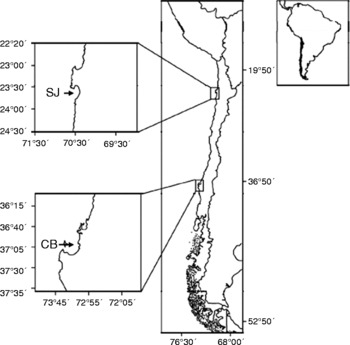
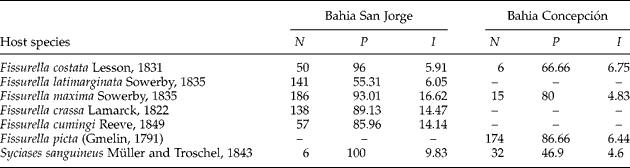
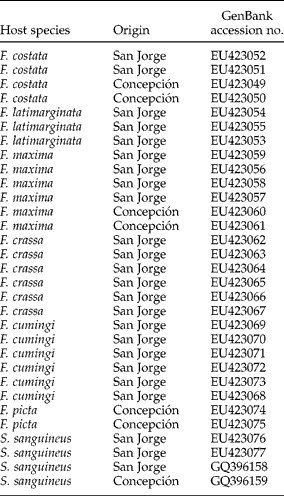
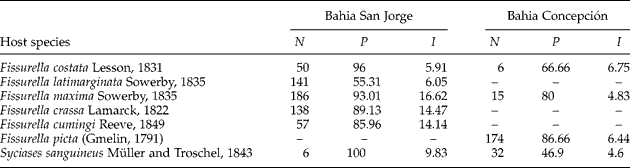
Specimens of P. cf. lintoni were collected from two localities – Bahia San Jorge (23°40′S) and Bahia Concepción (36°50′S) (fig. 1). These localities correspond to the areas where P. humboldti and P. chilensis were originally described. Number of sampled individuals of keyhole limpets and clingfish, as well prevalence and mean intensity of infection from each locality, are shown in table 1. Fissurellids and clingfish were collected by divers and parasites were immediately sampled and processed. Thirty-one specimens of P. cf. lintoni from a total of 27 specimens of six different species of fissurellid and four specimens from one clingfish species were sequenced (table 2). Parasites were collected from the gonads and intestine of their respective hosts. Specimens were the same as those described as P. humboldti by George-Nascimento & Quiroga, Reference George-Nascimento and Quiroga1983 and P. chilensis by Oliva, Reference Oliva1984, both of which were identified as P. lintoni by Oliva & Zegers (Reference Oliva and Zegers1988) (see fig. 3). Samples were stored in absolute alcohol until DNA extraction in the laboratory.
Location of the collecting sites in Chile. SJ, Bahia San Jorge; CB, Bahia Concepción.

Proctoeces lintoni in Fissurella spp. and Syciases sanguineus. Total number of specimens studied (N), prevalence (P) and mean intensity (I) of infection from two geographic locations: Bahia San Jorge (23°40′S) and Bahia Concepción (36°50′S).
Host species, origin and GenBank accesion number for the studied specimens.

DNA extraction, amplification and sequencing analysis
To extract genomic DNA from the whole worm, the phenol–chloroform method of Sambrook et al. (Reference Sambrook, Fritsch and Maniatis1989) was used. The V4 region of the SSU rRNA gene was amplified using the primers SB3a: 5′ GGA GGG CAA GTC TGG TGC 3′ and A27a: 5′ CCA TAC AAA TGC CCC CGT CTG 3′ following the protocol described by Hall et al. (Reference Hall, Cribb and Barker1999). Each polymerase chain reaction (PCR) had a final volume of 50 μl, including: 5 standard units of Taq polymerase, 5 μl 10 × PCR buffer, 4 μl MgCl2 (50 mm), 4 μl of each deoxynucleotide triphosphate (dNTP) (2.5 mm), 20 pm of each primer and c. 200 ng template DNA. A Boeco Ecogermany M-240R Thermal Cycler (Boeckel, Hamburg, Germany) was used with a cycling profile as follows: initial denaturation step at 94°C (5 min) followed by 35 cycles at 94°C (30 s), 45°C (30 s), 72°C (3 min), and a final extension step at 72°C (10 min). Double-stranded PCR products were cleaned using an E.Z.N.ATM Cycle-Pure Kit (Omega Bio-Tek, Inc., Atlanta, Georgia, USA) and both DNA strands were directly sequenced (Macrogen, Seoul, Korea; http://www.macrogen.com). Sequences were edited using ProSeq v 2.9 beta (Filatov, Reference Filatov2002) and aligned with Clustal X (Larkin et al., Reference Larkin, Blackshields, Brown, Chenna, McGettigan, McWilliam, Valentin, Wallace, Wilm, Lopez, Thompson, Gibson and Higgins2007). Statistics on nucleotide composition were compiled using DnaSP version 3.15 (Rozas et al., Reference Rozas, Sánchez-Delbarrio, Messeguer and Rozas2003).
Phylogenetic analysis
Sequences available from other members of the Fellodistomidae in the GenBank database were used to compare our data (Hall et al., Reference Hall, Cribb and Barker1999; Olson et al., Reference Olson, Cribb, Tkach, Bray and Littlewood2003): Complexobursa sp. (accession number AJ224462); Fellodistomum fellis (accession number Z12601); Coomera brayi (accession number AJ224469). For Proctoeces maculatus, the GenBank database had two sequences available from different authors and geographical regions, one from Heron Island, Australia (Hall et al., Reference Hall, Cribb and Barker1999) and the other from the Gulf of Mexico (Olson et al., Reference Olson, Cribb, Tkach, Bray and Littlewood2003) (accession numbers AJ224459 and AY222161, respectively).
In accordance with Hall et al. (Reference Hall, Cribb and Barker1999), Tandanicolidae corresponds to the sister taxon of the Fellodistomidae and members of this family were considered as the out-group in this analysis. The following Tandanicolid species were also obtained from the GenBank database: Bucleytrema indica (AJ224461); Monodhelmis torpedinis (AJ224460) and two sequences of Prosogonarium angelae (AJ224455; Hall et al., Reference Hall, Cribb and Barker1999 and AJ287564; Olson et al., Reference Olson, Cribb, Tkach, Bray and Littlewood2003).
The phylogenetic trees were inferred by distance (neighbour-joining; NJ), and maximum likelihood (ML) criteria using PAUP* 4.0b10 (Swofford, Reference Swofford2001), and by Bayesian inference (BI) using MrBayes v3.1.2 (Huelsenbeck & Ronquist, Reference Huelsenbeck, Ronquist and Nielsen2005). To determine the model that gave best fit to our dataset, the program Modeltest 3.7 (Posada & Crandall, Reference Posada and Crandall1998) was employed, and the best model was selected using the Akaike information criterion (AIC). Results from Modeltest indicated that the Transversion Model plus gamma distribution (TVM+G) was the most appropriate evolution model for this dataset. Consequently, we incorporated this model of nucleotide evolution in ML and BI analyses. For the ML tree, a heuristic search using a random sequence addition (n = 100) and TBR branch swapping (Nei & Kumar, Reference Nei and Kumar2000) was implemented. Additionally, bootstrap resampling (Felsenstein, Reference Felsenstein1985) was applied to assess support for individual nodes by using 1000 bootstrap replicates. Bayesian phylogenetic analyses were conducted using four simultaneous Markov Chains running 1,000,000 generations, sampling each 100 generations. The first 2500 generations (burn-in) were discarded as suggested by Felsenstein (Reference Felsenstein1985). The remaining 7500 trees sampled were used to construct a 50% majority-rule consensus tree. Nodal support values (posterior probabilities) were calculated as the percentage of the 7500 sampled trees containing the node.
Results
Sequence variation
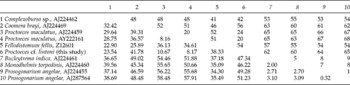
From 31 specimens of P. cf. lintoni a total of 402 base pairs of the V4 region of the SSU rRNA gene were sequenced. The mean nucleotide composition of nucleotide bases was: A, 32.3%; C, 30.4%; T, 17.1%; and G, 20.2%. Variation in length across the dataset (31 sequences) for the different specimens of Proctoeces from the different host species (seven) from Chile was not found. No mutations were detected among the 31 sequences of P. cf. lintoni (table 3). Therefore, all sequences of the Chilean specimens of Proctoeces were grouped as Proctoeces cf. lintoni in the distance matrix (table 3).
Pairwise sequence divergences for the V4 region of the SSU rRNA gene among species of the family Fellodistomidae. The maximum likelihood distance was calculated using the model described in the text (TVM+G) and is shown as percentage (below the diagonal). The raw number of pairwise differences is also shown (above the diagonal). Fellodistomidae: species numbered 1–6; Tandanicolidae: species numbered 7–10.

Due to the fact that sequences from the GenBank database were always shorter than the sequences obtained in the present study, and in order to develop the phylogenetic analysis, we decided to use only 307 bp of the V4 region of the SSU rRNA gene. The average number of pairwise differences among the analysed sequences for fellodistomids was 20.9. The lower divergence was observed between both P. maculatus sequences and the greater divergence was found between P. maculatus and C. brayi (table 3).
Phylogenetic analysis
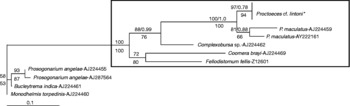
We obtained similar tree-topologies using three different methods (fig. 2). For nucleotides, the substitution rate parameters are: A–C = 0.54, A–G = 2.80, A–T = 1.0, C–G = 0.20, C–T = 2.80 and G–T = 1.0; the rate distribution at variable sites (gamma) with a shape parameter (alpha) is 0.30. The branching pattern of the tree showed two different groups for Proctoeces species: P. cf. lintoni from Chile and the two P. maculatus with NJ and ML bootstrap analysis support of 100%. For the BI, the tree topology was similar for NJ and ML and the posterior probability for the clade composed by members of P. cf. lintoni and both sequences of P. maculatus was 1.00 (fig. 2). Interestingly, the two sequences of P. maculatus obtained from the GenBank dataset showed more differentiation than was detected in our sequences of P. cf. lintoni. These two sequences were consistently separated with the bootstrap support of 81% for NJ, 66% for ML and posterior probabilities of 0.88 for BI. The base pair difference and percentage differences between both P. maculatus sequences and our sequences are shown in table 3. Three main results emerged from this analysis: first, all specimens from fissurellids and clingfish belong to the same clade; second, the group formed by Proctoeces from Chile has consistent differences with P. maculatus from both Hall et al. (Reference Hall, Cribb and Barker1999) and Olson et al. (Reference Olson, Cribb, Tkach, Bray and Littlewood2003) and, finally, sequences from both P. maculatus strongly suggest that they belong to different species.
Tree of phylogenetic relationships of 31 specimens of Proctoeces cf. lintoni and other members of Fellodistomidae with GenBank accession number, based on SSU rRNA gene sequences. Neighbour-joining (NJ), maximum likelihood (ML) and Bayesian inference (BI) analysis showed the same topology. The value above each branch indicates the bootstrap percentages for NJ and BI proportion. The value below each branch indicates the bootstrap percentages for the ML. The model for the ML tree (TVM+G) had an -lnL score of 1588.79, and Akaike information criterion (AIC) of 3193.756. * Includes sequences from 27 specimens of six species of Fissurella spp. and four specimens of S. sanguineus (see table 2 for accession numbers).

Discussion
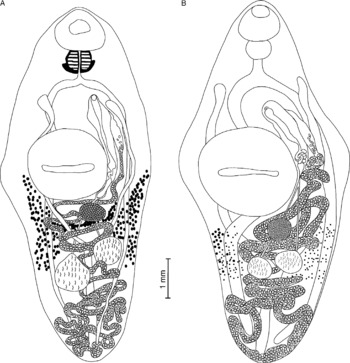
As suggested by Oliva & Zegers (Reference Oliva and Zegers1988), these results support the idea that P. humbolti and P. chilensis are members of the same taxonomic unit, considered as Proctoeces lintoni. Due to the absence of genetic information on specimens originally described as P. lintoni Siddiqi & Cable, 1960, we prefer to consider our material as P. cf. lintoni. Despite the fact that Oliva & Zegers (Reference Oliva and Zegers1988) concluded that specimens of P. lintoni from fissurellids and the clingfish in Bahia San Jorge are morphologically indistinguishable, small differences in some morphological characters are evident. For example, the cirrus sac does not reach the posterior border of the acetabulum in P. chilensis, and the vitellaria reaches the midlevel of the acetabulum in P. humboldti (fig. 3). Our result shows that these morphological differences represent individual variability.
Original drawings of Proctoeces humboldti (A) and Proctoeces chilensis (B).

Using a molecular approach, we were able to conclude that specimens isolated from five species of Fissurella in Bahia San Jorge, three species of Fissurella from Bahia Concepción, and those from the intestine of S. sanguineus from both localities belong to the same species, with a total absence of genetic variability (no mutations were found) for the V4 region of the SSU rRNA gene among specimens from two localities c. 2000 km apart. This pattern of genetic homogeneity on a wide geographic scale has been reported several times in the literature, mainly linked to marine species that have a high potential for dispersal. Aiken et al. (Reference Aiken, Bott, Mladineo, Montero, Nowak and Hayward2007) demonstrated total absence of genetic differences in the Monogenea Hexostoma thynni parasitizing different species of Thunnus from a wide geographical range; this pattern has been also described for other parasitic groups (Palm et al., Reference Palm, Waeschenbach and Littlewood2007). A different picture is described by Lo et al. (Reference Lo, Morgan, Galzina and Cribb2001) and Chambers & Cribb (Reference Chambers and Cribb2006), who found no significant genetic differences in Digenea parasitizing coral reef fish with a low dispersal capacity in the Indo-Pacific region. Miller & Cribb (Reference Miller and Cribb2007) described the same pattern for some Digenea parasites of Lutjanidae and Haemulidae living 9600 km apart in the Indo-Pacific.
Host specificity could be related to the emergence of barriers to gene flow and may well be considered one of the major ways to speciation (Brooks & McLennan, Reference Brooks and McLennan1993). Then, a host-dependent genetic structure could be the most common pattern. Steinauer et al. (Reference Steinauer, Nickol and Orti2007), motivated by apparent phenotypic variability of the acanthocephalan species Leptorhynchoides thecatus, investigated its population structure throughout North America and showed that it forms a cluster of several genetic lineages. Most of these lineages were represented by parasite specialists with a narrow host and microhabitat specificity; however, one lineage possessed a wide specificity with overlapping host range of all specialists.
Based on our results, P. cf. lintoni in Chile is represented by only one genetic lineage with a high potential for dispersal among hosts and geographic areas. The host species reported for P. cf. lintoni show no, or insignificant, motility and the parasite shows genetic homogeneity for the studied gene, over 2000 km. Explanations for these patterns include the possibility that the mytilid P. purpuratus is not the first intermediate host for P. lintoni but, instead, the first intermediate host is another invertebrate with high vagility. Our unpublished results show that the cercaria of P. lintoni (Aldana, Reference Aldana2007) has a genetic difference (V4 region of the SSU rRNA gene) of 33.4% compared to adults. These cercariae have been described as reptant larvae with less motility than swimming cercariae (Aldana, Reference Aldana2007).
Nonetheless, it is complicated to determine the actual limit among species without considering ecological aspects, the geographical range and reproduction (Nolan & Cribb, Reference Nolan and Cribb2005). The literature show that, for parasites, the level of genetic differentiation among species can fluctuate between 1 and 10%. For example, Sorensen et al. (Reference Sorensen, Curtis and Minchella1998), found interspecific genetic differences ranging from 0.8 to 2.9% between Echinostoma species. Differences among schistosomid species ranged from 1.49 to 2.15% (Kaukas & Rollinson, Reference Kaukas and Rollinson1997).
Another important result of this study is the fact that P. cf. lintoni constitutes a taxonomic group which is separated from P. maculatus. Our results show genetic differences of 8.16% between P. lintoni from the present study and P. maculatus sequenced by Olson et al. (Reference Olson, Cribb, Tkach, Bray and Littlewood2003) and 10.67% with P. maculatus sequenced by Hall et al. (Reference Hall, Cribb and Barker1999). These constitute sufficient genetic differences to state that P. lintoni is an independent taxonomic unit. Surprisingly, differences between both P. maculatus strongly suggest that sequenced specimens belong to two taxonomic entities, genetic differences in specimens of P. maculatus analysed by Hall et al. (Reference Hall, Cribb and Barker1999) and Olson et al. (Reference Olson, Cribb, Tkach, Bray and Littlewood2003), in addition to geographic location and different host species, strongly suggest that specimens from Choerodon cyanodus (Labridae) on Heron Island (Hall et al., Reference Hall, Cribb and Barker1999) and those from Archosargus probatocephalus (Sparidae) in the Gulf of Mexico (Olson et al., Reference Olson, Cribb, Tkach, Bray and Littlewood2003) can be considered as different species. These findings reinforce the idea that geographic isolation could be one of the most common ways to originate new species (Nolan & Cribb, Reference Nolan and Cribb2005). The absence of sequences of P. maculatus from the type host (Labrus merula, Labridae) and type locality (Mediterranean Sea) do not allow us to define whether P. maculatus of Hall et al. (Reference Hall, Cribb and Barker1999) or P. maculatus of Olson et al. (Reference Olson, Cribb, Tkach, Bray and Littlewood2003) really correspond to specimens of the type species, or whether they represent two different species of Proctoeces. Our results, suggesting that there are at least three species of Proctoeces, overturn the postulates of Bray & Gibson (Reference Bray and Gibson1980) and Bray (Reference Bray1983) who stated that all described species in Proctoeces are synonymous of the type species, P. maculatus, considered as a broad-based species living in different regions and hosts.
In this study we show preliminary evidence related to a geographic–host dependence of the genetic structure of P. lintoni. Interesting questions arise from the present work, especially the mechanism involved in the transmission pathway among hosts and the parasite species genetic heterogeneity (homogeneity).
Acknowledgements
This study was supported by FONDECYT grant 1070898.