The sun was just beginning to rise over the Susquehanna flats on May 3, 1813, when the crackling of gunfire roused Mary Sears from her bed. As the proprietress of a combination tavern and boarding house, she had heard rumors that the British would raid her hometown of Havre de Grace, Maryland. Now, from her wharf, Sears could see a dozen British barges drifting closer. American militiamen shot at the vessels, but British artillery soon forced them to retreat. With their defenders on the run, Havre de Grace capitulated to the Royal Marines, who congregated outside the tavern. A British captain then ordered his men to start looting. “Boys,” he shouted, “here is fine plunder.” At once, British troops scrambled throughout town, looking for booty. The captain robbed Sears of three boxes of goods—after his men took her teenage son prisoner.Footnote 1
While most of the British troops looted the town, a few others kindled a fire in Sears's yard. When asked about the fire, a British officer responded that they planned to lay the town in ashes. One resident begged Admiral George Cockburn, the British commander, to spare Sears's home, pointing out that she was a widow. Cockburn was unmoved. He intended to burn every building used by the United States military, and he had seen troops running from Sears's house.Footnote 2 Pursuant to Cockburn's wishes, the British burned forty of the town's sixty buildings, including Mary Sears's boardinghouse. Sears watched helplessly as they were “busily employed breaking, destroying, and carrying away [property], until the flames got to such height as to render it unsafe.”Footnote 3
During the conflagration, Sears's neighbor scorned the British for their “impropriety,” noting that, “with civilized nations at war, private property had always been respected.” The officer retorted: “You ought to be more particular in your choice of representatives; you wanted war, and you shall now feel the effects.”Footnote 4 As a woman, Sears had been ineligible to vote for the representatives who had “wanted war” with Britain back in 1812. Still, the British officer was technically correct that the federal government had incited the hostilities leading to the ruin of her home and possessions. According to Sears—and thousands of other so-called “sufferers” like her—it was the federal government's decision to declare war, along with its subsequent failure to protect private property, that now made it accountable for the war's costly “effects” on civilians.
Despite the recent spurt in scholarship to commemorate the bicentennial of the War of 1812, there is still no comprehensive study about the sufferers or their claims for lost property.Footnote 5 From their claims, however, it is clear that the sufferers represented a veritable cross-section of American society during the Early Republic, from frontier farmers and artisans to propertied merchants. Wealthy planters in Louisiana also suffered losses, including damages to their slave cabins. However, the enslaved men and women who lived in those cabins had no legal right to property, let alone any means of appealing for redress. Nevertheless, the federal government did receive claims from others who were usually excluded from the national polity. The British government confiscated property from Canadians who aided American troops in Canada. Those British subjects then turned to the United States for redress. So, too, did members of the Choctaw and Cherokee nations who had fought alongside the United States. And, in most cases, the claimants could little afford their losses.Footnote 6 As one newspaper observed, “the majority of sufferers in our late war is confined to poor men.”Footnote 7 Of course, there were female claimants, too. And most of those women were probably widows, like Mary Sears, who headed their households.Footnote 8
The losses that this diverse group of people sustained gave them the common objective of obtaining compensation.Footnote 9 And, in seeking this compensation, the sufferers forced statesmen to consider what their striving republic ought to do for citizens who had been harmed by events and decisions beyond their control. In 1816, Congress hastily created an Office of Claims to solicit claims, appraise lost property, adjudicate cases, and award restitution. President James Madison then appointed a former congressman from Virginia named Richard Bland Lee to administer this new office. Within months, Lee created an ad hoc national bureaucracy. However, Madison soon asked Congress to review Lee's awards. Consequently, congressmen had to debate the extent of federal responsibility for lost property. The federal government's policy therefore evolved in accordance with the ability of the representatives of the sufferers to find a supportive majority in Congress. This majority was difficult to muster, too. In fact, Congress consistently spurned the sufferers between 1817 and 1825. The question, then, is what changed at the end of that period?
As will be discussed, the sufferers were not the only ones seeking federal assistance for their wartime property losses. During the war, the British forces liberated thousands of enslaved men, women, and children in the United States.Footnote 10 And, like the sufferers, the former owners of these people sought help from the federal government, which, in turn, pressured the British to agree in the Treaty of Ghent to return most of the people that they had liberated. Although the British initially refused to fulfil this treaty obligation, the United States exerted continual diplomatic pressure to ensure that its slaveholding citizens would be compensated for their losses. The representatives of the sufferers were well aware of this effort, too. In that regard, this article will argue that they were only able to obtain more compensation for their constituents because they deftly created a sense of sectional aggrievement to garner additional support from their Northern colleagues.
Indeed, in 1824, Congress once again debated whether to ameliorate the plight of the sufferers. This time, however, representatives of the sufferers in New York protested that the federal government had obtained British indemnities for the people they liberated, but not for other types of private property losses. It was an inflammatory tactic, especially considering that sectional tension over slavery had escalated significantly during the Missouri crisis just a few years earlier. But it worked. Resentful of this unequal treatment, Northern representatives nearly united in support of the sufferers. And, in response, many Southern representatives—who were increasingly worried about extending federal responsibility—resisted enacting any new measure, particularly if it would not also compensate those who had lost slaves in the wartime service.
Yet, support for the sufferers did not cleave along purely sectional lines. In 1825, the representatives from war-torn areas of the South voted alongside most Northern representatives to pass a more generous law for the relief of the sufferers. This law, however, limited compensation only to lost buildings, which moderated the expansion of federal accountability.Footnote 11 And, in that sense, it balanced the damages endured by the sufferers against ideological concerns, especially from Southern representatives. Regardless of the new law's provisions, though, its proponents had successfully promoted a feeling of aggrievement among Northerners to shape the policy for helping civilians whose property had been lost during a national calamity. In other words, they shrewdly used a time-specific grievance to resolve—however imperfectly—a timeless problem.
Scholars of the Early Republic might find it surprising that Northern congressmen were, as early as 1825, already sensitive enough to accusations of the South's primacy in federal affairs to nearly unite over the claims issue.Footnote 12 Typically, they focus on the reverse; that is, the South's influence over federal policies regarding taxation, internal improvements, state development, and foreign affairs.Footnote 13 That Congress created this claims process at all will also come as a surprise to many legal historians, who, with good reason, presume that the federal state refrained from interfacing with individual citizens during the Early Republic.Footnote 14 And, ironically, slaveholders had provided the impetus for this sizable expansion of federal accountability and bureaucracy. In 1816, the slaveholding statesmen Richard Bland Lee and Henry Clay were perhaps the most forceful advocates for the sufferers. In addition, the slaveholders who sought indemnities from Britain inadvertently gave the representatives of the sufferers the political pretext they needed to recruit more Northern support in Congress for the claimants. Moreover, some of those claimants were themselves slaveholders. Among those who witnessed the ruin of Havre de Grace was a 23-year-old teacher from New England named Jared Sparks, who would eventually become one of the most influential historians of his age. A year before the British attack, Sparks penned a letter describing the town. “[T]he sight of such multitudes of slaves as I here see, in what is professed to be a land of liberty,” he wrote, “frequently fills me with disgust & painful reflexions.”Footnote 15
“Procure Them Some Relief”
During the War of 1812, American and British forces (along with their Indian allies) fought battles around much of the periphery of the early-national United States, which stretched from towns such as Havre de Grace on the Chesapeake Bay to frontier outposts such as Detroit on the Great Lakes. They also clashed as far north as the District of Maine and as far south as the Mississippi Territory. Private property was damaged in many of those engagements. And, as Mary Sears learned the hard way, the two sides sometimes purposefully destroyed property.Footnote 16 On the American side, some of the worst devastation occurred along New York's Niagara River, where, in 1813, the British laid waste to the towns of Lewiston, Black Rock, and Buffalo.Footnote 17 But violence was not necessary for civilians to lose their belongings. Troops on both sides often requisitioned provisions from their surroundings because poor roads made transporting food and supplies slow and expensive. Civilians therefore lost property almost wherever troops went.
Collectively, the civilians who lost property during the War of 1812 came to be known as the “sufferers” for their misfortunes and sacrifices.Footnote 18 But these men and women did not suffer in silence. Even in the midst of the war, many of the sufferers petitioned the federal government—as both the instigator and the administrator of the conflict—to compensate them for their losses. Mary Sears's petition for redress reached Washington, DC just a few weeks after the British sacked Havre de Grace. In essence, such petitioners were registering their belief that they had, through no fault of their own, been made to shoulder a disproportionate share of the war's costs. They therefore requested that the federal government use public resources to redistribute those costs more equitably throughout the American citizenry. “[T]he evils incident to the existence of every nation as a body politic, should be equally borne by all its members,” argued one letter to the Daily National Intelligencer in 1817. “So in a state of war, declared by the body politic, every individual has a right to charge the nation with the particular loss he may sustain.”Footnote 19
The sufferers did not know if Congress would be receptive to their requests. By sending petitions to Congress, they were trying to define what the federal government ought to do for them.Footnote 20 But Congress never formulated a comprehensive compensation policy during the war. Instead, the House's Committee of Claims decided the federal government's liability on a case-by-case basis. In general, this committee refused to assume responsibility for property that the enemy destroyed, explaining to one group of petitioners that such devastation “is much to be regretted and highly deprecated; but when it does happen, it is to be considered, between the Government and its citizens, as one of the calamities of war.”Footnote 21 In contrast, the committee was more receptive to claims for property lost while in the service of the United States military. For example, the committee compensated volunteers whose horses had been killed in battle. They also ruled in favor of petitioners whose property had been purposefully destroyed by the United States military in order to prevent it from falling into the enemy's hands. In all, between 1813 and 1815, Congress passed ninety-two bills for the relief of such petitioners, awarding more than $70,000 in payments.Footnote 22
Most of the sufferers waited for the war to end before pressuring their representatives for help, though. “The unfortunate sufferers at the Burning of Sodus [New York] request your aid and influence to procure a Law to be prepared for their relief,” wrote Robert Stoddard to his congressman, Peter B. Porter, in January 1816. In this particular letter, Stoddard, a justice of the peace in Sodus, delicately reminded Porter, an influential Republican politician and war hero, of his past assurance that he would strive to enact such a law. “It has been suggested, and I believe by yourself,” he noted, “that Congress might probably make some amends to the unfortunate people in those Towns which the enemy wantonly destroyed.” Stoddard proceeded to argue the merits of Sodus's case for federal relief, claiming that the British had only burned the town because its residents had courageously refused to surrender their valuable supplies to the enemy. “I trust, under every view of the case,” he contended firmly, “that the destruction of Sodus will appear to have been as unprovoked on the part of its inhabitants, and the conduct of the people under their trying and difficult situation to have been as patriotic and resolute as can be mentioned in any instance during the war.” “Under such circumstances,” Stoddard then prodded his fellow Republican, “I cannot well imagine a government of any sort, much less one of a Republican cast, would withhold relief.” He also tugged at Porter's heartstrings, pleading: “I pray you in behalf of my neighbors, the citizens of Sodus, to endeavor to procure them some relief. They are poor, and want the aid of the government to regain what has been destroyed.”Footnote 23
The flood of such appeals overwhelmed the pre-existing congressional claims process.Footnote 24 To break the logjam, Congress passed on April 9, 1816, the “Act to Authorize the Payment for Property Lost, Captured, or Destroyed by the Enemy, While in the Military Service of the United States, or for Other Purposes.” This act established an Office of Claims with a 2 year tenure to process, investigate, and adjudicate claims for property lost during the war. It also outlined the types of property losses that were eligible for remuneration. In that regard, the act stipulated that the federal government was liable to repay former members of the military who had “furnished [themselves] with arms and accoutrements, and sustained damage by the capture or destruction of the same.”Footnote 25 In addition, the act reasserted the principles of the Fifth Amendment, which prohibits the government from seizing private property without offering “just compensation” in return.Footnote 26 Accordingly, those civilians whose property had been requisitioned by the United States military or destroyed as a consequence of its use for the American war effort were entitled to repayment.
In late April 1816, President James Madison appointed his friend Richard Bland Lee, a former Federalist congressman from northern Virginia who had fallen on hard times, to be the commissioner of claims.Footnote 27 Lee reported for duty without a suitable bureaucracy in place to accomplish his task.Footnote 28 Instead, he created one from scratch. After dividing the types of claim into six different classes, Lee published in newspapers across the country excerpts of the claims law, along with instructions for the sufferers to submit their claims for their lost property.Footnote 29 Next, he requested from every congressman the names of five reputable individuals in their districts to serve as his deputy commissioners for appraising lost property and taking testimony in the cases.
Lee also established a process for evaluating claims. Upon receiving a claim, he would first decide whether the claimant was eligible for compensation. If he determined that the claim fell within one of the law's classes for lost property, he would write to the men on his list who lived nearest to the claimant and inform them of the case. After these men had been properly sworn into office, Lee would authorize them to begin collecting evidence and taking testimony. In general, the deputies would depose the claimant and contact both former and active military personnel to corroborate that the property had, in fact, been lost in the service of the United States. For example, in order to receive compensation for her lost property, Mary Sears had to prove that the British had burned her boardinghouse because she had been sheltering American militiamen or storing military equipment. And, in his testimony, Lt. John Ridgely confirmed that he and his dragoons had indeed been staying at Sears's boardinghouse when the British sacked Havre de Grace.Footnote 30 In addition, the American servicemen had placed a piece of artillery on Sears's wharf.Footnote 31 Having established the circumstances under which the property was lost, the deputies would then proceed to interview civilians who were familiar with the property under investigation. In Sears's case, the deputies asked three mechanics in Havre de Grace to appraise the value of the incinerated building. They also tracked down Sears's former housekeeper, Elizabeth Sutor, to verify the articles of personal property that had been listed in the claim.Footnote 32
Despite its relevance to contemporary cases for federal compensation, there is almost no scholarly literature about this claims process, save for an article by Michele Landis Dauber in the DePaul Law Review.Footnote 33 As Dauber explains in her article, the majority of those who submitted claims to Lee's office were, as the authors of the law probably anticipated, former members of the United States military who had lost items of personal property, such as saddles, weapons, and clothing. But those same authors had not been clear enough in drafting the law's ninth section, which dangled the possibility of compensation for sufferers whose houses or buildings had been purposefully destroyed by the enemy. In the law's ninth section, Congress stated that “any person who…has sustained damage by the destruction of his or her house or building by the enemy, while the same was occupied as a military deposite…[shall be] paid the amount of such damage: Provided, it shall appear that such occupation was the cause of its destruction.”Footnote 34 Congress had included this provision in the law because the United States military had often operated in areas with few or any public buildings. Many commanders had, therefore, housed their troops and stored their materiel in private property. On occasion, enemy forces had destroyed these privately owned buildings—including Sears's boardinghouse—because the United States military was using them. And, in those cases, Congress felt obligated to reimburse the owners for their losses.
Many claimants, however, alleged that the enemy had also destroyed buildings that the United States military had occupied and vacated in order to prevent the United States military from reusing those same buildings in the future. Lee then applied a broad interpretation of the law's ninth section to compensate those claimants.Footnote 35 Such claims were both relatively numerous and expensive. In fact, Lee granted 90% of the first $230,000 that his office disbursed under the ninth section.Footnote 36 And he issued that staggering amount within the first 7 months of his 2 year tenure.Footnote 37
The news of Lee's purported generosity elicited a joyous response from the sufferers.Footnote 38 The Buffalo Gazette announced: “We are happy to inform those persons who have suffered by loss of property, by the enemy, during the late war, in this vicinity, that the Hon. Richard Bland Lee…has decided favorably for the claimants.”Footnote 39 However, Madison was worried about Lee's vast and unsupervised expenditures. In November 1816, he barred Lee from presiding over decisions that fell under the law's ninth section. Madison then suspended the office's work until Congress had “an opportunity of defining more precisely the cases contemplated by them.”Footnote 40
But Congress did not have an agreed-upon interpretation of the ninth section, either. Instead, representatives reviewed a few of Lee's supposedly more overly liberal decisions to determine the soundness of his judgment. Although most agreed that Lee had erred in these decisions (perhaps unintentionally), the sad details of the cases themselves moved some of the representatives to re-evaluate whether their law had paid enough respect to the claims of the sufferers. As Robert Wright of Maryland concluded, “even admitting error in [Lee's] decisions, it was the error of the Government, not of the Commissioner.” At that point, the House of Representatives began to debate whether the federal government ought to take responsibility for those unfortunate citizens whose property had been destroyed by the enemy during the war.Footnote 41
These congressmen were hardly the first statesmen to ponder this issue. After all, warfare almost always encompasses the destruction or requisition of property.Footnote 42 With that in mind, some looked for a legislative precedent to guide their policy. Of course, the Revolutionary War had been the only other major war in the nation's history,Footnote 43 and American civilians who had lost property in that war had also sent the Congress of the Confederation petitions for redress. But the Congress rebuffed those sufferers in 1784, resolving that they “may be referred to the several States (at their own expense) to grant such relief to their citizens who have been injured…[but] no allowance [can] be made…for settling accounts for any charges of [this] kind against the United States.”Footnote 44 Eager to establish its new authority, the nascent federal government had taken claims for property lost during the Revolutionary War more seriously. In 1794, the House of Representatives even created a standing Committee of Claims, in large part to adjudicate them. However, the committee seldom offered compensation for destroyed or damaged property.Footnote 45
But the Speaker of the Republican-controlled House of Representatives, Henry Clay of Kentucky, dismissed the notion that Congress had to follow a precedent from the Revolutionary War. He noted that “the resources of the nation were then wholly inadequate to compensate individuals for their losses.” Instead, Clay pushed for his colleagues to enact a more generous policy. “If,” he asked, “in the case of a war of this kind, individuals suffer losses, ought they not to be indemnified as far as is consistent with the ability of the country?” Clay believed that the federal government ought to “alleviate the sufferings of the people as much as possible.”Footnote 46
With high hopes for the presidency, Clay probably expected that his vociferous support for the sufferers would attract new allies from areas beyond his stronghold in the West. In this case, though, his political considerations also overlapped with his belief that the federal government ought to take an active role in domestic development.Footnote 47 And the speaker was not alone in that regard. Some pointed out that Congress had appropriated funds for similar purposes. In fact, newspapers aligned with the Republican Party bristled that Congress had donated $15,000 to white refugees from St. Domingo, $50,000 for the relief of Venezuela following an earthquake, and funds to rebuild two Indian villages destroyed during the War of 1812.Footnote 48 “Shall it be said,” asked the National Intelligencer, “that while Indians, Spaniards and Frenchmen are objects of the generosity of Congress, that its ear is deaf to the supplications of our own suffering citizens?”Footnote 49
Few Republicans in Congress joined Clay in calling for a more liberal compensation policy for the sufferers, though. Ideologically, most of them distrusted centralized government. As a result, they remained suspect of Lee's office, not to mention its expenditures. In early 1817, however, it was widely reported that Britain was going to compensate all the Canadian civilians who had lost property during the war.Footnote 50 The advocates for the sufferers tried to use their former enemy's generosity to shame Congress into enacting a more liberal compensation policy. “What invidious comparisons,” Clay asked, would “the suffering citizens on the Niagara make between the British Government and ours, when he can pass in a canoe the narrow straight that separates us, and find an investigation of the claims for all losses, with an implied promise to indemnify the sufferers?”Footnote 51 He contended that the United States was a “compact between those who compose it, by which they agree that contributions for the common defense shall be equal; and there ought to exist an obligation by which those losses should be equally apportioned.”Footnote 52
Meanwhile, the citizens most concerned with the outcome of the legislative process—the sufferers, that is—took the payment for lost property debate as an opportunity to reiterate their own sense of justice. Indeed, Peter B. Porter received several letters from concerned constituents while Congress deliberated. In January 1817, a man named David Hawley notified Porter that he had “received a severe wound, had my house, furniture and effects destroyed by the enemy, and been [thrown] with my family on the world, without the power (from my wound) of contributing to their subsistence, or my own.” “After this suffering,” he stated defensively, “I shall not surely be deemed presumptuous in soliciting the consideration of my case from those officers whose province it is to decide on the legality or justice of my claims.” Hawley further implored: “Any assistance or information you will have the kindness to give me will be received with gratitude. My claims tho [sic] not great are of importance to me … [even] a small sum would be of material advantage.” “Please write,” he begged, “and inform me what prospect there is of us getting remuneration for the loss [of my] Buildings, etc.”Footnote 53 But others interpreted the congressional debate as a reason for optimism, rather than concern. In February 1817, a resident of Buffalo named Nathaniel Sill wrote to Porter, announcing: “I am very happy that our claims on [the] government have excited so much interest, and have so many able advocates.” “The justice of our claims,” he explained, “gives me confidence of their ultimate success, however they maybe be looked upon by those who know nothing of their character.” “We shall be abundantly able to show,” Sill predicted to Porter, “that we have borne an unusual and very unequal part of the burden of the war for which we are justly entitled to remuneration from the Government.”Footnote 54
However, Sill's vision of the federal government as an agent for economic redress was antithetical to most of the Republican representatives. “I have but one favor to ask of this or of any other Government under the sun,” exclaimed one such statesman, John Randolph of Virginia. “That they would keep their hands off my person and out of my pocket.”Footnote 55 It also became clear during the debate that nearly all of the representatives who favored creating a more generous compensation policy hailed from areas with extensive damage, such as the Chesapeake region, Louisiana, and upstate New York. And these representatives not only failed to muster enough support for their agenda, but they were also barely able—by a margin of just seven votes—to keep their colleagues from repealing the ninth section of the law altogether. Politically, then, their appeals on behalf of the sufferers were entirely ineffective. In fact, those opposed to assisting the sufferers ultimately succeeded in curtailing Lee's authority. In March 1817, Congress amended the claims law so that the secretary of war had to approve of all awards of $200 or more.Footnote 56
“This Unexpected and Unjust Determination”
Apparently, many sufferers viewed Congress's decision to retain Lee as a tacit approval of his interpretation of the law.Footnote 57 Expecting reimbursement, some took out loans to replace their lost property.Footnote 58 However, these claimants were only exacerbating their ruin; the War Department prohibited Lee from compensating claimants whose property had been destroyed by the enemy. Sears's file, for example, reached Lee's desk in December 1817. Lee thought she was entitled to the full amount of restitution ($3,200), especially considering that Cockburn had burned her house “because it was a military deposit.”Footnote 59 He was overruled, though. Given such rejections, claimants increasingly turned to their representatives for assistance. In December 1817, Thomas Robertson of Louisiana submitted a petition from his state's legislature, “praying that…the citizens and inhabitants of [Louisiana], [who] suffered loss by the invasion of that state, by the British forces, in the late war, may be indemnified for such losses from the Treasury of the United States.”Footnote 60 Petitioners from the Michigan Territory sent Secretary of State John Quincy Adams a petition for help, too. But Adams punted their request, writing: “How far the United States themselves are answerable to their individual citizens for the losses and damages occasioned by the enemy, and unhappily incident to the condition of war, it is for the wisdom of Congress alone to decide.”Footnote 61
Congress, in its “wisdom,” decided not to extend the tenure of the Office of Claims. Consequently, the office closed in April 1818, with the Committee of Claims reporting that, “it may well be questioned whether, in a national point of view, it would not have been better that the law of April 1816, had never been passed.”Footnote 62 All told, during its 2 year tenure, the Office of Claims settled over 4,000 claims and issued almost $542,000 in payments for lost property.Footnote 63
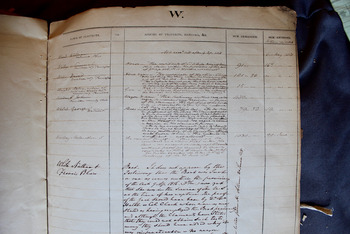
A page from Peter Hagner's Abstract of Claims. He crossed out “when settled” and substituted “when rejected.” Source: Abstract of Claims, April 30, 1818–February 11, 1820; Office of the Third Auditor, Records of the R.B. Lee Commission; Records of the Accounting Officers of the Department of the Treasury, 1775–1978, Record Group 217, National Archives Building, Washington DC. Photo credit Justine Thomas.

At that point, Lee's work was transferred to Peter Hagner, the third auditor of the Treasury. Hagner barred almost all new claims, crossing out on his forms the preprinted heading “when settled” and substituting it by hand with the heading “when rejected.” He listed 191 claimants under this column. More than 75% of their corresponding claims were for property lost while in the service of the military. Hagner usually offered reasons other than the perfunctory “missed deadline” for rejecting these formerly admissible claims. For example, he told one soldier from Tennessee that he would not compensate him for his lost horse because the soldier had lost his horse while he was dismounted, even though his commander had never ordered him to dismount. Hagner was even less sympathetic toward claimants for property that the enemy had destroyed. In one case, he denied a claim for two lost houses on the basis that the United States Army had used the buildings as hospitals and not as the literal text of the 1816 claims law stipulated as a “deposite [sic] for military or naval stores, or as barracks for the military forces of the U.S.” “But independent of this objection,” Hagner added to this claimant, “the claim is barred in consequence of its not having been exhibited within the time limited by the law.”Footnote 64
Many sufferers still refused to relent. However, their only recourse was to petition Congress for redress. And, in March 1818, the Committee of Claims—facing upwards of 160 different petitions from the Niagara frontier alone—endorsed providing some relief for the Niagara sufferers (not to mention its own workload). “Although the claimants have no legal demands upon the Government,” the committee members emphasized, “it would ill comport with the munificent character of the country to entirely withhold relief in a case of such extreme suffering.” After reviewing the claims, though, the committee members could not discern a best course for distributing relief among the sufferers. The problem, they explained, was that “some of the sufferers have lost no other property than buildings, and others nothing but personal effects. Some have lost personal effects to a large amount, while their neighbors had but little to lose.” Given this variability, the committee members conceded that they were “perfectly satisfied that no rule can be adopted for relieving the claimants from any portion of their sufferings, but such as will be arbitrary in its application.”Footnote 65 They therefore wrote a bill offering claimants one half the value of their lost buildings and three tenths of the value of their lost personal property.
The committee's proposal to pay eligible claimants 30% of the value of their lost personal property may have been “arbitrary,” but its decision to include a provision for personal property was not. The ninth section of the original law had not mentioned personal property, which, in turn, provided to those who sought to limit compensation a pretext for denying claimants reimbursement for their lost belongings. In response, sufferers had stressed to their congressmen the importance of providing compensation for lost personal property. In December 1817, the aforementioned Robert Stoddard—then serving as one of Lee's deputies for evaluating claims—dropped another line to Congressman Porter. In this letter, Stoddard griped about the federal government's ambiguous policy for dealing with personal property claims. “I know nothing of the course which a committee will take in Congress,” Stoddard professed, “but I think there is danger in raising particular objections, especially on the ground of personal property.” “If you examine the losses attentively,” he explained, “you will perceive that a very considerable number of the claimants were mere tenants of the houses they occupied, which houses the owners have laid claims for.” Stoddard asked: “If the idea that personal property is not to be paid for is stated, and makes an unfavourable [sic] impression, what would become of a tenant whose only loss consisted in mere personal property?” “I do believe,” he contended, “there are some even of that description whose losses were very great, and whose claims are for a just sum.”Footnote 66
But the committee's bill for the relief of the Niagara sufferers was short lived. On April 9, 1818, representatives from Louisiana, Maryland, and Virginia—in other words, those from other areas that had suffered damage during the war—amended the bill to make their constituents eligible for compensation as well. The next day, though, the House rejected the bill with a lopsided vote of 91 to 51. The sufferers took the news of the bill's defeat badly. On May 6, the Commercial Advertiser of New York reported that “not since the heart appalling hour, when the citizens of this frontier were guided in their flight…by the gleam of their burning dwellings, has there ever been known such a universal sentiment of depression and despair.”Footnote 67 Two days later, another newspaper, The New York-Columbian, lamented: “This unexpected and unjust determination cannot fail of involving many honest and excellent citizens in poverty and ruin.”Footnote 68
Despite this legislative setback, individual sufferers continued to petition Congress for redress. Toward that end, they usually had to solicit assistance from their own congressional representatives. To illustrate, in 1819, the citizens of New York's 18th Congressional District elected a veteran state legislator named William Ford to serve as their new representative. Years later, Ford's son, in an unpublished biographical sketch of his then-late father, remarked that his district, which bordered Lake Ontario and the St. Lawrence River, encompassed an area that “had been more exposed to the attacks and invasions of the enemy than any other part of the country.” Although the residents of other war-ravaged areas might have taken issue with this assertion, Ford's district had certainly been the site of several military engagements, including two different battles at Sackets Harbor. Those engagements had caused a “great destruction of property,” too. Moreover, troops on both sides had appropriated private property while they were stationed in the district. In some cases, American officers paid for this property with due bills that they assured the recipients could be exchanged for repayment from the federal government. In the sketch of his father, Ford's son recounted that “in all those and numerous other cases, arising out of the war on that frontier, petitions were presented to Congress asking for payment or indemnification.” “My father,” he went on to explain, “as representative of that district, was charged with the duty of obtaining relief for his patriotic and credulous constituents.”Footnote 69
Remarkably, Ford's notebook from his single term in Congress has survived the ensuing two centuries. In this notebook, Ford jotted details about the litany of petitions to Congress from his constituents. “From examination of the book,” Ford's son rightfully observed in his sketch, “it is apparent that much of my father's time must have been surrendered to his ‘prayerful and confiding’ constituents, who had been wounded or thought they had been, or gave their property to the government in exchange for paymaster's due bills.”Footnote 70 Take the case of Eber Hubbard, for example. In September 1812, Hubbard “was compelled” to loan his 18 ton boat to a military subcontractor, who used the vessel to transport a cargo of provisions from Sackets Harbor on Lake Ontario to Ogdensburg on the St. Lawrence River. Two British vessels captured Hubbard's boat during its return voyage, even though the American crew “made every attempt in their power to escape.” After the war, Hubbard filed a claim for his lost property with Lee's office, which took testimony in the case. His claim was rejected, though, leaving him with no alternative but to petition Congress for relief. Ford supported Hubbard in that endeavor. He scribbled three pages in his notebook about Hubbard's case, summarizing the evidence that Lee's deputies had collected and listing arguments in favor of the claim. Among other points, Ford noted that the subcontractor “swears that he heard the boat [had] an express contract that the risque [sic] of capture and destruction by the enemy should be on the part of the U. States.”Footnote 71 He also presented Hubbard's petition for compensation to the House of Representatives on December 13, 1820.
Back in 1816, Henry Clay had quipped during the House's debate about Lee's conduct that “the right to be heard by petition in this House is in fact little more than the right to have your petition rejected.”Footnote 72 Time soon validated his provocative remark. Even with Ford's support, the House's Committee of Claims rejected Hubbard's petition the week after receiving it. The committee members refused to honor the subcontractor's “express contract” that the federal government would compensate Hubbard if the British captured his boat. “Admitting there was, between the Government and the contractor, a stipulation of which the latter might avail himself in case his means of transportation had been taken by the enemy,” they ruled, “it is not perceived by what process that stipulation has been converted into even an implied contract between the Government and the present claimants.”Footnote 73 The Committee of Claims also disapproved of Mary Sears's petitions for compensation. With the help of her own congressional representatives, Sears petitioned the House no less than five times between 1813 and 1824. Despite her persistence, however, the Committee of Claims consistently dismissed Admiral Cockburn's own admission that he had destroyed Sears's boardinghouse because it was a military facility. That contention, they decided, was merely “the vague excuse of a vindictive freebooter for a disgraceful outrage on the usages of civilized warfare.” As such, they did not “feel the obligation on the Government to make indemnity, nor discover any practical principle of justice that would allow it.”Footnote 74
Given such rejections, it did not take long for the sufferers and their representatives in Congress to realize that they would need to pass new legislation to make it easier for claimants to qualify for compensation. For example, in January 1820, a man from Michigan Territory named J. R. Williams urged his territorial delegate to Congress, William Woodbridge, to breathe new life into the defunct claims process. “The several heavy losses which I have sustained,” he explained with frustration, “imperiously call for my greatest exertions to satisfy pecuniary engagements; without some relief from my Government, I shall be under the necessity of adding sacrifices to property, to those already made during the late war, to repair the losses then made.”Footnote 75 “Should the subject [of compensation] be again revived,” Williams then entreated Woodbridge, “I earnestly solicit your attention to it, that the Law may be so framed, that I may have a chance to share in the relief contemplated by it.”Footnote 76 Despite such supplications, though, Michigan had little influence in Congress. The territory would not even become a state for another 17 years. But that was not true for other areas that had suffered damage during the war.
Indeed, by 1824, the sufferers and their congressional representatives had reason to hope that they could revive—as J. R. Williams from Michigan had put it—“the subject.” Unlike Michigan, several areas that had suffered damage during the war now held more political sway than they had in 1817. Louisiana went from having one representative to having three. New York boasted nine additional representatives. Ohio more than doubled its representation. Moreover, a few of the territories that the enemy had invaded—Alabama, Illinois, Indiana, and the former District of Maine—were now full-fledged states, complete with their own representatives.
With their added leverage in Congress, representatives of the sufferers were able to create a select committee to investigate what further initiatives might be “fit and necessary” to help their constituents. In April 1824, this committee issued a report, blaming the federal government for the destruction on the Niagara frontier. According to the committee, the government had “not only declared the war, but…selected [the] frontier for the theater of its operations; gave to the property upon it a military character; provoked the vengeance of the enemy by an unjustifiable act [the burning of Newark]; and then imprudently withdrew its troops, leaving its defenseless inhabitants to the power of the enemy.” The committee therefore concluded that “the claims, which sufferers…have for the sympathy and compassionate relief of their Government, cannot be resisted without doing violence to the most generous and godlike feelings of our natures.”Footnote 77
Accompanying the select committee's report was a bill to amend the 1816 law to provide sufferers with an opportunity to resubmit their claims to the Third Auditor of the Treasury, who would then have to adjudicate the claims using Lee's interpretation of the ninth section of the law. “The ninth section,” stipulated the bill, “shall be construed to extend to damage sustained by any person during the late war…by the destruction of his, or her, house or building, by the enemy, if the same had been at any time during the war, used or occupied for any military purposes.”Footnote 78 Like the Committee of Claims in 1818, the select committee also included a provision for personal property in its bill, specifying that eligible claimants “shall be paid the amount…of the value of his buildings, and one half of the ascertained value of the personal property destroyed within.”Footnote 79 Unlike in 1818, though, the committee members did not limit eligibility for compensation to the Niagara sufferers alone. And, by broadening the eligibility, they probably hoped to elicit support from other areas of the country with outstanding claims.
“Equal and Exact Justice”
Although the select committee submitted its report on the Niagara sufferers in April 1824, the House did not begin debating the subject until that December. At that point, the debate began essentially where it left off in 1817—over the “great question,” as Philip P. Barbour put it, “What is the nature and character, and what is the extent, of the obligation which a whole community owes to its individual members for losses sustained during a state of warfare from acts of the enemy?”Footnote 80 For most representatives, the answer was still—in the words of Lewis Williams of North Carolina—that “it is the nature of things impracticable, that a government should pay for every loss its citizens may sustain by a state of warfare. All such as are merely incidental must be borne by the sufferers.”Footnote 81 Williams even alleged that the sufferers from the Niagara frontier who had sent to Washington, DC, “the most heart-rending accounts of their calamities…received more benefit than injury from being to the extent it was the seat of war.”Footnote 82
Even with their added representation, then, the advocates for the sufferers faced an uphill battle. Their opponents stood on very high ground, too. Channeling the jurist Emmerich de Vattel, the scholarly Barbour expertly demonstrated that “there exists nothing [in the case of the sufferers] like that sort of obligation by which a man is bound to pay his debts.”Footnote 83 But he also proceeded to paraphrase Vattel's contention in The Law of Nations that “were the state strictly to indemnify all those whose property is injured…the public finances would soon be exhausted.”Footnote 84 And, perhaps decisively, Barbour used a case from nineteenth century America to illustrate the eighteenth century Swiss jurist's point. “Suppose, for farther illustration,” he said, “that we had no treaty stipulation on the subject of the negroes of the South, which were carried off during the war.” “Is this committee,” Barbour asked, “prepared to say that [the] Government would be bound to indemnify the losers for every negro[?]” “Sir,” he scoffed, “the loss would be immense.”Footnote 85
Before Barbour's “illustration,” few congressmen had mentioned slavery in any context while debating the federal government's policy for compensating wartime sufferers. Presumably, most regarded the two topics as unrelated. But that was no longer the case. As the historian Alan Taylor describes in The Internal Enemy, the British liberated approximately 5,000 enslaved men, women, and children during the War of 1812. Most of these black people hailed from Maryland, Virginia, and South Carolina. And, as slaveholding Virginians, President Madison and Secretary of State James Monroe were apprised of this issue. In his instructions to the American peace negotiators in Europe, Monroe expressed his hope that, “should a treaty be formed, it is just in itself, and would have a happy effect on the future relations of the two countries, if indemnity should be stipulated on each side for the destruction of all unfortified towns, and other private property, contrary to the laws and usages of war.” “It is equally proper,” he then added, “that the negroes taken from the Southern States should be returned to their owners, or paid for at their full value…If these slaves are considered as non-combatants, they ought to be restored; if as property they ought to be paid for.” Monroe also reminded the negotiators that the United States and Britain had already “recognized this principle” in their Treaty of Paris from 1783.Footnote 86
In November 1814, the American negotiators who were assembled in Ghent, Belgium, presented their British counterparts with a draft treaty. Per Monroe's instructions, they included an article that would have made the two nations pay indemnities to the “subjects or citizens of the other party for all losses and damages sustained…by reason of the destruction of unfortified towns, and the pillage or destruction of private property, and the enticement and carrying away of negroes.”Footnote 87 The British flatly rejected this article, responding disdainfully that the proposed indemnifications were “so unprecedented and objectionable, that any further perseverance of the American plenipotentiaries in requiring them is not anticipated.”Footnote 88 Subsequently, the Americans dropped their request.Footnote 89 However, the Treaty of Ghent ultimately included an article requiring both parties to return most of their captured territories, without “carrying away…any Slaves or other private property.” The Americans included this article to ensure that the British forces would not withdraw from American territory and territorial waters with the people they had liberated.Footnote 90 Regardless, Admiral Cockburn—the British commander who had burned Havre de Grace—purposefully misconstrued the treaty so that he only had to relinquish a small fraction of those they liberated. Instead, the British resettled most of the liberated people in their colonies. In response, American diplomats spent the next several years pressuring their British counterparts to compensate the former owners. It was not until 1822 that the two sides agreed to let the Tsar of Russia mediate their dispute. Although the Tsar ruled in favor of the United States, the British (as of 1824) were still haggling over the total cost that they would have to pay in compensation.Footnote 91
Barbour was very interested in the outcome of this negotiation. As a representative from Virginia, he knew that nearly half of the liberated slaves came from his home state. But it is hard to imagine why Barbour—as someone who was opposed to compensating additional sufferers—would point out that the British had consented to pay back American slave owners, but not those who had lost other types of property. The congressional investigators had even griped about this discrepancy in their report, noting that the United States had secured the “principle of reparation” for its aggrieved slaveholders, yet “no indemnification [was] obtained for [other aggressions], infinitely more aggravated and distressing.”Footnote 92 And, not surprisingly, the representatives of the Niagara sufferers quickly capitalized on Barbour's political faux pas. The next day, on December 29, Albert Tracy of New York countered: “The gentleman from Virginia had said, that, if there existed no treaty stipulation respecting slaves, and the losers of them should come to Congress with a demand for indemnification, he should have opposed the demand on the same ground that he opposed the present bill.” “Now,” he reminded his audience, “I have to reply, first, that the case put forward by the gentleman does not arise, since there is a treaty stipulation with respect to slaves.” Tracy then claimed that Britain's agreement to return the slaves it had liberated was “a stipulation by which I apprehend other claims to a great amount have been sacrificed.”Footnote 93
In fact, the American plenipotentiaries at Ghent had barely enough leverage to return to the status quo ante, let alone demand that the British compensate Americans civilians whose property had been damaged or destroyed during the war. But Tracy was more focused on politics than accuracy. For years, the sufferers and their representatives had appealed to their opponents’ compassion, patriotism, and sense of fairness. Their appeals had little effect, though. By late 1824, then, the representatives of the sufferers had come to realize that they would need to employ realpolitik to rally additional support. Toward that end, Tracy was attempting to drive a wedge through the opening that Barbour's reference to the Treaty of Ghent had made. This wedge—sectional politics—had not been available to his predecessors back in 1817. After all, at that time, the British had not yet agreed to pay the United States for the slaves that they liberated.
Slavery had been less divisive in 1817, too. However, the United States had experienced a seismic shift in sectional politics in the years since Congress had last addressed the issue of compensation. This shift had occurred in 1819 during the Missouri crisis: an impassioned political dispute between the North and South over Missouri's attempt to enter the Union as a slave state. Although Congress had resolved the Missouri crisis in 1820, the dispute itself had long-standing political consequences.Footnote 94 In particular, many Northern statesmen were more eager to resist any perceived mistreatment from the South because they had already grudgingly agreed to permit slavery to spread west. Given this heightened tension, though, Tracy might have also refrained from bringing up slavery if Barbour had not been the first to mention it. Indeed, the issue was so potentially explosive that allies and opponents alike might have criticized him for being either overly inflammatory or desperate. But Barbour was a Southerner, not to mention a slaveholder himself. For him to call attention to the relentless American campaign to obtain compensation from Britain for the people it had liberated during the war practically served as an invitation for Northerners to demand equal treatment, especially in a post-Missouri-crisis context.
With that in mind, Tracy signaled to his fellow Northerners that the federal government had put the interests of slaveholders ahead of those who had lost their houses and livelihoods. Adopting Barbour's own hypothetical, he speculated that if a claim for lost slaves “had arisen, the claim on the government for slaves carried off would be far from equal in strength to that of the Niagara sufferers for their buildings destroyed.” “The claim of those proposed to be benefited by the bill,” Tracy contended, “was much stronger than that of persons who had lost negroes.”Footnote 95 At first, no other Northern congressmen openly joined in beating the sectional drum, though a few expressed their willingness to relieve the sufferers. On January 3, 1825, however, Tracy's fellow New Yorker, John Cady, picked up where he had left off. “I have been instructed by the Legislature of New York,” Cady announced, “to advocate these claims.” He exclaimed that the state of New York “asks you to do equal and exact justice—she has seen you pay for losses in the West and in the South—she has seen your western dragoons remounted, and the negroes of the southern planter restored.” “Will you now listen to her application?” Cady then asked.Footnote 96
The strategy of the New Yorkers seemed to be having the desired effect. That same day, several representatives from areas in the North that had not suffered any property damage during the war voiced their support for the sufferers. Those who spoke up saw no reason why Congress “should not,” as Tracy had suggested, “relieve some of its citizens, whose sufferings had been the greatest.”Footnote 97 In that regard, James Buchanan of Pennsylvania announced that Congress should “mitigate their calamities, not indemnify them for their losses.” “They have suffered more than the common misfortunes of war,” he stated. “They are therefore entitled to the compassion of a paternal government.”Footnote 98 Among other Northerners, Thomas Ross of Ohio agreed. “Let us,” he exclaimed the next day, “act with boldness, under a due sense of what is our imperative duty.”Footnote 99
Shortly after Ross's speech, Henry Martindale, another member of New York's delegation, reiterated the arguments in favor of alleviating the sufferers. In addition, though, Martindale argued that the United States was responsible for the property losses because it had “neglected” to obtain restitution for those losses in the Treaty of Ghent. “It did get compensation for slaves carried off,” he pointed out. “Why not for these spoliations?” Like other advocates for the sufferers, Martindale also insisted that the British had only burned towns in the United States as retribution for American transgressions in Canada. In his view, this circumstance now made Congress “liable” for compensating the sufferers. With forensic deftness, Martindale then manipulated this argument to accuse the South of hypocrisy. He questioned whether Barbour would have supported claims for lost slaves if the British had taken those slaves in retaliation for American seizures. “Would the gentleman from Virginia oppose such a claim?” Martindale asked. He “suspected not.”Footnote 100 Whether Martindale knew it or not, however, this scenario was not pure conjecture. Some distressed slaveholders had, in fact, sought restitution for slaves that they had lost during the war. For example, a surgeon in the Tennessee militia named William P. Lawrence had brought a slave to war, rather than employ an assistant. Lawrence's slave then died from a disease that he contracted while attending to sick soldiers. Consequently, Lawrence petitioned Congress to compensate him for his lost slave, just as if he had lost a horse in battle.Footnote 101
The Committee of Claims denied Lawrence's claim. In fact, the Southerners on the Committee of Claims had consistently refused to compensate such claims. In one case, an officer named Andrew Montgomery asked Congress to compensate him for a slave that he lost during the infamous Fort Mims massacre. After the massacre, Montgomery had successfully led a large group of white settlers and soldiers from nearby Fort Pierce to safety in Mobile. Nevertheless, Bartlett Yancey of North Carolina denied the federal government's liability for Montgomery's slave, arguing that if compensation were to be made it “would have the effect of compelling the United States to become the warrantor of the value of the servant.”Footnote 102 In another case, a man from Maryland named Richard Frisby claimed that the British had destroyed his estate and “forcibly carried off four of his most valuable negroes” because American militiamen had been using his property to observe their movements. In response, Lewis Williams of North Carolina informed Frisby that the Committee of Claims could only remunerate him for property that the militiamen had been using as their barracks. However, he seemed unsure whether the House itself would condone his strict interpretation of the law. And, if not, Williams sought to ensure that claimants like Frisby could receive compensation for their lost slaves. He warned that, “if Government pays for the houses, it is just as necessary to pay for the negroes, because the same motive which produced the destruction of the one led to the stealing of the other.”Footnote 103
Of course, Martindale was not truly interested in learning whether Southerners such as Yancey and Williams had denied claims for lost slaves. Like other members of the New York delegation, he was intentionally stoking sectional partisanship, in this case by implying that, in the absence of the Treaty of Ghent, Southern representatives would have supported federal relief for their own constituents if the British had taken their slaves for the same reason that they had burned towns. This strategy seemed to have the intended result. Indeed, the House began to vote on amendments to the select committee's bill immediately after Martindale's speech. At that time, it became clear that the sufferers—for perhaps the very first time—had momentum on their side. Indeed, the House only narrowly approved of capping the total expenditure (at $350,000).
At the same time, it was becoming equally clear that several representatives from the South were growing eager to thwart the bill. Politically, these representatives probably felt obliged to counter the tide of Northern support. In addition, they were likely wary of increasing federal expenditures, especially for the purposes of redistributing wealth. After all, these were the same representatives who, only months before, had resisted increasing the federal tariff. They were also reluctant to permit the federal government to judge the relative importance of different types of property. And, in that regard, the bill was problematic because it offered full restitution for lost real estate, but only half the value of lost personal property. Moreover, claimants could only receive compensation for personal property that was “in the said house or building, at the time of its destruction, and which was destroyed therewith.” As a result, claimants whose slaves had either died or disappeared in the public service would still not qualify for repayment.
With that in mind, John Forsyth of Georgia explained that the Treaty of Ghent—contrary to the increasingly popular misconception among the Northerners—“included no provision for [slaves] as had been pressed into the public service.” He therefore proposed his own amendment, which stipulated that “the value of every slave impressed into the public service during the late war…and lost to the owner in consequence of his impressment, shall be paid to the owner out of any money in the Treasury.”Footnote 104 But the House peremptorily rejected Forsyth's amendment.Footnote 105 At that point, the debate was heading in a sectionally contentious direction. And so, the next day, John Wright of Ohio assumed the role of an honest broker. Although Wright supported carrying the previous laws into “practical effect,” he believed that the bill “does in truth relax the restraint imposed by those laws, and thereby extends their provisions.” He was especially concerned that the select committee had removed the proviso in the ninth section of the law requiring claimants to prove that the enemy had destroyed their buildings because the U.S military was occupying them. Consequently, Wright proposed to substitute the committee's bill with a new version—one that would preserve “the whole of the act of 1816.” He believed, however, that the Niagara sufferers would still qualify for redress. “Most of the cases of destruction,” Wright reassured, “had happened to buildings then in the occupation of the United States or its agents.”Footnote 106
Years later, in February 1861, Wright would pass away while trying to broker a deal to avert the Civil War.Footnote 107 He had better success crafting a compromise in 1825. Indeed, several representatives voiced their support for Wright's bill, especially after Henry Storrs of New York struck out its clause requiring claimants to prove that the enemy had destroyed their property because it was occupied by the U.S. military. With that change, a majority in the House seemed to regard the bill as a fair measure that would enable most sufferers to receive compensation, if only for their lost buildings. Representatives from slaveholding districts that suffered wartime damage might have even been relieved that the bill would no longer include a provision for lost personal property, which practically would have invited ineligible claims for lost slaves.Footnote 108 But Forsyth was still upset that Wright's bill would favor claimants for lost buildings over claimants for lost slaves. The next day, he again tried to add a provision to offer compensation for slaves lost while employed in public service. And, once again, the House rejected this amendment. Perhaps as a consolation, Storrs then proposed an amendment to cap the total expenditure of the bill at an indeterminate amount (which the House eventually agreed should be $250,000).
Forsyth remained unsatisfied. He gave a speech decrying the unconstitutionality of the bill and its various precursors. In particular, Forsyth insisted that they all subverted the Third Amendment, which banned the quartering of troops in any house in a time of war, except in a manner prescribed by law. In addition, he argued that the Fifth Amendment only required Congress to provide “compensation for the time in which [the] Government had use of the property, and compensation for any injury it may have sustained in consequence of its occupation by [the] Government.”Footnote 109 Others had raised similar concerns in the past, but the representatives of the sufferers had always brushed aside such “constitutional objections” as an excuse for withholding compensation. “I have also read the Constitution of my country,” John Cady of New York had stated three days earlier. “And in the preamble,” he exclaimed, “I am told that it was adopted ‘to promote the general welfare.’”Footnote 110 However, Southern statesmen like Forsyth were genuinely worried about mission creep in the federal government, especially for endeavors purportedly intended to “promote the general welfare.”Footnote 111 Indeed, many would grow so anxious about federal power that they would come to believe that states should be able to nullify federal laws.
But Forsyth had left himself open for a riposte. Storrs quickly accused him of hypocrisy for having tried to amend the bill to include compensation for lost slaves right before denouncing the principle of the bill itself. “The gentleman,” Storrs observed, “had been opposed to this act.” “But,” he then sneered, “let us see what he himself proposes respecting slaves: he would have the Government pay for all the slaves impressed during the last war, and afterwards lost.”Footnote 112 That Storrs had sided with the South during the Missouri crisis likely added weight to his charge.Footnote 113
The House voted to adopt the amended version of Wright's bill immediately after Storrs spoke. However, Charles Mercer of Virginia then proposed to lay the bill on the table until the Treasury Department and the War Department could provide some additional information. The House agreed, postponing the final vote until January 19. On that day, the opponents of the bill made a last-ditch effort to scuttle its acceptance, prompting a series of rebukes. With both sides escalating their bombast, John S. Barbour rose to express his belief in both the constitutionality and justice of the bill. But this speaker's identity was probably more meaningful than his words. As a leading Virginian, Barbour's support for the bill signaled to Southerners from other districts that had suffered during the war that they could, on this occasion, set aside their constitutional scruples and fears about federal encroachment. Indeed, Barbour was not even on the same side as his own cousin, Philip Pendleton Barbour, who remained a steadfast opponent of the bill.Footnote 114
The House voted on the bill that same day. And for the first time, the sufferers and their advocates triumphed. The roll call was a rout, too, with a fifty-three vote margin of victory. All the representatives from Alabama, Illinois, Indiana, Louisiana, and New York voted for the bill. Among Ohio's fourteen member delegation, only Wright, the primary author of the bill, voted against it. Presumably, he felt too troubled that claimants would no longer have to prove that the enemy had destroyed their property because it was occupied by the United States military. In all, though, just 22 of the 112 Northern representatives voted against the bill.Footnote 115 In contrast, representatives from the Southern states that had not suffered any damage during the war—Georgia, Mississippi, North Carolina, and South Carolina—still refused, by a margin of twenty-six to three, to vote for the bill. James Hamilton, another future nullifier, was the lone representative from South Carolina to support the bill. Having witnessed the depredations along the Niagara frontier during his wartime service, Hamilton was apparently unwilling to desert the sufferers while serving in Congress. Meanwhile, representatives from the slaveholding states of Maryland and Virginia were heard on both sides of the roll call, which, considering the rift within the Barbour family, was hardly surprising.
The bill became law on March 3, 1825. Next to military pensions, it encompassed the largest appropriation in the 1825 federal budget. Under the law's terms, the Third Auditor of the Treasury, Peter Hagner, gave sufferers 9 months to resubmit their claims. Of the 209 sufferers who restated their cases, 114 now qualified for compensation. Hagner issued $220,365 to these claimants, 105 of whom hailed from New York.Footnote 116
In addition, Congress applied the new law's provisions when it itself was reviewing claims from the war. Between 1813 and 1843, it appropriated approximately $210,000 through 215 special acts for the relief of petitioners. One of those beneficiaries was the aforementioned Eber Hubbard, whose boat had been requisitioned in 1812 and then captured after transporting provisions to American troops. In December 1829, Hubbard repetitioned Congress to compensate him for his lost vessel, which, as an item of personal property, was not covered under the new law. The congressional claims process moved slowly, however. It was not until March 1832—in other words, 20 years after the British had captured the boat—that Congress passed a bill for Hubbard's relief and awarded him $700, which was the appraised value of the vessel and rigging back in 1812.
In all, the federal government settled at least 4,700 claims from the War of 1812 and granted claimants no less than $955,000 in compensation. That was an unprecedented extension of federal accountability and administration, especially considering that Congress strived to keep its outlays to a minimum during the Early Republic. In that sense, the decade-long struggle of the sufferers to obtain compensation for their losses constitutes a successful case of ordinary citizens and their representatives being able to influence federal legislation and shape national policy.Footnote 117
Many sufferers, however, still believed that Congress should have broadened the eligibility to receive compensation. “Whatever might have been the intention of Congress,” wrote the Legislative Council of the Territory of Michigan to Congress in 1827, the acts “have fallen far short of giving relief to the suffering citizens.”Footnote 118 Indeed, it was not enough that the federal government had been unable to protect private property or that the enemy had destroyed property in retaliation for the United States military's misdeeds. The “suffering citizens” still had to prove that their lost buildings had been used for the war effort. As Hagner explained to William Brook of Falmouth, Virginia, he could only offer payment for buildings “where the destruction was occasioned by the act of the government in depriving the buildings of a private and giving them a public character…[they had to be used] openly as places of deposit for public stores.”Footnote 119 Those with ineligible claims resented these limitations. “The question [should] not be asked of the claimant, if his house was occupied as military post, or place of deposit,” scorned the members of Michigan's Legislative Council. “The citizen complains,” they said, that “his cattle were shot, and plundered; his clothes were pillaged from his house; his furniture made bonfires; and his house a conflagration; by a cruel and unrelenting enemy. That it is the duty of the Government, to protect the citizen and his property, in time of war, is a sufficient argument for his relief.”Footnote 120
Of course, even claimants who proved that their property had been lost in the public service were not necessarily entitled to restitution. Most conspicuously, the federal government did not pay one cent of the more than $296,000 in claims for lost personal property that sufferers submitted to Hagner in 1825. Undoubtedly, this denial was devastating for many claimants, including Mary Sears. In 1825, Hagner finally conceded that her boardinghouse had, in fact, been used as a military deposit. However, because Sears had been renting her building from a man named William Stokes, only he, as the owner of the lost real estate, was entitled to receive compensation. And, sure enough, he received $7,000. But Sears did not receive any payment because everything she lost—tavern equipment, furniture, goods, and clothing—was personal property. “The law,” the Committee of Claims told her after she appealed Hagner's decision in 1826, “is confined alone to houses or buildings, and having excluded personal property, is very conclusive that the Government did not intend to pay for it when destroyed.”Footnote 121 Sears kept petitioning Congress for her losses until her death in 1837, all to no avail. Evidently, though, she was not destitute. Indeed, according to the 1820 United States Census, Sears either owned or rented two enslaved women—one between the ages of 14 and 26 and another 45 years old or older.
Conclusion
Americans suffered substantial property losses during the War of 1812. To adjudicate petitions for compensation, Congress, in 1816, established an Office of Claims, which then proceeded to award money to allegedly undeserving claimants. In response, Congress restricted the office's power, limiting compensation only to those whose property had been taken by the United States military. Under continual political pressure, however, Congress readdressed the plight of the sufferers in 1824. At that time, representatives of the sufferers in New York shrewdly pointed out that American diplomats had sought and won indemnities for the enslaved people whom the British had liberated during the war, but not for other types of private property losses. With that perceived injustice in mind, most congressmen from the North gave their support to the sufferers, creating in 1825—for the first time—a majority in the House of Representatives for enacting a more generous law for compensating claimants. Five years after the Missouri Compromise, then, Northerners were still ready and willing to resist the South's unfair influence over federal policy.
Yet, many sufferers derided the 1825 law because it only offered compensation for buildings that had been used by the United States military. Why had Congress limited it? Immediately preceding the House's vote on the bill, Enoch Lincoln of Maine suggested that “the best rule to be followed is, the best feelings of the heart, unless, by following them, we endanger some principles vitally connected with our national existence.”Footnote 122 By that time, however, many of Lincoln's Southern colleagues had come to believe that an overactive federal authority could, itself, “endanger some principles vitally connected with [the] national existence.” Under the circumstances, then, the representatives of the sufferers had to moderate their expectations.
But even the attenuated policy was still too generous for numerous Southerners, who, with an eye toward defending slavery, were fearful of empowering the federal government. The heirs to this ideology would not escape poetic justice, however. Following the War of 1812, Americans began to presume that the federal government would be responsible for remedying their property losses during military conflicts.Footnote 123 In the wake of the Civil War, then, thousands of Southern civilians petitioned the federal government to compensate them for their lost property. They were rebuffed, though, with the same arguments that Southern statesmen had championed following the War of 1812.Footnote 124 Echoing a point made by Philip Barbour of Virginia in 1824, the legal scholar William Lawrence explained after the Civil War that the United States was “no more bound to repair the losses of citizens by the ravages of war than to indemnify them against the losses by arson or other individual crimes.”Footnote 125 Charles Sumner of Massachusetts—an unshakable supporter of both the Union and black civil rights—then deployed this same legal reasoning from his seat in the United States Senate. In 1869, he declared that “the [southern] claimant can look for nothing beyond such contribution as Congress in its bounty may appropriate.”Footnote 126
After (inaccurately) describing the federal government's policy for compensating the War of 1812 sufferers, Sumner remarked to the Senate that the law was “now marked in our Statutes, ‘Obsolete.’ But it is not without its lesson. It shows what may be expected, should any precedent be adopted by Congress to quicken the claimants now dormant in the South.” Quoting from a congressional report on the fraud allegedly committed by the Niagara claimants, Sumner continued: “‘It is the duty of a good Government to attend to the morals of the people as an affair of primary concern.’ So said the Committee in 1818, recommending the non-extension of the [claims] Act. But this warning is as applicable now as then.”Footnote 127 Sumner failed to note the irony that this “warning” had been written by a Southerner, Lewis Williams of North Carolina.