





In-patient mental health admissions provide intensive support for people in crisis but are commonly reported to be distressing, restrictive, (re)traumatising, disruptive to daily life and costly.Reference Hallett, Dickinson, Eneje and Dickens1–Reference Davidson4 Expansion of community-based crisis services has therefore been a policy priority in England. Since the early 21st century, Crisis Resolution and Home Treatment teams (CRHTs) have been the main alternative to admissions, offering rapid assessment and intensive home-based care.Reference Carpenter, Falkenburg, White and Tracy5 Although CRHTs are established nationwide and demonstrate some effectiveness in reducing admissions,Reference Carpenter, Falkenburg, White and Tracy5 demand for in-patient services remains high, compulsory admissions are rising and there is substantial patient dissatisfaction with crisis care. Recent policy in England6 has supported the implementation of additional community-based crisis services alongside CRHTs, including low-threshold drop-in services such as crisis cafés and phonelines – to create comprehensive, integrated crisis care pathways.Reference Johnson, Dalton-Locke, Baker, Hanlon, Salisbury and Fossey7,Reference Dalton-Locke, Johnson, Harju-Seppänen, Lyons, Sheridan Rains and Stuart8 Ensuring that these services reach groups disproportionately subject to compulsory detention – particularly Black people and men9–Reference Bignall, Jeraj, Helsby and Butt11 – is critical. However, there is little research about patterns of use of community crisis services.Reference Johnson, Dalton-Locke, Baker, Hanlon, Salisbury and Fossey7
Study aims
This study addresses this evidence gap by exploring demographic (age, gender, ethnicity) and socioeconomic (area-level deprivation) differences in the use of in-patient and community crisis services in England. We focus on service models with available national routine data: (a) crisis phonelines; (b) crisis cafés; (c) CRHTs; (d) voluntary admissions; (e) compulsory admissions under civil sections 2 and/or 3 of the Mental Health Act 1983 (MHA); and (f) conveyance to a place of safety (PoS) by the police under section 136 (s136) of the MHA.
Method
Study design and data source
This project was conducted by the National Institute for Health and Care Research Policy Research Unit in Mental Health.12 A working group, comprising academic and lived-experience researchers and clinicians, met regularly throughout all stages of the project and contributed across all elements. This included defining research questions, informing methodological decisions (including selection and operationalisation of variables), shaping the presentation and interpretation of results and providing feedback on drafts of the manuscript. In addition, two lived-experience researchers authored a dedicated commentary (see end of Discussion), providing an independent space for reflection on the paper from a lived-experience perspective.
We conducted a retrospective observational study using the Mental Health Services Data Set (MHSDS) version 5 between financial years 2021/2022 and 2023/2024. MHSDS is a pseudonymised administrative database capturing information on anyone in contact with secondary mental health services funded by the National Health Service (NHS) in England.13 As an activity-based data-set, it offers little information on care quality or experience. It comprises multiple linked sub-data-sets covering patient demographics, referrals, care contacts, in-patient care and legal status under the MHA, enabling longitudinal tracking of service use across settings.
MHSDS provides rich service-level information, but is an evolving data-set in which completeness and quality of data vary across fields. Some fields are non-mandatory, and some services are inconsistently coded, limiting the ability to generate reliable national estimates for all types of care. One of our aims was to assess what can feasibly be reported from MHSDS regarding crisis care. NHS England monitors MHSDS data quality, which has improved over time.13
This study is reported in accordance with the Strengthening the Reporting of Observational Studies in Epidemiology guidelines (see Supplementary Material Appendix A available at https://doi.org/10.1192/bjo.2026.12094).
Study population, outcome and exposures
Our study population included all adults aged 18+ years who had contact with at least one of the following six crisis-related service types during the study period.
-
(a) crisis phonelines: telephone services providing access to crisis care across a catchment area;
-
(b) crisis cafés: community drop-in services offering informal, non-clinical crisis support as an alternative to emergency departments;
-
(c) CRHTs: teams providing rapid assessment and intensive home-based treatment;
-
(d) in-patient services – voluntary admissions: hospital admissions consented to by the patient;
-
(e) in-patient services – compulsory admissions: hospital admissions for individuals detained without their consent under civil sections 2 (up to 28 days for assessment) and/or 3 (up to 6 months, renewable, for treatment) of MHA, which governs compulsory mental healthcare in England;
-
(f) s136 PoS detentions: being brought from a public place to a PoS (usually a hospital or care facility) by police for assessment under section 136 of the MHA.
All these services were identified using MHSDS service type codes. Other crisis-related services available in some areas in England (walk-in crisis assessment units, psychiatric decision units, acute day services and crisis houses) were excluded due to insufficient available data. See Supplementary Material Appendix B for detailed descriptions of each included and excluded service type.
We considered service use regardless of the provider and did not consider the intensity of utilisation, because our aim was to examine national patterns of crisis service use across service types rather than provider-level variation.
We excluded individuals with dementia using the mental healthcare organic supercluster,14 because their crisis-care pathways and service needs differ from those of adults using general mental health crisis services.15 Care clusters classify patients into groups based on clinical presentation and care needs.
Compulsory admissions under section 2 and/or 3 were identified using MHA section codes and in-patient records. To reduce misclassification, we restricted these to admissions beginning within 30 days of the relevant MHA legal status start date, because some of these compulsory admissions are transfers which might justify the time gap between the MHA legal start date and admission date. We also classified admissions that began as voluntary, but where patients were subsequently detained during the same episode, as compulsory. Voluntary admissions were all admissions not classified as detentions under Part II (sections 2 and 3) and Part III (sections 35, 36, 37, 38, 44, 45A, 46, 47 and 48) of the MHA. This approach was agreed with NHS England analysts.
Individuals brought to a PoS by the police under s136 of the MHA were identified through MHA legal status records. We considered only those detentions occurring during the study period.
Our outcome was a categorical variable indicating the type of crisis care used. Individuals using multiple service types were assigned separate records for each.
MHSDS has information on patients’ age (which we measured in 5-year bands), gender and ethnicity. Ethnicity was categorised into five groups based on the 2021 Census, to avoid small subgroups, which would limit regression robustness. Age, gender and ethnicity were recorded within each financial year of MHSDS activity. Socioeconomic status was proxied by the Index of Multiple Deprivation (IMD) quintile measured at the patient’s lower-layer, super-output area of residence.16 Accordingly, IMD may vary over time for individuals with activity recorded across multiple financial years. Variables such as diagnosis, care cluster, accommodation status, employment and marital status were excluded due to extensive missingness.
Statistical analyses
To assess differences in patients’ demographic and socioeconomic factors across the six crisis-related service types, we estimated a multinomial logit regression model with patient-level robust standard errors and year fixed effects to account for time-varying unobserved heterogeneity. Covariates were age group, gender, ethnicity and IMD quintile. Missing values in the included covariates were retained in the analyses by creating a separate ‘missing/unknown’ category, thereby avoiding the exclusion of observations with incomplete data. No imputation was performed. For ease of interpretation, we computed and reported the average marginal effects (AMEs), including 95% confidence intervals and reflecting the probability of attending each service group, for each demographic and socioeconomic characteristic while adjusting for the others in the model.
To explore how estimates changed when considering factors individually, we ran separate univariate models for age, gender, ethnicity and IMD quintile, including year fixed effects and patient-level robust standard errors. This allowed us to examine the extent to which associations were explained by other demographic or socioeconomic variables.
All statistical analyses were conducted using Stata 18 for macOS (StataCorp LLC, College Station, Texas, USA; https://www.stata.com/).
Ethical standards
Ethical approval was not required for this study because it used pseudonymised secondary data and did not involve direct contact with patients. The study did not require Institutional Review Board/Research Ethics Committee review, or a formal waiver. The project uses pseudonymised secondary data and results are reported at aggregated levels, with small numbers suppressed in line with NHS England guidance. Patients are not identifiable from the data-set. The data were subject to the NHS National Data Opt-Out, which was applied by the data provider.17 Analyses were conducted in secure environments in line with data-sharing and confidentiality protocols. Individual patient consent was not required.
Results
Descriptive statistics
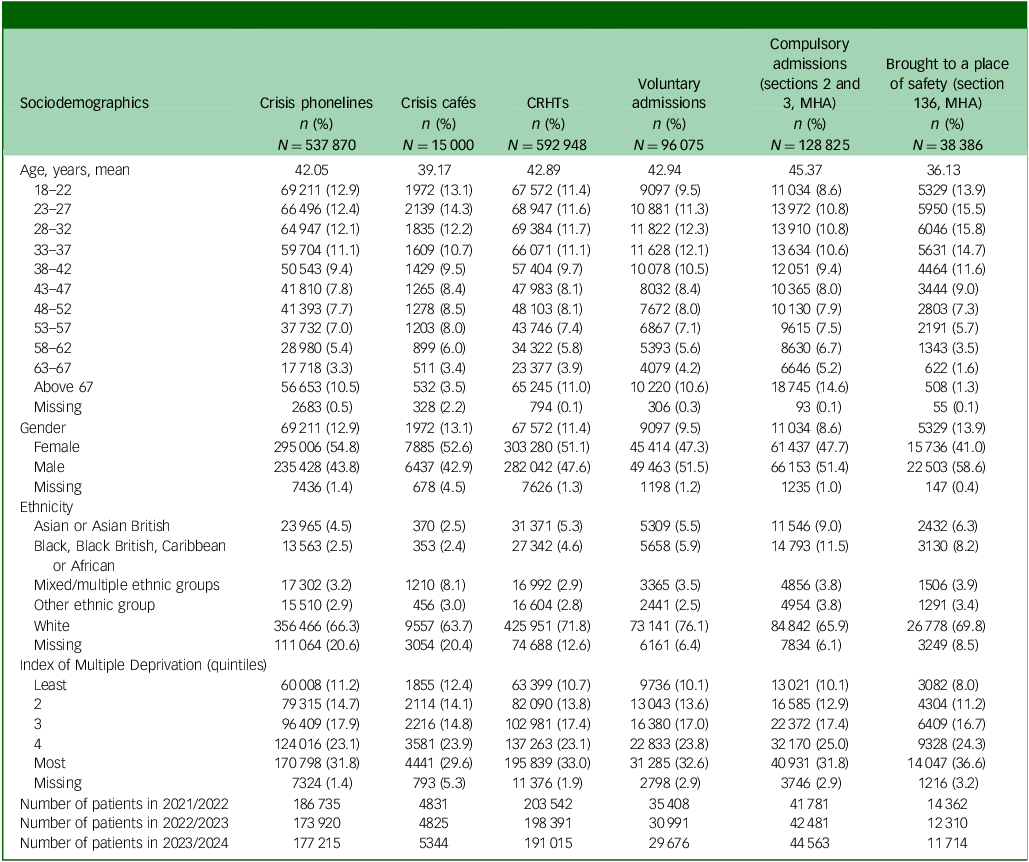
Table 1 summarises the socioeconomic and demographic characteristics of patients accessing one of the six crisis-related services between 2021/2022 and 2023/2024. During the study period, around 1.4 million adults had contact with at least one of these services (80% attended only one service). The most frequently accessed services were CRHTs (used by 42% of patients), followed by crisis phonelines (38%). By contrast, only 3% of patients were brought to a PoS by the police under s136 of the MHA, and just 1% accessed crisis cafés.
Descriptive statistics of acute/crisis patients between 2021/2022 and 2023/2024

Table 1 Long description
The table presents data on sociodemographics and their interaction with various crisis services. It includes columns for Crisis phonelines, Crisis cafés, CRHTs, Voluntary admissions, Compulsory admissions, and Brought to a place of safety. Each column lists the number and percentage of patients. The table is divided into rows based on age, gender, ethnicity, and index of multiple deprivation. Key data points include the mean age of patients, the distribution across different age groups, gender distribution, and distributions across different ethnic backgrounds and Index of Multiple Deprivation quintiles. Notable trends include the highest usage of CRHTs and the lowest usage of crisis cafés. The table provides a comprehensive overview of the demographic spread and service usage patterns among crisis patients.
CRHTs, Crisis Resolution and Home Treatment teams; MHA, Mental Health Act.
Over the 3-year period, we observed a reduction in the number of patients accessing several crisis services: crisis phonelines (−5%), CRHTs (−6%), voluntary admissions (−16%) and being brought to a PoS by the police (−18%). Conversely, there was an increase in the number of patients accessing crisis cafés (+11%) and being compulsorily admitted under sections 2 and/or 3 of the MHA (+7%).
Age
The average age of patients varied by service type. Patients accessing crisis phonelines and CRHTs, as well as those voluntarily admitted, had a mean age of 42–43 years. Patients attending crisis cafés were younger (mean age 39 years), whereas those admitted compulsorily were older (mean age 45 years). The youngest group (mean age 36 years), comprised individuals brought to a PoS by the police under s136 of the MHA.
Age group distributions showed that individuals aged 18–32 years (the 3 youngest age bands) were the most represented across all service groups, especially among those brought to a PoS by the police (45%) and those attending crisis cafés (40%). For compulsory admissions, the proportion declined only gradually with age, with those aged 53–57 years just 1 percentage point lower than those aged 18–22 years.
Gender
Gender distribution varied across services. Most patients accessing crisis phonelines (55%), crisis cafés (53%) and CRHTs (51%) were female. In contrast, patients voluntarily (52%) or compulsorily admitted (51%), and those brought to a PoS by the police (59%), were more likely to be male.
Ethnicity
White patients represented the majority in all six crisis-related service types, accounting for over 60% in each. Percentages should be interpreted with caution, however, because the proportion of missing ethnicity data was higher for crisis phonelines (21%), crisis cafés (21%) and CRHTs (13%), compared with around 6–8% in the remaining services. Among patients accessing crisis phonelines and CRHTs, the second most common ethnic group was Asian or Asian British (around 5%). For crisis cafés, the second largest group was individuals from mixed/multiple ethnic groups (8%). Among those admitted voluntarily, compulsorily and those brought to a PoS by the police, the second most prevalent group was Black, Black British, Caribbean or African, comprising 6, 12 and 8% of patients, respectively.
For context, in the 2021 Census for England, 81.0% of the population identified as White, 9.6% as Asian or Asian British, 4.2% as Black, Black British, Caribbean or African, 3.0% as mixed/multiple ethnic groups and 2.2% as other ethnic groups.18
IMD
Socioeconomic patterns showed a gradient, with increasing proportions of patients living in more deprived areas across all service groups; 30% or more of patients in each service group lived in areas ranked in the most deprived quintile compared with 8–12% in the least deprived quintile.
Regression results
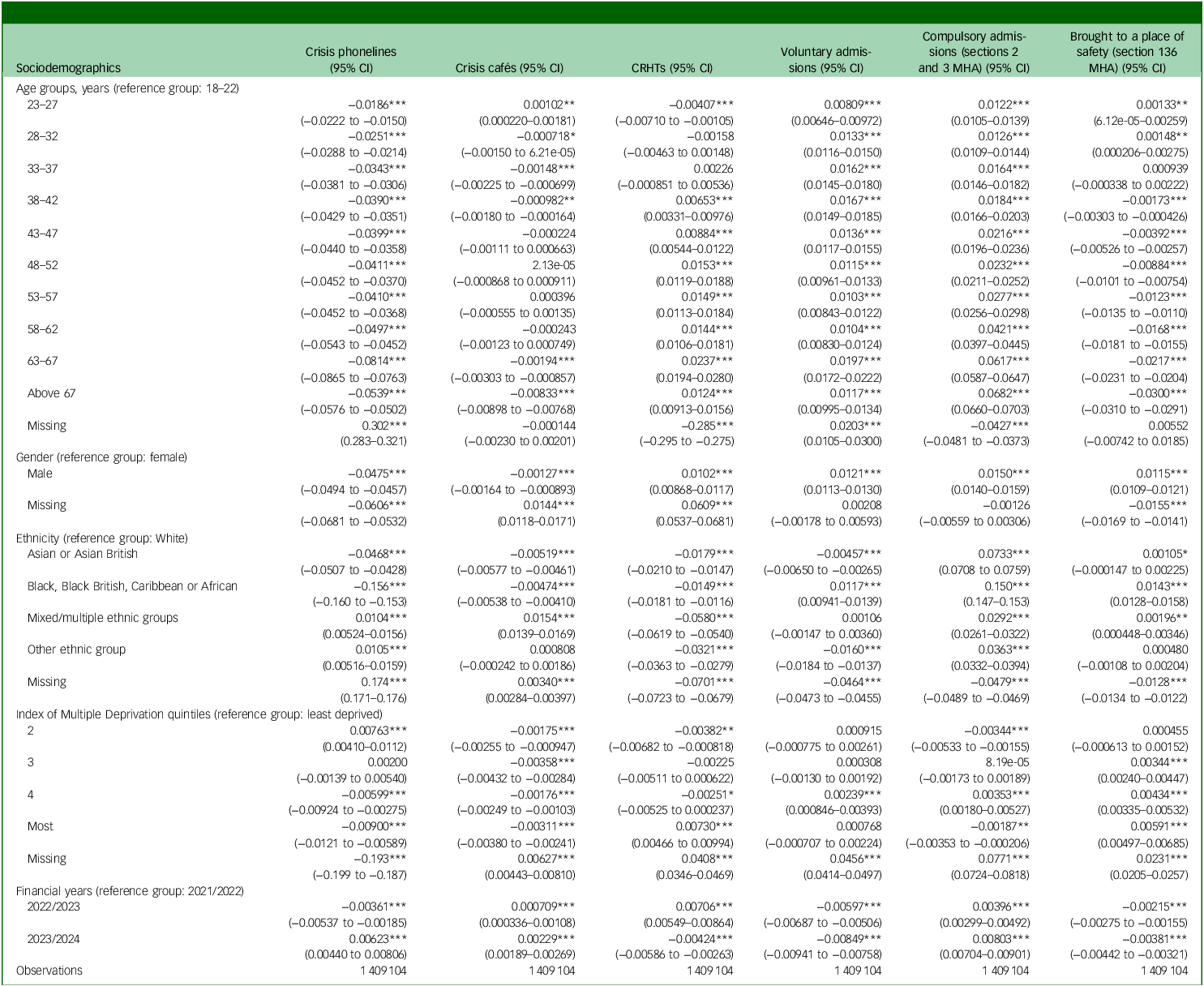
Table 2 presents the AMEs and 95% confidence intervals derived from the multinomial logit regression model. These AMEs indicate the change in the probability of a patient accessing a particular crisis-related service type, relative to the reference category, associated with each sociodemographic characteristic (i.e. age group, gender, ethnicity and IMD), while controlling for the other covariates in the model. In Table 2, the AMEs are reported in their original scale (proportions). Figures 1 and 2 visually depict these effects multiplied by 100, expressed in percentage points for ease of interpretation. Figures 1 and 2 display results for age groups and gender, respectively. Figure 3 presents estimates for ethnicity (top) and IMD quintiles (bottom). To aid interpretation, we also estimated univariate models including one characteristic at a time. These results are presented in Supplementary Material Appendix C.
Regression results: average marginal effects among acute/crisis patients
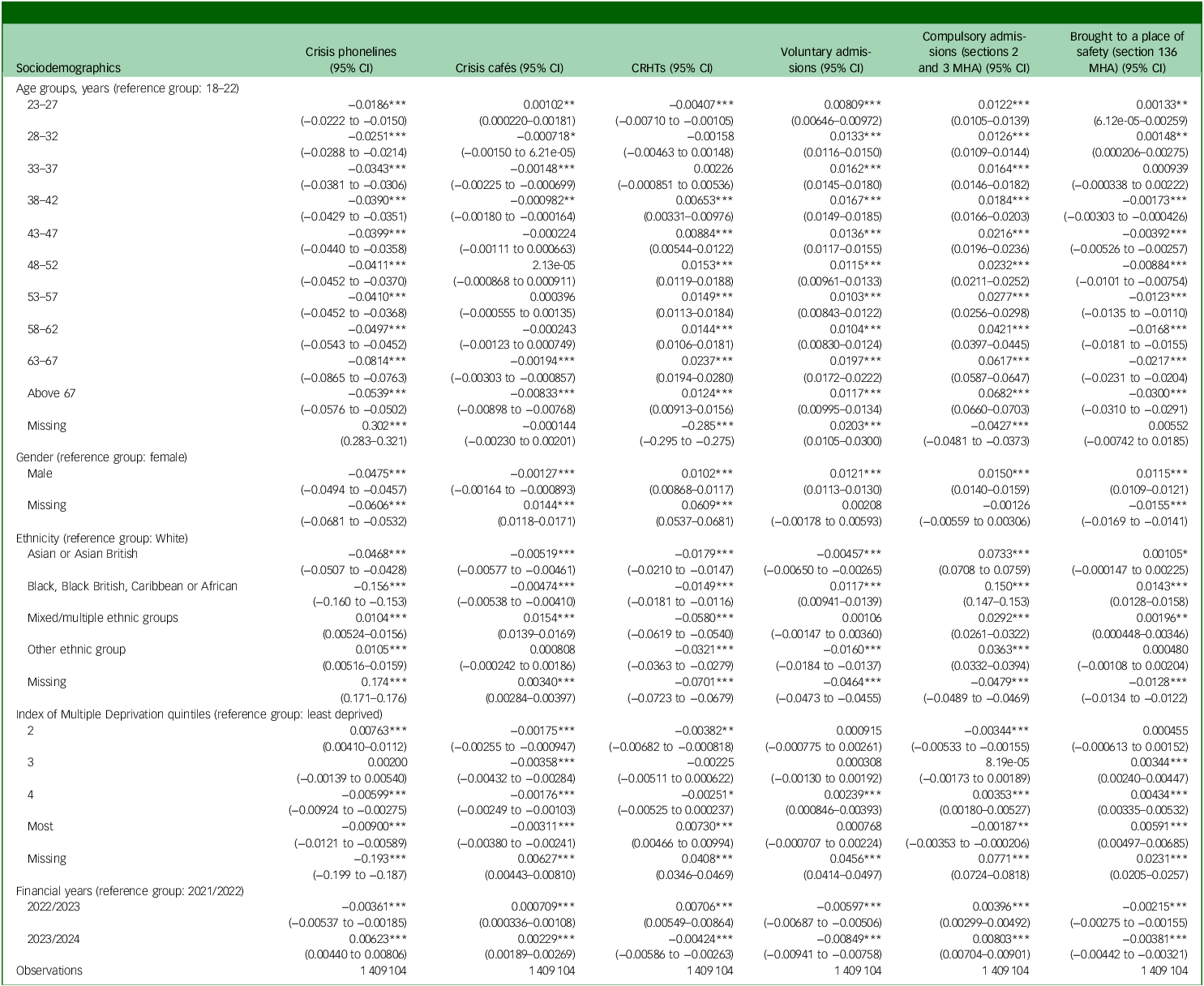
Table 2 Long description
A table comparing the average marginal effects (AMEs) of sociodemographic characteristics on the probability of accessing different crisis-related services. The table has 14 rows and 7 columns. Column headers are: Sociodemographics, Crisis phonelines (95% CI), Crisis cafés (95% CI), CRHTs (95% CI), Voluntary admissions (95% CI), Compulsory admissions (sections 2 and 3 MHA) (95% CI), and Brought to a place of safety (section 136 MHA) (95% CI). Row labels include age groups, gender, ethnicity, and Index of Multiple Deprivation (IMD) quintiles. Each cell contains values representing the AMEs and their 95% confidence intervals. Notable trends include variations in service access probabilities across different age groups, genders, ethnicities, and deprivation quintiles.
CRHTs, Crisis Resolution and Home Treatment teams; MHA, Mental Health Act.
Multinomial logit with clustered standard errors at the patient level. We report average marginal effects (AMEs), which represent the change in the probability of a patient accessing a given crisis-related service, relative to the reference category, associated with each sociodemographic characteristic (age group, gender, ethnicity and Index of Multiple Deprivation (IMD)), holding other covariates constant. For example, an AME of +0.02 indicates that, on average, patients in that category are two percentage points more likely to use the service than those in the reference group, all else being equal. Reference categories were selected to aid interpretation and comparability: White for ethnicity and female for gender, because these were the most common categories across relevant service types; 18–22 years for age, to reflect the youngest group in this population; and the least deprived quintile for IMD, in line with standard analytical practice.
***p < 0.01, **p < 0.05, *p < 0.1.
Average marginal effects for age among acute/crisis patients. SPA, single point of access; CRHTs, Crisis Resolution and Home Treatment teams; s136, section 136 of the Mental Health Act.

Fig. 1 Long description
A line graph titled ‘Likelihood of attending each group, by age category (years)’ displays the likelihood of attending various crisis-related services across different age groups. The horizontal axis represents age categories ranging from 23-27 to above 67 years. The vertical axis represents the likelihood, in percentage points, ranging from 10.0 to 10.0. The graph includes six lines, each representing a different service: SPA/crisis response line (blue), Crisis café services (orange), CRHTs (red), Voluntary admissions (gray), Compulsory admissions (purple), and Brought to a place of safety section 136 (cyan). The SPA/crisis response line shows a decreasing trend with age, starting around 0 percentage points and dropping to approximately -7.5 percentage points. Crisis café services remain relatively flat, slightly above 0 percentage points. CRHTs show a slight increase with age, staying around 0 percentage points. Voluntary admissions have a slight upward trend, staying close to 0 percentage points. Compulsory admissions increase significantly with age, starting around 0 percentage points and rising to about 7.5 percentage points. Brought to a place of safety section 136 shows a decreasing trend, starting around 0 percentage points and dropping to approximately -5.0 percentage points.
Average marginal effects for gender among acute/crisis patients. SPA, single point of access; CRHTs, Crisis Resolution and Home Treatment teams; s136, section 136 of the Mental Health Act.

Average marginal effects for ethnicity (top) and Index of Multiple Deprivation (IMD) quintiles (bottom) among acute/crisis patients. SPA, single point of access; CRHTs, Crisis Resolution and Home Treatment teams; s136, section 136 of the Mental Health Act.

Age group
Age was significantly associated with variation in service use. In all models, patients aged 18–22 years were the reference group. Crisis phonelines showed the most distinct age-related patterns. All age groups were less likely to access this service compared with patients aged 18–22 years, with likelihood decreasing progressively with age. The most pronounced difference was observed among patients aged 63–67 years, who were 8.1 percentage points less likely to use this than those aged 18–22 years.
In regard to voluntary admissions, likelihood increased progressively among patients aged 23–42 years compared with the youngest group. Compulsory admissions were more pronounced from age 43 years onwards, and patients aged 38 years and over were also more likely to use CRHTs than those aged 18–22 years. For example, patients over 67 years were 6.8 percentage points more likely to be compulsorily admitted and 3.0 percentage points less likely to be brought to a PoS by the police compared with the youngest group. The likelihood of attending crisis cafés did not differ markedly across most age groups, although patients aged 63 years and above were significantly less likely to attend than those aged 18–22 years.
Gender
Males were less likely to use crisis phonelines and crisis cafés than females, by 4.8 and 0.1 percentage points, respectively. Although the effect for crisis cafés was statistically significant it was substantively small, suggesting minimal differences between male and female patients. For the remaining services, male patients were more likely to access these than females. The AMEs for CRHTs, voluntary admissions and being brought to a PoS by the police were similar (with overlapping 95% confidence interval), indicating no substantial differences between services. However, for compulsory admissions, male patients were 1.5 percentage points more likely to be admitted (see Fig. 2).
Ethnicity
Ethnic disparities were evident in several service types. Compared with White patients, individuals from all other ethnic backgrounds were more likely to be compulsorily admitted. This difference was most pronounced among Black patients, who were 15.0 percentage points more likely to be compulsorily admitted, and among Asian ethnic groups, who were 7.3 percentage points more likely.
All ethnic minority groups were less likely to access CRHTs than White patients, particularly patients of mixed/multiple ethnic backgrounds, who were 5.8 percentage points less likely.
Asian and Black patients were significantly less likely to use crisis phonelines than White patients, by 4.7 and 15.6 percentage points, respectively. Conversely, patients from mixed/multiple and other ethnic backgrounds were more likely to use crisis phonelines, although these differences were small (1.0 and 1.1 percentage points, respectively).
Differences in the use of crisis cafés by ethnicity were generally small but statistically significant, except for the other ethnic group, which was not statistically significant.
Asian and other ethnic groups were less likely to be voluntarily admitted (0.5 and 1.6 percentage points, respectively), whereas Black patients were 1.2 percentage points more likely to be voluntarily admitted than White patients. There was no statistically significant difference in the likelihood of voluntary admission for patients from mixed/multiple ethnic backgrounds.
Black patients were also 1.4 percentage points more likely to be brought to a PoS by the police than White patients. Patients from mixed/multiple ethnic backgrounds were 0.2 percentage points more likely to experience this outcome than White patients, but differences for the remaining ethnic groups were not statistically significant.
IMD
Differences in crisis service use by area-level deprivation (IMD quintiles) were small (all <1.0 percentage points). Compared with the least deprived quintile, individuals in the most deprived quintiles were slightly more likely to use CRHTs and to be brought to a PoS by police, and slightly less likely to use crisis phonelines or crisis cafés. With increasing deprivation, crisis phoneline use consistently declined and being brought to a PoS by police consistently increased. Patterns for other service types across quintiles were less consistent (full results in Table 2).
Univariate analyses
Results from univariate models showed patterns consistent with the fully-adjusted analysis. Strong univariate associations, including the age gradient in crisis phoneline use, higher likelihood of compulsory admission among Black patients and gender differences in crisis phoneline use and compulsory admissions, remained evident after adjusting for other characteristics. Smaller univariate associations, particularly for voluntary admissions across some ethnic and deprivation groups, were attenuated once covariates were included in the fully adjusted analysis (see Supplementary Material Appendix C for full results).
Discussion
This study explored sociodemographic differences in the use of six NHS-funded mental health crisis-related services in England, using a national administrative data-set. Over half of users lived in the two most deprived quintiles, highlighting the concentration of crisis service use in more deprived areas. Among those accessing crisis-related services, adjusted analyses showed clear disparities in service use for ethnicity, gender and age whereas adjusted differences by area-level deprivation were small, indicating limited variation in which crisis services people use once in contact with crisis care.
Ethnic inequalities were most pronounced: all minority ethnic groups were more likely than White individuals to be compulsorily admitted rather than using other crisis-related services, with the largest disparities for Black, then Asian, groups. Minority ethnic groups were also less likely to access CRHTs. Use of lower-intensity services such as crisis cafés and crisis phonelines was substantially lower among Black groups and moderately lower among Asian groups, compared with White individuals. These findings extend previous evidence of disproportionately high compulsory detention rates among Black and Asian ethnic groups, and that Black groups are more likely to encounter mental health services via the criminal justice system.9,Reference Barnett, Mackay, Matthews, Gate, Greenwood and Ariyo10,19–Reference Morgan, Mallett, Hutchinson, Bagalkote, Morgan and Fearon21 Our findings show that these ethnic inequalities persist across a broad range of crisis services, with relatively low use of community crisis services in comparison with compulsory detention rates. Contributing factors could include the following: racist stereotypes influencing services offered and decisions about detention; cultural preferences and understanding; stigma associated with the use of mental health services; differences in help-seeking; higher prevalence of psychosis; lack of culturally appropriate care; or mistrust in services.Reference Barnett, Mackay, Matthews, Gate, Greenwood and Ariyo10,Reference Bignall, Jeraj, Helsby and Butt11,Reference Bansal, Karlsen, Sashidharan, Cohen, Chew-Graham and Malpass22–Reference Fernando24
Gender and age differences were also evident but smaller. Men accessed crisis phonelines and crisis cafés proportionately less than women but were more likely to use CRHTs, be voluntarily or compulsorily admitted or brought to a PoS by police. This aligns with existing evidence of higher detention rates9,Reference Walker, Mackay, Barnett, Sheridan Rains, Leverton and Dalton-Locke25 and lower mental health treatment-seeking ratesReference Krishnamurti, Monteith, McCoy and Dichter26–28 among men. Possible explanations include gender differences in distress expression (e.g. displaying more externalising behaviours such as aggression or substance use); pressure to conform to traditional masculine stereotypes (e.g. stoicism, self-reliance, invulnerability); differences in coping strategies; help-seeking, emotional literacy; stigma; clinician bias (e.g. overlooking distress); and service acceptability.Reference Seidler, Dawes, Rice, Oliffe and Dhillon29–Reference Smith, Mouzon and Elliott32
Older crisis-related patients were less likely to use crisis phonelines or to be taken to a PoS by police, but were more likely to use CRHTs or be voluntarily or compulsorily admitted. Barriers to accessing lower-intensity community crisis services for older adults could relate to unawareness of services, digital exclusion, vision, hearing or physical disability, stigma, mistrust of services or acceptability, and failure to recognise a need for support.Reference Iskander-Reynolds33,Reference Frost, Beattie, Bhanu, Walters and Ben-Shlomo34 Notably, compulsory detention rates remained relatively high across older age groups, highlighting that initiatives to reduce detentions should not target young adults only – crisis-response policies and interventions that specifically consider the needs of older adults are needed.Reference Iskander-Reynolds33
Most crisis patients lived in more deprived areas, with the proportion using each service type increasing with deprivation. However, differences in the types of services accessed by area-level deprivation were very small (all <1.0 percentage points) and notably smaller than those observed for other demographic characteristics, particularly ethnicity. This suggests that area-level deprivation influences whether people use crisis services but has little impact on which crisis services they use. These findings are broadly consistent with evidence linking higher levels of area deprivation to higher rates of mental health difficulties,Reference Cairns, Graham and Bambra35–Reference Morris, Hill, Brugha and McManus37 urgent and emergency care use38 and compulsory detentions.9
Taken together, the findings generally suggest that groups with higher compulsory admission rates – including Black and Asian patients, men and older adults – also tend to engage less with lower-intensity services such as crisis phonelines when experiencing a crisis. Differences for Black patients were substantially larger than those for any other ethnic group or demographic characteristic. Because this is an observational study we cannot establish causality, but the findings suggest associations between lower engagement with lower-intensity community crisis services and higher rates of coercive care, which warrants further investigation. Although some estimated differences were small in percentage points terms, applied to the large population using crisis services nationally they represent substantial absolute numbers and remain of policy relevance.
Strengths and limitations
A key strength of this study is the use of a large, national administrative dataset (MHSDS), which allowed comparisons across multiple crisis-related services in England. Additionally, lived-experience researchers within the study team shaped the research questions and interpretation of findings, ensuring that the study reflected both patients’ and carers’ perspectives. Multivariate analysis allowed examination of the combined influence of demographic and socioeconomic factors on service use, helping to identify disparities among people accessing crisis care. This addresses an important evidence gap around how community-based crisis models are being used in practice.
Limitations include limited available data in MHSDS on some crisis service types (e.g. crisis houses, acute day services, walk-in crisis assessment units), which we therefore could not include. This is probably due to challenges in how these services are reported or classified in the data-set, and also to inconsistent reporting across areas where they are available. Second, limited availability of variables in MHSDS meant that we could not account for all factors that may influence crisis service use. Analyses adjusted for age, gender, ethnicity and area-level deprivation, but other potentially relevant characteristics (e.g. education, sexual orientation, disability, employment, housing, diagnosis and care cluster) were either unavailable or had substantial missingness. Missing data may also have influenced the findings, particularly for ethnicity, where the extent of missingness varied across service types. If missingness was not random, some estimates of sociodemographic differences in service use may be biased. Consequently, some observed associations may be partially explained by residual confounding. Third, ethnicity was measured using broad categories, which may obscure within-group variation, but was necessary to obtain reliable regression estimates given the small numbers in some subcategories. Fourth, IMD-based deprivation reflects area-level rather than individual socioeconomic circumstances. Fifth, this study did not account for variation in crisis service availability or configuration across providers or geographic areas. Our aim was to examine national patterns of crisis service use by sociodemographic characteristics rather than by provider-level differences. Consequently, some observed differences may partly reflect variation in local service provision and access pathways across England. Finally, our quantitative paper was unable to explore people’s treatment experiences of crisis care and what may deter people from accessing help: qualitative methods are required for this. Taken together, these limitations constrain how fully we could capture the complexity of sociodemographic and clinical factors’ influences on crisis service use.
Future research, practice and policy
Mixed-methods research involving patients, families/carers and staff is needed to better understand the mechanisms driving these differences, and to establish guidance for culturally aware, inclusive crisis care practices that can reduce inequalities in use and experiences of services. This is especially important for groups who tend to use high-intensity in-patient services rather than community crisis services – including older adults, men and people from Black ethnic groups. For example, research could clarify why rates of voluntary and compulsory detentions remain high across older age groups. Our study highlights challenges in community crisis care access for people from Black ethnic groups, who are much more likely than others to be coerced and less likely to use community alternatives. Addressing the reasons for this should be a priority for research, policy and practice, supported by initiatives like the Patient and Carer Race Equality Framework.Reference Smith, Kheri, Ariyo, Gilbert, Salla and Lingiah39
Commissioners and service providers should demographically monitor local service use, meaningfully involve underrepresented groups to understand barriers and inform service development and implement both targeted interventions and wider structural changes to improve acceptability, equity and access across the crisis-care pathway.
Crisis cafés are an emerging model,Reference Staples, Cadorna, Nyikavaranda, Maconick, Lloyd-Evans and Johnson40 and our findings provide preliminary evidence that, where available, these are accessible and inclusive across demographic groups. Further research is warranted to understand their role in the mental health pathway, their effectiveness in reducing hospital admission rates and producing good outcomes, and user experience.
Observed patterns may partly reflect local service availability. National mapping of crisis care alongside improved routine data collection for underrepresented services – including crisis houses, acute day services and walk-in crisis assessment units,Reference Dalton-Locke, Johnson, Harju-Seppänen, Lyons, Sheridan Rains and Stuart8 and emerging models such as mental health accident and emergency services6 – would allow evaluation of their reach, accessibility and impact, supporting more equitable and evidence-based commissioning. In addition, improving the completeness of MHSDS, or linking it with other data-sets, would reduce missing data and allow inclusion of other clinical and sociodemographic variables in analyses, such as diagnosis, accommodation, employment, migrant status, disability, gender identity, sexual orientation and other protected characteristics. Analyses could also examine intersectionality by testing interaction effects and extend our work by examining intensity of crisis service use. These approaches could clarify how sociodemographic and clinical factors influence crisis service use and support efforts to improve access to community crisis care, reduce risk of compulsory admissions and reduce inequalities.
Lived-experience commentary, by authors J.B. and M.H.
We welcome this retrospective observational research study, which used MHSDS between 2021/2022 and 2023/2024.
However, our primary concerns are the following.
-
(a) The higher rates of compulsory detentions for people from Black, Asian and/or minority ethnic groups than for white people. Institutional, structural, systemic and in-person prejudices, stereotypes and racism (overt and/or covert) are plausible root causes of these disparities in outcomes, and the lack of cultural, sensitive, appropriately tailored treatments.
-
(b) The coercive care, including being brought to a place of safety by police, is more common among older adults and men. Difficult treatment experiences have discouraged most of these patients from accessing other community crisis care services, which women are more likely to use, such as crisis phonelines, crisis cafés and CRHTs, unless they are in desperate need.
Over 1.4 million people accessed crisis services during the study period. The researchers did not look at whether people in mental health crises accessed services once, multiple times, or not at all, and consequently had unmet needs. Some crisis service types and demographics were not included because of missing data. Furthermore, we are unaware of the availability of crisis cafés in our locale, and the study did not explore ‘postcode lotteries’ among different regions in England.
It is important to consider societal and cultural contexts when focusing on the priority outcome from this study to address these disparities in crisis care and outcomes, by changing mental health policy and practice and hence improving access and reducing clear inequalities.
Finally, this study does not involve patient interviews whereby they shared their experiences and could have given possible explanations for these deeply personal issues – there is scope for this in future research. Because these patients are unidentifiable from the data-set, direct follow-up with each of them is impossible.
Supplementary material
The supplementary material is available online at https://doi.org/10.1192/bjo.2026.12094
Data availability
The data supporting the findings of this study are available from NHS England. Restrictions apply to the availability of the following data-sets that were used under licence for this study. This work uses data provided by patients and collected by the NHS as part of their care and support. The Mental Health Services Data Set is copyright, ©2021/22-2023/24, NHS England. Reused with the permission of NHS England. All rights reserved.
Acknowledgements
We are grateful for the support from York Data Safe Haven and Research Computing teams. This project was conducted by the National Institute for Health and Care Research (NIHR) Policy Research Unit in Mental Health (MHPRU), based at University College London, King’s College London and University of York. The NIHR MHPRU conducts research in response to policymaker need (e.g. in the Department of Health and Social Care or NHS England).
Author contributions
B.L.-E., R.J., S.J. and M.A.M. formulated the research question. B.L.-E., R.J., S.J. and M.A.M. designed the study. M.A.M. analysed the data. M.A.M. and J.L.G. wrote the first draft of the manuscript. J.B. and M.H. wrote the lived-experience commentary. B.L.-E., R.J., A.B., B.C., J.L., R.R.O., M.H., J.B., A.G., P.N., D.O., J.E.-C., K.T., M.W., S.J. and A.S. critically reviewed the manuscript. All authors approved the final version to be published.
Funding
This study was funded by the NIHR Policy Research Programme (grant no. NIHR206125). The views expressed are those of the authors and not necessarily those of the NIHR or the Department of Health and Social Care. The funders had no role in project design, data collection and analysis or preparation of this paper.
Declaration of interest
None.


 Open access


eLetters
No eLetters have been published for this article.