The rapidly growing nontuberculous mycobacteria (NTM), Mycobacterium chelonae, M. fortuitum, M. abscessus subsp. abscessus, M. abscessus subsp. massiliense, and M. abscessus subsp. bolletii have been associated with outbreaks and pseudo-outbreaks in healthcare settings worldwide.Reference Phillips and Fordham von Reyn 1 – Reference Leao, Viana-Niero and Matsumoto 4 Infections caused by M. abscessus complex strains are particularly problematic because these species are not only the most pathogenic rapidly growing mycobacteria, they are also the most antibiotic-resistant NTM, with treatment failure rates as high as 60%–70% despite years of combination therapy.Reference Jarand, Levin and Zhang 5
Nosocomial outbreaks of M. abscessus subsp. massiliense infections have reached unprecedented epidemic proportions in Brazil between 2004 and 2008 following laparoscopic surgeries and cosmetic procedures. More than 2,000 possible cases involving 15 different states and more than 86 hospital sites have been caused by a single strain of M. abscessus subsp. massiliense named BRA100.Reference Duarte, Lourenco and de Souza Fonseca 3 , Reference Leao, Viana-Niero and Matsumoto 4 The most striking feature of BRA100 isolates is their unusually high level of resistance to glutaraldehyde (GTA), the chemical used for disinfection of surgical instruments in all hospitals with confirmed cases. Survival times of the BRA100 isolates exceeded 10-hour exposure to 2% GTA. This resistance phenotype was advanced as the most likely reason for the selection and dissemination of BRA100 across the country.Reference Lorena, Duarte and Pitombo 6 Sporadic cases of nosocomial infections and pseudoinfections caused by M. chelonae and M. abscessus isolates resistant to aldehyde-based and other high-level disinfectants have been traced to automated endoscope/bronchoscope washer disinfectors and manual dialyzer reprocessing systems in Japan, the Netherlands, the United Kingdom, and the United States.Reference Rutala and Weber 2 , Reference Bolan, Reingold and Carson 7 – Reference Fisher, Fiorello and Shaffer 16
While the ability of rapidly growing mycobacteria to survive and persist within treated medical devices and washers may result from their high intrinsic tolerance to biocides, involvement in biofilms, and association with free-living amoebae, this ability is also sometimes due to their ability to develop a high level of resistance to disinfectants, as illustrated by M. abscessus subsp. massiliense BRA100 and a recently characterized GTA-resistant M. chelonae isolate from the United Kingdom.Reference Duarte, Lourenco and de Souza Fonseca 3 , Reference Svetlíková, Škovierová and Niederweis 17 In the latter case, defects in porin expression accounted, at least in part, for the resistance phenotype of the isolate, raising concerns that the selection of aldehyde-resistant strains in clinical settings might select for isolates displaying cross resistance to other disinfectants and/or antibiotics as well as increased pathogenicity.Reference Svetlíková, Škovierová and Niederweis 17 Reduced porin expression in the rapidly growing Mycobacterium species, M. smegmatis, has indeed been associated with increased resistance not only to aldehyde-based products but also to quaternary ammonium compounds, isothiazolinones, methylenbisoxazolidine, and lipophilic biocides such as polyhexamethylene biguanine and octenidine dihydrochloride, in addition to multiple antibiotics.Reference Svetlíková, Škovierová and Niederweis 17 – Reference Frenzel, Schmidt and Niederweis 19 Furthermore, 5 studies have reported that GTA-resistant M. chelonae and M. abscessus strains isolated either experimentally or from endoscope washer disinfectors demonstrated increased resistance to peracetic acid, peroxygen, sodium dichloroisocyanurate, or quaternary ammonium compounds.Reference van Klingeren and Pullen 13 , Reference Griffiths, Babb and Bradley 14 , Reference Lynam, Babb and Fraise 20 – Reference Cortesia, Lopez and de Waard 22
Considering the prevalence of aldehyde-resistant rapidly growing mycobacteria and concerns about the possible development of cross resistance to other biocides, we sought to profile the disinfectant-susceptibility pattern of a panel of aldehyde-susceptible and resistant Mycobacterium isolates to explore alternative high-level disinfection strategies in mycobacterial GTA-resistant outbreaks. A variety of high-level disinfectants commonly used in the reprocessing of endoscopic equipment, including different formulations of aldehyde-based products, oxidizing agents, and alcohol, were tested against these isolates in suspension and carrier tests.
METHODS
Bacterial Strains and Standard Growth Conditions
The 6 control (GTA-susceptible) mycobacterial strains used in this study were M. bovis BCG (Pasteur strain 1173 P2), M. avium 104, M. terrae ATCC 15755, M. chelonae ATCC 35752, M. abscessus subsp. massiliense CIP 108297, and M. abscessus subsp. massiliense CRM-0270.Reference Duarte, Lourenco and de Souza Fonseca 3 The 4 NTM isolates with known resistance to GTA included M. abscessus subsp. massiliense CRM-0019,Reference Duarte, Lourenco and de Souza Fonseca 3 M. chelonae 9917,Reference Svetlíková, Škovierová and Niederweis 17 M. chelonae Harefield and M. chelonae Epping.Reference Fraud, Hann and Maillard 23 The M. abscessus subsp. massiliense CRM-0270 isolate is genetically closely related to the GTA-resistant outbreak isolate from Brazil but is GTA susceptible.Reference Duarte, Lourenco and de Souza Fonseca 3 All mycobacterial cultures were grown under agitation in Middlebrook 7H9 (Difco Laboratories, Sparks, MD) medium supplemented with 10% OADC (oleic acid, albumin, dextrose, catalase) enrichment (Becton Dickinson, Sparks, MD) and 0.05% Tween 80 (Sigma Aldrich, St Louis, MO) at 30°C to an optical density (OD600) of 1.0.
Disinfectants
Overall, 5 commercial disinfectants labeled for high-level disinfection were evaluated along with the quaternary ammonium compound, cetrimonium bromide (10%; Sigma Aldrich). The 5 products included the GTA-based disinfectants Cidex (2.4% GTA; Johnson & Johnson, New Brunswick NJ) and Aldahol (3.4% GTA; Alden Medical, West Springfield, MA), the ortho-phthalaldehyde-based disinfectant Cidex OPA (0.55% OPA; Johnson & Johnson), the peracetic acid-based products, Reliance DG (Steris, Mentor, OH) and S40 (Steris), and the hydrogen peroxide-based product Resert XL HLD (Steris). To best reflect the use of the products in clinical settings, minimum recommended concentrations (MRCs) or minimum effective concentrations (MECs) were chosen for each disinfectant based on the minimum concentration of active disinfectant necessary to create a “passing” response on the corresponding manufacturer’s product testing strips. The passing responses on Cidex and Cidex OPA are based on the MEC, whereas the passing responses for Resert XL HLD and Aldahol test strips are based on the MRC (Tables 1–3). Prior to each series of tests, Cidex and Aldahol were tested for exact concentration of GTA using the hydroxylamine hydrochloride pH titration method and, wherever applicable, diluted to the desired concentration (MEC=1.5% GTA for Cidex; MRC=1.8% GTA for Aldahol) with sterile double-distilled water. Cidex OPA was similarly diluted to 0.3% OPA (MEC value) with sterile double-distilled water. All disinfectants were freshly prepared prior to use. Susceptibility tests were performed at the recommended temperatures.
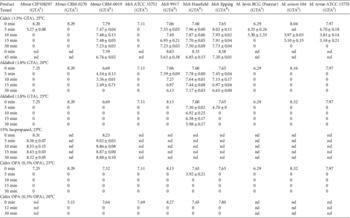
Mycobactericidal Effects of Aldehyde-Based Products Against GTA-Susceptible and GTA-Resistant Mycobacterium Isolates in Suspension TestsFootnote a

NOTE. GTA, glutaraldehyde; OPA, ortho-phthalaldehyde; CFU, colony-forming units; GTAR, GTA-resistant; GTAS, GTA-susceptible. nd, not determined.
a The mean log10 CFU counts and standard deviations of duplicate tests for each strain and test product are shown. The 0-minute time point (enumeration of CFU in the bacterial suspension prior to disinfectant exposure) is the result of a single serial dilution plating. Control suspension tests using the GTA-susceptible isolate, M. massiliense CIP 108297, confirmed the neutralizing efficacy of the neutralizing broth with each disinfectant product. The detection limit of the suspension tests is 1 CFU/mL.
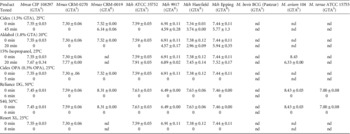
Mycobactericidal Effects of Aldehyde-Based and Oxidizing High-Level Disinfectants Against GTA-Susceptible and GTA-Resistant Mycobacterium Isolates in Carrier-Disk TestsFootnote a

NOTE. GTA, glutaraldehyde; OPA, ortho-phthalaldehyde; CFU, colony-forming units; GTAR, GTA-resistant; GTAS, GTA-susceptible. nd, not determined.
a Control carrier tests using the GTA-susceptible isolate, M. massiliense CIP 108297, confirmed the neutralizing efficacy of the neutralizing broth with each disinfectant product. The detection limit of the carrier-disk tests is 1 CFU.
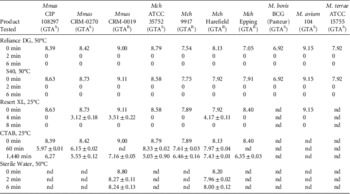
Mycobactericidal Effects of Oxidizing High-Level Disinfectants and a Quaternary Ammonium Compound Against GTA-Susceptible and GTA-Resistant Mycobacterium Isolates in Suspension TestsFootnote a

NOTE. GTA, glutaraldehyde; OPA, ortho-phthalaldehyde; CFU, colony-forming units; GTAR, GTA-resistant; GTAS, GTA-susceptible; CTAB, cetyl trimethylammonium bromide; nd, not determined.
a Control suspension tests using the GTA-susceptible isolate, M. massiliense CIP 108297, confirmed the neutralizing efficacy of the neutralizing broth with each disinfectant product. The detection limit of the suspension tests is 1 CFU/mL.
Suspension Tests
Each mycobacterial strain was prepared for testing by adding 1.0 mL of 0.9% sterile saline (Hospira, Lake Forest, IL) containing 0.1% Tween 80 to 9.0 mL of bacterial suspension (~1010 colony-forming units [CFU]) previously washed 3 times with sterile double-distilled water. The preparation was then dispersed for 1 minute using a sterile 15-mL Wheaton pestle to generate a homogeneous bacterial suspension. Next, 1 mL of bacterial suspension was added to 99 mL of the disinfectant solution maintained at the recommended temperature under continuous mixing conditions. At predetermined time points, 1.0 mL of test solution was removed and placed in either 9.0 mL of sterile Dey Engley/1% sodium thiosulfate neutralizing broth (Becton Dickinson; Sigma Aldrich) for oxidizers or 9.0 mL of sterile Dey Engley/1% sodium bisulfite neutralizing broth (Becton Dickinson; Sigma Aldrich) for GTA and OPA, and immediately vortexed for 60 seconds to neutralize the disinfectant solution. The neutralized test solutions were then vacuum-filtered through a sterile 0.45 µm MicroFunnel filter unit with a Metricel black-gridded membrane (Pall, Ann Arbor, MI). After a final rinse of the filter housing with 30–40 mL 0.9% saline/0.1% Tween 80, the filters were aseptically placed onto 7H11 agar plates supplemented with OADC and incubated at 30° for 7 to 21 days, after which CFUs were counted. Control experiments performed in parallel on the GTA-susceptible strain M. massiliense CIP 108297 confirmed the neutralizing efficacy of the neutralizing broth with each disinfectant and verified that the neutralizer by itself did not contribute any mycobactericidal activity, whether in suspension tests or on carrier disks. No significant loss of bacterial viability was observed in the presence of neutralizing broth in the test solution. The detection limit of the suspension test is 1 CFU/mL. All suspension and carrier tests were performed in duplicate using independent bacterial culture batches, and the results of 1 typical experiment are presented in the tables.
Carrier-Disk Tests
For the carrier-disk test, 10 µL of each of the homogeneous bacterial suspensions described above was placed at the center of a 1-cm stainless-steel carrier disk and allowed to air dry for 30 to 40 minutes. Each carrier disk was then sterilely placed, inoculum side up, in a 30-mL straight-side wide-mouth Nalgene jar (ThermoScientific, Rochester, NY). Next, 50 µL of each freshly prepared disinfectant solution preheated to the recommended temperature was applied to the dried inoculum on each carrier disk and held for the desired contact time. Then, 9.95 mL sterile neutralizing broth was added to the jar and vortexed for 60 seconds before vacuum filtration was performed as described above. The carrier disk was then vortexed 3 more times with 15 mL 0.9% sterile saline/0.1% Tween 80. Vacuum filtration was performed between washes. The MicroFunnel filters were aseptically placed onto 7H11 agar plates supplemented with OADC for CFU counting. The detection limit of the carrier-disk test is 1 CFU. All suspension and carrier-disk tests were performed at least twice.
RESULTS
Approach
Several of the most commonly used disinfectants were tested against 10 different rapidly growing and slow-growing mycobacteria, including 4 M. chelonae and M. abscessus subsp. massiliense isolates that had been previously reported to display resistance to GTA. Each disinfectant was tested using 2 independent methods, a suspension test and a carrier test. The latter was considered more stringent and more reflective than the former regarding the disinfection of microorganisms on dried surfaces. Tables 1 and 3 show the results of the suspension tests, and Table 2 shows the results of the carrier tests.
Glutaraldehyde-Based Disinfectants
All GTA-based high-level disinfectants displayed the expected mycobactericidal efficacy against the GTA-susceptible control strains, M. bovis BCG (Pasteur strain 1173 P2), M. avium 104, M. terrae ATCC 15755, M. chelonae ATCC 35752, M. abscessus subsp. massiliense CIP 108297, and M. abscessus subsp. massiliense CRM-0270. During the suspension test, control strains were reduced to no detectable bacterial counts within 10 minutes of exposure to Cidex (1.5% GTA) at 25°C, except for the slow-growing species M. avium, M. terrae, and M. bovis BCG, which required longer contact times of 15 to 30 minutes (Table 1). Reduction to no detectable bacterial counts was achieved for all control strains within 5 minutes of exposure to Aldahol (1.8% GTA), a GTA-based product containing isopropanol and potassium acetate,Reference Miner, Harris and Cao 24 at both 20°C and 25°C (Table 1). The carrier-disk test yielded similar results with reduction to no viable bacteria for all GTA-susceptible strains and GTA-based products tested (Table 2).
As expected, the GTA-resistant M. abscessus subsp. massiliense and M. chelonae isolates, CRM-0019, 9917, Harefield and Epping, showed significant resistance to the GTA-based products with <0.5-log10 reduction in CFUs after 10 minutes of exposure to Cidex (1.5% GTA) in suspension tests (<3.2-log10 reduction in CFUs after the recommended time of exposure of 45 minutes) and in the carrier-disk test (<3.6-log10 CFU reduction after 45 minutes) (Tables 1 and 2). For Aldahol (1.8% GTA), the suspension test results for the GTA-resistant strains at the recommended exposure time of 10 minutes at 20°C showed significant resistance to this disinfectant as well (Table 1). The greatest CFU reduction at the 10-minute time point was observed for the GTA-resistant M. abscessus subsp. massiliense strain CRM-0019 (3.33 log10 CFU reduction), while the GTA-resistant M. chelonae strains 9917, Harefield and Epping showed a <1.0-log reduction in CFU counts. When tested at additional time points to 30 minutes, the 3 GTA-resistant M. chelonae strains continued to show greater resistance with a maximum 1.0 log10 reduction in CFUs, while M. abscessus subsp. massiliense CRM-0019 was reduced to no detectable CFU by 30 minutes. The carrier-disk testing similarly pointed to the significant resistance of M. chelonae 9917, Harefield and Epping with no more than a 4.42-log10 CFU reduction after 20 minutes, while M. abscessus subsp. massiliense CRM-0019 again showed susceptibility to Aldahol at the extended 20-minute time point, with a>7.0-log10 CFU reduction (Table 2). When the testing temperature for Aldahol was increased from 20°C to 25°C, the suspension testing results showed greater bactericidal efficacy. All GTA-resistant strains except one were reduced to no detectable CFU within the recommended 10 minutes. However, M. chelonae Harefield only achieved a 0.68-log10 reduction after 10 minutes and, even at the extended 30-minute time point, CFU counts were only reduced by a meager 1.62-log10 (Table 1). Because the 1.8% GTA Aldahol preparation contains isopropanol,Reference Miner, Harris and Cao 24 15% isopropanol alone was tested for mycobactericidal activity. Neither M. abscessus subsp. massiliense CIP108297 nor the GTA-resistant M. abscessus subsp. massiliense strain CRM-0019 showed any significant reduction in CFU counts with 30 minutes of exposure to this compound (Table 1).
Ortho-phthalaldehyde
Suspension test results for the Cidex OPA (0.3% ortho-phthalaldehyde [OPA]) at 25°C achieved reduction to no detectable CFU counts at the recommended time point of 5 minutes for all M. chelonae strains except M. chelonae Harefield. However, this strain was reduced to no detectable CFU by the 10-minute time point at 25°C and to no detectable CFU by the recommended 12-minute time point at 20°C (Table 1). When 0.3% OPA was tested using the carrier-disk method, all test strains were reduced to no viable CFU within 5 minutes (Table 2).
Oxidizing Agents and Other Disinfectant Products
For the 2 disinfectants used in automated endoscope washers at 50°C, S40 and Reliance DG (2 peracetic acid-based products), CFU counts for all tested strains were reduced below detection levels within 2 minutes of exposure under suspension testing, and by the 6-minute time point under carrier-disk testing (Tables 2 and 3). To assess the impact of the 50°C temperature on the viability of mycobacteria, 2 GTA-resistant strains, M. abscessus subsp. massiliense CRM-0019 and M. chelonae Harefield, were exposed to sterile water at 50°C for up to 6 minutes; in both cases, no significant loss of viability was detected (Table 3). For Resert XL (a hydrogen-peroxide–based product), viable bacterial counts were reduced>7-log10 within 8 minutes under both the suspension and carrier-disk methods (Tables 2 and 3). Finally, suspension testing of a quaternary ammonium compound found in many disinfectants and antiseptics (10% CTAB) demonstrated, as expected,Reference Cortesia, Lopez and de Waard 22 very modest bactericidal activity against rapidly growing mycobacteria, with <4-log10 reduction in CFU for all tested strains after 24 hours (Table 3).
DISCUSSION
Whereas OPA is now the leading high-level disinfectant in the United States, activated alkaline GTA at ambient temperature remains one of the most widely used high-level disinfectants worldwide for its broad-spectrum microbicidal activity, relatively low cost, ease of use, and nondamaging effects on medical equipment and reprocessors. The emergence of globally circulating virulent clones of M. abscessus complex speciesReference Bryant, Grogono and Rodriguez-Rincon 25 has caused great concern, coupled with reports of rapidly growing mycobacteria presenting resistance to aldehyde-based products, including the recent largest outbreak ever reported of M. abscessus complex infections in Brazil.Reference Duarte, Lourenco and de Souza Fonseca 3 , Reference Leao, Viana-Niero and Matsumoto 4 , Reference Lorena, Duarte and Pitombo 6 In addition, some of the mechanisms of resistance to aldehydes evolved by NTM may confer cross-resistance to other disinfectants and antibiotics.Reference Svetlíková, Škovierová and Niederweis 17 , Reference Frenzel, Schmidt and Niederweis 19 Taken together, these factors led us to systematically investigate the susceptibility profile of a collection of GTA-resistant M. chelonae and M. abscessus subsp. massiliense isolates to various disinfectant chemistries using 2 different testing methods.
Tests with the GTA-based products Cidex and Aldahol confirmed the aldehyde resistance phenotype of the 4 M. abscessus subsp. massiliense and M. chelonae isolates from the United Kingdom and Brazil. Interestingly, increasing the incubation temperature of Aldahol from 20°C to 25°C overcame this resistance in all isolates except M. chelonae Harefield. This finding probably reflecting differences in the physiology and mechanisms of aldehyde-resistance evolved by these isolates. Similarly, Cidex OPA at 25°C showed variable efficacy against the GTA-resistant strains, achieving only partial killing of M. chelonae Harefield after the recommended 5-minute time point in the suspension test at the minimum effective concentration of 0.3% OPA; however, CFU counts for all isolates were reduced to zero upon exposure to 0.3% OPA for 12 minutes at 20°C. Under the testing conditions used herein that lacked organic load in the suspensions and, therefore, favored disinfectant activity, all Mycobacterium isolates tested were fully susceptible to the peracetic acid– and hydrogen peroxide–based disinfectants, independent of their level of resistance to GTA.
In summary, all oxidizing disinfectants tested in this study effectively killed GTA-resistant mycobacteria, whereas aldehyde-based products (GTA and OPA) showed variable results despite evidence that changing the product formulation (ie, Aldahol) and increasing the temperature might improve their efficacy against some isolates. Although more isolates need to be tested in the presence and absence of organic load to reach definitive conclusions, it appears that the use of oxidizing chemistry (compatibility with the medical devices permitting) provides a safe alternative to aldehyde-based products, especially when GTA resistance is suspected. Alternatively, increasing the temperature and/or formulation of aldehyde-based products may increase their efficacy, but this option should carefully be evaluated on a case-to-case basis.
ACKNOWLEDGMENTS
We thank Dr N. Miner and V. Harris (MicroChem Laboratory) and Dr G. McDonnell and A. Fiorello (Steris) for their advice with the disinfectant testing methods.
Financial support: This work received support from the Steris Foundation, Dow Microbial Control, the College Research Council (College of Veterinary Medicine and Biomedical Sciences) at Colorado State University, and the National Institutes of Health (NIH)/National Institute of Allergy and Infectious Diseases (NIAID) (grant no. AI089718). The content is solely the responsibility of the authors and does not necessarily represent the official views of the NIH. The funding sources were not involved in the collection, analysis, or interpretation of data; in the writing of the report; or in the decision to submit the article for publication.
Potential conflicts of interest: All authors report no conflicts of interest relevant to this article.