Introduction
In 1999, the Government made its ambitious pledge to end child poverty by 2020. This came after a period when the child poverty rate in the UK had soared in the 1980s, peaking round 34 per cent in 1996–1997 at a rate which was more than twice as much as in 1969 and 1979 (Work and Pensions Committee, 2004). Since then the Government's overarching strategy to eradicate child poverty can be characterised as having two elements: to increase employment rates among parents, and to increase financial support to low income families. Efforts to increase employment are seen in the expanding New Deal programmes and welfare reform agenda, which focuses on getting lone parents, for example, into employment. Increased financial support is delivered in the form of Child Tax Credits for families with children. Working Tax Credit is also key, both as an incentive for parents to work (to try to ensure that ‘work pays’) and in order to supplement the income of the families of low paid workers.
As a result, some progress has been made and child poverty has been reduced by a fifth (Hills and Stewart, Reference Hills and Stewart2005; DWP, 2006). However, in 2006, the Government had fallen short of meeting its target of reducing the number of children in relative poverty by a quarter and the child poverty rate stood at 30 per cent (DWP, 2006; DWP, 2007a). Commentators have argued that unless new strategies are developed and greater financial support provided, the Government would fall significantly short of meeting its target of halving child poverty by 2010 (Hirsch, Reference Hirsch2006; Strelitz, Reference Strelitz2007).
In the 2008 budget, amidst such concerns, the Government reaffirmed its commitment to eradicating child poverty, promised £1 billion for this work and talked of taking a ‘renewed approach’ to the problem. The immediate measures of its ‘renewed approach’ focus on extra financial help for families, including increases in Child Benefit, Child Tax Credit and Housing and Council Tax Benefit (HMT, 2008). The ‘renewed approach’ reiterates the emphasis on getting parents into work, but, compared with previous strategy documents (for example, DWP, 2006), there is also a distinct prominence given to employment retention and progression (HMT, 2008). Moreover, the ‘renewed approach’ aspires to provide responsive financial support to families as parents move in and out of work (HMT, 2008).
This article suggests that this new attention to the importance of addressing people's needs in work and between jobs represents an important step in filling in some of the gaps in strategy. This step can be interpreted as marking the difference between a view of poverty as something that will be ‘fixed’ by entry to employment or movement above the low income threshold at one point-in-time, towards an understanding of poverty as something that needs to be addressed over time. As I will argue with reference to poverty dynamics research, this is an essential development for tackling child poverty. The poverty dynamics literature shows that the only genuine escape from poverty is a sustained escape. Entry into employment does not guarantee freedom from poverty. Without addressing employment retention and progression, many children will continue to live in families experiencing ‘low-pay-no-pay’ cycles and so may never genuinely escape poverty. The poverty dynamics literature also shows that risks of entering poverty for children are marked at points of parents' transitions into and out of work. Intervention and support at these points are likely to be critical elements of an anti-poverty policy. Taking the poverty dynamics perspective further, it is also possible to consider how the shape of ‘renewed approach’ might develop in the future.
Point-in-time poverty and poverty dynamics
The dominant notion of poverty in UK social policy is relative income poverty. Low income is meant here as a proxy for poverty: the problem is not so much an absence of cash at any particular time but when having a low income impacts on quality of life and opportunities. What constitutes a low income is an arbitrary decision: in the UK, and across other countries, it is measured as having a household income equivalent to less than 60 per cent of the average (median) income. The current official poverty rate is based on cross-sectional data from the Family Resources Survey (FRS). The FRS is a point-in-time survey: households are interviewed on a one-off basis and asked about their circumstances at that current time. Change in the poverty rate is estimated by comparing the data gathered at one point in time with that gathered at a later period, or periods. The survey draws on independent representative samples and so is unlikely to include the same individuals more than once. This approach thus entails capturing a ‘snap shot’ of the number of low income households at one point-in-time, with change in the poverty rate calculated as the difference in the number in poverty from one year to the next.
This approach towards measuring poverty can give rise to a misleading view of the nature of poverty (Smith and Middleton, Reference Smith and Middleton2007). For example, it might be assumed from the figures that those households in poverty at one point are pretty much the same households found in poverty at later points. It might further be assumed that the poor share the same experience of poverty: after all, distinctions are not made in terms of severity or length of poverty. And if the poverty rate drops, it appears that hitherto poor families are no longer poor. The policy response to addressing child poverty, in these terms, is to focus on raising the income of all low income families from below the threshold to above it and so secure a transition from poverty to non-poverty.
In contrast to the point-in-time measurement of the poverty rate, poverty dynamics research traces the changing circumstances of the same households over time.Footnote 1 This research shows that many families living under the low income threshold in one year are different to those in the next. Families' experiences differ significantly in terms of how long episodes of low income last. Although these experiences will constitute a continuum, from very brief to very long periods of low income, it is helpful to think in terms of three types of poverty: temporary, recurrent and persistent.
Temporary poverty
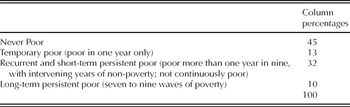
Table 1 shows that, over a nine-year period, 13 per cent of children were poor only once. It is likely that small errors in measuring income may show such children's households as ‘blipping’ under the poverty threshold. Where these cases are not the result of measurement error, they will relate to children in families experiencing a temporary and unusual (for them) episode of low income – perhaps a ‘rough patch’ for a family where a parent is moving between jobs, which they weather and recover from.
Relative income poverty among dependent children in nine-wave window (1991–1999)

Note: Poverty = 60 per cent of contemporary median income.
Source: Jenkins and Rigg (Reference Jenkins and Rigg2001).
Recurrent poverty
Some children move in and out of poverty over time. Indeed, Table 1 shows that most children with any experience of low income over a nine-year period are not poor continuously. Among the 32 per cent recorded here, experiences vary from children in low income for two years out of the nine to those in poverty for six out of nine years, separated by just one year in non-poverty.
Children experience higher rates of recurrent poverty than working-age adults. For example, Hill and Jenkins (Reference Hill, Jenkins, Bradbury, Jenkins and Micklewright2001) showed that, over a six-year period (1991–96), 13 per cent of children were poor in three to five of the years (not necessarily consecutively), compared with 8 per cent of adults. The reason for the high incidence of recurrent poverty is that income mobility tends to be short range (Jarvis and Jenkins, Reference Jarvis and Jenkins1996). For example, Bradbury et al. (Reference Bradbury, Jenkins, Micklewright, Bradbury, Jenkins and Micklewright2001) found that 57 per cent of children entering poverty came from a borderline low income bracket (50 to 60 per cent of median income, where 50 per cent was used as the poverty threshold); 44 per cent of children escaping poverty only moved as far as this borderline income bracket. Indeed, recurrent poverty highlights the arbitrary nature of the official 60 per cent threshold. Because this threshold is located in a relatively crowded section of the income range, and because income mobility is short ranged, it means that raising the threshold by, for example, 10 percentage points would substantially increase the number of children counted as living in poverty and those classified as being in persistent poverty (Jarvis and Jenkins, Reference Jarvis and Jenkins1997).
Persistent poverty
Table 1 also shows that, over a nine-year period, 10 per cent of children had unbroken periods of low incomes for seven years or more. The Government's own longitudinal analysis shows that children are twice as likely to experience persistent poverty as working-age adults (where persistency is defined as being below the 60 per cent threshold in at least three out of four years; DWP, 2007b).
Strategy from a dynamics perspective
What are the implications of poverty dynamics research for tackling child poverty? As discussed below, in principle there is a case for differentiating between different types of poverty and focusing efforts on children in more sustained poverty. In practice, however, this is difficult to operationalise. The dynamics research supports the current strategy of addressing poverty through increasing employment rates and providing financial support for low income families. But the research further highlights the necessity not only of getting people into work, but also of helping them to remain and progress in employment, and to better supporting their transitions when moving in and out of work.
Targeting different types of poverty
By differentiating between different types of poverty, dynamics research suggests that some experiences of low income are more profound for children than others. That is, temporary ‘blips’ of low income are likely to have a less adverse impact on children's well-being than more sustained poverty. This means that the different poverty types raise particular issues for the child poverty strategy.
In terms of temporary poverty (where this is not the result of measurement error), the number of children experiencing a single period of low income suggests that, while state provision such as Jobcentre Plus may help, many families recover from periods of low income ‘naturally’ and without intervention. This is one reason for arguing that policy – rather than seeing its task as addressing the circumstances of all low income families – should focus its efforts on those in longer-term income poverty. Interventions delivered in a blanket fashion to all families on low income (rather than being targeted at those most at risk of more sustained poverty) would be likely to ‘cream off’ those that would otherwise escape poverty under their own steam. A more pressing argument is that a short blip of low income does not constitute poverty. For example, Berthoud et al. (Reference Berthoud, Bryan and Bardasi2004) found that dipping below the poverty threshold for temporary periods does not have a significant or lasting impact on families' material circumstances.
What recurrent poverty means for children will vary in relation to a number factors, including the number and duration of episodes of low income. For some children, two or so short dips beneath the threshold in an otherwise stable financial history would seem unlikely to result in long-term material deprivation. Nevertheless, the impact of low income for even a limited duration may be disproportionate for children: two years of poverty in a child's early life could be a very significant experience (Work and Pensions Committee, 2008). For other children, recurrent poverty will mean that their families manage to have brief bursts of higher (above threshold) income but these are not sustained. In these cases, temporary movement above the low income threshold would be counted as movement out of poverty whereas, substantively, children's circumstances would not have changed.
However, determining some particular point at which recurrent poverty starts to become a problem for children's well-being and opportunities – enough of a problem to necessitate a tailored, prioritised policy response – is difficult and likely to be essentially contestable. A more practical issue raised by recognising the prevalence of recurrent poverty is that it drives home the fact that movement out of low income at a single point-in-time does not necessarily constitute an escape from poverty. Many children moving out of low income at one point do not become much better off, but remain in borderline low income. They are likely to return to low income at a later point without having experienced higher income for long enough for it to have had an impact on their material circumstances. As discussed further below, this is a critical issue of anti-poverty strategy as it highlights that the only genuine escape from poverty is a sustained period of higher income (above low income).
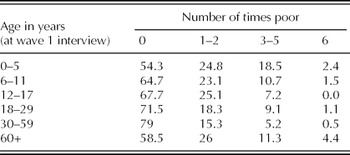
Persistent poverty is associated with entrenched material deprivation, one which does not improve without long periods above the low income threshold (Berthoud et al., Reference Berthoud, Bryan and Bardasi2004). Recognition of persistent poverty leads to acknowledgement of a distinct group of the most disadvantaged children. In turn, this suggests the need to prioritise and target policies and services for children in persistent poverty. However, putting this into practice is difficult. For a start, the literature suggests that the type of families in which children are most at risk of persistent poverty are the same as those at risk of poverty generally. This includes, for example, families with younger children and those with a higher number of children. Table 2 suggests that the younger the child, the greater the risk of persistent poverty. That is, children aged five years or less were more than twice as likely as older children and working age adults to be in poverty persistently over a six-year period. But it also shows that children aged five or younger were more likely to experience poverty per se, whether temporary or persistent.
Distribution of number of times poor out of six according to age (1991–1996)

Note: Poverty = 50 per cent of wave 1 median income.
Source: Hill and Jenkins (Reference Hill, Jenkins, Bradbury, Jenkins and Micklewright2001).
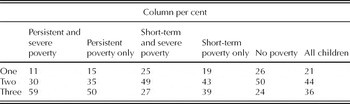
In terms of families with a greater number of children, Table 3 shows that 59 per cent of households in persistent severe poverty (see table for definitions) were families with three children compared with 11 per cent of families with one child. However, families with three children were also more likely to experience short-term poverty than those with a lone child. The same is true for children in lone parent families, workless households and households with a family member with a disability or in ill-health (Ruspini, Reference Ruspini1999; Jenkins and Rigg, Reference Jenkins and Rigg2001; Adelman et al., Reference Adelman, Middleton and Ashworth2003). Rather than particular risk factors being associated with shorter- or longer-term poverty, a sliding scale of poverty persistence results from an accumulation and intensity of risk factors (Muffels et al., Reference Muffels, Fourage and Dekker2000).
Average number of children in the household over five years by poverty status (1991–1999)

Notes: Poverty = income poor (40 per cent of median income) and/or one measure of material deprivation. Severe poverty = income poor and two measures of material deprivation. Persistent = three or more years in poverty.
Source: Adelman et al. (Reference Adelman, Middleton and Ashworth2003).
Therefore, in order to target children in persistent poverty, it would not be a case of targeting family types, but targeting specific families. This option, though, is unrealistic: the administrative process involved in identifying such families – requiring assessment of their equivalised income over a period of years – would be intrusive, prone to error and resource-intensive.
Increasing employment
The empirical and practical obstacles to targeting children in persistent poverty make it difficult to see how specific policies can be designed to tackle different types of poverty. This brings us back to reflect on how else dynamics research informs strategy. What is clear is that the Government's long-standing, overarching strategy of tackling child poverty through increasing employment rates and increasing financial support to families is well supported by dynamics research. However, the research also suggests that both elements have their limitations which, left unaddressed, would represent gaps in the strategy.
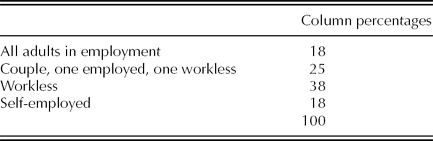
Poverty dynamics research has long reported the relationship between employment and income (see for example, Jenkins et al., Reference Jenkins, Schluter and Wagner2001). Table 4 shows that children in workless households were more than twice as likely to be in persistent poverty as those in households where all adults were in work.
Economic status of households of children in persistent poverty 2002–2005
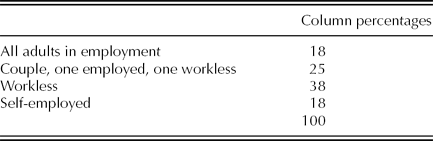
Notes: Poverty = 60 per cent of median income after housing costs.
Persistent poverty = three or more years out of four in poverty
Source: DWP (2007b).
A critical factor in children's chances of avoiding poverty is the ratio between dependent children and adults (potential wage-earners) and, for this reason, children in lone parent families face particularly high risks (Vegeris and Perry, Reference Vegeris and Perry2003). Indeed, of all households, those headed by lone mothers with dependent children are most vulnerable to poverty. For example, Ruspini (Reference Ruspini1999) found that 71 per cent of lone mothers entered poverty at least once during a five-year window, with 20 per cent in persistent poverty (measured as a single spell lasting at least three years). By contrast, 31 per cent of partnered mothers entered poverty at least once and just 6 per cent experienced persistent poverty.
Because poverty dynamics research takes into account changes in households' circumstances over time, it is able to indicate what triggers movement out of poverty (or, more specifically, what events are associated with movement out of poverty). A key finding here is that an increased employment rate within a household is the most important trigger for poverty exit. For example, among all individuals in households where there had been a rise in the number of workers (without changing the household size), 56 per cent had moved out of poverty at the same time (DWP, 2007b). Jenkins et al. (Reference Jenkins, Schluter and Wagner2001) found that, of all events, the two most likely to trigger poverty exit for children were a change from having a one-parent to having a two-parent household, and an increase in household employment. However, again, employment is key: the effects of re-partnering on children's poverty were ‘dwarfed’ in comparison to the reduction in poverty risk associated with an increase in the number of full-time workers (Jenkins et al., Reference Jenkins, Schluter and Wagner2001).
Nevertheless, employment does not guarantee freedom from poverty (Taylor, Reference Taylor2002; Nolan and Maitre, Reference Nolan, Maitre, Chase-Lansdale, Kiernan and Friedman2004). In 2005/06, 57 per cent of children under the low-income threshold had at least one parent in work (DWP, 2007a). Table 4 suggests that at least 43 per cent of children in persistent poverty lived with one or more adults in employment. This extent of in-work poverty means that, for example, New Deal programmes focused on getting people into work, whilst important, will not alone serve to eradicate child poverty.
What this suggests is that transition into employment among parents, is only the beginning of the process of moving children out of poverty. In order to overcome in-work poverty, parents need to be able progress up pay scales and this, in turn, would seem to necessitate having relevant skills. Training, therefore, is important for tackling child poverty.
Job retention is equally important, not only for parents to have demonstrable work experience in order to enhance career progression but also to avoid the risks associated with transitions in and out of work. That is, as we discuss below, the higher risks of child poverty associated with movements off and on – and on and off – benefits (Adelman et al., Reference Adelman, Middleton and Ashworth2003) mean that insecure work can be more damaging for some than not working. In practice, those most at risk of poverty are those most likely to have unsustained, patchy employment histories. For example, the scale of the problem of unsustained employment among lone parents has been reported in the Department of Work and Pension's evaluation of New Deal for Lone Parents, which found that up to 20 per cent of those who entered work returned to benefits within six months, and 40 per cent returned within two and a half years (Evans et al., Reference Evans, Eyre, Millar and Sarre2005).
Providing financial support
By definition, increasing financial support to low income families addresses the needs of children living in income poverty. Dynamics research shows that increased state support serves to lift families out of poverty (albeit with less effect that increased employment). For example, rise in benefits income (including tax credits and pensions) has been associated with 32 per cent of all movements out of persistent poverty (1991–2005, DWP,2007b).
On the other hand, one of the over-arching limitations of current state support is the adequacy of current levels of provision. For example, Government figures suggest that 47 per cent of children in workless families and reliant on state support experience persistent poverty (2002–2005, DWP, 2007b). (It is worth recognising though that progress has been made in this regard since the 1990s when 70 per cent of children in workless households were in persistent poverty (DWP, 2007b)).
Dynamics research also highlights another, less commonly recognised limitation of the current benefit and tax regime, this being its lack of responsiveness to change and transitions in families' circumstances. This is suggested in the work of Adelman et al. (Reference Adelman, Middleton and Ashworth2003) which highlights the importance of a benefits and tax system that can smooth the income of families when parents move in and out of work. They found that children in households with no workers in each year were at less risk of poverty than those in households where people had moved out of – or in and out of – employment. Of children in persistent and severe poverty, 19 per cent came from households continuously without workers, 20 per cent came from households in which there had been one transition from work to no work, and 29 per cent came from families where there had been two or more transitions from work to no work (Adelman et al., Reference Adelman, Middleton and Ashworth2003).
As well as employment change, other types of transition also appeared to be flashpoints of risk for children. Adelman et al. (Reference Adelman, Middleton and Ashworth2003) observed that children with a parent with a disability or poor health were at particular risk of entering poverty: more than half of children in persistent poverty had lived with an adult in poor health for at least one year during a five-year period, compared with a quarter of children who had experienced no poverty. However, among these children, risks are highest among children living with a parent moving in and out of illness, rather than for those with parents with a stable condition (Adelman et al., Reference Adelman, Middleton and Ashworth2003).
Family change represents another flashpoint. For example, 24 per cent of children in persistent and severe poverty had been in a lone parent household continuously over five years, compared with 29 per cent who were from families that had moved in and out (or out and in) of lone parenthood (Adelman et al., Reference Adelman, Middleton and Ashworth2003).
Filling the gaps
Arguably, ‘dynamics thinking’ has indirectly influenced UK social policy for many years. Alcock (Reference Alcock2004) suggests that poverty dynamics research in the US emphasised the role of personal agency in escaping poverty, this then motivated the introduction of US welfare to work policies, and these developments in turn helped transform UK policy, both in terms of the adoption of a more agency-focused welfare approach and the creation of New Deal. Certainly, the Government's current anti-poverty strategy claims a ‘life-course perspective’ in working towards a fairer society (DWP, 2006). This includes recognition of the intra- and intergenerational dynamics, insofar as education and pension reforms look to breaking generational cycles of disadvantage.
However, over the last decade, there does not appear to have been a proactive approach to tackling year-on-year child poverty dynamics. The focus on employment and financial support during this time has been about triggering change at discrete points in time – getting a parent into a job, payment of a benefit or tax credit – and not about responding to families' needs and children's lives over time. In this sense, lack of emphasis on job progression and retention and on the responsiveness of the tax and benefits system can be regarded as gaps in the child poverty strategy. These have been serious gaps for children: as discussed above, persistent child poverty is associated significantly with in-work poverty and movement on and off benefits and tax credits.
Relatively recently these gaps have begun to be addressed. For example, some of the major independent, Government-commissioned reviews in the last few years have emphasised developing initiatives to improve job retention and progression. For example, the Leitch Review of Skills (Leitch, Reference Leitch2006) and the Harker Report on measures necessary for meeting the child poverty targets (Harker, Reference Harker2006) emphasise the importance of training and education to improve families' opportunities to access more secure jobs and to develop the skills necessary for job progression.
Training alone will not improve retention. For example, recent qualitative longitudinal research about lone parents and employment identifies complex sets of inter-related life events, which mediate patterns of movements into and out of work (Millar, Reference Millar2007). New Deal for Lone Parents (NDLP) provides in-work support (or ‘Aftercare’) to help parents deal with these events, insofar as a Personal Adviser contacts them shortly after they start work, though there is as yet little evidence about the effectiveness of this provision (DWP, 2007c). At the same time, a number of pilots are being conducted to test the efficacy of other methods of in-work support, including In-Work Credit (payments of £40 a week to lone parents for the first year in a new job) and the In-Work Emergency Fund (providing financial help to parents during the first 60 days in employment) (Harker, Reference Harker2006). In addition to financial help, there is also growing recognition of the need to develop opportunities for flexible working for parents, matched with flexible childcare (Work and Pensions Committee, 2008).
However, a dynamics perspective encompasses more than entry into and retention in employment. No matter how effective policies are in this regard, most parents' employment history will constitute both periods of employment and transitions between employment. For many, these transitions will be interspersed by periods out of employment, for example, unemployment, to undertake childcare, or because of illness. Currently, these points of transitions represent ‘flash points’ for entering poverty. For example, children with parents moving in and out of work are as much at risk of poverty as those with parents continually out of work, and children with a parent moving in and out of poor health are just as disadvantaged as those with persistently ill parents.
Recent policy is more sensitive to the potential problem of financial volatility when people move from benefits into work. This is apparent in provisions such as the Lone Parents Benefit Run-On, whereby lone parents can continue to claim Income Support or Job Seekers Allowance for two weeks after starting work. Attention has also started to be given to ‘smoothing’ the income of families moving out of employment. For example, the 2007 Budget announced a four-week run-on in entitlement to Working Tax Credit after eligible claimants cease to work 16 hours. More generally, a number of pilot schemes have been set up to provide more responsive services to reduce delays between people leaving jobs and receiving benefits payments, such as the DWP/HMRC trials in North Tyneside (DWP, 2007d).
What next?
This article has highlighted the Government's child poverty strategy as something which is contingent and developing. Until the last few years, insufficient attention had been given to appreciating and addressing child poverty dynamics. Recently, a policy agenda around job retention and progression and the responsiveness of financial support has developed. Poverty dynamics research suggests that these developments are essential for tackling child poverty.
At the same time, the rate of these developments should not be overstated: it is still early days. Many of the initiatives cited above are pilot trials, and some of these have been targeted only at lone parents. The Harker Report recommends that, after evaluation of these pilots, the effective elements of the NDLP need to be rolled out nationally for all parents as part of a new New Deal for Parents (Harker, Reference Harker2006).
Even at this early stage, we can consider what might be key issues for how these developments unfold. In terms of providing training to promote career progression, the potential impact on child poverty will depend ultimately on the quality of training provided. Commentators have pointed out that women in particular will need more than basic skills training to compensate for the gender pay gap (Work and Pensions Committee, 2008). Moreover, progression and long-term security for women and their families may require more than skills. Ruspini (Reference Ruspini1999), for example, argues that the high risk of poverty in lone parent families is likely to reflect the relatively fewer opportunities for stable employment available to adults with dependent children. Therefore, job retention and progression among lone parents will depend on the creation of genuine and ‘workable’ opportunities.
In terms of the responsiveness of the benefits and tax credits system, emphasis is given to movement into and out of work. In order to address the other poverty risks and triggers discussed above, it is also important to ensure that state support is designed to respond effectively to other forms of family change, such as the poverty dynamics associated with parents' movement into and out of poor health, movement from two- to one-parent households, and increases in the size of families when babies are born. In time, however, an overarching approach must be the development of a more personalised system of support for families with children, to provide more tailored and responsive assistance for families as they negotiate changes over time.
Perhaps the key issue for the future is need for the continued political commitment required to secure the investment needed to tackle poverty over the longer-term. Provision such as, for example, genuinely beneficial training and education, resources to help smooth income between points of change, flexible childcare and the development of personalised services will all come at a cost. However, a lack of investment in this strategy would be a false economy. That is, if policy does not pursue such options and focuses instead only on poverty exit – and not on keeping children out of poverty – it is likely to devote successive waves of resources to many of the same families. As many of these families will continue to return to poverty, resources will be wasted and efforts to eradicate child poverty will be inherently undermined.
Acknowledgements
The author wishes to thank Alan France and Line Predelli for their comments on the drafting of this article.