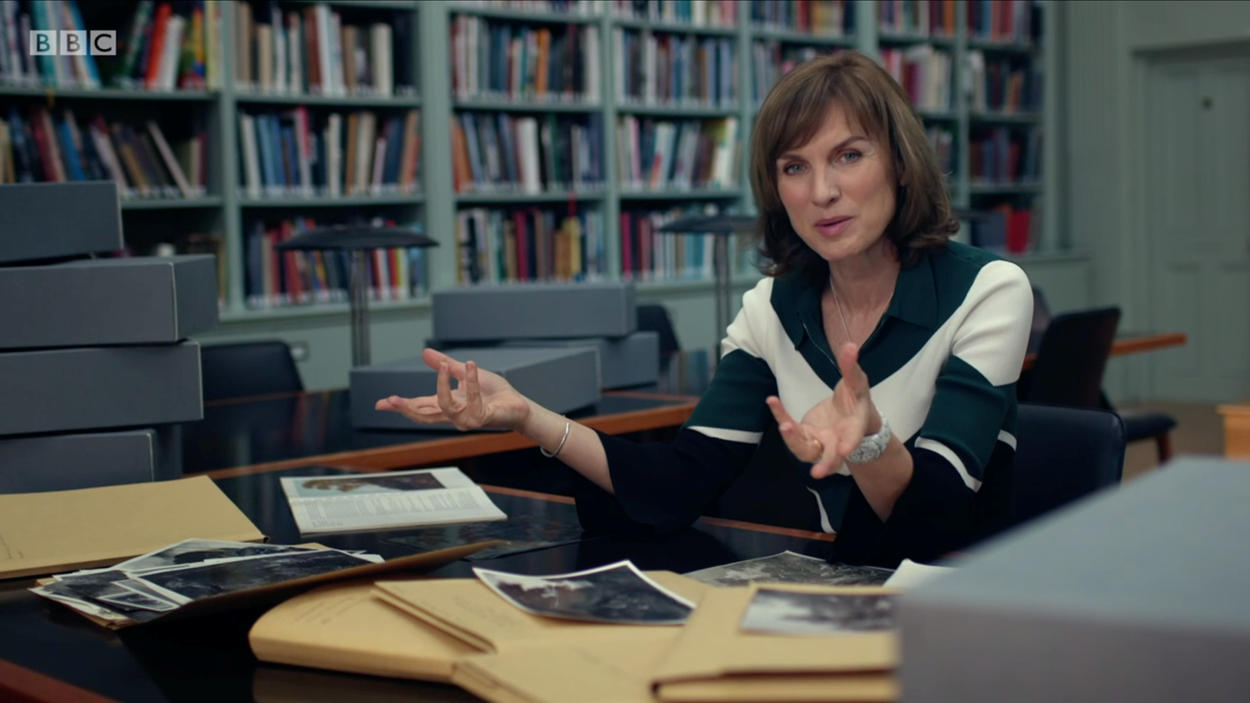
Series 8: Episode 1 of the BBC's programme Fake or Fortune, presented by Fiona Bruce and the art dealer Philip Mould and regularly watched by upwards of 5 million viewers, features a section filmed in the Paul Mellon Centre for British Art's public study room.Footnote 1 Fiona Bruce sits surrounded by box files and an array of black and white photographs set out on the desk before her. She is pursuing what she describes as the ‘provenance trail’ of an 18th-century landscape painting which could (and we won't add any spoilers here!) be a lost work by the British artist Thomas Gainsborough (1727–1788).
Working through the archive collections of the great Gainsborough experts Ellis Waterhouse and John Hayes, in tandem with images from the photo archive, Bruce sifts through images that have also purported to be the ‘lost Gainsborough’ that is being investigated by the Fake or Fortune? team. ‘Working through this lot,’ Bruce exclaims, ‘I'm just beginning to get a sense of what we are up against.’ She sorts through photographic images of pictures that have also been contenders for, and then rejected as, the original painting depicting a scene of Gypsies in a landscape. These include pastiches, copies and fakes. ‘So, you have a little collection of broken dreams here,’ Bruce summarises.Footnote 2 Broken dreams, new leads, provenance data, object biographies; these are all the daily dramas contained within the photo archive. However, it isn't very often they feature on popular primetime television shows. The conventional image of the photographic archive is of a place of quiet, scholarly research, hidden away from the outside world. These research repositories, often of largely black and white images taken in the twentieth century, can sometimes look and feel like they belong to a different era of art history, technologically and materially. Yet, as Fake or Fortune? demonstrates, there is a public appetite for the stories that photo archives hold. They will always remain a rich, scholarly resource for expert researchers; but there is also a wider interest in the possibilities offered by photographic archives as image repositories and containers of art's many and varied histories.
Between 1964 and 1969 the Paul Mellon Foundation began to collate an internationally important collection of reference photographs of paintings, sculpture, architecture, and the decorative arts, as well as images of sketchbooks and exhibitions. At this point in history, British art arguably lacked a serious body of scholarship, especially in comparison to the art histories of its neighbours on the Continent, and dedicated research resources were scant. The photo archive was established to address this lacuna, providing access to art that was often locked behind the closed doors of Britain's private country houses and collections. This practice was continued when the Foundation was re-established as the Paul Mellon Centre for Studies in British Art (PMC) in 1970, and maintained until 2013, at which point the collection contained more than 100,000 reference images. The most valuable—and unique—materials contained within it are those images produced by a staff photographer, Douglas Smith and – between 1972 and 1977 – his assistant James Read. Smith was employed by the Centre for over thirty years and focused his efforts on capturing records of objects that were otherwise difficult to obtain: those in private collections, sold at auction, or loaned to exhibitions. Between 1964 and 1996 he and Read photographed more than 35,000 works.
Still from Fake or Fortune?, Series 8, Episode 1: The Lost Gainsborough, 00:27:10, broadcast on BBC One, 25 July 2019.

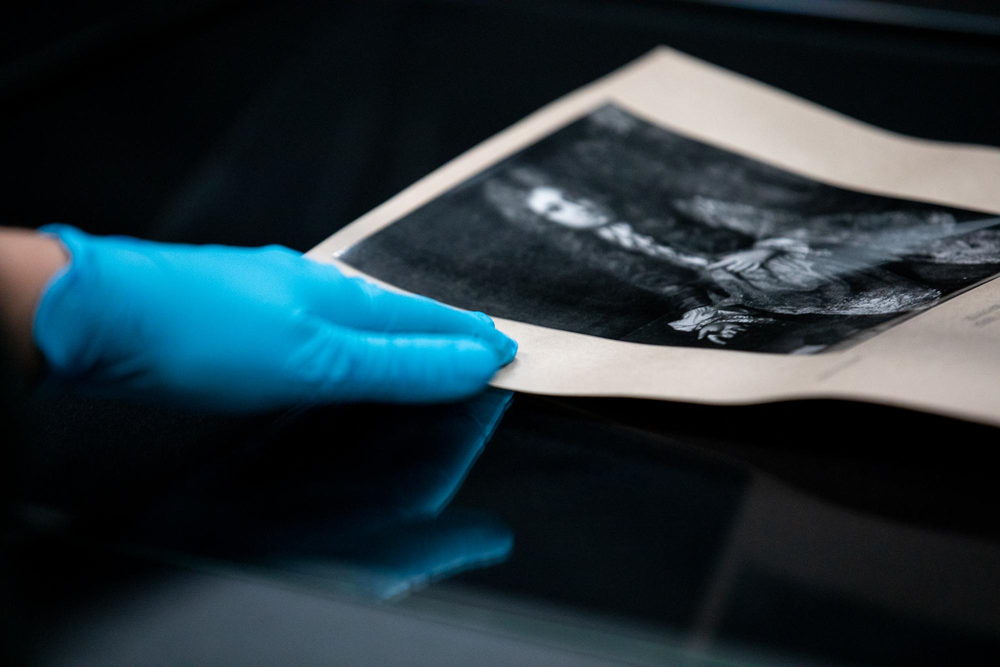
This reference collection has been crucially important to the development of research in the field, providing the images and information that scholarly publications rely upon; it continues to be regularly consulted by art historians, curators, conservators, picture researchers and students. It has been available as a reference resource in our public study room in London and the library at the Yale Center for British Art (YCBA), New Haven, where copies of Smith's and Read's images were routinely sent. The photographs document objects at various points in their existence — before and after restoration, modification, or sale. Crucially, the mounts were annotated by staff librarians, who painstakingly recorded known information about the provenance, exhibition history, and literature on each work, and later by scholars who corroborated or refuted this information. Still, the cataloguing processes that created the documentation about these works of art were inherently partial and fragmentary. The expertise of librarians was not uniform, and their methodologies varied. Like all collections, it evolved over time, and it was shaped by the interests of the various personnel who were tasked with its stewardship. This is true, for instance, of Smith's photographs, which were indexed by the PMC by sitter and collection, but not iconographically by subject, as was routine at the YCBA. It has always been necessary, therefore, for a researcher to visit numerous other research collections containing similar materials in order to build up a comprehensive history of the subject of their inquiry. As Fiona Bruce and the Fake or Fortune? production team found out, these resources often provide crucial pieces in the jigsaw puzzle of provenance research, but the complete picture needs to be constructed from missing pieces held elsewhere.
In the UK, the Courtauld Institute of Art's Witt Library and Warburg Institute's Photographic Collection have offered such complementary resources. Further afield, art libraries in Los Angeles, New York, New Haven, Washington D.C., Paris, The Hague, Florence, Rome, Marburg, and Rome contain millions of reproductions documenting the history of European art. The modernisation of the labour-intensive and costly practice of maintaining such archives, and of making them more easily accessible and searchable, is something that a group of 14 research centres and photographic libraries have been discussing since 2013.Footnote 3 The PHAROS consortium, as it has become known, has developed plans to digitise and publish their collective photo archive collections online, using interoperable methods for the exchange of data and images. Digital reconciliation of the records will, it is hoped, unlock the combined knowledge of the decades of scholarship invested in the assembly of these collections for researchers, regardless of their location. The PMC is a founding member of PHAROS and the conversations we have had with our partners have energised our discussion, and advanced our thinking and research around the use (and potential use) of this resource. Converting this archive from photographs mounted on card to a digital asset appears, at first glance, a relatively straightforward digitisation project. However, the questions, challenges and issues raised by this project have prompted us not only to focus on the ‘how’ (the process of this conversion), but also to think about the ‘why’. As the project has progressed, these questions — about why we are digitising our photographic archive and what benefits this will have to users in the field of British art history — have only grown more voluble. This article focuses on the research we have conducted so far with users and reflects on how we are reflecting on these findings to develop our project as it progresses.
User Workshop
As this project is hosted by a research centre, we are led by research questions: why make digital copies of these photographic images? Who are photo archives for? What new research methodologies will digitization make possible? What do users want from photo archives? We decided to gather information on two fronts: through engagement with our habitual researchers to define use practices and habits; and in consultation with other research organisations holding similar collections, to determine best practices for the development of the technical specifications and infrastructure. The information collected from our research has helped us to iterate on our initial model, test our assumptions, and direct our resources to achieve the best return.
A workshop was held at the PMC in November 2018 to engage with some of these questions. The purpose of this workshop was to explore the possibilities and challenges of using digitised photo archive materials to conduct research. We invited forty academics, researchers, curators, conservators, collection managers, educators, arts professionals, photographic experts, and digital technologists to take part in a roundtable discussion about the digital future of the Centre's collection.
As our photo archive collection had been physically stored off-site for an extended period of time, the staging of a workshop to bring together key stakeholder groups was considered useful on a number of fronts: to test assumptions about the value of the resource; to generate audience profiles and use patterns; and to discuss how the physical discovery process may differ—and be augmented by—the digital platform.
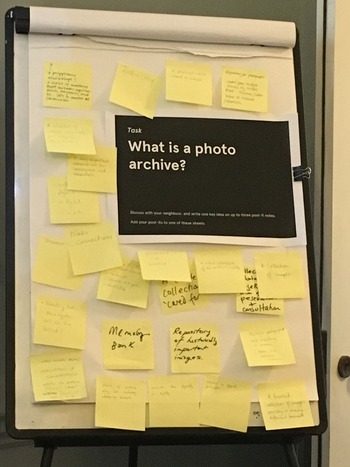
The workshop was delivered in a number of formats, including formal presentations, question and answer sessions, practical handling sessions, demonstrations, and user journey testing. Additionally, opportunities for feedback outside of group discussion were offered by means of brainstorming tasks with Post-It Notes as a way for participants to feel comfortable giving their feedback, encouraging them to respond openly and honestly. Tasks and questions were designed to elicit stories about user-behaviours, activities, thought patterns, needs, expectations, and goals. We recorded proceedings using a variety of methods, including formal minutes, audio recordings, screen captures, empathy mapping, and user observation grids. This holistic approach to notation allowed us not only to record what was said, but also how things were said, and what impact tone and body language had on the proceedings.
Some of the most remarkable insights concerned the nature of the collection as a ‘scholarly resource’. When quizzed, it seemed that participants had little comprehension of the distinctions between a photo archive, a collected archive, an image bank, or a collections website. In fact, when asked in advance to contribute a list of online photo archive catalogues they routinely visited as part of their research, not a single ‘photo archive’ site was included. Rather, all suggestions were for image banks such as Bridgeman Images, or online collection catalogues such as those operated by the Courtauld, V&A Museum, Royal Academy of Art, or Tate. Users were clearly uncertain of the boundaries between one intellectual unit and the next when broadly similar resources were being presented in the homogenous and porous online environment. Questions were asked about the nature of the boundaries between an institutional website and collections catalogues: where exactly does one end and the other begin? Taxonomic and institutional divisions that information professionals may construct to better manage and maintain their collections were, for our participants, immaterial. When searching, our users expected any relevant resources to be presented regardless of how the materials might be internally grouped: a search for ‘Gainsborough’ should return all records regardless of the conceptual arrangement of the underlying collections.
‘What is a Photo Archive?’ participant responses from Paul Mellon Centre user workshop, 13 November 2018. Image courtesy of Sarah Victoria Turner.

One of the key takeaways from the process was that while users had a very clear understanding of the research questions that might be asked of a photo archive collection, there was little understanding of the complexity of the underlying data that would be necessary to answer such questions. Though many of our workshop participants had considerable experience of using and in some cases creating digital catalogues, few had a firm grasp of ‘metadata’ as a necessary means by which to deliver accurate results, and many relied on free-text searching to surface resources. While they asserted that a reliable free-text search would be sufficient for their needs, many of the use cases they described (provenance research, for instance) would require complex and exhaustive structured data to return useful information. Having developed certain expectations about the nature of online searching by large information aggregators such as Google, there is clearly a discontinuity between these expectations and what is achievable in the Gallery, Library, Archive, and Museum sector.
A central practice in the use of the physical photo archive collections is the juxtaposition of images against one another. In sessions where participants were observed as they undertook research using the Centre's collection of photographs, users chose images from files, then aligned, compared, and contrasted their selection. Replicating such a process digitally is achievable: however, in discussion about the tools that a digital research environment might offer, a common concern was that such juxtaposition would not be possible without specialist desktop software. While the ability to save, collate, and zoom is now commonplace in online collections catalogues, more pioneering tooling that offers the ability to compare-and-contrast directly in a web browser (and across different collection sites) did not seem to be widely known. For example, the Frick's ARIES software, an interactive image manipulation system that replicates something akin to a light box, was unfamiliar to our participants.Footnote 4 Likewise, even when such tooling was present on the web page, members of our cohort were unable to identify it. The function of the small red and blue ‘IIIF’ icon scattered across numerous collection sites was alien to all of our participants. The icon, an acronym for the International Image Interoperability Framework, ostensibly offers users the ability to select and compare multiple images in a web browser from multiple collections.Footnote 5 When this ‘drag-and-drop’ feature was shown in action using tools such as Mirador viewer, participants were thrilled to see that their physical working practices could be transmitted into a digital environment.Footnote 6 However, it is clear that user experience work needs to be done to better communicate functionality through the system's design and presentation.
Process
Documentation of the workshop encouraged us to segment and profile our users into groups with similar behaviours and use cases. In doing so we have been able to focus our list of requirements to better reflect the range of expectations and needs. Profiles for ‘Publishing professionals,’ ‘Curators,’ ‘Academics,’ ‘Information professionals,’ and ‘Art market professionals’ were created, allowing us to prioritise requirements regarding the kinds of services that we should be offering as a twenty-first-century research centre.
The ambitious project to digitise, catalogue, and publish the collection in its entirety began in earnest in spring 2018, and will be completed in 2020. Picturae, a Dutch company working extensively in the cultural heritage sector, removed the collection to one of their facilities and imaged the back and front of each item in turn. The PMC benefited from the familiarity, knowledge and expertise that Pictuare had developed through similar work for the Frick Art Reference Library, the Yale Center for British Art, and the Courtauld Institute of Art, who had each begun similar projects beforehand. The digitisation was completed in seven months, after which the collection returned to permanent off-site storage.
The user workshop helped us to test many of our assumptions about how a ‘successful’ online catalogue might function. Each of the use cases defined through work with our participants called for types of complex querying that require extensive structured metadata. To discover objects, for example, that were sold by the dealers Thomas Agnew & Sons within a specified time period would require that the provenance descriptive text present on our mounts be transcribed. To reproduce an image in an academic essay would require that we first determine the copyright holder by transcribing the source of the negative and its accession, from which we could infer the extent of its potential re-use.
Digitisation of the Paul Mellon Centre Photographic Archive underway, Mana Contemporary, New Jersey, January 2019. Image courtesy of Picturae, The Netherlands.

In our library catalogue, Heritage Cirqa, the PMC's photo archive collection had previously been catalogued by the name of the artist. This has produced in excess of 6,500 records. This allowed researchers to discover the existence of documentation about the artist but gave no indication of the extent of the holdings beyond file level and included none of the rich item-level metadata. Prior to undertaking user consultation we had expected to use Optical Character Recognition (OCR) software to detect text contained on the mounts. However, as this process would have introduced omissions, errors, and inconsistencies, the workshop participants recommended finding a more reliable mode method of cataloguing to unlock the maximum value of the resource.
The data contained within the mounts is the result of decades of effort and investment. A machine-generated capture of the data may have corrupted the integrity of this information, so we have instead opted to have the collection manually transcribed. Working again with Picturae and a third-party contractor, we produced a clear set of protocols that explain the content on the mounts and describe how to transpose it into a structured format. A team of ten worked to transcribe the data from the 200,000 digital images, and the process took three months to complete. The resulting data describes more than 100,000 objects, which will be published in a new digital collections website. This will be supplemented by contextual information found in our negative ledgers and institutional papers.
Plans
Mindful of the need to aggregate the resulting images and metadata, the PHAROS group plans to adopt open standards for interoperable distribution of each data set. Unlike previous initiatives to create union catalogues using a reduced data schema such as Europeana, one of the fundamental aims of the PHAROS project is to maintain the complexity and nuance of the data created in each institution. The Data Model Working Group, the work of which is discussed in this issue by Emmanuelle Delmas-Glass and Robert Sanderson, meets periodically to compare data sets and map them to Linked Art, a community initiative working together to create a shared descriptive model based on Linked Open Data.Footnote 7 Linked Art offers a ‘slim’ profile of the CIDOC Conceptual Reference Model (CRM) that defines patterns to describe common components such as objects, people, places, exhibitions, transactions, and publications in a structured data format. In theory, using Linked Art allows each institution to maintain their own idiosyncratic cataloguing methodologies and avoids the inevitable flattening and simplification of data otherwise necessitated by trying to reach a common ground. The programmatic reconciliation of information across data sets is enabled through authority identifiers: for example, to identify ‘Thomas Gainsborough’ as a person involved in the creation of a work of art, the PMC may choose an identifier from the Getty's Union List of Artist Names (500115200), while the RKD may use their own internal identifier (29966), and the National Gallery of Art D.C. may prefer one from the Library of Congress (n79055449). Aspects of the Linked Art model are still in development, but it has been used in a prototype for the American Art Collaborative.Footnote 8 It will also shortly be implemented for five PHAROS organisations in a pilot project funded by the Andrew W. Mellon Foundation.Footnote 9 The development of the PHAROS research platform will be informed by this pilot, which will serve as both a testing ground and model for the broader initiative of PHAROS, a phase scheduled to conclude at the end of 2021.
Centralised storage of the roughly 20 million images held by the PHAROS partners would be prohibitively expensive. Instead, the consortium has opted for a distributed model whereby each organisation maintains storage costs for their own materials locally and makes them available via the IIIF API. Using this standard means that derivative copies of each PHAROS member's image files need not be stored on a centralised server, minimising data hosting costs. Instead, an identifier for each file will be deposited with the aggregate catalogue which can then be requested from the holding repository's server as and when it is required. Manipulation of the images to return different sizes, crops, formats and rotations can occur on the server too, reducing the need for pre-processing and the storage of additional derivative copies.
The PMC's project will conclude in 2020 with the launch of an institutional catalogue for its digitised collections. This coincides with the organisation's 50th anniversary and recognises the central importance of the Centre's photo archive in the development of the field of British art studies. The decision to maintain an institutional catalogue in additional to that planned as part of the PHAROS research platform was also felt necessary, in part thanks to the feedback we received in the user workshop. When asked what to prioritise within the collection, participants were very clear: a focus on those items that are unique to the PMC's collection. It was advised that the institutional context for the collation of the archive should be foregrounded, as this frame of reference will likely be lost within the scale of resources presented within the PHAROS aggregate catalogue. We plan to do this by offering interpretative narratives around highlights from the collection, and by producing data visualisations that will more quickly familiarise uninitiated users with the collection and its history. We imagine visualisations that, for example, track the quantity of photographs taken by the PMC on a year-by-year basis and align these with significant publications, exhibitions, and events in the field of British art studies. This, we hope, will demonstrate the impact and continued relevance of such resources in the academic sphere.
Conclusion: ‘broken dreams’ and/or new insights?
As Fiona Bruce found out in her hunt for the lost Gainsborough, photo archives are not silent, inert repositories merely documenting the past. Rather, they contain drama, telling stories about works of art, as well as their makers, owners and collectors, that have the potential to impact scholarship and understanding in the future. They can be repositories of ‘broken dreams’ – in other words, they can give the researcher information that suggests a work is a copy or a fake. But just as leads can go cold, so new ones might be found. Photo archives can generate fresh new insights and discoveries, linking works and information about those works within their networks of authorship, patronage, collection and distribution. Once the PMC's archive is made available digitally, we plan to carry out further user surveys and consultation exercises to monitor and explore how researchers are accessing this collection in its online form, and to find out more about the art historical insights that are enabled by such digital access. As we head into our anniversary year, we are already pondering what the next 50 years of the photo archive will look like.
We would like to thank our colleagues at the PMC, especially Charlotte Brunskill and Mark Hallett, for their assistance with this article, as well as all the participants of our user workshop.