In this study, we analyze socioeconomic and demographic factors along with health services provider availability for the Zika outbreak in Miami-Dade County, South Florida. We hypothesize the possibility that Zika outbreaks could disproportionately impact poorer urban neighborhoods with a larger percentage of minority residents compared with relatively wealthier neighborhoods because of health disparities between the two areas. The term “health disparities” can be further divided into two types: “healthcare disparities,” which refer to differences in access to or availability of facilities and services, and “health status disparities,” which refer to the variation in rates of disease occurrence and disability between socioeconomic and/or geographically defined population groups.Reference Artiga 1 By furthering our understanding of socioeconomic and demographic factors combined with the availability of a health services provider for residents of Miami-Dade County, we can provide insights for strategically targeting efforts to areas with high health services demand, which are challenged with a low healthcare supply.
Background
Zika virus infection is spread by an infected mosquito from the Aedes species, specifically, Ae. aegypti and Ae. albopictus. In urban and suburban environments, the Zika virus is transmitted in a human–mosquito–human transmission cycle.Reference Petersen, Jamieson and Powers 2 The virus can cause fever, rash, joint pain, and conjunctivitis in some adults, whereas others may remain asymptomatic. However, the effect of Zika may be far more devastating in a developing fetus, and can potentially result in a birth defect known as microcephaly, as well as in other severe brain defects and disorders of the nervous system: for example, Guillain–Barré syndrome.Reference Petersen, Jamieson and Powers 2 As of April 11, 2017, the Centers for Disease Control and Prevention (CDC) reported a total of 1762 cases of pregnant women with any laboratory evidence of possible Zika infection in the US States and the District of Columbia, and a total of 58 liveborn infants with birth defects associated with laboratory evidence of Zika virus infection. 3 Zika infection and associated health outcomes, thus, remain a significant public health concern.
The first active local transmission in the continental United States was identified on July 29, 2016, in the Wynwood community of Miami. 4 It is important to note that this triggered a historic first, as the CDC warned people not to travel to a site within the contiguous United States. On August 19, 2016, a new area of mosquito-borne transmission of Zika was identified in the Mid Beach part of Miami Beach, a 1.5-square-mile area across Biscayne Bay from Wynwood. 4 Given the outbreak and migration of local Zika transmission in the Wynwood and Miami Beach communities, we would like to assess the socioeconomic data of these neighborhoods and correlate this information with provider network adequacy data for the Federally Facilitated Marketplaces (FFM) at the county and ZIP code level. 5 We will then translate and group unique providers practicing in each ZIP code to Primary Care Service Areas (PCSAs) to provide meaningful interpretation for the availability of healthcare service providers for residents across different Miami neighborhoods. The analyses will help us to gauge and compare the challenges in accessing healthcare services within the Zika outbreak neighborhoods.
Data source
We analyzed health services provider data from the Center for Consumer Information & Insurance Oversight Machine-readable Public Use Files (MR-PUFs), which contain provider-level directory data from states that are participating in the FFMs. 5 The provider data from June 2016 of this year includes National Provider Information (NPI), provider type, names, specialties, and address information (city, state, county, and ZIP). We obtained data pulled from the NPPES Database from Centers for Medicare and Medicaid Services (CMS) to help identify specialties based on codes rather than on the free text in the JavaScript Object Notation (JSON) data. 6 We obtained socioeconomic and demographic data for 2016 from the Miami Matters homepage. 7 We used the 2010 PCSA Data Download on the Dartmouth Atlas of Health Care website to conduct our analysis on PCSA codes and provider availability for different neighborhoods of Miami-Dade County. 8
Methodology
As mentioned, the MR-PUFs contain links to issuers’ provider directories, in which the data are stored in JSON format. We used Python, a programming language, to extract the provider JSON June 2016 data from the links, which resulted in a large data set. We then split the data set into two parts: one part contains the provider information and specialty; the other contains the address information split into separate columns for street address, ZIP code, state, etc. These two data sets were connected on a common record ID key, which was set for each entry in the original JSON file. For our analysis, we focused on 5 specialties for provider count estimation—Primary Care, Pediatrics, Obstetrics and Gynecology (OB/GYN), Infectious Diseases, and Neurology—for 2 PCSAs in Miami-Dade County Zika outbreak and the surrounding communities. In order to identify the records pertaining to the specialties of interest, we used the NPPES Database to create a NPI to Specialty crosswalk based on the NPPES’ taxonomy codes and matched the NPIs from the JSON data to the specialties derived from the NPPES Database. These specialties were selected because we estimate that these providers will be involved with the diagnosis and treatment of patients infected with Zika. As the JSON provider data contained the ZIP code information for providers and not the PCSAs, we used the Dartmouth Group’s ZIP code-PCSA table to crosswalk the zip codes provided in the JSON address data to their respective PCSAs to enable a comparison of the provider data for these two service areas.
Challenges to Data Extraction
The data within the JSON file was inconsistent; therefore, cleansing and organizing the data was required before analysis. In addition, we identified outdated or dummy NPIs for the same provider, inconsistent specialties, inaccurate addresses and zip codes, and removed duplicate providers within the data set as providers can contract multiple issuers.
In order to overcome the challenges noted above, we used Quest Analytics software 9 to geocode the provider address data to obtain a longitude, latitude, and standard ZIP code. We also used an “NPI: Specialty Crosswalk,” which was created internally at LMI with Statistical Analysis System Enterprise software. The crosswalk was created to determine whether a provider is valid and active by matching the JSON NPIs to a standard specialty code derived from the National Plan and Provider Enumeration System Database. Using RStudio, a programming language for statistical computing, we filtered the two JSON data sets on the targeted specialties and ZIP codes. We then merged the data sets together into 1 table on a common record ID key, exported the data into Excel, and removed duplicates in the data based on NPI, latitude, and longitude in order to perform analysis.
Results
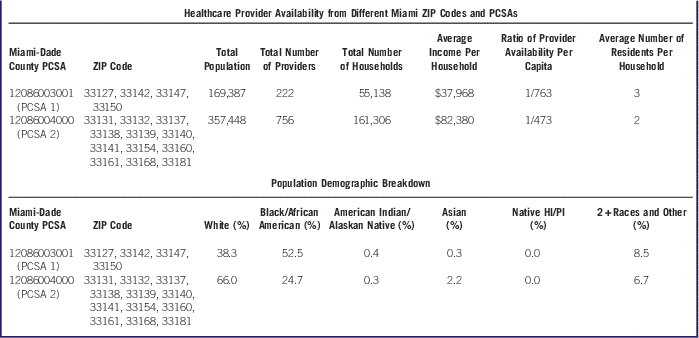
Table 1 provides the total number of unique providers in the fields of pediatrics, infectious disease, neurology, OB/GYN, and primary care physicians practicing in Miami-Dade County, which belong to a total of 16 ZIP codes and 2 distinct PCSA codes. 10 , 11 Data showed that healthcare providers’ availability and income levels are unevenly distributed across the 2 PCSA codes. PCSA 1—12086003001 has an average income per household of ~$38,000 in comparison with PCSA 2—12086004000’s average income per household of ~$82,000. PCSA 1 also has a lower ratio of provider availability per capita at 1/763 in comparison with the higher provider per capita of 1/473 in PCSA 2. PCSA 1 has providers servicing the Wynwood community and the surrounding three low-income ZIP codes (33142, 33147, and 33150). It has an estimated 222 unique providers in comparison with PCSA 2, which has 756 unique providers servicing the Miami Beach neighborhoods. In addition, the Wynwood ZIP code has considerately less number of providers of 19 in comparison with the other 3 ZIP codes within the same PCSA. The Wynwood ZIP code also has a relatively low median income, with a per-household income of $23,770 in comparison with Miami Beach neighborhoods. 11 For example, the median income per household for the Miami Beach ZIP code of 33140 is $53,604, which is almost double the Wynwood community’s household income. It is important to note that 81% of the Wynwood downtown area consists of Spanish-speaking residents. 11 Moreover, 54.88% of the residents in the Wynwood neighborhood are identified as being black/African American compared with 11.30% in the Miami/Miami Beach neighborhoods.
Healthcare Provider Availability by Primary Care Service Area (PCSA) and Socioeconomic and Demographic Data
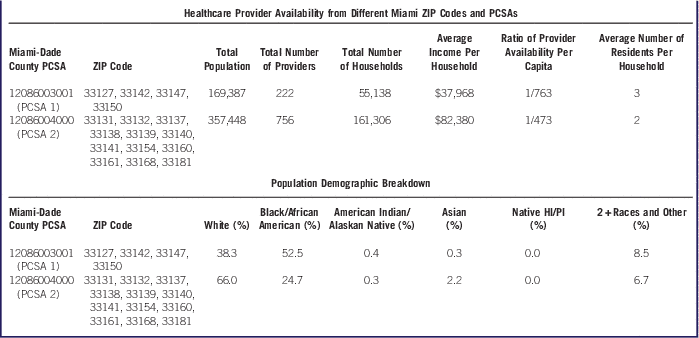
In Table 1, we provided the socioeconomic and demographic data 7 of the 16 Miami ZIP codes within 2 main PCSAs to compare socioeconomic levels and provider availability between the Wynwood neighborhood and the mid-Miami and Miami Beach neighborhoods. The Wynwood neighborhood is within PCSA 1 and the Miami Beach neighborhoods are within PCSA 2.
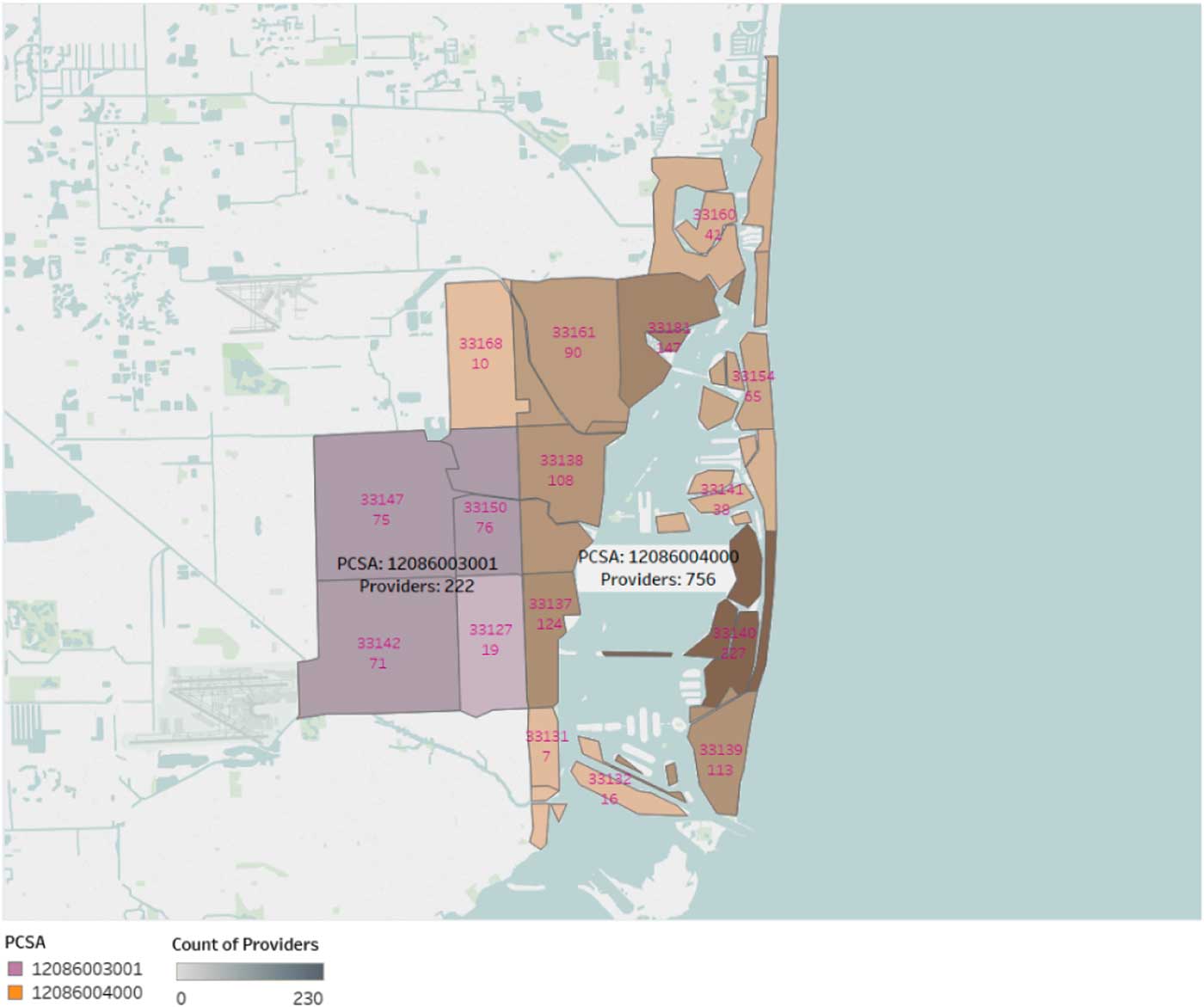
Figure 1 illustrates the total number of providers of the considered specialties for each of the 16 zip codes and the 2 affiliated PCSAs in Miami-Dade County. PCSA 1 represents the primary care service area where Wynwood’s residents are mostly likely to travel to seek care services. It has one-third or less healthcare provider availability than PCSA 2 where the Miami Beach residents seek healthcare services. There are three other Miami zip codes that surround the Wynwood neighborhood which also belong to PCSA1 (33142, 33147, 33150). These inland Miami neighborhoods have a median income similar to Wynwood’s poverty level and their residents are predominately minorities. For example, 75% of residents are Spanish speakers and 91% of residents are Hispanic and black minorities in zip code 33142. 11
Count of Unique Healthcare Providers in Miami-Dade County Neighborhoods by Primary Care Service Areas (PCSAs). The count of providers include Primary Care, Pediatrics, Obstetrics and Gynecology, Infectious Diseases, and Neurology. There are 16 ZIP codes in Miami-Dade county for the original Zika outbreak Wynwood neighborhood and the surrounding Miami neighborhoods that are covered by 2 unique PCSAs. The Wynwood neighborhood and 3 other surrounding Miami ZIP codes are within PCSA 1 which has a total of 222 providers.

Discussion
With the recent identification of local Zika virus infection, transmission, and migration in Miami-Dade County, public health precautions, allocation of prevention resources and awareness should target areas where demand is high but services are relatively scarce. We surmise that residents of the low-income neighborhoods may well be underserved by the local health system. Study findings show that there is a disproportionate availability of providers servicing the Miami neighborhoods across 2 PCSAs in Miami-Dade County. PCSA 1 is associated with the low-income Wynwood ZIP code and 3 surrounding ZIP codes (33142, 33147, and 33150). PCSA 1 has a lower number of providers per capita, lower average income per household, and a higher percentage of minorities than PCSA 2. The number of providers per capita is 1.6 times higher in PCSA 2 than in PCSA 1. PCSA 1 also services 3 other low-income and underserved neighborhoods in ZIP codes 33142, 33147, and 33150. Similar to the Wynwood ZIP code of 33127, these underserved residents are confronted with challenges such as low average income per household, high population density, and fewer providers. The average annual income per household is almost twice for residents in PCSA 2 in comparison with PCSA1. As previously mentioned, the initial outbreak of Zika originated in the Wynwood neighborhood. The lower provider availability, low-income, and language barrier factors of Wynwood could lead to disadvantages and challenges in getting healthcare access to timely treatment and prevention needed for residents. Public health and State Health Department Zika prevention and treatment services such as mobile clinics and education efforts should target PCSA 1 neighborhoods where the demand for health services is high and the availability of resources is low in comparison with PCSA 2 neighborhoods.
We hope these results will provide additional insights and, potentially, add tools to help the Florida Department of Health, CDC, and other government agencies to better target Zika prevention efforts. We are planning to conduct network provider research for Puerto Rico in order to include larger data sets and suggest additional findings that may be generalizable to other urban areas and communicable diseases.