

Introduction
Understanding life-history variation is essential for predicting species’ responses to ecological changes and for informing conservation and management strategies, particularly for species with specialised reproductive strategies or those at risk of population decline (Sæther and Bakke Reference Sæther and Bakke2000; Sæther et al. Reference Sæther, Coulson, Grøtan, Engen, Altwegg and Armitage2013; Winkler et al. Reference Winkler, Dunn and McCulloch2002). Reproduction is considered the most important component of life history, as it directly influences population dynamics, species interactions, and community structure (Gadgil and Bossert Reference Gadgil and Bossert1970; Pulliam et al. Reference Pulliam, Dunning and Liu1992; Sandvik et al. Reference Sandvik, Erikstad and Sæther2012). The success of reproduction, in turn, is shaped not only by behavioural and life-history traits but also by a range of biogeographical and ecological factors (Martin et al. Reference Martin, Bassar, Bassar, Fontaine, Lloyd and Mathewson2006; Smart et al. Reference Smart, Downing, Austin, Greeney, Londoño and Nahid2024; Zerbe et al. Reference Zerbe, Clauss, Codron, Bingaman Lackey, Rensch and Streich2012).
The Giant Nuthatch Sitta magna is a globally Endangered species found only in lower montane habitats in south-western China, eastern Myanmar, and northern Thailand (BirdLife International 2020). However, as with many threatened species in the region (Xiao et al. Reference Xiao, Hu, Lang, Fang, Guo and Zhang2017), baseline quantitative data on the ecology and demographics of the species in relation to habitat parameters, particularly regarding nesting habitat and nesting success, which are essential for its conservation and management, remain poorly documented. Thailand comprises approximately 5–10% of the Giant Nuthatch’s global range, which is relatively well covered by protected areas (Khamcha et al. Reference Khamcha, Angkaew, Pierce and Gale2022), and is the only part of its range with initial quantitative estimates of population size and available suitable habitat (Khamcha et al. Reference Khamcha, Angkaew, Pierce and Gale2022; Techachoochert et al. Reference Techachoochert, Gale, Khudamrongsawat and Round2018). Khamcha et al. (Reference Khamcha, Angkaew, Pierce and Gale2022) estimated the population size of the Giant Nuthatch in Thailand to be 578 individuals (ranging from 391 to 854) within approximately 156 km² of suitable habitat, dominated by mature pine (Pinus kesiya) forests and plantations.
The Giant Nuthatch has been reported to nest in mixed pine–broadleaf evergreen forests. In Thailand, Techachoochert et al. (Reference Techachoochert, Gale, Khudamrongsawat, Safoowong and Round2022) recorded a nest in Premna latifolia, while four other reported nests were found in Fagaceae or other unidentified broad-leaved tree species (Charonthong and Sritasuwan Reference Charonthong and Sritasuwan2009; Round Reference Round1983). In Myanmar, a nest was documented in Castanopsis indica (Htike Reference Htike2020). In south-west China, its nesting habitat was suggested to be mainly Pinus yunnanensis forest, but the only nest described was in a P. yunnanensis tree (Mo et al. Reference Mo, Li, Kang and Duan2025).
Mature forests provide unique habitat features, such as tree cavities, which are a critically important resource for a variety of animal species that rely on them for shelter, roosting, and nesting, thereby playing a vital role in the survival and reproduction of many species (Ibarra et al. Reference Ibarra, Novoa, Jaillard and Altamirano2020; LaMontagne et al. Reference LaMontagne, Kilgour, Anderson and Magle2015; Newton Reference Newton1994). In the case of Giant Nuthatch, Khamcha et al. (Reference Khamcha, Angkaew, Pierce and Gale2022) suggested that mature pine (P. kesiya) plantations, mixed with large native broad-leaved trees, could potentially serve as suitable nesting habitats, particularly as they may provide the necessary structural features, such as large, mature trees with cavities. Therefore, maintaining and restoring mature pine plantations could play a crucial role in conserving the Giant Nuthatch and other cavity-nesting species.
Our aims here were to estimate nest survival and identify the characteristics of nest cavities and nest-sites at a location that contains the largest known subpopulation of the species, possibly representing 2–5% of the global population. Since this study site is surrounded by villages, roads, and agricultural areas, we also aimed to assess the differences in nest survival between the forest interior and the forest edge. Given that the largest subpopulation in Thailand is found in a site dominated by old pine plantations, we were particularly interested in understanding the potential role of pine plantations in the species’ long-term conservation.
Methods
Study site
Based on our previous study determining baseline population and general habitat availability estimates of Giant Nuthatch in Thailand (Khamcha et al. Reference Khamcha, Angkaew, Pierce and Gale2022), the fieldwork for this study focused on Doi Kham Fah-Khun Khong (hereafter DKK), the core area of the Doi Kham Fah-Mueang Haeng Subdistrict locality containing the largest suitable habitat of mature pine (P. kesiya) plantation (62 km2), at elevations of 1,160–1,750 m, and the largest subpopulation (~230 individuals) of Giant Nuthatch in Thailand (Khamcha et al. Reference Khamcha, Angkaew, Pierce and Gale2022) and the largest currently documented for the species globally. DKK is enclosed within Pha Dang National Park, in Chiang Mai province, northern Thailand (19°55’N, 98°88’E). The average annual rainfall is 2,200 mm and the average temperature is 19ºC, ranging from 3.5ºC to 39ºC. The area is dominated by mature pine (P. kesiya) plantation (more than 30 years old). Doi Kham Fah is montane habitat with low levels of human activity. Lower elevations of Khun Khong and Pang Klang villages are located along a two-lane low traffic road, mostly protected; ~5% is dominated by unprotected mixed pine plantation–agricultural–village areas (Khamcha et al. Reference Khamcha, Angkaew, Pierce and Gale2022). Pine plantations were established in 1965 on the flatter, lower elevations around the village areas. The oldest patches in the core area of Doi Kham Fah are approximately 50 years old, while the youngest patches are about 32 years old. In DKK, although dominated by planted P. kesiya, this pine is also mixed with large-diameter broad-leaved native trees such as Castanopsis sp. and Schima wallichii.
Data collection
Nest searching and nest monitoring
Based on the known locations of Giant Nuthatch from our previous surveys in this locality (Khamcha et al. Reference Khamcha, Angkaew, Pierce and Gale2022), we followed individuals or pairs during the breeding season (February–May of 2022–2024), covering as much of the area as logistically possible. The surveys were conducted daily after sunrise from approximately 06h30 until 15h00. Giant Nuthatch is likely to reuse nesting cavities in subsequent breeding seasons as seen in other secondary cavity-nesters (Aitken et al. Reference Aitken, Wiebe and Martin2002). Each tree with potential nest cavities, where adult birds were observed calling (particularly alarm calling) and/or entering, was marked, its location recorded and subsequently monitored. Active nests (containing at least one egg) were confirmed through direct observation or indirectly by observing adult behaviour, such as entering a cavity for more than 30 minutes and/or carrying nest material or food into the cavity. Once active nests were confirmed, we also noted whether they were inside the forest interior or within 200 m of the forest edge (Khamcha et al. Reference Khamcha, Powell and Gale2018). When possible, nest contents (eggs and nestlings) were observed directly using an AOERWEI endoscope camera (3.9-mm lens, 1,080-pixel resolution, 3.4-inch display, six adjustable LEDs for illumination, and IP6 waterproofing). For nests up to 6 m high, the endoscope camera was mounted on a 1.5–5 m PVC pole to facilitate observation. For nests beyond the reach of the endoscope, we observed adult behaviour to determine the nest stage. A female remaining in the cavity for more than 30 minutes indicated incubation, while the presence of both adults carrying food into the cavity or carrying faecal sacs indicated the nestling stage. We considered the incubation period to begin when the last egg was laid, and the nestling period to begin when the first egg hatched. Nests with unclear stage durations were excluded from calculations of breeding stage duration. Active nests were monitored every 2–4 days, depending on the nest stage, until the nest either failed or successfully fledged young. Successful nests were identified either through direct observation during nest monitoring or indirectly by spotting fledglings in the vicinity. Failed nests were identified by the absence of eggs or nestlings before the expected fledging period, or by observing no activity at the nest for more than two hours. The two-hour threshold was based on our observations that parent birds never left an active cavity for more than one hour. To further confirm the outcomes for such likely failed nests, we monitored such nests at least one additional time.
Nest-cavity and nest-site characteristics
Nest-cavity and nest-site characteristics are critical factors influencing nesting success in cavity-nesting birds, as these traits affect protection from weather, visibility to predators, and predator accessibility (Phringphroh et al. Reference Phringphroh, Khamcha, Sankamethawee, Powell, Angkaew and Pierce2024; Shiao et al. Reference Shiao, Chuang, Yuan and Wang2015). To assess the characteristics of nest cavities, and nest-sites as well as to determine the potential factors influencing daily nest survival probability, we measured cavities and trees either at the end of the breeding season or once the nest fate was determined. For each used tree, we identified the species, tree height, diameter at breast height (DBH), and percentage of the crown touching other trees. For each used cavity, we measured the following variables: cavity height (measured from the lower lip of the entrance to the ground), diameter at cavity height, cavity types (excavated by other species, natural cracks in the trunk, natural cracks at major forks in the trunk), vertical height and horizontal width of entrance, vertical and horizontal depth of cavity, and distance to the nearest vegetation (following Cockle et al. Reference Cockle, Martin and Wiebe2011). For nest-site characteristics we used a 12.6-m radius circular plot (~0.05 ha) (Khamcha et al. Reference Khamcha, Angkaew, Pierce and Gale2022) centred at each measured tree and recorded DBH of trees greater than 10 cm, number of trees with DBH greater than 10 cm, percentage canopy cover, slope, elevation, and evidence of fire (0 = none, 1 = low at ground level ≦1 m, 2 = mid above 1–5 m, 3 = high above 5 m to canopy). For further comparison, we also selected two unused cavities found in different trees (which had never been observed to be in use during the same or previous seasons) within a 300-m radius from each used cavity. We then measured all variables in a similar manner as the used cavity. The 300-m radius represents the approximate breeding season home range size of a male Giant Nuthatch (~32 ha) based on telemetry data (Techachoochert et al. Reference Techachoochert, Gale, Khudamrongsawat, Safoowong and Round2022) and our three years of observations in the study area.
We measured tree and cavity height using a laser rangefinder. If the cavity was lower than 2 m, we used a measuring tape. We used diameter tape to measure tree DBH and diameter at cavity height. The diameter of the entrance and the interior horizontal depth were measured directly using a ruler or measure tape or indirectly using a ruler mounted on the PCV tube and/or a tube that had 1-cm marks along its length, either while standing on the ground or climbing with a ladder. The vertical depth was measured directly using a ruler or measuring tape if the cavity was lower than 4 m reached either while standing on the ground or by climbing the tree. For higher cavities, we measured the vertical depth by climbing the tree or standing on the ground and inserting a weight attached to a PVC tube into the cavity.
The cavity types were classified based on the shape of the entrance, evidence of excavation at the entrance lip, and the position of the entrance. Cavities with a round or oval entrance with a rough lip and evidence of excavation at the entrance lip were classified as excavated, while those cavities with irregularly shaped entrances were classified as ‘natural’ either as cracks in a tree-trunk or at a tree-trunk fork.
Canopy connectivity was quantified visually by one observer, who estimated the percentage of crown touching other trees, while the percentage of canopy cover was measured using an ocular tube by a different observer. To assess the visual obstruction of the cavity, we measured the distance to the nearest vegetation that was at the same height as the cavity or higher using a measuring tape or a laser rangefinder.
Rainfall and temperature
Weather can significantly affect nesting success, especially severe conditions like low temperatures and heavy rain, which can impact nestling thermoregulation and may cause flooding within cavities (Wesolowski et al. Reference Wesolowski, Czeszczewik, Rowinski and Walankiewicz2002; Whittow Reference Whittow2000). To assess the impact of weather, specifically rainfall and temperature, on nest survival we gathered rainfall and temperature data from either of two weather stations within a 5-km radius of nest-sites, depending on which one was closer to a given nest. One station was located inside the forest, while the other was at a research station, less than 500 m from the forest edge. The rainfall and temperature were collected daily from both stations.
Data analysis
To estimate daily survival rate (DSR) of Giant Nuthatch we used the nest survival model of MARK 11.1 via program R with the RMark package (Laake Reference Laake2013) to construct models. We evaluated the influence of nest-cavity and nest-site characteristics, weather (rainfall and temperature), and the first active date on DSR of Giant Nuthatch. Specifically for weather data, we considered cumulative rainfall over 30 days and 7 days before nest fates were identified, cumulative breeding season rainfall from February to the last active day of the season, and average temperature over 30 days and 7 days before nest fates were identified. Evidence of fire was not included in the nest survival model due to the unknown timing of fire events. We compared the differences in the DSR between the forest interior and forest edge and among cavity types (i.e. excavated by other species, natural cracks on trunks, or natural cracks at trunk forks) using the program CONTRAST (Hines and Sauer Reference Hines and Sauer1989). Nesting success was derived by raising the estimated DSR to the length of the nesting period.
To assess nest-cavity and nest-site characteristics, we used mixed-effects logistic regression models with the ‘glmmTMB’ function in the glmmTMB package (Brooks et al. Reference Brooks, Bolker, Kristensen, Martin, Magnusson and McGillycuddy2023). The binary response variables included unused cavities (0) and used cavities (1), with individual nests assigned as a random effect.
Prior to running the statistical analysis, we removed outliers and standardised all tested variables using the ‘scale’ function. To avoid multicollinearity, primarily we examined a pairwise correlation matrix and included only one variable from each pair with a correlation coefficient ≥0.6 (Zuur et al. Reference Zuur, Ieno and Elphick2010) in the model. Specifically for the mixed-effects logistic regression model, we used the DHARMa package (Hartig Reference Hartig2024) to validate all models ensuring none of the models violated assumptions.
We constructed nest-survival models and mixed-effects logistic regression models using the same approach. Initially, we developed a set of single-variable models to identify potential variables, followed by the construction of additive models incorporating the likely important variables. For each additive model, specifically in mixed-effects logistic regression, multicollinearity was further assessed by examining the variance inflation factor (VIF) using the performance package. Akaike’s information criterion adjusted for small sample size (AICc) and 85% confidence intervals (CIs) were used for model selection and assessing the significance of variables. Models within 6 delta AICc of the top model and which accounted for a cumulative weight of 95% were considered to have similar support (Akaike Reference Akaike1998; Arnold Reference Arnold2010; Burnham and Anderson Reference Burnham and Anderson2004). We applied model averaging using the MuMIn package if more than one model had similar support relative to the top model. Specifically for the mixed-effects logistic regression models, we examined the area under the receiver operating characteristic curve (AUC) for model evaluation using the ‘roc’ function in the pROC package (Robin et al. Reference Robin, Turck, Hainard, Tiberti, Lisacek and Sanchez2011). All statistical analyses were performed in program R version 4.4.2 (R Core Team 2024).
Results
Cavity and nest-site characteristics
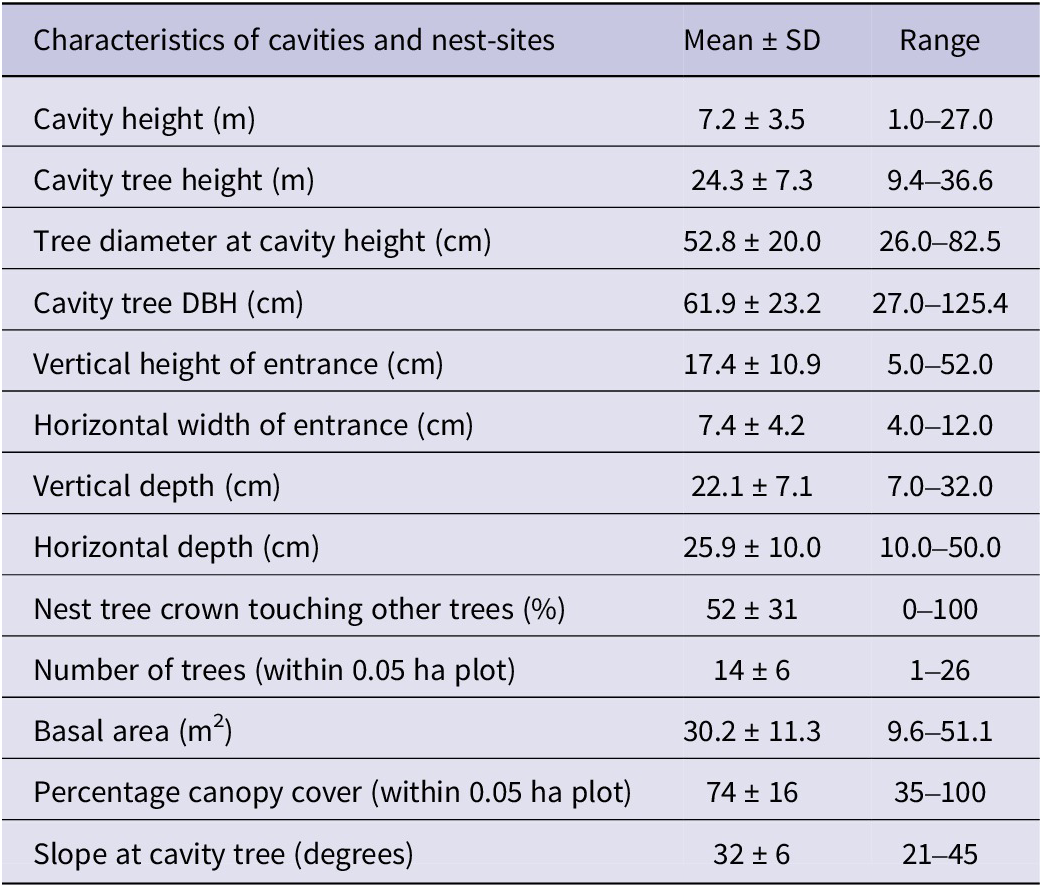
Based on 31 active nests found over three breeding seasons (2022–2024), 14 nests were in pines and 17 in broad-leaved trees. Nests were either in natural tree holes (caused by decay), such as cracks in the trunk (n = 13) or forks (n = 9) of living P. kesiya or broad-leaved trees, or in cavities excavated by other bird species (n = 9). We found only one cavity nest in a dead tree (pine) and it was used for three consecutive years. Giant Nuthatches nested in cavities at heights ranging from 1 m to 27 m. The cavities were 7 cm to 32 cm deep, with vertical heights of the entrance ranging from 5 cm to 52 cm, and the horizontal widths of the entrance ranging from 4 cm to 12 cm. The DBH of cavity trees ranged from 27 cm to 125 cm, while the diameter at cavity height ranged from 26 cm to 83 cm (Table 1). The bottom of the nest cavity was lined with materials including dry leaves, mosses, lichens, tree bark, and plant fibres or adult feathers. In nests located at the edge, we also found human-made materials, including plastic, paper, and artificial fibres. We found one nest with two opposite entrances. The elevations of nest locations ranged from 1,238 m to 1,589 m. Over three breeding seasons, we found that on seven occasions the Giant Nuthatch reused the same cavity in the following year where the initial nest was successful, provided the cavity remained usable. If the cavity had failed, they tended to use a different one in the next season, potentially returning to reuse the cavity in subsequent years.
Nest cavity and nest tree characteristics of Giant Nuthatch recorded in mature pine plantation forests of Doi Kham Fah-Khun Khong, Thailand during breeding seasons of 2022–2024
There were no distinct characteristics indicating a strong preference for cavity or nest-site selection in the Giant Nuthatch. The top four models included cavity horizontal depth, number of trees with DBH greater than 10 cm, percentage canopy cover, and slope. However, following model averaging, we found that Giant Nuthatches were more likely to prefer cavities with a greater horizontal depth (β = 2.8389 ± 0.7659, 85% CI: 1.7420–3.9357). They also tended to nest in flatter areas (β = -1.1489 ± 0.5809, 85% CI: -1.9808 to -0.3170) and in sites with a more open canopy (β = -0.9143 ± 0.5935, 85% CI: -1.7641 to -0.0644). The model had strong predictive performance with an AUC of 0.8344.
Daily survival rate
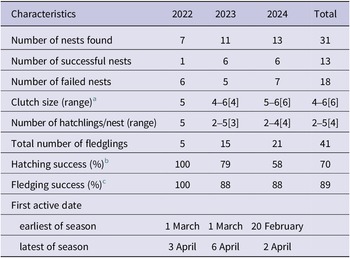
Over three breeding seasons we found 16 nests in the forest interior and 15 nests in pine patches at the edge close to villages and agricultural lands. Nests with 6 eggs were recorded most frequently (6 of 11 nests where contents were visible), and the median clutch size was also 6 eggs (range: 4–6), and the total nesting period lasted approximately 43 days (range: 41–48 days), including 4–6 days for laying, 11–15 days for incubation, and 25–28 days for the nestling period (Table 2). The total exposure days for all 31 nests was 860.5 days, with 424.5 days in the forest interior and 436 days at the edge.
Breeding characteristics of Giant Nuthatch in mature pine plantation forests of Doi Kham Fah-Khun Khong, Thailand during the breeding seasons of 2022–2024. Values in square brackets indicate median values
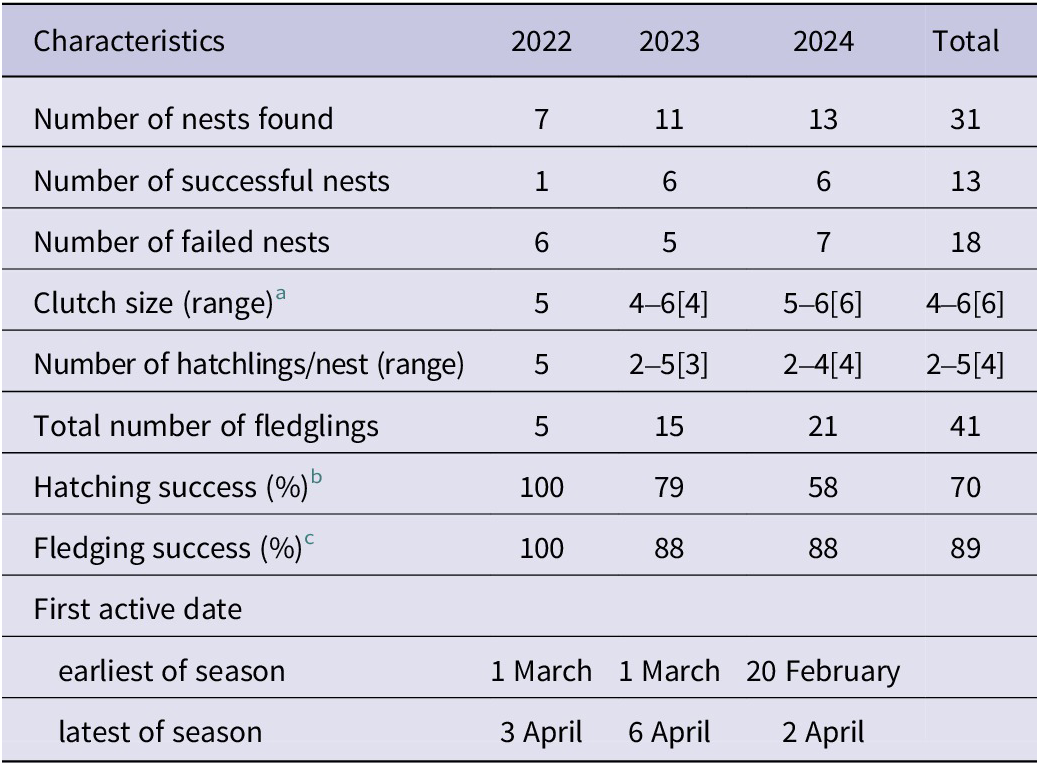
a Sample size: 2022 = 2 nests, 2023 = 3 nests, 2024 = 6 nests.
b Hatching success was calculated as the proportion of eggs that hatched.
c Fledging success was calculated as the proportion of hatchlings that fledged.
The overall DSR of Giant Nuthatch across three breeding seasons was 0.9686 ± 0.0079 (SE), which corresponds to an approximate nest success of 25%. Although the DSR in the forest interior tended to be lower than at the edge, we found no significant difference in DSR between the interior (0.9632 ± 0.0120, 95% CI: 0.9308–0.9807, n = 16) and the forest edge (0.9724 ± 0.0090, 95% CI: 0.9477–0.9855, n = 15) (χ² = 0.369, P = 0.543). We observed two cases where Giant Nuthatch was usurped from cavities, once by Great Myna Acridotheres grandis and Common Myna A. tristis and two unsuccessful attempts by Great Myna at edge sites. Such competitive pressures from mynas include aggressive behaviours, where one or more individuals actively chase away adult nuthatches to force nest abandonment or attempt to enter cavities to destroy the nest material and eggs. We observed two instances of mynas killing nestling nuthatches. We found no significant difference in DSR among the three types of cavities: those excavated by other species (0.9783 ± 0.0123, 95% CI: 0.9349–0.9929, n = 10), natural cracks in the trunk (0.9677 ± 0.0119, 95% CI: 0.9339–0.9845, n = 8), and natural cracks in a trunk fork (0.9628 ± 0.0129, 95% CI: 0.9273–0.9813, n = 13) (χ² = 0.796, P = 0.672).
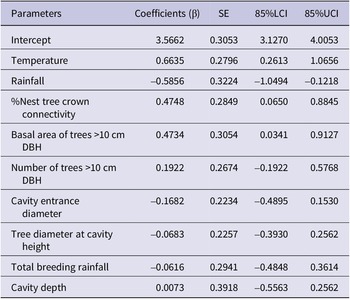
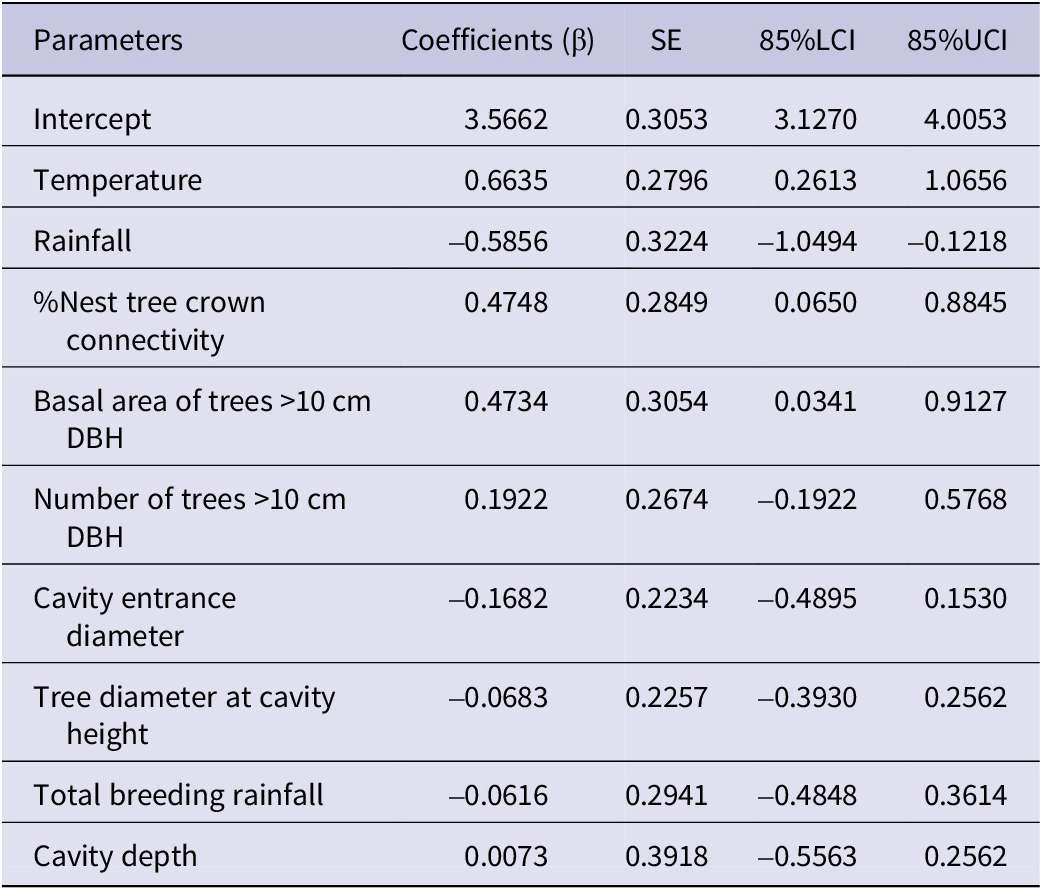
We constructed 41 nest survival models. The top-ranked model included average temperature from seven days before nest fates were identified and basal area, although 17 other models had similar support (within 6 delta AICc of the top model). Following model averaging, we found that periods of higher rainfall and lower temperatures during the seven days prior to nest fate determination were significantly associated with reduced DSR, while greater basal area and more connected crowns (greater percentage of nest tree crown touching other trees) were significantly associated with a higher DSR (Table 3, Figure 1).
Variables influencing daily nest survival rate (DSR) of Giant Nuthatch in mature pine plantation forests of Doi Kham Fah-Khun Khong, Thailand during the breeding seasons of 2022–2024. Temperature and rainfall represent the average temperature and cumulative rainfall over the seven days prior nest fate determination
Predicted daily nest survival rate (DSR) of Giant Nuthatch in relation to average temperature and cumulative rainfall over the seven days prior to nest fate determination, percentage of nest tree crown connectivity, and basal area. Mean predicted estimates are shown as distinct red lines, with 85% confidence intervals in grey.

Discussion
Our study represents the most comprehensive assessment of Giant Nuthatch nesting ecology across its range. Notably, the research was conducted in a mature plantation, yet nesting activity was relatively high, offering some hope for habitat restoration in modified landscapes. Our findings suggest that the Giant Nuthatch primarily relies on available natural cavities, with limited dependence (~32%) on primary cavity excavators such as woodpeckers. The clutch size and nesting stage durations were similar to those reported in south-west China, where one nest box and one natural cavity nest were studied. The clutch size range was 4–5 eggs, the incubation period lasted 16 days, and the nestling period lasted 24 days. However, the nesting season in south-west China likely starts about a month later than we report here, from March to June (Mo et al. Reference Mo, Li, Kang and Duan2025). Additionally, Giant Nuthatch appears to be relatively tolerant of human disturbance based on our observations of cavities occurring at the forest edge. Over three breeding seasons, we found that Giant Nuthatch nesting success was approximately 25%. Rainfall during cooler periods reduced DSR, while larger trees and crown connectivity were linked to higher DSR. We found no differences in DSR between forest interior and edge sites or among nest types. While no distinct preference for cavity and nest-site characteristics was observed, Giant Nuthatch appeared to prefer cavities with larger horizontal depth and flatter areas with a more open canopy.
Nest survival
The nest survival of Giant Nuthatch appeared to be low compared with other nuthatches and cavity-nesting birds, although it remains within the observed range for cavity-nesting birds (Cockle et al. Reference Cockle, Bodrati, Lammertink and Martin2015; Cox and Slater Reference Cox and Slater2007; Deng and Gao Reference Deng and Gao2005; Mo et al. Reference Mo, Li, Yuan, He, Xu and Chen2023). However, most of those studies were conducted in temperate regions, where birds generally exhibit higher nest survival than in tropical regions, likely due to lower predation pressure (Brawn et al. Reference Brawn, Angehr, Davros, Robinson, Styrsky and Tarwater2011; Freeman et al. Reference Freeman, Scholer, Boehm, Heavyside and Schluter2020; Smart et al. Reference Smart, Downing, Austin, Greeney, Londoño and Nahid2024). Although we lack definitive evidence to confirm that all nest failures were due to predation, we inferred predation in approximately 29% (n = 9) of failures based on signs such as destroyed nest material, leftover eggshells, and missing eggs or nestlings before expected fledging dates. Furthermore, our study was conducted in mature pine plantations which, despite containing mature trees, may offer fewer or lower-quality nesting cavities than older natural primary forests (Kikuchi et al. Reference Kikuchi, Akasaka, Yamaura and Nakamura2013; Pakkala et al. Reference Pakkala, Peltonen, Lindberg, Hjältén and Kouki2024). Our results indicated that adverse weather conditions, specifically higher rainfall levels during periods of lower temperatures, negatively impacted DSR, whereas nest-cavity and nest-site characteristics, such as greater basal area and greater crown connectivity, were associated with increased DSR.
Schöll and Hille (Reference Schöll and Hille2020) reported a similar negative effect of heavy and persistent rainfall on nestling survival in cavity-nesting Great Tits Parus major, leading not only to brood reduction but also to complete brood failure. Shiao et al. (Reference Shiao, Chuang, Yuan and Wang2015) revealed that the DSR of cavity-nesting Green-backed Tits Parus monticolus was also reduced by colder weather combined with heavy rain and suggested that severe weather may have a more pronounced effect on birds inhabiting montane forests. Rain, particularly during the early parts of the breeding season when temperatures are lower, may reduce parental provisioning, as parent birds may need to spend more time inside the cavity and they are more likely to encounter adverse foraging conditions, resulting in reduced food delivery to nestlings (McCarty and Winkler Reference McCarty and Winkler1999; Öberg et al. Reference Öberg, Arlt, Pärt, Laugen, Eggers and Low2015; Radford et al. Reference Radford, McCleery, Woodburn and Morecroft2001). Rain may also increase the risk of flooding, soaked nest material (Radford and Du Plessis Reference Radford and Du Plessis2003; Wesolowski et al. Reference Wesolowski, Czeszczewik, Rowinski and Walankiewicz2002), and hypothermia, particularly in young nestlings, which lack thermoregulatory abilities and rely on parent birds for warmth (Whittow Reference Whittow2000).
The positive influence of basal area and crown connectivity on DSR of Giant Nuthatch may be attributed to their ability to provide shelter and protection from severe weather conditions, such as direct sunlight, strong wind, and particularly cold rain. These vegetation parameters buffer extreme microclimatic conditions and moderate temperature and humidity fluctuations, thereby reducing thermoregulatory stress on both parents and nestlings and enhancing nestling survival (Schöll and Hille Reference Schöll and Hille2020; Wesolowski et al. Reference Wesolowski, Czeszczewik, Rowinski and Walankiewicz2002). This finding contrasts with Cockle et al. (Reference Cockle, Martin and Wiebe2011), who reported that secondary cavity-nesters in Neotropical Atlantic forest preferred more isolated trees, thought likely to reduce the risk of predation. For example, high crown connectivity may facilitate the movement of nest predators, such as snakes, potentially leading to higher predation rates, as shown in many studies (e.g. Koenig et al. Reference Koenig, Joseph, Wunderle and Enkerlin-Hoeflich2007; Maziarz et al. Reference Maziarz, Wesołowski, Hebda, Cholewa and Broughton2016; Phringphroh et al. Reference Phringphroh, Khamcha, Sankamethawee, Powell, Angkaew and Pierce2024; Sperry et al. Reference Sperry, Cimprich, Peak and Weatherhead2009). Despite this, it appeared to have no negative effect on the DSR of the Giant Nuthatch.
We initially expected lower DSR at the forest edge, particularly near villages and agricultural areas (Cox et al. Reference Cox, Thompson and Faaborg2012; Newmark and Stanley Reference Newmark and Stanley2011), whereas DSR in the forest interior tended to be lower than at the edge, although not significantly so. Due to limitations of sample size, nest predator data, and nest competitors, it is difficult to determine the primary cause of this, but it is likely associated with the lower abundance and diversity of nest predators in the more simplified and highly disturbed edge areas compared with the greater complexity and lower disturbance of the forest interior, which may provide more suitable habitat and food availability for nest predators (Khamcha et al. Reference Khamcha, Powell and Gale2018; Pretelli et al. Reference Pretelli, Cavalli, Chiaradia, Cardoni and Isacch2023). Although we observed some evidence of interspecies nest competition at the edge areas between Giant Nuthatch and other cavity-nesting species, particularly the Great Myna and Common Myna, as mentioned earlier, nests located in the forest interior may also experience some level of competition due to higher abundances and diversity of cavity-nesting species.
Cavity and nest-site characteristics
The Giant Nuthatch appeared to have no distinct preference for the cavity and nest-site characteristics we measured. As a secondary cavity-nester, it seemed to rely on available natural cavities or those excavated by other birds, often reusing cavities in subsequent years (Aitken et al. Reference Aitken, Wiebe and Martin2002; Altamirano et al. Reference Altamirano, Novoa, Ibarra, Navarrete, Bonacic and Martin2024). Giant Nuthatch rarely used cavities in dead trees, which is similar to the findings of Martin et al. (Reference Martin, Aitken and Wiebe2004), who reported that in Canadian temperate forest, 65% of secondary cavity-nester nests were found in live, healthy trees. Similarly, Cockle et al. (Reference Cockle, Martin and Wiebe2011) found that secondary cavity-nesters also preferred natural cavities formed by decay in large, live trees. More broadly, dead trees may be less abundant in tropical forests than in temperate forests (Gibbs et al. Reference Gibbs, Hunter and Melvin1993).
Although we found no distinct preferred characteristics for cavity and nest-sites, Giant Nuthatch seemed to select cavities with larger horizontal depths, presumably indicating a preference for larger internal volumes. Some studies have indicated that a larger internal volume may be preferred by various cavity-nesting species, potentially increasing the likelihood of nest survival by helping regulate microclimatic conditions, providing more space for movement, and reducing the risk of nestling overcrowding (Di Sallo and Cockle Reference Di Sallo and Cockle2022; Rendell and Robertson Reference Rendell and Robertson1989; Wiebe and Swift Reference Wiebe and Swift2001). However, horizontal depth did not influence the DSR of Giant Nuthatch. Secondary cavity-nesters in particular may be limited to cavities that offer sufficient space for nestlings (Martin et al. Reference Martin, Aitken and Wiebe2004). The preference for flatter areas with a more open canopy is likely associated with the landscape and structure of suitable pine forest habitat, which primarily occurs along the flatter ridges, rather than adjacent slopes (Khamcha et al. Reference Khamcha, Angkaew, Pierce and Gale2022).
Conclusions
Although nest survival in the Giant Nuthatch (25%) was perhaps relatively low for a cavity-nester, our findings suggested some or limited effects of cavity and nest-site characteristics on nest survival and site preference, with no significant difference in DSRs between nests in the forest interior and edge. Given the restricted range of the Giant Nuthatch and its dependence on mature pine forests, the on-going degradation of suitable habitats, particularly the loss of mature pine trees and larger hardwood trees, may lead to cavity limitation, potentially reducing reproductive success and eventually affecting population viability (Ke et al. Reference Ke, Cedeño, Karubian, Carrasco, Castillo and Gonzales2023; Lopes et al. Reference Lopes, Martin, Henriques, Monteiro, Regalla and Tchantchalam2018; Newton Reference Newton1994).
Our findings however highlight the importance of mature pine plantations, including small patches near human settlements and agricultural areas, as key nesting and foraging habitats for the Giant Nuthatch, and thus considering these habitats in conservation strategies may help sustain populations of the species, especially in areas where natural forests are limited or degraded. Furthermore, P. kesiya, a native conifer, and the primary species used in the reforestation programme in Thailand, offers potential for restoring and maintaining Giant Nuthatch habitat. However, extensive feasibility studies are required to assess the long-term effectiveness of these plantations for conservation efforts.
Acknowledgements
We are grateful to the former and current chiefs of the Khun Khong Watershed Research Station, as well as the station staff, for their support and accommodation. We also thank M. M. Soe, N. Taengsaen, N. M. M. Aung, M. Phringphroh, P. Thanyalaksanakul, N. Sukumal, and R. Angkaew for their valuable assistance in the field. This work was supported by Thailand Science Research and Innovation (TSRI; FRB640008, FRB660073/0164, FRB670016/0164), The Rufford Foundation (35713-2), and The Asahi Glass Foundation Research Grant (65001065). This study was approved by The King Mongkut’s University of Technology Thonburi Institutional Animal Care and Use Committee (KMUTT-IACUC-2022-012) and the Department of National Park, Wildlife and Plant Conservation, Thailand.